Original Research Article
Study on knowledge about gestational diabetes mellitus and its risk
factors among antenatal mothers attending care, urban Chidambaram
D. Lakshmi, A. John William Felix*, R. Devi, M. Manobharathi
INTRODUCTION
GDM has appeared to be growing diagnostic and epidemiological problem in recent years.1 As per WHO GDM is defined as any degree of glucose with onset or first recognition during pregnancy.2
The two types of GDM include G1-impaired glucose tolerance with normal blood sugar which required diet modification alone and G2-hyperglycemia on fasting and postprandial requiring diet and insulin treatment.3 GDM arises because the action of insulin is diminished (insulin
resistance) due to hormone production by placenta.3 Other risk factors include older age, overweight, obesity, excessive weight gain, a family history diabetes and history of still birth or giving birth to infant with congenital abnormality.4
GDM is a serious health concern because it not only pose immediate maternal (pre-eclampsia, ceasarian delivery) and neonatal (macrosomia, shoulder dystocia, birth injuries, hypoglycemia, Respiratory distress syndrome) complications but also increase the risk of future type 2 diabetes in mother as well as the baby.5,6
ABSTRACT
Background: Gestational diabetes mellitus (GDM) is a growing epidemiological problem. GDM is defined as the
glucose intolerance during pregnancy. Treatment of GDM is important to avoid maternal and fetal complications. The objectives of this study was to assess the knowledge about GDM among antenatal mothers and to find out the association between knowledge and demographic factors.
Methods: A descriptive cross sectional study was done among 191 antenatal mothers in Maternity Health Centre and
Government Hospital, Chidambaram during September 2017. A pre tested questionnaire was used to assess knowledge about GDM among all antenatal mothers attending OP.
Results: Among the participants, 49.2% were in the age group of 21–25 years, 93.7% of them were housewives, 56.0% of them have studied up to higher secondary level and 72.8% of them were living in rural areas. In this study it was found that 35.2% of the participants had adequate knowledge about GDM and 21.5% had adequate knowledge about its risk factors. Education and residence were found to be associated with knowledge and risk factors of GDM which is statistically significant (p<0.05).
Conclusions: The knowledge of antenatal women on GDM was just average. There is a need for training the
physicians, paramedical people, and public regarding GDM. Health education programs must be conducted to improve the awareness among antenatal women for better utilization of health services. A regular screening of GDM among all pregnant women should be promoted in all health centres.
Keywords: GDM, Prevalence, Risk factors, Knowledge
Department ofCommunity Medicine, Rajah Muthiah Medical College, Chidambaram, Tamil Nadu, India
Received: 06 July 2018
Revised: 10 August 2018
Accepted: 11 August 2018
*Correspondence: Dr. A. John William Felix, E-mail: [email protected]
Copyright: © the author(s), publisher and licensee Medip Academy. This is an open-access article distributed under
the terms of the Creative Commons Attribution Non-Commercial License, which permits unrestricted non-commercial use, distribution, and reproduction in any medium, provided the original work is properly cited.
The prevalence of GDM is on the rise globally. This global increase is occurring mostly in low and middle income countries like India where access to maternal care is often limited.7
Recently, prevalence of GDM was found to be 18% in HAPO study (hyperglycemia and adverse pregnancy outcome).8 WHO estimated that prevalence of GDM in India was about 40.9 million in 2009 & is expected to rise to 69.9 million by 2025. Thus making it an important public health problem in India.4
Knowledge about GDM among an women will translate into adoption of healthy life style, better health seeking behaviour, better self-care and thus prevention and early diagnosis of the disease.9
Thus, this study was conducted to assess the knowledge about GDM and its risk factors among antenatal women who attend maternity centre and government taluk hospital, Chidambaram.
METHODS
Study design
Descriptive cross sectional study.
Study period
Five days in the month of September 2017.
Sample size
Convenient sampling method was used to select the study participants.
191 pregnant women who attended antenatal clinics during the study period at Maternity health centre attached to Rajah Muthiah Medical College, Chidambaram and Government Taluk hospital, Chidambaram.
Study area
Maternity health centre attached to Rajah Muthiah Medical College, Chidambaram and Government Taluk hospital, Chidambaram.
Inclusion criteria
All pregnant women available during the data collection period and willing to participate were included in the study.
Exclusion criteria
Pregnant women who cannot give response like critically
with mental health problem were excluded from the study.
Data collection
Data collection was done by administering pre tested proforma to the pregnant women. The proforma was translated into local language (Tamil) and was given to the participants. They were then asked to fill the proforma by themselves. Proforma consisted of two parts. I part: Questions regarding participants' socio - demographic details like name, age, education, occupation, income, etc., and details about like no. of pregnancies, no. of live children,,etc.
II part: Questions to assess participants level of knowledge about Gestational diabetes mellitus
In the II part of the proforma, there was a set of 15 questions. Each correct response was given 1 mark. According to the scores obtained, participants were considered to have:
Inadequate knowledge: for those who scored 0-8,
Moderately adequate: for those scored 8-12
Adequate knowledge: for those who score more than 12
III part: Questions to assess participants level of knowledge about risk factors of GDM
In the III part of the proforma, there was a set of 10 questions. Each correct response was given 1 mark. According to the scores obtained, participants were considered to have:
Inadequate knowledge: for those who scored 0-5,
Moderately adequate: for those scored 5-8,
Adequate knowledge: for those who score more than 8.
For illiterate mothers, interview method was followed.
Data analysis
The collected data was entered in Microsoft excel and data was compiled and analysed using SPSS version 20. Frequencies and percentages well used to describe the data Kruskal Wallis test was used to determine association between means of each independent variable and knowledge about GDM and its risk factors. P value of <0.05 was considered to be statistically significant.
Ethical consideration
about the purpose of the study and their consent for participation was obtained.
RESULTS
Socio demographic characteristics of respondents
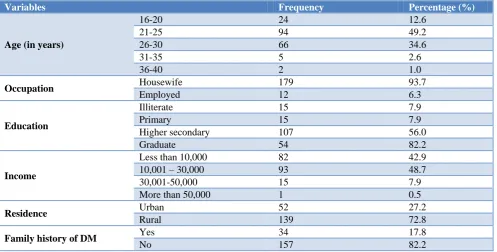
A total of 191 pregnant women participated in the study. Table 1 shows the socio-demographic characteristic of the study participants. 94 (49.2.1) of the respondents were within the range of 21-25 years. Out of the total respondents 179 (93.7%) were house wires concerning education status 107 (56.0%) of antenatal woman were educated up to higher secondary level and 15 (7.9%) were illiterates. Occupationally (93.7%) were home makers and the house hold income for most of the antenatal women was between the range of Rs. 10,001-30,000/ month.
Most of them belonged to rural among the study participant 82.2% had family history of diabetics.
Knowledge about GDM
Out of 191 respondents 18.6% had adequate knowledge about GDM 50.7% had moderately adequate knowledge. And 35.2% had inadequate knowledge about GDM.
Knowledge about risk factors of GDM
Among the study participant 21.5% had adequate knowledge 49.2% had moderately adequate knowledge
and 31.2% had in adequate knowledge about risk factors of GDM.
Figure 1: Level of knowledge of GDM among and antenatal mothers.
Factors associated with knowledge of GDM and its risk factors
Among the participants socio-demographic characteristics, education was found to be associated with knowledge of participants about GDM with significant p<0.05. As the level of education increases, knowledge of participants about GDM increases also residence of participants found to be associated significantly with participants knowledge about GDM participants to who were from urban areas had significantly higher knowledge when compared to those from rural areas with p=0.043. Other socio-demographic characteristics of participants like age, occupation, family history of DM, income had no significant association with knowledge about GDM and its risk factors in this study.
Table 1: Classification of the respondents on the basis of socio demographic variables.
Variables Frequency Percentage (%)
Age (in years)
16-20 24 12.6
21-25 94 49.2
26-30 66 34.6
31-35 5 2.6
36-40 2 1.0
Occupation Housewife 179 93.7
Employed 12 6.3
Education
Illiterate 15 7.9
Primary 15 7.9
Higher secondary 107 56.0
Graduate 54 82.2
Income
Less than 10,000 82 42.9
10,001 – 30,000 93 48.7
30,001-50,000 15 7.9
More than 50,000 1 0.5
Residence Urban 52 27.2
Rural 139 72.8
Family history of DM Yes 34 17.8
Table2: Association between knowledge of gestational diabetes and its risk factors with socio-demographic characteristics of participants.
Variables Frequency Knowledge Knowledge about risk factors
Mean SD P value Mean SD P value
Occupation Housewife 179 6.14 2.23 0.626 7.80 30.2 0.427
Employed 12 6.58 2.87 7.33 3.31
Education
Illiterate 15 5.60 2.79 0.00
6.53 3.15
0.277
Primary 15 5.26 1.62 7.46 2.13
Higher Secondary 107 5.83 2.30 7.70 3.18
Graduate 54 7.25 1.80 8.35 2.83
Income
Less than 10,000 82 6.09 2.43
0.689
7.75 3.22
0.997 10,001-30,000 93 6.32 2.08 7.81 2.87
30,001-50,000 16 5.68 2.44 7.62 3.15
Residence Urban 52 6.67 2.32 0.043 8.13 2.96 0.335
Rural 139 5.98 2.22 7.64 3.05
Family History of DM
Yes 34 6.32 2.56
0.439
7.94 2.85
0.683
No 157 6.14 1.86 7.73 2.56
Figure 2: Level of knowledge and risk factors of GDM among antenatal women.
DISCUSSION
Prevalence of GDM is increasing throughout the world along with type 2 diabetes mellitus.10 GDM if left untreated leads to serious maternal and neonatal complications.11 Knowledge about GDM along with proper diagnosis and treatment of GDM will help to prevent it and its complication.10
In the sample 191 antenatal women, 35.2% had adequate knowledge about GDM and 21.5% had adequate knowledge about risk factors of GDM.
Shreeram et al, in their study in south India found that only 17.5% of women had good knowledge about GDM which was slightly lower when compared to this study.9 Similarly, in a Bangladesh study 26.3% of study paths had good knowledge about GDM.10
In the present study, educational of a mother was found to have statistically significant association with their
Similarly, Bhowmik et al, reported that participants with higher educational status were found to have significant higher mean knowledge Score than their counterparts.10 The reason for this association may because educated women might have greater access to gain knowledge from health-related articles or literatures.10 Also they can better understand the health information given by the health personnel during antenatal visits.
Knowledge about GDM and its risk factors was found to be significantly associated with residence of the participants AN mother those who are residing in urban area had adequate knowledge when compared to those from rural areas.
Bhowmik et al also reported similarly that those who were from urban areas had significantly higher knowledge about GDM than those from rural areas.10 Though no statistical significance Balaji et al reported that knowledge about GDM and its risk factors was poor among rural women when compared to urban women.12 This may be due to that women from urban areas when compared to rural areas have better exposure to mass media like TV, Radio, Internet through which they can gain health information and knowledge.
knowledge score when compared to housewife or unemployed women.10,13 This may be because those employed mothers gain knowledge by interaction with others at their work place and also because of their own experience.13 However, there was no such significant association found between occupation and knowledge about GDM in this study.
Considering the limitations of the present study, sample size calculation was not done. And as this study was based on self-report of the participants, the information obtained might had less validity and there might be chance for recall bias.
CONCLUSION
Since the prevalence of GDM is growing higher a good knowledge and awareness about the same is mandatory. The knowledge of antenatal women on GDM was just average. There is a need for training physicians paramedical people, and public regarding GDM. Early education before pregnancy can also be done. Health education sessions can be conducted in antenatal clinics, in villages by mobile medical units and social gatherings will create more awareness about GDM and its complications. Health education posters can be displayed in public places and information leaflets can be distributed.
Health awareness programs must be conducted to improve the knowledge of antenatal women for better utilization of health services. Future and ongoing monitoring of diabetes prevalence in pregnancy, information on pregnancy outcomes and epidemiological data on diabetes in pregnancy among other indigenous population will be necessary. There are ideal groups for targeting lifestyle modification to delay the development of DM in future. Therefore a regular screening of GDM among all pregnant women should be promoted in all health centres.
Funding: No funding sources Conflict of interest: None declared
Ethical approval: The study was approved by the Institutional Ethics Committee
REFERENCES
1. Surwade VM, Sinha V, Kachhawa P. Prevalence of Gestational Diabetes And Risk Factors Among Women Visiting Antenatal Clinic of A Tertiary Health Care Hospital. IOSR-JDMS. 2017;16(9):1–4. 2. Arulmani A, Annie IK, Felix AJW. Prevalence of
Gestational Diabetes Mellitus among Cohort of Pregnant Women Registered in Primary Health Center. JMSCR. 2016;4(10):13239–43.
3. Antos E, Nowak B, Olszewski J. The analysis of midwives’ knowledge on the education of women
with gestational diabetes and preparation for it. 2013.
4. Varghese R, Thomas B, Hail M Al, Rauf A, Sadi M Al, Sualiti A Al, et al. The Prevalence, Risk Factors, Maternal and Fetal outcomes in Gestational Diabetes Mellitus. Int J Drug Develop Res. 2012;4(3):356–68.
5. Price LA, Lock LJ, Archer LE, Ahmed Z. Awareness of Gestational Diabetes and its Risk Factors among Pregnant Women in Samoa. Hawaii J Med Public Health. 2017;76(2):48–54.
6. Petry CJ. Gestational diabetes : risk factors and recent advances in its genetics and treatment. Br J Nutr. 2010;104(6):775-87.
7. Hirst JE, Tran TS, An M, Do T, Rowena F, Morris JM, et al. Women with gestational diabetes in Vietnam : a qualitative study to determine attitudes and health behaviours. BMC Pregnancy Childbirth. 2012;12:81.
8. Arora GP, Thaman RG, Prasad RB, Almgren P, Brøns C, Groop LC, et al. Prevalence and risk factors of gestational diabetes in Punjab, North India : results from a population screening program. Eur J Endocrinol. 2015;173(2):257-67
9. Shriraam V, Rani MA, Sathiyasekaran BWC, Mahadevan S. Awareness of gestational diabetes mellitus among antenatal women in a primary health center in South India. Indian J Endocrinol Metab. 2013;17(1):146–8.
10. Bhowmik B, Afsana F, Ahmed T, Siddiquee T, Ahmed T, Pathan F, et al. Evaluation of knowledge regarding gestational diabetes mellitus : a Bangladeshi study Evaluation of knowledge regarding gestational diabetes mellitus : a Bangladeshi study. Public Health. 2018;161:67–74. 11. Nielsen KK, Rheinländer T, Kapur A, Damm P,
Seshiah V, Bygbjerg IC. Factors influencing timely initiation and completion of gestational diabetes mellitus screening and diagnosis - a qualitative study from Tamil Nadu, India. BMC Pregnancy Childbirth. 2017;17:1–13.
12. Bhavadharini B, Deepa M, Nallaperumal S, Anjana RM, Mohan V. Knowledge about Gestational Diabetes Mellitus amongst Pregnant Women in South Tamil Nadu. 2017;8(1):22-6.
13. Elamurugan S, Arounassalame B. What do Mothers know about gestational diabetes : knowledge and awareness. Indian J Obstetr Gynecol Res. 2016;3(4):393–6.
Cite this article as: Lakshmi D, Felix AJW, Devi R,