International Journal of Advanced Engineering Research and Applications May – 2015
www.ijaera.org 41
Production Scheduling in a Job Shop Environment with consideration of
Transportation Time and Shortest Processing Time Dispatching Criterion
Pardeep Kumar1* & Mukesh Kumar2
1
Assistant Professor, Panipat Institute of Engineering and Technology, Pattikalyana, Panipat – 132 102, INDIA
*
Email: [email protected]
2
Assistant Professor, R.P. Inderaprastha Institute of Technology, NH-1, Gharaunda, Bastara Karnal - 132 114, INDIA
Email: [email protected]
Abstract: Job-shop manufacturing environment requires planning of schedules for the systems of low-volume having numerous variations. For a job-shop scheduling, ‘k’ number of operations and ‘n’ number of jobs on ‘m’ number of machines processed through an assured objective function to be minimized (makespan). This paper presents a capable genetic algorithm for the job-shop scheduling problems among operating parameters such as random population generation with a population size of 50, operation based chromosome structure, tournament selection as selection scheme, 2-point random crossover with probability 80%, 2-point mutation with probability 20%, elitism, repairing of chromosomes and no. of iteration is 1000. An algorithm is programmed for job shop scheduling problem using MATLAB 2009 a 7.8. The proposed genetic algorithm with certain operating parameters is applied to the two case studies taken from literature. The results also show that genetic algorithm is the best optimization technique for solving the scheduling problems of job shop manufacturing systems evolving shortest processing time and transportation time due to its implications to more practical and integrated problems.
Keywords: Manufacturing system; Job-shop; Scheduling; Genetic algorithm; Shortest processing time; Transportation time
I. INTRODUCTION
Manufacturing is the spine in the economic pact of a country, as it facilitate together in growing GDP/GNP and make available of services. Productivity influences the enlargement of GDP. Payback from a manufacturing structure can be increased if on-hand possessions (resources) are properly utilized with optimized methods. A fine scheduling system helps to optimize the employ of resources for production. Therefore, the production scheduling is a greatly significant portion of a manufacturing system. The objective of scheduling is to satisfy various production constraints and maximize or minimize a desired objective [1].
www.ijaera.org 42 defined as problems with the aim of optimizing one or more scheduling objectives. Most research is in concerned with the optimization of a single criterion Therefore the multiple criteria analysis is required. The job shop scheduling is known to be a strong NP-hard problem. Hence the job shop scheduling included “m” objectives must also be an NP-hard problem. Mathematical programming approaches for solving multi-objective scheduling problem are computationally intractable for practical problems [2]. Various objective of the scheduling in the manufacturing system are: (1) solving interruption on the shop floor like machine overloads, breakdowns and rush orders; (2) diminution of in-process catalog; (3) growing equipments consumption; (4) minimize the makespan, tardiness, (tardiness being the lateness of the job if it fails to meet its due-date) and (5) minimizing mean flow-time (which measures the average response of the schedule to individual demands of jobs for service). This paper presents the schedule in the form of Gantt chart for the job-shop manufacturing environment in which shortest processing time and transportation time are considered [3]. Several researchers have addressed the problem of creating schedule for the job-shop manufacturing system. The important contributions using Genetic Algorithm approach for job shop scheduling are discussed below.
Mattfeld and Bierwirth [4] considered job shop scheduling problem with release and due-dates as well as various tardiness objectives. Genetic Algorithm can be applied almost directly, but come along with apparent weaknesses. They discussed two mode of dipping a search space, first with concern of shortest-term decisions prepared at the machine level and second; with long-term decisions completed at the shop floor stage. Gao et al [5] worked on open job-shop scheduling problem in which operations can be performed in any order. They used genetic algorithm to solve open job-shop scheduling problem in order to curtail the makespan. Various operators of genetic algorithm were rightfully customized in order to preserve achievability. Wang et al [6] projected genetic algorithm with two stages, (1) locate the fittest parameters, such as population size, crossover and mutation probabilities, with a fraction of time via the optimal computing budget allocation technique, and (2) the fittest parameters were used for a further searching operation to find the optimal solution using genetic algorithm. In the past few decades, Genetic Algorithms had demonstrated considerable success in providing efficient solutions to many Non-polynomial-hard (NP-hard) optimization problems.
Haq et al [7] used genetics algorithm for optimal allocation and scheduling of jobs in multiple processing lines of parallel-line job-shop in order to minimize makespan. Manikas and Chang [8] proposed shortest processing time (SPT) and earliest due date (EDD) to compute a practicable schedule swiftly. Defersha, and Chen [2] proposed a mathematical model for a job-shop scheduling considering sequence-dependent setup time, attached or detached setup time, machine release dates, and time lag requirements. They implemented a parallel genetic algorithm for parallel computing and found that it can significantly pick up the computational act of the algorithm.
www.ijaera.org 43 exploit an operation-based scheme to signify chromosomes schedules. Chromosomes was processed through a 3-stage decoder from first to end, in which, initially tardiness based on due dates, following deadlines, and lastly reduce earliness based on due dates. Zhang et al [12] noticed on the non-delay schedules and employed genetic algorithm to optimize the combination of dispatching rules. They stated that this method can gladly apply in a dynamic scheduling through simulation.
Demir & İşleyen [13] proposed a procedure to handle the overlapping in operations for flexible job shop scheduling. In this procedure, the sublots were relocating from one machine to the subsequent for processing with no waiting for the whole group to be processed at the predecessor machine. They followed two phases, viz; (1) a mathematical model was developed and compared to other model for computational efficiency, (2) a genetic algorithm was used in order to solve the problem and it was tested on standard problems available in literature of different sizes. They concluded that the developed algorithm performed superior as compare to other well-known methods. Amirghasemi & Zamani [14] they used the notion of elite pool and presented asexual genetic algorithm for job shop scheduling. They gently explained the working of mutation operations and elite pooling. They concluded that the victory of the proposed procedure considerably depends on the working mechanism of updating the elite pool. A comprehensive literature on job-shop scheduling optimization has been given by Jain and Meeran [15]. On the basis of literature the problem has been formulated to solve for makespan performance measure for production scheduling of Job-Shop environment with consideration of transportation time and shortest processing time dispatching rule.
II. PROBLEM FORMULATION
Literature review reveals that many researchers have been done into the field of evolutionary computations or meta-heuristic techniques particularly with Genetic Algorithm. No attempts so far have been made with Genetic Algorithm in addition with Transportation Time and Shortest Processing Time as dispatching rule for job-shop scheduling problem. The present job shop configuration is defined as: there is a combination of ‘n’ numbers of jobs given as: J = {J1, J2, J3….. ..Jn} and every job self-possessed of over one operation (O) that have to be processed on a combinations of ‘m’ number of machines, given as M = {M1, M2, M3……Mm}. Each action (operation) resides in one of the machines for a predetermined period of time. In the present job shop manufacturing system following are the assumptions: (1) a machine can process only one job at a instance (2) processing time of each operation in a particular machine is definite and defined (3) release time of the products are indeterminate (4) there is no set up time and cost (5) each job contains unchanging number of operations (6) each job can visit each machine more than one time (7) no machine can stop the progress of a job and start another before finishing the earlier job (8) each and every machine has completely capable.
In order to simplify the problem, the following notations are used.
j= job (j=1, 2, 3………… n)
i= machine (i=1, 2, 3………… m)
Tt= transportation time
Pt= processing time
www.ijaera.org 44 a) Job batch: J = {J1, J2, J3………… Jj} | j = 1, 2, 3, 4………… n
b) Machine combination: M = {M1, M2, M3…… Mi}| i = 1, 2, 3, 4………… m
c) Operations Numbering = {O1, O2…Oo} | o = 1, 2, 3……….k
d) Processing time for each operation:
(Pij) = {P11,P12, P13………,Pij},| i = 1,2,3,4.………..n ; j =1,2,3,4……..……m
e) Transportation time:
(Ttij) = {Tt11, Tt12, Tt13……….,Ttij} | i = 1,2,3,4………n ; j =1,2,3,4……..……m
III. ADOPTED METHODOLOGY
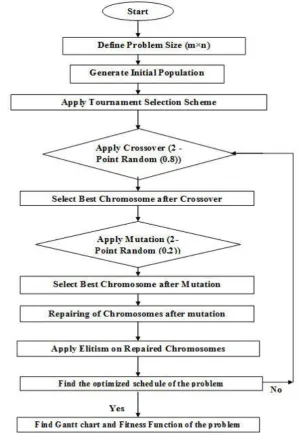
In this paper, Genetic Algorithm is used to optimize the job-shop scheduling problem with shortest processing time dispatching rule and transportation time. Primarily, the configuration of job-shop is finalized by defining the number of machines available and the number of jobs can be processed. In the present work, volume job shop configuration is considered. Once the low-volume job-shop environment is developed the different input such as processing time of each operation for each stage as well as the transportation time for each stage is entered in the system. At this stage, the optimization tool is called to generate the optimal schedule. In the present work, Genetic Algorithm is used as a optimization tool. It contains various operations that works in predefined steps such as generation of initial population, selection scheme, crossover and mutation operations etc. Figure 1 present the flow chart of adopted methodology.
In the present work, job-shop manufacturing environment is scheduled by considering the shortest processing time and transportation time. Genetic Algorithm approach is applied for the optimization of adopted methodology. There are two case studies considered in order to optimize the makespan performance measure. The algorithm is developed using MATLAB programming tool and codes are run for both case studies with their operating parameters which give the value of makespan. The operating parameters used in the present work for solving the job shop scheduling are given below in table 1.
A. Case Study 1
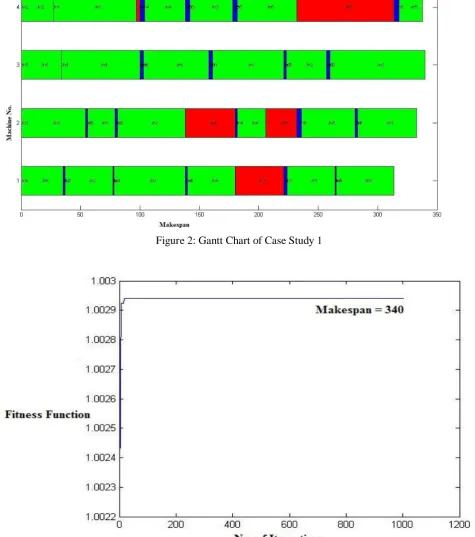
In This case study is taken from Singh et al [16]. The numbers of machine (m) are four and the numbers of job are 6. This configuration is optimized for makespan performance measure considering adopted methodology in which shortest processing time as dispatching rule and transportation time are considered. The present case study is solved by using operating parameters as given in table 1.
www.ijaera.org 45 Figure1: Flow chart of adopted methodology using genetic algorithm.
Table 1: Operating parameters and there values used in present work
Operating Parameters Values
Population Size 50
www.ijaera.org 46 Figure 2: Gantt Chart of Case Study 1
Figure 3: Convergence curve of Fitness Function of Case Study 1
B. Case Study 2
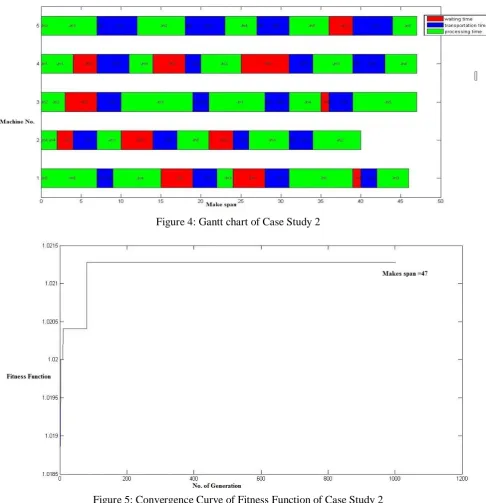
www.ijaera.org 47 methodology in which shortest processing time as dispatching rule and transportation time. The present case study is solved by using operating parameters as given in table 1.
The value of makespan for case study 1 is shown by Gantt chart in figure 4 and convergence curve of fitness function in figure 5. It shows that addition of transportation time in shortest processing time increases the value of makespan.
Figure 4: Gantt chart of Case Study 2
Figure 5: Convergence Curve of Fitness Function of Case Study 2
www.ijaera.org 48 Table 2: Details of Case Studies
Case Study No.
Authored By Size (m×n) Makespan Makespan
(proposed approach)
1 Singh et al [16] 4×6 329 340
2 Omar et al [17] 5×5 34 47
IV. CONCLUSION
The Genetic Algorithm approach is applied for optimizing the low-volume job-shop scheduling problem considering shortest processing time and transportation time for makespan performance measure. It shows that Genetic Algorithm approach is able to obtain the optimum or a useful near optimum value of makespan. The case studies reveal that the transportation time is an important factor to be considered during the optimization of low-volume job-shop scheduling. The addition of transportation time in shortest processing time increases the value of makespan. Therefore, it cannot be neglected. The present work can be extended by considering the following points: (1) varying maintenance time and setup time can be considered to produce more accurate schedules (2) breakdown can also be taken into account that effects the delivery commitments to customers (3) the proposed algorithm can also be applied to more practical and integrated problems.
V. REFERENCES
[1] Li, L., Keqi, W., & Qi, Y. (2012). A Combined Optimization Algorithm for Multi-objective Flexible Job Shop Scheduling Problem. International Proceedings of Computer Science & Information Technology, 47.
[2] Defersha, F. M., & Chen, M. (2010). A parallel genetic algorithm for a flexible job-shop scheduling problem with sequence dependent setups. The international journal of advanced manufacturing technology, 49(1-4), 263-279.
[3] Azadeh, A., Keramati, A., Karimi, A., & Moghaddam, M. (2010). A multi-objective genetic algorithm for scheduling optimisation of m job families on a single machine. International Journal of Industrial and Systems Engineering, 6(4), 417-440.
[4] Mattfeld, Dirk C., & Christian Bierwirth. (2004) An efficient genetic algorithm for job shop scheduling with tardiness objectives European Journal of Operational Research, 155(3), 616-630.
[5] Gao, J., Gen, M., & Sun, L. (2006). Scheduling jobs and maintenances in flexible job shop with a hybrid genetic algorithm. Journal of Intelligent Manufacturing, 17(4), 493-507.
[6] Wang, Y. M., Xiao, N. F., Yin, H. L., Hu, E. L., Zhao, C. G., & Jiang, Y. R. (2008). A two-stage genetic algorithm for large size job shop scheduling problems. The International Journal of Advanced Manufacturing Technology, 39(7-8), 813-820.
[7] Haq, A. N., Balasubramanian, K., Sashidharan, B., & Karthick, R. B. (2008). Parallel line job shop scheduling using genetic algorithm. The International Journal of Advanced Manufacturing Technology, 35(9-10), 1047-1052.
[8] Manikas, A., & Chang, Y. L. (2009). Multi-criteria sequence-dependent job shop scheduling using genetic algorithms. Computers & Industrial Engineering, 56(1), 179-185.
[9] Bożejko, W., & Makuchowski, M. (2011). Solving the no-wait job-shop problem by using genetic algorithm with automatic adjustment. The International Journal of Advanced Manufacturing Technology, 57(5-8), 735-752.
[10] Teekeng, W., & Thammano, A. (2012). Modified genetic algorithm for flexible job-shop scheduling problems. Procedia Computer Science, 12, 122-128.
www.ijaera.org 49 [12] Zhang, R., Song, S., & Wu, C. (2013). A dispatching rule-based hybrid genetic algorithm focusing on
non-delay schedules for the job shop scheduling problem. The International Journal of Advanced Manufacturing Technology, 67(1-4), 5-17.
[13] Demir, Y., & İşleyen, S. K. (2014). An effective genetic algorithm for flexible job-shop scheduling with overlapping in operations. International Journal of Production Research, 52(13), 3905-3921.
[14] Amirghasemi, M., & Zamani, R. (2015). An effective asexual genetic algorithm for solving the job shop scheduling problem. Computers & Industrial Engineering, 83, 123-138.
[15] Jain, A. S., & Meeran, S. (1999). Deterministic job-shop scheduling: Past, present and future. European journal of operational research, 113(2), 390-434.
[16] Singh, S., Kapoor, S., Chikara, S., & Singh, V. (2012). Improved Solution to Job Shop Scheduling Problem with Delay Constraints using Genetic Algorithm. International Journal of Computer Applications, 45.