www.ijaera.org 2016, IJAERA - All Rights Reserved 446
Fuzzy Logic Based CSTR Control
Manish Talwar
Assistant Professor, Bharati Vidyapeeth, College of Engineering, New Delhi, India
Abstract: Continuous stirred tank reactor can be thought of as a tank where reactants and products are added and stirred uniformly and simultaneously. This tank is used often in applications such as that of wastewater treatment units (i.e. activated sludge reactors).often the primary requirement of a plant is to control the common parameters like temperature and pressure. If the temperature is not controlled, it may lead to loss of product quality and even lead to life threatening situations in industries. In this paper artificial intelligence technique, fuzzy logic has been applied to control the temperature at which the process in operating. Since function of controllers has been improved using artificial intelligence. Simulation results demonstrate the effectiveness of Artificial Intelligence modeling techniques.
Keywords: Simulation, Artificial Intelligence, Fuzzy Logic Control
I. INTRODUCTION
Process control is a primary branch of engineering dealing procedures, mechanisms and algorithms for checking the output of a plant. This field is widely used in applications like oil refining, paper manufacturing, chemicals, power plants etc. To reduce the risk and economical operation of the process is the requirement of current trends in control processes. To accomplish these requirements strict quality control is required. Using artificial intelligence techniques for these kinds of control processes is an effective tool for control engineer nowadays. Control theory is an interdisciplinary branch that involves the use of control techniques and deals with controlling the temperature of plant. Often an external input known as the reference or the set point (SP) is used in the system. Basically, the controller alters the inputs to the system when one or more than one output variable is observed to follow the reference value for observable time [1-8].
II. CONTINUOUS STIRRED TANK REACTOR
It can be viewed as a Mixing vessel in which reactants are added and mixe d and process is controlled using controllers and is used in many chemical processes. These mixing vessels are heated through jacket or coil surrounding the vessel. This heating of the fluids should occur at a certain controlled temperature to achieve the desired results. The modification of power when observed results in altering the current to the heating system or the setting of the output flow from the heating/cooling system.
Physical Modelling of STH [1]
The assumptions taken in the paper are
www.ijaera.org 2016, IJAERA - All Rights Reserved 447 Figure 1: Stirred Tank Heater model [1]
A. Mathematical Equivalent Model of CSTR [1]
Conservation of Mass in the Tank
Conservation of Energy in the Tank can be deduced as-
B.Equivalent Simulink Model of STH
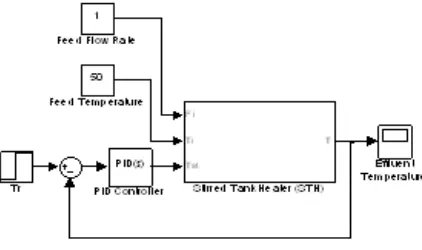
www.ijaera.org 2016, IJAERA - All Rights Reserved 448 Figure 2: Simulink Model of Stirred Tank Heater
Our objective is to keep the temperature of the tank at 400 ºF under different operating conditions. The simulation is carried out with steam temperature (Tst) as the manipulated variable with the PID
controller while keeping the input disturbance values to 1 ft3/min (tank feed flow rate Fi) and 50 ºF
(tank feed temperature Ti). The Simulink model of the system is shown below:
Figure 3: PID Based Simulink Model of STH
PID controllers which are often called the basic building blocks of the process industry has the following form:
E
T
dt d K d
E K
T E K T
U p i
T d0
Where:
U(T) is the observed control output with error
www.ijaera.org 2016, IJAERA - All Rights Reserved 449 p
K , Ki, and Kd are control gains.[9]
III. CONTROL METHOD USED
Fuzzy logic has been used in this paper to maintain the temperature at which process is operating. FIS has been developed to develop the rules and membership function and the results are then simulated using Simulink. Fuzzy logic is an advanced interpretation of multi valued logic useful in developing smart systems.
A. FUZZY LOGIC CONTROLLER
Conventional controllers now can be replaced with intelligent controllers like fuzzy logic controller which generate fast dynamic response. Compared to conventional controller’s fuzzy logic controllers are better in complex problem solving. A fuzzy logic controller mainly consist of three section namely fuzzifier, inference engine and defuzzifier.
MEMBERSHIP FUNCTIONS
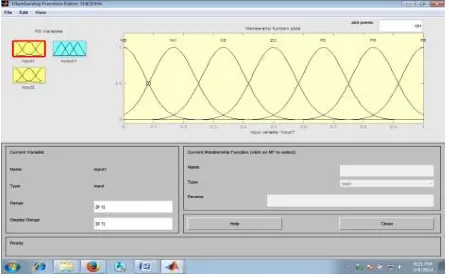
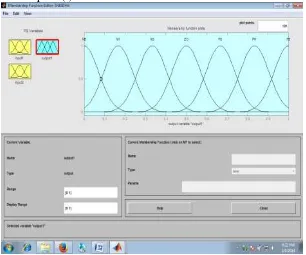
The input and output membership functions are shown below. The notations used for linguistic levels are NB: negative big; NS: negative small; ZE: zero; PS: positive small; PB: positive big.
Membershipifunction of E(t)[8]
www.ijaera.org 2016, IJAERA - All Rights Reserved 450 Membershipfunction of de/dt
Figure 5: Membershipifunction of de/dt
Membershipfunction of output u(t)
www.ijaera.org 2016, IJAERA - All Rights Reserved 451 Rules in Inference System
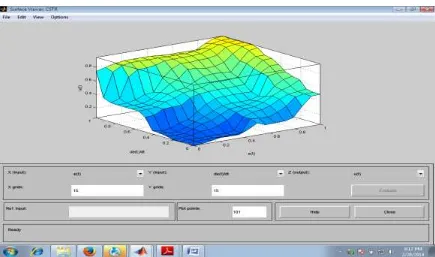
The rules defined in fuzzy controller are used to indicate a relation between the input and the output which are obtained by knowledge of the system design. The rules can then be defined by the linguistic variables. All rules governing the mechanism of each output are explained in the following table.
RULE BASE
de/dt NB NM NS ZE PS PM PB
NB NB NB NB NM NS NS ZE
NM NB NM NM NM NS ZE PS
NS NB NM NS NS ZE PS PM
ZE NB NM NS ZE PS PM PB
PS NM NS ZE PS PS PM PB
PM NS ZE PS PM PM PM PB
PB ZE PS PS PM PB PB PB
The names zero, positive, negative are labels of fuzzy. NB, NM, NS, PS, PM,PB(Negative Big, Negative medium, Negative Small, Positive Big and Positive Medium, Positive Small ). The above representation is also possible in an economical manner.
RULE VIEWER
www.ijaera.org 2016, IJAERA - All Rights Reserved 452 Figure 7 Rule Viewer
www.ijaera.org 2016, IJAERA - All Rights Reserved 453
IV. RESULT
Characteristics of Step Response for PID Tuning using Fuzzy Logic
Fuzzy Logic Controller Results
Rise Time (sec) 0.701
Overshoot (%) 0.78
Settling Time (sec) 1.11
V. REFERENCES
[1] Stephanopoulos, G. (1984). Chemical process control: an introduction to theory and practice.
[2] Smith, C. A., & Corripio, A. B. (1985). Principles and practice of automatic process control (Vol. 2). New York: Wiley.
[3] Katsuhiko iOgata, “Modern Control Engineering”, 4th Edition,i Prentice Hall India, 2006
[4] Available at: https://en.wikipedia.org/wiki/Fuzzy_logic
[5] Morari M., E. Zafirion, “Robust Process Control”, Prentice Hall International, Englewood Cliffs, NJ, 1989 [6] Zulfatman, iM.F. Rahmat, “Application of Self Tuning Fuzzy PID Controller on Industrial Hydraulic
Actuator Using System iIdentification Approach”, International Journal on Smart Sensing and Intelligent Systems, Vol. 2, No. 2, June 2009
[7] Abdur Raquib Ridwan, Ishtiza Ibne Azad, Md. Ibnea Sina Bony, “A Simulink Modeling to Develop a Control System of Stirred Tank Heater with Multifarious Operating Conditions”, International Journal of Computer iApplications (0975 – 8887), Vol. 57 – No. 21, Nov. 2012
![Figure 1: Stirred Tank Heater model [1]](https://thumb-us.123doks.com/thumbv2/123dok_us/1290100.1635685/2.612.223.404.110.330/figure-stirred-tank-heater-model.webp)