Comparative Study on Medical Image
Classification Techniques
Dr Rajesh Sharma R
1,
P S Renisha
2,
Dr Akey Sungheetha
31,2 Hindusthan College of Engineering and Technology, Coimbatore, India 3 Karpagam College of Engineering Coimbatore, India
Abstract— This brief study compares the proposed RGSA
algorithm with other recent methods by several experiments to indicate that proposed 3DGLCM and SGLDM with SVM classifier is more efficient and accurate. The accuracy results of this study imply how well their experimental results were found to give more accurate results of classifying tumors. The center of interest for this study was made on supervised classification approaches on 2D MRI images of brain tumors. This paper gives the comparative study of various approaches that was used to identify the tumor cells with classifiers.
Keywords—MRI, SVM, RGSA, KNN, BPNN.
I. INTRODUCTION
Magnetic Resonance Imaging (MRI) modality outperforms towards diagnosing brain abnormalities like brain tumor, multiple sclerosis, hemorrhage and many more. This study compares medical image classification with classifier performance results and to compare the efficiency, specificity, sensitivity, accuracy, and ROC and mean square error values for imaging modalities.
II. BACKGROUNDSON BRAIN TUMOR
CLASSIFICATION STUDY
According to brain tumor statistics, the primary brain tumor occurs in all ages of people but they are statistically more frequent in children and older adults. A primary brain tumor is a tumor which originates in the brain that can be cancerous (malignant) or non-cancerous (benign).A brain
tumor is an abnormal growth of tissue in the brain or central spine that can disrupt proper brain function. Diagnosing these tumors from brain is very challenging. Radiological diagnosis is based on the multi-parametric imaging profile (CT, conventional MRI, advanced MRI). Magnetic Resonance Imaging (MRI) is the most common ways of diagnosing brain tumors. These scans use magnetic
fields and radio waves, instead of X-rays, and measures tumor’s size. MRIs show visual “slices” of the brain that can be combined to create a three-dimensional picture of the tumor. Since 2D images cannot precisely convey the complexities of human anatomy and hence interpretation of complex anatomy in 2D images requires special training. Representation of a 3D data in the form of 2D projected slices result in loss of information and may lead to erroneous interpretation of results (Megha P. Arakeri & G. Ram Mohana Reddy, 2013).Therefore, automatic brain tumor recognition in MRI images is very essential towards diagnostic and therapeutic applications. Hence this proposed system presents automatic classification of magnetic resonance images (MRI) of brain under two categories as lesion benign and malignant.
Literature studies on texture analysis in biomedical images have directly used the classic methods and hybrid methods (Kassner&Thornhill 2010, Adrien Depeursinge et al 2014, Just 2014, Daniela M. Ushizima et al 2013).In recent years, techniques have been integrated with artificial neural networks (ANNs) and various optimization algorithms to improve the performance.
Applicability of 3D Texture Analysis for extracting additional information from MR images (GCM and Run length) and to obtain imperceptible quantitative individual information from MR images of the brain in epilepsy type EPM1 patients was carried out in (Suoranta et al 2013). Kovalev et al (2001) reported non- trivial classification tasks for pathologic findings in brain datasets. Texture analysis from gradient matrix, run length matrix, auto regressive model, wavelet analysis and co-occurrence matrices and classification using artificial neural network (ANN) for classifying multiple sclerosis lesion was studied in Zhang et al (2008).Herlidou–Meme (2003) performed analysis based on 3D histogram, co-occurrence, and gradient and run-length matrix parameters for tumor grading.
Li et al (2006) perform classification of gliom as according to their clinical grade employing linear SVMs trained on a maximum of 15 descriptive features. Three dimensional textural features with an ensemble classification scheme employing a support vector machine classifier to discriminate benign, malignant and metastatic brain tissues on T1 post-contrast MR imaging was studied in Georgiad is et al (2009).Gao et al (2010) has performed analysis using 3D local binary pattern (LBP), 3D GLCMs, 3D wavelets, and 3D Gabor textures for brain image retrieval. 3D GLCM and volumetric run length matrix with ELM classifier was proposed for brain tumor tissue classification in Arunadevi&Deepa (2013).El-Sayed Ahmed et al (2010) classified the brain images into normal or abnormal using ANN and k-nearest neighbor (kNN) classifiers. These include few of the literature studies employed for brain tumor classification and the following section compares
various classifiers with SVM classifier.
III. BRAIN TUMOR DETECTION USING MRI
Brain Tumor is the most common destructive among human beings which are diagnosed by the computer-aided system to detect malignant regions. The first phase of this system
identifies unsure sore at a high sensitivity, which involves a feature extraction process using volumetric analysis on the MRI scans. The second phase points to detect the tumor and to reduce the number of false positives without decreasing the sensitivity drastically.
IV. FEATURE EXTRACTIONS USING
STATISTICAL MODELS
Feature extraction techniques are useful in classifying and recognition of images. A portion of the image in dataset on which focus point is needed is drawn by the Volume of Interest (VOI).Extracted features that are feasible in diagnosing a VOI in the MR image are given as an input type to the classifier by considering image properties into feature vectors.
V. OPTIMAL FEATURE SUB SELECTIONS
Subset selection evaluates a subset of classes as a group for suitability for classification. The optimal informative feature vector that produce the highest possible classification accuracy to select a feature subset from a huge amount of features. To attain the best classification performance, the practice of subset feature selection methods that generally have better performance is required. This feature selection can greatly reduce the computational burden for classification.
5.1 Refined Gravity Search Algorithm (RGSA)
GSA is a heuristic optimization algorithm which is based on the Newton’s law of gravity and the law of motion is intended to solve optimization problems. The Refined Gravity Search Algorithm is comprised of N searcher agents that include positions and velocities for fitness evaluation. Identification of search space is carried out before generating random agents. Then compute (G(t)) best and worst fitness of the problem and calculate total force, acceleration and velocity repeatedly until the number of objective function evaluations is reached. Finally return the best fitness as a global fitness and the positions of the corresponding agent as the global solution of that problem
VI. SVM CLASSIFICATIONS FOR TUMOR
RECOGNITION
class are termed as support vectors (Medhat Mohamed et al 2010).
Support Vector Machines are based on the concept of decision planes that separates between a set of objects having different class memberships. This paper is intended to compare performance results with standard BPN, KNN classifier with modified3DGLCM and SGLDM with SVM classifier SVM classifier.
VII. COMPARATIVE RESULTS AND
DISCUSSION
The comparative results demonstrate performance factors which include efficiency, specificity, sensitivity, accuracy, and ROC and mean square error values by considering 320 real time brain volume images. Classifier with training and testing data sets are build using Leave one out classification (LOO) method for cross validation. Each sample evaluate error rate in each steps. Diagnosis of cancerous and non-cancerous tissues are depends on the volumetric features extracted after normalization. Statistical features analysis on 3D VOI images shows the variations of micro-structural features. These selected features differentiate the image tissues to anticipate malignant and nonmalignant cancer. Refined gravitational search algorithm (RGSA) enforces extracted seventy seven features for selection and the selected features are ranked with respect to the number of occurrences and fitness- function criteria. The 2D GLCM, 3D GLCM+RLM and proposed Centroid model outcomes are exceptionally good compared to other models. Based on the comparison of BPN, kNN and SVM classification algorithms, the SVM method enhance overall classification accuracy of98.4%, sensitivity at 98.94% and specificity of
95.0%.The 2D region of interest (ROI) computes textural features for the same dataset. Out of seventy seven features, twenty eight features were selected to be optimal, reporting the classification accuracy to be 98.4%.Hence 3D VOI analysis showed a better discrimination towards cancer analysis (malignant and nonmalignant) cross validated by
leave-one-out validation.
The misclassification rates are evaluated by sensitivity and specificity values which in turn diagnose success of classifier. RMSE (Root mean Square error)measures the difference between predicted and observed values which then squares and average the samples. Mean absolute error (MAE) is a spatial measurement which computes the
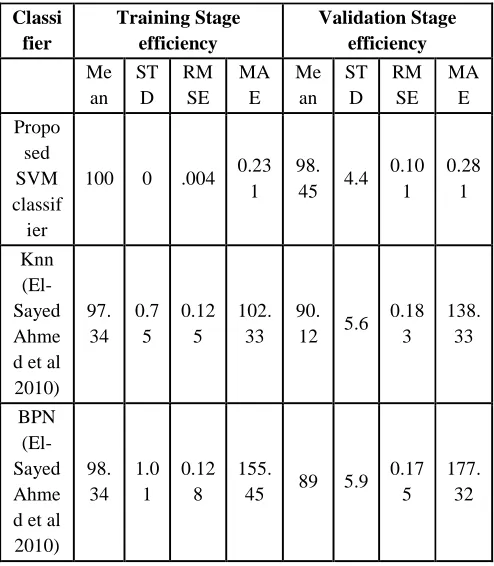
average magnitude of the errors in a set of predictions and observed samples with equal supremacy. The observed values of RMSE and the MAE parameters, in case of SVM for both training and testing are proven as the optimal with lowest values. Table 1 shows the performance of the classifiers.
Table.1: Performance of the Classifiers
Classi fier Training Stage efficiency Validation Stage efficiency Me an ST D RM SE MA E Me an ST D RM SE MA E Propo sed SVM classif ier
100 0 .004 0.23
1 98.
45 4.4 0.10 1 0.28 1 Knn (El-Sayed Ahme d et al 2010) 97. 34 0.7 5 0.12 5 102. 33 90. 12 5.6
0.18 3 138. 33 BPN (El-Sayed Ahme d et al 2010) 98. 34 1.0 1 0.12 8 155.
45 89 5.9
0.17 5
177. 32
Table 1 demonstrates the outcome of the proposed SVM classifier with that of BPN and kNN with respect to specificity, sensitivity, accuracy, ROC and mean square error.Both in training and validation stage the obtained
mean values are higher as 100% and 98% with respect to kNN and BPN classifier. In the similar way the results of RMSE, STD, MAE are more efficient compared to other models. The developed SVM classifier conforms again in Table 2 that it achieves very minimal mean square error of 0.015 in comparison with that of the earlier classifier
Table.2: Average results on the 3D feature extraction model for various classifiers on real time320 patient data volumes
Classifier Specificity %
Sensitivity %
Accuracy %
ROC (Az)
Mean Square Error BPN(El-Sayed
Ahmed et al 2010)
68.17 89.58 88.85 0.89 0.21
kNN(El-Sayed
Ahmed et al 2010)
76.19 91.84 91.14 0.93 0.10
Developed
SVMClassifier 95.0 98.94 98.4 0.99 0.015
The Support Vector Machine classifier examines 30 patients sample dataset to provide 98% of classification rate. The area under a ROC curve (Az value) obtained by the
proposed methodology is 0.99greater in contrast with other methodology.
Table.3: Performance analyses of classifiers and feature extraction both 2D and 3D
Texture Analysis Classifier
Accuracy % w/o Feature selection
Accuracy % with Feature selection
2D GLCM +2D RUN LENGTH +2D SGLDM
(El-Sayed Ahmed et al 2010)
BPN 72.45 81.2
kNN 84.34 89.45
SVM 89.55 91.02
Proposed 3D
GLCM + 3D RUN LENGTH
+ 3D SGLDM
BPN 81.65 88.85
kNN 89.55 91.14
SVM 90.78 98.4
The proposed refined gravitational search algorithm forms a set of solutions over singleresulttoovercome the trap of localoptimum.Here in Table 3 analyze the accuracy results of 3D GLCM and SGLDM with two dimensional features and shows better performance of 3D texture analysis. The analyzed feature improves the RGSA algorithm as a promising method for feature selection over a high dimension space. The experimental result shows that RGSA is of remarkable performance in feature selection optimization and SVM classification. Hence the proposed
RGSA-SVM improves the classification accuracy by minimal optimization of the feature sets and SVM parameters simultaneously.
VIII. CONCLUSIONS
The improved version of gravitational search optimization algorithm for optimal feature selection and high dimensional SVM classifier resulted in promising outputs compared to other algorithms. Thus, it is inferred that the best performance and Accuracy of SVM classifier along with 3D GLCM and SGLDM resulted in better testing performance with a lower error and higher accuracy.
REFERENCES
[1] Megha P. Arakeri and G. Ram Mohana Reddy, “An
Effective and Efficient Approach to 3D
Reconstruction and Quantification of Brain Tumor on Magnetic Resonance Images”, International Journal of Signal Processing, Image Processing and Pattern Recognition Vol. 6, No. 3, June, 2013
[2] Medhat Mohamed, Ahmed Abdelaal ,Muhamed
WaelFarouq, “Applied Classification Support Vector Machine for providing Second Opinion of Breast
Cancer Diagnosis”, The Online Journal on
Mathematics and Statistics (OJMS) Vol. (1)-No.(1) Reference Number: W10-0010, 2010.
[3] Chao-Ton Su ,Chien-Hsin Yang, “Feature selection for the SVM: An application to hypertension diagnosis”, Expert Systems with Applications 34 (2008) 754–763. [4] Kassner, Thornhill.R.E, “Texture analysis: a review of
neurologic MR imaging”, AJNR Am. J. Neuroradiol., 31 (5) (2010), pp. 809–816.
[5] Daniela M. Ushizima , Andrea G. C. Bianchi , WeihongGuo, “Characterization of MRI Scans associated to Alzheimer’s disease through texture analysis”, International Symposium on Biomedical Imaging: from Nano to Macro, Apr 2013.
[6] Sharma, Harish A., "Multiparametric Imaging and MR
Image Texture Analysis in Brain Tumors", University of Western Ontario -Electronic Thesis and Dissertation Repository, 2014.
preliminary study”, Stud Health Technol Inform, pp. 213-216, 2014.
[8] Suoranta S, Holli-Helenius K, Koskenkorva P, Niskanen E, Könönen M, “3D Texture Analysis Reveals Imperceptible MRI Textural Alterations in the Thalamus and Putamen in Progressive Myoclonic Epilepsy Type 1, EPM1”, PLoS ONE 8(7): e69905. doi:10.1371/journal.pone.0069905, 2013.
[9] Kovalev, V.A., Kruggel,F.,vonCramon, D.Y. and Gertz,H.J. “Three-Dimensional Texture Analysis of MRI Brain Datasets”, IEEE Trans. on Medical Imaging, Vol.20, No.5, pp.424-433, 2001.
[10]Zhang,J., Tong,L., Wang,L and Li, N, “Texture analysis of multiple sclerosis: a comparative study”, Magnetic Resonance Imaging,Vol.26, No. 8, pp.1160-1166, 2008.
[11]Cortes.,C and Vapnik,V.“Support-vector network,” Machine Learning, Vol.20, 1995.
[12]El-Sayed Ahmed El-Dahshan, Hosny,T., Badeeh,A. and Salem,M. “Hybrid Intelligent Techniques for MRI Brain Images Classification”, Digital Signal Processing, Vol.20, No.2, pp. 433-441, 2010.
[13]Georgiadis, P., Cavouras, D. and Kalatzis, I. “Enhancing the discrimination accuracy between metastases, gliomas and meningiomas on brain MRI by volumetric textural features and ensemble pattern recognition methods”, Magnetic Resonance Imaging, Vol.27, pp.120-130, 2009.
[14]Li, G., Yang, J., Ye, C. and Geng, D. “Degree prediction of malignancy in brain glioma using support vector machines”, Computers in Biology and Medicine, Vol.36, pp. 313-325, 2006.
[15]Herlidou -Meme,S, “MRI texture analysis on texture test objects, normal brain and intracranial tumors”, Magnetic Resonance Imaging, Vol.21, No.9, pp. 989-93, 2003.
[16]Arunadevi B. and Deepa S.N. “Brain Tumor Tissue Categorization in 3D Magnetic Resonance Images