Original Research Article
Study of substance use in teenage students in Miraj Town:
a cross sectional descriptive study
Ganesh S. Lokhande
1*, Shekhar S. Rajderkar
2, Sachin B. Jadhav
3, Ujwala U. Ukey
4INTRODUCTION
Adolescence is recognized as the period for onset of behaviors and conditions that not only affect health limited to that time but also lead to adulthood disorders.1 Unhealthy behaviors such as smoking, drinking, and illicit drug use often begin during adolescence; they are closely related to increased morbidity and mortality and
represent major public health challenges.2
Unemployment, poor health, accidents, suicide, mental illness, and decreased life expectancy all have drug misuse as a major common contributing factor. Substance
abuse has a major impact on individuals, families, and communities as its effects are cumulative, contributing to costly social, physical, and mental health problems. Several factors can enhance the risk for initiating or continuing substance abuse including socioeconomic status, quality of parenting, peer group influence, and biological/inherent predisposition toward drug addiction.1 Many family characteristics have been shown to influence adolescent tobacco use.3 Considering such factors, the present study had been undertaken to Study the substance use in teenage students. Substance use in the present study was limited to tobacco chewing, smoking, use of alcohol, gutkha and pan masala.
ABSTRACT
Background: Adolescence is recognized as the period for onset of behaviors and conditions that not only affect health limited to that time but also lead to adulthood disorders. Unhealthy behaviors such as smoking, drinking, and illicit drug use often begin during adolescence. Behavior patterns that influence health in adulthood have their origin in adolescence. The habit of substance use comes either from the peer groups or it may be generated within the family because the elders are resorting to one or the other form of substance use. Considering such factors, the present study had been undertaken with the objectives to study socio-economic class wise prevalence of substance use in study population; to study knowledge, attitude and practices of study population regarding substance use; to study various determinants that affect substance use.
Methods: Cross sectional, descriptive study was being conducted in selected High schools and Junior Colleges in the Miraj Town. The method of data collection was the pre-designed, pre-tested proforma.
Results: Various forms of tobacco, alcohol and pan masala were used by 58.9% of the family members/friends/peer groups of the study participants. Overall use [ever use + regular use] of tobacco products was observed in 9.0%, alcohol in 4.6% and pan masala in 33.3% of the study participants.
Conclusions: Several factors can enhance the risk for initiating or continuing substance use including socioeconomic status, substance use by family members or friends and peer group influence.
Keywords: Teenage, Substance use
Department of Community Medicine, 1Government Medical College, Aurangabad, 2Government Medical College, Miraj, 3Government Medical College, Latur, 4Government Medical College, Gondhia, Maharashtra, India
Received: 11 December 2017
Revised: 05 May 2018
Accepted: 08 May 2018
*Correspondence:
Dr. Ganesh S. Lokhande, E-mail: [email protected]
Copyright: © the author(s), publisher and licensee Medip Academy. This is an open-access article distributed under the terms of the Creative Commons Attribution Non-Commercial License, which permits unrestricted non-commercial use, distribution, and reproduction in any medium, provided the original work is properly cited.
Objectives
To study socio-economic class wise prevalence of substance use in study population.
To study knowledge, attitude and practices of study population regarding substance use.
To study various determinants that affect substance use.
METHODS
A cross sectional, descriptive study was carried out in selected High schools and Junior Colleges in the Miraj Town during January 2008 to December 2008. There are total 25 high schools and 3 junior colleges. Out of these every 3rd institution was selected by systematic random sampling. The students from these educational institutes of both the genders in the age group of 13+ to 19+ years were included in the study. The present study was planned to achieve the comparable number of the sample
size among the three socio-economic classes.
Accordingly, the sample of 33.33% each in upper, middle and lower socio-economic groups were achieved. The teenagers, who were willing to participate in the study,
were included with the due permission from their teachers/institutional authorities. Total 3420 students were studied from the selected high schools and junior college. The method of data collection was the pre-designed, pre-tested proforma.
RESULTS
3420 eligible students were surveyed, after resorting to the requisite inclusion & exclusion criteria; and according to the random sampling methods already quoted in the methodology.
The present study was actually planned in such a manner to have the comparable number of the sample size in all the three socio-economic classes. Thus the sample size is evenly distributed in upper, middle and lower socioeconomic groups (33.33% each) (Table 1).
It has been observed that, various forms of tobacco, alcohol and panmasala were used by 58.9% of the family members/friends/peer groups of the study participants (Table 2).
Table 1: Socio-economic status-wise distribution of 3420 students.*
Sr. No. Class Male (%) Female (%) Total (%)
1 Upper 618 (30.7) 522 (37.1) 1140 (33.33)
2 Middle 706 (35.1) 434 (30.8) 1140 (33.33)
3 Lower 689 (34.2) 451 (32.1) 1140 (33.33)
Total 2013 (100) 1407 (100) 3420 (100)
*Parentheses show group-wise percentages.
Table 2: Family members/friends having habit of substance use.
History of substance use in family members / friends Number of students Percentage (%)
Yes 2016 58.9
No 1404 41.1
Total 3420 100
Table 3:Positive family history and substance use in study participants.*
Gender-wise substance use History of substance use in other family members
Yes (%) No (%) Total (%)
Male 742 (60.57) 483 (39.43) 1225 (100.0)
Female 0 0 0
Total 742 (60.57) 483 (39.43) 1225 (100.0)
*Parentheses show group-wise percentages.
Table 4a: SES-wise use of tobacco by participants.*
Tobacco Socioeconomic status P value
Upper (%) Middle (%) Lower (%) Total (%)
1 Not used 1057 (92.7) 1038 (91.1) 1016 (89.1) 3111 (91.0)
<0.001
2 Ever used 45 (3.9) 71 (6.2) 106 (9.3) 222 (6.5)
Table 4b: SES-wise use of alcohol by participants.
Alcohol Socioeconomic status P value
Upper (%) Middle (%) Lower (%) Total (%)
1 Not used 1087 (95.4) 1086 (95.3) 1090 (95.6) 3263 (95.4)
<0.588
2 Ever used 46 (4.0) 49 (4.3) 48 (4.2) 143 (4.2)
3 Regular used 7 (0.6) 5 (0.4) 2 (0.2) 14 (0.4)
4 Total 1140 (100) 1140 (100) 1140 (100) 3420 (100)
*Parentheses show group-wise percentages. χ2=2.82; d.f.=4; p≤0.588.
Table 4c: SES-wise use of pan masala by participants.
Pan masala Socioeconomic status P value
Upper (%) Middle (%) Lower (%) Total (%)
1 Not used 762 (66.8) 737 (64.6) 783 (68.7) 2282 (66.7)
<0.001
2 Ever used 298 (26.1) 286 (25.1) 292 (25.6) 876 (25.6)
3 Regular used 80 (7.0) 117 (10.3) 65 (5.7) 262 (7.7)
4 Total 1140 (100) 1140 (100) 1140 (100) 1140 (100)
*Parentheses show group-wise percentages. χ2
=18.4; d.f.=4; p≤0.001.
Table 5: Reasons for initiation of substance use by the study participants.*
Sr. No. Reason Number of students (N=1225) (%)
1 Peer Pressure 659 (53.79)
2 Curiosity 305 (24.89)
3 Experience 187 (15.27)
4 To feel good 49 (4.00)
5 Seeing actors in movies 25 (2.05)
Total 1225 (100.0)
*Parentheses show group-wise percentages.
Table 6: Measures suggested by study participants to control the tobacco use.*
Opinion of the students
Age in years
Total
[n=3420] (%)
13 + to 15 [n=1296] (%)
15 + to 17 [n=1044] (%)
17 + to 19 [n=1080] (%)
Ban tobacco products 1149 (88.65) 941 (90.13) 1017 (94.16) 3107 (90.84)
Ban advertisements 882 (68.05) 471 (45.11) 677 (62.68) 2030 (59.35)
Health education 508 (39.19) 456 (43.67) 634 (58.70) 1598 (46.72)
Strict law 406 (31.32) 513 (49.13) 556 (51.48) 1475 (43.12)
*Parentheses show group-wise percentages, **Multiple responses.
Table 7: Awareness of study participants regarding diseases caused because of substance use [Tobacco chewing/smoking, alcohol].
Awareness about
diseases because of tobacco use
Age in years
Total [3420] (%)
13 + to 15 [1296] (%)
15+ to 17 years [1044] (%)
17 + to 19+ [1080] (%)
Cancer 1089 (84.02) 987 (94.54) 1080 (100.0) 3156 (92.28)
Respiratory diseases 815 (62.88) 870 (83.34) 957 (88.61) 2642 (77.25)
Heart diseases 412 (31.79) 663 (63.50) 781 (72.31) 1856 (54.26)
General debility 363 (28.01) 438 (41.95) 536 (49.63) 1337 (39.09)
Peptic ulcer 216 (16.66) 445 (42.62) 528 (48.88) 1189 (34.76)
Table 8: Attitude of participants towards family members/friends having habit of tobacco use.*
Sr. No. Attitude of study participants Boys
[n=2013] (%)
Girls
[n=1407] (%)
Total
[n=3420] (%)
1 Attempted to control use of tobacco among family
members 67 (3.33) 31 (2.20) 98 (2.86)
2 Nobody should use tobacco in their presence 769 (38.20) 1126 (80.03) 1895 (55.41)
3 No response 1177 (58.47) 250 (17.77) 1427 (41.73)
4 Total 2013 (100.0) 1407 (100.0) 3420 (100.0)
*Parentheses show group-wise percentages.
More than half of the study participants (60.57%) with the habit of substance use had history of substance use by family members or friends. No female participants were found to have habit of substance use (Table 3).
Proportion of the participants with tobacco use was more in lower socio-economic class accounting for 10.9% compared to middle (8.9%) and upper socioeconomic class (7.2%), whereas overall use of alcohol seen in 4.6% participants with no statistical difference among three socio-economic classes and use of pan masala was observed more in middle socio-economic class accounting for 35.4% followed by upper (33.1%) and lower socio-economic class (31.3%) (Table 4).
Most common reason given by the study participants for the initiation of the substance use was the peer pressure accounting for 53.79% followed by curiosity (24.89%), as an experience (15.27%), to feel good (4%) and seeing actors in movies (2.05%) (Table 5).
Measure suggested to control substance use by study participants was, to ban the tobacco products followed by ban advertisements, health education and strict laws (Table 6).
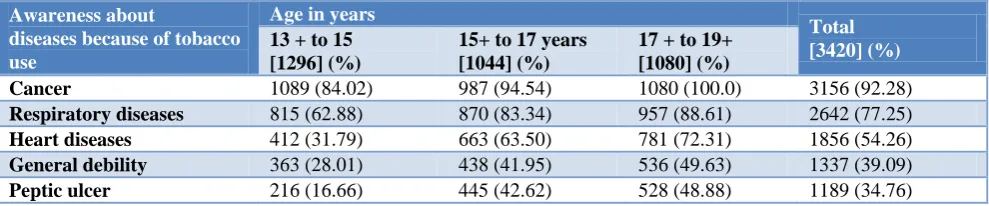
Awareness about diseases caused by substance use increased with increasing age of study participants. Maximum awareness was seen about the cancer at any given age while awareness was lowest about peptic ulcer (Table 7).
58.27% participants responded when asked regarding their attitude towards family members/friends having habit of tobacco use, while remaining 41.73% preferred not to respond. Among the respondents more than half (55.41%) of the study participants wished that, nobody should use tobacco in their presence and only 2.86% of the study participants actually attempted to control substance use among family members/friends (Table 8).
DISCUSSION
The habit of substance use comes either from the peer groups or it may be generated within the family because
the family members/friends/peer groups of the study participants.
It has been observed that more than half of the study participants (60.57%) with the habit of substance use had history of substance use by family members or friends. Study conducted in Singapore by Emmanuel et al to assess cigarette smoking among school children aged 9-20 years observed that, 52% of boys currently smoking reported that their fathers smoked as well.4
Proportion of the participants with tobacco use was more in lower socio-economic class accounting for 10.9% compared to middle (8.9%) and upper socioeconomic class (7.2%), whereas overall use of alcohol seen in 4.6% participants with no statistical difference among three socio-economic classes and use of pan masala was observed more in middle socio-economic class accounting for 35.4% followed by upper (33.1%) and lower socio-economic class.
Findings comparable to present study was observed in the study conducted by Langille showed that, the smoking was the behavior most often associated with lower socioeconomic status.5 Whereas Kokkevi in his study observed that, the prevalence of smoking was lower in the higher socio-economic class.6
Study conducted by Mukharjee, Sarangi and Kumar, at different places i.e. Mumbai, Sambalpur and Tirupati respectively observed that the peer pressure was the important factor for the initiation of substance use which was similar to the findings observed in present study.7-9
Most common measure suggested by study participants to control the tobacco use was to ban the tobacco products, similar finding was observed in the study conducted at Bhavnagar City, Gujarat by Shah.10
CONCLUSION
members or friends. No females participants were found to have habit of substance use. Tobacco use was seen more in lower socioeconomic class compared to middle and higher class and no statistical difference was observed for the use of alcohol among various socio-economic classes.
Most common reason given by the study participants for the initiation of the substance use (tobacco + alcohol) was the peer pressure followed by curiosity, as an experimentation & experience, to feel good and mimicking the actors in the movies.
Awareness regarding hazards of tobacco and alcohol use increased with advancing age. Most common measure suggested controlling tobacco by study participants was, to ban the tobacco products followed by ban advertisements, health education and strict laws. Among the respondents more than half of the study participants wished that, nobody should use tobacco in their presence and only few of the study participants actually attempted to control substance use among family members/friends.
Funding: No funding sources Conflict of interest: None declared
Ethical approval: The study was approved by the Institutional Ethics Committee
REFERENCES
1. Das JK, Salam RA, Arshad A, Finkelstein Y, Bhutta ZA. Intervention for Adolescent Substance Abuse: An Systemic Reviews. J Adolescent Health. 2016;59(4):61-75.
2. Mangerud WL, Bjerkeset O, Holmen TL, Lydersen
S, Indredavik MS. Smoking, Alcohol Consumption & Drug use among adolescents with Psychiatric disorder compared with population based sample. J Adolescent. 2014;37(7):1189-99.
3. Jaisoorya TS, Beena KV, Beena M, Jose DC,
Ellangovan K, Thennarasu K, et al. Prevalence & Correlates of Tobacco use among adolescents in Kerala, India. Indian J Med Res. 2016;144(5):704-11.
4. Emmanuel SC, Ho CK, Chen AJ. Cigarette smoking
among schoolchildren in Singapore. Part II-development of the smoking habits. Singapore Med J. 1991;32:146-50.
5. Langille DB, Curtis L, Hughes J. Association of socio-economic factors with health risk behaviors among high school students in rural Nova Scotia. Can J Public Health. 2003;94(6):442-7.
6. Kokkevi A, Stefanis C. The Epidemiology of Licit and Ilicit Substance Use among High School Students in Greece. Am J Public Health. 1991;81(1):48-52.
7. Mukherjee K, Hadaye RS. Gutkha consumption and
its determinants among secondary school male students. Indian J Community Med. 2006;31(3):177. 8. Sarangi L, Acharya HP, Panigrahi OP. Substance abuse among adolescents in urban slums of
Sambalpur. Indian J Community Med.
2008;33(4):265-7.
9. Kumar C, Prabhu GR. Prevalence of drug abuse among male youth in Tirupati, A.P. Indian J Community Med. 2006;31(4):177.
10. Shah VN, Verma PB, Tripathi CB. Knowledge
attitude and practice regarding tobacco consumption among the college students of Bhavnagar City (Gujarat). Indian J Community Med. 2005;30(1):39-40.