http://www.ijcmph.com pISSN 2394-6032 | eISSN 2394-6040
Original Research Article
Clinico-epidemiological profile of eclampsia patients admitted in an
urban tertiary care hospital of West Bengal: a record based study
Baisakhi Maji
1, Sumana Samanta
1*, Sreetama Banerjee
2, Tanjib Hassan Mullick
1,
Sudhanshu Saharay
3, Debjit Sarkar
4INTRODUCTION
Eclampsia is an acute life-threatening complication of hypertensive disorders of pregnancy. It is characterized by convulsions or unexplained coma or both in a patient with signs and symptoms of pre-eclampsia during pregnancy or postpartum period.1 Eclampsia precedes
preeclampsia in 80% cases although it is hard to predict which women with preeclampsia go on to have eclampsia. Once eclampsia started the prognosis of mother and baby becomes gloomy.2
It’s a major public health problem specially in developing countries, contributing to maternal and perinatal
ABSTRACT
Background: Eclampsia is a multi–system disorder with complex pathogenesis, causing 12% of global maternal deaths. It is a major public health problem specially in developing countries, contributing to maternal and perinatal morbidity as well as mortality. Majority of them are preventable if managed timely, promptly and with expertise.The objectives of the study were to identify the incidence of eclampsia in R G Kar Medical College and Hospital as well to identify the determinants of feto-maternal outcome.
Methods: A retrospective, record-based cross-sectional study was conducted in an urban tertiary care teaching hospital. There were 354 pregnant women with eclampsia admitted and delivered during the study period which was 1st January-31st December’2015. Complete enumeration was done to get the sample for the study. Data were retrieved from eclampsia registers and log books of delivery kept in the labour room and hospital record section. After wards it was analysed with the help of SPSS 20.0 version to get different inferential statistics.
Results: Incidence of eclampsia in that hospital in 2015 was18.4/1000 deliveries. Almost 72% patients had ante-partum eclampsia and rest had post-ante-partum eclampsia. Emergency caesarean section was the most common (62.14%) mode of delivery. Perinatal mortality was found in 5.6% of the eclampsia patients. Majority (65%) of the babies delivered belonged to low birth weight. Muslim patients and the patients of gestational age more than 36 weeks had unfavourable outcome.
Conclusions: There is need to educate and encourage the general public for antenatal care and institutional delivery. Along with this the socio-economic, cultural and educational status are to be uplifted for the improvement of the present scenario regarding eclampsia in our country.
Keywords: Eclampsia, Perinatal mortality, Incidence, Emergency c/s, Low birth weight
Department of Community Medicine, 1Bankura Sammilani Medical College and Hospital, Bankura, 2College of Medicine and JNM Hospital, Kalyani, Nadia, West Bengal, India
3
Kurseong Sub-divisional Hospital, Darjeeling, West Bengal, India
4
NUHM Society, Kolkata, West Bengal, India
Received: 14 March 2018
Accepted: 02 May 2018
*Correspondence:
Dr. Sumana Samanta,
E-mail: [email protected]
Copyright: © the author(s), publisher and licensee Medip Academy. This is an open-access article distributed under the terms of the Creative Commons Attribution Non-Commercial License, which permits unrestricted non-commercial use, distribution, and reproduction in any medium, provided the original work is properly cited.
morbidity as well as mortality.3 Pre-eclampsia, precursor of eclampsia ranges from 2% to 10% of total pregnancies worldwide.4 maternal mortality for eclampsia ranges from 1.8% to 43.1%.5 WHO estimates incidence of pre-eclampsia is seven times higher in developing countries than developed world, probably because of the lack of comprehensive antenatal care, early detection of pre-eclampsia and its effective management, absence of uniform national health care policy.6 Situation in developing countries is further worsened by illiteracy, lack of health awareness, poverty and superstitious beliefs preventing women from seeking medical advice during pregnancy.7
The maternal mortality ratio in India is 167 per 1 lakh live births (Sample Registration System 2011-13), with hypertensive disorders specially eclampsia causing 12% of maternal deaths.8,1 Deaths of mother is a tragic event. In practical life, it has a severe impact on the family, community and eventually the nation. The young surviving child left motherless are unable to cope with daily living and are at increased risk of death.[9] Prompt diagnosis at the onset during antenatal period, medical management to keep the blood-pressure under control as well as a balanced judgment for timing and mode of delivery plays an important role in optimizing the feto-maternal outcome.5,10,11
In West Bengal a study conducted in Midnapur Medical college revealed that Eclampsia accounted for 45.36% of total maternal death with case fatality rate 4.96%.12 Death due to eclampsia commonly occurs in younger age group of 19-24 years and in Primi gravida.9 Extensive literature search explored that most of the studies were conducted in rural hospitals of West Bengal. With this back drop the present study had been conducted in an urban tertiary care hospital of West Bengal with the following objectives:
To describe the socio-demographic profile of eclampsia cases admitted in R. G. Kar Medical College and Hospital, Kolkata.
To determine the incidence and types of eclampsia.
To identify the determinants of perinatal outcome of eclampsia patients.
METHODS
A hospital record based cross-sectional study was conducted in Obstetrics and Gynaecology department of R. G. Kar Medical College and Hospital, Kolkata. It is a tertiary care teaching hospital in West Bengal with 1100 beds conducting more than 15,000 deliveries every year. There were 354 pregnant women with eclampsia admitted and delivered during the study period which was 1st January-31st December 2015. The pregnant women with known seizure disorders and the mothers delivered in other health facilities but referred to this hospital for management of severe post-partum eclampsia were
After obtaining ethical approval from Institutional Ethics Committee and necessary permission from the authorities; data were retrieved from eclampsia registers and log books of delivery kept in the labour room and hospital record section. Study variables were socio- demographic profile of patients like age, residence; factors associated with the eclamptic patients e.g. parity, booking status, gestational age at the time of admission, type of eclampsia, time interval from admission to delivery, mode of delivery; various perinatal and maternal outcomes e.g. Still birth/IUD, maternal complications during the delivery etc. In the study period all the eclampsia cases were treated with magnesium sulphate.
Collected data were entered in Microsoft excel spread sheet. Mean, standard deviation (SD), proportion were estimated as descriptive statistics. Tables and figure were used for displaying data. Chi square, unpaired ‘t’ test and multiple logistic regression were performed in SPSS 20.0 version to obtain inferential statistics.
RESULTS
There were 19,257 deliveries conducted at R. G. Kar Medical College and Hospital, Kolkata in 2015, among them 354 cases were eclampsia patients, so the incidence of eclampsia in that hospital in 2015 was 18.4/1000 deliveries.
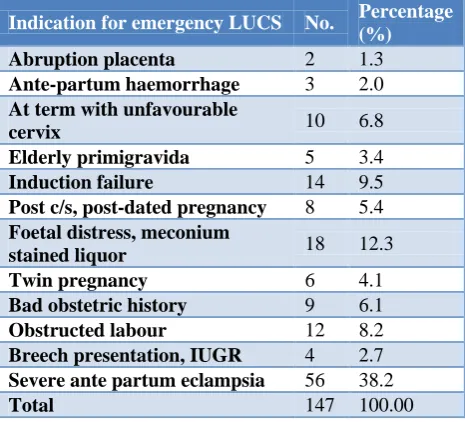
Table 1: Distribution of the mothers suffering from ante-partum eclampsia (APE) according to indications for emergency caesarean section (n=147).
Indication for emergency LUCS No. Percentage (%)
Abruption placenta 2 1.3
Ante-partum haemorrhage 3 2.0
At term with unfavourable
cervix 10 6.8
Elderly primigravida 5 3.4
Induction failure 14 9.5
Post c/s, post-dated pregnancy 8 5.4
Foetal distress, meconium
stained liquor 18 12.3
Twin pregnancy 6 4.1
Bad obstetric history 9 6.1
Obstructed labour 12 8.2
Breech presentation, IUGR 4 2.7
Severe ante partum eclampsia 56 38.2
Total 147 100.00
primigravida (68%). Most of the patients (99.7%) had eclampsia in third trimester. Among them about 23% belonged to near term pregnancy (32-36 weeks) and 71% in term pregnancy. Most of them were booked cases (59.3%) in R. G. Kar Medical College and rest were referred from peripheral hospitals. Almost 72% patients had ante-partum eclampsia and rest had post-partum eclampsia. Emergency caesarean section was the most common (62.14%) mode of delivery followed by vaginal delivery (28.53%), assisted vaginal delivery (9.03%) constitutes forceps delivery, assisted breach delivery etc. Among the patients having ante-partum eclampsia who undergone emergency LUCS most common indication of C/S was severe ante-partum eclampsia (38%) (Table 1).
Almost 2.5% eclampsia patients had twin pregnancies. Perinatal mortality was found in about 5.6% cases, which consisted of intrauterine foetal demise and stillbirth. Majority (65%) of the babies delivered belonged to low birth weight. Average birth weight of the delivered baby was 2.33±0.50 kgs (Mean±SD). Death rate of eclamptic mothers was 0.84%.
The study showed that mean age of the patients who had unfavourable outcome was less than the patients who had favourable perinatal outcome (live birth) and difference was statistically significant (Table 2). Unfavourable perinatal outcome was more among the Muslim patients than the Hindus. It was also revealed that rural eclampsia patients had more unfavourable perinatal outcome than the urban patients. Patients who are primigravida and of gestational age >36 weeks had more unfavourable perinatal outcome. All these differences were statistically significant (Table 3). In the present study the time interval between admission and delivery was more in case of postpartum eclampsia than the antepartum eclampsia and the difference was statistically significant (Table 4).
Binary logistic regression showed that religion of eclamptic patients and duration of pregnancy were the factors which determined the perinatal outcome mostly as these were statistically significant considering the effects of other confounders in the regression model (Table 5).
Table 2: Distribution of eclampsia patients according to their age and perinatal outcome (n=354).
Perinatal outcome Age of the patients (years) Independent t test at df, p value
Mean ± SD
Live birth (n1=333) 21.28±3.88
4.65 at df 352, p=0.00
Others* (n2=21) 19.24±1.75
*Others included stillbirth/IUFD, maternal death.
Table 3: Distribution of eclampsia patients according to various attributes and their perinatal outcome (n=354).
Attributes
Perinatal outcome
χ2
at df, p value
Live birth No. (%)
Others* No. (%)
Religion
Hindu (n1=212) 205 (97) 7 (3)
6.55 at 1, 0.01 Muslim (n2=142) 128 (90) 14 (10)
Total 333 (94.1) 21 (5.9)
Residence
Rural (n1=225) 207 (92) 18 (8)
4.73 at 1, 0.03 Urban (n2=129) 126 (98) 3 (2)
Total 333 (94.1) 21 (5.9)
Gravida
Primi (n1=240) 221 (92) 19 (8)
5.25 at 1, 0.02 Multi (n2=114) 112 (98) 2(2)
Total 333 (94.1) 21 (5.9)
Duration of pregnancy
>36 weeks (n1=215) 197 (91.6) 17 (7.4)
3.92 at 1, 0.04 ≤36 weeks (n2=139) 136 (97.8) 4(2.2)
Total 333 (94.1) 21 (5.9)
*Others included stillbirth/IUFD, maternal death.
Table 4: Distribution of eclampsia patients according to type of eclampsia and time interval between admission at hospital and delivery (n=354).
Type of eclampsia Time interval between admission and delivery (hours) Independent t test at df, p value
Mean±SD
Antepartum (n1=256) 6.77±5.7
-1.94 at 352, 0.007
Postpartum (n2=98) 8.53±3.6
Table 5: Binary logistic regression showing association between the factors affecting perinatal outcome of eclampsia patients (n=354).
Input variables* Category Sample size Live birth (%) β Sig. AOR 95% CI for AOR
Lower Upper
Age ≤20 years 222 93 0.29 0.603 1 * *
>20 years 132 96 1.34 0.45 3.98
Religion Muslim 142 90 1.02 0.040 1 * *
Hindu 212 97 1.36 1.14 1.95
Residence Urban 129 98 1.2 0.064 3.32 0.93 11.82
Rural 225 92 1 * *
Gravida Multi 114 98 1.39 0.073 4.02 0.88 18.37
Primi 240 92 1 * *
Duration of pregnancy
>36 weeks 215 91.6
1.16 0.046 1 * * ≤36 weeks 139 97.8 3.19 1.02 9.95
Figure 1: Time trend of admission of eclampsia patients in R G Medical College in 2015.
If we see the time trend of eclampsia patients came in 2015, it can be concluded that in the month of January, October, November, December there were more number of eclampsia patients than the rest of the months (Figure 1).
DISCUSSION
Incidence of Eclampsia in R. G. Kar Medical College and Hospital was 18.4/1000 deliveries in the year of 2015. Much lower rates were observed by Pradeep et al, Sunita et al and Choudhary, whereas high rates were found by Khan et al, Pal et al, Begum et al, Singh et al.4,7,13-17
Present study revealed that almost 40.7% were un-booked cases suggesting irregular antenatal care, but the study conducted by Pal et al found much lesser proportion whereas Pradeep et al (88%) and Sunita et al (95%), Das (90.09%), Singh et al (90.5%) found much higher proportions.6,4,13,9,17 Eclampsia was common in young
Pradeep et al (79% among 19-24 years), Choudhary (97.2%), Das (19-24 years- 44.1%), Khan (84% <25 years), Singh (45.9%, 21-24 years) but Pal et al. revealed different finding (6.97% below 20 years).4,14,9,7,17,15
Eclampsia was more in Primi-gravida women (68%). Similar finding was revealed by Pradeep et al.(67%) and Choudhary (80.9%), Das (61.3%), Khan (83.9%) but Pal et al found much lower proportion (7.43%).4,14,9,7,15 Present study found that most of the eclampsia patients were presented at term pregnancy (73.7%), as also found by Choudhary (72.3%), Singh (44.7%).14,17 Majority of the eclampsia cases were antepartum (72.3%) in the present study, which was quite similar with findings of Pal et al (64%) and Sunita et al (56%), Begum et al (80%).15,12,16
Perinatal death was 5.6% in the present study; which was less than the study conducted by Pradeep et al, Pal et al and Choudhary.4,15,14 Incidence of low birth weight among the eclampsia patients was 65% in present study, which was more than the study conducted by Pal et al (26.96%).15 Contribution of maternal mortality due to eclampsia was 0.84% in the present study, which was lesser than the study conducted by Pal et al (6.05%), Sunita et al (4%) and Begum et al (8.6%).15,13,16
Normal vaginal delivery conducted in 28.53% of cases in present study, which was higher in study conducted by Pal et al (58.3%) and Khan (65.4%).15,7 Second stage of labour was curtailed by forceps in 9.03% cases in the present study, comparable with the studies conducted by Pal et al and Begum et al.15,16
patients along with severe form of eclampsia. Begum et al also found similar indications for LUCS in eclampsia patients.16
CONCLUSION
Incidence of eclampsia was found to be high in the present institution. In depth analysis of every mortality due to eclampsia either at community level (verbal autopsy) or at the institutional level should be carried out to identify the actual cause of mishap and deficiencies in our health care delivery system that might contribute to formulate more effective preventive measures.
Eclampsia can be prevented to a large extent by proper antenatal care and detection of pre-eclampsia with early management. Early presentation, skilled and prompt management, early referral with quick and well-equipped transport facilities, timely decision to terminate pregnancy will improve the maternal and perinatal outcome. There is need to educate and encourage the general public for antenatal care and institutional delivery. Along with this unless the socio-economic, cultural, educational status are uplifted much improvement in the situation can’t be achieved.
ACKNOWLEDGEMENTS
Authors are thankful to all the staffs of medical record section and Labour room of department of Obstetrics and Gynaecology, R.G. Kar Medical College and Hospital, Kolkata for their cooperation and support during the entire study period.
Funding: No funding sources Conflict of interest: None declared
Ethical approval: The study was approved by the Institutional Ethics Committee
REFERENCES
1. Park K, Park’s Textbook of Preventive and Social Medicine. 24th ed. Jabalpur, India: M/s Banarsidas Bhanot publishers; 2017: 593-598
2. Khan A, Ghosh A, Banerjee PK, Mondal TK. Analysis of the causes of maternal death in eclampsia. IOSR-JDMS. 2014;13(3):7-10.
3. Singh A, Shrivastava C. Changing trends in eclampsia and increasing cesarean delivery – an interesting retrospective study from a tertiary care hospital of Raipur, Chhattisgarh, India. Int J Reprod Contracept Obstet Gynecol. 2016;5:1031-5. 4. Pradeep MR, Shivanna L. Retrospective study of
Eclampsia in a Teaching Hospital. Int J Recent Trends Sci Tech. 2013;8(3):171-3.
5. Edgar NM, Albert K, Richard R, Beatrice IH, Anthony MN. Maternal and Perinatal Ouotcome among Eclamptic Patients Admitted to Bugando
Medical Centre, Mwanza, Tanzania. Afr J Reprod Health. 2012;16(1):35.
6. Make every mother and child count. The world health report. Geneva, Switzerland: WHO;2005. Available from www.who.int/whr/2005/whr2005 _en.pdf. Accessed on 12 March 2018.
7. Khan A, Ghosh A, Banerjee PK, Mondal TK. Profile and Outcome of Eclampsia in a Rural Tertiary Hospital. Int J Recent Trends Sci Tech. 2014;10(3):526-9.
8. Sample registration System. Ministry of Home affairs. Govt. of India. New Delhi. 2011-13. Available at: www.censusindia.gov.in/2011-Common/Sample_Registration_System.html. Accessed on 12 March 2018.
9. Das R, Biswas S. Eclampsia: The major cause of maternal mortality in eastern India. Ethiop J Health Sci. 2015;25:111-16.
10. Prabhakar G, Shinde MA, Jadhav CA. Clinical study of eclampsia patients at DR. V M. Government Medical College Solapur, India. IOSR J Dental Medical Sci. 2014;13(7):10-6.
11. Labib G, Baha S. Maternal Mortality from Preeclampsia/Eclampsia. Semin Perinatol. 2012;36:56-9.
12. Sarkar M, Basak S, Mondal SK, Das S, Roy D, Mandal J, et al. Maternal mortality associated with eclampsia in an Indian medical college: a four-year retrospective study. J Med Med Sci. 2013;4(10):394.
13. Sunita TH, Desai RM. Eclampsia in a Teaching Hospital: Incidence, clinical profile and response to Magnesium Sulphate by Zuspan’s regimen. IOSR J Dental Med Sci. 2013;4(2):1-5.
14. Choudhary P. Eclampsia: a hospital based retrospective study. Kathmandu Univ Med J. 2003;1(4):237-41.
15. Pal A, Bhattacharyya R, Adhikari S, Roy A, Chakraborty D, Ghosh P et al. Eclampsia- scenario in a hospital- a ten years study. Bangaladesh Med Res Counc Bull. 2011;37(20):66-70.
16. Begum MR, Begum A, Quadir E, Akhtar S, Samsuddin S. Eclampsia: Still a Problem in Bangladesh. Medscape General Med. 2004;6(4):52. 17. Singh A, Shrivastava C. Changing trends in
eclampsia and increasing cesarean delivery – an interesting retrospective study from a tertiary care hospital of Raipur, Chhattisgarh, India. Int J Reprod Contracept Obstet Gynecol. 2016;5:1031-5.
Cite this article as: Maji B, Samanta S, Banerjee S, Mullick TH, Saharay S, Sarkar D.