Original Research Article
The prevalence of retinopathy in diabetes mellitus and associated risk
factors: a community-based cross sectional study in peri urban area
Sanjeev K. Gupta
1, Anshuman Sharma
1, Sanjay Agarwal
2, Sanjay Gupta
3, Shalini Sarouthia
1INTRODUCTION
Longstanding diabetes can cause various serious consequences like diabetic retinopathy (DR), diabetic neuropathy & diabetic nephropathy (DN). Out of these DR is the most important ophthalmic complication of diabetes mellitus (DM) and in many adults, causes blindness.1 DR is the second leading cause of legal blindness in developed countries in addition to it being the primary cause of blindness in people between 25 and 64 years old.2-5 Diabetes mellitus is often associated with progressive loss of vision and is one of the
fastest-growing health problems in the world.6,7 The loss of vision is more likely to occur in people with type 2 diabetes than in older adults without type 2 diabetes.3,4 Moreover, a higher incidence of cataracts, glaucoma, or corneal diseases has also been observed in this population along with diabetic retinopathy.8-11 Visual impairment not only worsens and reduces quality of life of diabetic patients but also increases economic burden on the society. The amplified prevalence of visual impairment in association with diabetes has become a major public health problem that entails significant attention.
ABSTRACT
Background: Visual impairment i.e. diabetic retinopathy is the one of most common manifestation of diabetes mellitus. Globally it is becoming an increasing public health problem especially in the developing countries because of increase in number of diabetic patients.
Methods: A cross sectional study was conducted in the vicinity of Urban Heath and Training Centre (UHTC), Peoples University, Bhopal over a period of 6 months through screening in camps held, which included a total of 840 participants (aged ≥25 years) by following simple random procedure and in those who had newly diagnosed or long standing diabetes were referred to ophthalmologist for further evaluation. Retinopathy was determined by ophthalmoscopy and fundus photography. Anthropometric measurements (BMI), glycosylated haemoglobin were also evaluated among the confirmed diabetic patients in the study.
Results: An increased prevalence of diabetes (5.95%) and retinopathy (28%) (95% CI 11.2-32.0) was found. In all age groups prevalence of bilateral blindness, bilateral low vision, unilateral blindness and unilateral low vision were respectively 2%, 28%, 0%, 70%. Independent risk indicators for the occurrence of diabetes such as age, BMI, HbA1c, were found significant for the occurrence of retinopathy in the study population.
Conclusions: Visual impairment due to diabetic retinopathy remains an important public health problem in people with diabetes so timely interventions are required to resolve this major issue.
Keywords: Prevalence, Diabetes mellitus, Diabetes retinopathy, Visual impairment, Community, Factors
Department of Community Medicine, 1RKDF Medical College and RC, Jatkhadi Bhopal, 2RD Gardi Medical College, Ujjain, 3Peoples College of Medical Science & RC, Bhopal, Madhya Pradesh, India
Received: 30 March 2018
Revised: 29 April 2018
Accepted: 30 April 2018
*Correspondence:
Dr. Sanjeev K. Gupta,
E-mail: [email protected]
Copyright: © the author(s), publisher and licensee Medip Academy. This is an open-access article distributed under the terms of the Creative Commons Attribution Non-Commercial License, which permits unrestricted non-commercial use, distribution, and reproduction in any medium, provided the original work is properly cited.
The rapid evolution in urbanization in conjunction with increase in the prevalence of diabetes mellitus inescapably affects the pattern of visual impairment in Indian populations, especially in diabetic patients. Currently, little is known about how low vision and blindness are associated with type 2 diabetes in India. Thus, we conducted this study to determine the prevalence and factors associated with low vision in a population with previously diagnosed diabetes mellitus.
METHODS
Sample size calculation
As this study was only a part of continuing large epidemiological study worldwide, to determine the required sample size for this study, the formula: n=PQ/l2 was used, where P is prevalence (of DM + Pre DM) from the previous study, i.e. 0.14 (14%); Q=1 – P, i.e. 0.86 and l=allowable error of known prevalence i.e. 0.085×0.14. Thus the calculated sample size, n=850. In the current study a total of 840 subjects participated. This subset of population was investigated to estimate the prevalence of retinopathy among diabetics and explore the associated risk factors for developing retinopathy. Following a simple random procedure 1000 individuals aged ≥25 years were identified to participate in this study, among which 840 individuals agreed to participate and were investigated in the present study.
Study period
The present study was completed in 6 months period. Three camps were organized in three different places in the vicinity of UHTC for the period of two days each. The first camp was held in April 2015, second camp in May 2015 and the last camp in October 2015.
Inclusion criteria
Both men and women ≥25 years of age who were inhabitants of the camp area and were willing to participate voluntarily and comply with the instruction, were included in the study
Exclusion criteria
People who were not qualified by inclusion criteria were excluded from the study. Pregnant women and physically or mentally disabled persons unable to follow simple questions / instructions were excluded.
Methodology
This epidemiological survey was conducted through screening in camp settings within the catchment area of Urban Health and Training Centre (UHTC), People’s University Bhopal, to detect diabetic retinopathy.
A total of 50 (36 male, 14 female) known diabetics were identified during the camps. 8 of 50 patients were early
age onset diabetics (diagnosed before the age of 30) and the remaining 42 patients were older onset diabetics. The participants were provided with the necessary information about this study and their consent taken. They were called to the Ophthalmology Unit for ophthalmic examination and treatment. At the same time, we reconfirmed the diabetic status of these 50 known diabetic patients by investigating their fasting and post prandial serum blood sugar levels. Moreover, the body mass index (BMI) and glycosylated hemoglobin (HbA1c) was furthermore tested for confirmed diabetic patients. Though recommended, we were unable to conduct further investigations (urine routine and microscopy, lipid profile, renal and liver function test and hip waist ratio) due to lack of personnel and time. Patient’s ophthalmic examination was conducted in UHTC by trained ophthalmologist.
A detailed questionnaire, including socio-demographic status, DM and history of other illness, weight, height, and results of eye examination was given to all 50 patients.
Routine ophthalmologic examination was performed. When the best-corrected visual acuity (BCVA) in the better eye was ≤0.1, it was accepted as legal blindness. If the BCVA was 0.2 to 0.4, it was accepted as low vision. When the BCVA in the better eye was ≥0.5 and the fellow eye was ≤0.1, it was grouped as unilateral blindness, and if the BCVA was 0.2 to 0.4 in the fellow eye, it was grouped as unilateral low vision.
Data analysis
The data was entered in the pre-designed Microsoft office excel format which was later imported into the statistical software SPSS 20. The prevalence rates of diabetes and retinopathy were determined by simple percentages. Statistical comparisons between categorical variables were made by using χ2 test and comparisons between continuous variables were made by using independent sample t test. All presented p values are two-tailed. The statistical tests were considered significant at a level ≤5% (≤0.05).
RESULTS
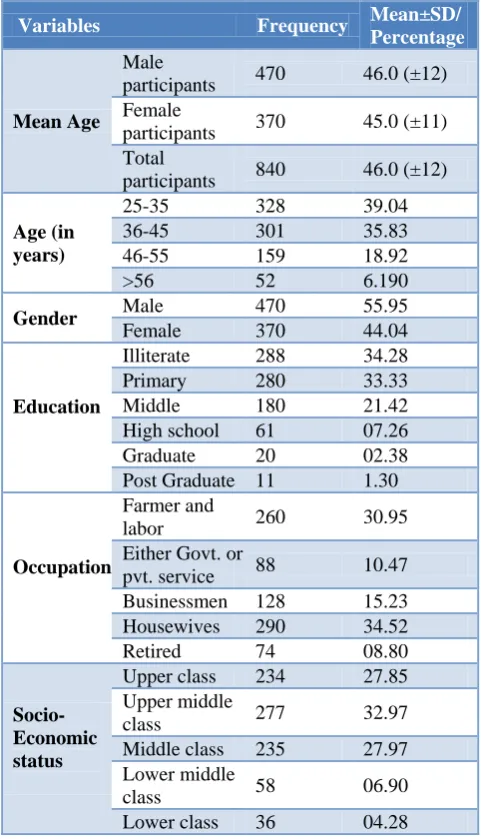
In the study a total of 840 participants were registered to attend all the activities of the camp. The mean (±SD) age (in years) of the participants was 46 (±12) years. All participants were divided into 4 age groups with 10 years age interval.
Table 1: Demographic and socio-economic characteristics of the study subjects (n=840).
Variables Frequency Mean±SD/
Percentage
Mean Age
Male
participants 470 46.0 (±12)
Female
participants 370 45.0 (±11)
Total
participants 840 46.0 (±12)
Age (in years)
25-35 328 39.04
36-45 301 35.83
46-55 159 18.92
>56 52 6.190
Gender Male 470 55.95
Female 370 44.04
Education
Illiterate 288 34.28
Primary 280 33.33
Middle 180 21.42
High school 61 07.26
Graduate 20 02.38
Post Graduate 11 1.30
Occupation
Farmer and
labor 260 30.95
Either Govt. or
pvt. service 88 10.47
Businessmen 128 15.23
Housewives 290 34.52
Retired 74 08.80
Socio-Economic status
Upper class 234 27.85
Upper middle
class 277 32.97
Middle class 235 27.97
Lower middle
class 58 06.90
Lower class 36 04.28
A major portion of the 840 participants were illiterate (34%) and below primary level (33%), middle, high school, graduate, and masters’ level participants were nearly 22%, 7%, 2% and 1% respectively. Major number of female participants was housewives (34%). Among the male participants, farmers and labors were 31%, service holders 10%, small businessmen 15% and retired personnel 8%. Among the total participants all but 28% were from upper class and 33% from upper middle class.; rest were from middle, lower middle or lower class according to their socioeconomic status.
Among the study sample of 840, only 50 people were found to be either newly diagnosed Diabetics or previously known diabetic cases hence prevalence of Diabetes was 5.95% in this peri urban community. Socio-demographic profile and characteristics of identified 50 diabetic patients, (42 are older and 8 are younger onset) is given in Table 1A. The female: male ratio was 2.5:1 for all diabetic patients and 76% of the diabetic patients (38
patients) used oral anti diabetic drugs while rest 24% used insulin for treatment. The average age for the diabetic group was 43.6±12.5 years, nevertheless it was significantly lower for the insulin group (40.2±8.8 years) than oral anti diabetic users (50.4±7.4 years) (p <0.05). The average time since diagnosis was 6.2±5.3 years for all diabetic patients. Following ophthalmic examination of diabetic patients; 2% had bilateral blindness, 28% bilateral low vision and 70% unilateral low vision.
Table 1A: Distribution of known diabetic population with their variables (n=50).
Number Percentage (%)
Age group
Less than 30 years 8 16.00
30 to 39 years 16 32.00
40 to 49 years 7 14.00
50 to 59 years 13 26.00
More than 60 years 6 12.00
Total 50 100.00
Gender
Female 14 28.00
Male 36 72.00
Total 50 100.00
Education
Illiterate 11 22.00
Primary 14 28.00
Middle 10 20.00
High school 15 30.00
Total 50 100.00
Onset of diabetes
Younger 8 16
Older 32 84
Type of anti-diabetic treatment
Oral anti-diabetic drugs 38 76
Insulin 12 24
Vision
Bilateral blindness 1 2.00
Bilateral low vision 14 28.00
Unilateral blindness 0 0.00
Unilateral low vision 35 70.00
Total 50 100.00
As per Table 2, based on descriptive statistics of age, BMI and HBA1C among diabetic group, it was evaluated that BMI was in range of 20 to 31 with mean value of 28 and SD of ±2.16 and HbA1c was in range of 7 to 9.2 with mean value of 7.93 and SD of ±0.73.
and low vision. The prevalence of legal blindness in the diabetic group was 2% (1 patient). This value was 2.9%
for males and 0% for females and the difference was statistically significant (p<0.05).
Table 2: Descriptive statistics as per their age, BMI and HbA1c.
Descriptive statistics Minimum Maximum Mean Std. deviation
Age 25 65 43.64 12.52
BMI (kg/square meter) 20 31 28.002 2.16
HbA1c 7 9.2 7.93 0.73
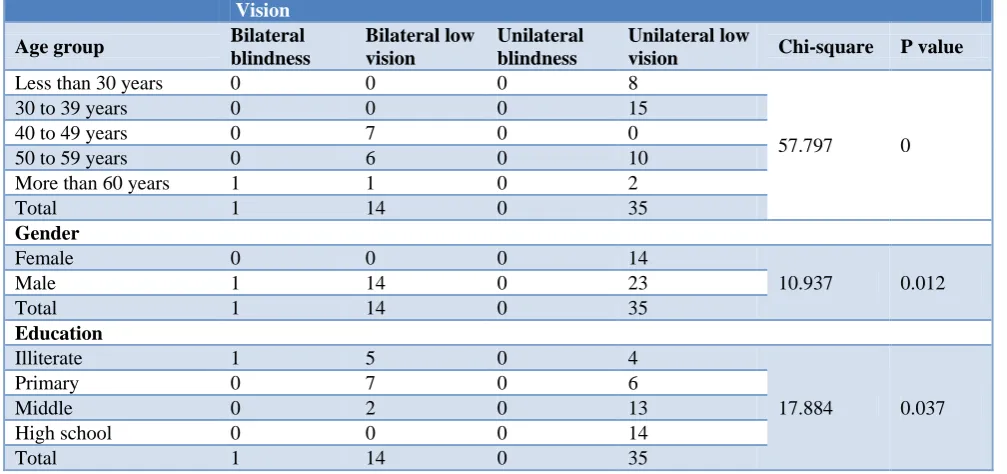
Table 3: Association of vision with various parameters (n=35). Vision
Age group Bilateral blindness
Bilateral low vision
Unilateral blindness
Unilateral low
vision Chi-square P value
Less than 30 years 0 0 0 8
57.797 0
30 to 39 years 0 0 0 15
40 to 49 years 0 7 0 0
50 to 59 years 0 6 0 10
More than 60 years 1 1 0 2
Total 1 14 0 35
Gender
Female 0 0 0 14
10.937 0.012
Male 1 14 0 23
Total 1 14 0 35
Education
Illiterate 1 5 0 4
17.884 0.037
Primary 0 7 0 6
Middle 0 2 0 13
High school 0 0 0 14
Total 1 14 0 35
DISCUSSION
The present study dealt with the prevalence of diabetes and its associated risk factors for diabetic retinopathy in a peri urban population in Bhopal. The prevalence of diabetes was found to be 5.95% which is comparable to the recent studies, but significantly higher than the studies conducted in early 2000s.12-17 Data on the rising trend of diabetes in present study were based on the comparison of data accumulated from different parts of the country at different times applying not one single technique/system but different methods.16 The prevalence of diabetes documented in this study was moderately a little higher than the prevalence found in rural China (5.6%), but was more aligned to prevalence in rural part of our country (6.3%) except that prevalence was lower to the occurrence of diabetes in rural population in Turkey (7.2%) and Pakistan (11.1%).18-21 The direct comparisons of prevalence rates are challenging owing to different methodologies applied and varied characteristics of the population. Therefore, it is difficult to make a scientific conclusion of the rising trend of diabetes. To compare secular trends, it would be more accurate to document prevalence of diabetes within the same region applying identical methodology.
diabetes occurred at a lower BMI threshold (<23 kg/m2) in Asian Indians.25 Conversely, in other studies higher BMI (>25.0 kg/m2) was found as an important predictor for occurrence of type 2 diabetes.16,13,14 A study in India found the prevalence of diabetes among urban and rural population was high even though the rates of obesity were low.26 It was noticed that the risk of diabetes was augmented by central adiposity along with lower BMI threshold in Asian Indians.25
In the present study, central obesity was observed even among people with normal BMI in the population. Therefore, the transition in lifestyle occurring in the peri-urban population seemed to produce rapid adverse changes like obesity favoring risk of developing diabetes. Our study also revealed strong evidence to suggest, that the development and progression of retinopathy is influenced and associated with glycosylated hemoglobin (HbA1c) level as well with BMI. In line with our study, in other studies too, a positive association had been publicized between BMI, HbA1C and retinopathy that included diabetic patients.
In the present study prevalence of retinopathy was 28% (95% CI 11.2-32.0) among the diabetic patients wherein unilateral low vision was 16% in the age group less than 30 years; however it was 30% in the age group 30 to 39 years. Bilateral low vision had 14% prevalence in age group 40 to 49 years and 12% in 50 to 59 years. In all age groups prevalence of bilateral blindness, bilateral low vision, unilateral blindness and unilateral low vision were respectively 2%, 28%, 0%, 70%. Prevalence of unilateral low vision and bilateral low vision amongst male were 46% and 28% respectively. Having found higher prevalence of diabetes in our population, it was indicative that the prevalence of retinopathy was increased in patients with increasing deciles of glycemic level.
Limitations
1. We were unable to screen the remaining 790 participants for diabetes, nor were able to enquire about history of diabetes in their family members especially parents.
2. We were unable to conduct other recommended investigations i.e. Urine routine and microscopy, Lipid profile, Renal and Liver Function Test and Hip Waist Ratio which would have given us better and precise finding and results in association with diabetic retinopathy.
CONCLUSION
The present study confirms that prevalence of diabetes in peri-urban area is correlated with presence of Diabetic retinopathy which essentially requires more effective screening and treatment. In our study we have also highlighted variations and association susceptibility of known diabetic patients to branded risk factors of diabetes complications. Like other studies, done in other
regions in India and in other countries, the prevalence of diabetes points out affiliation with obesity, urbanization, BMI, changes in dietary habits and sedentary lifestyle as well as HbA1C levels, therefore leading to increased burden of diabetic retinopathy.
Funding: No funding sources Conflict of interest: None declared
Ethical approval: The study was approved by the Institutional Ethics Committee
REFERENCES
1. Foulds WS, McCuısh A, Barie T, Green F, Scobie IN, Ghafour IM, et al. Diabetic retinopathy in the west of Scotland: its detection and prevalence, and the cost-effectiveness of a proposed screening programme. Health Bull (Edinb). 1983;41:318-26. 2. Blankenship GW, Skyler JS. Diabetic retinopathy; a
general survey. Diabetes Care. 1978;1:127-37. 3. Foster A, Johnson GJ. Magnitude and causes of
blindness in the developing world. Int Ophthalmol. 1990;14:135-40.
4. Klein R, Klein BEK. Vision disorders in diabetes. In: Hamman R, Harris MWH, eds. Diabetes in America, U.S. Public Health Service NIH Pub. No. 85-1468. Bethesda, MD: National Institutes of Health; 1983: 1-36.
5. Sjöleie AK. Eye diseases. In: Williams DRR, Papoz L, Fuller JH, eds. Diabetes in Europe. London: John Libbey; 1994: 61-71.
6. Shaw JE, Sicree RA, Zimmet PZ. Global estimates of the prevalence of diabetes for 2010 and 2030. Diabetes Res Clin Pract. 2010;87:4–14.
7. Zhang P, Zhang X, Brown J, Vistisen D, Sicree R, Shaw J, et al. Global healthcare expenditure on diabetes for 2010 and 2030. Diabetes Res Clin Pract. 2010;87:293–301.
8. Klein BE, Klein R, Wang Q, Moss SE. Older-onset diabetes and lens opacities: the Beaver Dam Eye Study. Ophthalmic Epidemiol. 1995;2:49–55.
9. Klein BE, Klein R, Jensen SC. Open-angle
glaucoma and older-onset diabetes: the Beaver Dam Eye Study. Ophthalmology. 1994;101:1173–7. 10. Pasquale LR, Kang JH, Manson JE, Willett WC,
Rosner BA. Prospective study of type 2 diabetes mellitus and risk of primary open-angle glaucoma in women. Ophthalmology. 2006;113:1081–6.
11. Klein R, Lee KE, Knudtson MD, Gangnon RE, Klein BE. Changes in visual impairment prevalence by period of diagnosis of diabetes: the Wisconsin Epidemiologic Study of Diabetic Retinopathy. Ophthalmology. 2009;116:1937–42.
12. Sayeed MA, Mahtab H, Khanam PA, Latif ZA, Ali
SMK, Banu A. Diabetes and impaired fasting glycemia in a rural population of Bangladesh. Diabetes Care. 2003;26:1034-9.
population of Bangladesh. Diabetes Res Clin Pract. 1997;34:149-55.
14. Sayeed MA, Khan AR, Banu A, Hussain MZ. Prevalence of diabetes and hypertension in a rural
population of Bangladesh. Diabetes Care.
1995;18:555-8.
15. Hussain A, Vaaler S, Sayeed MA, Mahtab H, Ali SMK, et al. Type 2 diabetesand impaired fasting blood glucose in rural Bangladesh: a population-based study. Eur J Public Health. 2006;17:291–6. 16. Rahim MA, Hussain A, Khan AKA, Sayeed MA,
Ali SMK, Vaaler S. Rising prevalence of type 2 diabetes in rural Bangladesh: A population based study. Diabetes Res Clin Pract. 2006;77(2):300-5. 17. Hussain A, Rahim MA, Khan AKA, Ali SMK,
Vaaler S. Type 2 diabetes in rural and urban population: diverse prevalence and associated risk factors in Bangladesh. Diabetic Med. 2005;22:931-6.
18. Dong Y, Gao W, Nan H, Yu H, Li F, Duan W, et al. Prevalence of type 2 diabetes in urban and rural Chinese population in Qingdao, China. Diab Med 2005;22:1427-33.
19. Ramachandran A, Snehalatha C, Basker ADS, Mary S, Kumar CKS, Selvam S, et al. Temporal changes in prevalence of diabetes and impaired glucose tolerance associated with lifestyle transition occurring in the rural population in India. Diabetologia. 2004;47:860–5.
20. Satman I, Yilmaz T, Sengul A, Salman S, Salman F, Uygur S, et al., Population-based study of diabetes and risk characteristics in Turkey: results of the Turkish Diabetes Epidemiology Study (TURDEP). Diabetes Care. 2002;25:1515–56.
21. Shera AS, Rafique G, Khwaja IA, Baqai S, Khan IA, King H, et al. Pakistan National Diabetes Survey prevalence of glucose intolerance and associated factors in North West at Frontier Province (NWFP) of Pakistan. J Pak Med Assoc. 1999;49:206–11.
22. Ramaiya KL, Kodali VRR, Alberti KGMM.
Epidemiology of diabetes in Asians of the Indian subcontinent. Diabet Metab. 1990;6:125–46. 23. Ramachandran A, Snehalatha C, Dharmaraj D,
Viswanathan M. Prevalence of glucose intolerance in Asian Indians: urban-rural difference and significance of upper body adiposity. Diabetes Care. 1992;15:1348–55.
24. Cheah JS, Thai AC. Epidemiology of non-insulin dependent diabetes mellitus (NIDDM) in ASEAN. Proceedings of the 7th Congress of the ASEAN Federation of Endocrine Societies, 1993;6:1-58. 25. Snehalatha C, Vijay V, Ramachandran A. Cut off
values for normal anthropometric variables in Asian Indian adults. Diabetes Care. 2003;26:1380–4. 26. Ramachandran A, Snehalatha C, Shyamala P,
Vishanathan V, Vishanathan M. High prevalence of NIDDM and IGT in an elderly south Indian population with low rates of obesity. Diabetes Care. 1994;17:1190-2.
Cite this article as: Gupta SK, Sharma A, Agarwal S, Gupta S, Sarouthia S.The prevalence of