www.ijahss.com
My tomato sauce is better than yours: a culinary trial
Manuela Simoni
1, Gianna Fantuzzi
2, Eric Adriano Zizzi
3, Daria Vellani
4and
Daniele Santi
11Department of Biomedical, Metabolic and Neural Sciences, University of Modena and Reggio Emilia, Modena,
Italy
2Azienda Agricola “Dante Malverti”, Modena, Italy
3Department of Mechanical and Aerospace Engineering, Politecnico di Torino, Torino, Italy
4Istituto Superiore di Scienze dell'Educazione e della Formazione “G. Toniolo”, Modena, Italy
Abstract :
Laypeople and public are often convinced that their theory is true independently of facts and objective evidence. Theories can be approached by stringent scientific criteria. Here we present an example, taken from domestic, Italian, experience and proposed in a narrative, entertaining style, of how such believes can be approached scientifically. The topic of this trial concerns the belief, common among Italian housewives, that one’s own, homemade tomato sauce is better than any other. We test the hypothesis that the tomato sauce handcrafted by one of the authors was conferring a better taste to the “ragù” (otherwise known as “Bolognese sauce”) used for tagliatelle noodles, compared to a purchased tomato sauce made from the same tomatoes but differently crafted. We carried out a prospective, randomized, single-blind, cross over, culinary study. Over a Sunday noon lunch, fifteen volunteers were randomized to eat tagliatelle dressed with ragù prepared with either homemade (group 0) or purchased (group 1) tomato sauce in a domestic setting. After washout, volunteers were crossed over to receive the other preparation. After each phase of the trial participants expressed a vote from 1 (awful) to 10 (luscious). Results showed no statistically significant difference between the two preparations (comparison between continuous variables by Mann-Whitney test). In spite of this, the author of the homemade tomato sauce remained convinced of the superiority of her product. The study shows that: 1) purchased tomato sauce is not necessarily inferior to homemade sauce; 2) common culinary stereotypes can be tackled with a rigorous, controlled, randomized study design; and 3) despite statistical evidence, laypeople retain their original belief. This essay can be useful to didactically explain the scientific approach to any problem in everyday life.Keywords:
tomato, tagliatelle, ragù, clinical trialRole of the authors in the study:
MS designed the study, cooked for the participants and wrote the paper
GF home made one of the two tomato sauces and the tagliatelle
DV assisted MS in serving the dishes in single-blind fashion
EAZ wrote and edited the paper
DS performed randomization, statistical analysis and wrote the paper
I.
Introduction
drug companies, enjoy the benefits and prescribe whatever, with or without evidence. Patients are relieved by the prescribed medicine and, remarkably, sometimes even cured.
This is not any different from what common people experience in their dietary choices when everyday life faces them with troublesome decisions like what products to buy and what to cook: aggressive adverts in the media and special offers condition the choice of the buyers and boost the prosperity of producers, retailers and banks, while the unsophisticated consumer is fully convinced of having made the best choice, making everyone happy.
While drug companies and doctors are variably involved in well controlled clinical studies, consumers never are. We here present the first prospective, single-blind, controlled experiment evaluating, in a domestic setting, dining companions’ preferences when the same dish, i.e. “tagliatelle al ragù” is prepared using two different tomato sauces handcrafted from the same tomatoes by two different housewives.
II.
Materials and Methods
Rationale
One of the investigators (GF) once burst in on the principal investigator (PI: MS) on an otherwise undisturbed winter day, brandishing a bottle of home-made tomato sauce and shouting: “You have to try this. It’s not as good as mine. You will most certainly agree with me”. GF is trained to buy tomatoes in bulk every year in July from a neighbor bio-agriculture farm and handcraft tomato sauce for own use. Being in shortage of sauce and fearing to run out before the upcoming spring, she purchased bottled tomato sauce from the same tomato provider to elude the dangerously imminent sauce draught, in the hope that, being made from the same tomatoes, it would have the same taste/quality. Disappointed by the tasting, GF searched support for her sentiment by the PI. Being a palpably serious scientist, the PI refused to test this hypothesis in an uncontrolled setting and designed, promoted and performed the study described herein.
Aim of the study
To demonstrate that the tomato sauce handcrafted by GF was conferring a better taste to the “ragù” (otherwise known as “Bolognese sauce”) used for tagliatelle, compared to the purchased tomato sauce.
Study design
Prospective, randomized, single-blind, cross over, culinary study.
Primary end point: tastiness score in a subjective, arbitrary, not validated scale from 1 (awful) to 10 (luscious).
Secondary end points: merriment of the eaters, loudness of the event.
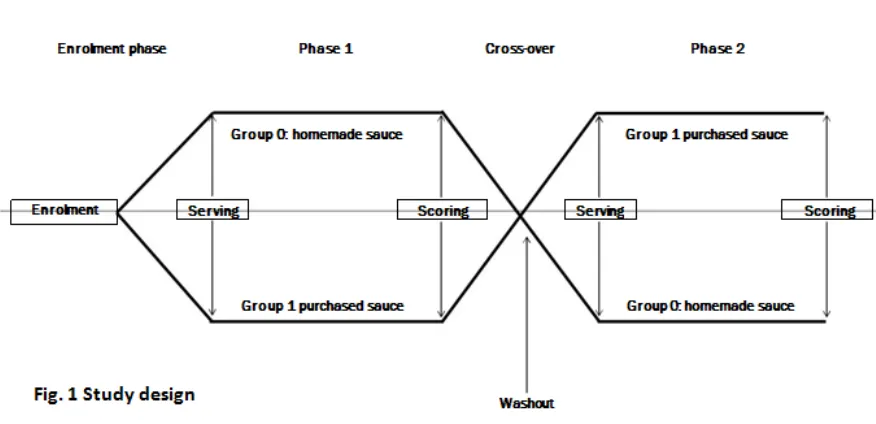
The study design is shown in Fig 1. Participants were randomized to first eat one of the two preparations, express their vote, wash-out their mouth with a selection of seasonal raw vegetables, and were crossed over to the second preparation, expressing their second vote thereafter.
Participants
Fifteen volunteers participated to the study. They were meticulously selected among relatives and friends usually attending festivity dinners at PI’s home. Subjects were eligible if they were available for the trial on the Sunday noon chosen by the PI according to her busy calendar. An additional volunteer (DV) is vegetarian and was excluded from the study. She helped the PI in preparing and serving the dishes according to the randomization list, ensuring blindness. All participants were fully informed about the aim of the trial and enthusiastically adhered without signing any written consent. Although the competent Ethics Committee was not consulted, the study is reasonably compliant with the Helsinki declaration.
Materials and procedures
The dish selected for the trial was “tagliatelle al ragù”. The two batches of tomato sauce were provided by GF. For the entire duration of the study the PI was the only person aware of the identity of the two sauces, designated as “0” (home made by GF) and “1” (purchased).
3A). After seasoning with basil and adjusting with iodinated salt, the two ragù were cooked slowly for 3 hours (Fig. 3B).
Tagliatelle were hand made by one of the investigators (GF) by mixing thoroughly a 1:1 mixture of type “0” white flour and semolina (De Cecco, Fara S. Martino, Italy) with full chicken eggs from the own yard (the hens contributed equally to this work). The dough was drawn with a rolling pin, let dry shortly at room temperature and cut into stripes (tagliatelle) with a cutting machine (Atlas 150 Cromo Marcato, Campodarsego, Italy). Tagliatelle were air dried for 24 hours at a roughly constant temperature and humidity (Fig. 4).
Tagliatelle were boiled in water, drained, split and mixed with either one of the two ragù and served to the participants according to the randomization list. Grated Parmesan cheese was individually added by each tablemate at libitum. After expressing the vote and the wash-out phase, each volunteer was crossed over, received the second dish and expressed again a vote. Data were collected for statistical analysis.
Statistics
The randomization list was generated by permuted block with a 1:1 ratio, using the ‘Statistical Package for the Social Sciences’ software for Macintosh (version 21.0; SPSS Inc., Chicago, IL). The distribution of the score was evaluated by Kolmogorov-Smirnov test. According to the non-normal distribution of variables, the difference between group O and 1 was performed by U Mann-Whitney test.
Power analysis and sample size were calculated using G*Power (Version 3.1.9.2 © Franz Faul, Edgar Erdfelder, Albert-Georg Lang, and Axel Buchner, 2006, 2009).
III.
Results
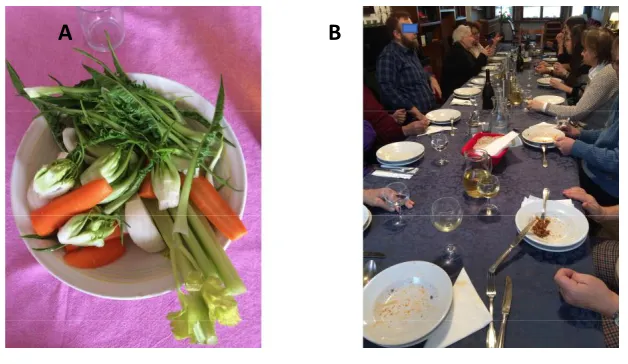
All participants completed the study industriously (no drop out). After the first course, a brief wash out phase was accomplished by serving raw vegetables (Fig. 5A). Compliance, as assessed by evaluating the cleanliness of the plates at the end of each course, was 100% (Fig. 5B).
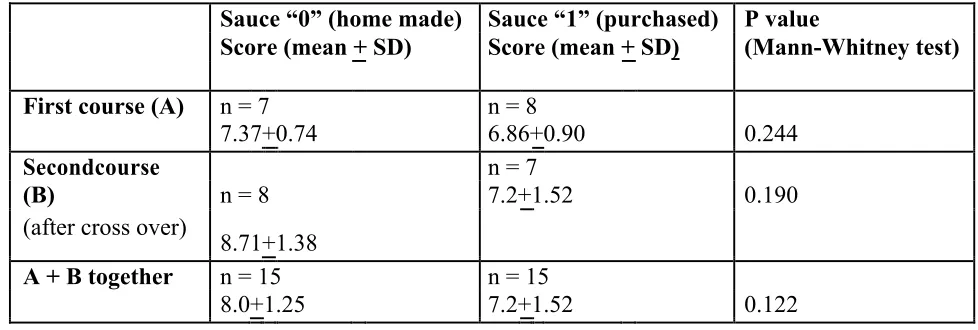
The statistical analysis of the scores attributed at the end of each course revealed no differences between the two sauces (Table 1), analyzed either individually or together, although sauce “0” (homemade) had slightly higher values. This was enough to make GF gleeful and fully convinced that her tomato sauce was indeed better than the one purchased, regardless of statistics. Indeed, the analysis suggests she may very well be right, since this trial has a statistical power of 77%. Therefore, while superiority of sauce “0” could not be demonstrated, non-inferiority of sauce “1” could be assumed with a statistical power of 77%. A post hoc power analysis revealed that, in order to prove/exclude a statistically significant difference between the two sauces with a power of 95%, a group size of 35 fellow diners would be necessary.
Irrespective thereof, at the end of the day, everybody was happy and proud of their contribution to this valuable experiment. A toast to the cook concluded the trial.
No serious adverse events, such as indigestion, soreness or complaints from the neighbors about the noise from the loud company, were recorded.
IV.
Discussion
To the best of our knowledge, this is the first prospective, randomized, single blind culinary trial scientifically assessing the assumption, common among Italian housewives, that one’s own, homemade products are superior to those purchased or prepared by others. Here we show that 1) the assumption is, most probably, not true and 2) in spite of this, the aforementioned housewife remained assured of the superiority of her tomato sauce. For the vast majority of Italians, few activities are more rewarding than dining together with friends and relatives on Sundays, especially for those whose contribution does not involve cooking, but is limited to consuming. On such occasions, hot commotion may occur among the participants, who express different opinions about common topics of debate such as soccer, politics, finance, weather, children’s education, health/disease and, most recently, earthquakes, floods and other natural calamities, generally in this order of priority. Such amenities occasionally culminate in quarrels, which are, however, wisely extinguished by the next, tempting serving.
Good food, therefore, is a very effective means of calming down animosities, albeit not devoid of long-term side effects resulting in chronic degenerative diseases, such as diabetes, hypertension, obesity and metabolic syndrome. It may even have post-mortem consequences, leading to eternal damnation for gluttony in hell, where souls are lashed by never ending, heavy rain (2). Disputes about the goodness/tastiness of food are, therefore, potentially very dangerous and require a careful and objective approach. Here, we tried to tackle the problem of whether the tomato sauce handmade by GF was indeed better than that purchased, albeit being made out from the same starting raw material, i.e. the same tomatoes cultivated in the same fields. The obvious difference between the two products lies in the manufacturing process, which is completely known and controlled in the case of GF’ sauce (data on file), but unknown/uncontrolled in the case of purchased sauce.
is but an idiosyncrasy, albeit a profitable one for everyone involved. Moreover, our result suggests that even scientific evidence may not be sufficient to convince ordinary people. This phenomenon, well known in medicine (3), extends to all fields of everyday life, including politics (4) and religion, e.g. all what cannot be explained is either miracle or a matter of faith, like the cult of Virgin Mary) (5), just to mention a few.
This study has some strengths and some weaknesses. The strength of this trial is that it is the first to assess with a scientific approach, i.e. a prospective, randomized, single blind, cross-over design, a common, everyday-life belief (“my tomato sauce is better than yours”) taken as an example of several, endless, ongoing discussions on blogs, social networking platforms and inside pubs. Here we demonstrate that such questions can easily be addressed objectively and statistically. Other stereotypes which could benefit from a similar approach are, for instance, assumptions such as “Englishmen tend to form queues spontaneously”, “Italians eat only pizza and pasta”, “Germans have no sense of humor”, etc…
The weakness of this study is the limited sample size which was, however, sufficient to suggests at least non-inferiority. A larger trial, with 35 participants per arm, would be necessary to dispel any residual doubts about the equivalence of the two tested products in terms of tastiness. This, however, is hardly manageable in a domestic context and would probably require sponsoring by an industry, thereby introducing a bias, which is not present in this investigator-started trial.
In conclusion, the superiority of the homemade tomato sauce of GF could not be demonstrated by this prospective, randomized, single blind, culinary trial. In spite of this, given the slight numerical superiority of the score obtained, GF remained firmly convinced that her tomato sauce was indeed better than the purchased product. These results suggest that, while a scientific approach can be applied to a real life culinary question, this method, even if corroborated by statistic evidence, may not be sufficient to convince laypeople. Alternative conviction methods should be identified to eradicate common beliefs and stereotypes.
References
[1.] Fuorigiro. 2016. Available from: http://www.mercatoalbinelli.it. [2.] Alighieri D. La Divina Commedia. Inferno1304.
[3.] Passalacqua R, Campione F, Caminiti C, Salvagni S, Barilli A, Bella M, et al. Patients' opinions, feelings, and attitudes after a campaign to promote the Di Bella therapy. Lancet. 1999 Apr 17;353(9161):1310-4. PubMed PMID: 10218529. Epub 1999/04/28. eng.
[4.] Zoso G. Referendum, ecco perchè Renzi vince anche se perde 2016. Available from:
http://www.vvox.it/2016/11/18/referendum-ecco-perche-renzi-vince-anche-se-perde/.
[5.] Wikipedia. 2016. Available from:
https://en.wikipedia.org/wiki/Veneration_of_Mary_in_the_Catholic_Church.
Table 1: Scores attributed by the participants randomized to be served ragù prepared with either tomato sauce “0” or “1” (first course), after cross over (second course) and analyzed together.
Sauce “0” (home made) Sauce “1” (purchased) P value
Score (mean + SD)
Score (mean + SD)
(Mann-Whitney test)
First course (A)
n = 7
n = 8
7.37+0.74
6.86+0.90
0.244
Secondcourse
n = 8
n = 7
(B)
7.2+1.52
0.190
(after cross over)
8.71+1.38
A + B together
n = 15
n = 15
Fig 2: A: The raw vegetables used for soffritto. B: The minced raw vegetables
Fig. 3: Binary coding of the two tomato sauces; 0: homemade, 1: purchased.
A
B
Fig. 4: The dried, homemade tagliatelle, just before cooking.
Fig. 5: A: the raw vegetables eaten by the participants for washout between the two phases of the trial. B: The empty dishes showing compliance.