Original Research Article
Breast cancer: knowledge, attitude and practices among undergraduate
female students at a government college in Koppal, Karnataka
Smita M. Nimbannavar, Vijaykumar P. Mane*
INTRODUCTION
Cancer is one of the major cause of death both in developed and developing countries. The morbidity and mortality associated with cancer has increased in the last few decades with occurrence of 18.1 million new cases and 9.6 million deaths especially in developing countries.1
As per recent estimates, number of people living with cancer in India was 2.25 million and the number of cancer related deaths were around 0.7 million. Among women, breast cancer is one of the most common cancer
and accounts for 14% of all cancers in them. Recently, breast cancer has surpassed cervical cancer and now is the leading cause of cancer deaths in India.2,3
A total of 1,62,468 new cases of breast cancer were registered in the year 2018 and the number of deaths reported were 87,090 and it is estimated that by the year 2020, the number is likely to increase to 1.7 million. Incidence rates begin to rise in the early thirties and peak at 50-64 years among Indian women. The probability of development of breast cancer is one in every 28 women with one in every 22 woman and one in every 60 women in urban and rural areas respectively. Breast cancer
ABSTRACT
Background: Breast cancer is the second most common malignancy in general and most common cancer among women in both the developed and developing countries. Its incidence is on the raise due to increased life expectancy of people, increased urbanization and adoption of unhealthy lifestyles. An awareness of brest cancer and its presentation is essential among women for detection at an early stage and timely treatment for better prognosis. The objective of the study was to assess knowledge, attitudes and practices towards breast cancer among female students in the study setting.
Methods: A descriptive study was conducted for duration of 3 months from July 2018 to September 2018 among female students at a degree college in Koppal city, Karnataka. A total of 396 students were included and data was collected using a pre tested and semi structured questionnaire after taking an informed consent. Data thus obtained was entered and analyzed using Microsoft Office Excel 2013.
Results: More than 80% of study participants had heard about breast cancer in the present study but their knowledge on its various aspects was limited. More than half were positive in their attitude believing that they are not at risk of breast cancer and were willing to practice breast self-examination (BSE) in future but only 5.28% of them admitted to have done BSE in the past. Most common source of information about disease was school in the present study. Conclusions: The present study demonstrated KAP gap among graduate female students which needs to be tackled through proper educational interventions.
Keywords: Attitude, Breast cancer, Knowledge, Practices
Department of Community Medicine, Koppal Institute of Medical sciences, Koppal, Karnataka, India
Received: 11 April 2019 Accepted: 17 May 2019
*Correspondence: Dr. Vijaykumar P. Mane,
E-mail: [email protected]
Copyright: © the author(s), publisher and licensee Medip Academy. This is an open-access article distributed under the terms of the Creative Commons Attribution Non-Commercial License, which permits unrestricted non-commercial use, distribution, and reproduction in any medium, provided the original work is properly cited.
burden was found to be 41 per 1,00,000 women in Delhi,
followed by Chennai, Bangalore and
Thiruvanathapuram.2-4
The increased incidence of breast cancer in urban areas can be attributed to lifestyle changes such as bearing a child late in life, lack of breastfeeding, hormonal therapy, sedentary lifestyle, obesity, little or no awareness on early signs of disease and screening methods.5-7 We cannot completely eliminate the occurrence of breast cancer by lifestyle modification but we can improve the prognosis / outcome by timely detection and adequate treatment. For the breast cancer to be detected at an early stage, women must be aware of the various signs and symptoms of disease as well as about breast self-examination. With this background, the present study was done to assess knowledge, attitude and practices (KAP) of female students towards breast cancer at a degree college in Koppal city, Karnataka.
Objective of the study
To estimate the level of knowledge, attitudes and practices towards breast cancer among undergraduate female students in the study setting.
METHODS
A cross-sectional study was conducted for duration of 3 months from July-September 2018 among female students at a Governement degree college in Koppal city, Karnataka. Prior permission for the study was obtained from concerned authorities. Minimum sample size calculated was 256 with an absolute precision of 5% and significance level of 0.05, taking 80% prevalence of awareness on breast cancer as per recent estimates.8 Only female students were segregated separately and explained about the purpose of the study. Data were collected using a pretested and semi structured questionnaire after taking an informed consent. The study was conducted anonymously and students absent on the day of data collection were excluded. In the present study, knowledge, attitude and practices were defined as the
responses given by study participants to the administered questionnaire. Data thus obtained were entered and analyzed using Microsoft Office Excel version 2013.
RESULTS
A total of 396 female students participated in the present study and their mean age was 19.02±0.84 years. Majority i.e. 384 (96.9%) were unmarried, majority i.e. 361 (91.1%) belonged to Hindu religion and majority i.e. 270 (68.1%) of study participants were residing in rural locality.
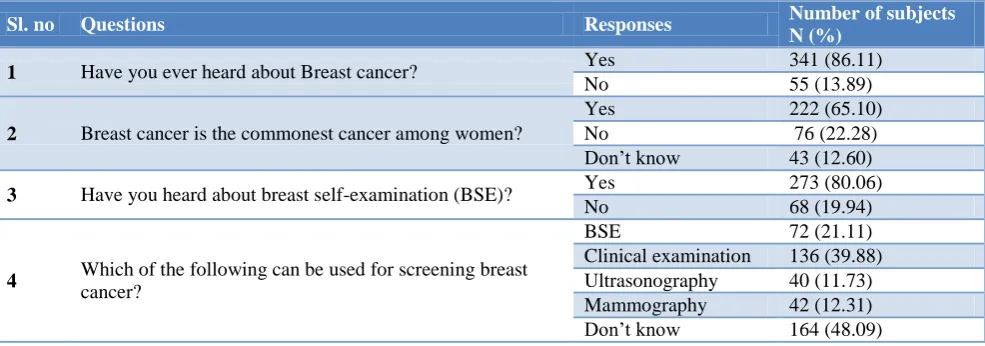
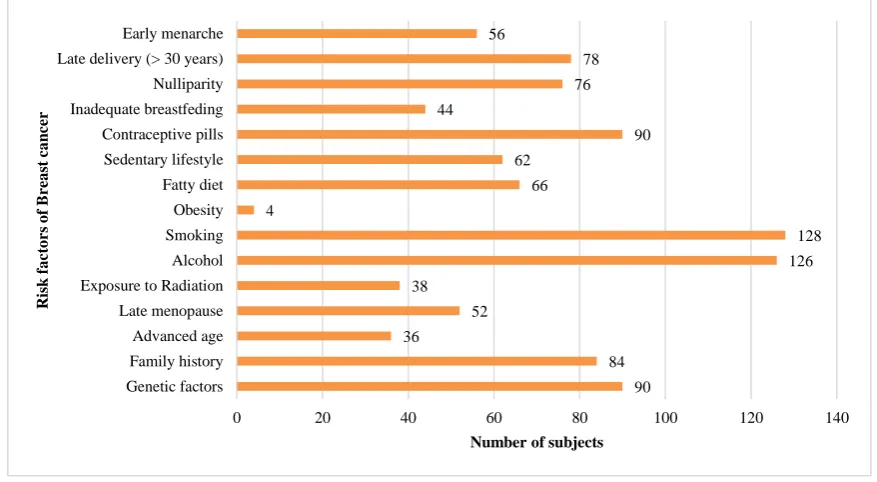
Table 1 and Figure 1-3 demonstrate distribution of study subjects according their knowledge on various aspects of breast cancer. As seen in the table, majority i.e. 341 (86.11%) of the study subjects have agreed to have heard about Breast cancer and among them, majority i.e. 222 (65.10%) know that Breast cancer is the most common cancer among women and majority i.e. 273 (80.06) have also heard about Breast self-examination. When enquired about risk factors, more than one third of the women who were aware about the disease, believed that smoking and alcohol consumption were the major risk factors for breast cancer followed by use of contraceptive pills, genetic factors as well as family history of disease by 90 (26.39%), 90 (26.39%) and 84 (24.63%) women respectively as evident from Figure 1. Similarly when asked about signs and symptoms among women who accepted to have heard about disease, nearly two third i.e. 224 (65.68%) of them knew that mass/lump in the breast could be a symptom of disease followed by pain in the breast and change in size/shape/color of breast by 210 (61.58%) and 132 (38.70%) of women respectively as seen in Figure 2. Women who had agreed to have heard about disease, had satisfactory knowledge on protective factors for breast cancer with majority i.e. 210 (61.58%) quoting regular exercise followed by 142 (41.64%) quoting diet rich in fiber as shown in Figure 3. Further, 70% of them believed that early detection improves their chances of survival and another 218 (63.92%) believed that breast cancer is curable.
Table 1: Distribution of study subjects according to their knowledge on breast cancer.
Sl. no Questions Responses Number of subjects
N (%)
1 Have you ever heard about Breast cancer? Yes 341 (86.11)
No 55 (13.89)
2 Breast cancer is the commonest cancer among women?
Yes 222 (65.10)
No 76 (22.28)
Don’t know 43 (12.60)
3 Have you heard about breast self-examination (BSE)? Yes 273 (80.06)
No 68 (19.94)
4 Which of the following can be used for screening breast cancer?
BSE 72 (21.11)
Clinical examination 136 (39.88) Ultrasonography 40 (11.73)
Mammography 42 (12.31)
Don’t know 164 (48.09)
Sl. no Questions Responses Number of subjects N (%)
5 Do you think early detection of breast cancer improves chances of survival?
Yes 239 (70.08)
No 14 (4.10)
Don’t know 88 (25.80)
6 Do you think Breast cancer is curable?
Yes 218 (63.92)
No 19 (5.57)
Don’t know 104 (30.49)
7 Which of the following is/are treatment modalities for breast cancer?
Surgery 146 (42.81)
Chemotherapy 62 (18.18)
Radiotherapy 38 (11.14)
Don’t know 186 (54.54)
Note: Responses for questions from 2–7 are only from study subjects who accepted to have heard about breast cancer.
Figure 1: Distribution of study subjects according to their knowledge on risk factors for breast cancer (n=341).
Note: Number of study subjects may exceed sample size as multiple options were allowed.
Figure 2: Distribution of study subjects according to their knowledge on signs and symptoms of breast cancer (n=341).
Note: Number of study subjects may exceed sample size as multiple options were allowed. 90 84 36
52 38
126 128 4
66 62
90 44
76 78 56
0 20 40 60 80 100 120 140
Genetic factors Family history Advanced age Late menopause Exposure to Radiation Alcohol Smoking Obesity Fatty diet Sedentary lifestyle Contraceptive pills Inadequate breastfeding Nulliparity Late delivery (> 30 years) Early menarche
Number of subjects
R
isk
f
a
ct
o
rs
o
f
B
re
a
st
c
a
n
ce
r
224
210
132
54
20
6
64
30 32
0 50 100 150 200 250
N
u
m
b
er
o
f
su
b
je
ct
s
Figure 3: Distribution of study subjects according to their knowledge on protective factors for breast cancer (n=341).
Note: Number of study subjects may exceed sample size as multiple options were allowed.
Table 2: Distribution of study subjects according to their attitude and practices on breast cancer (n=341).
Sl. No Questions Responses Number of subjects N (%)
Attitude
1 Do you think you are at risk of developing breast cancer?
Yes 0 (0)
No 197 (57.77)
Don’t know 144 (42.23)
2 Will you perform BSE regularly in the future for its early detection?
Yes 232 (68.03)
No 109 (31.97)
3 Whom will you prefer to consult if you develop any of the breast cancer symptoms?
Allopathy 44 (12.90)
Homeopathy 123 (36.07)
Traditional 109 (31.96)
Others 65 (19.05)
Practices
4 Have you ever done breast self-examination? Yes 18 (5.28)
No 323 (94.72)
Figure 4: Distribution of study subjects according to their source of information about breast cancer (n=341).
Note: Number of study subjects may exceed sample size as multiple options were allowed. 0
50 100 150 200 250
Regular Mammography Diet poor in fat Diet rich in fibre Regular Exercise
46 30
142
210
N
u
m
b
er
o
f
su
b
je
ct
s
Protective factors for Breast cancer
116
94
70
174
106
52
108
48 48
28
0 20 40 60 80 100 120 140 160 180 200
N
u
m
b
er
o
f
su
b
je
ct
s
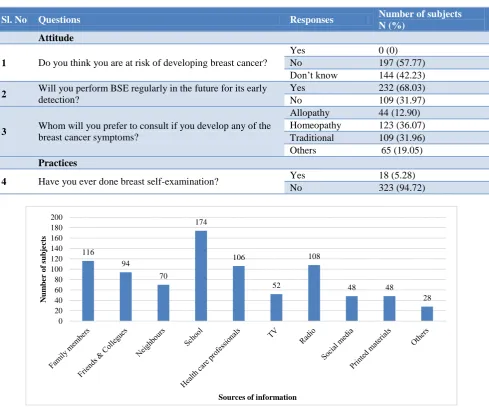
Table 2 shows distribution of study participants according to their attitude and practices towards breast cancer. In the present study, no study participant believed that they are at risk of developing breast cancer and in fact more than half i.e. 197 (57.77%) assumed that they are not at risk. Despite this, majority i.e. 232 (68.03) still wanted to practice Breast self-examination in future for early detection but very few i.e. 44 (12.90) would prefer to consult allopathic system of medicine in case if they develop any symptoms of breast cancer. Only 18 (5.28) of women in the present study admitted to have done breast self-examination.
Figure 4reveals distribution of study subjects according to various sources of information on breast cancer and it was found that the most common source of information as mentioned by more than half of study subjects was school, followed by family members, radio and health care professionals mentioned by 116 (34.01%), 108 (31.67%) and 106 (31.08%) of women respectively.
DISCUSSION
The present study was an attempt to assess knowledge, attitude and practices among female students studying various graduate courses at a Government college in Koppal city and a total of 396 female students participated in the study after excluding absentees. Majority i.e. 341 (86.11%) of the students in the present study accepted to be aware about breast cancer similar to the findings of many other studies 8,10,12-14 done both within and outside India and was higher than a couple of studies.9,11 Four out of every five in the present study had heard about BSE in confirmation with the findings of few studies and was far better than many other studies done in the past.8-14 This difference in awareness levels both about Breast cancer and BSE could be due to differences in study periods, study settings, sampling techniques, profile of study subjects, tools of data collection etc.
On enquiring about risk factors for Breast cancer, majority of the females in the present study quoted smoking and alcohol consumption as confirmed by other studies.10,14-16 On the contrary, majority of the study participants in few other studies done in different parts of the country have quoted family history of breast cancer as the major risk factor.17-20 When asked about symptoms, majority mentioned any mass/lump in the breast followed by pain in line with the findings of many other studies.8,11,14,15,20 Regular exercise was considered as one of the major protective factor against the occurrence of breast cancer by more than 60% of study participants in the present study in confirmation to the findings of other studies.10,12,18
More than half of the participants in present study believed that they are not at risk and remaining were unaware but none positively believed that they are at risk of developing breast cancer. But still, majority i.e. 232 (68.03) of study subjects were admitted to have will to
practice BSE regularly in future for early detection of breast cancer, demonstrating a positive attitude. Only 18 (5.28) however have agreed to have done BSE in the past similar to the findings of two more studies done in India exhibiting a KAP gap for breast cancer.8,11 A number of other studies have found out a high proportion of participants practicing BSE on contrary to the findings of present study.10,13-16,18
CONCLUSION
The present study concludes that the level of knowledge among female graduate students about breast cancer was poor and identifies several areas where educational interventions are necessary. Even though majority had positive attitude both towards disease and practice of BSE only few practiced it which needs to be tackled through BCC. The introduction of the subject in the curriculum could address some of these deficiencies. Television and other mass media can also be used to disseminate information.
ACKNOWLEDGEMENTS
Authors acknowledge Principal and faculty at Government Degree College for granting permission and for coopearting to conduct study at their institute. Authors also acknowledge students for their enthusiastic participation in the study.
Funding: No funding sources Conflict of interest: None declared
Ethical approval: The study was approved by the Institutional Ethics Committee
REFERENCES
1. Cancer. Available at: https://www.who.int/cancer/ en/ Accessed on 12th March 2019.
2. Globocon 2018: India factsheet. Available at: http://cancerindia.org.in/globocan-2018-india-factsheet/. Accessed on 12th March 2019.
3. The Changing Face of Breast cancer in India. Available at: http://www.scind.org/1099/Health/the-changing-face-of-breast-cancer-in-india.html. Accessed on 12th March 2019.
4. Malvia S, Bagadi SA, Dubey US, Saxena S. Epidemilogy of breast cancer in Indian women. Asia Pac J ClinOncol 2017;13:289-95.
5. World Cancer Report 2008. Available at: http://publications.iarc.fr/Non-Series-Publications/ World-Cancer-Reports/World-Cancer-Report-2008 Accessed on 12th March 2019.
7. Daniei G, Hoorn SV, Lopez AD, Murray CJ, Ezzati M, Comparative Risk Assessment collaborating group (Cancers). Causes of cancers in the world: Comparative risk assessment of nine behavioral and
environmental risk factors. Lancet.
2005;366(9499):1784-93.
8. Sehrawat JS, Garima, Mor S. Knowledge, beliefs and practices about breast cancer and its self-examination procedure among urban and rural women of district Gurdaspur, Punjab, India: a cross sectional study. Int J Community Med Public Health. 2017;4:120-8.
9. Gangane N, Nawi N, Sebastian MS. Women’s Knowledge, Attitudes and Practices about Breast Cancer in a Rural district of Central India. Asian Pac J Cancer Prev. 2015;16:6863-70.
10. Makanjuola OJ, Amoo PO, Ajibade BL, Makinde OY. Breast Cancer: Knowledge And Practice Of Breast Self Examination Among Women In Rural Community Of Ondo State, Nigeria. IOSR J Pharm BiolSci. 2013;8(1):32-37.
11. Siddharth R, Gupta D, Narang R, Singh P. Knowledge, attitude and practice about breast cancer and breast self-examination among women seeking out-patient care in a teaching hospital in central India. Indian J Cancer. 2016;53:226-9. 12. Ahuja S, Chakrabarti N. To Determine The Level
Of Knowledge Regarding Breast Cancer And To Increase Awareness About Breast Cancer Screening Practices Among A Group Of Women In A Tertiary Care Hospital In Mumbai, India. Int J Public Health 2009;1(1):1-19.
13. Legesse B, Gedif T. Knowledge on breast cancer and its prevention among women household heads in Northern Ethiopia. Open J Prevent Med. 2014;4:32-40.
14. Priyanka S, Meenal S, Rajeev Y, Vandana S, Madhusudan S. Cross sectional study of knowledge
attitude & practice (KAP) regarding breast carcinoma in women of 21 to 65 years of age in a medical college hospital, Jaipur, Rajasthan, India. J Pharm Biomed Sci. 2013;35(35):1747-51.
15. Alharbi NA, Alshammari MS, Almutairi BM, Makboul G, El-Shazly MK. Knowledge, awareness, and practices concerning breast cancer among Kuwaiti female school teachers. Alexandria J Med. 2012;48:75-82.
16. Singh R, Turuk A. A study to assess the knowledge regarding breast cancer and practices of breast self-examination among women in urban area. Int J Community Med Public Health. 2017;4:4341-47. 17. Santhanakrishnan N, Prabakaran S, Singh Z.
Knowledge, attitude, and practice regarding breast cancer and its screening methods among nursing staff working in a tertiary-care hospital located in South India. Int J Med Sci Public Health 2016;5:1650-5.
18. Khalid A, Hassnain S, Gakhar H, Khalid B, Zulfiqar F, Wahaj A. Breast cancer among young girls: a KAP study conducted in Lahore. Int J Sci Rep. 2018;4(6):166-71.
19. Madhu B, Shankar P. Awareness and screening behaviors of breast cancer among urban women in Mysuru, India- need for breast health education program. Int J Community Med Public Health. 2017;4:2967-72.
20. Azubuike SO, Celestina UO. Breast cancer: The perspective of Northern Nigerian women. Int J Prev Med. 2015;6:130.