Original Research Article
A study of work-related stress among nurses in
a tertiary care hospital in Goa
Shefalee Pai Vernekar, Hemangini Shah*
INTRODUCTION
Health is a combination of biological, psychological (thoughts, emotions, and behavior), and social (socio-economical, socio-environmental, and cultural) factors.1 A healthy working environment is not only absence of harmful conditions but also an abundance of health promoting ones. There is a need for continuous assessment of risks to health, training on health issues and availability of health promoting organizational support structures.2
According to the International Labor Organization, stress is the harmful physical and emotional response caused by an imbalance between the perceived demands and the perceived resources and abilities of individuals to cope with those demands. Work-related stress is determined by work organization, work design and labor relations and occurs when the demands of the job do not match or exceed the capabilities, resources, or needs of the worker, or when the knowledge or abilities of an individual worker or group to cope are not matched with the expectations of the organizational culture of an enterprise.
ABSTRACT
Background: Nursing is, by its very nature, a stressful occupation. The role of nursing is associated with multiple and conflicting demands imposed by nurse supervisors and managers, and by medical and administrative staff. Such a situation appears to lead to work overload and possible to role conflict. This seriously impairs the provision of quality care and the efficacy of health services delivery. The objectives of the study were to determine the levels of work-related stress in nurses; to identify various sources of stress among nurses; to develop suitable recommendations based on the findings of the study.
Methods: A cross-sectional study was conducted among registered nurses working in wards of a tertiary care
hospital, Goa wherein Expanded Nursing Stress Scale was used to assess level and sources of stress among them. Results: 59.3% of nurses experienced moderate. 36.8% severe, 2.4% experienced very severe stress. Highest mean score was in the area of death and dying subscale (2.350.61) and workload subscale (2.110.53). Nurses working in casualty and general wards were more stressed. Also, younger nurses were more stressed in dealing with death of a patient.
Conclusions: Death of a patient and excessive workload were major contributors of stress. Stress reduction activities
and measures to decrease workload will help in decreasing the stress at workplace.
Keywords: Stress, Nursing, Work-related
Department ofPreventive and Social Medicine, Goa Medical College, Goa, India
Received: 30 November 2017
Revised: 05 January 2018
Accepted: 06 January 2018
*Correspondence: Dr. Hemangini Shah,
E-mail: [email protected]
Copyright: © the author(s), publisher and licensee Medip Academy. This is an open-access article distributed under
the terms of the Creative Commons Attribution Non-Commercial License, which permits unrestricted non-commercial use, distribution, and reproduction in any medium, provided the original work is properly cited.
Work-related stress may lead to emotional disturbances, behavioral problems, biochemical and neuro-hormonal changes, presenting added risks of mental or physical illness. On the contrary, when working conditions and human factors are in balance, work creates a feeling of mastery and self-confidence; increases motivation, working capacity and satisfaction; and improves health.
In the prevention of chronic non-communicable diseases evidence based research has stimulated health policymakers to look for the influences not only on individual behaviors and lifestyles but also on social economic and health inequalities and working conditions, and in particular work demands; examples of their work being the job strain model, and the effort-reward imbalance model. These studies have shown the long-term benefits of even small amounts of autonomy in the execution of tasks to the mental health and productivity of workers.1
It is now almost universally recognized that nursing is, by its very nature, a stressful occupation. The role of nursing is associated with multiple and conflicting demands imposed by nurse supervisors and managers, and by medical and administrative staff. Such a situation appears to lead to work overload and possible to role conflict. the experience of work-related stress generally detracts from the quality of nurses’ working lives, increases minor psychiatric morbidity, and may contribute to some forms of physical illness, with particular reference to musculoskeletal problems, stress and depression.3
In India, some of the issues related to nurse retention still remain to be tackled –excessive work load in both the government and private sectors, lack of a conducive work environment and infrastructure facilities.4 A study conducted to assess the job stress in Karnataka, India, revealed that 60% experienced low stress, 38% moderates stress, and 2% severe stress.5
It has been proven time and again that effective solutions exist for the prevention of psychosocial risks and work-related stress. This will in turn result in reduced absenteeism, better health, improved efficiency and productivity, and lower medical and other benefit costs.6
Hence, this study was done with the following objectives:
To determine the levels of work-related stress in nurses.
To identify various sources of stress among nurses.
To develop suitable recommendations based on the findings of the study.
METHODS
This cross-sectional study was conducted at a 1000 bedded tertiary care hospital.
Study place
Tertiary care hospital, Bambolim, Goa.
Study duration
October, 2016 – December, 2016.
Registered nurses working in various wards of the hospital participated in the study. Those newly appointed or working on a temporary basis, and those on leave or not available at the time of study were excluded. Nurses working in the outpatient departments and in operation theatres were also excluded.
Sample size
Sample size was calculated considering prevalence (p) of 38.4%, at 95% confidence interval (z) and sample error (d) of 10% using the following formula.5 N = (z2 pq)/d2
Stratified random sampling was used to obtain the required sample size as shown in figure 1.
Study tool
Data collection was done as follows:
Self designed/ Self administered structured anonymous questionnaire pertaining to socio-demographic details, work related information and medical history.
Expanded Nursing Stress Scale ( ENSS ) 7,8,9, a self report questionnaire consisting of 59 items with 9 subscales was used to assess stress. Each item required participants to rate on a five-point likert scale ranging from “1- never stressful ” to “ 4 – extremely stressful ”, and “ 0 – does not apply ”. Total score and subscale score was derived from the instrument.
Permissions
Permission from concerned administrative authorities. Also, permission to use the study tool (ENSS) was obtained from the original author Susan E. French, McMaster University Canada.
Consent for the study was taken from each nurse prior to questionnaire administration. The subjects were assured of the confidentiality of the information provided.
It was ensured that all questionnaires were completely filled by the nurses and the filled questionnaires were collected.
Data analysis
was used to summarize the frequencies, means and standard deviations of each variable. Chi square test and odds ratio was calculated for association between stress and certain variables.
RESULTS
In our study 37% of the nurses were above than 40 years of age. Majority of them were females, with males comprising of only 8%. Majority of the nurses (67%) were married and about 24% had 3 or more children.67% of the nurses resided in joint families, whereas only 41% had help to do household chores. Out of 253 participants, 72 nurses (28.4%) were suffering from some form of chronic medical illness. Majority of them suffered from diabetes and hypertension.
57.3% nurses had to travel a distance of more than 30 kilometers to their workplace and majority of them (66.4%) used public transport for travelling. 113 out of 253 (44.7%) had experience of less than 10 years in nursing profession and 32% had experience of less than one year in the currently posted ward.
Stress
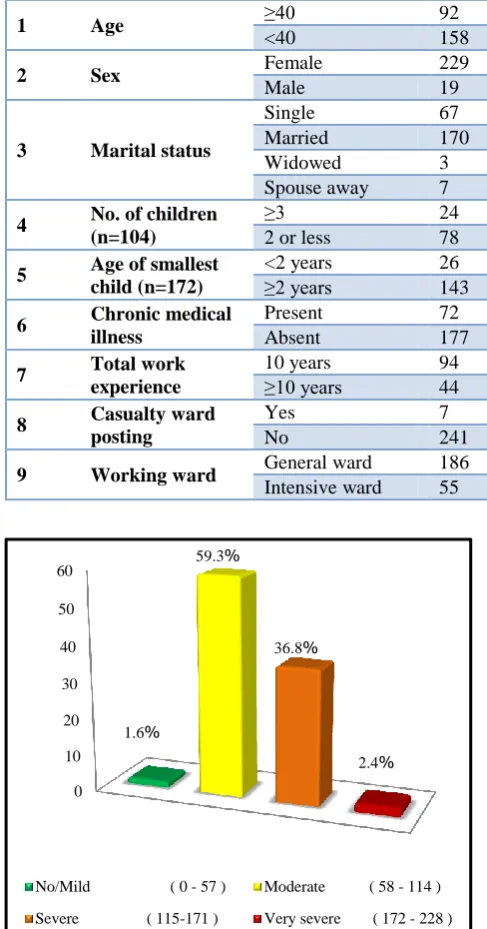
Out of 253 nurses, 4 (1.6%) had mild level of stress, 150 had moderate stress (59.3%), 93 (36.8%) reported severe
stress and 6 (2.4%) had very severe stress (Figure 2). The mean scores of the 9 subscales were also calculated. The mean score was highest in the area of death and dying followed by workload and least in the area of discrimination (Table 1). The association of stress with certain variables was also assessed (Table 2). Even though older nurses (more than 40 years of age) were found to be at higher risk of developing stress (OR=1.16), when it was dealing with death or a dying patient, those less than 40 years were at a higher risk of stress (OR=1.399).
Table 1: Mean scores of subscales.
Subscale Mean score
Standard deviation
Death and dying 2.35 0.611
Workload 2.11 0.53
Patients and their families 2.06 0.71
Problems with supervisors 2.02 0.81
Inadequate preparation 1.79 0.75
Uncertainty concerning
treatment 1.78 0.69
Conflict with physician 1.77 0.72
Problems with peers 1.56 0.67
Discrimination 0.6 0.84
Figure 1: Stratified random sampling and derivation of sample size. Of the 675 total nurses employed,
OT 63 OPD
33
Ward 579
563 16 (<1 year) excluded
OBG 68(12%)
Intensive care 127 (22.5%) Casualty
15(2.5%) Surgery
192(34%) Pediatrics
33 (6%) Medicine
128 (23%)
Table 2: Association of stress with certain variables.
Sr.No Variable (n=253) Stress Statistical test
Present Absent Chi square P value Odds ratio (OR)
1 Age ≥40 92 1 0.02 0.9 1.16[0.10, 13.02]
<40 158 2 Ref
2 Sex Female 229 4 1.02 0.3 3.01[0.32, 28.32]
Male 19 1 Ref
3 Marital status
Single 67 2
13.56 0.04
Ref
Married 170 2 2.54 [0.35,18.38]
Widowed 3 1 0.09 [0.01,1.29]
Spouse away 7 1 0.21 [0.02,2.61]
4 No. of children
(n=104)
≥3 24 1
4.11 0.04 0.10 [0.02,5.11]
2 or less 78 1 Ref
5 Age of smallest
child (n=172)
<2 years 26 1
0.72 0.39 0.36 [0.03,4.16]
≥2 years 143 2 Ref
6 Chronic medical
illness
Present 72 1
0.03 0.86 1.22 [0.12,11.93]
Absent 177 3 Ref
7 Total work
experience
10 years 94 1
0.15 0.69 1.61 [0.14,18.03]
≥10 years 44 2 Ref
8 Casualty ward
posting
Yes 7 1
4.75 0.02 0.12 [0.01, 1.18]
No 241 4 Ref
9 Working ward General ward 186 2 1.63 0.20 3.38[0.47,24.57]
Intensive ward 55 2 ref
Figure 2: Levels of stress.
DISCUSSION
According to this study, 98.4% of the nurses experienced moderate to very severe stress, whereas a study conducted by Bhatia et al, concluded that the prevalence of occupational stress amongst nurses was 87.4%.10
In the present study, the major stressors that the nurses experienced were situations relating to death and dying patients and excessive workload. These findings are similar to a study done in hospitals of Udupi and Mangalore districts.5 Nurses have to work with the sick
patients every day and witnessing suffering of the patient daily and sometimes death of the patient they cared for causes stress among them.
In our study, highest mean scores were among death and dying items (2.35) and excessive workload. These results were in accordance with Ahmed et al and Chang et al in a study among Palestinian and Australian nurses respectively.11,12 Similarly, excessive workload, especially at a government hospital contributes significantly to stress among health care professionals particularly nurses. A study by Mosadeghrad among Iranian nurses also revealed excessive workload and time pressure as one of the major factors leading to stress in terms of mean scores of occupational stress among them.13
In this study, nurses more than 40 years of age and females were found to be at a higher risk of developing work related stress. Similarly, a study among nurses in Sri Lanka revealed that high stress levels were significantly associated with 40-49 year age group.14 However, in a study conducted at Delhi, there was no significant association found between occupational stress and selected demographic variable namely age and sex.15 Also, those suffering from chronic medical illnesses were at a greater risk. The association of stress with marital status and number of children was found to be significant. Posting in the casualty department was found to be significantly associated with stress (p<0.05). In casualty at a tertiary care hospital, there is a high load of patients and nurses have performed tasks under emergency situations. In a study at a tertiary care hospital, in Meerut, 0
10 20 30 40 50 60
1.6%
59.3%
36.8%
2.4%
it was found that staff nurses posted in medicine, surgery, pediatrics, and obstetrics/gynecology department were less stressed as compared with those posted in the emergency/ICU department.16 However, in our study nurses working in general wards were found to be more stressed compared to those working in intensive care wards (OR=3.38). This is probably due to excessive workload in the general wards.
In this study, it was also found that the risk of stress due to death of a patient in a nurse less than 40 years of age was 1.4 times more than those above 40 years of age (OR=1.399).
CONCLUSION
Nurses experience a considerable amount of stress at workplace due to various causes which has an impact on their work performance. Out of all, death of a patient and the excessive workload are major contributors of stress. Emotional preparation of nurses in dealing with patients is required. Stress reduction activities such as yoga and meditation should be practiced. Being a tertiary care government hospital, the patient load is unavoidable. However, measures to decrease the workload by increasing the staff, reducing non nursing activities and proper planning of duty schedules are required. Focus should be laid on coping strategies of nurses. Younger nurses are at a greater risk of developing stress, especially in dealing with the death of a patient. Hence, it is recommended that duties should be allocated such that there is a senior nurse to mentor and support a younger nurse to deal with such stressful situations.
Funding: No funding sources Conflict of interest: None declared
Ethical approval: The study was approved by the Institutional Ethics Committee
REFERENCES
1. ILO. Workplace stress – A collective challenge. Available at: http://www.ilo.org/wcmsp5/groups/ public/---ed_protect/---protrav/---safework/
documents/publication/wcms_466547.pdf. Accessed on 20 November 2017.
2. WHO. Stress at workplace. Available at: http://www.who.int/occupational_health/topics/stres satwp/en/. Accessed on 20 November 2017.
3. ILO. Work-related stress in nursing. Available at: http://www.ilo.org/wcmsp5/groups/public/---ed_protect/---protrav/---safework/documents/ publication/wcms_118244.pdf. Accessed on 20 November 2017.
4. WHO. Wanted: 2.4 million nurses, and that’s just in India. Available at: www.who.int/bulletin/volumes/ 88/5/10-020510/en/. Accessed on 20 November 2017.
5. Jose T, Bhat SM. A descriptive study on stress and coping of nurses working in selected hospitals of Udupi and Mangalore districts Karnataka. IOSR J Nurs Heal Sci. 2013;3(1):10–8.
6. ILO. Psychosocial risks and work¬related stress. Available at: http://www.ilo.org/safework/areasof work/workplace¬health¬promotion¬and¬well-being/WCMS_108557/langen/index.htm. Accessed on 30 September 2016.
7. French SE, Lenton R, Walters V, Eyles J. An empirical evaluation of an expanded Nursing Stress Scale. J Nursing Measurement. 2000;8(2):161-78. 8. Damit AR. Queensland University of Technology
School of Nursing Centre for Health Research Identifying Sources of Stress and Level of Job within the First Three Years of Work as a Registered Nurse in Brunei Darussalam . Queensland University of Technology School of Nursing; 2007. Available from:eprints.qut.edu.au/ 16608/1/Abd_Rahim_Damit_Thesis.pdf. Accessed on 30 September 2016.
9. Onasoga OA, Ogbebor SO, Ojo AA. Occupational stress management among nurses in selected hospital in Benin city, Edo state, Nigeria. Eur J Exp Biol. 2013;3(1):473–81.
10. Bhatia N, Kishore J, Anand T, Jiloha RC. Occupational stress among nurses from two tertiary care hospitals in Delhi. AMJ. 2010;3(11):731-3 11. Ayed A, Eqtait F, Fashafsheh I, Basheer M, Aqel
M, Nassar D, et al. Exploring the Work Related Stress Sources and Its Effect among the Palestinian Nurses at the Governmental Hospitals. J Educ Pract. 2014;5(21):100–10.
12. Chang EM, Daly J, Hancock KM, Bidewell JW, Johnson A, Lambert VA, et al. The relationships among workplace stressors, coping methods, demographic characteristics, and health in Australian nurses. J Professional Nursing. 2006,22(1):30-8.
13. Mosadeghrad AM. Occupational Stress and Turnover Intention: Implications for Nursing Management. Int J Health Policy Manag 2013;1:169 ‑76.
14. Muraleeswaran R, Akilendran K. An Assessment of level of work – Related Stress Among Nursing Officers at District General Hospital Vavuniya In Sri Lanka. Int J Sci Res Publ. 2016;6(3):177–80. 15. Mohite N, Shinde M, Gulavani A. Occupational
Stress among Nurses Working At Selected Tertiary Care Hospitals. Int J Sci Res. 2014;3(6):999–1005. 16. Sharma P, Davey A, Davey S, Shukla A,
Shrivastava K, Bansal R. Occupational stress among staff nurses: Controlling the risk to health. Indian J Occup Environ Med. 2014;18(2):52–6.
Cite this article as: Vernekar SP, Shah H. A study of