http://www.ijcmph.com pISSN 2394-6032 | eISSN 2394-6040
Original Research Article
Availing entitlements under Janani Shishu Suraksha Karyakram in
Tamil Nadu: a reality
Vinoth Gnana Chellaiyan
1*, Christina S. C. Christopher
1, Shailaja Daral
2INTRODUCTION
Globally, on any given day, a staggering 830 women die from pregnancy and childbearing related causes. World Health Organization (WHO) estimates that of the overall maternal mortality burden, a staggering 99% is contributed by developing nations.1 India, over the past 20 years has seen a gradual decline in maternal mortality ratio (MMR) and the figure stood at 174 maternal deaths per 100,000 live births in 2015.2 IMR in the year 2015
was 32 deaths per 1000 live births worldwide and in India it was 38 per 1000 live births.3,4 This decline is expected to take India to the target MMR of 100 deaths per 100,000 live births and IMR of 28 per 1000 live births as envisaged by the National Health Policy of India 2017.5.
In order to decrease the MMR and IMR, and improve maternal and child health the Ministry of Health and Family Welfare, Government of India, implemented a scheme called Janani Shishu Suraksha Karyakaram (JSSK) in June 2011. The scheme entitles mothers and
ABSTRACT
Background: Janani Shishu Suraksha Karyakram (JSSK) was launched in India to improve maternal and child
healthcare, and to alleviate out of pocket expenditure on healthcare. The objective wasto analyze the awareness and utilization of the JSSK entitlements among residents in Kancheepuram district of Tamil Nadu.
Methods: This cross sectional study was conducted in Thriuporur block, which was selected randomly from 13
blocks of Kancheepuram district. Two primary health care centers - Ezhichur and Thiruporur of Thriuporur block, were selected based on population proportion to size. A total of 80 mothers who had recently delivered a live child were selected randomly from these two PHCS. The data was collected through house to house visits by trained interviewers using a pretested, validated, structured questionnaire.
Results: Mean age of the participants was 24.58 (±3.32) years. Around fifty two participants were aware about the
scheme. Better awareness was seen with higher literacy and higher socioeconomic status (p=-0.043, 0,032). Cashless deliveries (100%) and free drugs (100%) were availed by all participants and among the neonates, free diagnostics (100%) and blood transfusions (100%) were availed by all. Transportation services to and from health institutions were utilized by 1.2% of the participants. Majority of the participants (98%) spent on conveyance to and from hospital.
Conclusions: Though the study revealed good awareness of the scheme among the participants, it showed insight into
the existing gaps in utilization of these services. Further effort is required in providing additional information on JSSK and its services within institutions and at the community level.
Keywords: Pregnant women, Neonates, Beneficiaries of JSSK
Department of Community Medicine, 1Chettinad Hospital and Research Institute, Kelambakkam, Chennai, Tamil Nadu, 2VMMC and Safdarjung Hospital, New Delhi, India
Received: 06 January 2018
Accepted: 03 February 2018
*Correspondence:
Dr. Vinoth Gnana Chellaiyan, E-mail: [email protected]
Copyright: © the author(s), publisher and licensee Medip Academy. This is an open-access article distributed under
the terms of the Creative Commons Attribution Non-Commercial License, which permits unrestricted non-commercial use, distribution, and reproduction in any medium, provided the original work is properly cited.
sick infants to avail free and cashless treatment including deliveries, caesarian- sections, medications etc. in government institutions in both urban and rural areas. The main objectives of the scheme are to reduce MMR and IMR, bring about 100% institutional deliveries and reduce OOP expenditure on healthcare.6
According to the National Family Health Survey NFHS-4 conducted in 2015-2016, the average out of pocket expenditure (OOPE) on delivery in a public health facility in India was INR 3,198 and in one of its southern states, Tamil Nadu it was around INR 2,476.7 This is a quite a financial burden for an average Indian family to bear.
In Tamil Nadu, the percentage of institutional deliveries in public facilities has increased from 48% in 2005 - 06 to 66.7% in 2015-16.7 The boost in numbers could be attributed to many contributing factors, one including the introduction and utilization of the JSSK scheme. A study conducted on the utilization of JSSK scheme in Haryana found that there was a 2.7 times increase in the number of institutional deliveries post introduction of JSSK scheme.8 There are however, no such similar studies to illustrate the utilization of the scheme in Tamil Nadu and determine the awareness of JSSK among beneficiaries. Thus, the purpose of this study is to determine the awareness and utilization of the JSSK scheme in public institutions in Tamil Nadu.
Objectives
The objectives of the study were to evaluate the awareness and utilization of the JSSK and its services among residents in Kancheepuram district, Tamil Nadu.
METHODS Study design
The study was a cross sectional conducted in villages in Kancheepuram district of Tamil Nadu State. The study was conducted from June 2016- August 2016.
Study population
The study population comprised of mothers who recently delivered a live birth child. Inclusion criteria were mothers who delivered within past 1 year of study period and who availed services under public health facilities during antenatal and postnatal period. Mothers who availed ante natal & post natal services from private facilities and those cannot be approached even after 3 home visits were excluded.
Sampling
According to population census of India 2011, there were 13 blocks/ municipalities in Kancheepuram district of Tamil Nadu state. Among the 13 blocks, Thiruporur
block was selected by simple random sampling using lottery method.
Based on the total number of pregnant women registered in the previous year, two primary health centres (PHCs)- Ezhichur and Thiruporur were selected on the basis of population proportion to size. These two PHCs cater health services to 50 villages in their territory. Total population catered by Ezhichur and Thiruporur are 1,373 and 13,666 respectively.9,10
Sample size
List of registered pregnant women who delivered with in previous one year were obtained from the selected PHCs. There were around 182 registered pregnant women who delivered within past one year. Among these 168 live births, 92 deliveries were conducted in public health facility and 76 in private health facility. The present study included a total of 80 mothers who fulfilled the inclusion criteria (Figure 1).
Data collection procedure
Data collection was done by house visits. After explaining about study intention, written informed consent was obtained. Data was collected using a pretested, validated, structured questionnaire in local vernacular language. Three trained investigators were involved in data collection process.
Study tool
The study tool comprised of details including baseline characteristics of study participants, details of antenatal and post natal period, awareness about maternal and neonatal services under JSSK, services availed through JSSK and expenditure incurred towards conveyances, drugs, consumables, lab investigations and indirect costs.
Outcome variables
The outcome variables were awareness about maternal and neonatal services provided under JSSK utilizing these services and expenditure occurred while availing these services. Those who were aware of any two services among entitlements for pregnant women and neonates provided under JSSK were considered to be aware of the scheme.
Statistical analysis
Significance of difference in proportions was determined using Chi square test. A p value of <0.05 was considered to be significant.
Ethical consideration and confidentiality
Ethical permission was obtained from ethics committee of Tagore Medical College & Hospital, Chennai, Tamil Nadu. Written consent was obtained from study participants who were willing to participate in the study. Confidentiality of study participants was maintained in all the phases of the study.
RESULTS
Socio demographic profile
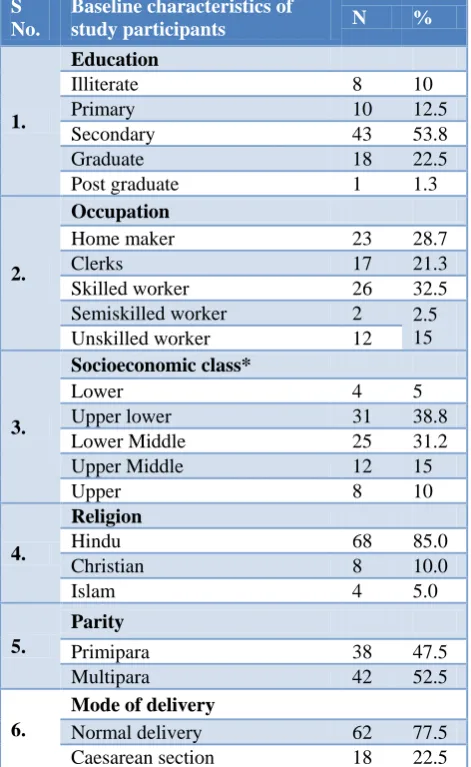
A total of 80 study participants were included in the study. The mean (SD) age of the mothers was 24.58 (±3.32) years. Eight (10%) study participants were illiterates and 23 (28.7%) were homemakers (Table 1).
Table 1: Profile of the study participants (n=80).
S No.
Baseline characteristics of
study participants N %
1.
Education
Illiterate 8 10
Primary 10 12.5
Secondary 43 53.8
Graduate 18 22.5
Post graduate 1 1.3
2.
Occupation
Home maker 23 28.7
Clerks 17 21.3
Skilled worker 26 32.5
Semiskilled worker 2 2.5
15
Unskilled worker 12
3.
Socioeconomic class*
Lower 4 5
Upper lower 31 38.8
Lower Middle 25 31.2
Upper Middle 12 15
Upper 8 10
4.
Religion
Hindu 68 85.0
Christian 8 10.0
Islam 4 5.0
5.
Parity
Primipara 38 47.5
Multipara 42 52.5
6.
Mode of delivery
Normal delivery 62 77.5
Caesarean section 18 22.5
*Modified BG Prasad scale classification- revised in 2016
Awareness about JSSK entitlements
Among the study participants, forty two (52.5%) reported of having had heard of JSSK program services. None of the participants were aware about free drop back services from institutions to home after 48 hours. Only few were aware about the free referral services and exemption from user charges (Table 2).
Table 2: Awareness about entitlements under JSSK. (n=80).
S.No Awareness about JSSK
entitlements N %
1
Entitlements for pregnant women*
Free and cashless delivery 36 45
Free C-Section 21 26.2
Free drugs and consumables 34 42.5
Free diagnostics 12 15
Free diet during stay in the
health institutions 23 28.7
Free provision of blood 11 13.7
Exemption from user charges 4 5
Free transport from home to
health institutions 34 42.5
Free transport between facilities
in case of referral 9 11.2
Free drop back from Institutions
to home after 48hrs stay 0 0
2
Entitlements for newborn*
Free treatment 38 47.5
Free drugs and consumables 36 45
Free diagnostics 34 42.5
Free provision of blood 24 30
Exemption from user charges 3 3.7
Free Transport from Home to
Health Institutions 21 26.2
Free Transport between facilities
in case of referral 21 26.2
Free drop Back from Institutions
to home 1 1.2
* Multiple response.
Higher educational status and higher socioeconomic class was found to be associated with awareness of JSSK services. (P value-0.043, 0,032) Multipara women were found to be much more aware about JSSK services than primipara (p=0.047) (Table 3).
Entitlements utilization
Table 3: Association between awareness about JSSK and other parameters.
S. No. Variables
Aware N=32 N (%)
Unaware N=48 N (%)
P value
1.
Education
0.043
Illiterate 0 8 (16.7)
Primary 3 (9.4) 7 (14.6)
Secondary 16 (50) 27 (56.2)
Graduate 12 (37.5) 6 (13.5)
Post graduate 1 (3.1) 0
2.
Socioeconomic class
0.192
Lower 1 (3.2) 3 (6.2)
Upper lower 8 (25) 23 (47.9)
Lower Middle 10 (31.2) 15 (31.3)
Upper Middle 8 (25) 4 (8.4)
Upper 5 (15.6) 3 (6.2)
3.
Religion
0.213
Hindu 28 (87.5) 40 (83.4)
Christian 3 (9.4) 5 (10.4)
Muslim 1 (3.1) 3 (6.2)
4.
Parity
0.047
Primipara 4 (12.5) 34 (71)
Multipara 28 (87.5) 14 (29)
* Chi square test applied, p<0.05 is significant.
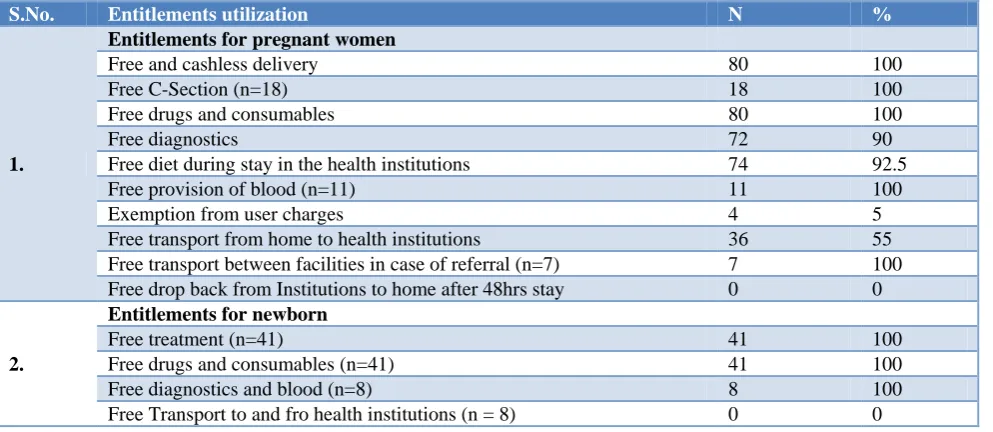
Table 4: Entitlements utilization among the study participants (n=80).
S.No. Entitlements utilization N %
1.
Entitlements for pregnant women
Free and cashless delivery 80 100
Free C-Section (n=18) 18 100
Free drugs and consumables 80 100
Free diagnostics 72 90
Free diet during stay in the health institutions 74 92.5
Free provision of blood (n=11) 11 100
Exemption from user charges 4 5
Free transport from home to health institutions 36 55
Free transport between facilities in case of referral (n=7) 7 100
Free drop back from Institutions to home after 48hrs stay 0 0
2.
Entitlements for newborn
Free treatment (n=41) 41 100
Free drugs and consumables (n=41) 41 100
Free diagnostics and blood (n=8) 8 100
Free Transport to and fro health institutions (n = 8) 0 0
Expenditure incurred towards healthcare
Analysis of out of pocket expenditures (OOPE) for maternal services revealed that study participants were experiencing OOPE on conveyance, both home to hospital and vice versa, diagnostics and drugs, food and indirect costs. With conveyance charges from home to hospital, 41.3% (n=33) of the participants incurred charges ranging from 1 to >2000 rs, and 58.8% (n=47) incurring no out of pocket expenditures. Conveyance
from hospital to home, highlighted that 98.8% (n=79) of the participants experienced OOPE ranging from 1 to more than 2000 rs.
In terms of diagnostics and drugs, food and indirect costs 2.8% (n=2), 12.5% (n=10) and 17.5% (n=14) of the participants suffered OOPE respectively.
from 1 to 2000rs on conveyance from home to hospital and vice versa.
DISCUSSION
JSSK scheme was introduced to provide free, cashless deliveries, diagnostics and treatments for mothers and infants. Our study showed that the JSSK scheme, in general, was well known among the community in Tamil Nadu (52.5%), as compared to other states such as West Bengal (31.25%) and Maharashtra (47.2%); where lower awareness levels were reported, however as per awareness criteria of our study, the awareness about JSSK in our study was 40%.11,12 Awareness levels were found to be higher among mothers who were multipara and who had higher educational status. This could be attributed to previous experience and literacy. JSSK, having completed five years since the inception of program, the awareness level could have been better.
In regards to maternal and infants benefits, majority of the respondents were aware of the main services of the scheme such as cashless deliveries (45%), free drugs and consumables for mothers and newborns (42.5% and 45% respectively), free transport from home to institutions for mothers and children (42.5%, 26.2% respectively), and free treatment for newborns (47.5%). The services that respondents were less aware of are free diagnostics (15%), free provision of blood (13.7%) and exemption from user charges (5%) among maternal benefits. Awareness about free diagnostics and drugs varied among studies with a report from West Bengal having an awareness level of 18.7% and 10.4% respectively(11). Among entitlements for newborns, exemption from user charges (3.7%) and free drop back services to home (1.2%) were the services less known. These findings are significantly better when compared to other studies, such as the one conducted in West Bengal, where only 18.75% of the women were informed about free normal deliveries and none were aware of free caesarian sections.
Most significant finding was poor response in awareness and usage of transportation services. This service was never availed by any family members when they had come for confinement or for treatment of their newborns. In comparison, other studies also reflected poor awareness. However, our current study had the lowest level of awareness and utilization of transportation back home. In Maharashtra only 9.9% were aware of free transport back home, and in West Bengal 35.4%.9,12 Additionally, another study conducted to specifically assess the awareness and usage of transportation services under JSSK in Maharashtra, it was reported that only 18% were aware of such a service provided, and amongst the 18% majority were unable to avail the service when needed.13
In terms of utilization of the services provided for pregnant women, all services such as free deliveries, free caesarian sections, free blood, free drugs and
consumables, and free transport between facilities in case of referrals (100%) were entirely used by the respondents. The infrequently used services were free transport from home to institution (55%) and exemption from user charges (5%). Utilization of services catered for infants was also used to the fullest, except for transportation services back home.
This poor utilization also reflected negatively on out of pocket expenditure on transportation from institution to home, with expenditures ranging from 1000 to 2000 INR. In a study conducted in New Delhi it was found that the majority of expenditure incurred among JSSK users was due to diagnostics and medications whilst expenditure on transport was the least, Given that one of the major objectives of the scheme was to reduce OOP expenditure on health, this finding possibly impedes the progress of the scheme.14
CONCLUSION
It is evident that findings in this study showcase the level of awareness and utilization of the scheme among public in Tamil Nadu. Though many of the services were availed free of cost, few services were not availed for free. Further steps would be a mandate to improve awareness of the scheme among the public, which can be achieved by increasing promotional efforts by displaying and providing more information regarding the scheme at health care delivery centers. Furthermore, it would be effective if information or health education campaigns about the scheme were provided by health workers at the field level. This could improve the chances of JSSK service utilization and thus improve overall healthcare of community.
Funding: No funding sources Conflict of interest: None declared
Ethical approval: The study was approved by the Institutional Ethics Committee of Tagore Medical College & Hospital, Chennai, Tamil Nadu
REFERENCES
1. WHO. Maternal mortality. WHO. Available from: http://www.who.int/mediacentre/factsheets/fs348/en /. Accessed on 13 June 2017.
2. Maternal mortality ratio (modelled estimate, per
100,000 live births). Data. Available at:
http://data.worldbank.org/indicator/SH.STA.MMRT ?locations=IN. Accessed on 13 June 2017.
3. WHO. Infant mortality. Available from:
http://www.who.int/gho/child_health/mortality/neon atal_infant_text/en/. Accessed on 13 June 2017. 4. Mortality rate, infant (per 1,000 live births). Data.
Available at: http://data.worldbank.org/indicator/ SP.DYN.IMRT.IN. Accessed on 13 June 2017.
5. Ministry of Health and Family Welfare,
Government of India. National Health Policy 2017.
https://www.nhp.gov.in//NHPfiles/national_health_ policy_2017.pdf. Accessed on 13 June 2017.
6. Janani Shishu Suraksha Karyakaram (JSSK).
National Health Portal of India. Available at: https://www.nhp.gov.in/janani-shishu-suraksha-karyakaram-jssk_pg. Accessed on 13 June 2017.
7. National Family Health Survey 4 - Tamil Nadu Fact
Sheet. Ministry of Health and Family Welfare; 2015. 2016: 6.
8. Salve H, CharletteL L, Kankaria A, Rai S, Krishnan A, Kant S. Improving access to institutional delivery through Janani Shishu Suraksha Karyakram: Evidence from rural Haryana, North India. Indian J Community Med. 2017;42(2):73–6.
9. Ezhichur Village Population - Sriperumbudur -
Kancheepuram, Tamil Nadu. Available at:
http://www.census2011.co.in/data/village/629323-ezhichur-tamil-nadu.html. Accessed on 13 June 2017.
10. Thiruporur City Population Census 2011 - Tamil Nadu. Available at: http://www.census2011.co.in/ data/town/803363-thiruporur.html. Accessed on 13 June 2017.
11. Chatterjee S, Das D, Singh R, Basu A, Chakraborty A, Ghosh P. Awareness about Janani Shishu Suraksha Karyakram (JSSK) among pregnant mothers – a community based study in a rural area
of West Bengal, India. IOSR Journal of Dental and Medical Sciences. 2015;14(9):1–5.
12. Deshpande S, Gadappa S, Pagare S, Dhaduti R, Andurkar S. Awareness regarding Janani Shishu Suraksha Karyakram among pregnant women of Marathwada, Maharashtra, India. Int J Reprod Contracept Obstet Gynecol. 2017;5(6):1985–91. 13. Mangulikar SK, Shinde P. A cross sectional study to
assess the Knowledge and Practice about free transport service available under JSSK, among the Post-natal Mothers at a tertiary care Hospital in Maharashtra. Int J Interdiscip Multidiscip Stud. 2015;2:4–8.
14. Sharma S, Bothra M. Maternal and Child
Healthcare: An Analysis of Out-of-pocket
Expenditure under the Janani Shishu Suraksha Karyakaram. Available at: http://www.iegindia.org/ upload/profile_publication/doc-020816_112403 WP%20366%20Sharma.pdf. Accessed on 13 June 2017.
Cite this article as: Chellaiyan VG, Christopher