Original Research Article
A study on the effectiveness of the structured teaching programme
regarding cardiopulmonary resuscitation among undergraduate
students at selected college of Dehradun, Uttarakhand
Rekha Koranga*, Priya J. P. Narayan, Kanchan Bala
INTRODUCTION
Human life is a precious gift of God where we all are connected with each other in this beautiful world and lives with our loved one. Sometimes when our loved one or other person get entangle in sudden or unexpected accidents which could be fatal as road traffic accident,
respiratory arrest, cardiac arrest, heart attack, burn, poison, or become suddenly unconscious with no pulse and breath. Non- medical people get more panic than the victim and not able to handle these emergency situations, due to lake of knowledge and skills but victim can survive by doing some emergency procedures and life-saving technique such as cardiopulmonary resuscitation instead of doing nothing.1
ABSTRACT
Background: Cardiopulmonary resuscitation is a technique of the basic life support, which helps to maintain blood circulation in the victim's brain and heart during cardiac arrest or during the absence of pulse and breath. Adults are more active and long-time information delivers, but non-medical people are not having the knowledge regarding emergencies managements, hence this study was conducted to assess the knowledge and check the effectiveness of STP regarding CPR among Undergraduate students.
Methods: Quantitative approach with Quasi-Experimental research design was used in the present study with Simple random sampling technique to select 61 undergraduate students at Himalayan School Of Management, Jollygrant, Dehradun. Structured knowledge questionnaire was used to collect the data and followed by administrating the structured teaching programme (STP).
Results: Findings of the present study showed that the mean post test score (25.80±3.0) was higher than pre-test mean score (13.18±3.3). Arbitrary score reviled that, in pre-test majority of the (undergraduate) UG students had (60.65%) Average knowledge, most of the UG students had (36.06%) poor knowledge, only (3.27%) had the good level of knowledge. Where in post-test, maximum students had very good knowledge (62.92%), most UG students had 36.06% good knowledge and only 1.63% had average knowledge which showed that the knowledge had increased after administration of (STP), Calculated t value was 19.327 and found highly significant at p<0.001.
Conclusions: The findings of the study revealed that STP was an effective method to enhance the knowledge of undergraduate students regarding cardiopulmonary resuscitation. So the study concluded that structured teaching program had a great potential for improving the knowledge of undergraduate students.
Keywords: Cardiopulmonary resuscitation, Structured teaching programme, Knowledge, Effectiveness, Under-graduate
Swami Rama Himalayan College of Nursing, Jollygrant, Uttarakhand, India
Received: 30 May 2018 Revised: 08 April 2019 Accepted: 10 April 2019
*Correspondence: Dr. Rekha Koranga,
E-mail: [email protected]
Copyright: © the author(s), publisher and licensee Medip Academy. This is an open-access article distributed under the terms of the Creative Commons Attribution Non-Commercial License, which permits unrestricted non-commercial use, distribution, and reproduction in any medium, provided the original work is properly cited.
In 1960, Kowenhoven, conducted a study on "closed cardiac massage" which report of 14 cases of cardiac arrest that were successfully managed with chest compression.2
In 1966 AHA developed the first Cardiopulmonary resuscitation.3 The most important factor affecting CPR in the medical emergency is the amount of time lost before a patient reached to hospital.4
According to Indian Ministry Of Road Transport and Highway (2013), 380 deaths occur per day and around 1,37,576 people lost their life before reached hospital.5 Non-Medical people think that CPR is the medical process and done by only medical people, where India faces a challenge of shortage of trained healthcare personnel at all levels, and especially in the rural areas, which is only about one doctors for every 1700 people in India and it faces a more than 60% shortage of specialist at the CHC level.6
According to critical care article (2009), its generally accepted that increase number of people trained in CPR may help people to improve the frequency of by stander CPR, also well acceptable that school children may be a valuable target audience to teach. It was shown that children as 9 to 18 yrs of age are able to cognitively learn the skill, if they are unable to physically perform them due to size at the time of instruction, they will be better prepared to performed CPR in future.7
So if we educate Non-Medical people regarding CPR it can reduce the death rate due to the lake of these type of medical help and Adolescents group are physically able to perform CPR, as well also capable to retain the information on a long-term basis.8
Between (2011 to 2012) more than 14 million people in 60 countries were trained in CPR.9 According to Heart Disease and stroke statistic (2012 to 2016), out of hospital cardiac arrest incident in U.S was (326,000 to 424,000), By standard CPR given overall (40.1% to 46.1%) and the survival rate was (9.5% to 12%).10
According to Rosenbaur, “some CPR is better than no CPR, it doesn‟t have to be perfect. Your CPR isn‟t going to make them worse, but it sure could make them better”. It needs to be started with in two minutes after a person enters Cardiac arrest to increase their like hood of surviving, people with training are most likely to give high-quality chest compression and are more confident about their skill than those not trained.11 Thus the researcher thought to conduct this research which can bring a positive impact on knowledge and enhance the skills of CPR can further serve as a key to save lives of people by getting first-hand management in an emergency.
Objectives
The objective was to assess the level of knowledge of undergraduate students and evaluate the effectiveness of structured teaching program on Cardiopulmonary resuscitation, also to determine the association between the pre-test level of knowledge score regarding cardiopulmonary resuscitation among Undergraduate Students with their Selected demographical variables..
METHODS
In the present study researcher had used a quantitative approach with quasi-experimental (one group pretest-posttest) design. The population was undergraduate students of Uttarakhand. Research setting for the present study was Swami Rama Himalayan School Of Management, SRHU, Jollygrant, Dehradun (Uttarakhand). Simple random sampling technique was used to select total 61 samples. Demographical variables and structured knowledge questionnaire with total 32 questions was used to assess the knowledge regarding CPR. Structured teaching program was prepared for undergraduates students. After the validity of tool from seven expert‟s and reliability calculated (r=0.83) by Karl Pearson co-relation, coefficient of tool conducted a pilot study and started final study data collection process.
Data collection procedure
After permission was taken from the ethical committee, to conduct final study permission taken from Principal Himalayan College of Nursing. BLS training is done by the investigator and gets certified to demonstrate CPR among undergraduate students. Administrative permission was taken from Dean Himalayan School of management SRHU, Jollygrant. Data collection started from 19- January- 2017 to 28- January-2017. Out of 209 undergraduate students 75 samples randomly selected according to the inclusion criteria. On the day first of the data collection, ten students were absent. Consent was taken from available 65 students than pre-test was taken by distributing structured knowledge questionnaire with demographical data to 65 undergraduate students, four sample were absent while administrating STP, so the STP were conducted regarding Cardiopulmonary resuscitation with demonstration among 61 students, then after 7th day of intervention post-test was conducted with the same 61 sample.
Data analysis
RESULTS
Findings of the present study showed that frequency and percentages of sample characteristics majority of the participants (90.17%) were under age group of 17-19 years. and only (9.83%) were in the age group of 20-22 years.
Regarding gender maximum students (65.5%) were female and (34.4%) were male.
Regarding education status most of the students were studying in B.com IVth sem (36.06%), were from B.B.A IInd sem (31.14%) students, from B.com IInd sem (22.95%), BBA IVth sem having (8.19%) students, and only (1.63%) was from B.Com VIth sem.
Maximum undergraduate students (68%) belonged to urban area, were (32%) belonged to rural area.
Majority students (95.1%) were not having knowledge regarding cardiopulmonary resuscitation were all (4.9%) were having information from guide.
Maximum undergraduate students (68%) belonged to urban area, were (32%) belonged to rural area.
Majority students (95.1%) were not having knowledge regarding cardiopulmonary resuscitation, all (4.9%) students were having information from guide training (Table 1).
Table 1: Frequency and percentage wise distribution of demographic data of undergraduate students (n=61).
S.No Demographic variables Frequency (f) Percentage (%)
1.
Age (in years)
17–19 55 90.17
20–22 6 9.83
2.
Gender
Male 21 34.4
Female 40 65.6
3.
Education status
B.com IInd sem 14 23
B.B.A IInd sem 19 31.14
B.com IVth sem 22 36.06
B.B.A IVth sem 5 8.19
B.com VIth sem 1 1.61
4.
Residential area
Rural 19 32
Urban 41 68
5.
Previous information regarding CPR
Yes 3 4.9
No 58 95.1
Source of the information.
Scout / guide other sources 3 4.9
Findings related to knowledge of undergraduate students according to arbitrary score in pre and post-test.
Depicts the arbitrary scoring of knowledge score at pre-test and post-test level. In the pre-test majority of the undergraduate students had (60.65%) Average knowledge, most of the undergraduate students had (36.06%) poor knowledge, and only (3.27%) had good knowledge, were in post-test maximum undergraduate students had very good knowledge (62.92%), most of the undergraduate students had good (36.06%), knowledge and only 1.63% had average knowledge.
Knowledge score and in pre-test maximum students improper their knowledge and gain score under good (36.06%) and V. good (62.29%) (Figure 1).
Figure 1: Comparing the level of knowledge score of undergraduate students according to arbitrary
scoring at pre and post-test level.
36.06%
0% 60.65%
1.63% 3.27%
36.06%
0%
62.92%
0.00% 10.00% 20.00% 30.00% 40.00% 50.00% 60.00% 70.00%
Pre test Post test
The effectiveness of the structured teaching program
regarding cardiopulmonary resuscitation among
undergraduate students
Mean pretest and post- test knowledge scores were 13.18±3.338 and 25.80±3.0778 respectively with the
mean difference of 12.62, which was found to be statistically significant as evident from t value (19.327) at 0.001 level of significance and suggested that the effectiveness of structured teaching programme regarding cardiopulmonary resuscitation in term of increasing knowledge among undergraduates students (Table 2).
Table 2: Effectiveness of the structured teaching programme regarding cardiopulmonary resuscitation (n=61).
S.no
Level of knowledge score
Pre-test Mean±SD
Post-test Mean±SD
Mean difference
Paired ‘t’
value P<0.001
1. 13.18 ± 3.3 25.80 ± 3.0 12.62 19.327
df60, tab 2.02at the level of p<0.05 *significant.
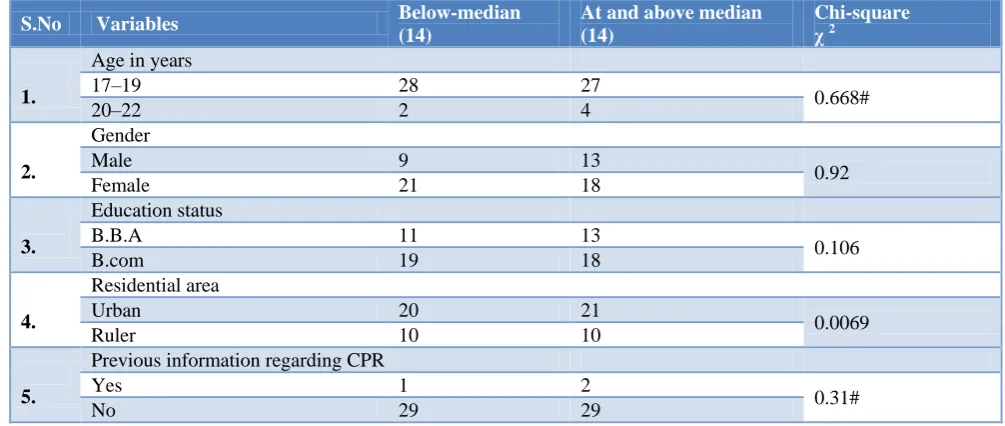
Table 3: Association between pre-test level of knowledge score with selected demographic variable of participants (n=61).
S.No Variables Below-median (14)
At and above median (14)
Chi-square χ 2
1.
Age in years
17–19 28 27
0.668#
20–22 2 4
2.
Gender
Male 9 13
0.92
Female 21 18
3.
Education status
B.B.A 11 13
0.106
B.com 19 18
4.
Residential area
Urban 20 21
0.0069
Ruler 10 10
5.
Previous information regarding CPR
Yes 1 2
0.31#
No 29 29
Df1, tab 3.84 at the level of p<0.05, # yates correction.
Association between post-test knowledge score of undergraduate students with there selected demographical variable.
The data showed in Table 3; that there was no significant association between level of knowledge score with their selected demographic variables as age, gender, education status, residential area, previous information regarding cardiopulmonary resuscitation. Hence the null hypothesis was rejected at the level of p<0.05 (Table 3).
DISCUSSION
The effectiveness of the structured teaching program regarding cardiopulmonary resuscitation among undergraduate students.
Mean pretest and post- test knowledge scores were 13.18±3.338 and 25.80±3.0778 with the mean difference of 12.62, which was found to be statistically significant as evident from t value (19.327) at 0.001 level of significance and suggested that the effectiveness of
structured teaching programme regarding cardio-pulmonary resuscitation in term of increasing knowledge among undergraduates students. It indicates that the post knowledge score is more homogenous in the sample.
The study findings were supported by the study done by Owojuyigbe, et al among 68 dental students in Nigeria to check the impact of the basic life support training on the knowledge of the basic life support results showed. students had knowledge score 4.7±1.47 in the pre-test, 8.04±1.47 in post test.12
Findings of the study were consistent with the study conducted by Lakshmi, et al to assess the knowledge and skills regarding CPR among 102 nurses. Themean score of the nurses‟ CPR skills before training was (9.42±9.8), indicating a low level of competence. Immediately following training, the post-test mean score increased to (78.31±17.5).13
Basic life support among BSC interns at Bhubaneswar, study showed that knowledge score of post-test (13.4±2.89) was higher than the pre test (9.12±1.97) and calculated „t' value was 13.9 which was greater than the tabulated value at the (p=0.001)14
Association between the pre-test level of knowledge score regarding cardiopulmonary resuscitation among undergraduate students with their selected demographical variables.
Statistical analysis showed that in the present study, there was no any significant association between all demographical variable and pretest knowledge score at the level of (p<0.05). Hence H2 research hypothesis is rejected.
These study findings were supported by Parajulee, Valarmathi, conducted a cross-sectional study to assess the knowledge of 175 nurses towards cardiopulmonary resuscitation and association between the nurses knowledge score and selected demographic variables in a tertiary care teaching hospital in Nepal and found no significant association between the demographic variables such as age, total scores and duration of experiences.15
The study findings were supported by Sharma R, et al conducted a prospective study among 100 patients on CPR knowledge and opinions on end of life decision making of older adults admitted to an acute medical service and found no association between older age, religion, or comorbid illnesses, and preference for CPR.16
Other findings
Most of the participants were eager to know the post-test results.
Students who were not part of the study were interested to learn CPR.
Students shared their life experiences regarding collapse victim near to them.
Strengths
Simple random sampling technique was used. Structure teaching programme gave with
demonstration in small groups.
Students were interested and willing to learn CPR.
Weakness
Lack of control over the samples due to absenteeism. Less supportive review.
Limitation
Small number of sample size which might affect the generalizability of the finding.
Re- demonstration was done only for few students.
Recommendations
Study could include the practice and attitude regarding cardiopulmonary resuscitation.
Study could be done in community or hospital setting among non-medical peoples.
Study can be done with large sample size.
CONCLUSION
Cardiopulmonary resuscitation is the live-saving technique which can save the life of collapsed victim with no pulse and breath in such case as respiratory arrest, cardiac arrest, sever road traffic accident, heart attack., poisoning. To share knowledge regarding CPR by teaching and demonstration programme among non - medical undergraduate students was a great experience, it could be concluded that students significantly improved their knowledge regarding CPR and become more confident and aware about this life-saving technique. Structured teaching programme with demonstration was effective for the students.
Funding: No funding sources Conflict of interest: None declared
Ethical approval: The study was approved by the Institutional Ethics Committee of SRHU, Jollygrant Dehradun
REFERENCES
1. Pradeep VS. Knowledge regarding Cardio-pulmonary Resuscitation among 3rd year General and Midwifery students in Vijayanagar School of nursing Mudalpalya. Golden Thoughts. 2012;2(5):1. 2. Kouwenhoven WB, Jude JR, Knickerbocker GG. Closed-chest cardiac massage. JAMA. 1960;173:1064-7.
3. Hwang SO. Cardiopulmonary Resuscitation-From the past into the future. J Acute Med. 2013;3(3)67-72.
4. Cooper JA, Cooper JD, Cooper JM. Cardiopulmonary Resuscitation: History, Current Practice, and Future Direction. American Heart Association Circulation. 2006;114:2839-49.
5. Anwar T. Want to help accident victims but scared of the law? Fear no more India, 2014. Available at http://www. firstpost.com/ india/want-help-accident-victims-scared-law-fear-1783297.html Accessed 7 February 2017.
6. Anand KU. India has just one doctor for every 1,700 population. The new India Express, 2015. Available at: http://www.newindianexpress.com/magazine/ India-has-just-one-doctor-for-every-1700-people/ 2013/09/22/article1792010.ece Accessed on 18 February 2016.
http://cipher.org.au/bystander-cpr-doubles-cardiac-arrest-survial-rate Accessed on 7 February 2017
8. Jeffery MC, Eastman AL, Paul PE. Year in review 2009:Critical Care – Cardiac arrest trauma and disaster. Critical Care. 2010;14(6):242.
9. CPR: legal and ethical issues. American heart Association, 2006. Available at http://www. amirecianheart.org/cpr Accessed on 12 September 2016.
10. Stix M. Unwxtraordinary measures: Stats show CPR often falls flat. Cable News Network, 2013. Available at: http://edition.cnn.com/2013/07/ 10/health/cpr-lifesaving-stats/index. Accessed on 8 March 2017.
11. Haelle T. By Stander CPR Dobles Cardiac Arrest survival rates; Internal Medicine, 2015. Available at;http://www.everydayhealth.com/news/bystander-cpr-doubles-cardiac-arrest-survival-rates/. Accessed 8 January 2016.
12. Owojuyigbe AM, Adenekan AT, Faponle AF, Olateju SO. Impact of basic life support training on the knowledge of basic life support in a group of Nigerian Dental Students. Niger Postgrad Med J. 2015;22:164-8.
13. Lakshmi R, Ehlers JV. Cardiopulmonary Resuscitation knowledge and skills of registered nurses in Botswana. AOSIS/, 2014. Available at: http://www.curations.org.za/index.php/curationis/art icle/view/1259/15 Accessed on 12 September 2017.
14. Kabina R, Swarnakanti P, Pradhan R. Evaluate the effectiveness of Planned teaching programme regarding Basic Life support among intern ( Bsc. Nursing) students at selected Nursing college, Bhubaneswar, Odisha. Journal of nursing and health science, 2014. Available at: www.iosrjournals.org. Accessed 12 September 2016.
15. Parajulee S, Valarmathi S. Knowledge of Nurses towards cardiopulmonary Resuscitation in Tertiary care teaching hospital in Nepal. JCDR, 2011. Available at: http//www.jcdr.net/article_fulltext. asp?issn=0973-709x&year=2011. Accessed 12 September 2016.
16. Sharma R, Jayathissa S, Weatherall M. Cardiopulmonary Resuscitation knowledge and opinions on end of life decision making of older adults admitted to an acute medical service. The New Zealand Medical Journal, 2016. Available at:
https://www.nzma.org.nz/journal/read-the-journal/all-issues/2010-2019 Accessed 12 January 2016.