Original Research Article
An interventional study regarding knowledge and awareness of TB and
HIV among high school children in rural and urban areas of Dehradun
Harsimranjit K. Natt, Ashwani Sharma*, Megha Luthra, Puneet Ohri, Kamal S. Negi
INTRODUCTION
Worldwide the number of people infected with both HIV and tuberculosis is rising. In developing countries HIV associated tubercular disease is very common. The HIV virus weakens the host’s body immune system hence accelerating the susceptibility towards any infection. Tuberculosis is the most common opportunistic infection that most frequently kills HIV positive people. With the advent of the HIV/AIDS epidemic the problem has compounded. One of the components of new WHO stop-TB strategy released in 2006 is to empower people with
TB and communities through education and communication. RNTCP relies on passive case finding of chest symptomatic in the community which requires adequate knowledge and awareness among general public and younger generation in particular.1
The World Health Organization global TB report reported that TB now ranks alongside HIV as a leading cause of death worldwide, with 10.4 million people being estimated to have fallen ill with TB in 2015, of whom 5.9 million (56%) were men, while 3.2 million (44%) were women, and 1.0 million were children.
ABSTRACT
Background: The World Health Organization Global TB report reported that TB ranks alongside HIV as a leading
cause of death worldwide. Evidence based studies revealed that knowledge and awareness has a substantial impact on the prevention of HIV/AIDS and tuberculosis. This study was conducted to compare the awareness and knowledge of high school children regarding HIV and TB in the rural and urban areas and to assess the impact of educational intervention on the same.
Methods: One school each from rural and urban field practice area was selected by purposive sampling technique. A
total of 205 high school students were included in the study by total enumeration method. An interventional study was conducted regarding awareness and knowledge about TB and HIV/AIDS by means of health talk and help of audio visual aids. The data was collected in a predesigned self administered questionnaire by pretest and post test method. Results: The total of 205 students participated in the study. Majority of the respondent have correct knowledge regarding the causative agent of TB (38.5%) with 28.4% in rural and 48.5% in urban area. Moreover majority of the respondent correctly elicited the causative agent of HIV/AIDS (52.6%) with 44.1% in rural and 61.1% in urban area. Overall the intervention had a substantial effect on the awareness and knowledge level of the students regarding HIV/AIDS and tuberculosis.
Conclusions: Although awareness among the masses is there but right knowledge and practice plays a pivotal role in
improving the health status and awareness of the community.
Keywords: Intervention, Knowledge, TB, HIV/AIDS
Department of Community Medicine, SGRRIM and HS, Dehradun, Uttrakhand, India
Received: 29 March 2019
Revised: 17 May 2019
Accepted: 18 May 2019
*Correspondence: Dr. Ashwani Sharma,
E-mail: [email protected]
Copyright: © the author(s), publisher and licensee Medip Academy. This is an open-access article distributed under
the terms of the Creative Commons Attribution Non-Commercial License, which permits unrestricted non-commercial use, distribution, and reproduction in any medium, provided the original work is properly cited.
An estimated 11% of TB patients were HIV-positive, and TB remains the leading cause of death among people living with HIV (PLWHA), accounting for one in three HIV-related deaths. The WHO estimates that only 6 million new cases of TB were reported to WHO in 2014, representing less than two-thirds of the estimated number of TB cases (WHO 2015).2
School children of today are exposed to the risk of HIV/AIDS, which was quite unknown to their predecessors a few decades ago.3 The major reason for their vulnerability to STDs is the lack of sex education, including education on the prevention of STD.4 It can be very easily prevented by information education and communication (IEC) activities with regard to behavioural changes.5 With this intention, the present study was conducted to assess the knowledge about TB and HIV/AIDS among school students and design an intervention to improve the same.
The study was conducted with the following aim and objectives
To assess the awareness of high school children regarding HIV and tuberculosis in the rural and urban areas
To compare the level of knowledge among the high school students regarding HIV and tuberculosis in the rural and urban areas.
To assess the impact of educational intervention on the knowledge regarding HIV and tuberculosis.
To provide suggestion for improving awareness and knowledge regarding HIV and tuberculosis among school children in the rural and urban areas.
METHODS
The Department of Community Medicine SGRRIM and HS, Dehradun conducted this study in its Rural and Urban field practice area. One school each from rural and urban field practice area was selected by purposive sampling technique. The study subjects were the high school students from each school. A total of 205 high school students were included in the study by total enumeration method.
The study instrument was a self administered questionnaire translated in both Hindi and English language. It was constructed of questions derived from several previously validated questionnaire that were administered as part of relevant previous studies.
The schools principals were duly explained about the objective and purpose of the study and Written consent was obtained from them.
The study was conducted in December 2018. The research team comprised of Doctors (faculty and PG students) and field staff of Department of Community Medicine visited the school and the pre test questionnaire
administration. It contained majority of closed ended question on yes/no and don’t know basis and a few open ended question as well. The questionnaire included the socio demographic profile of the study participant and 20 question each to assess the knowledge of the students with regards to tuberculosis and HIV respectively on the following domains, namely disease awareness, disease transmission, prevention and treatment. It was followed by session of health education focused on HIV and Tuberculosis. This included two way communications between the resource person and the students. Audio visual technology was also implied to make the session interesting and more informative.
After a week the same procedure was followed and pre test questionnaire was re- administered as a post test. Another session of health education was conducted to refresh and consolidate the knowledge and to address the queries.
Statistical analysis
The data collected was refined, compiled and tabulated using Microsoft Excel. The data was further analyzed using Epi info software and SPSS 20.0 version. Both paired and unpaired student t–test and chi square test was applied for finding any association and significance between the study variables. The level of significance taken for our analysis is 95%.
RESULTS
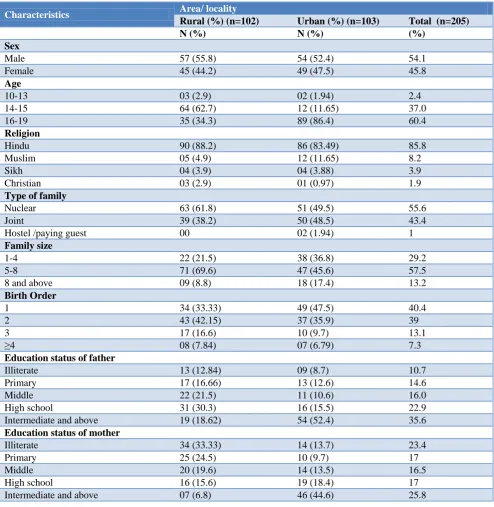
The total of 205 students participated in the study (54.1% males and 45.8% females) excluding the non participation/non filling the post test questionnaire and absenteeism. In rural total 102 student participated which include 57 (55.8%) boys and 45 girls (44.2%) and in urban 103 student participated which include 54 boys (52.4%) and 49 girls (45.8%).
Majority of the students (60.4%) belonged to late adolescence (16-19 years) age group. Regarding religion majority of the respondents were Hindus (85.8%) followed by Muslims (8.2%). Among the type of family majority belonged to Nuclear family structure (55.6%) followed by joint family (43.4%) and among family range majority were of 5-8 family members per family (57.5%) followed by 1-4 family members per family (29.2%). Most of the respondents were having first birth order (40.4%) followed by second birth order (39%). Regarding the education status of the father and mother majority were intermediate and above with 35.6% and 25.8% respectively (Table 1).
Table 1: Socio demographic profile of the study participants.
Characteristics Area/ locality
Rural (%) (n=102) Urban (%) (n=103) Total (n=205)
N (%) N (%) (%)
Sex
Male 57 (55.8) 54 (52.4) 54.1
Female 45 (44.2) 49 (47.5) 45.8
Age
10-13 03 (2.9) 02 (1.94) 2.4
14-15 64 (62.7) 12 (11.65) 37.0
16-19 35 (34.3) 89 (86.4) 60.4
Religion
Hindu 90 (88.2) 86 (83.49) 85.8
Muslim 05 (4.9) 12 (11.65) 8.2
Sikh 04 (3.9) 04 (3.88) 3.9
Christian 03 (2.9) 01 (0.97) 1.9
Type of family
Nuclear 63 (61.8) 51 (49.5) 55.6
Joint 39 (38.2) 50 (48.5) 43.4
Hostel /paying guest 00 02 (1.94) 1
Family size
1-4 22 (21.5) 38 (36.8) 29.2
5-8 71 (69.6) 47 (45.6) 57.5
8 and above 09 (8.8) 18 (17.4) 13.2
Birth Order
1 34 (33.33) 49 (47.5) 40.4
2 43 (42.15) 37 (35.9) 39
3 17 (16.6) 10 (9.7) 13.1
≥4 08 (7.84) 07 (6.79) 7.3
Education status of father
Illiterate 13 (12.84) 09 (8.7) 10.7
Primary 17 (16.66) 13 (12.6) 14.6
Middle 22 (21.5) 11 (10.6) 16.0
High school 31 (30.3) 16 (15.5) 22.9
Intermediate and above 19 (18.62) 54 (52.4) 35.6
Education status of mother
Illiterate 34 (33.33) 14 (13.7) 23.4
Primary 25 (24.5) 10 (9.7) 17
Middle 20 (19.6) 14 (13.5) 16.5
High school 16 (15.6) 19 (18.4) 17
Intermediate and above 07 (6.8) 46 (44.6) 25.8
Table 2: Knowledge about causative agent of tuberculosis.
Causative agent TB
Area/ locality
Pre test Total (%)
(n=205)
Post test Total (%)
(n=205)
Rural Urban Rural Urban
Bacteria 29 50 38.5 65 88 74.6
Virus 41 24 31.7 31 15 22.9
Parasite/ bug/ insect 01 08 4.3 04 00 1.9
Don’t know 31 21 25.3 02 00 0.9
Table 3: Knowledge about causative agent of HIV/AIDS.
Causative agent HIV/AIDS
Area/locality
Pre test Total (%) Post test Total (%)
Rural Urban (n=205) Rural Urban (n=205)
Bacteria 04 21 12.1 29 08 18
Virus 45 63 52.6 66 92 77
Parasite/bug/insect 04 04 3.9 02 00 0.9
Don’t know 48 18 32.1 06 00 2.9
Chi sq=4.58,df =1, p<0.05 Chi sq=22.92,df =1, p<0.05
Table 4: Transmission of tuberculosis.
Mode of transmission
Area/locality
Pre test Total Post test Total
Rural Urban (n=205) Rural Urban (n=205)
N (%) N (%) N (%) N (%) N (%) N (%)
Coughing and sneezing 33 (32.3) 10 (9.7) 43 (20.9) 60 (58.8) 21 (20.3) 81 (39.5)
Sharing meals 06 (5.8) 06 (5.8) 12 (5.85) 00 01 (0.9) 1 (0.4)
Blood 04 (3.9) 04 (3.8) 8 (3.9) 02 (1.9) 00 2 (0.8)
Heredity 10 (9.8) 02 (1.9) 12 (5.85) 05 (4.9) 02 (1.9) 7 (3.4)
Smoking 06 (5.8) 03 (2.9) 9 (4.3) 09 (8.8) 00 9 (4.3)
Don’t know 42 (41.1) 81 (78.6) 123 (60) 27 (26.4) 78 (75.7) 105 (51.2)
Chi sq=16.97, df =1, p<0.05 Chi sq=28.86, df =1, p<0.05
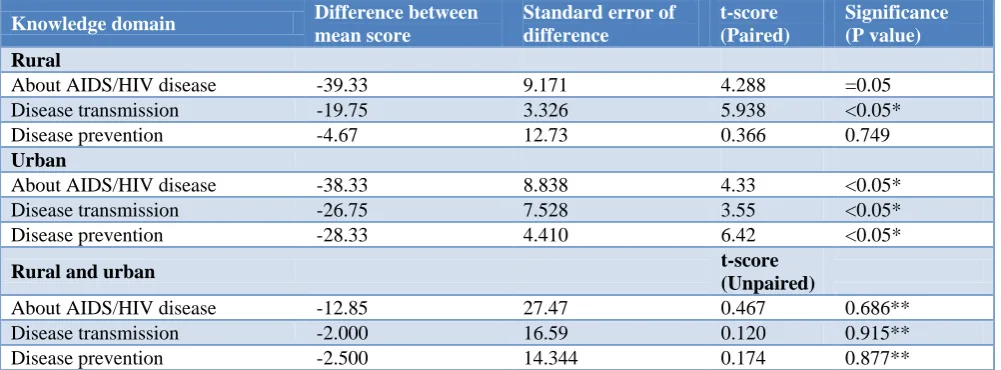
Table 5: Comparison of knowledge domains regarding HIV/AIDS in urban and rural areas in pre test and post test.
Knowledge domain Difference between mean score
Standard error of difference
t-score (Paired)
Significance (P value) Rural
About AIDS/HIV disease -39.33 9.171 4.288 =0.05
Disease transmission -19.75 3.326 5.938 <0.05*
Disease prevention -4.67 12.73 0.366 0.749
Urban
About AIDS/HIV disease -38.33 8.838 4.33 <0.05*
Disease transmission -26.75 7.528 3.55 <0.05*
Disease prevention -28.33 4.410 6.42 <0.05*
Rural and urban t-score
(Unpaired)
About AIDS/HIV disease -12.85 27.47 0.467 0.686**
Disease transmission -2.000 16.59 0.120 0.915**
Disease prevention -2.500 14.344 0.174 0.877**
*Knowledge about AIDS/HIV disease, transmission and prevention among students in urban area was found to be statistically significant. **No statistically significant association was found.
In our study (Table 3) majority of the respondent correctly elicited the causative agent of HIV/AIDS (52.6%) with higher percentage in urban area. The percentage escalated to 77% in post test which indicates the effectiveness of our intervention.
The association was found to be statistically significant related to both pre test and post test
In our study (Table 4) majority of the respondent didn’t know or were wrong in knowledge regarding
9.7% in urban area stated coughing and sneezing as the mode of transmission. The correct knowledge was among 20.9% respondents which escalated to 39.5% in post test which indicates the effectiveness of our intervention.
The association between the knowledge regarding transmission of TB among students in rural and urban area was found to be statistically significant related to both pre test and post test
HIV/AIDS prevention and treatment from pre test to post test sessions.
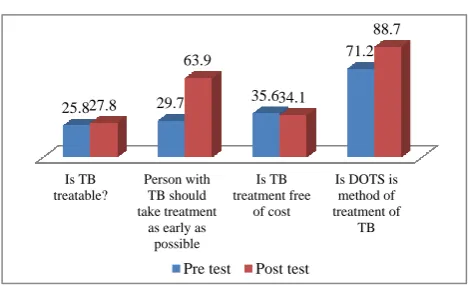
This figure (Figure 2) clearly demonstrates that there has been a significant rise in the knowledge regarding TB
Diagnostics and treatment from pre test to post test sessions. There data showed slight negative or negligible change in knowledge regarding “is TB treatment free of cost” which may be due to the non evitable fact that TB treatment is paid in private sector.
Table 6: Comparison of knowledge domain regarding tuberculosis in urban and rural areas in pre test and post test.
Knowledge domain Difference between mean score
Standard error of difference
t-score (Paired)
Significance (P value) Rural
About TB disease -32.33 5.78 5.59 <0.05*
Disease transmission 2.00 3.00 0.666 0.625
Disease prevention -9.80 7.85 1.247 0.281
Urban
About TB disease -29.43 3.48 9.29 <0.05**
Disease transmission -21.00 12.00 1.75 0.33
Disease prevention -18.00 4.79 3.75 <0.05**
Rural and urban t-score
(Unpaired)
About TB disease -0.50 25.164 0.019 0.986#
Disease transmission 7.00 10.05 0.696 0.556#
Disease prevention 15.50 9.014 1.719 0.227#
*Knowledge about TB disease among students in rural area was found to be statistically significant. **Knowledge about TB disease and its prevention among students in urban area was found to be statistically significant. #No statistically significant association was found.
Figure 1: HIV/AIDS prevention and treatment.
Figure 2: TB diagnostics and treatment.
DISCUSSION
It is observed that the findings of the present study were acceptable and consistent with the research findings of the previous studies. In present study, all the respondents have acquaintance about tuberculosis and HIV/AIDS from varied sources which was in coherence with the study findings of Sah et al.6 In our study The source of information about TB was teachers (34%) and books (26%) and of HIV/AIDS was TV/radio and means of mass communication (34%) followed by friends and relatives (21%) and teachers (20%). Sah et al in their study among higher secondary school students in Nepal also documented mass media and teachers as the main source of TB information among the respondents.5,6 Gupta et al in their study on secondary school students elicited the main source of information about HIV/AIDS was television followed by newspaper and friend and relatives.5 Similarly Bhalla et al in their study in Jamnagar Gujarat among senior secondary school students also reported that majority of the students knew about HIV/AIDS through Television.7 Lal et al regarded television/radio as the major source of information about HIV/AIDS among students (79.6%), a similar study in Chandigarh among senior secondary students revealed a majority of 62.7% students who revealed TV and Radio as the primary major source of knowledge about HIV/AIDS.8,9 In our study peer learning stands for the second most common method of awareness regarding HIV/AIDS which is fully supported by published HIV is
preventable by safe blood
transfusion
HIV is preventable
by use of Condoms
HIV is preventable
by using Disposable
syringes
Are there any treatment available for HIV/AIDS? 43.4
62.4
41.4
74.1
73.6 75.6
44.3
89.7
Pretest post test
Is TB treatable?
Person with TB should take treatment
as early as possible
Is TB treatment free
of cost
Is DOTS is method of treatment of
TB
25.8 29.7 35.6
71.2
27.8
63.9
34.1
88.7
literature indicating that peer education has a significant impact in reducing risk behaviour.10
However all the respondents in our study were aware about TB disease but majority of them were unaware about the most commonly affected body organ (52.1%). Similarly Sah et al in their study also reported that there was confusion among the respondents about the type of tuberculosis and less than half (42%) of the respondents knew about the pulmonary form of tuberculosis.6
In present study Bacteria as causative agent of TB is known to a less percentage of respondents (38.5%) on the contrary Gopichandran et al in their KAP study among high school students in Vellore reported 77.1% awareness among the students as bacteria the causative agent for TB.11 Singh et al in their study in slum community of Delhi showed only 2.3% respondents claimed TB as caused by germ.8,12 Lal et al in their study among senior secondary school children of Delhi reported that all the students have heard about HIV/AIDS which is in coherence with our study findings. Inspite of such awareness majority 51.4% write full form of AIDS and lesser 19.9% knew about full form of HIV in our study similar trend was seen as only 29.7% were able to write full form of AIDS and very less 8.7% knew about full form of HIV. A study on HIV/AIDS awareness amongst 250 Nigerian school students revealed that only 5% were able to write the full form of HIV and AIDS.13
ACKNOWLEDGEMENTS
We wish to thank our head of the department Dr. Puneet Ohri and other faculty members especially Dr Megha Luthra, Dr Kajal Gupta and Dr K S Negi for the necessary guidance and support. My heartfelt gratitude to the field staff, interns and my colleagues especially Dr Ritu Singh PG 2nd Year for her outstanding support during the study.
Funding: No funding sources Conflict of interest: None declared Ethical approval: Not required
REFERENCES
1. Renuka M, Dhar M. Knowledge and Awareness of Tuberculosis among High School Students of Mysore City. Al Ameen J Med Sci. 2012;5(3):333-6.
2. Park K. Preventive and Social Medicine, 21 ed.prem nagar, Jabalpur, India: Banarsidas Bhanot; 2015.
3. Urmil AC, Dutta PK, Sharma KK, Ganguly SS. Medio-social profile of male teenager STD patients attending a clinic in Pune. Indian J Public Health. 1989;33(4):176-82.
4. Dehne K, Riedner G. Sexually transmitted infections among adolescents. Geneva, Switzerland: Dept. of Child and Adolescent Health and Development, World Health Organization; 2005. 5. Gupta P, Anjum F, Bhardwaj P, Srivastav JP, Zaidi
ZH. Knowledge about HIV/AIDS among secondary school students. N Am J Med Sci. 2013;5(2):119-23.
6. Sah BK, Sah JP, Shah SK, Amita KC. Knowledge on tuberculosis among students of higher secondary school, Lalitpur, Nepal. MOJ Public Health 2016;4(5):133-41.
7. Bhalla S, Chandwani H, Singh D, Somasundaram C, Rasania SK, Singh S. Knowledge about HIV/AIDS among senior secondary school students in Jamnagar, Gujarat. Health Popul Perspect Issues. 2005;28(4):178-88.
8. Lal P, Nath A, Badhan S, Ingle GK. A study of awareness about HIV/AIDS among senior secondary schools children of Delhi. Indian J Community Med. 2008;33(3):190-2.
9. Sodhi S, Mehta S. A comparative study of girls of two senior secondary schools of Chandigarh. Man India. 1997;77(2-3):259-66.
10. Kerrigan D, Weiss E. Peer Education and HIV/AIDS: Past Experience, Future Directions. New York: Population Council; 2000.
11. Gopichandran V, Roy P, Sitaram A, Karthick, John KR. Impact of a Simple Educational Intervention on the Knowledge and Awareness of Tuberculosis among High School children in Vellore, India. Indian J Community Med. 2010;35(1):174-5. 12. Singh MM, Bano T, Pagare D, Sharma N, Devi R,
Mehra M. Knowledge and attitude towards tuberculosis in a slum community of Delhi. J Commun Dis. 2002;34(3):203-14.
13. Okonta JM, Momoh MA, Ekwunife OI, Mbagwu IS, Abali SO. Assessment of HIV/AIDS awareness and changes in sexual practices among secondary school students in Nsukka environment. Trop Doct. 2007;37(4):269-71.
Cite this article as: Natt HK, Sharma A, Luthra M,