179 | P a g e
IMPROVING THE PERFORMANCE LEVEL OF TRUST
WORTHINESS ON CLOUD PLATFORM THROUGH
DYNAMIC AUTHORITY CERTIFICATION
Ms. R. Poorvadevi
1, M. Bala Yasaswi
2, M.S.V.S.S Manoj
3,
M. Praneeth Reddy
4,
1
Assistant Professor,
2,3,4UG Student (CSE), SCSVMV University, Kanchipuram, Tamilnadu
ABSTRACT
Cloud computing introduces several characteristics that challenge the effectiveness of current certification
approaches. Cloud-specific certification processes can improve trust in the cloud computing paradigm, and can
lead to the wide adoption of cloud services in enterprises by mastery of uncertainty, lack of transparency, and
trust. Through third party evaluation cloud customers could receive more unbiased information about
cloud-based services and security measures implemented as well as they could compare different cloud service
providers much easier. Common certificates are a backward look at the fulfillment of technical and
organizational measures at the time of issue and therefore represent a snapshot. This creates a gap between the
common certification of one to three years and the high dynamics of the market for cloud services and
providers. The proposed dynamic certification approach adopts the common certification process to the
increased flexibility and dynamics of cloud computing environments through using of automation potential of
security controls and continuous proof of the certification status. The proposed approach of dynamic
certification is based on a new semi-automated certification process and the continuous monitoring of critical
parameters of cloud services. Although intended to ensure cloud service providers security, reliability, and legal
compliance, current cloud service certifications are quickly outdated. Dynamic certification, on the other hand,
provides automated monitoring and auditing to verify cloud service providers ongoing adherence to
certification requirements.
Key words: Public cloud security, Cloud services provider, Cloud customer, Dynamic certification,
Cloud service certification, Data centre.
I. INTRODUCTION
180 | P a g e
The auditing protocol should have the following properties that can be implemented on the secure cloud platform which are listed below:
Confidentiality
Dynamic auditing
Batch auditing
The auditing protocol should keep owner’s data confidential against the auditor. 2) Dynamic auditing. The auditing protocol should support the dynamic updates of the data in the cloud. 3) Batch auditing. The auditing protocol should also be able to support the batch auditing for multiple owners and multiple clouds. Recently, several remote integrity checking protocols were proposed to allow the auditor to check the data integrity on the remote server.
II. RELATED WORK
As per an author P. Stephanow, N. Fallenbeck, “Towards Continuous Certification of Infrastructure-as-a-Service using low-level Metrics,” this paper has proposed the various certification policies for making use of the IaaS services which can focuses on the increasing the security level performance by considering the minimum level of metrics. [1]
Author R.K.L. Ko et.al,“Trust Cloud: A Framework for Accountability and Trust in Cloud Computing,” this work was improved the accountability feature in the public cloud environment and it also used as a trust worthiness among the public cloud service providers. [2]
The various level of security implications are performed and operated on the improving the client level security features and emphasizing the security functions on the cloud service platform to increase the rate of service agility.
III. PROPOSED WORK
The proposed system mainly focuses on providing security in the public infrastructure of cloud environment. To realize the purpose of dynamic certification, cloud service providers must establish an internal monitoring and auditing department. This department performs extensive, frequent type of monitoring operations which related to the distinct set of virtualized environments, intrusion detection, service-level agreements, compliance, networks, and so on.
181 | P a g e
Fig: 3.1 proposed system architecture
To provide the guaranteed security system, it is important to analyze the scope of identity and access management (IAM). It will emphasize the various security factors which is listed below:
Open Authentication
Open API
Open ID
So, with the help of strong security tools it can eliminate and reduce the possible occurrences of intruder’s entry.
IV. IMPLEMENTATION WORK
In the process of user level of authentication and authorization control will proceed the functions of distinct level of control segments are to be followed in the service processing environment. It will works on the security control platform under which all the security constraints will be functioned in the client end location.
The following components are used in the specific cloud based service oriented security framework which will specifies the user level constraint set. The components are listed below:
Cloud user PII values
Segmented data value of the authenticity process
Specification of IAM process
Risk factor values in the cloud platform.
Aggregate the security parameters.
Security control values.
Iterated Process in the cloud vendor
User service based operational outcomes.
Above said parameters are used as a major security trusted components in the public cloud infrastructure environment.
The various set of security protocols and the secure hyper – c and hyper – v components are used in the cloud security model to enable the security functioning process. It will reside the various security levels in the following types:
Host level security
Application level security
Software level security
Storage level security
Data level security
In the service provisioning security and privacy platform it will implicates the various security parameters which are listed below:
Cloud based encryption process
Open ID
Information cards
Open API
Open Auth
Security Algorithms
Security procedures
Secure – enabled – vendor services
SSH and MD5 security process
The security based mechanisms are mainly concentrating on the security based service platforms for proving the dynamic based certification enabled process. The set of constraints can be used in the trusted approaches in order to protect the cloud user operation and their confidential transaction information.
Dynamic Certification Process
In the service based cloud resource sharing environment, it is needed to secure the registered clients. It will specify lots of information in the security access platforms and also functioning on the continuous security proof and authorization process functions.
The following set of process can be migrated on the cloud user platform and it can be simulated with the various security based information analysis process. It will suitably used in the platforms of service provisioning, security provisioning, and privacy preserving techniques. The security values which is used for the certification process includes the following factors which is given below:
User IP and MAC address mapping values
Security field identifiers and the improvement of attribute comparison value.
Security service validation
Prompting the secured service usage
Monitor the SLA and compliance services.
CIA security proving values
183 | P a g e
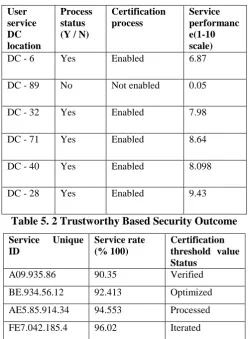
The simulation result can be provided in order to specify the security control process which can be migrated from the legacy to custom based applications. The information can be processed as an identitical value which thoroughly identifies the security functions and service based transactional values.
Table 5. 1 Dynamic Certification Process Outcome
User service DC location
Process status (Y / N)
Certification process
Service performanc e(1-10 scale)
DC - 6 Yes Enabled 6.87
DC - 89 No Not enabled 0.05
DC - 32 Yes Enabled 7.98
DC - 71 Yes Enabled 8.64
DC - 40 Yes Enabled 8.098
DC - 28 Yes Enabled 9.43
Table 5. 2 Trustworthy Based Security Outcome
Service Unique ID
Service rate (% 100)
Certification threshold value Status
A09.935.86 90.35 Verified
BE.934.56.12 92.413 Optimized
AE5.85.914.34 94.553 Processed
FE7.042.185.4 96.02 Iterated
Above tables shows that, the consistent type of security values will be processed in the security access platform. The processes will enables the certain security factor will be resulting in to that the secured access way API platforms.
VI. EXPERIMENTAL RESULTS
Fig:6.a) Dynamic Certification Outcome Graph - 1
The following diagram will implicates the process of security outcome and how the result set value can be iterated in the security access platforms. It will provide the distinct services to the end users who are liable to the SLA process and proving the identity.
Fig:6.b) Trustworthy Based Security Outcome Graph - 1
So, from the above two diagrams fig 6.a and 6.b will specify lots of security control I their service access environment. It has been proved the improvement of security performance through the dynamic certification process.
VII. CONCLUSION
185 | P a g e
VIII. FUTURE ENHANCEMENT
Security factor is playing as a major strategy for decision making process. Service providers can apply this kind security mechanism in the other domains of data analytics, IOT, Social mining. This might be helpful to the service broker and service provider to ensure the QOS.
REFERENCES
[1.] I.Windhorst and A. Sunyaev, “Dynamic Certification of Cloud Services,” Proc. 8th Int’l Conf. Availability, Reliability and Security (ARES 13), 2013, pp. 412-417.
[2.] A. Sunyaev and S. Schneider, “Cloud Services Certification,” Comm. ACM,vol. 56, no. 2, 2013, pp. 33–36. [3.] S. Lins et al., “What Is Really Going on at Your Cloud Service Provider? Creating Trustworthy Certifications Continuous Auditing,” Proc. 48th Hawaii Int’l Conf. System Science (HICSS 15), 2015, 5352–5361.
[4.] C.E. Brown, J.A. Wong, and A.A. Baldwin, “A Review and Analysis of the Existing Research Streams 70 IEEE Security & Privacy March/April 2016 IT ALL DEPENDS in Continuous Auditing,” J. Emerging Technologies in Accounting, vol. 4, no. 1, 2007, pp. 1–28.