Dissertations (ASC) Annenberg School for Communication
1976
Client Relationship and Mass Media Policy: A
Comparative Case Study of Mass Market and
Library Market Production And Distribution In
Children's Book Publishing
Joseph Turow
University of Pennsylvania, [email protected]
Follow this and additional works at:http://repository.upenn.edu/dissertations_asc Part of theCommunication Commons
This paper is posted at ScholarlyCommons.http://repository.upenn.edu/dissertations_asc/11 For more information, please [email protected].
Recommended Citation
Turow, Joseph, "Client Relationship and Mass Media Policy: A Comparative Case Study of Mass Market and Library Market Production And Distribution In Children's Book Publishing" (1976).Dissertations (ASC). 11.
Client Relationship and Mass Media Policy: A Comparative Case Study of
Mass Market and Library Market Production And Distribution In
Children's Book Publishing
Abstract
CHAPTER l: AN INTRODUCTION TO THE STUDY AND ITS METHODOLOGY
Analysts of the mass media tend to agree that the organizational nature of mass communication has important consequences for the shaping of those messages which are distributed to large, dispersed audiences (see, for example, Wright, 1975, p. 8). Many scholars have commented, as well, upon the importance which mass produced, widely shared, message systems have for individuals and society. One especially persuasive perspective on the significance of mass communication has been articulated by Gerbner (1972) and is encapsulated in the following passage:
Degree Type
Dissertation
Degree Name
Doctor of Philosophy (PhD)
Department
Communication
First Advisor
Gerbner, George
Subject Categories
Communication
CASE STUDY OF MASS MARKET AND LIBRARY MARKET PRODUCTION
AND DISTRIBUTION IN CHILDREN'S BOOK PUBLISHING
Joseph Turow
A DISSERTATION
in
COfl11UtllCA TI ONS
Presented to the Graduate Faculty of the University of Pennsylvania in Partial Fulfillment of the Requirements for the Degree of Doctor of Ph i 1 osophy.
1976
- y -
-~
. .~
_/"/~
. /~
--'
COPYRIGHT
Joseph Gregory Turow
1976
•
ACKNOfiLEDGEMENTS
Hindsight can sometimes be a frightening thing. I realize now
that when I started this project, about a year and a half ago, I did
not fully comprehend the magnitUde of the work I was undertaking.
The intimidating in@ensity of the job fortunately continued to be
masked by the help which tens of individuals gave me during the course
of my research. Because space does not permit nami ng them all ,
and because the generous people in the organizations I have studied
prefer to remain anonymous, I must content myself with a general
ex-pression of deep gratitude.
Certain individuals, however, must be publicly thanked.
With-out them I could never have accomplished this task. Esther HaJtzig, a
cherished relative and an award-winning children's book writer, was
the original reason for my interest in the children's book industry.
Her unstinting generosity with journals, contacts, and solace has been
of immeasurable help during the past 18 months. Moral and intellectual
support has also been forthcoming from my friends at The Annenberg
School of Communications and The School of Educ~tion, University of
Pennsylvania. I would especially like to single out Peggy Petrino,
Professor Norma B. Kahn, and my teacher and friend Professor Robert
Lewis Shayon. Jan Terrell and Pat Leburg's rapid and accurate typinq
has made the final stages of this drama much calmer than they might
iv
Warm thanks are also due to the. members of my dissertat.ion
commi ttee--Professor George .. Gerbner, . Professor Neal Gross, ProfessQr·
Larry Gross, and Professor William Melody. Their firm insistence·
on rigorous planning and conceptualization at the start of this
project made the road to its concl usion much smoother. Professor
Gerbner, the committee chairperson, has been my adviser for the past
four yearS. My great philosophical debt to him can be seen throughout
this work.
The concern and help of my family has been the greatest
en-couragement of all. Sol, Masha, Jerry, Mark, and Debbie Gabry--my
uncle, aunt, and cousins--have always been interested. r1y brother,
Victor, has been very helpful with ·good ideas and good conversation.
The role which Abraham and Danuta Turow have played in the
development, execution, and completion of this study has been
profound. In many ways, they have. been my collaborators. To them,
my parents, I would like to dedicate this Ivork.
JGT
Brooklyn, New York
Philadelphia, Pennsylvania West Lafayette, Indiana
•
INDEX
Audience for children's books:
5, 6, 11,17,84-87,89,111, 118-123, 179,208-209,226, 238-240·,
Distribution outlet activities in children's book pUblishing: 2, 3, 5, 10, 16, 20, 22, 23, 231.
distribution in the 1 ibrary market: .36,46,47,90-135,138
distribution in the mass market: 35, 138, 151, 193-227
Guidelines for children's book selections: 5, 18, 37, 62-79,
111-126, 165-180.
History of children's book publishing: 34-41, 138-144.
Production of activities in children's book publishing: 2, 3, 5, 10, 16, 20, 22, 23, 231.
Production activities in the library market: 42-89.
Production activities in the mass market: 195-227.
Research on children's book publishing: 15-19.
Research on mass media organizations: 6-10.
vi
TABLE OF CONTENTS .
Page
COPYRIGHT.. .. .•...••. . . ...•.. . .•... ... . .... •. •. •. .••. i i
ACKNOWLEDGEMENTS.. •. . .•. . .• . .•• .•. .. •. •• . . . . •• ••. •. .• •••• .• iii
INDEX ...•...•...•.•... ,~ ..• v
TABLE OF CONTENTS... vi
LIST OF TABLES... vi i i LI ST OF CHARTS .•••...•...•••.••.•.•...•...•..•..•••.•••• · i x B I BLI OGRAPHY . • . . • • . . . . • . • . . . • • . . • • . • • . • . . . • . . • • • • • • • • x
CHAPTER 1 - AN INTRODUCTION TO THE' STUDY AND ITS METHODOLOGY •...•...•..••.•..••..•...•...•.. Background. . . • . . . • . . .. . . • . . • . . • . • . . . • • . • . . . • 6
The Research and Its Methodology... 19
A Gl ance Ahead... 30
End Notes ..•.•..••...•..• :... 32
PART I: THE LIBRARY MARKET SEGMENT ••....•.•. ;... 33
CHAPTER 2 - AN HISTORICAL PREFACE TO THE LIBRARY MARKET.... 34
CHAPTER 3 - THE LIBRARY ~IARKET PUBLISHING FIRM... 42
Conceptualizing the Requirements and Opportunities of the Client Relationship.... ... ...•.•..•.• 45
Selecting and Producing Books for the Library Market ..•...•...•... ,... 52
The Client Relationship and the Seasonal Lists .. :... 80
,The Client Relationship and Images of the Ultimate Audience... 84
Chapter Summary... 87
CHAPTER 4 - THE LIBRARY MARKET DISTRIBUTION OUTLET... 90
The Client Relationship and the Book Selection Procedure. . . 92
The Client Relationshi p , Audience Images, and Book .' Selectic)n Guidelines ...•.... : .•... : ...•••..•.. ; The Client Relationship and the LMCLS Book Lists •...••
Chapter Surnrnary ... 0' • • • • • • • • • • • • • • • • • • • • • • • • • • • • • • • • •
End Notes ... .
Page
···111 ." 126 133 135
PART II: Tf!E MASS MARKET SEGMENT. ..•.••• ,. .. • .. .••••. .• . . • 137
CHAPTER 5 - AN HISTORICAL PREFACE TO THE ~lASS MARKET... 138
End Notes .••....•.. ·..•.•...••••.•...•.•...•.•••.•••. 144
CHAPTER 6 - THE MASS MARKET PUBLISHING FIRM... 145
Conceptualizing the Requirements and Opportunities
of the Client Relationship... ... ....•..••• 148
Selecting and Producing Books for the Mass Market... 160
The Client Relationship and Images of the Ultimate
Audience... 179
The Client Relationship and the Seasonal Lists. ••. ..•• 180
Chapter Summary... 188
End Notes... 191
CHAPTER 7 - THE MASS MARKET DISTRIBUTION OUTLET.... .•... 193
The Client Relationship and the Book Selection
Procedure ... ',' .. . . .•. . . .• ..•..•• 195
Client Relationship, Audience Images and Book
Selection Guidelines... ... 208
The Client Relationship and the MMBSC Seasonal
Lists.... .•.•....• ..•...••... ..•... .•..•.... 215
Chapter Surflllary... 225
End Notes... 227
CHAPTER 8 - A GENERAL SUMMARY AND ANALYSIS. .•••...•... 22d
On the General Significance of the Client Re-.
lationship... 233
End Notes ... '. . .... ... • 246
APPENDICES
APPENDIX A .•....•.• ;... .•...•...• 247
viii
•
LIST OF TABLES
Table Page
1. Estimated Trade Industry Sales by AAP Survey
Ca tegori es. . . ·13
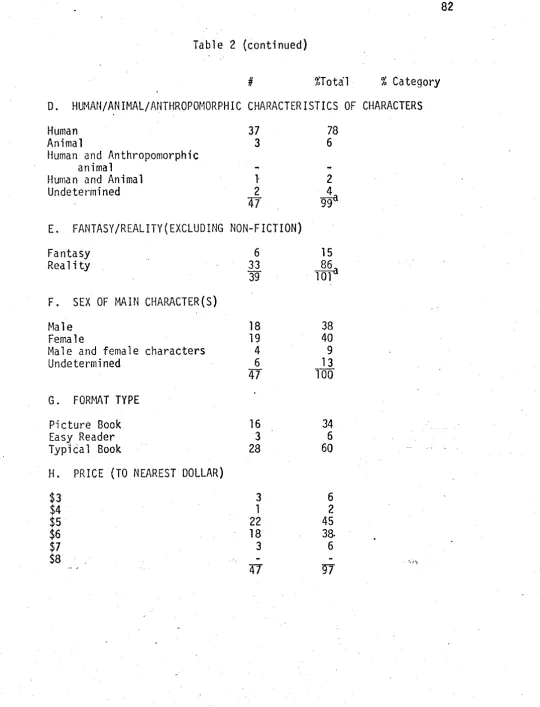
2. Categories Relating to New Books On LMCBD's Fall 1974
and Spring 1975 Lists ... ;.... ... 81
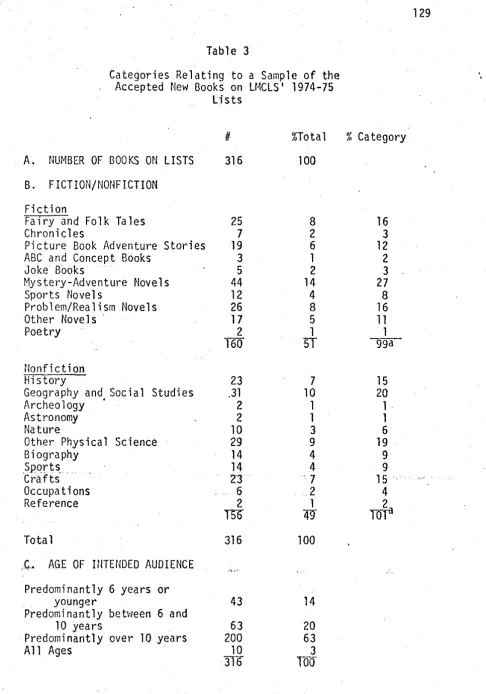
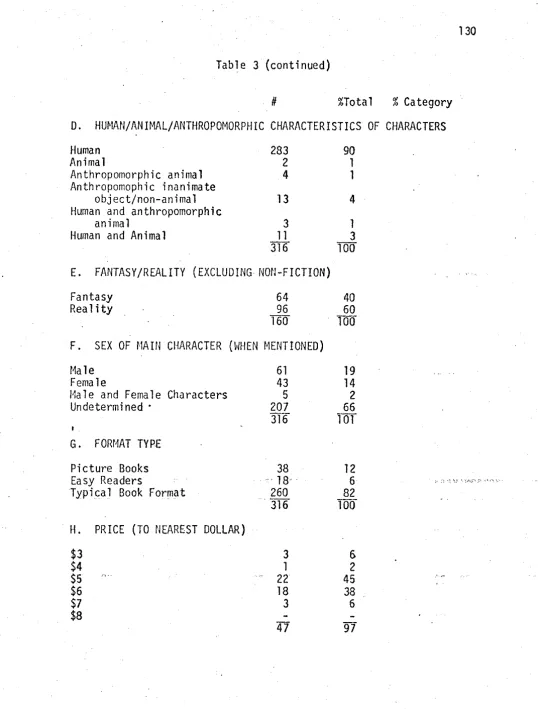
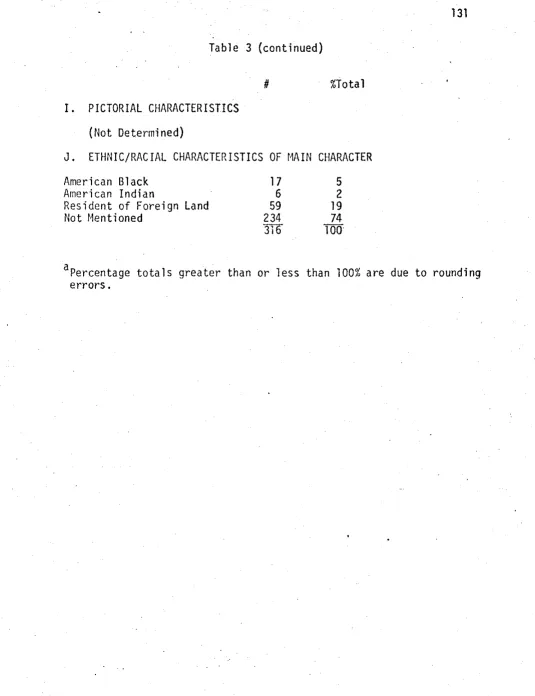
3. Categories Relating To A Sample of the Accepted New
Books on LMCLS' 1974-75 Lists... .... .... ... 129
4. Categories Relating to New Books on t1t1CBD's Fall 1974
and Spring 1975 Lists... 181
5. Statuses of MMCBD Titles Receiyed by LMCBD. ... 185
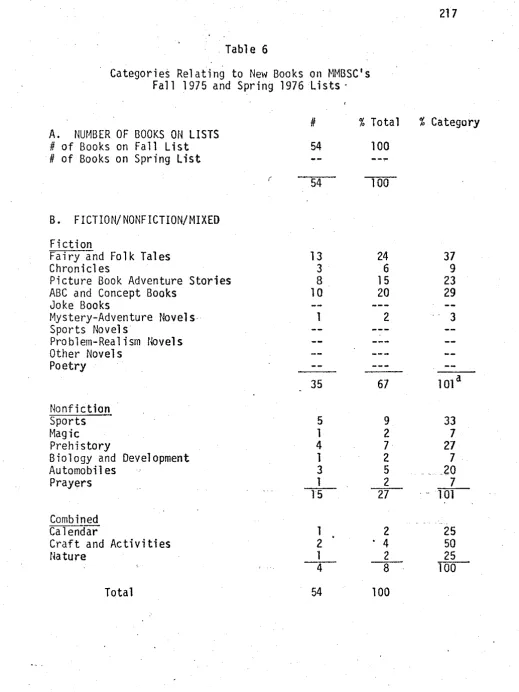
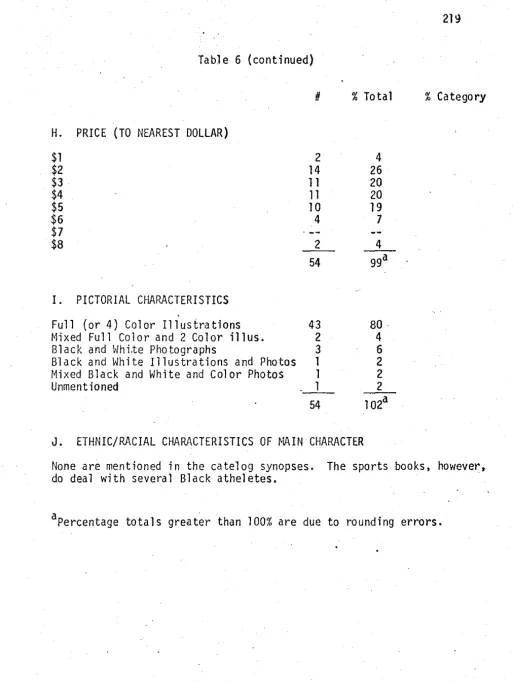
6. Categories Relating to New Books on f1t~BSC's Fall 1975
LI ST OF CHARTS
Chart Page
1. Schematic Diagram of Research in Focal
Organizations ...•. 23
2. Major Elements of LMCBD's Organizational
Structure... 44
BIBLIOGRAPHY
Arbuthnot, May Hill and Sutherland, Zeena. Children and Books. Fourth edition. Glenview, Illinois: Scott, Foresman, and Company, 1972.
Bailey, Jr., Herbert S. The Art and Science of Book Publishing. New York: Harper
&
Row, 1970.Breed, Warren. "Social Control in the Newsroom: A Functional Analysis," Social Forces. 33 (1955) pp. 326-335.
x
Broderick, Dorothy r1. An Introduction to Children's Work in Public
Libraries. New York: The H. W. Wilson Company, 1965.
"'Problem Nonfiction,'" Library ,1ournal. 87 (October 1, 1962), pp. 3373-78.
Busha, Charles. The I\ttitudes of l1id\~estern Public Librarians Toward Intellectual Freedom and Censorship. Ph.D. Dissertation, Indiana University, 1971.
Cantor, t1uriel.
New York: Basic Books, 1971.· The Hollywood TV Producer: His Work and His Audience.
Colby, Jean. Writing, Illustratinq, and Editing Children's Books. flew York: Hastings House, 1967 .
. Coser, Lewis. "Publishers as Gatekeepers of Ideas," The Annals. 421 (September, 1975), pp. 14-22.
Denisoff, R. Serge. Solid Gold: The Popular Husic Industry. flew
Brun~wick, New Jersey: Transaction Books, 1975.
Dessauer, John. Book Publishing: What It Is, What It Does. New
York: Bowker, 1974.
Drennan, Henry and Holladay, Doris. Statistics of Public Libraries, Part I. Hashington D.C.: U.S. Department of HeaTth, Education, and Welfare, 1962.
Eps tei n, Edward Jay. News From Nowhere. New York: Vi ntage Books. 1973.
-Fi e 1 d. E1 inor . Wh itney. camp i1 er. Horn Book Refl ec t i ans: On Children's
Books and Reading. Boston: The Horn Book. 1969.
Fiske, Marjorie. Book Selection and Censorship. Berkeley: University
of California Press, 1959.
Gerbner. George. "Institutional Pressures On Mass Communicators,"
Sociological Review Monograph No. 13 (1969). pp.205-248.
"Communication and Social Environment." Scientific
American. (September, 1972) 227:3. pp. 153-160.
Gerhardt, Lillian, compiler. Issues in Children's Book Selection. New
York: Bowker, 1974.
Gieber, Walter. "tlel1s is l'lhat Nel1spapermen Make It."
and I-lass Communications. Edited by Lel1is Dexter
New York: The Free Press, 1959.
People, Society, ana-David White.
Gross, Elizabeth H. Public Library Service To Children. Dobbs Ferry:
Oceana Publications, Inc., 1967.
Grannis, Chandler B. What Happens. in Book Publishing. New York:
Columbia University Press, 1967.
Guback, Thomas H. "Film as International Business," Journal of
Communication, 24:1 (lHnter, 1974), pp. 90-102.
Hazard. Paul. Books, Children, and Men, translated by Marguerite
t1itchell, 4th edition. Boston: The Horn Book, 1960.
Jenkins, William A. "The Future of Children's Books," Book Publishin9_:
Inside Vie\-Is. Edited by Jean S. Kujoth. Metuchen, tJew Jersey:
The ScareCrO\1 Press, 1971.
Karl, Jean. From Childhood to Childhood: Children's Books and Their
Creators. New York: Stein
&
Day, 1970."The Children's Book Department," in What Happens in Book
Publ ishing, edited by Chandler B. Grannis .. NeVI York: Columbia
University Press. 1967.
Kujoth, Jean Spealman. editor. Book Publishinq: Inside Views.
Metuchen, NeVI Jersey: The Scarecrow Press, 1971.
Lanes, Selma G. Down the Rabbit Hole: Adventures and Misadventures in
the Realm of Childreri's Literature. tJew York: Atheneum, 1971.
xii
Long, Harrie.t. Publ ic Librart;Service to Children: . Foundation and .
Development. Metuchen, ew Jersey: The Scarecrow Press,
191)9.
L6wentha 1 , Leo. . "B iograph 1 es'inP-opul arMagazfnes-."
:.:.R",ad::..ic.::o:....c:.Re;;;s::oe,",a:.:..f",ch:.:..-1942-43. Edited by Paul Lazersfeld and Frank Stanton. New
York: Duell, Sloan and Pearce, 1944).
McQuail, Denis. "Uncertainty About the Audience and the Organization
of Mass Commun ica t ions," Soc i 01 ogi ca 1 Revi ew. Monograph Number 13.
(1969), pp. 75-84.
March, James, and Simon, Herbert. Organizations. New York: John
Wiley, 1958.
Meigs, Cornelia; Eaton, Anne; Nesbitt, Elizabeth; and Viguers, Ruth. A Critical History of Children's Literatur'e, revised edition. New York: Macmillan, 1969.
Moon, Eric. "'Problem' Fiction" Library Journal, 87 (January 1, 1962).
pp. 484-96.
Pope, Michael. Sex and the Undecided Librarian: A Study of Librarians' Opinions on Sexually Oriented'Literature. Metuchen, New Jersey: Scarecrow Press, 1974.
Powdermaker, Hortense. Hollywood: The Dream Factory. Boston:. Little
Brown, 1951.
Siegelman, L. "Reporting the News," American Journal of Sociolo.91.,
79:1 (July, 1973), pp. 132-151.
Smith, Datus C. A Guide to Book Publishing. New York: Bowker, 1966.
Tamblyn, Eldon W. "They Play It Safe," Library Journal, 90 (June 1,
1965)i pp. 2495-98.
Tebbel, John. A History of the American Book Publishing Industry.
Volume II. New York: R. R. Bowker, 1974.
Townsend, John R. A Sense of Story. New York: Longman's. 1971.
Written for Children: An Outline of English Children's
..
Tuchman, Gaye. "Objectivity as Strategic Ritual: ,An Examination of
Newsmen's Notions of Objectivity," American Journal of Sociology,
n.
4 (January 1972), pp. 600-679."Making News By Doing Work: Routinizing The Unexpected,"
.
'Weitzman, Lenore J.; Eifler, Deborah; Hokado, Elizabeth; and Ross,
Catherine. "Sex-Role Socialization in Picture Books for
Pre-schoolChildren," American Journal of Sociology, 77:6, pp.
1125-1150. .
White, David M. '''The Gatekeeper': A Case Study in the Selection of
News," Journalism Quarterly, 27:4 (Fall, 1950), pp. 383-390.
Williams, Raymond. Television, Technology, and Cultural Form. New
York: Schocken, 1975.
Wright, Charles R. Mass Communication: A Sociological Perspective~.··
CHAPTERl: AN INTRODUCTION TO THE STUDY AND ITS METHODOLOGY
Analysts of the mass media tend to agree that the organizational
nature of mass communication has important consequences for the
shaping of those messages which are distributed to large, dispersed
audiences (see, for example, Ylright, 1975, p. 8). Many scholars have
commented, as well, upon the importance which mass produced, widely
shared, message systems have for individuals and society. One
es-pecially persuasive perspective on the significance trll ti,e
sigllifi-e:a:Ree of mass communication has been articulated by Gerbner (1972)
and is encapsulated in the following passage:
The organs of mass communication--printing, television, and radio--provide the means of selecting, recording, viewing, and sharing man's notion of what is, ~Ihat is important, and what is related to what else, The media are the cultural arms of the industrial order from which they spring. They bring into existence and then cultivate a new form of conscious-ness--modern mass publics. (p. 155)
Such an approach to mass communication has many ramifications
for research, one of ~Ihich is especially relevant here: Because the
production of mass media material has societal significance, a need
. to understand the organizations which produce such materials is
evi-dent. This need also applies to the study of mass media complexes,
the informal conglomoration of organizations (including production
organizations) that consistently interact in the process of producing
and distributing mass media content. Of particular interest, though
rarely scruti~ized, is the impact which the continual interaction
between certain key organizations in these complexes has for mass
media material. Gerbner has designated the most prominent of these
interactions--those between "media managements" that produce mass
media content and "patrons" that invest in or subsidize materia1--as
"client relationships."
The purpose of this study is to examine such relationships and
their consequences in a particularly interesting and important area
of the American mass media--the children's book industry. As Lanes
&--(1971, pp. 135-139) has noted, general "children's" (non-text) book
publishing contains two separate segments with distinct, generally
non-overlapping production and distribution outlet organizations.
The 1 ibrary market segment consists mostly of non-profit patron
insti-tutions whose (usually publicly employed) selectors buy books from
library-oriented publishing firms. The commercially-oriented mass
market for children's books is dominated by department chain, and
bCl'ok store pa trans who support a different group of pub1 i shi ng fi rms.
-It will be noted that in both sets of client relationship, t~e patron
organizations are also important ultimate distributors of
manage-ments' books to the children and/or their parents.
The concern of this investigation is to delineate the mnner in
which these different c1 ient relationships help structure the. spectrum
of choice for nevI books which await children (and their parents) in
book and department stores as compared to those that aVlait them in
3
public libraries. From a more theoretical perspective, the study
is concerned with the consequences different client relationships
have for the process of producing and distributing content directed
towards the same purported audience. In order to accomplish these
goals, a comparative case study was conducted. One important
manage-ment (or production) organization from each segmanage-ment and one important
patron (or distribution outlet) organization from the library
market--two from the mass market--Ylere studied with the goal of charting the
influences upon the selectors of content within each organization
and, extensionally, of gauging the impact of the client relationships
on various aspects of book selection at both the production and
dis-tribution outlet levels. These aspects included guidelines relating
to the size and diversity of the selection list (the number and types
of titles selected); the choosing of authors and illustrators; and
the plot, style, characterization, illustrations, moral perspectives,
and physical characteristics of the books. It should be noted that
the patron organizations were chosen from the same city so thaJ.the
. . ·_H.", .• -consequences of,' the-different· client-!'e la ti onsh i ps from· the,-ElistrJi:Ju tion ...
of a sizeable number of juvenile books within the same area could. be
exami ned.
Interviews with 62 people connected with the 4 focal organizations,
a questionnaire -survey -of 50 TUn;i!r;ans, and analyses .of th~Q~'II,;,
titles which the production and outlet organizations released during
approximately the same period led to the finding that the library
differing--ramifications for the production and distribution of
juvenile books in each segment. The forthcoming analysis will show
that the differences between the major client relationships in the
mass market and library market segments of the children's book
industry are rooted in differences between'the two segment's
distri-bution outlets. These differences relate to the reward systems under
which the distribution outlet selectors operate as well as to the
en-vironment in which the books are displayed to the public. The
distinctiveness of the two segments (which stems from crucial
dif-ferences in the client relationships) has an historical ·basis. It is
perpetuated through the influences of publishers on outlets and of
outlets on publishers, because of their compatible--though not
congruent--interests in maintaining the traditional selection
per-spectives of each segment.
The different client relationships within the mass market and
library market segments of children's book publishing were observed
. to have .significant. consequences. for both the publ ishing firms and.
distribution outlets that·were exam'ined for the study; ·t10reovenc
despite important differences in the specific impacts of the
re-lationships in each segment, the same "client relationship dynamics"
could be seen to operate in both segments. With regard to the
publishers, the_different rela,t,jonships.coujd be
seenasmajor·.:in-fluences in bringing about and perpetuating differences in 1) the
structure of decision-making (the channels and direction of
conmuni-cation) regarding the books to be published; 2) the process of
The client relationship of each segment, then, was seen to
bring about systemic consequences that guided very different book
production and distribution policies in each segment and that re-·
sulted in very different final spectra of choice.
Background
The consequences of different client/producer interactions for
the production of content directed towards the same purported general
audience within the same mass media complex have never been
investi-gated. Ext~nt 0- research ha s shown. however, tha t factors other· than
the purported ultimate audience are often most immediately important
to those people within mass media production organizations I'lho are
responsible for the selection of content, though audience images do
sometimes pay a significant background role (see, for example, Breed,
1955; Cantor, 1971; Epstein, 1973; Gieber, 1959; Sige1man, 1972;
Tuchman, 1972; and White, 1950). Organ i zati ona 1 goa 1 sand requi rements;
colleague and co-worker rapport and pressures; the need to routinize
tasks; technological and logistical constraints--these have been
cited as more salient than the audience.
While such studies are quite important for the light they shed
upon some of the determinants of content, their frames of analysis
are often too narrow to focus upon certain types of questions
regard-ing influences. For example, even when a researcher has gone beyond
the study of an individual position within a mass media production
organization to investigate the interactions of several positions and
7
processes affect content selection, the investigator still has not
addressed (and, by the nature of his study, cannot address) the larger
question of the influences which have shaped the focal organization's
structure and decision-making process. In order to approach this
problem, one must study the extra-organizational and
supra-organiza-tional impingements upon the entity, a task which few researchers
have tried. Studies which have scrutinized extra-organizational
influences upon mass media production organizations to some degree
(e.g. Powdermaker, 1947 and Denisoff, 1976) tend to lack a theoretical
focus that will suggest the possibility of generalizing some of the
findings to other mass media complexes. Allied to this failing has
been a failure to conduct, in as far as possible, comparative analyses
of mass media complexes with the objective of determining how
differ-ent characteristics within othen~ise similar complexes influence the
production of content, its distribution, and the final spectra of
choi ce which are presented to consumers. The present i nves tigation
is an example of such a"systemic, comparative analysis.
The Theoretical Framework
A systematic theoretical framework for performing this"type of
research is provided by Gerbner (1969). Called "institutional process
analysis," the framework rests on ~he notion that
communicate. Power and its appl ications become relevant to
this scheme as they affect l'ihat is being communicated to mass media publics. (Gerbner, 1969,pp. 242-243.)
Gerbner outlines nine types of "power roles" which organizations or
groups may take on within a mass media complex--authorities, patrons,
managements, auxilaries; colleagues, competitors, experts, [public
interest] organizations, and publics--and notes the types of leverage
and typical functions of each. For example, functions of "managements"
include setting, supervising, and carrying out policies regarding
the selection of content as well as regarding public relations.- The
mass media materials which "managements" produce is supported by
"patrons," who directly invest in or subsidize media operations in
exchange for economic, political, or cultural benefits and which, in
doing so, set conditions for the supply of capital and operating funds.
"Publics" are, in effect, the products of mass media output. They
are loose aggregations of individuals who, through activities which
are often separate and individualized, share common media experiences.
While publics are usually too amorphous to act as entities, the
individuals 'who composethemcanaffeGt the availabil tty of m,a,ss, medi;:\'
content by individual patronage Signals (for example, by watching or
refusing to watch particular films or by buying or refusing to buy
particular books). Note should be taken, hoY/ever, that these signals
'are usually based on the spectrU(!1'qf chotce'which has been made available . . ,-, . . , . - ' ' J
by media managers. It might also be noted that the term "public"
as Gerbner uses it is different from the more commonly used word,
9
characteristics of those who attend to an event or to media materials,
"publ ie" refers to the people who have entered into a loose community
of meaning as a result of that event or those media materials.
By focusing attention on the relationships between entities in a
mass media complex (that is, on the sustaining interactions of those
entities over long periods), Gerbner's framework encourages the
ex-amination of those relationships and the consequences they have for
"what the media communicate." Because a relationship is, in a sense,
a supra-organization concept (that is, it points not merely to the
individual organizations involved but to the dynamic interaction that
has evolved between the organizations over time), it is quite useful
for approaching the question of influences which shape the structures
and decision-making processes of organizations within mass media
complexes. Of particular interest are the relationships beb/een
certain key organizations within a complex for such relationships
would seem to have the most impact on the selection of mass media
materia 1.
" ... Recause the producers of mass med.ia material are dependenLupon
theirsubsidizers for their solvency, it would seem that the most
important relationship within a mass. media complex would .be. the one
between media "managements" and "patrons." Gerbner calls such
re-. htionships "cl ient relationships ,"re-. ".', " " h , ;
Cl ient relationships can be said to vary in their degrees of
patron influence and, thus, in their levels of importance. A "major"
".' ,
most important class of patrons is involved. In view of the preceding
discussion, it would follow that this kind of relationship would
have a crucial influence on the structures and decision-making
pro-cesses of both managers and patrons and, ultimately, on the actual
mass media material which is released to the consumers. Moreover,
it would follow that different client relationships would influence
the production of different spectra of content, even if the purported
audience were the same in both cases.
The American Children's Book Complex
The general children's (non-text) book complex in America is a
good area in which to explore this hypothesis because, unli.ke most
media complexes, it contains two distinct segments with separate,
generally non-overlapping client relationships and the same purported
audience (LaneS,1971, pp. 131-139). What might be called the "library
market" segment contains publishers vlho sell the overwhelming majority
of their books to school and public (i.e. non-school related)
libraries. By contrast, what might be called the "mass market"
segment contains publishers who market their books overwhelmin~ly to a
large variety of non-library outlets--particularly discount,
de-partment, and book stores. The library market distribution outlets
("the patr'ons") generally contain publicly sponsored
selectors--librarians--who purchase the books, both fiction and non-fiction, from
which the audience may ultimately choose. In the mass market
seg-ment this function is performed by privately sponsored
11
well as from outlet servicers such as jobbers and wholesalers.
It should be emphasized that mass market distribution outlets stock
relatively few 1 ibrary market books and libraries stock relatively
few mass market materials. This separation obtains at the publishing
level as well: Mass market publishers are rarely also library market
publishers and visa versa.
Another aspect of the children's book complex is important to note
at this point: The patrons of the publishing firms in each segment are
also the ultimate distributors of their books to the readers. In
essence, then, an examination of the client relationships within
the mass market and library market areas of the children's book
in-dustry would be an examination of the influences upon organizational
structures and decision-making processes which result in the selection
of mass media material at two levels--that of the producer and that
of the distribution outlet.l
Statistical Information on Children's Book Publishing
Investigation of current literature on children's books reveals
little ~oncern with the organizational questions raised in the pre~
vious section. In fact, there are no sources which attempt to even
delineate the children's book complex in terms of the books produced
and distributed. That is, no study can be found which tries to break
down the re 1 a t i ve sa 1 es of, the number of books produced for, and the
number of books distributed in, the library market, the mass market,
the home "book club" and the school "book club" markets which make up
j , ., .. ' "
l'ihat little research there is on the general market for books; these
figures are invariably selective or estimated, since some publishers
refuse to divulge their sales figures.
Table 1 presents data compiled for the Association of American
Publishers (AAP) that estimate book publishing industry sales by
AAP Survey categories. The figures found under njuvenil en do not
include either home or school book club sales; almost no public
in-formation is available with regard to those two segments. The
juvenile statistics in Table 1 thus refer to the library and mass
markets. Unfortunately, however, the 117.2 million dollars worth of
juvenile book sales that is reported for 1974 does not include the
sales of an extremely important mass market juvenile book producer,
Western Publishing, which is not a member of the AAP. Moreover, the
nature of the survey report is such that an AAP member might have
reported its adult but not its juvenile sales. Because of the fiercely
competitive nature of the juvenile mass market, such a failure to
report is a distinct possibility. Indeed the sales manager of a
'·mass··market·firm.speculated tothis .. writer that his comp.anYi.fli4};1H~.
report its juVen i1
e
'saTes toMP : ' U must thus be concluded that Table 1 seriously underestimates total juvenile sales.The AAP statistics do not allow a clear differentiation between
the ltbra'ry and mass market ·segments; nor does any other study,. , ,
follow juvenile books from publ ishers to outlets in an attempt to
accurately note the size of each segment and the degree to which they
13
Tab 1 e 1
Estimated Trade Book Publishing Industry Sales by AAP Survey Categories
Millions of Dollars
1971 1972 1973 1974 1974
Percent Percent
$ $ $ $
Change Change
From '73 From '72
Trade (Total) 422.7 442.0 460.1 522.7 13.6 23.6
Adult Hardbound 242.0 251.5 264.8 308.2 16.4 27.3
Adult Paperbound 69.6 79.6 86.7 97.3 12.2 39.8
public libraries can, however, be found in a study of "the library
market" commissioned by Publisher's Weekly (June 16, 1975, pp. 3-30).
The study estimates that during the 1974-75 school year, school and
public libraries bought 46.2 million dollars worth of juvenile books
and public libraries bought 32.9 million dollars worth. These
figures cannot strictly compared to the AAP total estimate of 117.2
million presented earlier because of the somewhat different time
frames used; the difference of 45.1 million dollars can only, in any
event, be taken as a rough estimate of book sales to classrooms
com-bined with some of the sales to the mass market.
It should be noted that a comparison of library market and mass
market juvenile book sales would n-ot, at any rate, be an accurate
comparative indicator of books sold. Because some mass market books
tend to be quite a bit less expensive than books for the library
market, relative dollar amounts ar.e not good reflections of relative
units produced. Unfortunately, no report of the number of juvenile
books printed in 1974 or 1975c_could be found. It is known that
',.'·approx.imately -3;000 -newchildren·!s ·book titles were publ ished'''iW
AniericaKduring each year and that 85% of these were destined fOr
school and publicHHbraries (School library Journal, January 16,
1976, p. 109). The general number of children's books that have been
-circulating through American school_and public libraries
in-Ietent-years is not available. This figure would be most appropriately
compared to the number of units sold in the mass market to gauge the
15
The most recent statistic .of this sort, compiled in 1962, is that the.
total number of juvenile books which circulated 'during that year
through public libraries serving over 35,000 people (there were 860
such libraries) was 215,594,239 (Drennan and Ho11ady, 1962, p. 4).
Although this figure and the others that have been presented do not
really contribute specifications regarding the size and reach of the
mass market segments in 1974 and 1975, they do give a general idea of
the magnitude of both those areas.
Hriting and Research on Children's Book Pub1 ishing
It has been seen that statistical information on the children's
book camp lex is quite rare. Literature on the opera t i on of publish i ng
firms in the complex, though available, is not very extensive and
does not speak to the concerns of the present study. One text which
is devoted entirely to the children's book field, Jean Colby's
Hriting, Illustrating, and Editing Children's Books (1967) is, despite
its age, a handy introduction to the routines of the trade. H0I1ever,
Colby is almost exclusively interested in library market books, and
theinHuenceof clienLre1ationshipseven in this segmentis .. ,not.one ..
of her concerns.
Of the general guides to book publishing (Baily Jr, 1970;
Dess,auer, 1975; Grannis, 1967; Kujoth, 1971; Lippincot, 1967; and.
Smith 1966), only the Grannis and Kujoth anthologies delve into
juvenile pub1 ishing in any detail. In the former book, an especially
interesting article by Karl (1967) presents an overvie~1 of the basic
devotes several paragraphs to the differences between mass market
and library market juveniles, noting that quick sales and high-powered
merchandising by subject and publisher names are the hallmarks and
fortes of the former. Lanes (1971), in a wide-ranging, gener.ally
literary analysis of children's literature. also distinguishes between
the t\~O markets; she praises the library market products as creative
and condemns mass market output as hackneyed and non-l i terary.
The amount of sociological research which has been conducted on
the publishing industry in general has been quite small. although
there is a growing recognition of the importance of this area as a
field of study. In the September. 1975, issue of The Annals. which
was devoted entirely to book publishing (mostly of the academic and
scholarly sort). Lewis Coser comments that "curiously enough. no major
sociological study of the modern publishing industry is available"
(Coser. 1975, p. 22). One of the .few published pieces of research
about the children's book industry does, interestingly enough, touch
upon the importance of the client relationship for the library market.
. " Wi.l Ham.Jenki ns" in a 1964 surwey .. of juvenile book ed Hors •. J'QUOd, ..
that the editors ; when asked to rank "the factors affecting'publ ishers!
decisions to publish a given children's title," tended to place.
"librarians' requests or comments" and "teachers requ~sts or cOlTlT1ents"
. ·first·.a'nd,second, ·while "marketana].yses of children's reading,habits,.~!
"patterns in adult reading habits," "trends in bther mass media" and
"publ ishing trends in other countries" were ranked 6th through last
respectively (Jenkins, 1965, pp. 331-333). Unfortunately, no published
17
Writing and Research on Chilren's Book Distribution Outlets
No research at all could be found regarding. mass market
out-1 ets for ch il dren' s books. At the same time, the greates t amount of writing about the children's book complex undoubtedly concerns the
selection of particular books for public and school libraries.
Maga-zines such as School Library Journal, The Horn Book, Publisher's Weekly,
and others evaluate many new titles for juveniles in every issue,
primarily as an aid to librarians in choosing books for their shelves.
Virginia Kirkus Reviews, Booklist, and Bulletin Of the Center For
Children's Books are major reviewing operations aimed at critiquing
an enormous number of children's books for the benefit of subscribing
librarians. The New York Times Book Review, which has a more general
audience, publishes weekly reviews of a few juvenile titles. Most
of the reviews in these media are short statements about the quality
of book and its appropriateness for children at certain age or grade
levels. Lengthier pieces of reflective literary criticism are rarer
but can be found in such journals as The Horn Book, Ilookbird, Phaedrus,
. Elementary .English., and.Colle.ge. . .Engl ish and in the works oLs.uch, ..
'critics as John Rowe Townsend (l965', 1971). Articles on book-selection
.regularly appear in. the trade .press and in productions of more.
radical voices like The Carnegie Quarterly, The Interracial Books For
. Children Bulletin, Feministson·ChHdren's t1edia, and Women on Word,s
and Images. Some of the trade articles have been collected in
Mos t of those who write on ch i 1 dren' s books woul d probab ly agree
with the concern which Weitzman and her co11eagu~s (1974) evidence
regarding this mass· medium:
Through books, children learn about the world outside of their immediate environment; they learn what other boys and girls do, say, and feel; they learn about what is right and wrong; and they learn what is expected of their age. In addition, books provide children with role models--images of what they can and shou 1 d be.
General guidelines for the selection of children's books which reflect
this concern can be found in introductory texts on library work with
children (for example, Broderick, 1965; Gross, 1967) and in works on
the world of children's literature (Arbuthnot and Sutherland, 1972;
Hazard, 1960; Karl, 1970; and ~leigs, et. al. 1969). When discussing
selection, these books basically articulate a view of children and
childhood and then attempt to set forth generalizations about the
types of books which should be chosen for different ages so 'that, in
the words of one writer (Gross, 1967, p. 21), they '~ill find in the
library sources for everlasting growth, wonder, and delight."
Most 'studies of library selection (see, for example, Broderick,
1962; Busha, 1971; Eakin, 1948; Fiske, 1959; Moon, 1962; Pope, 1974;
and Tamblyn, 1965) are surveys directed tOl-lards the question of library
censorship, a sanction that is only one facet of the overall
organi-zational selection process. Moreover, of the seven studies mentioned
above, only Marjorie FiSke's'-resea-rchwas conducted through interviews;
the rest used questionnaires and concentrated on quantifiable
con-clusions about opinions of large librarian populations rather than on
study contains many important and interesting insights into the
pressures on librarians, although her study suffers somewhat from
19
the fact that the interviews were conducted with head 1 ibrariansand
school principal~ only (not the rank and file who select books for the
branches) as well as from her failure to confront squarely the meaning
of "censorship." In addition, Fiske only mentions children's books
incidenta lly.
The Research and Its f1ethodology
It can be seen, then, that this study focuses upon an
organi-zational complex which is virtually ignored in systematic
aca-demic research. Because the aim of the investigation has been to
compare the consequences of different client relationships for the
selection of content at production and distribution outlet levels of
library market and mass market, an in-depth, case study approach which
allows for organizational analysis was been used. "Nanagement" (or
publishing) and "patron" (or distribution outlet) organizations from
the library market and mass market were studied \~ith the goal
of charting the influences upon the selectors of content within each
organization and, extensionally, of gauging the impact of client
relationships on various aspects of book selection at both the
pro-duction and distribution levels. The patron organizations were
chosen from the same large city so that the consequences of the
different client relationships for distribution of a sizeable number
of juvenile books within the same area could be examined. In order to
firms are operating (and which helps shape their operation), this
comparative case study was supplemented by interviews vlith key
figures from throughout both segments of the complex and by an his~
torical analysis of the origins of the client relationships. The
following sections will introduce the objects of study and outline the
research methodology more specifically.
The Organizations and Positions That Were Studied
Two factors guided the choice of organizations within each
segment--importance andava il ability. The latter factor didn.ot,
however, compromise the former. On the publ ishing level, the firms
selected are -large corporations which publish children's books that
are known to have strong sales and good reputations in their segments.
On the distribution outlet level, the juvenile division of a
munici-pal public library system was examined, as were two mass market
distribution outlets in that. same area--a book store chain and a
de-partment store
chain.-The public library system was chosen over the city's school
library system as an object of analysis because of the important
national, regional, and local significance it has, an influence that
extends to its school-based counterpart. An initial feeling that
book stores might have very different requirements and selection
guidelines from other kinds of mass market outlets led to a decision
to choose two types for analysis: A book store chain that operates
many stores throughout the country (including 4 in the area studied)
21
11 branches in the city. Jhe small number of selectors in the mass
market outlets made this double examination feasible. These small
numbers were not found in the public and school library systems;
consequently only one of those organizations could be studied.
The focus of a large part of the research was on those positions
in each organization that have responsibility for determining which
books are to be accepted. A position can be designated as a
"pro-duction" or "distribution outlet" selector, depending on whether the
position belongs to a management or patron organization in the segment.
Two types of selectors in each organization can be usefully
defined. A direct selector is one who has direct power over the
selection, timing, withholding, or repetition of particular messages.
An indirect selector is one who controls the resources (information or
money) which are needed by direct selectors in order for them to
perform their duties. For example, children's book editors are
usually direct selectors while children's book salespeople and
promo-tion people (who inform the editors of the types.ofbookswhich out- ..
"lets 'walit) are usually indirect selectors.
Chart 1 presents a schematic diagram of the research design and
notes the direct and indirect selectors who were contacted. The
objective was to reach all direct selectors in each organization. The
number ... of Mre.ct selectors in .. the .. -publishing firms of both se;grtJents ..
and in the mass market distribution outlet organizations was small
enough so that an attempt could be made to interview all of them.
"MA~:";GE:~E;-{T"
"CLI::::i
RELA TIG:iSHI PS"
"P,;iRO~\S"
;'LISRI,RY t1ARKET" n~JI,SS MARKET"
Library r~ar-ket Publishing Firm
The juven;:le d-ivision's' publisher·
3 senior editors*
2 of 4 ass:ociate editors*
1 of 3 reac!ers:*
The fir~'s vice president (vp) for finance . The finr.' S vp Ifor f:'.arketing
The jwveni"1e marketing director
The juvenile/adult library promotion and acvertisir.q d·irector
7he jt:\'eni1e/ad~lt pu~1iclty director The paoerback division's sales director The assistant production manager (juvenile) The firm's director of foreign rights The juvenile divis-ion's director of
subsicary rights
4 of 19 trade salespeople 1 of 7 paperback salespeople
The Puolic Library
15 chi1dren's branch librarians inter':iewed
pius a questionnaire survey of 45~
4 juve!1i1e library coord~nators (interviel-Ied and and gi yen c;~estionnai re)*
The library syste~'s director
3A11 were intervie',oiad~ except whera notad
·These are direct selectors"; the othars are i1direct selectors
Mass Market Publishino Firm
The juvenfle division's publisher and
the firr..'s rarke:.ing directOf"s* 2 of 3 Division vice presidents* The managi ng edi tor*
The senior editor* The editor-art director·
1 of 2 art directors*
The fir~'s vp in charge of finance The f;r~'s trac2 sa1es direc~ors
The juvenile produc:ion s~~ervisor
The juveni1e/ad:..Jlt library promotion
and advertising director
4 of 5, trade salespeo?le
The Book Store Chain
The central book buyer*
ihe 4 brancn store auxiliary buyers·
The Deo~rt~ent Store Chain
The central book buyer"
N
23
distribution of survey questionnaires to them after a 1/3 sample
was interviewed. It was also decided that key indirect selectors who
were closely connected to the juvenile book selection processes in
those organizations (and who were mentioned by direct ,selectors in
their interviews) should be approached, since their input might be
crucial to selection decisions. These selector's were especially
prominent in the publishing firms; interviews with them as well as
with a small number of salespeople (most of whom worked in the outlets'
city) were carried out.
Entering the Organizations
Some words should, perhaps, be said about the manner in which
entry was made into the organizations. The procedure varied
depend-ing on the organization involved. In all cases, however, the people
contacted were told only in general terms that the study related to
book production and distribution within the juvenile book industry.
The notion of client relationships was avoided so as not to bias
-their 'answers; nor, for the same reason, was any mention made of a
comparison between the mass market and the library market segments.
A conversation on this basis with the head of the public library'S
juvenile division and the division's head of book selection led to
a complete access to files as well as the permission to interview
the4·'julferrile coordinatorsand·,15· branch librarians (in an-accidental
sample of those who were scheduled to visit the System Coordinating
Office during a certain period of time for new book ordering) and to
central book buyer and the focal area's 4 branch store auxil iary
buyers were contacted and interviewed. With regard to the department
store, only one person coordinates juvenile book selection for all
11 branches; he was contacted and interviewed.
The publishing firms presented the greatest complexity with
regard to interviewing. In order to avoid alienating the principals of
the firms with large plans to interview many people, direct and key
indirect selectors were contacted and intervie~led without the
co-ordinated help of management. This approach was possible because of
The Literary Marketplace annual, a tome that lists the names and
titles of important figures in all American publishing houses. In
some cases, where a position was not listed in Marketplace or where
selectors seemed difficult to approach individually, previous inter.;.'
viewees were helpful in arranging a meeting. This "hop-scotch"
approach, though to a large degree. very successful, did have its
drawbacks. One editor ~Iho was contacted (at the mass market firm) ,.
refused to submit to an interview, and in a few cases potential
... ,.. interview arrangers made clear,.their·Aeel ings that meetingsw~th.more
people'itT the sameargani rationaYToTes were redundant and would take
too much valuable time from the juvenile department as a whole.
Consequently, only 1 of 3 readers and 2 of 4 associate editors were
. " Y 'interviewed in,.the library marketr·irm, and only a number ohsales·~
people could be interviewed in both publishing houses.
Prominent figures with the children's book complex or individuals
in the areas of the complex (such as book wholesaling or jobbing)
25
most cases, the same questions that were posed to the focal
organi-zat ions' se 1 ectors were asked of them. In afe\1 cases , however, the
discussion of broad issues, problems, and hypotheses which were being
grappled with by the researcher was thought to be more useful.
The Interviews
Essentially the same interview questions were asked of all
selectors. Since the focal library system has two stages of book
selection, some of the questions had to be asked twice. A comparison
-of the two interview schedules in Appendix A will show, however, that
the library version is modeled after the four-part schedule used for
the other focal organizations.
In the first part, the selector is asked to describe the
activi-ties which he (or she performs in his position and the objectives that
he has. The second part deals with questions relating to the
inter-viewee's role regarding specific aspects of book selection. The
subject is asked to note the degree of influence he has in his
organi-zation regarding each aspect of book selection, the importance that
aspect has for him, the guidelines he holds with respect to it, and
the reasons for those guidelines. Specific probes of the influence
on the selector which emerge from the latter question are used to
explore why those influences are important and how their requirements
are discovered. A question regarding controversial issues and one
regarding controversial issues and one regarding the selector's
image of his audience and the way he arrives at that image further
The third part of the interview schedule examines the activities
and perspectives which the selector has with respect to the
organiza-tions opposite to his in the client relaorganiza-tionship (the distributio~
outlets for the publishing selectors). Both the publishing and
dis-tribution outlet selectors are asked if there are any types of books
which they feel outlet selectors want but which are not being
pub-lished. Similarly, selectors from both types of organizations are
asked about the extent and nature of their contacts with
representa-tives from the opposite organizational type. Here, the intention is
to gauge the manner in which the selectors either are influenced by
or attempt to influence selectors on the other side of the client
relationship. Specific probes also query the mass market and the
library market outlet selectors about the desirability of books from
the two focal publishing firms; selectors from the latter, in turn,
are asked about the importance of those outlets for their books. The
final part of the interview schedule is comprised of questions
de-signed to explore the interviewee's professional background and his
'previ'ous experience in the industry~ ." .0
The open-ended nature of the questions allowed the interviewer
to clarHy and pursue in more depth interesting comments by the
res-pondent. Most interviews ranged from 45 minutes to an hour, though
seve,r.:alwere longer and 'some were.shorter. Direct selectors usually
had longer interviews than indirect selectors; interviews with
libra-rians were the longest of all. Some interviewees were more open
27
selectors dwelled on some areas of the interview schedule·more than
others, depending on their areas of professional responsibility.
For example, the publishing firms' marketing and sales people spent
most of their time in Parts I and III, while the editors and 1 ibrarians
were more talkative in I and II.
In many of the interviews with direct selectors a tape recorder
was used and the results transcribed. When a tape recorder was not
present, quick notes were taken and fleshed out immediately after the
. meeting. Analysis of the interviews was performed by grouping the
responses in terms of organization and segment and by comparing the
answers of the selectors to each question. By piecing together the
various respondents' comments about their own and others'
responsi-bilities and duties from Part I (as well as from comments scattered
throughout the interview), a picture of each focal organization's
structure as it relates to juvenil~ book selection was obtained. The
specifications which were described by respondents from each focal
organization regarding the aspects of book selection in Part II were
listed and ~compared ,as were theinfl uences which the respondents.·».
·saidbrought about those specifications . Categories of specifications
and related influences were formulated, and the relative saliences of
these categories across selection aspects and across respondents were
noted·. ,." "..,
The answers in Part III were similarly sifted and analyzed with
the aim of clarifying some of the more formal mechanisms by which
about and influence each other. The background data in Part
IV
was grouped by cirgani~ation and position in order to compare thepro-fessional experience of selectors in each segment and to determine the
extent to which the two segments exchange personnel. Through
syn-thesizing the interview responses in this manner and comparing the
findings in each segment, a picture of the various fashions in which
different factors--especially the major client relationship--exert
influence upon the structure and process of content selection in each
organization was obtained.
The Question of Response Bias
in the Interviews
A concern in any study based to a large extent on interviews is
the degree to which there exists a pattern of interview response
bias that makes suspect any relationship between the answers given
and the respondents' actual activities. It is probably impossible
to prevent self-aggrandizing talk on the part of interview SUbjects'.
However, by the firm promise to the respondents that personal and
organizational anonymity was assured, an attempt was made to minimize
pressures conducive to outright prevarication.
It should also be noted that the answers which were collected
in the five organizations did not yield a simple consistency that
would imply publicity-oriented responses. Rather, as will be seen,
the varied responses revealed different facets of the same activities
from different points of view that could be seen to converge, yielding
29
systematic fashion. This convergence of responses, plus the
consis-tency with wh.ich responses did match certain findings about the
actual books produced and distributed in each segment, lends a strong
confidence in the validity of the research.
The Questionnaire Survey
It was noted above that a decision was made to interview a one
third sample of the 45 branch librarians (plus the four coordinators)
and the distribution of a survey questionnatire to the entire population
afterward. The questionnaire was designed to test certain hypotheses
that had been formulated about the library book selection process as a
result of the interviews. As seen in Appendix B, the questionnaire
(which was completed by 35 librarians) is similar in thrust to the
interview schedule. In the first part the respondents are presented
with a list of particular influences which were mentioned as important
in the interviews and are asked whether each interview is very
im-port, somewhat important, or not important at all in their thinking
regarding the selection of books. The second part queries respondents
about particular influences upon them in their branches. The third
part presents questions regarding activities and perspectives which
the selector has with respect to the organizations opposite to his in
the client relationship. The final part a~ks for information about
the librarians' branch and her professional background.
Analyses of New Books Produced
Although a systematic analysis of the interviews and