DESIGN AND IMPLEMENTATION OF PID BASED
TWO WHEELED SELF BALANCING MOBILE
ROBOT
B.Malathi
1, M.Ramchandran
21
PG student ,Department of Electronics and Communication Engineering, SRM University, India
2
Faculty, Department of Electronics and Communication Engineering, SRM University, India
ABSTRACT
In this project is to design and implementation of PID based two wheeled self-balancing robot to solve the inclination angle problem to balance the movement of robot and to implement in real time. We are designing the code and implement an efficient self-balancing PID algorithm using the embedded controller and to implement in real time. Accelerometer is fitted on the robot to measure the angle of tilt during load imbalance .It gives a summary of the work done in the fields of mechanical design, electronics, software design, system characterization and control theory. This wide array of fields necessary for the realization of the project holds the project up as a leading example in the field of mechatronics. Here special focus will be on the modelling of the robotic system and the simulation results of various control methods required for the stabilization of the system.
Keywords- Microcontrollers, Accelerometer,PID, Android OS, Smartphone, Bluetooth
I. INTRODUCTION
The research on a two-wheel inverted pendulum, which is commonly known as the self-balancing mobile robot, has gained momentum over the last decade in a number of robotic laboratories around the world. This is shown by a rapid increase in the number of journal papers, research projects and theses on the subject, which have been dealing with similar projects. The principles of operation of such a robot are also used in a commercial electric transportation vehicle called Segway. The self-balancing mobile robot on two wheels, called Tilter, works on the principle of an inverted pendulum. The robot is inherently unstable and without external control it would roll around the wheels’ rotation axis and eventually fall. Driving the motors in the right direction returns the robot to
the upward position. Although the robot is inherently unstable, it has several advantages over the statically stable multi-wheeled robots – since it has only two wheels (two points touching the ground) it requires less space; since it is based on dynamic stability (it constantly needs to correct its tilt angle to remain stable) it exhibits improved dynamic behaviour and mobility. This additional manoeuvrability allows easy navigation on various terrains, turning sharp corners (it can turn on the spot) and traversing small steps or curbs.
The stages in the project realization are explained in the following text. The first part deals with the mechanical structure of the robot containing the explanation about how it differs from that of classical mobile robots.
The next part gives an overview of the system modelling which was built by reference to the controller design and the estimator design.
The last part deals with the software implemented in the robot, the computer and the cell phone.
1.1 Mechanical structure
The robot is comprised of three Plexiglas boards connected by threaded bars and separated by cylindrical separators. The bottom board contains a motor controller board and two motors connected to the wheels by means of a planetary gearbox. The middle board holds the control electronics and the Bluetooth communication module. On the top board there are two gel type batteries which make the main portion of the robots mass. Unlike classical mobile robots where the centre of gravity is placed as low as possible, here it should be placed as high as possible. That is because distributing the larger part of the mass to the upper part of the robot increases its moment of inertia around the wheel axis, thus slowing down its rotation. This reduces the dynamics of the upper part in relation to the bottom part, making it easier to stabilize and control the robot. Every component of the robot was first modelled in SolidWorks and then manufactured.
FIG.1 Prototype of the two-wheeled mobile robot Electronics
Fig.2 An exploded view of the CAD model
1.2
Background/Motivation
To make small size robot with less components.2 wheel instead of 3 or 4 wheel. Efficient improvement on two wheeled balancing robots are based on inverted pendulum configuration by designing code and implementing a self-balancing control algorithm using the PID controller. The proposed model implements self-balancing robot with reduced hardware and increased power efficiency. Also the project simple two-wheeled balanced robot can become the perfect educational and hobbyist tool to explore the electronics and programming area.
1.3
Algorithm
1.3.1 PID Controller
This project concerns the development of a mobile robot with a platform, which can be levelled using PID controller. The main objective is to control the flatness of the platform efficiently with a low cost hardware without limiting the strength and performance of the whole system. There are various stages that have been used to stabilize the platform such as modelling the system, obtaining the data from sensors and determining how the control algorithms will be implemented. V.J. Van Doren (2009) suggested a two wheeled robot to perform the balancing and control of mobile robots. In this project the Proportional, Integral, Derivative (PID) has been implemented to control the flatness of a mobile robot platform. PID has proven to be popular among the control engineering community. As stated by the author of article Vance J. Van Doren (2009), “For more than 60 years
after the introduction of Proportional-Integral-Derivative controllers, remain the workhorse of industrial process control”
1.4 Android Phone Controlled Self balancing Mobile Robot Using Bluetooth
1.4.1 Android Platform
Android devices are powerful mobile computers and they become more and more popular smart phones used worldwide. They becomes more and more popular for software developers because of its powerful capabilities and open architecture, also it’s based on the java programming language. Because Android uses the Java
because it’s much cheaper than any other ARM-based processing unit. We use android platform because it is the
widest used in the word and runs the largest number of smartphones worldwide.
1.4.2 Connectivity and Communication
For the communication of the robot with the cell phone or a mobile we are using the Bluetooth device. The Bluetooth device (HC-05) is attached to the robot that receives the data from the mobile and also can transmit the data.
Bluetooth: Bluetooth is a wireless communications protocol running at 2.4 GHz, with client-server architecture, suitable for forming personal area networks. It is designed for low power devices such as mobile phones. Bluetooth now comes as standard on the majority of mobile phones, and desktop computers. It can be easily fitted with a module to allow Bluetooth communication. Bluetooth is the only appropriate communications protocol because there is no fear of getting the frequency interference. Bluetooth uses the MAC Address of the device. The Bluetooth gives the connectivity between two devices using their MAC Address.
1.5 Design
The Android app is generally developed using JAVA language but this Android app can also be build without knowing the Java language. This app was developed in “App Inventor” developed by MIT [8].
Fig.3 Android App Development
Embedded Systems & Robotics. The app invented by this searches for the Bluetooth devices along with their MAC addresses. The user just has to select the particular MAC Address.
When a particular MAC is selected, the status shown on the screen is “Connected”. Now all the buttons are
active and the app is now connected with the robot and mobile phone can control the robot.
1.5.1 System Architecture
Fig. 1 shows the overall architecture of the system, and with which components the different types of users will interact.
Fig.4 System Architecture
1.5.2 Mobile Application
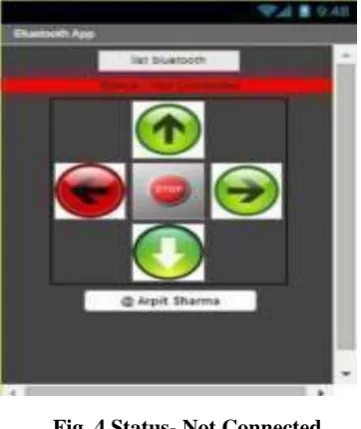
The Mobile application consists of 5 buttons viz. Right, Left, Forward, Reverse, Stop.
Fig. 4 Status- Not Connected
Fig.5 Status- Connected
Now since the Bluetooth of the mobile is connected to another Bluetooth Module, the status shown is “Connected”.
II. Results & Discussion
As performance limits in mobile robotics are increasing, dynamic effects (and therefore dynamic stability) are becoming ever more important. This project has resulted in building a working self-balancing mobile robot on two wheels. The robot is successfully balanced and driven using a computer or a cell phone. Various control techniques have been designed and tested.
The paper has presented the process in which the project has been carried out from the design and production of specific parts to the integration of electronic, mechanical and software sections. Because of the need to use the knowledge in the fields of mechanics, electronics, programming and control, this project is extremely interdisciplinary and as such one of the most representative mechatronic problems. Further work will include increasing the level of autonomy of the robot by adding a vision system, thus allowing the robot to avoid obstacles. Also, by improving the components of the robot we hope to achieve higher speeds.
References
[1] R.S.Meena,VikasKumawat(2011) .Controller Design For Servo Motor Using MATLAB .In Proceeding of National Conferences on Advances & Research in Electrical System Technology ( AREST 2011).
[2] Popescu, Cristina; Paraschiv, Nicolae; Cangea, Otilia.(2011) Comparison Between Pid And Fuzzy Controllers Used In Mobile Robot Control annals of daaam& proceedings;jan2011, p223
[3] Kotaki, Masakazu; Yamakawa, Yuji; Yamazaki, Takanori; Kamimura, A Tuning Method for PID Controller That Considers Changes in System Characteristics. ASHRAE Transactions. 2005, Vol. 111 Issue 2, p13-22. 10p.
[5] Robert L.Woods(1999).Modeling And Simulation Of Dynamic Systems.New Jersey: Prentice Hall.
[6] Nise, Norman S... Control Systems Engineering. Fifth edition 2008.
[7] D. Simon, Kalman Filtering With State Constraints: A Survey Of Linear And Nonlinear Algorithms, IET Proceediings in Control Theory & Applications, vol. 4, no. 8, pp. 1303-1318, 2010