161 | P a g e
PERFORMANCE ANALYSIS OF CCGT POWER CYLCE
USING MAT LAB CODING
Neelam Khandelwal
1, Nikita Agarwal
2,Binit Kumar Jha
31
Assistant Professor, Department of Manufacturing Technology, JSSATE, Noida (India)
2
Assistant Professor, Department of Manufacturing Technology, JSSATE, Noida (India)
3
Professor & Head Department of Manufacturing Technology, JSSATE, Noida (India)
ABSTRACT
A combined cycle is a synergistic combination of two or more power cycles operating at different temperatures running independently. Normally the cycles are classified as a 'topping' and a 'bottoming' cycle. Presently, the gas steam combined cycle is widely accepted, where Brayton Cycle has high source temperature and rejects heat at suitable temperature that is conveniently used as the energy source for the Rankine Cycle. The performance of combined cycle depends upon number of parameters like TIT, component efficiencies, turbine exhaust temperature, degree of supplementary firing and condition of steam generation. Our work is to find specific work output and optimize the thermal efficiency of combined cycle by reheating without supplementary firing and reheating with supplementary firing when steam is generated at 12 bar 3250C for a given set of parameters like temperature, pressure ratio and A/f ratio. MAT lab coding has been used for validation of research work.
Keywords: Combined Cycle, Optimization, Steam turbine, Gas turbine, Efficiency, Supplementary heating, ,
A/F ratio, Pressure ratio.
I. INTRODUCTION
The introduction of combined cycle had opened new avenues in the field of power generation. The gas turbines that were
initially used in peak load power generation and emergency conditions could be used in base load power generation.
Combined Cycle is a synergistic combination of gas cycle and power cycle. Thus performance of combined cycle
depends upon the performance of gas cycle and steam cycle. So in order to achieve this objective the parameters that
affect the performance of gas turbine (maximum temperature, component efficiency, a/f ratio and pressure ratio) the
limitations that restrict the performance of gas turbine (space, cost and metallurgical limitations) were determined .One of
the major limitations of gas cycle is the unavailability of materials that could withstand high temperature. So, gas turbines
162 | P a g e
amount of unused oxygen in which additional fuel can be burnt. Thus concept of supplementary heating comes intopicture.
S. De and P.K. Nag[1] has been done the exergy analysis of various components at different degree of supplementary
heating . It is found that the most favorable benefit of supplementary heating is for a low temperature ratio only and for
higher temperature ratio gain in work output is at an expense of overall efficiency of the plant. .Louis JF Hirao Ka K and
E.I. Masri M.A [2] have proposed the comparative study of the influence of different means of turbine cooling on gas
turbine performance G.CARRY et. Al. [3] has discussed the effect of steam cycle regeneration on combined cycle. They
find out that efficiency could rise for low turbine pressure ratio and for small regeneration degree and regeneration degree
causes an increase in efficiency when it is small enough .Considerable work on comparative evaluation of advanced
combined cycle alternatives is reported in literature [4].IG RICE [5] have discussed the effect of pressure ratio and firing
temperature on power output, thermal efficiency, turbine exit temperature. According to this reheat cycle gas turbine
efficiency is degrade slightly over the simple cycle for equal firing temperature and the reheat cycle gas turbine output is
increased significantly. It has been also mentioned that as the pressure ratio is increased the compressor discharge
temperature also increase. However gas generator exit temperature decreases with increase in pressure ratio. He
emphasize on the role of pressure ratio on specific power output and thermal efficiency. And find that as the pressure
ratio for compression increases the specific work output for gas turbine increases whereas work output in steam turbine is
decrease .M.A. Da Cunha et. Al. [6] has discussed the concept of inter cooling and reheat for gas turbines and the effect
of position of inter-cooling and reheating on gas turbine performance. In our analysis we discuss the optimized efficiency
of the combined cycle with given sets of constraints and variables. The optimized result will give the maximum
efficiency of the Combined Cycle which defines the running conditions of both the Gas Turbine and Steam Turbine
Cycles. In 2012 Thamir K. Ibrahim2(7) has discussed the effect of compression ratio on performance of Combined Cycle
Gas Turbine. R-I Crane [8] has discussed the critical analysis of the thermodynamic advantages of reheat in Gas
Turbines.
In the present analysis, the specific work output and thermal efficiency of combined cycle is determined at different a/f
ratio in the range of 50-130 and pressure ratio in the range of 4-40. It is observed that specific work output and thermal
efficiency improve at lower a/f ratio and higher-pressure ratio.
II. THERMODYNAMIC MODELING OF COMBINED CYCLE
In the present analysis of combined cycle, the effect of various parameters like a/f ratio), pressure ratio on specific work
output and thermal efficiency. The effect of reheat, supplementary heating and condition of steam generation i.e. pressure
and temperature on specific work output and thermal efficiency are also analyzed.
To analyze the present study the methodology adopted are
Firstly calculate worknetl, work net2 and efficiency 1, efficiency 2 at different a/f ratio and pressure ratio for
a) Reheat , inter-cooling without supplementary firing
b) Reheat , inter-cooling with supplementary firing
when the steam is generated at 12 bar and 325oC
163 | P a g e
contribute.Thus we can calculate work3 and efficiency3. Here,
work 3 = work net 1 + work net 2
efficiency 3 = efficiency 1 + efficiency 2
Fig. 1 Gas Turbine Cycle (Brayton Cycle) Fig. 2 Rankine Cycle
without Supplementary heating with Reheat without Supplementary heating with Reheat
and with Inter-cooling. and with Inter-cooling.
III. ANALYSIS OF GAS TURBINE CYCLE
3.1 With Reheat Without Supplementary Heating
ti pi γ-1/ γ--- = ---
t1 p1
where γ –1
--- = 0.2857
γ
Also, pi = sqrt (p1 x p2), where Sqrt = Square Root
164 | P a g e
ti - t1--- = ηc
tia – t1
ti – t1
tia = --- + t1
ηc
Now, similarly
t2 – tx
t2a = --- + tx
ηc
Here, for perfect inter-cooling, tx = t1
t2 – t1
So t2a = --- + t1
ηc
Now, to calculate t3
mf x L.C.V = (mf + ma ) x Cpg x (t3 – t2a)
ma = 1 x a/f
mf x L.C.V
t3 = --- + t2a
(mf + ma) x Cpg
t
3 p3 0.2857--- = ---
t4 p4 and p4 = sqrt (p3 x p5)
t3
t4 = ---
(p3 / p5) 0.2857
and t5 = t3
t5
t6 = ---
165 | P a g e
t5 – t6aηt = --- , t6a = t5 – ηt (t5 – t6)
t5 – t6
Here,
wt = (mf + ma) x Cpg x (t3 - t4a + t5 –t6a)
and
wc = ma x Cpa x (t2a – tx + tia – t1)
Now,
Work 1
Thermal = ---
Efficiency mf x L.C.V + (mf+ ma) x Cpgx (t5– t4a)
3.2 Reheat With Supplementary Heating
We have,wt = Z x (mf + ma) x Cpg x (t3-t4a + t5 –t6a)
IV ANALYSIS OF STEAM CYCLE
4.1 With Reheat Without Supplementary Heating
Mass of steam generated by utilization of waste energy.
Work (steam) = ms x (h3-h2)
Now to calculate 'ms'
(mf+ ma) x Cpgx (t8– t9)
ms = ---
(h3 - h2)
Also,
work net 2 = (work 2)
---
(mf + ma)
Efficiency 2 = (work 2)
---
mfx L.C.V + (mf+ ma) x Cpgx (t5– t4a)
4.2 With Supplementary Heating With Reheat With Inter Cooling
To calculate mass of steamms(h1- hf3) = Z x (mf+ ma) x Cpg x (t8 – t9) +Za x mf x L.C.V
166 | P a g e
Where Z is supplementary fuel fired.ms = Z x (mf + ma) x Cpg x(t8-t9) + Za x mf x L.C.V
---
. (h3 – h2)
work net2 = work2
---
(mf + ma)
Here,
work2
Efficiency 2 = ---
mf x L.C.V+ (mf+ ma) x Cpgx (t5– t4a)
V.
ANALYSIS THROUGH MATLAB CODING
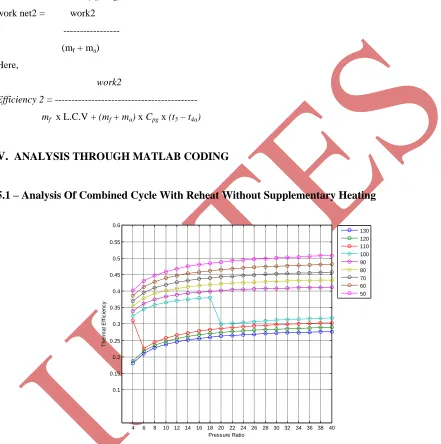
5.1 – Analysis Of Combined Cycle With Reheat Without Supplementary Heating
4 6 8 10 12 14 16 18 20 22 24 26 28 30 32 34 36 38 40 0.1 0.15 0.2 0.25 0.3 0.35 0.4 0.45 0.5 0.55 0.6 Pressure Ratio T h e rm a l E ff ic ie n c y 130 120 110 100 90 80 70 60 50
Fig. 3: Thermal Efficiency v/s Pressure Ratio at Different A/F Ratio with Reheat without Supplementary Heating
When Steam is generated at 12 bar 3250C
The Optimized Value of Efficiency at Air/Fuel Ratio 50.00 and Pressure Ratio 40.00 is 0.508.
1) Steam cycle become effective for A/F ratio 110 and lower.
2) At A/F ratio of 100 Efficiency 3 increases from pressure ratio 4 to pressure ratio 18. Efficiency 3 decreases sharply in
167 | P a g e
3) At a particular pressure ratio the Efficiency 3 increases with lowering of A/F ratio.4)It is also seen that Efficiency 3 continuously increases with pressure for all A/F ratio.
5)The optimized value of Efficiency 3 is at A/F ratio 50 and pressure ratio 40.
5.2 – Analysis Of Combined Cycle With Reheat With Supplementary Heating.
0 2 4 6 8 10 12 14 16 18 20 22 24 26 28 30 32 34 36 38 40 0
0.05 0.1 0.15 0.2 0.25 0.3 0.35
Pressure Ratio
T
h
e
rm
a
l
E
ff
ic
ie
n
c
y
130 120 110 100 90 80 70 60 50
Fig.4 : Thermal Efficiency v/s Pressure Ratio at Different A/F Ratio with Reheat with Supplementary Heating
When Steam is generated at 12 bar 3250C
The Optimized Value of Efficiency at Air/Fuel Ratio 50.00 and Pressure Ratio 10.00 is 0.322.
1) The steam cycle becomes effective for A/F ratio 110 and lower.
2) It is seen that when steam is generated at high pressure and temperature, Efficiency 3 increases.
3) The optimization point-shift downward if we opt for lower A/F ratio and is located at A/F ratio 50 and pressure ratio
10.
VI. CONCLUSION
Turbine exit temperature is decreasing as pressure ratio is increased keeping A/F ratio constant because turbine maximum
temperature does increase with pressure ratio but this effect is marginalized by the increase of expansion ratio owing to
higher pressure ratio. At a particular pressure ratio if a higher A/F ratio is optimized then turbine maximum temperature
168 | P a g e
mass of fuel is used for raising the temperature of higher quantity of flue gas resulting in low temperature of turbine inlettemperature. In the gas turbine cycle the efficiency first increase and then decreases with increasing pressure ratio when
steam is generated at, 12 bar 3250C with reheat .A steam cycle does not effective at higher A/F ratio. Generally steam
cycle is effective at A/F ratio 110 and less than it. Efficiency of steam cycle is decreases as pressure ratio increases when
steam is generated at 12 bar 3250C, with or without reheating and with or without supplementary heating. In combined
cycle for A/F 130 to A/F 100 the turbine exit temperature is less than 3250 C i.e. ( the condition of Steam generated )so
steam cycle does not contribute and, Efficiency = Efficiency 1.Steam cycle became effective at A/F ratio of 100 and
lower. Here Efficiency = Efficiency 1 + Efficiency 2.At a particular pressure ratio the efficiency of combined cycle is
increases at lower A/F fuel ratio.
NOMENCLATURE
mf Mass of fuel
ma Mass of Air
a/f Air Fuel Ratio
ηc Isentropic compressor efficiency
ηt Isentropic turbine efficiency
h1 Enthalpy of steam at turbine Inlet temperature
h2 Enthalpy of steam after expansion in turbine.
hf3 Enthalpy of feed water after considering pump work.
Work 1 Work output in gas turbine per kg of fuel burnt.
Work net 1 Work output in gas turbine cycle per kg of flue gas.
ms Mass of steam
Work 2 Work output (steam cycle.) per kg of fuel burnt.
Work net 2 Work output (steam cycle.) per kg of flue gas.
Efficiency 1 Thermal efficiency for gas turbine cycle.
Efficiency 2 Thermal efficiency for steam cycle.
Work 3 Specific work output for combined cycle.
Efficiency3 Thermal efficiency for combined cycle.
p2 Compressor exit pressure.
t2 Compressor exit temperature.
t3 Turbine Inlet Temperature
t4 Isentropic Turbine Exit Temperature (w/o Reheating)
t5 Temperature after Reheated.
t6 Isentropic Turbine exit temperature (with Reheating).
p3 Pressure in combustion chamber for gas turbine cycle.
p4 Reheat Pressure.
ti Isentropic Temperature of air after intercooler.
169 | P a g e
T.I.T Turbine Inlet Temperature
w/o Without
H.R.S.G Heat Recovery Steam Generator
H.P.C High Pressure Compressor
L.P.C Low Pressure Compressor
High Pressure Turbine H.P.T
L.P.T Low Pressure Turbine
ti Actual temperature of air after passing low pressure
Compressor
t2a Actual temperature of air after passing high pressure Compressor
t4a Actual temperature of flue gas after passing high pressure
Turbine
t6a Actual temperature of flue gas after passing low pressure Turbine
tx Temperature of air after passing through intercooler.
wt Work output of turbine.
wc Work required in the compressor.
tia Actual temperature after compression
L.C.V Lower Calorific Value.
.p1 Ambient pressure.
t1 Ambient temperature.
Cpg Specific heat of flue gas.
Cpa Specific heat of air.
Z The percentage of fuel that is burnt in Combustion Chamber
when supplementary heating is considered.
Za The percentage of fuel that bypass the Combustion Chamber
when supplementary heating is considered.
REFERENCES
[1] S-De and P.K. Nag, "Effect of Supplementary Firing on the Performance of an Integrated Gasification Combined
Cycle Power Plant" I Mech E, Vol. 214 Part A, 2000
[2] Louis JF Hirao Ka K and E.I. Masri M.A. "Comparative study of the influence of different means of turbine cooling
on gas turbine performance" ASME paper 83 - GT 180.
[3] G.CARRY and A.COLAGE July "Steam cycle regeneration influence on Combined Gas-Steam power plant
performance" ASME paper, 1985
[4] Bolland April, “A Comparative Evaluation of Advanced Combined Cycle Alternatives”. Journal of Engineering for
Gas Turbine and Power, Vol.113 Pages 190-202, 1991
[5] I.G Rice January "The Combined Reheat Gas Turbine & Steam Turbine Cycle" Journal for Engineering for power
170 | P a g e
[6] M.A Da Cunha Alves H F De Franca Mendes Carneiro, J R Barbosa, l.E.Travieso, P pilidis and K W Ramsden, “Aninsight on inter-cooling and reheat Gas Turbine”. Proc Institute of Mechanical Engineers Vol. 215 Part A, 2001
[7] Thamir .K.Ibrahim “Thermodynamic analysis of gas turbine power plant” internal journal of physical science vol 6
(14), 2011
[8] R-I Crane,1998 "A Critical Analysis of the Thermodynamic Advantages of Reheat in Gas Turbines." Proc Institute
Mech. Engineers Vol 212 Part A.
[9] Cohen H. Rogers, Gas Turbine Theory ( G.F.C. and Sarvanmutto HIH, 1972) 4th Edition.
[10] Cox H.R., Gas Turbine Principles and Practice (George Newton Ltd. London, 1955)
[11] R.Yadav, Steam and Gas Turbines( Central Publishing House, Allahabad).
Biographical Notes
Ms. Neelam Khandelwal is working as a Assistant Professor in Manufacturing Technology Department , JSSATE, Noida,
India.
Ms. Nikita Agarwal is working as a Assistant Professor in Manufacturing Technology Department , JSSATE, Noida,
India
Prof.Binit Kumar Jha is working as a Professor & Head in Manufacturing Technology Department , JSSATE, Noida,