fi
Population
WHAT’S KNOWN ON THIS SUBJECT: Botulinum spores are ubiquitous, found in the soil of most countries worldwide, and also in honey. It is well established that ingestion of honey by children aged,1 year can lead to infant botulism.
WHAT THIS STUDY ADDS: This study examines the prevalence of honey pacifier use among a pediatric population aged,1 year. We also assessed parental knowledge of the dangers of giving honey to children in this age group.
abstract
BACKGROUND:Use of honey pacifiers by infants presenting to a pedi-atric clinic at a county hospital in Houston, Texas, was observed by several of our staff members. Although we could not find any pub-lished studies linking the use of honey pacifiers to infant botulism, we also could not find any studies assessing the prevalence of honey pacifier use in general.
METHODS: We conducted a cross-sectional, descriptive study using a novel survey that had 19 items. The survey was administered to the parents of children up to age 12 months presenting to a county hospital pediatric clinic for well-child care in Houston, Texas, from February 2010 to April 2011.
RESULTS: There were 397 respondents. Approximately 11% of the respondents reported using honey pacifiers with their infant children. Reasons for use included tradition, infant preference, and perceived health benefits (eg, helps with constipation or colic). Approximately 20% of the honey pacifier users and 23% of the entire group reported knowledge of honey potentially causing an illness in children ,12 months of age. Nearly 40% of all respondents also reported using herbal or folk remedies.
CONCLUSIONS:Honey pacifier use was relatively common among this population, seen in ∼1 out of 10 respondents. A majority of the mothers surveyed (∼80%) were unaware of the potential dangers of giving honey to infants under age 12 months. Herbal medicine use was also common.Pediatrics2013;131:e1838–e1841
AUTHORS:Laura J. Benjamins, MD, MPH,aAnand Gourishankar, MD,bVanessa Yataco-Marquez, BS, MPH,c Elizabeth Hernandez Cardona, MD,dand Lisa de Ybarrondo, MDb
aDivision of Adolescent Medicine, Department of Pediatrics, bDivision of Community and General Pediatrics, Department of
Pediatrics, andcStudent at the University of Texas Medical School
at Houston, Houston, Texas; anddDepartment of Surgery, Baylor
University Medical Center, Dallas, Texas
KEY WORDS
honey, food-borne botulism, infantile, pacifiers, knowledge, herbal medicine
Dr Benjamins, principle investigator, held primary responsibility for the design and implementation of the study and for the analysis of the data and writing of the results and the manuscript. Dr Gourishankar contributed significantly to the analysis of the data, as well as to the content of the manuscript; contributed significantly to the literature review and writing of the introduction; and approved thefinal version of the manuscript submitted. Ms Yataco-Marquez held primary responsibility for the collection and management of the data, aided in the analysis of the data and the writing of the manuscript, and approved thefinal version of the manuscript submitted. Dr Cardona contributed significantly to the design of the study as well as to the survey used; contributed significantly to the institutional review board application; contributed significantly to the literature review and writing of the introduction; and approved thefinal version of the manuscript submitted. Dr de Ybarrondo oversaw the implementation of the study and data collection, contributed significantly to the writing of the manuscript, and approved thefinal version of the manuscript submitted.
www.pediatrics.org/cgi/doi/10.1542/peds.2012-3835
doi:10.1542/peds.2012-3835
Accepted for publication Feb 19, 2013
Address correspondence to Laura Benjamins, MD, MPH, Department of Pediatrics, University of Texas-Houston Medical School, 6431 Fannin St, MSB 3.137, Houston, TX 77030. E-mail address: [email protected]
PEDIATRICS (ISSN Numbers: Print, 0031-4005; Online, 1098-4275).
Copyright © 2013 by the American Academy of Pediatrics
FINANCIAL DISCLOSURE:The authors have indicated they have nofinancial relationships relevant to this article to disclose.
It has been well documented that con-sumption of honey by a child aged,12 months is associated with infant botu-lism.1–4 Botulinum spores are ubiqui-tous and found in most countries; the spores have also been found in honey. Although adults who swallow botuli-num spores are almost never affected, infants can become ill because the spores can germinate in their large intestine and begin producing the bot-ulinum toxin. This has been reported to occur even when the honey was only used to sweeten a pacifier.5
Infant botulism is age-related but does not seem to be affected by race or ethnicity; 95% of all cases occur in patients 6 weeks to 6 months of age.6 More than 1500 cases have been iden-tified in the United States since it was first recognized in 1976, with ∼80 to 100 cases per year currently being reported.6 A recent publication re-viewing the global occurrence of infant botulism found that honey exposure was significantly more common among infants hospitalized outside of the United States.1 Although Clostridium
botulinum spores are known to be found in soils and dust worldwide, most countries have not yet reported cases of infant botulism, suggesting that the disease is either underrecog-nized and or underreported.1Likewise, the full extent of infant morbidity and mortality that result from the intestinal production of botulinum toxin is not known. However, on the basis of what is known, the single most effective way to prevent infant botulism is to avoid honey consumption altogether.
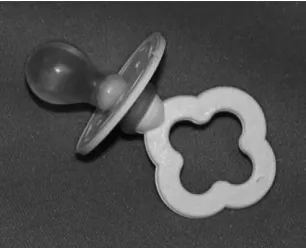
It may not be standard in most practices to inquire about pacifier use; therefore, many practitioners may be unaware that their infant patients are using a honey-filled pacifier. Honey pacifiers are typically produced outside the United States but are widely available; the nipple is usually round andfilled with honey (Fig 1). There are no published
studies on the prevalence of honey pacifier use and the link to infant botu-lism. There was, however, a recent re-call of these pacifiers put out by the US Consumer Product Safety Commission because the nipples frequently detach from the base and pose a choking haz-ard.7 In our clinical practice, we ob-served that the use of honey pacifiers is common among the indigent Hispanic patients of Mexican descent. Many of the families that use these pacifiers are unaware of the risks associated with using them. There are no documented studies regarding a connection between the indigent population and use of honey-filled pacifiers or published rec-ommendations for prevention of its use. Therefore, we conducted a novel survey of the families visiting our clinic to as-sess their knowledge of infant botulism and their use of honey-filled pacifiers.
METHODS
From February 2010 to April 2011, we conducted a cross-sectional, descrip-tive study using a novel survey that asked parents about use of honey pacifiers with their children aged,1 year. We estimated that the proportion of patients using honey pacifiers based on our clinical experience was∼1 out of 10. We therefore calculated that a minimum sample size of 384 patients would be needed to obtain a confidence level of 95% and a confidence interval of 63%. Approval from the University
of Texas Committee on the Protection of Human Subjects as well as the Harris County Hospital District Institutional Review Board was obtained.
Subjects
The parents of children presenting to a pediatric clinic at a county hospital in Houston, Texas, were approached to participate in a 19-item survey. Families were eligible if they were bringing their infant for a well-child care visit, from newborn to 12 months of age. Families bringing their children for sick visits were excluded.
Instrument and Data Collection The 19-item survey was available in English and Spanish and included pic-tures of honey pacifiers (Fig 1). A re-search assistant who was fluent in both languages was also available to help administer the survey and answer any questions. There was a letter of explanation; willingness to complete the survey implied consent. Items in-cluded questions on the use of honey pacifiers, reasons these pacifiers were used, as well as questions about infant botulism and the association of honey consumption by infants. Additional items included questions about use of herbal remedies, alternative medi-cines, and demographic information including type of insurance (Medicaid, Children’s Health Insurance Program, Harris County Gold Card, or private). After the survey was completed, the families were given a handout on infant botulism that briefly discussed causes, symptoms, and prevention.
Statistical Analysis
We entered our data into an Excel spreadsheet and then analyzed by using Stata 11 (Stata Corp, College Station, TX) with descriptive statistics. To see if there were significant differences across groups, we also performed stratified analysis by demographic characteristics
FIGURE 1
Honey pacifier.
ARTICLE
PEDIATRICS Volume 131, Number 6, June 2013 e1839
at Viet Nam:AAP Sponsored on August 27, 2020
www.aappublications.org/news
RESULTS
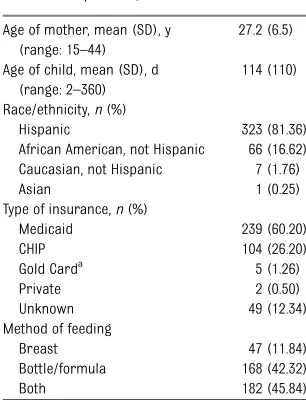
There were 397 respondents; no one refused participation. Demographic information is presented in Table 1. A majority of the respondents were His-panic (81%) and had either Medicaid or Children’s Health Insurance Program as insurance for their child (86% combined). Approximately 11% of the population surveyed reported using honey pacifiers with their infants (Table 2). Use was 13.5% among His-panic responders compared with 1.5% in African Americans and 0% in White and Asian responders. Reasons for use included tradition, infant preference, and perceived health benefits (eg, helps with constipation or colic). Ap-proximately 40% of honey pacifier users reported ever noticing a hole or a leak in the pacifier nipple. About 22% of honey pacifier users and 18% of the entire group reported ever being told that the honey pacifier could be dan-gerous for their infant. Similarly,∼20% of the honey pacifier users and 23% of the entire group reported knowledge
,
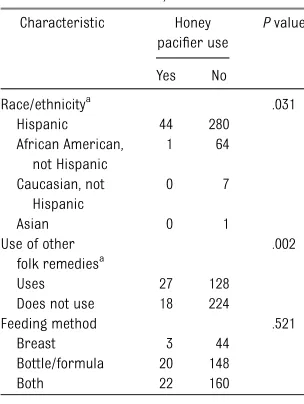
Nearly 40% of all respondents used other folk or herbal remedies, which included sage, rue, peppermint, aloe vera, eucalyptus, corn syrup, garlic, and oregano. The most commonly used her-bal remedy was chamomile tea (84%). Mothers who gave honey pacifiers to their infants were also more likely to give their children these alternative remedies (Table 3). Hispanic ethnicity was also significantly related to honey pacifier use; no other factors that we examined were associated with use.
DISCUSSION
While there have been no published reports of honey pacifiers being linked to infant botulism, the risks of giving honey to infants aged,1 year are well established. Even though 1 out of 10 of the families surveyed reported using these pacifiers, most were unaware of the risks. The mean age of starting honey pacifier use was∼2 months of age, which is within the peak incidence of infant botulism. Furthermore, the majority of the families that used honey pacifiers with their infants also gave them other folk remedies and herbal medications, some of which can be potentially harmful. For example, Clos-tridium botulinum spores have been isolated in chamomile as well,8which was the most frequently used alterna-tive remedy in our population. This underscores the need of physicians to be aware of common practices within their population and to educate their families about possible risks. Although these pacifiers are primarily manu-factured in Mexico, they are widely available in Texas through Mexican stores, chain grocery stores, andflea markets, despite the recent recall of these products. Nearly half of our re-spondents purchased their honey paci-fiers in Houston. This may indicate a need for better regulation of such
products within US cities close to the Mexican border. Lastly, at the time of our study, it was understood that these pacifiers were filled with honey. More recently, pacifiers marketed aschupon con mielare reportedlyfilled with corn syrup. Previous studies have found bot-ulinum spores in corn syrup as well as a possible association with infant botu-lism,9,10although more recent changes in corn syrup production has made this less likely (at least in the United
TABLE 1 Characteristics of Study Population,N= 397
Age of mother, mean (SD), y (range: 15–44)
27.2 (6.5)
Age of child, mean (SD), d (range: 2–360)
114 (110)
Race/ethnicity,n(%)
Hispanic 323 (81.36) African American, not Hispanic 66 (16.62) Caucasian, not Hispanic 7 (1.76)
Asian 1 (0.25)
Type of insurance,n(%)
Medicaid 239 (60.20)
CHIP 104 (26.20)
Gold Carda
5 (1.26)
Private 2 (0.50)
Unknown 49 (12.34)
Method of feeding
Breast 47 (11.84)
Bottle/formula 168 (42.32)
Both 182 (45.84)
CHIP, Children’s Health Insurance Program.
aHarris County Hospital District Insurance Program.
No. of children who use a honey pacifier,n(%)
45 (11.34)
Age of child when started using the honey pacifier, mean (SD), days
67.7 (69.4)
No. of moms that used a honey pacifier with other children,n(%)
18 (4.62)
Reasons mom chose a honey pacifier,n(%)
Preferred by baby 7 (20.00) Tradition/used it in Mexico 7 (20.00) Softer than other pacifiers 5 (14.29) Family member gave/
recommended
4 (11.43)
Health benefit (eg, for constipation)
4 (11.43)
It was a gift 3 (8.57) Convenience (eg, only
one in store)
3 (8.57)
Tastes better 2 (5.71) Does honey pacifier sooth
better,n(%), yes
15 (33.33)
Does child prefer honey pacifier,n(%), yes
16 (35.56)
Where honey pacifier was purchased,n(%)
Mexico 20 (44.44)
Hispanic store in United States (tienda Hispana)
7 (15.56)
Chain grocery store 6 (13.33) Flea market 3 (6.67)
Gift 4 (8.89)
Ever noticed a hole or leak,
n(%), yes
17 (37.78)
Ever been told that a honey pacifier could be dangerous,
n(%), yes
10 (22.22)
Entire group (n= 397) 72 (18.14) Ever told honey can cause
illness in children aged
,1 y,n(%), yes
9 (20.00)
Entire group (n= 397) 91 (22.92) Use other folk remedies,
n(%), yes
27 (60.00)
States).11 Regardless, the parents we interviewed believed the pacifiers were filled with honey; a majority of them were unaware of risks associated with honey. Lacking this knowledge could make other behaviors, such as dipping the pacifier in honey, or adding it to other foods or drinks, a possibility.
The use of a novel survey to address an issue, which has previously not been written about, is one of this study’s strengths. Although our results may not be generalizable to other pop-ulations throughout the United States, it emphasizes the importance of asking families about the use of alternative medications. Similarfindings, in terms of alternative medicine use, have been found by other authors; Pitetti et al found that the rate of use was 12% among patients presenting to a pediat-ric emergency department12; Lanski et al found a rate of 45% of herbal use among their pediatric population.13In the Lanski study, a majority of the families interviewed were also un-aware of possible side effects of these substances. Furthermore, physicians often underestimate the use of alter-native medications by their patients,14 and many families do not discuss this use with their doctor.15,16 Some folk and herbal remedies have potentially harmful side effects, and a surprisingly
large number of parents in our study gave their infants$1 herbal remedies.
CONCLUSIONS
Approximately 10% of our population surveyed used honey pacifiers with their infants. Use was predominantly seen among Hispanic mothers and was associated with the use of other folk remedies. Most mothers who used these pacifiers did not know that they could be dangerous. A majority of the mothers surveyed (∼80%) were un-aware of the potential dangers of giv-ing honey in general to infants under the age of 12 months. This highlights the need among this population for education about the risks of giving honey to infants, as well as the impor-tance of asking about alternative medicine use.
ACKNOWLEDGMENTS
We thank all of the families that partic-ipated in this study.
REFERENCES
1. Koepke R, Sobel J, Arnon SS. Global oc-currence of infant botulism, 1976–2006. Pediatrics. 2008;122(1). Available at: www. pediatrics.org/cgi/content/full/122/1/e73
2. Long SS. Infant botulism.Pediatr Infect Dis J. 2001;20(7):707–709
3. Risko W. Infant botulism.Pediatr Rev. 2006; 27(1):36–37
4. van der Vorst MM, Jamal W, Rotimi VO, Moosa A. Infant botulism due to consump-tion of contaminated commercially prepared honey. First report from the Arabian Gulf States.Med Princ Pract. 2006;15(6):456–458 5. Fenicia L, Ferrini AM, Aureli P, Pocecco M. A case of infant botulism associated with honey feeding in Italy. Eur J Epidemiol. 1993;9(6):671–673
6. Brook I. Infant botulism.J Perinatol. 2007; 27(3):175–180
7. US Consumer Product Safety Commission. CPSC, Ideal Distributors Inc. announce
recall of pacifiers. December 1, 2005. Available at www.cpsc.gov/cpscpub/prerel/ prhtml06/06043.html. Accessed December 2, 2012
8. Bianco MI, Lúquez C, de Jong LIT, Fernández RA. Presence ofClostridium botulinumspores in Matricaria chamomilla(chamomile) and its relationship with infant botulism. Int J Food Microbiol. 2008;121(3):357–360 9. Kautter DA, Lilly TJ, Solomon HM, Lynt RK.
Clostridium botulinum spores in infant foods: A survey.J Food Prot. 1982;45:1028– 1029
10. Spika JS, Shaffer N, Hargrett-Bean N, Collin S, MacDonald KL, Blake PA. Risk factors for infant botulism in the United States.Am J Dis Child. 1989;143(7):828–832
11. Lilly TJ, Rhodehamel EJ, Kautter DA, Solmon HM.Clostridium botulinumspores in corn syrup and other syrups.J Food Prot. 1991; 54(8):585–587
12. Pitetti R, Singh S, Hornyak DM, Garcia SE, Herr S. Complementary and alternative medicine use in children. Pediatr Emerg Care. 2001;17(3):165–169
13. Lanski SL, Greenwald M, Perkins A, Simon HK. Herbal therapy use in a pediatric emergency department population: expect the unexpected. Pediatrics. 2003;111(5 pt 1):981–985
14. Sikand A, Laken M. Pediatricians’ experi-ence with and attitudes toward complementary/alternative medicine.Arch Pediatr Adolesc Med. 1998;152(11):1059– 1064
15. Sawni-Sikand A, Schubiner H, Thomas RL. Use of complementary/alternative thera-pies among children in primary care pe-diatrics.Ambul Pediatr. 2002;2(2):99–103 16. Jean D, Cyr C. Use of complementary and
alternative medicine in a general pediatric clinic.Pediatrics. 2007;120(1):e138–e141
TABLE 3 Honey Pacifier Use by Characteristics,N= 397
Characteristic Honey pacifier use
Pvalue Yes No
Race/ethnicitya
.031 Hispanic 44 280 African American, not Hispanic 1 64 Caucasian, not Hispanic 0 7
Asian 0 1
Use of other folk remediesa
.002
Uses 27 128
Does not use 18 224
Feeding method .521
Breast 3 44
Bottle/formula 20 148
Both 22 160
aP#.05.
ARTICLE
PEDIATRICS Volume 131, Number 6, June 2013 e1841
at Viet Nam:AAP Sponsored on August 27, 2020
www.aappublications.org/news
DOI: 10.1542/peds.2012-3835 originally published online May 6, 2013;
2013;131;e1838
Pediatrics
Hernandez Cardona and Lisa de Ybarrondo
Services
Updated Information &
http://pediatrics.aappublications.org/content/131/6/e1838 including high resolution figures, can be found at:
References
http://pediatrics.aappublications.org/content/131/6/e1838#BIBL This article cites 15 articles, 4 of which you can access for free at:
Subspecialty Collections
b
http://www.aappublications.org/cgi/collection/infectious_diseases_su Infectious Disease
http://www.aappublications.org/cgi/collection/neonatology_sub Neonatology
sub
http://www.aappublications.org/cgi/collection/fetus:newborn_infant_ Fetus/Newborn Infant
following collection(s):
This article, along with others on similar topics, appears in the
Permissions & Licensing
http://www.aappublications.org/site/misc/Permissions.xhtml in its entirety can be found online at:
Information about reproducing this article in parts (figures, tables) or
Reprints
DOI: 10.1542/peds.2012-3835 originally published online May 6, 2013;
2013;131;e1838
Pediatrics
Hernandez Cardona and Lisa de Ybarrondo
Laura J. Benjamins, Anand Gourishankar, Vanessa Yataco-Marquez, Elizabeth
Honey Pacifier Use Among an Indigent Pediatric Population
http://pediatrics.aappublications.org/content/131/6/e1838
located on the World Wide Web at:
The online version of this article, along with updated information and services, is
by the American Academy of Pediatrics. All rights reserved. Print ISSN: 1073-0397.
the American Academy of Pediatrics, 345 Park Avenue, Itasca, Illinois, 60143. Copyright © 2013 has been published continuously since 1948. Pediatrics is owned, published, and trademarked by Pediatrics is the official journal of the American Academy of Pediatrics. A monthly publication, it
at Viet Nam:AAP Sponsored on August 27, 2020
www.aappublications.org/news