*Corresponding author: [email protected]
2017 UTHM Publisher. All right reserved. penerbit.uthm.edu.my/ojs/index.php/jst
Identification of a Spheroid based on the First Order Polarization Tensor
Nurhazirah Mohamad Yunos
1, Taufiq Khairi Ahmad Khairuddin
2* and William RB
Lionheart
31*Department of Mathematical Sciences, Faculty of Science, Universiti Teknologi Malaysia, 81310 UTM JB,
Johor, Malaysia.
2*UTM Centre for Industrial Applied Mathematics & Department of Mathematical Sciences, Faculty of Science,
Universiti Teknologi Malaysia, 81310 UTM JB, Johor, Malaysia.
3School of Mathematics, The University of Manchester, M13 9PL Manchester, UK.
Received 30 September 2017; accepted 30 November 2017; available online 28 December 2017
1. Introduction
Recently, there are some applications of electric and electromagnetic systems that use polarization tensor (PT). In electrical imaging such as for biomedical or industrial purposes, the PT is adopted in the algorithm of image reconstruction to enhance the quality of the image [1,2]. Moreover, by using similar technique in electrical imaging, the PT is also considered during the investigation of electro- sensing by weakly electric fish [3,4,5,6,7,8,9]. On the other hand, a slightly different model than electrical imaging has been developed to apply PT in metal detection for examples in security screening [10,11,12] and landmine clearance [13,14,15]. In all mentioned applications, the PT is investigated based on the perturbation of electric [1,3,4,5,6,7,8,9] or electromagnetic field [16,17,18,19,20,21] in a free space (such as 2D or 3D) due to the conductivity contrast between the space itself and a conducting object. In this case, the PT depends on the geometry and the conductivity of the object. Therefore, the PT representing the perturbation due to the presence of the object is also referred as the PT for that object. In the literatures, there are two approaches used to determine the PT. In the study of electrosensing fish, the PT is mostly determined by using analytical formula whereas in metal detection, the PT is obtained
based on data collected during field measurements.
Computing the PT based on both approaches are essential in order to effectively apply the PT. A few studies focusing on computing the PT according to the analytical formula can be found for examples in [19,22,23,24,25]. Meanwhile, the PT used in [11,12,13,14,15] are computed according to optimization technique based on a few measurements data obtained during experiments in the laboratory. In addition, other studies such as by [20,26,27] compare the PT computed both by analytical formula and field measurements. Besides, understanding the properties of the PT is also important in the related applications. For example, in order to describe a conducting object based on its PT, we must be able to explain how PT represents that object. Because of this, many researchers have investigated the important properties of PT but, there are some useful properties of PT that have not yet been revealed.
In this study, by examining the analytical formula of the first order PT for ellipsoid, we will present some properties related to the first order PT specifically for spheroid. Previous studies have shown that the first order PT for most objects are actually also the first order PT for spheroid [7,27,28]. Thus, we might increase our understanding on the first order
Abstract: Polarization tensor (PT) has a lot of useful and important practical applications. In this case, it must be firstly determined by some appropriate method. Besides, understanding some properties of the PT might also be very useful in order to apply it. In this study, we investigate the first order PT for ellipsoid and use it to describe the first order PT for spheroid as well as identify the spheroid. Numerical examples are also given to further justify our results.
155
PT for many objects by investigating the first order PT for the spheroid.
In the next section, we will briefly review the mathematical formula of the first order PT for ellipsoid before investigating spheroid.
2. Mathematical Formulation of the Polarization Tensor
Let B be a small object presented in the space
3
R
.
The conductivity
x is then defined such that for any pointx
R
3.
. for
, 1
, for , )
( 3
R x
B x k
x
(1)
where k is a constant depending on the material of B. Equation (1) suggests that there exists a conductivity contrast between R3
(conductivity equal to 1) and B (conductivity equal to k). According to Ammari and Kang [1], if there is an electrical field in R3with the presence of B, B are then described by the terminology called as the Generalized Polarization Tensor (GPT). GPT can be determined by solving system of integral equations and the simplest form of GPT denoted by M is called as the first order GPT (or simply the first order PT). Here, M for B at conductivity k, denoted by M (k, B) where
0
k
1
is a real 3 x 3 matrix and it is proven in [1] that M is symmetric. Moreover, [1] has also shown that M is positive definite if1
k
whereas, it is negative definite if0
k
1
.
In addition, by adapting [1,29,30,31], Mohamad Yunos and Ahmad Khairuddin [32] have proposed a slightly different explicit formula of the first order PT when B is an ellipsoid. If B is an ellipsoid with semi principal axes a, b and c (a,b,c0), that can
be represented by
2 2 2
2 2 2 1
x y z
a b c in the
Cartesian coordinate system,
M k B
( , )
is a nonzero matrix given by [32] as
3 2 1
0 0
0 0
0 0
) 1 ( ) , (
m m m
B k B k
M , (2)
where
|
B
|
is the volume of B and for i1, 2and 3, 1 .
(1 )
i
i i
m
d kd
di are nonnegative
constants called as depolarization or demagnetizing factors [29,30,31] given by
2
i i
abc
d I where
1 2 3 2 2 2
0
1
,
(
)
(
)(
)
I
dy
a
y
b
y c
y
(3)2 2 3 2 2 2
0
1
,
(
)
(
)(
)
I
dy
b
y
a
y c
y
(4)3 2 3 2 2 2
0
1
.
(
)
(
)(
)
I
dy
c
y
a
y b
y
(5)Previously, depolarization factors were classically appeared in the study of composites [29] and also had been used by [30,31] to study electromagnetism.
Therefore, equation (2) together with (3), (4) and (5) will be used to investigate some properties of the first order PT for spheroid.
3. Results
In this section, we will present some properties related to the first order PT for spheroid. Here, the spheroid is a specific case of the ellipsoid given by the previous Cartesian equation, where, two of its semi principal axes are equal. In order to achieve our purpose, we firstly prove the following lemma.
Lemma 1 Let
a b
,
and c be the semi principal axes of ellipsoid2 2 2
2 2 2 1
x y z
a b c
and di is the depolarization factors for
1, 2,3
i
.
a.
a
b
, if and only if
d1d2.
b. ac
, if and only if
d1 d3.c.
b
c
, if and only if
d2 d3.Proof :
156
Assume that
a
b
.
We need to show that1 2.
d d By substituting
a
b
into both1
d and d2,we immediately have d1 d2.
Now, suppose that d1d2.We need to
show that
a
b
.
Since d1 d2,we will have2 3 2 2 2
0
1
2
(
)
(
)(
)
abc
dy
a
y
b
y c
y
2 3 2 2 2
0
1
2
(
)
(
)(
)
abc
dy
b
y
a
y c
y
which implies
21 21 .(a y) (b y)
Thus,
2 2
b
a
that is
b
a
.
Therefore, it is pro-
ven that
a
b
since
a b, 0.Next, for simplification, we rewrite (2) as
1
2
3
0 0
( , ) 0 0 ,
0 0
M
M k B M
M
(6)
whereMi (k1) |B m| i.For each i=1,2,3,
i
m is given as in the previous section. We now propose the next theorem.
Theorem 2 Let
M k B
( , )
be the first order PT for ellipsoid2 2 2
2 2 2 1
x y z
a b c at any conduc-
tivity
k,
where0
k
1
.
a. ab,
if and only if
M1 M2.
b. ac,
if and only if
M1M3.c.
bc,if and only if
M2 M3.Proof :
We prove part (a) first.
Suppose that
a
b
.
We need to show
that
M1 M2. According to Lemma 1, we
know that
a
b
implies
d1d2. Thus, by
substituting
d1 d2into
M1and
M2, we
immediately obtain
M1M2.
Now, assume
M1 M2. We need to
prove that
a
b
. Since
M1 M2, we have
1 1
1
( 1) | |
(1 )
k B
d kd
2 2
1
( 1) | | ,
(1 )
k B
d kd
1 1 2 2
1 1
, (1d )kd (1d )kd
2 2 1 1,
kd d kd d
2 1
(d d )(k 1) 0.
So, we have either
(d2 d1)0or
(k 1) 0
or both. However,
k
1
and
thus
d1d2. Therefore,
a
b
by Lemma
1.
The same steps can be repeated to
prove part (b) and (c).
4. Discussion
In the previous section, we have shown that the first order PT (in the form of (6)) for a
spheroid, given by
2 2 2
2 2 2 1
x y z
a b c where
either ab, ac or bc,has two distinct diagonals. Numerical examples to validate this can be found for examples in [7], [27], [28] and [32]. Here, all the first order PT for the spheroids at any conductivity
k
are positive definite matrices whenk
1
whereas they are negative definite matrices whenk
1
, as suggested by [1].In addition, we have also shown that either
,
a
b
acorb
c
when the first order PT for a spheroid in the form of (6) has two distinct diagonals. Given the first order PT for a spheroid with two distinct diagonals in the form of (6), finding the values of a,b and c is not straightforward. For example, we have to solve (2) equal to a given (known) first order PT (usually in the form of (6)). A method to solve (2) from a given first order PT actually has been discussed in [27] and [28]. This technique is used during the investigation of the first order PT in electrosensing fish by [7], [27] and [33].157
,
a b c the conductivity
k
1
if the first order PT of a spheroid is positive definite matrix whereask
1
if the first order PT of a spheroid is negative definite matrix. This is a rule that has to be followed to find the value aand b=c from a given first order PT. The next two examples given in this study will follow the results in [34] and also Theorem 2 part (c).
Table 1 shows the values for a and b=c
when (2) is solved equal to
44 0 0
0 44 0
0 0 32
,
(7)by the method proposed in [27] for three different conductivities,
k
. Here,k
1
since (7) is a positive definite matrix. The diagonal matrix (7) is actually the first order PT at5 10
k for a pyramid with length, width and height all equal to 3, as given in [5].
Table 1. The value for semi principal axes
,
a bc of a positive definite first order PT when
k
1
.
Conductivity, k Principal axes, a,b=c
1.5
a
0.6308
5.8770
b
50
a
1.2311
1.6379
b
100
a
1.2257
1.6175
b
In contrast, the values for a and
b
c
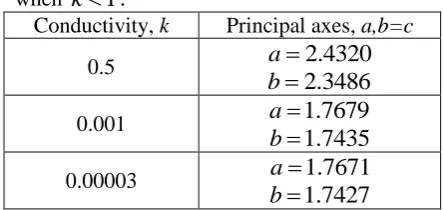
in Table 2 are obtained when (2) is solved equal to
81 . 33 0
0
0 81 . 33 0
0 0
53 . 33
,
(8)by the same method for three different conductivities, k where
k
1
since (8) is a negative definite matrix. Here, matrix (8) as given in [28] is the first order PT for a cylinder with diameter and length both are equal to 3 at5
5 10 .
k
For all a and
b
c
in Table 1 and Table 2, the first order PT (7) and (8) can bedetermined back by using (2) with the corresponding
k
given in the same table
. Thus, the first order PT for the spheroids obtained, given by either (7) or (8) are also the first order PT for pyramid or cylinder. In the future, we might be able to increase our understanding about the first order PT forTable 2. The value for semi principal axes
,
a b
c
of a negative definite first order PT whenk
1
.
Conductivity, k Principal axes, a,b=c
0.5
a
2.4320
2.3486
b
0.001
a
1.7679
1.7435
b
0.00003
a
1.7671
1.7427
b
pyramid and cylinder by investigating the first order PT for these spheroids.
Finally, numerical examples for semi principal axes
a
b
and c (or acandb
)
from a given first order PT, as required by Theorem 2 part (a) and (b), can be found in [7], [27], [28] and [33]. In those particular studies, the values of
a b
,
and c do not follow the theories proposed in [34]. However, the same rule for k is applied when solving (2) equal to a given first order PT to obtain,
ab c or ac b,
.
5. Conclusion
In this study, we have investigated some properties which are related to the first order PT for spheroids. By investigating the first order PT for ellipsoid, we can describe and also identify a spheroid based on its first order PT. Moreover, some numerical examples are also given to further discuss our findings.
References
[1] Ammari, H. and Kang, H. (2007). Polarization and Moment Tensors : with Applications to Inverse Problems and Effective Medium Theory. Applied Mathematical Sciences Series. Springer, New York.
158
Imaging, Mathematiques and Applications. Springer, New York.
[3] Ammari, H, Boulier, T and Garnier, J (2013). “Modelling Active Electrolocation in Weakly Electric Fish” in SIAM Journal on Imaging Sciences, Vol. 6. No. 1 pp. 285-321.
[4] Ammari, H, Boulier, T, Garnier, J and Wang, H (2014). “Shape Recognition and Classification in Electro-sensing” in Proceedings of the National Academy of Sciences, Vol. 111. No. 32 pp. 11652-11657.
[5] Khairuddin, T.K.A and Lionheart, W.R.B (2014). “Does Electro-sensing Fish Use the First Order Polarization Tensor for Object Characterization? Object Discrimination Test” in Sains Malaysiana, Vol. 43. No. 11 pp. 1775-1779.
[6] Ahmad Khairuddin, T.K and Lionheart, W.R.B (2016). “Polarization Tensor: Between Biology and Engineering” in Malaysian Journal of Mathematical Sciences, Vol. 10. No. S pp. 179-191. [7] Ahmad Khairuddin, T.K and Lionheart,
W.R.B (2016). “Characterization of Objects by Electrosensing Fish based on the First Order Polarization Tensor” in Bioinspiration and Biomimetics, Vol. 11. No. 5 pp. 1-8.
[8] Ammari, H, Boulier, T, Garnier, J and Wang, H (2017). “Mathematical Modelling of the Electric Sense of Fish : the Role of Multifrequency Measurements and Movement” in Bioinspiration and Biomimetics, Vol. 12. No. 2 pp. 1-9. [9] Bazeille,S., Lebastard,V. and Boyer,F.
(2017). “Model based Object Localization and Shape Estimation using Electric Sense on Underwater Robots”. Unpublished article, HAL archieves.
[10] Marsh, L.A, Ktistis, C, A, Armitage, D.W and Peyton, A.J (2013). “Three-dimensional Object Location and Inversion of the Magnetic Polarizability Tensor at a Single Frequency Using a Walk through Metal Detector” in Measurement Science and Technology, Vol. 24. No. 2 pp. 1-13.
[11] Marsh, L.A, Ktistis, C, A, Armitage, D.W and Peyton, A.J (2014). “Determination of the Magnetic Polarizability Tensor and Three Dimensional Object Location for Multiple Objects using a Walk-through Metal
Detector” in Measurement Science and Technology, Vol. 25. No. 5 pp. 1-12. [12] Makkonen, J, Marsh, L.A, Vihonen, J, A,
Armitage, D.W, Visa, A and Peyton, A.J (2014). “KNN Classification of Metallic Targets using the Magnetic Polarizability Tensor: in Measurement Science and Technology, Vol. 25. No. 5 pp. 055105. [13] Dekdouk, B., Marsh, L.A., Armitage,
D.W. and Peyton, A.J. (2014). “Estimating Magnetic Polarizability Tensor of Buried Metallic Targets for Landmine Clearance” in Springer Science and Business Media, pp. 425-432.
[14] Dekdouk, B, Ktistis, C, Marsh, L.A, Armitage, D.W and Peyton, A.J (2015). “Towards Metal Detection and Identification for Humanitarian Demining using Magnetic Polarizability Tensor Spectroscopy” in Measurement Science and Technology, Vol. 26, No. 11 pp. 115501.
[15] Abdel-Rehim, O.A, Davidson, J.L, Marsh, L.A, Ooole, M.D and Peyton, A.J (2016). “Magnetic Polarizability Tensor Spectroscopy for Low Metal Anti-personnel Mine Surrogates” in IEEE Sensors Journal, Vol. 16. No. 10 pp. 3775-3783.
[16] Ammari, H, Vogelius, M.S and Volkov, D (2001). “Asymptotic Formula for Perturbations in the Electromagnetic Fields due to the Presence of Inhomogeneities of Small Diameter II. The Full Maxwell Equations” in J. Math. Pures Appl., Vol. 80. No. 8 pp. 769-814. [17] Ammari, H, Chen, J, Chen, Z, Garnier, J
and Volkov, D (2014). “Target Detection and Characterization from Electromagnetic Induction Data” in J. Math. Pures Appl., Vol. 101. No. 1 pp 54-75.
[18] Ammari, H, Chen, J, Chen, Z, Volkov, D and Wang, H (2015). “Detection and Classification from Electromagnetic Induction Data” in Journal of Computational Physics, Vol. 301. pp. 201-217.
159
[20] Ledger, P.D and Lionheart, W.R.B (2016). “Understanding the Magnetic Polarizibility Tensor” in IEEE Transactions on Magnetics, Vol. 52. No. 5 pp. 1-16.
[21] Ledger,P.D and Lionheart,W.R.B. (2017). “Generalised Magnetic Polarizability Tensors”. in arXiv preprint arXiv:1705.00580.
[22] Capdeboscq, Y, Karrman, A.B and Nedelec, J.C (2012). “Numerical Computation of Approximate Generalized Polarization Tensors” in Applicable Analysis, Vol. 91. No. 6 pp. 1189-1203. [23] Ahmad Khairuddin, T.K and Lionheart,
W.R.B (2013). “Some Properties of the First Order Polarization Tensor for 3-D Domains” in Matematika UTM, Vol. 29. No. 1 pp. 1-18.
[24] Ahmad Khairuddin, T.K and Lionheart, W.R.B (2013). “Computing the First Order Polarization Tensor : Welcome BEM++!” in Menemui Matematik, Vol. 35. No. 2 pp. 15-20.
[25] Ahmad Khairuddin, T.K and Lionheart, W.R.B (2015). “Numerical Comparisons for the Approximated First Order Polarization Tensor for Ellipsoids” in App. Math. and Comp. Intel., Vol. 4. No. 1 pp. 341-354.
[26] Khairuddin, T.K.A, Ledger, P.D and Lionheart, W.R.B (2015). “Investigating the Polarization Tensor to Describe and Identify Metallic Objects” in Proc. of the World Congress on Engineering, Vol. 1 pp 122-127.
[27] Ahmad Khairuddin,T.K. (2016). “Characterization of Objects by Fitting the Polarization Tensor”. Ph.D thesis, The University of Manchester. (also available at MIMS e-print 2016.55 http://eprints.ma.man.ac.uk/2514/). [28] Ahmad Khairuddin, T.K and Lionheart,
W.R.B (2013). “Fitting Ellipsoids to Objects by the First Order Polarization Tensor” in Malaya Journal of Matematik, Vol. 4. No. 1 pp. 44-53.
[29] Milton, G. (2002). Theory of Composites. USA : Cambridge University Press. [30] Osborn, J (1945). “Demagnetizing
Factors of the General Ellipsoid” in Physical Review, Vol. 67. No. 11-12 pp. 351-357.
[31] Stoner, E.C (1945). “The Demagnetizing Factors for Ellipsoids” in The London,
Edinburgh, and Dublin Philosophical Magazine and Journal of Science, Vol. 36 No. 263 pp. 803-821.
[32] Mohamad Yunos, N and Ahmad Khairuddin, T.K. (2017). “Adapting Depolarization Factors in the First Order Polarization Tensor for Spheroid”. Unpublished Final Year Project Proceeding 2017, Department of Mathematical Sciences, University Teknologi Malaysia.
[33] Lionheart, W.R.B and Ahmad Khairuddin, T.K. (2017). “Polarization Tensors and Object Recognition in Weakly Electric Fish”. In Balleri, A, Griffiths, H and Baker, C. Biologically-Inspired Radar and Sonar : Lessons from nature. SciTech Publishing, United Kingdom.