ABSTRACT
Target Costing (TC) has been successfully implemented to bring customers’ needs back to the products design and development stage. The best practice of TC depends aggressively on organizational capabilities (OCs) where organizational functions are combined with cross-functional teams. This paper reviews the literature carried out from 1993-2012 on TC implementation and OCs as the success factors influencing TC. The review revealed that there were two research gaps; firstly the dimension(s) used by the literature to represent OCs as success factors for TC implementation has been fairly simplistic, emphasizing on “financial” or “non-financial” variables. Secondly, the OCs dimensions have not been specifically measured. Based on the research gaps identified, a research framework is developed. The paper intend to develop a framework that link the TC principles of “Price-led”, “Customer-focused”, “Design-centered”, and “Cross-functional” with the four BSC’s perspectives of “Financial”, “Customer”, “Internal Process”, and “Learning and Growth”. The proposed framework aims to get the right balance across the crucial elements of TC including cost reduction, quality, functionality, and lead time.
Keywords: Target Costing – Organizational Capabilities – Research
Framework
Target Costing Implementation and
Organizational Capabilities: A Research
framework
Hussein Hamood Normah Omar Suzana Sulaiman
INTRODUCTION
Due to diversity of products and increasing competition, manufacturing companies today are looking for ways in which they can make their products more competitive. Target Costing (TC) has been proposed as one of the ways that companies can adopt to ensure product competitiveness in terms of design, development and cost. It has been described in the literature as a multidisciplinary technique used for managing products costs by individual efforts shared across organizational functions. Recent attention of many manufacturing companies worldwide towards TC adoption has created a need to radically change their Organizational Capabilities (OCs) so that TC can be successfully implemented.
TC was developed by TOYOTA in the beginning of the 1960s and it has been used since by the Japanese automotive industry in general (Afonso
et al., 2008). Adopting TC is initiated at the ealier stages of products life cycle as a cost management technique to manage product features; cost, quality, and functionality. According to Cooper & Slagmulder (1997), TC is a feedforward cost management technique rather than the traditional feedback techniques used to manage products cost during the production stage. In general, TC enables Organisations to manage their future profit target by determining the products’ features.
The Consortium for Advanced Manufacturing-International’s (CAM-I,
1999) defines TC as “a system of profit planning and cost management that is price-led, customer-focused, design-centered and cross-functional”. Tanaka et al. (1993) define TC as “the process established to set and support the attainment of cost levels, usually, but not exclusively, expressed as a product cost which will contribute effectively to the achievement of an organization financial performance”. On the other hand, Kato (1993) stresses that the “…target costing is not a simple cost-reduction technique, but a complete strategic profit management system”. This is supported by Cooper & Slagmulder’s (1997) that the term of TC should be a “cost management” and not a “cost reduction” technique. This justifies the vital role of TC in providing products with a desired function and better quality at lower costs.
trade-off between products cost, quality and functionality. It has been widely noted as a practice to support New Product Development (NPD) by keeping constant vigilance on the cost, quality, and functionality of products, and establishing tools to close the gap between current and desired costs (Ellram, 2006). Hence, OCs in the form of relevant information to product’s cost as well as a careful decomposition of product’s cost elements during the early stages of product life cycles determine the success of TC adoption. This requires Organisations to effectively maximize its capabilities and infrastructure throughout its value chain.
Joshi, 2001; Swenson et al., 2005; Kocsoy et al., 2008; Huh et al., 2008, recognized OC as the most important factor for TC implementation. Much attention was given in addressing the influence of OCs on the successful implementation of TC. However, the definitive measurement of OCs was confined to only financial and non-financial issues. This paper has two main objectives. Firstly, to identify and develop the dimension(s) used in addressing OCs as an influential factor of TC implementation. Secondly, to propose a framework based on the different dimensions. The paper is organized as follows: Section 1.2 discusses the selected studies pertaining to the TC implementation and OCs factors. Section 1.3 discusses the research gap of previous studies reviewed in the paper. The research framework based on the research gap identified is presented and discussed in section 1.4. Finally, the paper is concluded in section 1.5.
PREVIOUS RESEARCH
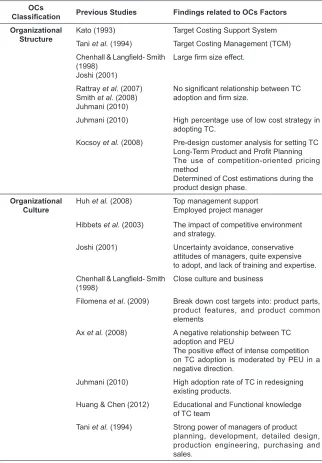
Table 1.0: Target Costing Implementation and OCs ocs
Classification Previous Studies Findings related to OCs Factors Organizational
structure Kato (1993)Tani et al. (1994) Target Costing Support System Target Costing Management (TCM)
Chenhall & Langfield- Smith (1998)
Joshi (2001)
Large firm size effect.
Rattray et al. (2007) Smith et al. (2008) Juhmani (2010)
No significant relationship between TC adoption and firm size.
Juhmani (2010) High percentage use of low cost strategy in adopting TC.
Kocsoy et al. (2008) Pre-design customer analysis for setting TC Long-Term Product and Profit Planning The use of competition-oriented pricing method
Determined of Cost estimations during the product design phase.
Organizational
Culture Huh et al. (2008) Top management supportEmployed project manager
Hibbets et al. (2003) The impact of competitive environment and strategy.
Joshi (2001) Uncertainty avoidance, conservative attitudes of managers, quite expensive to adopt, and lack of training and expertise. Chenhall & Langfield- Smith
(1998) Close culture and business
Filomena et al. (2009) Break down cost targets into: product parts, product features, and product common elements
Ax et al. (2008) A negative relationship between TC adoption and PEU
The positive effect of intense competition on TC adoption is moderated by PEU in a negative direction.
Juhmani (2010) High adoption rate of TC in redesigning existing products.
Huang & Chen (2012) Educational and Functional knowledge of TC team
Organizational
Relations Kato (1993)Tani (1995) Feil et al. (2004)
Engineering function involvement Involvement of financial and accounting function at the final stages
Hibbets et al. (2003) A very tight linkage between supply management and the design function in the TC practice
Ellram (2006) The involvement of R&D, supply management and suppliers in the early stages of TC process
Rattray et al. (2007) High involvement of manufacturing, product development and design in TC process Suppliers are not involved in TC process
Dekker & Smidt (2003) The involvement of product development and design departments
No involvement of accounting department. Juhmani (2010) High involvement o manufacturing
department in TC. Feil et al. (2004)
Kocsoy et al. (2008) Simultaneous engineering involvementHigh use of simultaneous engineering.
From these studies, OCs were classified into three main categorize namely; organizational structure, organizational culture, and organizational relations.
Organizational Structure
Organization size, measured in the selected studies either by sales volume or number of employees, has been found to be varied between the effect and not effect on TC implementation. For example, the studies of Chenhall & Langfield-Smith (1998) and Joshi (2001) among others argue that the organization size is an important factor in influencing the adoption of modern management accounting techniques. They reported that the application level of these techniques, such as more complex methods as TC, is shown to be higher in large size companies compared to medium and small companies. In Joshi’s (2001) study, the company’s size is a major influence in adopting TC among Indian companies. This clearly indicates that large size companies have adequate resources to support the implementation of such techniques. These new techniques would be suitable for their complex operations. Moreover, large size companies have relatively greater access to expertise in management innovations. In a case of New Zealand companies, Rattray
company’s size and the application of TC. Similarly, Juhmani (2010) , found that there is no statistically significant relationship between the adoption of TC and Bahraini manufacturing firms. In addition, Smith et al. (2008)
found that the TC technique is not significantly correlated with technological innovations as well as (number of employees and sales turnover).
TC, as one of many management accounting initiatives, must be driven by top management (Swenson et al., 2005). Therefore, Huh et al. (2008) found
that the most important factor for the successful implementation of TC among Japanese companies are top management support, linkage to profit planning, and cross-functional team. According to Tanaka et al., (1993), management considerations should be taken into account before setting TC. This includes the definition of TC scope (e.g. planning and design costs; manufacturing costs; selling expenses; customer’s costs), the choice of full/ partial variable costs that must be made, the decision made on how the TC is to be set, the expectation of the production volume, period, speed and cost reduction rate, and the basis of the TC. Hence, top management decision to support all these considerations must be consistent with strategic targets is a top-down commitment towards TC setting.
Huh et al. (2008) examined the relationship between the three dynamic capabilities; local capabilities, architectural capabilities, and process capabilities; as success factors of TC implementation. They found that the architectural capabilities, such as management support, linkage of profit planning, and cross-functional team, are the most important factors for successful implementation of TC. These factors have a positive relationship with the three major elements: efficiency, marketability, and cost reduction. Huh et al. (2008) also found that the next important factor for the success of the TC is the process capabilities, whereas the impact of local capabilities is found to be relatively weak on TC performance. These results are supported by the results of Kato (1993), Swenson et al. (2005), and Kocsoy et al.
(2008).
Organizational Culture
procedures and tools needed to support TC implementation. The influential factors of culture include managers’ attitudes, believes, values, and society norms. Many studies, as reported by Joshi (2001), found an impact of these factors on certain management accounting practices including TC. In the comparative study between Indian and Australian contexts, Joshi (2001) investigated the effect of other culture dimensions developed by Hosftede (1980). This includes; power distance, uncertainty avoidance, individualism, and masculinity. He also found that the large power distance associated with individualism factors have a great impact on management accounting practices such as TC in both countries. Interestingly, Joshi (2001) found that the conservative attitudes of Indian management and the lack of training and expertise were seen to be the main factors explaining the low adoption rate of the TC.
Organizational Relations
In setting TC, a cooperative effort of organizational members from various functional areas is required (Swenson et al., 2005). Based on CAM-I definition of TC, the principle of cross-functional team is essential in TC setting and this involves participants from within and outside an organization. According to Swenson et al. (2005), inside participants include
marketing, purchasing, production, servicing and accounting departments, whereas the outside participants include suppliers, dealers, distributers, and recyclers.To identify the departments involved in the application of TC, many literatures on this subject confirm the importance of Target Costing Management (TCM) team in any organization. According to Tani
et al. (1994), TCM can be used to derive target costs as well as a tool for planning the development and detailed design of new products. They argue that Japanese companies have adopted TCM as a response to the increasing environmental uncertainty. Similarly, Tani (1995) found that the managers of product planning, development, detailed design, production engineering, purchasing and sales have relatively strong power in the TCM.
the importance of supply management in the US as part of continuous improvement efforts. Kocsoy et al. (2008) found that low participation rate (2.91 – 29.6 per cent) of suppliers is a constraint for the success of TC activities within Turkish companies. The Juhmani’s (2010) results similarly revealed that the extent of suppliers’ involvement in Bahrain is low. However, the Ellram’s (2006) finding contrasts with that of Rattray et al. (2007) where he found that suppliers are not considerably involved in TC practices among New Zeeland companies. This, however, may stem from the lack of trust or lack of awareness on the benefits from the organizational relationship with suppliers. According to Huh et al. (2008), the dynamic capabilities of managers to integrate, build, and reconfigure of various competencies are examples of an organization’s competitive advantage. They classified organizational dynamic capabilities into local capabilities, architectural capabilities, and process capabilities. This was based on the model proposed by Kusunoki et al. (1995).
Gaps from Previous Research
In this section identifies two research gaps. The first gap relates to the definitional concept of product’s quality and functionality as the main focus of TC. Due to this lack of conceptual definition, much focus has been given on cost reduction as the main priority for TC (it should instead have been a spin off effect) which could adversely affected the quality and functionality of a product. Some of the studies reviewed examined OCs variables that influence TC implementation from the financial perspective. For example, Rattray et al. (2007), Kocsoy et al. (2008), Ax et al. (2008),
and Juhmani (2010) investigated the factors that may have impact on cost reduction objectives. These factors may have different impact on the extent of non-financial elements; quality and functionality. Other studies stressed the involvement of suppliers, design and development whilst ignoring the involvement of the accounting and financial department involvement (e.g. Kato, 1993; Tani et al., 1994; Tani, 1995; Feil et al., 2004). Hence, this may not be in line with the the trade-off objectives between cost, quality and functionality.
the Survival Triplet. The framework includes three elements namely: cost, quality, and functionality. However, the concepts of quality and functionality have not been adequately addressed in the current literature as they have been defined from a narrower idea. Researchers have reported that the most important benefit of TC is to assist companies in making the trade-off between cost, quality and functionality (e.g. Kato 1993; Cooper, 1995; Cooper & Slagmulder, 1997; Cooper & Slagmulder, 1999; Ax et al., 2008). Other researchers have found that the reason for a lower adoption of TC is that it results in a lower quality as the product has to become cheaper (e.g. Rattray et al., 2007; Kocsoy et al., 2008; Juhmani, 2010).
The second gap relates to the need to have a comprehensive measure of quality and functionality. Whilst OCs have been recognized in the literature as success factors for TC implementation, the dimension(s) used in previous studies to measure OCs has been fairly simplistic or generic. Most previous studies (e.g. Joshi, 2001; Swenson et al., 2005; Kocsoy et al., 2008; Huh
et al., 2008) have either used (i) “financial” or “non-financial” measures of OCs, or (ii) the OC variable is used to measure cost reduction, quality and functionality on a piecemeal basis rather than as an integrated measure. Therefore, product quality and functionality factors should be ensured in reducing cost from the extent of a broader balance among both financial and non-financial measures. This was not addressed in the current literature. As TC has been mainly used to reduce product cost whilst not sacrificing the other critical elements; product quality, functionality, and lead time. The balance between these elements is crucial. This is to make sure that the company in implementing TC is moving towards its strategic objectives. In other word, the complexity of frequent processes followed in decomposing the gap between estimated costs and TC makes it difficult for Organisations to balance between product cost, quality, functionality, and lead time. This requires organization a careful attention in adjusting products structure to achieve TC is required. Subsequent section proposes framework to close the above two researche gaps.
PROPOSED RESEARCH FRAMEWORK
Proposed Theory
As OCs have many definitions addressed by researchers, the focus here will be on the definition describing OCs as dynamic capabilities and
developed by Teece et al. (1991), as cited by Kato & Yoshida (1998). According to them, dynamic capabilities refer to the mechanisms and processes that enable Organisations to develop new competence. TC technique emphasizes systematic changes and knowledge creation within the Organisations as well as a full commitment across organizational functions toward TC implementation. Hence, the framework proposed below for TC implementation study particularly depends on the Dynamic Capabilities Approach theory as one of the organizational capabilities theories.
Research Framework
40
Learning and Growth Perspective
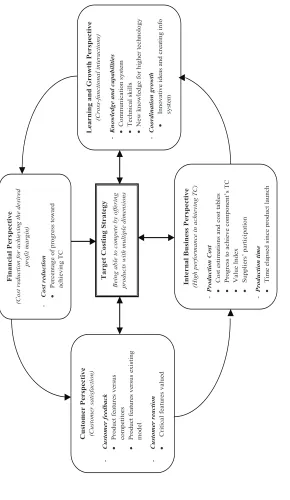
(C ro ss -f un ct io na l i nte ra ct io ns ) -K no wl ed ge a nd c ap ab ili tie s C om m uni cat io n sy st em Techn ical sk ills N ew kno w led ge fo r h igh er tech no log y -C oor di na tio n grow th In no va tiv e id ea s an d cr ea tin g in fo syste m Target Costi ng Strategy Bein g ab le to co mp ete by o fferin g pr odu cts with mu ltip le dimensio ns Custome r Pe rspective (C us to m er s at isf ac tio n) -C ust omer fee dbac k Pr od uc t f ea tu re s ve rs us co m petito rs Pro du ct feat ure s ve rsu s e xi st in g m od el -Customer reac tion Critical feature s val ued Internal Bus iness Per spe ctive (Hi gh perf or m ance in ac hi evi ng TC ) -Prod uctio n Cost Co st estim atio ns and co st tables Progress to ac hieve com pone nt’s TC Val ue Inde x Sup pliers’ part icip atio n -Prod uctio n time T im e el ap sed since p ro du ct la un ch Finan cial Perspecti ve (C ost re du ct io n f or achi evi ng th e desi re d pr ofit ma rg in ) -Cost re duction Perce nt age of pr og ress to war d ac hi ev in g T C Figure 1.0: L inking
BSC to the TC strategy
adapted
fr
om
Kaplan & Norton (19
Based on the linkage of BSC system to the TC strategy, the theoretical framework depicted in Figure 2.0 is developed for the current research by using the four perspectives of the BSC to measure OCs variables.
Figure 2.0: Theoretical Research Framework
The proposed framework is based on the Survival Triplet of Cooper (1995)
and CAM-I’s (1999) definition of TC. As stated above, TC is defined by CAM-I (1999) as “a system of profit planning and cost management that
is price-led, customer-focused, design-centered and cross-functional”. Using this definition, some similarities in certain aspects of these principles could be respectively recognized in the four perspectives of BSC; financial,
customer, internal process, and learning and growth. Both techniques are commonly used to satisfy customers’ needs and desires for achieving financial objectives and overall strategic objectives. Hence, the OCs
measures of price-led, customer-focused, design-centered and cross-functional would be reflected in the BSC’s four perspectives respectively; financial, customer, internal process, and learning and growth.
Based on the linkage of BSC system to the TC strategy, the theoretical framework depicted in Figure 2.0 is developed for the current research by using the four perspectives of the BSC to measure OCs variables.
Figure 2.0: Theoretical Research Framework
The proposed framework is based on the Survival Triplet of Cooper (1995) and CAM-I’s (1999) definition of TC. As stated above, TC is defined by CAM-I (1999) as “a system of profit planning and cost management that is price-led, customer-focused, design-centered and cross-functional". Using this definition, some similarities in certain aspects of these principles could be respectively recognized in the four perspectives of BSC; financial, customer, internal process, and learning and growth. Both techniques are commonly used to satisfy customers’ needs and desires for achieving financial objectives and overall strategic objectives. Hence, the OCs measures of price-led, customer-focused, design-centered and cross-functional would be reflected in the BSC's four perspectives respectively; financial, customer, internal process, and learning and growth.
CONCLUSION
TC technique has been reviewed by accounting literature as an excellent tool to reduce and control costs of products and services. This paper attempts to discuss the OCs
Design-Centered Reflected in Internal
Process Perspective
Cross-Functional Reflected in Learning &
Growth Perspective Customer-Focused Reflected in Customer
Perspective TC Implementation
Cost Reduction
Quality
Functionality
Lead Time
OCs measures within the BSC’s perspectives
Price-led Reflected in
CONCLUSION
TC technique has been reviewed by accounting literature as an excellent tool to reduce and control costs of products and services. This paper attempts to discuss the OCs influence in the TC practices. The organization strategy, infrastructure, culture, and its value chain relations internally and externally were identified as influencing factors on the TC implementation. This is clearly appeared in the adoption rate of this technique in the different studies reviewed. Most of the previous studies were limited to either financial or non-financial variables hence resulting in less comprehensive results. The proposed framework combines OCs factors and uses the four perspectives of BSC to measures OCs variables. This is to ensure opportunities for achieving the balanced TC objectives driven by applying BSC’s perspectives to measure OCs as predominant factors for achieving the successful implementation of TC. In developing the research framework, the paper applied the TC principles stated in CAM-I’s definition to be reflected in the BSC’s perspectives. This is to support TC strategy across all the dimensions of cost reduction, quality, functionality, and lead time. For future empirical studies, the integration of OCs measures within the BSC’s perspectives can be examined. This is to practically identify how the BSC model can be a supportive tool for TC implementation success.
REFERENCES
Afonso, P., Nunes, M., Paisana, A. & Braga, A. (2008), “The influence of time-to-market and target costing in the new product development success”,
Int. J. Production Economics, 115, pp. 559–568
Ax, C., Greve,J. & Nilsson, U. (2008), “The impact of competition and uncertainty on the adoption of target costing”, Int. J. Production Economics,
115, pp. 92– 103
Chenhall, R. and Langfield-Smith, K. (1998), “Adoption and benefits of management accounting practices: an Australian study”, Management
Accounting Research, Vol. 9, pp. 1–19
Dekker, H. & Smidt, P. (2003), “A survey of the adoption and use of target costing in Dutch firms”, Int. J. Production Economics, 84, pp. 293–305
Ellram, L. M. (2006), “The Implementation of Target Costing in the United States: Theory versus Practice”, Journal of Supply Chain Management, 42,
1; ABI/INFORM Global, pg. 13
Filomena, T. P., Jose, F., Neto, K. & Duffey, M. R. (2009), “Target costing operationalization during product development: Model and application”,
Int. J. Production Economics, 118, pp. 398–409
Hibbets, A. R., Albright, T. & Funk, W. (2003), “The competitive environment and strategy of target costing implementers: Evidence from the field”, Journal of Managerial Issues, 1, pp. 65–81
Huang, H. & Chen, Y. (2012), “Target Costing, Business Model Innovation, and Firm Performance: An Empirical Analysis of Chinese Firms”, Canadian
Journal of Administrative Sciences, 335 (November), 322–335
Huh, S., Yook, K-H. & Kim I-W. (2008), “Relationship between Organizational Capabilities and Performance of Target Costing: An Empirical Study of Japanese Companies”, Journal of International Business Research, Vol. 7, No. 1, pp. 91-107
Joshi, P. (2001), “The international diffusion of new management accounting practices: the case of India”, Journal of International Accounting, Auditing and Taxation, Vol. 10, pp. 85–109
Juhmani, O.I.H. (2010), “Adoption and Benefits of Target Costing in Bahraini Manufacturing Companies”, Journal of Academy of Business and Economics, Vol. 10, No. 1, pp. 113-122
Kaplan, R. S. & Norton, D. P. (1996), “The balanced scorecard: Translating strategy into action”, Harvard Business School Press: Boston/MA
Pineno, C.J. (2009), “A balanced scorecard model with incremental analysis for the motor homes industry based on survey results”, Competitiveness Review: An International Business Journal, 19, 1, pp. 63-80
Rattray, C. J., Lord, B. R. & Shanahan, Y. P. (2007), “Target costing in New Zealand manufacturing firms”, Pacific Accounting Review, Vol. 19, No. 1, pp. 68–83
Smith, M., Abdullah, Z. & Abdul Razak, R. (2008), “The diffusion of technological and management accounting innovation: Malaysian evidence”, Asian Review of Accounting, Vol. 16, No. 3, pp. 197–218
Swenson, D.W., Buttross, T.E. & Kim, Il-W. (2005), “Using the CAM-I Diagnostic to Evaluate Readiness for Target Costing”, Cost Management,
19, 3; ABI/INFORM Global, pg. 41
Tanaka, M., Yoshikawa, T., Innes, J. & Mitchell, F. (1993). Cost Management.
Tani, T. (1995), “Interactive control in target cost management”,
Management Accounting Research, 6, pp. 399–414