Hierarchical Codebook Design for Massive MIMO
Xin Su
1, Shichao Yu
1,2, Jie Zeng
1,∗, Yujun Kuang
21Tsinghua National Laboratory for Information Science and Technology, Tsinghua University, Beijing, China 2University of Electronic Science and Technology of China (UESTC), Chengdu, China
Abstract
The Research of Massive MIMO is an emerging area, since the more antennas the transmitters or receivers equipped with, the higher spectral efficiency and link reliability the system can provide. Due to the limited feedback channel, precoding and codebook design are important to exploit the performance of massive MIMO. To improve the precoding performance, we propose a novel hierarchical codebook with the Fourier-based perturbation matrices as the subcodebook and the Kerdock codebook as the main codebook, which could reduce storage and search complexity due to the finite a lphabet. M oreover, t o f urther r educe t he search complexity and feedback overhead without noticeable performance degradation, we use an adaptive selection algorithm to decide whether to use the subcodebook. Simulation results show that the proposed codebook has remarkable performance gain compared to the conventional Kerdock codebook, without significant increase in feedback overhead and search complexity.
Keywords: MassiveMIMO,Kerdockcodebook,Fourier-basedperturbation,adaptiveselection.
1. Introduction
Generally, for the MIMO system, the more antennas the transmitters/receivers equipped with, the higher degree of freedom that the propagation channels can provide, and the higher spectral efficiency, link reliability the system can provide[1]. Therefore, to meet the rapidly increasing demand of high-rate driven by the proliferation of mobile PCs, Smartphones, tablets, etc., and to exploit the precious wireless frequency resources, the massive MIMO system with numerous antennas in the base station (BS) has become an emerging research field. Moreover, in the research of fifth-generation mobile communication system(5G), massive MIMO has become an important research direction.
However, for practical application, the number of antennas should be restricted. Given a fixed number of antennas, we need to explore the massive MIMO system potentials through precoding techniques, which can mitigate the inter-user interference and improve the received SNR. In a closed-loop MIMO frequency division duplexing (FDD) system, the same codebook with a finite set of precoding matrices known to both the transmitter and the receiver should be pre-designed. A larger size codebook can increase the performance of precoding (i.e. Beamforming) at the cost of increasing the uplink feedback overhead, the storage
∗
Corresponding author. Email:[email protected]
requirement and search complexity. Therefore, it is important to explore better approaches for codebook design to balance the accuracy of precoding and the feedback overhead, and thus optimizing the overall performance.
There is a rich body of literature on the codebook design for traditional MIMO systems. But for the massive MIMO system, they have some disadvantages. Paper [2] has proposed a codebook based on vector quantization, which takes the channel distribution into account, resulting in a need of re-design when the channel distribution changes. The codebook based on Grassmannian packing in [3], [4] is nearly the optimal codebook for uncorrelated channels, but its construction requires numerical iterations, high storage requirement and search computational requirement, and thus restricts its application in massive MIMO. The Discrete Fourier Transform (DFT) codebook with simple systematic construction and appropriate storage requirement has been proposed in [5], but its performance is too low to meet the precoding requirement of massive MIMO, especially under the uncorrelated channels. Compared to these codebooks, the Kerdock codebook [6] can be extended and applied to massive MIMO system easily since its considerable precoding performance with reduced storage and selection computational requirements, besides, it has the characteristics of finite quaternary alphabet and systematic construction.
Received on 06 March 2014, accepted on 28 May 2014, published on 17 February 2015
Copyright © 2015 Xin Suet al., licensed to ICST. This is an open access article distributed under the terms of the CreativeCommons Attribution licence (http://creativecommons.org/licenses/by/3.0/), which permits unlimited use, distribution and reproduction in any medium so long as the original work is properly cited.
In a massive MIMO system, the feedback overhead, storage requirement and codeword searching compu-tational complexity would be significantly increased when the antenna array grows large. To compromise the system performance and feedback overhead, we propose a new hierarchical codebook combining the characteristics of the Kerdock main codebook with the Fourier based perturbation subcodebook. Moreover, to subtract the unnecessary feedback overhead for sub-codebook, which has no influence on the precoding per-formance in some cases, we propose an adaptive selec-tion algorithm to decide when to adopt the hierarchical codebook or the Kerdock codebook only according to the SNR differences among data streams.
The rest of the paper is organized as follows. Section 2 introduces the system model. Section 3 presents the detail design of a hierarchical codebook as well as an adaptive selection algorithm. Simulation results are shown in Section 4. Finally, Section 5 gives the conclusions.
2. System Model
In this paper, we focus on the downlink of a massive MIMO system withNttransmit antennas at the BS and Nr receive antennas at the user equipment(UE). We adopt the closed-loop MIMO transmission architecture with precoding and feedback mechanism.
Generally, the data processing at the transmitter has a number of steps. Firstly, the data stream which is inputted into the system would be demultiplexed into L substreams, then we get the substream vector s={s1, s2,· · · , sN
r}.Lis limited by 1≤L≤min(Nt, Nr). The condition when L= 1 is the case of transmission beamforming, while L >1, we call it multiplexing. Next the data is preprocessed by a precoding matrix W, which is chosen from the codebook stored in the transmitter according to the reported Precoding Matrix Indicator (PMI), the transmitted signalxshows:
x=Ws (1)
After preprocessed date passing the channel and being added the noise, the signal received by the UE can be expressed as:
y=HWs+z (2)
whereH∈(Nr×Nt) denotes the fading channel matrix
with its entryHij denoting the channel response from thej−thtransmit antenna to thei−threceive antenna,
and z denotes the white complex Gaussian noise (AWGN) vector with covariance matrixN0INr.
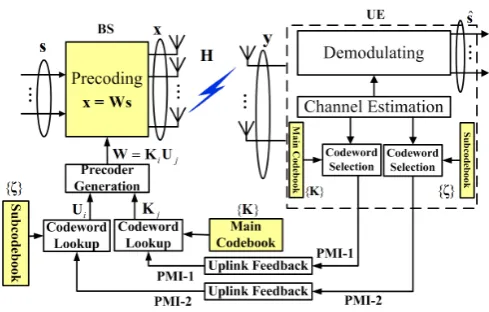
Then turn to the hierarchical codebook in limited feedback precoding system. Fig. 1 illustrates the pre-coding model of hierarchical codebook. It is con-structed by two parts, including the main codebook
Figure 1. The Limited Feedback Precoding Model
K={K1,K2,· · ·,KN}as the first part and the
subcode-book ζ={U1,U2,· · · ,UG} as the second part.
Assum-ing that the feedback overhead is limited to B bits, the size of these two parts should satisfy N×G= 2B.
Through receiving the reference signals from the BS and estimating the channel to acquire the Channel State Information (CSI), the UE can select an optimal codeword from K andζ respectively according to the CSI and report the corresponding indexes of precoding matrix named as PMI to the BS via the limited feedback channel [7]. Combining the two matrixKi andUjfrom the main codebook and the subcodebook respectively, the precoding matrix can be constructed asW=KiUj. Then the (2) can be rewritten as:
y=HKiUjs+z (3)
At the receiver, the UE obtains the estimated channel matrix through channel estimation and demodulates the received signal by employing various methods, such as Zero-Forcing (ZF) or Minimum Mean Square Error (MMSE), etc.
3. Design of the Novel Hierarchical Codebook
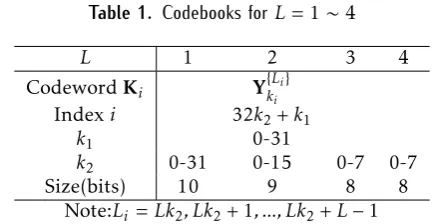
Table 1. Codebooks forL= 1∼4
L 1 2 3 4
CodewordKi Y
{Li} ki Indexi 32k2+k1
k1 0-31
k2 0-31 0-15 0-7 0-7
Size(bits) 10 9 8 8
Note:Li =Lk2, Lk2+ 1, ..., Lk2+L−1
and Fourier-based perturbation matrices as the second part. Moreover, based on the proposed hierarchical codebook, we proposed an adaptive selection algorithm to decide when to use the subcodebook.
3.1. Main codebook design
The basic idea of the Kerdock codebook design is using the feature of Mutually Unbiased Bases (MUB) to construct the precoding matrix, and with the main feature that all the elements of the matrix in the codebook are composed of±1 and±j.
An MUB is the set of bases satisfying the mutually unbiased property. Supposing S={s1,s2,· · ·,sM} and
Q={q1,q2,· · · ,qM}are twoM×Morthonormal bases.
If the column vectors drawn from S and Q satisfy
hsi ,qjE
= 1/
√
M, we can say that they have the mutually unbiased property [8].
The Kerdock codebook has several construction methods such as Sylvester-Hadamard construction and power construction [6]. In this paper, we adopt the Sylvester-Hadamard construction. The construction method is presented as follows:
Firstly, we generate a number of diagonal matrices Dn with the size of Nt×Nt, for n= 0,1,2· · ·, Nt−1, Nt = 2B, i.e.,Nt should be the power of 2. The details about their generation can be referred to [9].
Then we construct the corresponding orthogonal matrix:
Yn= √1
Nt
DnHˆNt (4)
where ˆHNt is theNt×NtSylvester-Hadamard matrix:
ˆ
HNt = ˆH2⊗Hˆ2.... (5)
where ˆH2 = 1 1 1 −1
!
Finally, we need to construct the codebook by selecting unique column combinations from each Yn according to the number of substreams, i.e.L. Taking Nt = 32 as an example, the codebooks forL= 1∼4 are shown in Table1.
Besides, having the estimated channel matrix, the codeword selection is an important issue. In this paper, for the main codebook, we choose the Minimum
Singular Value Selection Criterion (MSV-SC) to select the optimal codeword fromK.
For the beamforming, the beamformer that mini-mizes the probability of symbol error for maximum ratio combining receiver is expressed as:
ˆ
f[i] = arg max
f∈K
kH[i]fk22 (6)
wherefdenotes aNt×1 matrix.
For spatial multiplexing with a ZF receiver, the minimum singular value selection criterion is expressed as:
ˆ
F[i] = arg max
F∈Kλmin
{H[i]F} (7)
where λmin denotes the minimum singular value of the argument. This selection criterion approximately maximizes the minimum substream Signal-to-Noise Ratio (SNR).
3.2. Fourier-based perturbation subcodebook design
Several methods for constructing hierarchical code-books have been proposed in [10]. Rotation-based per-turbation is simple but it demands a large number of matrices to gain high performance. In this paper, we employ a novel construction method with Fourier based perturbation matrices since it can track the short-term change of the channel and deal with the SNR imbalance among the substreams.Because of the high throughput of massive MIMO system, our main consideration of subcodebook design is the bit error ration (BER) improvement. The unitary perturbation can enhance the performance of the codebook with linear receivers like ZF and MMSE. Using the linear ZF receiver, the SNR of thek−thdata
stream can be expressed as:
SN Rk(H,Kp) =
1
N0[(KHpHHHKp) −1
]kk
(8)
Then we add the perturbation matrix Up to the precoding matrix: Wp =KpUp ( Kp is the main codebook). We know that the BER performance of a precoding system is dominated by the performance of the substream with the lowest SNR. So the best condition is that every substream has an equivalent SNR. Using ZF receiver, the lowest SNR can be expressed as:
SN RZFmin(H,Wp) = min 1≤k≤LSN R
ZF
k (H,Wp)
= 1
max 1≤k≤L(N0[U
H
p(KHpHHHKp) −1
Up]kk)
(9)
We can see that the SNRs of the substreams are determined by the diagonal elements of the matrix (UH
pFHpHHHFpUp) −1
performance, we should balance the SNR of every substream. The optimal matrix Uopt, which can make the SNRs of different substreams approximately equal, would provide a room for balancing the SNRs of the substreams to maximize the overall BER performance. And we should note that the unitary perturbation can affect the performance of the codebook with linear receivers (ZF, MMSE), but it has no impact on the ML receiver.
Next is the method to construct the subcodebook matrix Ug. The Fourier based perturbation matrices, used in the second part of the codebook, can be designed as follows:
Ug =ΛgDL, g = 0,1, ..., G−1 (10)
whereDLis the normalized DFT matrix to be given in (12), andΛg is the rotation diagonal matrix to be given in (13), L is the number of layers and G is the total number ofUg.
DL ={dkl, k, l = 0, ..., L−1}, dkl = √1 Mexp(
j2πkl M ) (11)
Λg =diag(1,exp(j2πg
LG ),· · ·,exp(
j2π(L−1)g
LG )) (12)
Finally, like main codebook, we should discuss the codeword search scheme for subcodebook. From the design of the subcodebook, we can see that the search of the subcodebook should rely on the search of main codebook in addition to the channel matrix. Since we construct the subcodebook based on BER improvement, the selection criterion for the second codeword can be expressed as:
Uopt= arg min
U∈ζ 1max≤k≤L([U H(I
L+ 1 N0
KHpHHHKp) −1
U] kk
)
(13)
3.3. Adaptive selection
In this paper, we have proposed a novel hierarchical codebook in addition. The design of the hierarchical codebook with Fourier based perturbation is to bal-ance the SNRs of different substreams and make the SNRs of different data substreams in the precoding system approximately equal. So when the SNR of each substream have big difference, massive MIMO sys-tem would have remarkable performance gain through using subcodebook. However, under the condition where the SNRs of different substreams have little dif-ference, the second part of the codebook(subcodebook) makes little sense on the precoding performance. Thus, it is unnecessary to feedback the PMI of the second part. For this reason, we proposed an adaptive hierarchical selection algorithm according to the substream SNRs. In order to mark the codebook we use, we define a bit
Table 2. Simulated Codebook Type Selection Algorithm
Function GetCTI (SN R[], L)
//L: the number of substreams
//ε: the fixed threshold set previously
//CT I: codebook type indicator CT I = 0
fori= 0 :L−1
forj= 0 :L−1
ifSN R[i]−SN R[j]> εthen
CT I = 1 break end if end for end for returnCT I
variable named Codebook Type Indicator (CTI). Firstly, we compute the difference between any two SNRs of spatial multiplexing streams. Then if all the differences is lower the fixed threshold that we set previously, the CTI will be set as 0, which means we will only use the Kerdock codebook; otherwise, we will use the hierarchi-cal codebook with Fourier based perturbation. Through this method, we can save some feedback overhead. The pseudo code of this adaptive algorithm is shown in Table2.
4. Numerical Results
In this section, we present some simulation results in the configuration of Nt = 32, Nr = 3. The independent and identically distributed (i.i.d.) Rayleigh flat fading channels are assumed. Besides, receiver is able to acquire the perfect channel information, and the ZF method is adopted for equalization. The size of the proposed hierarchical codebook is denoted as [N , G], where N and G are the size of the main codebook and the perturbation subcodebook respectively. For this antenna deployment, we haveN = 1024, G= 8.
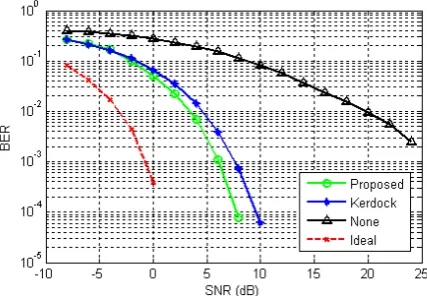
Fig.2and Fig.3show the curves of BER performance for different codebooks under the conditions with little and great SNR differences of different data substreams, respectively. The SNR in the x-axis denotes the average SNR of all the streams. For the purpose of comparison, we also present the BER performance under the ideal condition with the perfect CSI, as well as under the worst condition whithout precoding.
Figure 2. The BER Performance of Different Codebooks (little SNR differences)
Figure 3. The BER Performance of Different Codebooks ( great SNR differences)
different powers of noise for different substreams. It is shown that the proposed codebook has significant BER performance gain since the Fourier-based perturbation subcodebook make a difference.
5. Conclusion
In this paper, we proposed a hierarchical codebook for the massive MIMO system. We adopt the Ker-dock codebook as the main codebook of the hierarchi-cal codebook due to its low requirement for storage and selection computational complexity. To balance the SNR differences among different data substreams, thus getting higher precoding performance, we adopt the Fourier-based perturbation matrices as the sub-codebook. In addition, for the purpose of compromise
between the system performance and feedback over-head, we proposed an adaptive selection algorithm to reduce the feedback overhead and search complexity without noticeable precoding performance degrada-tion. Simulation results show that compared to the Ker-dock codebook, the proposed codebook has significant performance gain, especially under the condition with large SNR differences among substreams.
Acknowledgements. This work was supported by National
S&T Major Project (No.2013ZX03001-001), China 863 Project (No. 2012AA011402), Sino-Swedish Strategic Coop-erative Programme (No. 2012DFG12010) and National Basic Research Program of China(No. 2013CB329002).
References
[1] Rusek F.,Persson D., Lau B. K., and Tufvesson F.,
"Scaling up MIMO: opportunities and challenges with very large arrays,"IEEE Signal Processing Magazine, pp. 1-44, Oct. 21, 2011.
[2] Inoue T.and Heath R. W., "Kerdock codes for limited
feedback precoded MIMO systems," IEEE Trans. Signal Process.vol. 57, no. 9, pp. 3711-3716, 2009.
[3] Roh J.andRao B., "Design and analysis of MIMO spatial
multiplexing systems with quantized feedback," IEEE Trans. Signal Processvol. 54, no. 8, pp. 2874-2886, 2006. [4] Love D. J.and Heath R. W., "Limited feedback unitary
precoding for spatial multiplexing systems,"IEEE Trans. Inf. Theory,vol. 51, no. 8, pp. 2967-2976, 2005.
[5] Love D. J.and Strohmer T., "Grassmannian
beam-forming for multiple-input multiple-output wireless systems," IEEE Trans. Inf. Theory, vol. 49, no. 10, pp. 2735-2747, 2003.
[6] Raghavan V., Heath R. W., and Sayeed A.
M., "Systematic Codebook Designs for Quantized
Beamforming in Correlated MIMO Channels," IEEE Journal on Selected Areas in Commun., vol. 25, no. 7, pp. 1298-1310, 2007.
[7] Ryan D. J., Vaughan I., Clarkson L.andHonig M.L.,
"QAM codebooks for low-complexity limited feedback MIMO beamforming,"in Proc. IEEE Int. Conf. Commun., pp. 4162-4167, 2007.
[8] 3GPP TS 36.211: Evolved Universal Terrestrial Radio Access (E-UTRA); Physical channels and modulation. [9] Klappenecker A. andRoetteler M., "Constructions of
mutually unbi-ased bases,"Finite Fields Appl., pp. 137-144, 2004.
[10] Heath R. W., Strohmer T.and Paulraj A. J., "On
quasi-orthogonal signatures for CDMA systems,"IEEE Trans. Inf. Theory,vol. 52, no. 3, pp. 1217-1226, 2006.
[11] Huang Y., Xu D. and Yang L., "Limited Feedback
![Table 2. Simulated Codebook Type Selection AlgorithmFunction GetCTI (SNR[], L)](https://thumb-us.123doks.com/thumbv2/123dok_us/8428405.1696850/4.595.336.520.116.324/table-simulated-codebook-type-selection-algorithmfunction-getcti-snr.webp)