eISSN: 2600-8238 online
237
This open access article is distributed under a Creative Commons Attribution (CC-BY SA) 3.0 license
CONCEPTUAL FRAMEWORK FOR LIGHTWEIGHT
CIPHERTEXT POLICY-ATTRIBUTE BASED ENCRYPTION
SCHEME FOR INTERNET OF THINGS DEVICES
Norhidayah Muhammad1, Jasni Mohamad Zain2
2
Advanced Analytics Engineering Centre, 12
Faculty of Computer & Mathematical Sciences,
Universiti Teknologi Mara, 40450, Shah Alam, Selangor, Malaysia
1[email protected], 2[email protected]
ABSTRACT
The purpose of this paper is to propose a conceptual model for data security in the Internet of thing devices. Estimated by Jumoki in early 2018 to 2022, there will be about 18 billion connected Io devices. Therefore many issue related to IoT devices were discussed especially data security. Cryptography with lightweight features is one of the focus area by researchers to develop a powerful cryptography scheme for IoT devices. Lightweight cryptography scheme has been discussed and proposed widely recently. There are AES, PRESENT, Hash algorithm declared as a lightweight algorithm under consideration in ISO/IEC 29192 “Lightweight Cryptography”. Unfortunately these lightweight algorithm is one-to-one communication cryptography technique. This algorithm is very practical to implement for individuals or for small group communication but unpractical when implemented in a big company where many users can become a bottleneck. Therefore we propose a lightweight Ciphertext Policy-Attribute Based Encryption (CP-ABE) algorithm to implement in IoT devices. CP-ABE algorithm is one-to-many technique suitable for secure grouping communication, but this algorithm is not a lightweight feature. Therefore this paper proposes a lightweight CP-ABE algorithm for IoT devices.
Keywords: Cryptography, ABE, CP-ABE, Lightweight Cryptography, Internet of Thing.
1. Introduction
Cryptography was known as encryption become an important thing in data security, especially enabling safe internet communications in cloud computing. In cryptography, lightweight issues have long been identified and many studies have been conducted in producing more lightweight cryptography methods especially for constrain device such as IoT device. Lightweight cryptography was standardized with the properties of lightweight cryptography discussed in ISO/IEC 29192 (Katagi & Moriai, 2008). In ISO/IEC 29192, lightweight properties are described based on target platforms.
AES was known as lightweight cryptography if compared to RSA because AES is a symmetric key cryptography, it's using a small size of keys and only has one key for both encrypting and decrypting processes. Similarly with IBE, many researchers have developed IBE which is more lightweight and suitable for implementation in constraint devices. But all of these algorithms are for one-to-one communication, it is better suited for communication between individuals and small groups that do not involve many users. To meet the security requirements in the cloud system, one-to-many communication is required to facilitate data sharing and to ensure data security.
Previously people familiar with some well-known cryptograpy algorithms such as AES, RSAs are commonly used to ensure data security, but it provides problems for users to share data or ciphertext and requires a lot of steps to share data with many users because those algorithm is one-to-one communication encryption technique (Yuan, 2016; Muhammad et. al., 2018)).
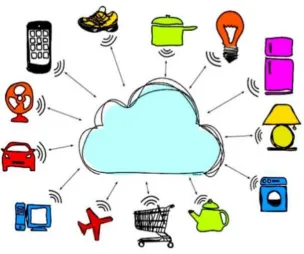
Figure 1: Role of IoT devices (Agarwal, 2015)
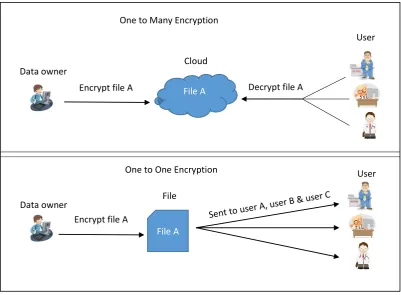
ciphertext in cloud, so user just decrypt file from cloud, so this method is more practical and systematically for company or institution with big size of users.
Figure 2. One to many Encryption and One to One Encryption
Attribute Based Encryption (ABE) scheme has obvious advantages in terms of efficiency and is fit for large scale network environment, such as cloud systems. The key contribution of this paper is to discuss and conclude the development of ABE and specifically is Ciphertext Policy- Attribute Based Encryption (CP-ABE). CP-ABE was a type of ABE and become better than Key Policy-Attribute Based Encryption (KP-ABE) based on specification of CP-ABE provide fine-grain access control. Although CP-ABE scheme was better than KP-ABE scheme, it still has a problem and needs to be improved. These issues will be discussed in this paper and the solutions proposed by the previous scheme. In this paper, firstly we review the different variants of CP-ABE problems and secondly, study the solution approaches that proposed by researcher
In one-to-many technique, one ciphertext can be accessed by many users as long as it meets the access policy specified in the ciphertext. This makes it easy for the data owner because it does not have to send one by one the same ciphertext to different users. This method is very efficient for a large company that has many users (Vaanchig et al., 2016). Goyal first person who introduced the concept of grouping by developing an Attribute based encryption (ABE). Then Sahai and water introduce (CP-ABE) more efficient because users have the right to determine who is eligible to access the ciphertext.
Many encryption algorithm can offer short decryption keys. For example, identity-based broadcast encryption (Delerablée, 2007), identity-based encryption with traitor tracing (Guo et al., 2012), multi-identity single-key decryption (Guo et al., 2013). Unfortunately, a few researcher in attribute-based encryption scheme offers short decryption keys. CP-ABE Instead of decryption key, ciphertext is also have problem with the size because it’s depend on number of Boolean in access policy. Therefore key design criteria in a CP-ABE scheme should include constant size secret key and constant size ciphertext, as well as a cost efficient mechanism for encryption and decryption.
File A
Encrypt file A Decrypt file A
User
Data owner
File A Cloud
Encrypt file A
File
User
Data owner
One to Many Encryption
2. Related work
Sahai and Waters (Sahai & Waters, 2005) made some initial steps to improve the primitives existing encryption scheme with one-to-one communication features by introduced the concept of Attributed-Based Encryption (ABE). The idea of ABE is grouping technique, means that user or decryptor will be scale in group. Therefore, one ciphertext can be decrypted by one group of users with certain attribute, stated in access policy by encryptor. ABE scheme has
obvious advantages in terms of efficiency and is fit for large scale network environment, such
as cloud systems. In an ABE system, a user’s keys and ciphertexts are labeled with sets of descriptive attributes and a particular key can decrypt a particular ciphertext only if there is a match between the attributes of the ciphertext and the user’s key.
The ABE scheme is allowed for decryption when at least k attributes overlapped between
a ciphertext and a private key. While this primitive was shown to be useful for error-tolerant encryption with biometrics, the lack of impressibility seems to limit its applicability to larger systems.Attribute-based encryption (ABE) enforces encrypted data to be decrypted with a secure access control mechanism that the assigned attributes must satisfy the access policies associated with ciphertext and private keys. ABE has become a promising cryptographic primitive providing one-to-many encryption.
2.1 Ciphertext Policy-Attribute Based Encryption
After the notion of Attribute-based Encryption (ABE) was introduced by Sahai and Waters (2005), after that Goyal et al. (2006) has proposed the first KP-ABE system, in which ciphertexts are associated with attributes, and secret keys are associated with access policies. Then BSW (Bethencourt, Sahai et al. 2007) has proposed CP-ABE scheme contrast with KP-ABE where attribute is associated with private key and access policy is associated with ciphertext and become better than Key Policy-Attribute Based Encryption (KP-ABE) based on specification of CP-ABE provide fine-grained access control, CP-ABE scheme in which the data owner hold direct control on access policy and decide who should or should not have access to the ciphertext. Then, Cheung and Newport (Cheung & Newport, 2007) proposed another CP-ABE in which the access structures are AND gates. Both scheme is based on bilinear map and pairing based cryptography practically implementing fine grained access control for data owner to control deep security and very usable in cloud system.
In the fundamental of CP-ABE, each entity can have attributes and each attribute is a descriptive string. Many entities may share common attributes, which allows encryptors to specify a secure data access policy over the shared attributes to reach a group of receivers. For example group of computer science, there are more than one entity have attribute of computer science. Ciphertext policy- Attribute based encryption schemes faced with bulky ciphertext problem, it’s because In CP-ABE, ciphertext is associated with an access policy, so the more boolean of access policy, the bigger size of ciphertext. In most of the existing CP-ABE schemes the size of the ciphertext increases linearly with increase in a number of attributes in access policy which incurs very large ciphertext size leading to computational overheads and several security infringements (Tamizharasi et al., 2016a) .For example, the message size in BSWCP-ABE (Bethencourt, Sahai et al. 2007) starts at about 630 bytes, and each additional attribute adds about 250-300 bytes. Previous privacy preserving schemes protect the access policies but require large linearly increasing ciphertext size. There is no work that can achieve privacy-preservation and constant ciphertext size at the same time (Zhou, Huang et al. 2015).
wildcards and incurs constant-size conjunctive headers, regardless of the number of attributes. Otherwise (Li, Gu et al. 2017) presents a new CP-ABE system based on the ordered binary decision diagram (OBDD). Therefore (Malluhi, Shikfa et al. 2017) was proposed a CP-ABE scheme supporting fine-grained, small ciphertext size, the ciphertext size is linear in either the size of the access boolean formula or the number of clauses depending on which is smaller between them. Tamizharasi has proposed a privacy-preserving CP-ABE scheme that significantly reduces the ciphertext size to be constant with any number of the user given attributes in a meaningful manner.
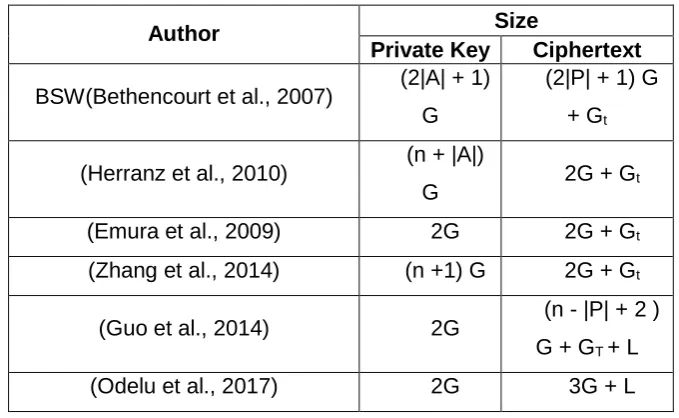
Table 1 shows previous research focuses on constant ciphertext and a constant private key. The proposed algorithm is focused on one either private key or ciphertext. Schemes with constant size ciphertexts (Zhang et al., 2014), (Emura et al., 2009),(Herranz et al., 2010) and constant size secret keys (Emura et al., 2009),(Guo et al., 2014) with an expressive access structure based on bilinear maps have been proposed. According to (Zheng et al., 2015) and (Li et al., 2014), the schemes based on bilinear maps, which is significantly more costly than schemes based on conventional cryptosystems. Besides that, even though Emura makes the size is constant, but it uses the structure (n, n) threshold. Where the threshold property is the number of attributes in the access structure and the user attribute in the private key must be the same. Thus, designing a cost efficient and expressive access structure CP-ABE with the constant size secret keys and ciphertexts using conventional public-key cryptosystems remains a research challenge.
Table 1: CP-ABE scheme with constant private key and constant ciphertext
Author Size
Private Key Ciphertext
BSW(Bethencourt et al., 2007) (2|A| + 1)
G
(2|P| + 1) G
+ Gt
(Herranz et al., 2010) (n + |A|)
G 2G + Gt
(Emura et al., 2009) 2G 2G + Gt
(Zhang et al., 2014) (n +1) G 2G + Gt
(Guo et al., 2014) 2G (n - |P| + 2 )
G + GT + L
(Odelu et al., 2017) 2G 3G + L
3. Proposed Conceptual Model
The weakness of CP-ABE is in terms of size decryption key and ciphertext, because it’s growing linearly with the number of attributes, if the number of attributes is more, then the size key will be bigger because attribute combined with the key. And this will be a barrier to constrain devices such as IoT. Each device has a different number of attributes. The challenge is to produce a constant size ciphertext, and making the size ciphertext is not dependent on the number of boolean in the access policy (Odelu et al., 2017; Sembiring et. al., 2010). As well as the challenge for generating a size private key that is constant and independent of the size attribute. This is because the attribute will be combined with the user private key and it should match the boolean in the access policy (Ambrosin et al., 2016). Thereby enabling the process decryption to succeed.
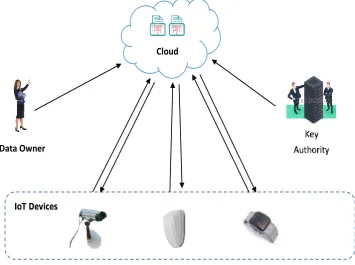
user's status by ensuring that the attribute used by the user is correct. Therefore the key authority plays a very important role in ensuring data security. The second is data owner. The data owner is the individual who will encrypt the data and he also will determine who has the right to access the data. The group of user that has access to the data will be specified in the access policy, and the access policy will be merged together with the ciphertext.
Third component is cloud, after data owner encrypts the data and put the ciphertext to cloud. Cloud is a storage that gathers thousands of servers and provides client service storage according to user requirements. Data security needs to be emphasized in cloud storage to ensure data security as data intrusion can occur easily. The forth is IoT devices. IoT devices become a new phenomenon today and forward. IoT devices are used today such as sensors for safety, medical, and so on systems. These devices have a lack of resources such as a battery, memory size, and processor. Therefore it requires a lightweight algorithm and a small size of data.
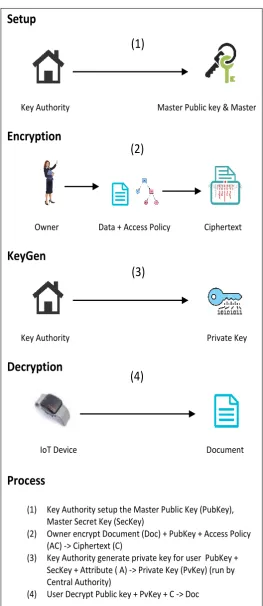
Figure 3: Conceptual Framework for CP-ABE algorithm in IoT devices
As shown in figure 4, there are four algorithms in the CP-ABE scheme. The first is setup algorithm, master public key and master secret key will be generated. Master public key will be used in encryption algorithm, keygen and also decryption algorithm. While the master secret key will be used to generate a private key in the algorithm keygen.
The second algorithm is encryption. After the master public key is generated, the data owner can apply from the key authority and can encrypt the data using the master public key that is given and also defines the access policy for the ciphertext. Only the attributes mentioned in the access policy that will successfully access the ciphertext.
The third algorithm is keygen. Keygen algorithm operates to generate decryption key or private key for the user to decrypt the ciphertext. The key authority will validate user attribute and then use the master secret key and combined with user attribute to create user private key. The fourth algorithm is decryption. In this algorithm, the user or IoT device will use the private key that has been generated in the keygen algorithm to decrypt the ciphertext. If the attribute contained in the private key match with the attribute in the access policy then the process decrypt will succeed.
Cloud
Muhammad and Mohamad Zain, Malaysian Journal of Computing, 4 (1): 237-245, 2019
Figure 4: Four Algorithm in CP-ABE cryptography scheme
Setup
Key Authority Master Public key & Master
Encryption
Owner Data + Access Policy Ciphertext
KeyGen
Key Authority Private Key
Decryption
IoT Device Document
Process
(1) Key Authority setup the Master Public Key (PubKey),
Master Secret Key (SecKey)
(2) Owner encrypt Document (Doc) + PubKey + Access Policy
(AC) -> Ciphertext (C)
(3) Key Authority generate private key for user PubKey +
SecKey + Attribute ( A) -> Private Key (PvKey) (run by Central Authority)
(4) User Decrypt Public key + PvKey + C -> Doc
(1)
(2)
(3)
4 Conclusions
From the previous explanation, it can be concluded, this paper proposes the framework to produce a lightweight cp-abe algorithm for IoT devices. The proposed algorithm allows one message or ciphertext placed in the cloud to be accessed by many IoT devices as long as it meets the policy set in the access policy. Expected output that will be obtained from research analysis later is size decryption key and also size ciphertext is do not increase with number of user attribute. Besides the small size, it is also constant size. This is because the big challenge in CP-ABE is to make sure attribute embedded in a private key are not influence the size of keys, as well boolean in access policy not affect the size of ciphertext.
REFERENCES
Agarwal, M. 2015. "Role of IOT devices and servcies in the development of smart cities." from
https://
www.slideshare.net/mayankagarwal51/role-of-iot-devices-and-servcies-in-the-development-of-smart-cities.
Ambrosin, M., A. Anzanpour, M. Conti, T. Dargahi, S. R. Moosavi, A. M. Rahmani and P. Liljeberg. 2016 "On the feasibility of attribute-based encryption on internet of things devices." IEEE Micro 36(6), 25-35.
Bethencourt, J., A. Sahai and B. Waters. 2007 "Ciphertext-policy attribute-based encryption".
IEEE Symposium on Security and Privacy, IEEE.321-334
Chen, N. and M. Gerla (2009). Dynamic attributes design in attribute based encryption. Annual Conference of ITA (ACITA), University of Maryland, MD.
Cheung, L. and C. Newport. 2007 "Provably secure ciphertext policy ABE". Proceedings of the 14th ACM conference on Computer and communications security, ACM.456-465 Delerablée, C. 2007 "Identity-based broadcast encryption with constant size ciphertexts and
private keys". International Conference on the Theory and Application of Cryptology and Information Security, Springer.200-215
Doshi, N. and D. Jinwala (2012). "Updating attribute in CP-ABE: A New Approach." IACR Cryptology ePrint Archive 2012: 496.
Emura, K., A. Miyaji, A. Nomura, K. Omote and M. Soshi. 2009 "A Ciphertext-Policy
Attribute-Based Encryption Scheme with Constant Ciphertext Length". ISPEC,
Springer.13-23
Guo, F., Y. Mu and W. Susilo. 2012 "Identity-Based Traitor Tracing with Short Private Key and Short Ciphertext". ESORICS, Springer.609-626
Guo, F., Y. Mu, W. Susilo, D. S. Wong and V. Varadharajan. 2014 "CP-ABE with
constant-size keys for lightweight devices." IEEE Transactions on Information Forensics and
Security 9(5), 763-771.
Guo, H., C. Xu, Z. Li, Y. Yao and Y. Mu. 2013 "Efficient and dynamic key management for multiple identities in identity-based systems." Information Sciences 221, 579-590. Herranz, J., F. Laguillaumie and C. Ràfols. 2010 "Constant size ciphertexts in threshold
attribute-based encryption". International Workshop on Public Key Cryptography, Springer.19-34
Katagi, M. and S. Moriai. 2008 "Lightweight cryptography for the internet of things." Sony Corporation, 7-10.
Lawanson, J. A. and A. James 2017, 31/october/2018. "Report predicts 18 billion connected
IoT devices by 2022." Retrieved 10/april/2018, from
Li, H., X. Lin, H. Yang, X. Liang, R. Lu and X. Shen. 2014 "EPPDR: an efficient
privacy-preserving demand response scheme with adaptive key evolution in smart grid." IEEE
Transactions on Parallel and Distributed Systems 25(8), 2053-2064.
Li, L., et al. (2017). "A Ciphertext-Policy Attribute-Based Encryption Based on an Ordered Binary Decision Diagram." IEEE Access 5: 1137-1145.
Malluhi, Q. M., et al. (2017). A Ciphertext-Policy Attribute-based Encryption Scheme With Optimized Ciphertext Size And Fast Decryption. Proceedings of the 2017 ACM on Asia Conference on Computer and Communications Security, ACM.
Muhammad, N., Zain, J.M., Mohamad, M. Current issues in Ciphertext Policy-Attribute based scheme for cloud computing: A survey (2018) International Journal of Engineering and Technology(UAE), 7 (2), pp. 64-67.
Odelu, V., A. K. Das, M. K. Khan, K.-K. R. Choo and M. Jo. 2017 "Expressive CP-ABE scheme for mobile devices in IoT satisfying constant-size Keys and ciphertexts." IEEE Access 5, 3273-3283.
Qin Hongwu, Xiuqin Ma, Tutut Herawan, Jasni Mohamad Zain (2014). MGR: An information theory based hierarchical divisive clustering algorithm for categorical data, Knowledge-Based Systems, Volume 67, September 2014, Pages 401-411
Qin Hongwu, Ma Xiuqin, Tutut Herawan, and Jasni Mohamad Zain, (2012). “DFIS: A Novel Data Filling Approach for Incomplete Soft Set”, Journal of Applied Mathematics and Computer Science, Vol. 22 (4), pp. 817-828
Sahai, A. and B. Waters. 2005 "Fuzzy identity-based encryption". Annual International Conference on the Theory and Applications of Cryptographic Techniques, Springer.457-473
Sembiring, R. W., Mohamad Zain, J., and Embong, A., “A Comparative Agglomerative Hierarchical Clustering Method to Cluster Implemented Course”, Journal of Computing, Vol. 2, Issue 12 , December 2010, pp. 33-38.
Tamizharasi, G., et al. (2016). Privacy preserving ciphertext policy attribute based encryption scheme with efficient and constant ciphertextsize. Inventive Computation Technologies (ICICT), International Conference on, IEEE.
Vaanchig, N., W. Chen and Z. Qin. 2016 "Ciphertext-Policy Attribute-Based Access Control with Effective User Revocation for Cloud Data Sharing System". International Conference on Advanced Cloud and Big Data (CBD), IEEE.186-193
Yang, Y., H. Cai, Z. Wei, H. Lu and K.-K. R. Choo.2016a Towards Lightweight Anonymous
Entity Authentication for IoT Applications. Information Security and Privacy: 21st Australasian Conference, ACISP 2016, Melbourne, VIC, Australia, July 4-6, 2016, Proceedings, Part I. J. K. Liu and R. Steinfeld. Cham, Springer International Publishing, 265-280.
Yang, Y., J. Lu, K.-K. R. Choo and J. K. Liu.2016b On Lightweight Security Enforcement in
Cyber-Physical Systems. Lightweight Cryptography for Security and Privacy: 4th International Workshop, LightSec 2015, Bochum, Germany, September 10–11, 2015, Revised Selected Papers. T. Güneysu, G. Leander and A. Moradi. Cham, Springer International Publishing, 97-112.
Yuan, W. 2016 "Dynamic Policy Update for Ciphertext-Policy Attribute-Based Encryption."
IACR Cryptology ePrint Archive, 457.
Zhang, Y., D. Zheng, X. Chen, J. Li and H. Li. 2014 "Computationally efficient ciphertext-policy attribute-based encryption with constant-size ciphertexts". International Conference on Provable Security,
Zheng, M., Y. Xiang and H. Zhou. 2015 "A strong provably secure IBE scheme without bilinear map." Journal of Computer and System Sciences 81(1), 125-131.