THEORIZING IN INFORMATION SYSTEMS RESEARCH USING FOCUS GROUPS
France Belanger Virginia Tech [email protected]
ABSTRACT
Information Systems researchers have embraced a number of qualitative research approaches and methodologies, including interviews, observations, and even action research. One research method gaining visibility in IS research is the focus group research method. Focus groups have the potential to provide great insights into phenomena of interest to IS researchers as they allow researchers to get deeper into the topic of interest by providing more background information about the circumstances of the subject’s answers or opinions. This paper presents a review of focus group research in the information systems literature, and provides a discussion of how and when the focus group research method can be the most appropriate method to use for IS theorizing. The discussion highlights the idea that the focus group research method is particularly useful for exploratory research on topics where concepts normally emerge through interactions among individuals or where concepts are initially unclear to participants, and as part of a multi-method research program for theory development. Examples of focus groups used in theory development are provided, together with a discussion of the limitations of the research method.
Keywords: focus group, qualitative research, information systems research, theory development
INTRODUCTION
“A research process can be viewed as a series of interlocking choices, in which we try simultaneously to maximize several conflicting desiderata”(McGrath 1982)
Focus groups not only allow researchers to collect a concentrated set of interactions in a given time period, they also enable researchers to obtain more background information about the circumstances of the answers provided by the subjects (Krueger 1994). As a result, focus groups have the potential to provide significant insights about phenomena of interest to IS researchers in several situations: first, when information systems researchers are interested in new topics to be studied via exploratory research (e.g., what are the critical success factors for implementation of cloud computing); second, focus groups can also support research where constructs emerge from group interactions as opposed to individuals situations (e.g., how do software development teams benefit from (or not) mandatory use of new standards) (Krueger and Casey 2000; Le Rouge and Niederman 2006); and finally, a review of the IS literature reveals that focus groups can play an important role in developing theoretical models of IS phenomena to be tested. The purpose of this paper is therefore to explore the use of the focus group method in the information systems literature, discuss its advantages and limitations, and discuss the applicability of this research method for the development of theories in information systems. More specifically, the discussion is guided by the following question: Under which circumstances is the focus group research method most appropriate for IS theorizing, and how can the method best be used for IS theorizing?
This paper provides two main contributions: first, it offers a review and categorization of how the focus group research method has been used in information systems research, and second and more importantly, it discusses how and when the focus group research method can be used for theory development in IS research. The remainder of the manuscript is organized as follows. The background section briefly discusses the focus group research method followed by a review and analysis of focus group research in the information systems literature. Then, a discussion of the applicability of the focus group research method to the field of information systems and the potential role of focus groups in IS theorizing are provided and illustrated by research examples. Finally, limitations of this work are offered before concluding comments are provided.
THE FOCUS GROUP RESEARCH METHOD
The focus group research method has long been used in studies of consumer attitudes, perceptions, and opinions in the marketing and business communications literature (Fern 1982; Hartman 2004). As a result, many researchers describe the method in substantial details (Edmunds 1999; Fern 2001; Krueger 1994; Krueger and Casey 2000). This section provides a brief overview of the method, with more details provided in Appendix A.
Typically, focus group sessions are conducted by a moderator with the responsibility of running the session. A very high level of involvement is necessary to ensure that all participants voice their ideas, attitudes, perceptions or opinions, and that emerging concepts of interest are explored through further probing when appropriate (Sobreperez 2008). The focus group participants are selected because they are knowledgeable about the topic investigated. The sessions are recorded with audio and/or video equipment, and are then transcribed so that they can be analyzed. In that aspect, focus groups follow similar procedures as other qualitative data collection approaches such as interviews and observations (Strauss and Corbin 1998). The focus group transcripts can be analyzed using standard qualitative analysis software and techniques (Miles and Huberman 1994). The results can be used to develop grounded theories (Eisenhardt 1989), provide contextual data for case studies (Yin 1994), or more frequently, to provide exploratory constructs and relationships that will be tested at a later stage of research (e.g., Dickinger et al. 2008; Lee et al. 1995). Interestingly, the data gathered from focus groups are not limited to transcripts obtained from the discussions in the sessions, but can also include the moderator (or assigned scribe) notes, body language if video is used, results from debriefing sessions (if conducted), and any pre-session questionnaires that can be distributed at the beginning of focus groups (Edmunds 1999).
Theory building is important to the development of the IS field, and as Straub (2009) suggests, having strong theoretical foundations and contributions is a major factor in publishing in top journals. Indeed, Tams and Grover (2010) find that factors related to theoretical development, rather than research methodology or implications, lead to more highly cited, i.e., influential, articles in IS literature. Given the possibility of eliciting constructs from collaborative construction (constructs emerging from group discussions) (Morgan 1997) and the ability to triangulate verbal data with other data sources such as gestures and reactions, this research method could be uniquely useful for theory building in many IS contexts. For example, when the domain of interest is exploratory and the focus groups are used to generate information or ideas that can be later tested, when trying to obtain a deeper understanding of constructs (i.e. their dimensions) in established theory, or, when the constructs of interest exist in or emerge from the interactions of individuals with one another. This is particularly important to the information systems field because many topics of interest in the domain, from knowledge management, to telecommuting, to software development are affected by individuals’ interactions. Using an individual unit of analysis to study group performance might lead to less complete and realistic theories. In order to explore this possible issue, and before further exploring how and when the focus group research method can be used in information systems theory development, the IS literature is reviewed to identify how focus group research has been used in the IS field.
LITERATURE REVIEW: FOCUS GROUP RESEARCH IN IS
Kruger (1994) suggests that focus groups can be very useful in gaining insights into a research domain in two particular cases: when there is limited research previously published, or when the focus group is part of a larger scale research effort. Others suggest that focus groups have broad appeal for various types of evaluations of products, concepts or services, or to generate ideas for questionnaires (Edmunds 1999).
(broadly defined to include information science, computer science and related fields), there were 58 articles from ABI/Inform and 51 from Business Source Complete. Taking into account articles found in both databases, 75 individual articles were downloaded for further review.
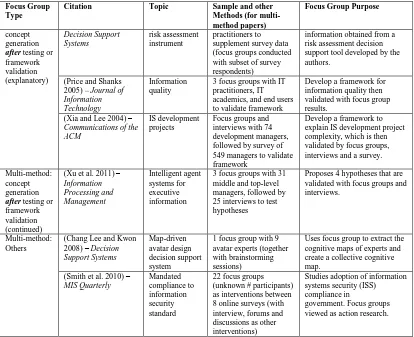
In the second round of review, only papers that study an IS phenomena using focus groups as part of the research design were retained. Papers removed from the list included papers that suggest future work should include focus groups, that were not IS-related, or papers that discussed focus groups as a method to be adapted for other purposes such as online market research (Clapper and Massey 1996; Markham et al. 2006; Montoya-Weiss et al. 1998) or for applicability checks (Glass 2009; Rosemann and Vessey 2008), discussed focus group as a research method (Sobreperez 2008; Stahl et al. 2011), discussed focus group as a method for requirements determination in IS development (Leifer et al. 1994; O'hEocha et al. 2010; Peffers and Tuunanen 2005) or to inform design research (Tremblay et al. 2010), or explored IS education issues using focus groups (Dunning et al. 2001; Dwyer and Knapp 2004; Maheshwari et al. 2009; Shuk Ying et al. 2008). The resulting sample of 58 papers shows that the oldest papers date to 1995 and 1996 in MIS Quarterly (Lee et al. 1995; Smith et al. 1996), Information Systems Research (Manning 1996), and Information Technology and Libraries (Tillotson et al. 1995). The sampled papers are summarized in Table 1.
Following the types of focus groups identified by Kruger (1994), information systems papers were classified along the dimensions of sole method or multi-method (also called mixed-method). Sole method papers are those where the entire research findings of the paper are based on the use of the focus group research method. The multi-method papers represent those studies where the focus group method is used in conjunction with other research methods. Extending the work of Kruger (1994), the classification is further broken down into exploratory vs. explanatory research. Exploratory research focuses on “what is” the state of some IS phenomenon, whereas explanatory research focuses on “how” and “why” some IS phenomenon is happening.
The distinction between the use of interviews and the use of focus groups (sometimes called group interviews) is important and sometimes misunderstood. In conducting the review of the literature, one study was found (Martz et al. 2007) where the researchers use the terminology of focus group in the description of the study (in the abstract) without apparently using focus groups as their research method. The authors conducted 18 interviews of practitioners and academics (in addition to observations) with the purpose of designing a Master of Healthcare Informatics curriculum. However, the interviews appear to be individual, which would not constitute a focus group (the focus group terminology is not used except in the abstract).
Focus Group Type
Citation Topic Sample and other
Methods (for multi-method papers)
Focus Group Purpose
Sole method: exploratory
(Campbell et al. 2005) – Journal of
Enterprise Information Management
Alignment of business and IS
3 focus groups with 6 IS/IT managers in each group
Explore how managers view the alignment between business and IT. Participants develop a causal loop diagram. (Grant and Fitzgerald
2005) - Electronic Journal of Business Research Methods
Nexus between teaching and research in IS
2 focus groups with staff and educators at universities
Explore whether a nexus exists between teaching and research at universities. Also, evaluate focus group as method to explore this.
(Huang and Lin 2009) – Journal of Computer Information Systems
Email usage 1 focus group with 11 participants
Explore email usage of knowledge workers.
(Jarvenpaa and Lang 2005) - Information Systems management
Mobile technology use
33 focus groups with 222 participants in 4 countries (Finland, Japan, China, USA)
Focus Group Type
Citation Topic Sample and other
Methods (for multi-method papers)
Focus Group Purpose
process framework. (Jarvenpaa et al. 2003)
- Communications of the ACM
Mobile technology use
32 focus groups with 200 participants in 4 countries (Finland, Japan, China, USA)
Identify services used by mobile technology users, and issues related to use of mobile IT.
(Le Rouge and Niederman 2006) - Communications of the AIS
Public health knowledge management
6 focus groups with higher education administrators, educators and students
Use focus groups for requirement elicitation to develop public health knowledge base system. (McKeen et al. 2005) -
Communications of the AIS
Digital dashboards
1 focus group with IT managers (# of participants unknown)
To explore the use and types of digital dashboards in use by IT managers.
(McKeen and Smith 2006) -
Communications of the AIS
Technology roadmap
1 focus group with IT managers (# of participants unknown)
Explore managers’ practices in terms of creating and evolving a technology roadmap.
(McKeen and Smith 2007)
-Communications of the AIS
IT delivery options
1 focus group with IT managers (# of participants unknown)
Identify decision criteria for IT delivery to build a decision framework to guide selection of delivery options for IT.
Sole method: exploratory (continued)
(McKeen et al. 2009) - Communications of the AIS
IT staffing 1 focus group with IT managers (# of participants unknown)
To explore the current IT staffing challenges and issues.
(McKeen and Smith 2010b) -
Communications of the AIS
Total cost of ownership
1 focus group with IT managers (# of participants unknown)
Identify firms’ use of total cost of ownership approach in IT.
(McKeen and Smith 2010a) -
Communications of the AIS
Application portfolio management (APM)
1 focus group with IT managers (# of participants unknown)
To understand managers’ use of APM strategies and practices.
(Payton and Zahay 2003) – Journal of database Marketing
CRM implementation success
5 focus groups with 21 marketing, IS, and strategic managers in a healthcare firm
Identify factors that lead to CRM implementation success for the focal firm (healthcare payer).
(Raitoharju et al. 2009) – Electronic Journal of Business Research Methods
Health Information Systems
Focus groups (# unknown) with 23 healthcare professionals.
Examine usage of health information exchange systems in 2 kinds of healthcare sectors (i.e. Finland and USA) (Reid et al. 2010) -
European Journal of Information Systems
Challenges for women in IT
6 same-sex focus groups (3 each) with 45 IT professionals in 3 USA companies
Identify how men and women describe the unique challenges that women face in the IS workplace.
(Resatsch et al. 2008) – Electronic Markets
Point-of-sale RFID
2 focus groups with 10 consumers and 10 sales assistants
Identify factors determining intentions to use RFID-based smart products
(Scott et al. 2009) - Communications of the AIS
Information systems as a career
6 focus groups with 31 undergraduate students
Identify factors that influence students to select IS as a career.
(Smith and McKeen 2003) -
Communications of the AIS
Knowledge management usage
1 focus group with knowledge managers (# of participants unknown) from 25 companies
Explore the state of knowledge management usage and its likely future development.
(Smith and McKeen 2004) -
Communications of the AIS
Knowledge management marketing
1 focus group with practicing knowledge managers (# of participants unknown)
Focus Group Type
Citation Topic Sample and other
Methods (for multi-method papers)
Focus Group Purpose
Sole method: exploratory (continued)
(Smith and McKeen 2007) -
Communications of the AIS
Information management implementation
1 focus group with IT managers (# of participants unknown)
Identify issues and challenges in information management.
(Smith et al. 2007) - Communications of the AIS
Perceptions of IS in organizations
1 focus group with IT managers from 15 companies
Identify how IS is perceived in companies – compared with similar results from 1996 study. (Smith and McKeen
2010a) -
Communications of the AIS
Business IT relationship
1 focus group with senior IT managers (# of participants unknown)
Explores the relationship between IT and business and how it can be characterized.
(Smith and McKeen 2010b) -
Communications of the AIS
Business and interpersonal competencies of IT staff
1 focus group with senior IT managers (# of participants unknown)
To explore the business and interpersonal competencies that IT staff will need in order to do their jobs effectively over the next five to seven years and what companies should be doing to help develop them. (Smith and McKeen
2011) -
Communications of the AIS
Collaboration and IT
1 focus group with IT managers (# of participants unknown)
Identify the role of IT in enabling collaboration within organizations.
Sole method: explanatory
(Sutton et al. 2008) - Journal of the Association for Information Systems
Critical risk factors in B2B e-commerce relationships
5 focus groups: 3 internal groups (IS security, internal IT audit, e-commerce development managers) and 2 external groups (e-commerce consultants, external IT auditors)
Identify critical risk factors used to assess impact of B2B e-commerce on overall enterprise risk. Tests performed between groups.
Multi-method: exploratory
(Bishop et al. 2000) – Journal of the American Society for Information Science and Technology
Use of digital libraries initiative
3 focus groups with 17 participants to supplement information from interviews, observations, usability testing, logs, and surveys.
Explore the use of the Digital Libraries Initiative at the University of Illinois
(Chesney et al. 2009) - Information Systems Journal
Grieving behaviours in virtual worlds
4 online focus group with 14 participants. Combined with 15 hours of non-participant observations
Identify grieving behaviours in virtual worlds, their impact, why they occur, who the likely targets are, and who
perpetrators are. Multi-method:
exploratory (continued)
(Cooper and Heinze 2007) – Journal of Information Systems Education
Multi-year projects in IS education programs
(# unknown) focus groups with students and staff, combined with interviews and survey
Identify best ways to evaluate multi-year projects in IS education programs.
(Hill et al. 1998) – Journal of Global Information Management Information technology transfer and culture
(# unknown) focus groups to supplement interviews and a field study in five Arab countries
Explore linkages between information technology transfer and sociocultural factors that support or impede a successful transfer.
(Jones et al. 2008) -Communications of the AIS
Post-installation use of ERP
5 focus groups in 1 organization to supplement 104 survey responses from five other organizations
Determine level and effectiveness of ERP training and usage several years after implementation.
Focus Group Type
Citation Topic Sample and other
Methods (for multi-method papers)
Focus Group Purpose
Journal of the American Society for Information Science and technology
Question-Answering Systems
analysts, followed by individual interviews
interactive, analytical question-answering (QA) systems.
(Kesner 2008) – Communication of the AIS
Competencies required of students
4 groups and 14 interviews with approximately 17 employees (15% of survey population), combined with survey of 111 employees
Identify competencies IT students need as perceived by potential employers.
(Klaus and Blanton 2010) - European Journal of Information Systems
User resistance 1 focus group of 7 IT professionals and 34 interviews in 3 organizations
Identify the determinants of user resistance to IT implementation.
(Lehaney et al. 1999) – Journal of End User Computing
Database marketing
1 focus group to supplement survey
Identify the success factors for technology-enabled database marketing in the tourism industry.
(Manning 1996) - Information Systems Research
Use of cellular technology in police context
(# unknown) focus groups of police officers and their leaders, combined with interviews and observations
Explore use of IT in police context.
(Nahar et al. 2006) – Information & Management
Information technology transfer
16 (or more?) focus groups of 4 to 6 participants (complemented by interviews) of IT managers, general managers, and executives in each in 4 Finnish companies
Identify and rank the various factors affecting IT-supported international technology transfers. Rankings of factors quantitatively evaluated between firms.
Multi-method: exploratory (continued)
(Otondo et al. 2009) – European Journal of Information Systems
Adoption of RFID
2 focus groups with 21 participants,
complemented with data from published interviews
Explores how managers evaluate RFID and participate in its adoption.
(Pettigrew et al. 2002) – Journal of the American Society for Information Science and Technology
Use of library community network systems
(# unknown) focus groups of public library staff, human service providers and users, complement surveys and interviews
Identify how users use public networked community information systems, as well as the barriers and benefits of use.
(Ramesh and Jarke 2001) – IEEE Transactions on Software Engineering Reference models for requirement traceability
37 focus groups (several phases) in 26 software development firms, combined with interviews
Identify reference models for requirement traceability and discuss requirements for future traceability mechanisms.
(Srivastava and Teo 2009) –
Communications of the AIS
Trust in e-government
5 focus groups with 45 participants in Singapore, followed by 27 interviews, and use of secondary data.
Identify factors determining used trust in e-government.
(Tillotson et al. 1995) - Information Technology and Libraries
Use of library for Internet usage
2 focus groups of 17 undergraduates to supplement online survey and logs of telnet
Explore use of the Internet via the University of Toronto Library online
Focus Group Type
Citation Topic Sample and other
Methods (for multi-method papers)
Focus Group Purpose
connections .
(van Velsen et al. 2008) – International Journal of Enterprise Information Systems
Requirements elicitation for an ERP system
1 focus group with 6 users of ERP, compared (findings) with heuristic evaluation of the interface by experts and developers
Identify most important functions and tasks for ERP users. Multi-method: concept generation for testing (explanatory)
(Dickinger et al. 2008) – European Journal of Information Systems
Adoption of Push to Talk (PTT) technology
3 focus groups with 23 experts, preceded by 10 interview with experts, followed by survey to test
Identify factors that affect user intentions to use PTT technology.
(Galup et al. 2008) - Journal of Computer Information Systems
Impact of job characteristics on satisfaction
6 focus groups in a governmental agency (county) in Florida followed by survey and interviews
Generate constructs for model of satisfaction (stage 1 of 3).
(Goh et al. 2010) – Journal of Computer Information Systems
Mobile tourism 1 focus group with 8 participants to generate items for a survey administered to 210 respondents
Identify mobile services of importance to tourists.
(Khalifa and Limayem 2003) -
Communications of the ACM
Internet shopping
(# unknown) focus groups with 177 Internet consumers (undefined) followed by survey
Identify factors that affect adoption and use of Internet shopping. Multi-method: concept generation for testing (explanatory) (continued)
(Krasnova et al. 2010) – Journal of Information Technology
Online social networks
2 focus groups with 16 students, followed by survey of 259 students
Generate items to measure students’ determinants of intentions to disclose information. (Lee et al. 1995) - MIS
Quarterly Skills and knowledge requirements for IS professionals
50 IS practitioners and academics (unknown # of focus groups), followed by survey
Generate items for subsequent survey of IS trends.
(Smith et al. 1996) – MIS Quarterly
Concern for information privacy
(# unknown) focus groups with 18 consumers (some interviewed ; some in focus group) and (# unknown) focus groups with 25 employees. Combined with interviews; followed by survey.
Generate and validate items for development of CFIP instrument.
(Torkzadeh et al. 2006) – Decision Support Systems
Customer relationship management
6 focus groups of 6 customer service representatives, followed by survey with 1460 responses
Identify key barriers to success of customer relationship management.
(Wang et al. 2004) – Information Systems Frontiers
Service quality, customer value, satisfaction
(# unknown) focus groups (# unknown participants)
Identify and refine items to measure service quality beyond the SERVQUAL instrument. (Weidong and Lee
2005) – Journal of Management Information Systems Information systems development project complexity
(# unknown) focus groups with 45 IS managers followed by survey
Generate items to measure ISD project complexity (phase 1 of 4).
Focus Group Type
Citation Topic Sample and other
Methods (for multi-method papers)
Focus Group Purpose
concept generation after testing or framework validation (explanatory) Decision Support Systems risk assessment instrument practitioners to supplement survey data (focus groups conducted with subset of survey respondents)
information obtained from a risk assessment decision support tool developed by the authors.
(Price and Shanks 2005) – Journal of Information Technology
Information quality
3 focus groups with IT practitioners, IT academics, and end users to validate framework
Develop a framework for information quality then validated with focus group results.
(Xia and Lee 2004) – Communications of the ACM
IS development projects
Focus groups and interviews with 74 development managers, followed by survey of 549 managers to validate framework
Develop a framework to explain IS development project complexity, which is then validated by focus groups, interviews and a survey.
Multi-method: concept generation after testing or framework validation (continued)
(Xu et al. 2011) – Information Processing and Management Intelligent agent systems for executive information
3 focus groups with 31 middle and top-level managers, followed by 25 interviews to test hypotheses
Proposes 4 hypotheses that are validated with focus groups and interviews.
Multi-method: Others
(Chang Lee and Kwon 2008) – Decision Support Systems
Map-driven avatar design decision support system
1 focus group with 9 avatar experts (together with brainstorming sessions)
Uses focus group to extract the cognitive maps of experts and create a collective cognitive map.
(Smith et al. 2010) – MIS Quarterly Mandated compliance to information security standard
22 focus groups (unknown # participants) as interventions between 8 online surveys (with interview, forums and discussions as other interventions)
Studies adoption of information systems security (ISS) compliance in
government. Focus groups viewed as action research.
Table 1. Information Systems Journal Articles Using The Focus Group Research Method
USING THE FOCUS GROUP RESEARCH METHOD FOR IS THEORIZING
The number of studies and the quality of journals publishing research using focus group research methods in the sample clearly shows that focus group research has a substantive role in the repertoire of research methods for IS researchers. The following discussion provides an analysis of the findings from Table 1, and further explores how and when the focus group research method can be appropriate in IS theorizing.
Table 1 reveals a number of interesting findings regarding the use of the focus group research method in information systems. First, it is clear that there are quite a few articles published that use this research method in general. Second, one can notice that most studies using the focus group research method have been published in recent years: 49 of the 58 studies were published between 2003 and 2011. This suggests that the method is gaining acceptance as an appropriate research method in information systems research. More importantly, the categorization of papers along types of focus group research reveals some interesting trends, which are discussed below, together with the role of each category of focus group research method in IS theorizing.
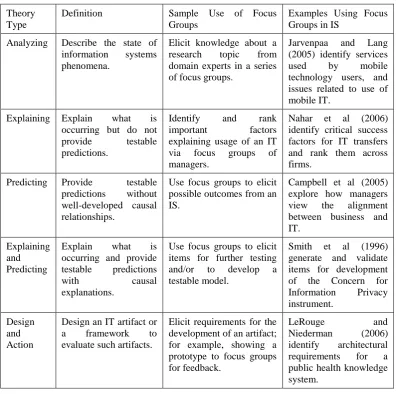
theory, but instead focuses on adapting or refining existing theories. Yet, theory development is core to the growth of a research discipline with many and various phenomena of interest. In discussing the role of theories in information systems, Gregor (2006) identified fives types of theories: analyzing, explaining, predicting, explaining and predicting, and design and action. Importantly, different types of theories can provide different insights into an information systems domain. Table 2 summarizes the different types of theories, and suggests how focus groups inform theory development for each type of theory. The subsequent discussion of each category of focus group studies will offer further examples of how they can be used in IS theorizing.
Theory Type
Definition Sample Use of Focus
Groups
Examples Using Focus Groups in IS
Analyzing Describe the state of information systems phenomena.
Elicit knowledge about a
research topic from
domain experts in a series of focus groups.
Jarvenpaa and Lang (2005) identify services
used by mobile
technology users, and issues related to use of mobile IT.
Explaining Explain what is
occurring but do not
provide testable
predictions.
Identify and rank
important factors
explaining usage of an IT via focus groups of managers.
Nahar et al (2006) identify critical success factors for IT transfers and rank them across firms.
Predicting Provide testable
predictions without well-developed causal relationships.
Use focus groups to elicit possible outcomes from an IS.
Campbell et al (2005) explore how managers view the alignment between business and IT.
Explaining and Predicting
Explain what is
occurring and provide testable predictions
with causal
explanations.
Use focus groups to elicit items for further testing and/or to develop a testable model.
Smith et al (1996) generate and validate items for development of the Concern for Information Privacy instrument.
Design and Action
Design an IT artifact or
a framework to
evaluate such artifacts.
Elicit requirements for the development of an artifact; for example, showing a prototype to focus groups for feedback.
LeRouge and
Niederman (2006)
identify architectural requirements for a public health knowledge system.
Table 2. Focus Groups and Theory Types (adapted from (Gregor 2006))
researchers to understand the extent to which factors are perceived similarly and/or the extent of shared meaning and relative value of the constructs.
FOCUS GROUP AS SOLE METHOD - EXPLORATORY
An important finding from Table 1 is that the majority of papers using the focus group research method in information systems fall in the sole method – exploratory category (25 of 58). This is interesting not only because it is consistent with the type of research for which focus group research methods are recommended (Krueger 1994), but also because it suggests that many more research projects could consider the focus group research method since new phenomena regularly become of interest to IS researchers. For example, emerging technologies offer many topics: what are the new rules of social interactions with the increased use of social networking? Or, what are the potential alterations to group culture when individuals interact substantially in virtual worlds?
In analyzing the list of “sole method – exploratory” papers in Table 1, it can be noted that most topics, with some exceptions, attempt to identify usage or managerial issues related to technology, systems, and IT management. In fact, several studies investigate how individuals use email, mobile technology, dashboards, CRM, health information systems, RFID, knowledge management, databases, application portfolio management, total cost of ownership, or digital libraries. In each of these studies, the main purpose of the focus group is to identify usage levels, determinants of use, or ways in which the system/technology/approach is used. As will be argued below, these exploratory studies are important in the research process towards future theory development. The second main group of studies investigate IS managers’ perceptions of various concepts related to IT management, such as IT staffing issues, IS-business alignment, teaching-research alignment, IS delivery options, IS careers, and general perceptions of IS1. These studies often use one large session where several
1
managers share their ideas on a general topic. This does not follow the typical rules of focus groups (4 to 6 participants; several focus groups to allow for comparisons), and as a result should be considered mainly as informative. However, there could still be value in these as idea generation for research questions, as will be discussed below.
Sole Method Focus Groups for IS Theorizing
Because the focus group research method allows concepts that would only emerge through interactions among individuals to be identified (Grant and Fitzgerald 2005; Hartman 2004), it is especially useful in IS theorizing when researchers are interested in group level phenomena (e.g., group cohesion in software development teams) or in phenomena that exist in the relationships among people (e.g., team satisfaction with technology used in teams within telecommuting environments). Sopreperez’ (2008) study of a UK Fire and Rescue service using focus groups highlights the value of group interaction. The researcher concludes, “some details only emerged when those in attendance were given the opportunity to discuss the incident as a group. Individual interviews would not have given this opportunity and observations would not have revealed attitudes and beliefs.” (p. 187). In information systems research, LeRouge and Niederman (2006) provide an example of how this type of focus groups can be useful in their study of architectural requirements for a public health knowledge system. They highlight the benefits of the focus group research method for identifying requirements for public health knowledge management systems:
1. “…stakeholder perspectives of the scope and potential of knowledge management systems were limited as the study began. By focusing on conceptual issues, the focus group method highlighted individual stakeholders’ reflections in building these conceptual insights…
2. … requirements gathering of systems such as knowledge bases may involve complex or vague topics as stakeholders look at new technologies or multifaceted constructs. When soliciting data from the field, it is sometimes difficult to achieve full explanation and understanding in surveys, especially in initial stages of research. Focus groups allow the gaps to be filled in by fellow participants. Limited moderator prompts may help ensure the topics and issues are understood, yet avoid excessive intervention by project directors, sponsors, or researchers…
3. …because the focus group draws participants from the full set of involved stakeholders, and because the participants are exposed to a wide range of ideas regarding the overall knowledge management program, these participants are themselves positioned to more easily continue diffusing knowledge about the program to nonparticipating stakeholders....” (pp. 18-19).
run online focus groups, which are said to reduce costs, enable participation of more dispersed subjects, and offer anonymity (Montoya-Weiss et al. 1998). As discussed by the authors, technology can help mitigate some of the limitations of face-to-face focus groups. Another potential use of this category of exploratory focus group studies is for requirements determination and design science (Leifer et al. 1994; O'hEocha et al. 2010; Peffers and Tuunanen 2005; Tremblay et al. 2010).
Potential Issues with Using Single Method Focus Groups for IS Theorizing
While the focus group research method as sole method – exploratory can be valuable in IS theorizing, there are some important pitfalls, many of which are found in the studies presented in Table 1. In particular, one has to be concerned with the lack of rigor regarding the sampling and research designs for this category of focus group research in the IS literature. The first issue is that several studies fail to disclose necessary information to evaluate the validity of the findings, such as the number of focus groups conducted, the number of individuals per focus group, or the nature of participants. All future IS studies using focus groups should clearly identify these important research design elements. Without proper information on participants, it is impossible to discuss the generalizability of the findings, an issue further discussed in the “Limitations of Focus Groups” section presented later in this paper.
A second major issue is that many of the focus group-based studies in Table 1 (as single method) use only one focus group. As a result, these studies do not allow for comparisons across groups. While this may not be an issue for exploratory studies seeking to simply elicit information (generating lists of concepts), it is of major concern when one tries to develop a theory based on the one focus group. Depending on the composition of the group (homogenous or heterogeneous strangers), the researcher may find completely different findings. For example, a researcher interested in the success of IT implementations in a firm can assemble participants for a focus group A with all participants from the IT department, and arrive at a particular conclusion based on their inputs. The researcher could also assemble for focus group B with only participants from one user department, and will likely obtain different conclusions. Finally, the researcher can create a focus group C, with a mix of IT and non-IT participants.2 Each of the groups would provide a different perspective on the success of the IT implementation in the firm. Each perspective could be valuable, depending on the interests or research question of the researcher. If the researcher wants to see how biased the view of the IT team is, then using groups A and B would provide valuable insights (using more than one group of each to achieve saturation). An example from Table 1 where this approach was well done is the study by Reid et al (2010) who purposely designed the study with several same sex focus groups to identify the challenges women face in the IS workplace were perceived similarly or differently by men and women. The use of several homogenous groups allowed the researchers to “validate” their findings across groups. In summary, the research design should identify which population is of interest to the particular research question, and then include enough focus groups and participants to achieve saturation, i.e., enough members from all stakeholder groups, relevant to the question and the intended references (what are we trying to say that can be obtained from the focus group findings?). Other researchers suggest that focus groups should only be used when part of a multi-method methodology. For example, in discussing the nexus between teaching and research, Grant and Fitzgerald (2005) conclude that “the issue of measurement bias is a major problem for users of focus groups” (p. 50) and that “focus groups are not beneficial as standalone research methods” (p. 52). It
should be noted, however, that some of the decisions involving the design of their focus groups could have impacted their limited findings. First, the authors ran only two focus groups, not seeking saturation in their findings (Carlsen and Glenton 2011). More importantly, the authors did not select homogeneous strangers (subjects relatively “compatible” with each other) for their focus groups. For example, their second focus group included senior faculty, including a head of a school and a professor with an established research program, two faculty with established research but one new to the department, and two non-research active faculty, both long-standing and one responsible for the largest undergraduate program. Academics active on committees in various academic institutions worldwide would probably recognize the potential issues of power plays, coalitions, and the like in such a group of individuals. It is therefore possible that the lack of “appropriate” results identified with the focus groups could be the result of the design of the study itself as opposed to weaknesses in the method. The authors suggest that other researchers may have had biased findings when using focus groups because of the “power and political interplay being exercised to give the illusion of a consensus.” However, as previously stated, it is this interplay that provides strength to focus group findings in theory development related to IS phenomena where conducting individual interviews or surveys may not reveal important constructs. The important implication for IS theorizing is that researchers must recognize whether the concepts of interest are meant to emerge from group discussions or are embedded in the social context of groups or communities (e.g., satisfaction with technology used in teams within telecommuting environments); or, whether they are clearly of individual-only concern (e.g., perceptions of mobile complexity). For example, a study that requires an understanding of individual perceptions or attitudes on their own, not embedded in social interactions, would benefit more from individual interviews or quantitative methods (e.g. an understanding of self-efficacy).
In summary, and as suggested by Morgan (1997), the focus group research method as sole method can provide greater insights than the sum of individual interviews through its synergistic effects. This is consistent with the advantages of the focus group research method presented by LeRouge and Niederman (2006), which could apply to other IS studies when concepts would only emerge through interactions among individuals (e.g., cultural effects in software development team interactions). In other words, when researchers are interested in phenomena where interactions of individuals are important, the focus group research method can be a better research method than individual interviews. If, however, the researcher is interested in analyzing individuals’ intra-personal cognitions or perceptions (e.g., self-efficacy), the interview research method (or other methods like surveys) might be more useful (although focus groups could still be used in the early stages of the research to elicit dimensions).
FOCUS GROUP AS SOLE METHOD - EXPLANATORY
from what has been accomplished in terms of knowledge elicitation in these studies since the goal in focus group research is usually saturation, where repeated focus group sessions should result in similar findings to a point where no new insight is gained from additional focus groups (Carlsen and Glenton 2011). Group comparisons in this case would not provide any differences. Yet, the possibility of comparing findings across diverse groups can provide further insights into the exploratory findings previously obtained (assuming saturation is reached with homogenous groups first and that there is availability of different stakeholder groups).
FOCUS GROUP AS PART OF MULTI-METHOD: EXPLORATORY
Published journal articles using focus groups that fall in the multi-method category can also be exploratory or explanatory. Exploratory papers tend to combine findings from focus groups with surveys and/or interview data to obtain a more global picture of the phenomenon of interest. In fact, findings from Table 1 suggest that the most often used complementary research method to focus groups is interviews (found in 10 of the multi-method exploratory studies) and surveys (found in nine of the multi-method exploratory studies). Other methods used in combination with focus groups include observations (3), logs (2), secondary data (2), and an expert evaluation (van Velsen et al. 2008). An analysis of the studies in this category in Table 1 reveals some interesting patterns, namely that the multi-method exploratory research studies explore similar topics as the single method exploratory focus groups, and suffer from some of the same issues. As can be seen from the Table, the main topics continue to be on usage (e.g., of analytical Question-Answering systems, digital libraries, ERP, database marketing, cellular technology, RFID) or identification (e.g., behaviours in virtual worlds, evaluation factors, IT transfers, competencies, resistance factors, trust factors). More importantly, there remain issues of lack of information with four of the 16 studies not specifying the number of focus groups and several studies not indicating the number of participants or the nature of the participants. Three of the studies were also conducted with only one focus group. While it might be less of a concern since the focus group is usually used only for eliciting concepts, it remains that using only one focus group might result in some missing concepts, as explained previously.
Multi-Method (Exploratory) Focus Groups for IS Theorizing
The use of multi-method exploratory focus groups is consistent with the case study method to theory building (Eisenhardt 1989; Orlikowski and Baroudi 1991; Strauss and Corbin 1990; Yin 1994) where multiple sources of data must be used (Myers 1997; Yin 1994). A good example of this type of study is the work of Manning (1996) who spent considerable time and effort studying the use of technologies by police officers. Combining individual interviews with focus group data and observations allowed the researcher to gain a deep understanding of such use. There was no stated research model to be tested in the paper, and no particular grounded theory was presented as a result of the analyses in the paper. Yet, the findings provide for an in-depth discussion of organizational use of technology, and the utility of the dramaturgical perspective used by the author for the analysis of technological innovation in organizational contexts. As used in later studies, the technology-in-practice perspective suggests that rules regulating technology use are developed through recurrent use of the technology (Orlikowski 2000).
why behind the relationships identified), 7. enfolding literature (comparing with conflicting and similar literature), and 8. reaching closure (with theoretical saturation when possible). While her work was more specifically targeted at case studies, the concepts to the multi-method focus group research can be applied as follows. Step 1 remains the definition of the problem or research question of interest. Step 2 involves selecting the appropriate population for the focus groups that is relevant to the research question. Step 3 involves developing the focus group protocol (see Appendix A for more details) and selecting the complementary research methods. Step 4 involves conducting the focus groups while allowing new insights to be incorporated into subsequent focus groups or other data collection methods (like interviews). Steps 5 to 8 remain similar (analysing the collected data, shaping hypotheses, comparing to the literature, and reaching closure), with the objective of developing theory.
An example of the use of focus groups for grounded theory work comes from the author’s (and colleagues) study of online children privacy where the researchers were trying to identify what factors would make parents use an online privacy protection tool (Bélanger et al. 2009). Most researchers would use long-standing technology adoption models as theoretical foundations for their work. Using the Technology Acceptance Model (Davis 1989) or the Unified Theory of Acceptance and Use of Technology (Venkatesh et al. 2003), researchers would likely create a model with perceived usefulness (or performance expectancy), perceived ease of use (or effort expectancy), and a variety of other factors such as social influence or facilitating conditions, as impacting likely intentions to use the software. Instead, we conducted focus groups and interviews with actual parents to build an emergent model, which did result in the inclusion of ease of use and usefulness, but also awareness of laws and risks, trust, and behavioural control, among others. The focus groups allowed parents to discuss what was important to them, and to build on one another’s comments. In the real world (which they were in), parents often discuss with one another the best ways to protect children, and this emerged from the focus groups. More importantly, we found that intentions to use the privacy protection tool was not the ultimate dependent variable, but that various techniques (such as keeping a home computer in view) were as important if not more important for parents in protecting their children’s online privacy. In this case, parents were considered experts since their level of knowledge was part of the information the study was seeking. The grounded theory model derived from the focus group data was then tested using a large scale survey.
In summary, while the findings from Table 1 reveal that several issues remain in many of the multi-method exploratory focus group research studies in terms of sampling, the examples show that the exploratory focus group used in conjunction with other research methods can be useful in developing grounded IS theories.
FOCUS GROUP AS PART OF MULTI-METHOD: EXPLANATORY
In Table 1, it can be seen that research papers in the explanatory multi-method focus group research category differ from the exploratory papers in many ways. First, topics of interest move beyond usage and identification to explanation of a variety of IS phenomena. For example, there are studies of impacts (e.g., job characteristics on IS employee satisfaction (Galup et al. 2008)) or adoption (e.g., Push-to-Talk technologies (Dickinger et al. 2008)), or development of new IS constructs such as Concern for Information Privacy (Smith et al. 1996) or IS development project complexity (Weidong and Lee 2005). A second major difference is that most of the studies provide detailed information on the focus group sample, quantity, and the nature of participants, and most of them include many focus groups (only one study uses one focus group). The fact that more planning appears to have been done for those studies as opposed to the previously discussed ones can be due to 1. the more advanced state of knowledge of the topics of interest (as opposed to exploratory topics), or 2. the fact that many of these studies are published in leading IS journals, which might be more demanding regarding details to be provided.
Multi-Method (Explanatory) Focus Groups for IS Theorizing
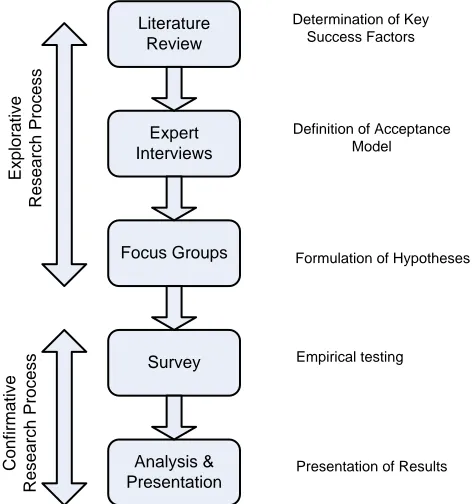
In analysing the papers in Table 1, it is clear that the multi-method explanatory focus group research method has been used for theory development, more specifically for the “Explaining and Predicting” types of theories proposed by Gregor (2006). For these theories, where researchers seek to explain what is occurring and provide testable predictions with causal explanations, focus groups can be used to elicit items for further testing and/or to develop the testable model (similar to what was done with exploratory focus groups presented before). This is most beneficial when IS researchers are interested in concepts that would only emerge through interactions among individuals. In these cases, the focus group research method can provide greater insights than the sum of individual interviews through its synergistic effects, allowing researchers to obtain a more realistic emergent model for later testing. If these interactions are important to the concepts of interest, a model built from interview data only might be missing some key constructs or relationships.
Literature Review
Expert Interviews
Focus Groups
Survey
Analysis & Presentation
Determination of Key Success Factors
Definition of Acceptance Model
Formulation of Hypotheses
Empirical testing
Presentation of Results
E
x
p
lo
ra
ti
v
e
R
e
s
e
a
rc
h
P
ro
c
e
s
s
C
o
n
fi
rm
a
ti
v
e
R
e
s
e
a
rc
h
P
ro
c
e
s
s
Figure 1. Research Process to Study Adoption of Push to Talk Technology (from Dickinger et al. 2008)
Another example from a study of attraction and retention of minorities in computing majors conducted by the author and colleagues (Lewis et al. 2007) highlights the value of focus groups in unearthing key concepts. In the study, the researchers conducted a survey based on the literature to explain why minorities stay into or leave computing majors. The survey included a number of intra-personal factors identified from the literature, such as coping styles, ethnic identity, affinity with the major, and even emotional intelligence. Some findings from the survey data were surprising, so subsequent to conducting the survey a series of seven focus groups were conducted with minority computing students. The focus group findings confirmed some of the previously identified factors, such as coping strategies, and helped identify additional factors such as stressors. Interestingly, the visual data helped identify a number of additional factors related to stereotypes in the major that helped explain prior findings. For example, many of the male students reacted with rolled eyes when the female member of one focus group discussed the issue of unbalanced life; or body reactions indicated that even students who denied that lack of confidence was a major stressor, actually thought it was important (but would never admit it). These findings were very helpful to the researchers in better understanding the retention issues they were studying.
MULTI-METHOD: OTHERS
create a collective cognitive map to be used in the development of a decision support system using avatars. Because the interest of the researchers was on defining the collective cognitive map, the use of focus groups was very appropriate. In fact, it is likely that other Group Support System research use focus groups to create cognitive mapping systems. This type of research would be considered the development of a design and action theory, an area that many researchers suggest need further work (Bélanger and Crossler 2011; Gregor 2006; Hevner et al. 2004). For this type of theory building, focus groups can be used prior to the IT artefact design as knowledge elicitation (as done in the above mentioned study) or after the IT artefact is designed for testing of the artefact (e.g., usability testing).
LIMITATIONS OF THE FOCUS GROUP RESEARCH METHOD
The focus group research method is not without its limitations. A good summary of the benefits and limitations of focus group research is provided by Morgan and Spanish (1984):
“… the strengths of focus groups come from a compromise between the strengths found in other qualitative methods. Like participant observation, they allow access to a process that qualitative researchers are often centrally interested in: interaction. Like in-depth interviewing, they allow access to the content that we are often interested in: the attitudes and experiences of our informants. As a compromise, focus groups are neither as strong as participant observation on the naturalistic observation of interaction, nor as strong as interviewing on the direct probing of informant knowledge, but they do a better job of combining these two goals than either of the other two techniques." (p. 260).
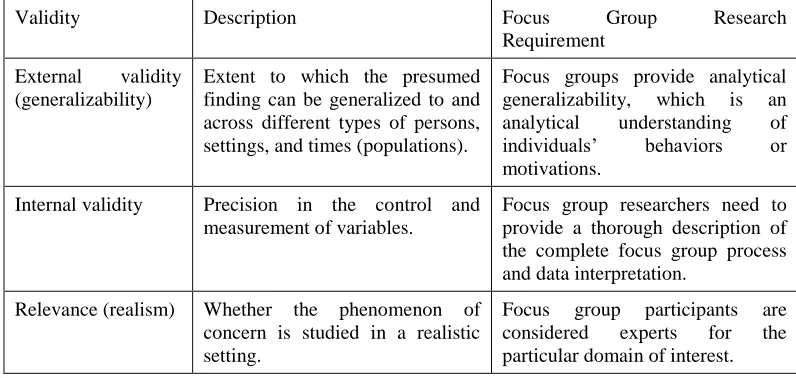
Some criticisms of the focus group research methods are that they are too dependent on the skills of the moderator, they have an unclear level of analysis, and have measurement bias (Grant and Fitzgerald 2005). Others have stated how focus groups represent collective thinking only; however, the main criticism is often validity. Having conducted several research projects with focus groups (as part of large research programs), I know that reviewers often question whether the findings of a study that uses the focus group method are valid. Clearly, positivist quantitative approaches to research have the favour of many researchers because of their ability to offer statistical validity (Cook and Campbell 1979) and to be “verifiable” through future studies (in reality, as a percentage, few published IS studies have actually been replicated in research). Although one can obtain quantifiable results using focus groups (as with interviews), focus groups are not designed for statistical validity (or internal validity as described below). Yet, they do meet other validity objectives as identified by McGrath (1982). The quote at the beginning of this paper is representative of the issues faced by researchers when making research design choices. McGrath (1982) proposes that there are several types of validity that must be balanced: internal validity, external validity, and relevance. McGrath also suggests that these validities represent mutually conflicting objectives: “There is no way […] to maximize all three conflicting desiderata of the research strategy domain.” Table 3 summarizes how focus groups can address these three validities.
subjects are considered experts in the topic of interest, their collective voice is representative of what others like them think of the subject. As discussed in Lee and Baskerville (2003), qualitative research can provide claims of generalizability when the context of the study and the boundaries are clearly delineated. In their recent discussion on generalizability, Seddon and Scheepers (2011) highlight the need for qualitative studies (or as relevant to this discussion, focus groups as sole method or as part of a multi-method effort) to clearly disclose and discuss the boundary conditions to which their findings apply. If researchers do provide their protocol as part of their publications, and clearly describe the population of interest, other researchers should be able to replicate the findings, just as survey instruments can be validated in multiple studies. Unfortunately, as demonstrated by studies on generalizability (Lee and Baskerville 2003; Seddon and Scheepers 2011), and consistent with the findings in Table 1, researchers often fail to disclose this important information.
Validity Description Focus Group Research
Requirement External validity
(generalizability)
Extent to which the presumed finding can be generalized to and across different types of persons, settings, and times (populations).
Focus groups provide analytical generalizability, which is an analytical understanding of
individuals’ behaviors or
motivations. Internal validity Precision in the control and
measurement of variables.
Focus group researchers need to provide a thorough description of the complete focus group process and data interpretation.
Relevance (realism) Whether the phenomenon of concern is studied in a realistic setting.
Focus group participants are considered experts for the particular domain of interest.
Table 3. Validity and Focus Groups
In terms of internal validity, or reliability, it is clear that this cannot be accomplished through controls and precision of the measurement method and its ability to reproduce the same results repeatedly. However, Sykes (1991) discusses how in qualitative research, reliability refers to the role of the researcher in the data collection and in her interpretation. She recommends the qualitative researcher provide a thorough description of the complete process used, including preparation, data collection, and analysis. In the context of focus groups, researchers should clearly indicate the research purpose, the selection criteria, and method used to solicit subjects, the focus group protocol, the capabilities and/or training of the moderator, the settings and tools used for the focus group sessions, the number of sessions held and the time spent at each session, and an actual description of the focus group sessions themselves (including a description of the transcriptions, analyses performed, etc.). Clearly, based on the findings from Table 1, IS researchers should be more careful in this regard when using the focus group research method for their studies.
thinking as individuals seek harmony and reduced conflict in group conversations. Groupthink has been identified as an issue in other research methods such as the Delphi research method3. It is the role of the focus group moderator to avoid such a phenomenon from occurring when conducting the focus group sessions.
CONCLUSION
The focus group research method is a qualitative research method of interest to information systems researchers. While it has some limitations with respect to statistical validity, if properly planned, conducted, and documented, the focus group research method can offer valuable insights to IS researchers for a plethora of information systems phenomena where individuals are embedded in collectives (Morgeson and Hofmann 1999) that impact the emergence of their perceptions, attitudes and behaviors. More importantly, when IS researchers are interested in constructs that emerge from or exist in group interactions, when they are exploring new IS concepts to be tested later, or when they seek a deeper understanding of constructs in established theories, the focus group research method can provide valuable insights for IS theorizing.
ACKNOWLEDGEMENTS
The paper greatly benefited from comments from Dr. Steve Sheetz, Kathy Enget, as well as the editors and reviewers of AJIS.
REFERENCES
Baskerville, R. L., and Myers, M. D. "Fashion Waves in Information Systems Research and Practice," MIS Quarterly (33:4) 2009, pp. 647-662.
Bélanger, F., and Crossler, R. E. "Privacy in the Digital Age: A Review of Information Privacy in Is Literature," MIS Quarterly (35:4), December 2011, pp. 1017-1041.
Bélanger, F., Crossler, R. E., Hiller, J. S., Park, J.-M., and Hsiao, M. "Children Online Privacy: Issues with Parental Awareness and Control," in: Annals of Emerging Research in Information Assurance, Security and Privacy Services, H.R. Rao and S. Upadhyaya (eds.), Reed Elsevier, 2009, pp. 311-333.
Bishop, A. P., Neumann, L. J., Star, S. L., and Merkel, C. "Digital Libraries: Situating Use in Changing Information Infrastructure," Journal of the American Society for Information Science and Technology (51:4) 2000, p 394.
Bryman, A. Quantity and Quality in Social Research Unwin Hyman, London, 1988.
Campbell, B., Kay, R., and Avison, D. "Strategic Alignment: A Practitioner's Perspective," Journal of Enterprise Information Management (18:6) 2005, pp. 653-664.
Carlsen, B., and Glenton, C. "What About N? A Methodological Study of Sample-Size Reporting in Focus Group Studies," BMC medical research methodology (11:26) 2011, pp. 2-10.
Chang Lee, K., and Kwon, S. "A Cognitive Map-Driven Avatar Design Recommendation Dss and Its Empirical Validity," Decision Support Systems (45:3) 2008, pp. 461-472.
Chesney, T., Coyne, I., Logan, B., and Madden, N. "Griefing in Virtual Worlds: Causes, Casualties and Coping Strategies," Information Systems Journal (19:6) 2009, pp. 525-548.
Clapper, D. L., and Massey, A. P. "Electronic Focus Groups: A Framework for Exploration," Information & Management (30:1) 1996, p 43.
Cook, T. D., and Campbell, D. T. Quasi-Experimental Design: Design and Analysis Issues for Field Settings Rand McNally, Skokie, IL, 1979, pp. 223-336.
Cooper, G., and Heinze, A. "Centralisation of Assessment: Meeting the Challenges of Multi-Year Team Projects in Information Systems Education," Journal of Information Systems Education (18:3), Fall2007 2007, pp. 345-355.
Davis, F. D. "Perceived Usefulness, Perceived Ease of Use and User Acceptance of Information Technology," MIS Quarterly (13:3) 1989, pp. 319-340.
Dickinger, A., Arami, M., and Meyer, D. "The Role of Perceived Enjoyment and Social Norm in the Adoption of Technology with Network Externalities," European Journal of Information Systems (17:1) 2008, pp. 4-11.
Dunning, K. A., Vijayaraman, B. S., Krovi, R., and Kahai, P. S. "Graduate E-Business Program Design and Evaluation," Journal of Computer Information Systems (42:1), Fall2001 2001, p 58.
Dwyer, C., and Knapp, C. A. "How Useful Is Is 2002? A Case Study Applying the Model Curriculum," Journal of Information Systems Education (15:4) 2004, pp. 409-416.
Edmunds, H. The Focus Group Research Handbook NTC Contemporary, Lincolnwood, IL, 1999. Eisenhardt, K. M. "Building Theory from Case Study Research," Academy of Management Review
(14:4) 1989, pp. 532-550.
Fern, E. F. "The Use of Focus Groups for Idea Generation: The Effects of Group Size, Acquaintanceship, and Moderator on Response Quantity and Quality," Journal of Marketing Research (19:1) 1982, pp. 1-13.
Fern, E. F. Advanced Focus Group Research Sage Publications, Thousand Oaks, CA, 2001.
Fitch, D. "Structural Equation Modeling the Use of a Risk Assessment Instrument in Child Protective Services," Decision Support Systems (42:4) 2007, pp. 2137-2152.
Galup, S. D., Klein, G., and Jiang, J. J. "The Impacts of Job Characteristics on Is Employee Satisfaction: A Comparison between Permanent and Temporary Employees," Journal of Computer Information Systems (48:4), Summer2008 2008, pp. 58-68.
Glass, R. "Making Research More Relevant While Not Diminishing Its Rigor," IEEE Software (26:2) 2009, p 96.
Goh, D., Ang, R., and Lee, C. "Determining Services for the Mobile Tourist," The Journal of Computer Information Systems (51:1) 2010, pp. 31-40.
Grant, K., and Fitzgerald, S. "The Nexus between Teaching and Research: A Qualitative Study Using Two Focus Group on Academic Information Systems Teachers," Electronic Journal of Business Research Methods (3:1) 2005, pp. 37-56.
Gregor, S. "The Nature of Theory in Information Systems," MIS Quarterly (30:3), September 2006, pp. 611-642.
Hartman, J. "Using Focus Groups to Conduct Business Communciations Research," The Journal of Business Communications (41:4) 2004, pp. 402-410.
Hevner, A. R., March, S. T., Park, J., and Ram, S. "Design Science in Information Systems Research," MIS Quarterly (28:1) 2004, pp. 75-105.
Hill, C. E., Loch, K. D., Straub, D. W., and El-Sheshai, K. "A Qualitative Assessment of Arab Culture and Information Technology Transfer," Journal of Global Information Management (6:3) 1998, pp. 29-38.