The influences of curriculum area and student
background on mindset to learning in the veterinary
curriculum: a pilot study
Elizabeth Armitage-Chan
and Jill Maddison
Department of Clinical Sciences and Services, Royal Veterinary College, Hatfield, UK
Abstract
A student’s mindset influences their achievement and response to challenge, with a ‘fixed mindset’ encouraging disengagement from challenging tasks and avoidance of learning and feedback opportunities. These behaviours resemble those reported for professional and non-clinical curriculum areas, which are important for employa-bility and resilience in veterinary practice. Students with a ‘growth mindset’ to learning are more persistent when faced with challenges and actively seek more demanding tasks. They also demonstrate higher levels of psychological well-being. The objectives of this study were to explore whether variation in veterinary students’ mindset to learning exists across different curriculum areas, and to identify whether students’ backgrounds influence their learning mindset. The mindsets of veterinary students at a UK veterinary school were measured using an adapted version of the Implicit Theories of Intelligence Scale. The survey was constructed to compare mindset in clinical reasoning, professional reasoning (incorporating ethics and critical thinking), communica-tion skills and refleccommunica-tion. More students demonstrated a growth mindset to communicacommunica-tion skills (59%), reflec-tion (84%) and clinical reasoning (83%) than to professional reasoning (34%). There were more students with a fixed mindset to professional reasoning (10%) than in other areas (0–5%). Students’ background (interna-tional or non-tradi(interna-tional university access) did not appear to influence mindset to learning. Disengagement from professional studies curricula may be a consequence of students lacking a growth mindset in professional reasoning. Curriculum interventions that encourage engagement and the development of a growth mindset to learning non-clinical competences may be beneficial.
Keywords: critical thinking, mindset, professional studies, resilience, student engagement.
Correspondence: Elizabeth Armitage-Chan, Department of Clinical Sciences and Services, Royal Veterinary College, Hawkshead Lane, North Mymms, Hatfield AL9 7TA, UK. E-mail: [email protected]
Introduction
Students’ mindset, or their beliefs about their capac-ity to learn, has important consequences for their academic achievement, retention and resilience (Yeager & Dweck 2012; Aditomo 2015). As described by Dweck (2006), students who believe intelligence to be a fixed trait (a function of ‘who one is’, or possibly one’s genetic code) perceive their competence in a particular area to be pre-deter-mined and therefore resistant to effort and engage-ment. Such students are described as possessing a fixed or entity mindset to intelligence (Dweck 2006).
Not only is their academic achievement
compromised, but they have also shown to demon-strate poor psychological well-being (Whittington et al. 2017). In contrast, other students, who believe intelligence to be malleable, with potential for devel-opment resulting from effort and engagement, are described by Dweck as possessing a growth or incre-mental mindset (Dweck 2006). They demonstrate greater potential for learning and improvement, as when they encounter challenge or failure, they tend to respond by engaging in learning to improve their performance.
Understanding veterinary students’ mindset may help to better understand their engagement in learn-ing, particularly in demanding areas of the veterinary
course. When encountering a challenging academic task, students with a fixed mindset are prone to dis-engaging; they become frustrated with the task, reject feedback and demonstrate avoidance beha-viour (failure to attend classes, disengagement from informal assessment opportunities) (Murphy & Lynda 2008; Sperlinget al. 2012). This is reinforced by the contextual stressors of higher education, such as preparation for examinations (Dweck 2012). The development of a fixed mindset typically occurs as a consequence of being praised for highly successful outcomes, while the effort and achievement involved in tackling a more demanding task (which is not completed perfectly) are ignored (Dweck 2006). As such students become dependent on such praise they may also become highly strategic, seeking out tasks they know they can do well and avoiding those in which they may be challenged. In this way many high-achieving and ‘perfectionist’ students, who may be assumed to possess a growth mindset to their development, paradoxically demonstrate a fixed intelligence belief system (Clinkenbeard 2012). There is a potential risk of this occurring in veteri-nary students, in whom a history of being praised as ‘high achievers’ (Zenneret al. 2005) may make them more vulnerable to disengaging from opportunities in which they may be challenged.
Mindset can be demonstrated to show domain-specific variation, such that a student may believe themselves to have finite capacity for some subjects while accepting their potential for growth and devel-opment in others (Atwood 2010). Domain-specific research has particularly focused on those areas asso-ciated with high levels of student attrition and those associated with limited diversity in student admis-sions, such as the STEM subjects (Science, Technol-ogy, Engineering and Mathematics) (Fitzakerley et al. 2013; Scherr et al. 2017; Lisberg et al. 2018). These studies suggest that while students may demonstrate learning behaviours associated with a growth mindset in other subjects, their avoidance and attrition from mathematics and science subjects may relate to domain-specific fixed mindset beliefs in these areas.
Within the veterinary and medical sciences, similar rejection of specific curriculum areas has been
described, for example in professionalism and busi-ness studies education (Leo & Eagen 2008; Birden & Usherwood 2013; Armitage-Chan & Jackson 2018). In these subjects, the skills required for success include entrepreneurial, interpersonal and reflective competences, and hence differ slightly to those uti-lised for learning and problem-solving clinical sub-jects (typically assumed to represent clinical reasoning of medical and surgical presentations). Student engagement is a multifaceted construct that can unlikely be explained on the basis of a single contributing element, and disengagement from non-clinical subjects is generally attributed to the hidden curriculum: sociocultural influences that under-pri-oritise certain curriculum areas, misalignment of taught content with the skills and behaviours observed in clinician role models, and lack of clarity in learning outcomes and assessment criteria (Brai-nard & Brislen 2007; Leo & Eagen 2008; Kahu 2013). However, given the similarities between the described behaviours of fixed mindset students when faced with a challenging task (missing classes, avoid-ance of informal assessment opportunities), and those observed institutionally for non-clinical sub-jects, it is possible that a fixed mindset belief sur-rounding capacity for learning in these areas also contributes to the reported engagement challenges. If students are identified as possessing a fixed mind-set to these non-clinical subject areas, interventions could be designed to encourage the development of a growth mindset, such as positive feedback or awarding of credit for engagement in problem-solv-ing processes (Dweck 2006).
student is, rather than being interpreted as an incen-tive to work harder at the task or subject area. Higher education internationalisation research has included a focus on whether students from particular global areas are hampered in their learning of com-petences such as collaborative working and critical thinking (Auyeung & Sands 1996; Ip et al. 2000). The implications of this research are contested, with observed variation suggested to arise from linguistic limitations when expressing critical thinking in a non-native language (Chalmers & Volet 1997; Car-roll & Ryan 2007). However, of particular interest are studies such as that performed by Ipet al. (2000), who proposed that students originating from their own geographical area (East Asia) have less educa-tional experience in critical thinking, and consider themselves as less able in this area, compared to those from elsewhere (Ip et al. 2000). Despite the contested nature of this research, the work by Ip et al. and Auyeung and Sands demonstrates the risk that international students may perceive themselves as less experienced in certain curriculum areas, and may develop fixed mindset behaviours as a result.
Recent work in veterinary education highlights the importance of non-clinical competences such as criti-cal thinking, communication and teamwork for employability and resilience (Armitage-Chan & May 2018a,b; Bell et al. 2018). It is therefore vital that curricula and teaching methods are structured to encourage success in these areas, that sub-groups of students (such as those from widening access pro-grams and international backgrounds) are not disad-vantaged and that efforts are made to encourage a growth mindset to learning in these non-traditional veterinary subjects. The aims of this pilot study were to explore whether domain-specific mindset variation is evident among veterinary students, and to evaluate whether students’ backgrounds contribute to their self-intelligence belief systems.
Methods
The mindset of students enrolled on the 5-year BVetMed course at the Royal Veterinary College (RVC), United Kingdom (UK), was assessed using an adapted version of the Implicit Theories of
Intelligence Scale, developed by Dweck and adapted extensively by others (Dweck et al. 1995; Atwood 2010; Bostocket al. 2018). In this survey instrument, a number of statements are presented surrounding the malleability or fixed nature of intelligence, and respondents are asked for the extent to which they agree with these, with responses provided using Lik-ert scales (strongly agree, agree, disagree, strongly disagree). Statements are constructed around impli-cit beliefs of one’s ability (for example, ‘You have a certain amount of intelligence and you can’t really do much to change it’) and goal measures, such as a students’ attitude when approaching a challenging task (‘Trying new things is stressful for me and I avoid it’) (Dweck 2006). As described by Atwood (2010), adapted versions substitute competences from the domain of interest where the word ‘intelli-gence’ appears in Dweck’s original survey instru-ment.
For the purposes of this research, four domains of interest (Clinical Reasoning, Professional Reasoning, Communication Skills and Reflection) were selected from the RVC veterinary curriculum. The domains were selected firstly to allow comparisons between the analytical thinking required in clinical curriculum subjects (‘Clinical reasoning’, denoting teaching in medical and surgical subjects) and non-clinical sub-jects (‘Professional reasoning’, denoting ethics and professional studies). Next, domains were selected to explore areas where the literature suggested there may be variation as a result of students’ cultural background (specifically collaborative working meth-ods and critical thinking). As well as representing a non-clinical competence, Professional Reasoning was therefore also selected as an example of critical thinking, particularly the management of uncertainty that is emphasised institutionally in ethics and pro-fessional studies teaching. Within the institution, crit-ical thinking and collaboration were also considered to be present within Communication Skills (taught through collaborative working) and reflection (incor-porating critical thinking).
ssroom20.com/forum/topics/motivating-students-with). Five statements were constructed for each domain, and efforts were made to include a similar spread of question type (ability beliefs and goal mea-sures). To make the individual domain questions as consistent as possible, attempts were made to incor-porate enjoyment/interest and perceptions of value/ relevance within each domain. However, questions also had to be constructed to reflect the different institutional approaches to curriculum delivery (e.g. feedback provision) in the individual subject areas (ethics, professional studies, communication skills, medical and surgical problem-solving), as well as reflection representing a generic competence rather than a taught subject area. Because of this, variation between the domains was impossible to eliminate entirely. Based on previously published versions of the survey, statements were also constructed to avoid repetition in the wording used (i.e. repetition of statements with single word substitutions to indicate different domains).
As an example of statement construction, within the communication skills domain, ability belief was represented by the statement ‘Other people on my course are naturally better communicators and have an advantage in this area’ and goal measures were represented by the statement ‘The feedback that I receive on my communication skills is helpful’. Within the ethics/professional reasoning domain, ability belief was represented by the statement ‘Other people on my course seem to have a more natural affinity for ethics problem-solving’ and goal measures by the statement ‘I enjoy the lack of a defi-nite correct answer to the problems in the profes-sionalism/ethics teaching’. The complete survey is provided in Appendix S1.
In accordance with earlier reported versions (Dweck 2006), for the purposes of scoring and response analysis, statements were classed as either ‘growth mindset’ or ‘fixed mindset’. Examples of a ‘growth mindset’ statement included ‘If I learn a log-ical approach to clinlog-ical problem-solving I am confi-dent I will be able to reach a diagnosis in my patients’ from the clinical reasoning domain, and ‘The ability to solve problems with no universally correct answer is important to me’ from professional
reasoning. A ‘fixed mindset’ question in the clinical reasoning section was ‘I find it unhelpful to receive feedback on the problem-solving process, what is needed is the diagnosis’ and in the reflection section ‘Reflection is difficult for people who learn like I do’. For ‘growth mindset’ statements, responses were scored from 3 (strongly agree) to 0 (strongly dis-agree); ‘fixed mindset’ statements were scored in reverse (i.e. 0 for ‘strongly agree’ and 3 for ‘strongly disagree’). Scores were totalled for each area, pro-viding a maximum of 15; scores of 10 and above were described as representing a growth mindset and those of 5 and below a fixed mindset, as described in the published model (Atwood 2010). Scores of between 6 and 9 are described as representing stu-dents with neither a strong fixed nor a strong growth mindset, and these were not used for data analysis in this study.
The survey, which also included questions to iden-tify student demographic information, was
con-structed using web-based survey software
(such as dyslexia). A small incentive for survey com-pletion was provided (entry into a prize draw for a
£10 voucher). The respondents were asked to pro-vide their email address if they wished to enter the prize draw; however, email addresses were removed from the extracted data to ensure anonymity of responses. It was possible to complete the survey without providing an email address, should respon-dents wish to remain completely anonymous.
Participant responses were exported into spread-sheets for initial review, and then analysed using IBM SPSS Statistics (version 23). The scores for mindset were used to calculate numbers of students demonstrating a fixed and growth mindset in each curriculum area, which were then handled as cate-gorical data. Comparisons between percentages of students with fixed and growth mindsets were per-formed using Fisher’s exact tests and significance was set atP<0.05. The study was approved by the insti-tutional ethics committee, reference number URN 2016 1643-2.
Results
Completed surveys were received from 198 students, representing a response rate of 34%. Gender balance was as predicted by the student population: 78% female, 21% male (1% of respondents selected the option ‘I do not self-associate with either gender’; there were no students who indicated they did not want to select a gender option). When examining the cultural background of respondents, the country with which the student felt the closest cultural connection was used (which in nearly all cases was the same as the country in which the respondent had most recently been educated). Response rates according to cultural background are shown in Table 1. There was an approximately equal spread of students from different year groups: 38% of responses were from year 3, 36% from year 4 and 26% from the final year.
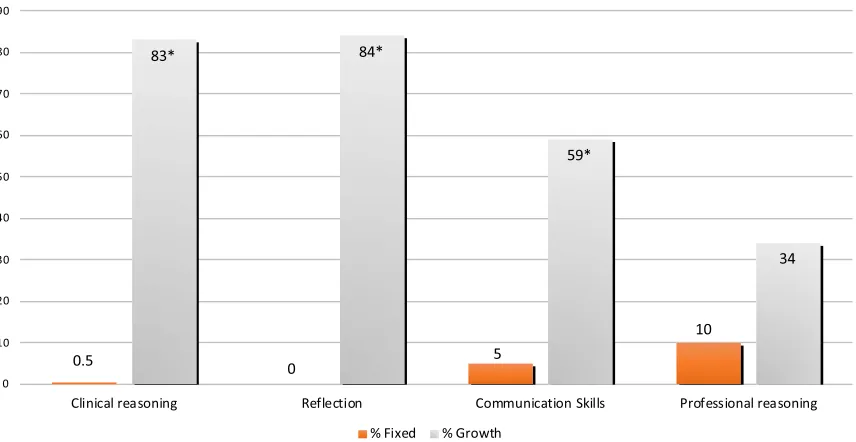
The variation in growth and fixed mindset for dif-ferent curriculum domains is shown in Figure 1. The percentage of students with a growth mindset for professional reasoning (34%) was significantly lower than the percentage with a growth mindset for other
curriculum areas (for example compared to 59% who demonstrated a growth mindset for communica-tion skills,P=0.005). The presence of a fixed mind-set was also higher for professional reasoning (10% of students) than for other curriculum areas (5% of students in communications skills, 0.5% in clinical reasoning and 0 in reflection); however, these data were not analysed statistically as this would be inap-propriate given the low numbers of students repre-sented.
Because of the greater variation in mindset evi-dent for communications skills and professional rea-soning (compared to minimal variation across the population in clinical reasoning and reflection), these were selected for further comparative analysis. The ranges of mindset evident across different cultural backgrounds in these curriculum areas are shown in Table 2. There was no significant effect of cultural background on the percentage of students demon-strating fixed or growth mindset in either communi-cations skills or in professional reasoning.
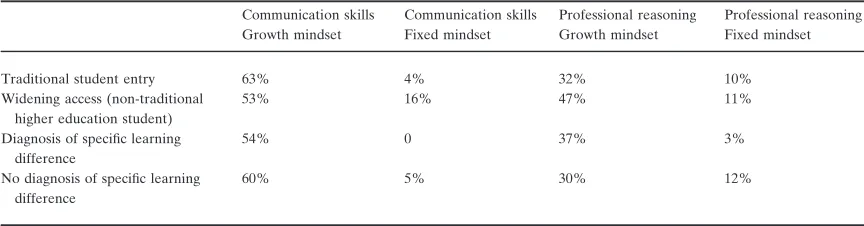
The influence of other demographic variables was then investigated, the results of which are shown in Table 3. There were no differences in growth and fixed mindset proportions for professional reasoning between students who accessed the veterinary course from different educational backgrounds (traditional undergraduate entry or entry via the widening access course). When mindset to learning communications skills was analysed according to students’ access route, there was a trend suggesting those who had entered via the widening access pathway may have an increased tendency towards a fixed mindset (P=0.053). There were no differences in mindset proportions for either communication skills or
Table 1.Cultural background of respondents
Region of closest cultural connection
Number of respondents (% of total responses)
Total number of students in cohort from each region
UK 163 (82%) 605
North America 22 (11%) 66 Asia (mainly
Singapore and Hong Kong)
9 (5%) 19
professional reasoning when students with a specific learning difference diagnosis were compared to those without a learning difference diagnosis. There were also no differences in mindset to either of the cur-riculum areas when responses were analysed by year of study (data not shown).
The potential for the variability in statement word-ing between the curriculum domains to influence the results was considered a risk of the study. To explore whether these differences in statement styles con-tributed to the observed differences in mindset across the subject domains, and to ensure that the
wording of an individual statement had not
singularly contributed to the results obtained, com-parisons were repeated with responses from individ-ual statements removed. This had no effect on the findings obtained (specifically, professional reasoning appeared to be persistently associated with lower growth mindset levels compared to the other domains, regardless of the statements used to per-form this analysis).
Discussion
There are several findings in this study that have potential implications for veterinary education. The
Fig. 1. Percentages of students demonstrating a fixed and growth mindset to learning in different curriculum areas. * = significant difference in growth mindset proportion compared to professional reasoning. Some students demonstrate neither a fixed nor a growth mindset to learning; these students are not represented within this figure.
Table 2. Mindset to learning communication skills and professional reasoning according to cultural background
Communication skills Growth mindset
Communication skills Fixed mindset
Professional reasoning Growth mindset
Professional reasoning Fixed mindset
UK 58% 5% 9% 9%
North America
27% 0 14% 14%
Asia 44% 11% 11% 22%
higher incidence of a fixed mindset to learning pro-fessional reasoning (representing ethics and profes-sional studies) compared to other areas of the curriculum, the apparent lack of difference relating to geographical cultural diversity and the potential for widening access students to demonstrate fixed mindset beliefs relating to communications skills are all of note and will be discussed.
Mindset for learning ethics/professional reasoning
Compared to other curriculum areas, the small num-ber of students who demonstrated a growth mindset to learning professional reasoning (and the sugges-tion that there may be more students with fixed mindset to learning in this area) was notable. It is perhaps unsurprising that students find this area of the curriculum to be challenging. Based on curricu-lum content, the survey statements focused on find-ing solutions to problems with no universally correct answer and those where the student/veterinarian faces uncertainty in predicting whether their chosen action will be successful. The findings suggest that students perceive themselves to be more challenged when managing this uncertainty, and less confident that practicing this skill will help them to gain com-petence, compared to their perceptions of learning capacity in other areas (communication skills, clini-cal reasoning and reflection).
This lack of growth mindset for learning has impli-cations for students’ engagement with professional
reasoning content. Engagement in professional stud-ies education is widely known to represent a chal-lenge (Brainard & Brislen 2007; Leo & Eagen 2008). Individuals with a fixed mindset are more likely to disengage from learning, so they avoid exposing their lack of ability. When faced with substantial learning challenge they fail to show up to class, see feedback as a threat or insult, avoid engaging in feedback opportunities, and tend to blame the content if they perform poorly in assessments (VandeWalle & Cum-mings 1997; Murphy & Lynda 2008). While it is unclear whether a fixed mindset is the cause or a sig-nificant contributor to observed engagement chal-lenges in professional studies subjects, it is possible that encouraging a growth mindset may support bet-ter engagement.
It is interesting to compare the findings of stu-dents’ attitudes to learning professional reasoning with their mindset to learning and achievement in clinical reasoning. In recognition of the complexity and risk of error associated with clinical problem-solving, analytical approaches have been developed that provide a systematic approach, in effect simpli-fying the complexity of disease presentation and attempting to avoid misleading clinical signs leading to diagnostic error (Maddison 2017). Teaching a sys-tematic approach to clinical reasoning therefore con-veys to students that if they work through the framework provided, they will successfully reach a diagnosis in their patients and avoid diagnostic error. Experiential learning opportunities are readily used by students to reinforce their clinical reasoning, for
Table 3. Mindset to learning communication skills and professional reasoning according to access route to the course and diagnosis of specific learning difference
Communication skills Growth mindset
Communication skills Fixed mindset
Professional reasoning Growth mindset
Professional reasoning Fixed mindset
Traditional student entry 63% 4% 32% 10%
Widening access (non-traditional higher education student)
53% 16% 47% 11%
Diagnosis of specific learning difference
54% 0 37% 3%
No diagnosis of specific learning difference
60% 5% 30% 12%
example during clinic placements and final year rota-tions (Matthewet al. 2010). The tangibility of clinical reasoning, exemplified through a systematic approach and readily available examples in the workplace, may have facilitated the development of a growth mindset to this domain.
In contrast, evidence suggests that students strug-gle to contextualise professional reasoning when they observe clinical practice (Matthew et al. 2010). A common complaint among medical students about this curriculum area is its lack of relevance to the work of the clinician (Morihara et al. 2013). Ele-ments of professional reasoning, including the clini-cian’s approach to resolving professional dilemmas, have also been poorly articulated to students, in part because of clinical faculty themselves receiving little formal education in this area (Stern & Papadakis 2006; Hawicket al. 2017). As a result, it appears that compared to the more tangible concepts of clinical reasoning, which emphasise a systematic, learnable process, professional reasoning may appear more elusive to students. Strategies to simplify profes-sional reasoning, particularly at early stages of stu-dents’ learning, may therefore be beneficial to scaffold students’ learning, improve confidence and help them to identify aligned behaviours present in the clinic (Armitage-Chan 2018).
As discussed in the introduction to this paper, stu-dent engagement is multifactorial and much of the observed disengagement likely results from hidden curriculum influences such as lack of clinical faculty role modelling professional competences and neglect in university assessments (Cribb & Bignold 1999; Hafferty & Hafler 2011; Hawicket al. 2017). It is also possible that the responses obtained in this study simply reflected students’ preferences for learning more overtly clinically useful competences, such as clinical reasoning and communication skills. How-ever, on the assumption that a fixed mindset ten-dency may contribute to this complex issue, a number of curriculum interventions have been implemented to encourage students’ engagement and development of a growth mindset in this area. The redesign of the curriculum has been undertaken with an increased understanding that students’ attainment of multiperspective critical thinking is a
gradual process, with a need for incremental devel-opments in the level of complexity presented (Armi-tage-Chan & May 2018a,2018b). A systematic framework for professional reasoning is now used, which aims to scaffold students’ integration of pro-fessional reasoning competences, and provide a more tangible, systematic approach to analysing complex problems (Armitage-Chan 2018). Greater use is also made of experiential learning and reflective assign-ments, so that students can apply their reasoning in context and receive feedback on this engagement.
Absence of effect of geographical cultural background on mindset to learning
In the light of increasing higher education interna-tionalisation, it is reassuring that geographical cul-tural background had no effect on mindset to learning in any of the curriculum areas. Prior work suggested that inter-cultural mindset differences observed in critical analysis, deep learning and man-agement of uncertainty, if present, are very small (Joy & Kolb 2009). Taken in the context of the bal-ance of the literature on this subject (Kee & Kuok 2003; Carroll & Ryan 2007), the findings of this study appear to suggest that geographical cultural diversity should be ignored in student groups. However, this may risk neglecting students who are less experi-enced in critical thinking or collaborative learning. This issue has been explored by several authors, who describe a concept of ‘meta-cultural competence’ for diverse student populations (Carroll & Ryan 2007). Students should neither be treated as if they are all the same, nor should they be assumed to follow the patterns suggested by their cultural history (Louie 2007). Rather, the collection of knowledge about dis-tinct cultural backgrounds should be applied individ-ually, used to inform an educator’s interactions with their student, but without assuming they will con-form to stereotype.
The influences of educational history and specific learning difference
to influence mindset to learning in the domains explored represents a positive outcome. Although students may feel challenged by having a learning difference or coming from a non-traditional back-ground, the data appear to suggest this does not affect their perceptions surrounding their potential for achievement, at least in the domains examined. The trend towards more students from a widening access (non-traditional) higher education back-ground having a fixed mindset to communications skills was of interest, and because the number of stu-dents with a fixed mindset was low, this may be a more significant finding than was suggested by statis-tical analysis. If there is a potential for some students to perceive themselves as innately less capable in this area, and therefore at risk of disengaging from classes, monitoring students’ engagement in commu-nications skills classes would be advisable.
Relationship of growth and fixed mindset scores to those in the wider literature
The findings demonstrated particularly high-growth mindset scores and low-fixed mindset scores across the student population, which is inconsistent with findings from previous studies in similar populations (Whittingtonet al. 2017; Bostocket al. 2018). How-ever, it is to be noted that the domain-specific nature of the survey design did not provide a global assess-ment of students’ mindset, and therefore comparison with other studies is of limited value. In general, stu-dent populations are described as being more bal-anced, with approximately 40–50% demonstrating a growth mindset and 40–50% a fixed mindset (Esparzaet al. 2014; Yanet al. 2014). Studies in pop-ulations of particular relevance to the veterinary pro-fession are similar to those reported for the general student population, with 51% growth/49% fixed mindset being described in paediatricians (Jegathe-sanet al. 2016) and approximately 43% growth/40% fixed mindset identified in veterinary students (Whit-tingtonet al. 2017).
The high-growth mindset scores for clinical rea-soning and reflection were therefore initially puz-zling. In clinical reasoning, much curriculum time in our institution has been devoted to the value of an
analytical reasoning process, and a devaluing of memorising the ‘correct answer’ to a set of clinical signs. At the start of year 3, students are also given instruction in the science of growth and incremental mindset by the course lead in clinical reasoning development. These interventions, and their effect on clinical reasoning mindset, could be explained in two ways. It is possible that they have supported the development of growth mindset in our students in clinical reasoning activities. Alternatively, they may be sufficiently powerful that the students knew the more growth mindset ‘right answers’ to the state-ments provided in the survey. Further work is there-fore needed to explore whether veterinary students in general demonstrate a particularly strong growth mindset to learning clinical problem-solving, whether this represented a consequence of teaching methods supporting growth mindset development, or whether it was a function of survey wording.
surrounding the importance of reflection to graduate continuing education (e.g. ‘Reflecting on CPD’, at http://veterinaryrecord.bmj.com/content/vetrec/178/ 25/618.full.pdf) has had a positive impact, at least on students’ perceptions of the importance and rele-vance of this material to the veterinarian.
Conclusions and limitations
There are some significant limitations to the design of this study that are important to discuss. As described in earlier sections, the survey included inconsistencies between the statements for each domain of interest. While the rationale for this was explained in the methods section, and an attempt was made to analyse whether responses were unduly affected by individual statements, the potential remains for survey construction to have influenced the results. It was therefore not possible, based on the methods described, to identify whether students innately possess a variable mindset to learning across different domains, or whether this finding was a sequence of different approaches to statement con-struction. It was also possible that the observed differences represented a teaching or learning phe-nomenon: students’ varying interest levels in differ-ent areas, or differdiffer-ent teaching methods. For example, providing higher quality feedback or more explicit experiential learning opportunities in certain areas may have enhanced students’ mindset to learn-ing. The potential role of learning engagement has also been presented in a very simplified way, assum-ing that a growth mindset will enhance student engagement. As well as neglecting other influences on students’ engagement (their interest and percep-tions of relevance, the quality of teaching provided), this also over-simplifies the potential cause–effect relationship of mindset and engagement. While a growth mindset may foster engagement, the reverse may also be true: teaching techniques that scaffold engagement may help students to develop a growth mindset as they are guided to being able to learn and develop their competence in a challenging area.
It is therefore important not to over-state the sig-nificance of the study findings, particularly in com-parisons between domain areas. However, the
observed differences between students’ responses to professional reasoning statements, and those for statements describing other domains, remain of interest. It is possible that the observed differences arose simply from differences in the statement word-ing. However, as the wording was modelled on the teaching content and delivery methods in profes-sional reasoning (ethics and profesprofes-sional studies) and clinical reasoning (medical and surgical teaching), the observed differences remain important to address. Mindset evaluation within a particular field of interest typically involves a more extended survey instrument (Bostock et al. 2018). Comparisons between clinical and professional reasoning would therefore merit being explored using a lengthier, and more consistent, mindset tool.
Whether the observed differences arose from gen-uine mindset variation, or were a function of engage-ment challenges (including students’ interest levels) or differences in curriculum expectations (for exam-ple, the focus on uncertainty in the professional rea-soning survey statements, and in the teaching in this area), the results support the need to facilitate stu-dents’ engagement in professional reasoning. The findings have therefore helped us to recognise that students need help to engage in the higher level com-petences of handling complexity and management of uncertainty that are emphasised within our profes-sional studies teaching. We have also been alerted to the potential for some students to disengage from communications skills teaching if they perceive themselves to be inherently less capable in this area; as a result we have instituted monitoring mechanisms so that students in need of assistance do not disen-gage from the available learning opportunities.
A further limitation lies in the institutional speci-ficity of the survey construct, and hence the repro-ducibility of the findings. The survey statements for each domain were based on how clinical reasoning, professional reasoning, critical thinking and commu-nication skills are framed and delivered in our
insti-tution. For example, if the management of
resemble our professional reasoning results. The findings should therefore be interpreted in the con-text of the skills and teaching approaches that we have described when defining each of the survey domains (e.g. management of uncertainty and critical thinking representing the Professional Reasoning domain, collaborative learning representing the Communication Skills domain) rather than exclu-sively as a representation of each subject area.
Conflict of interest
The authors have no conflict of interest to report.
Ethical statement
The authors confirm that the ethical policies of the journal, as noted on the journal’s author guidelines page, have been adhered to and the appropriate ethics review committee approval has been received.
References
Aditomo A. (2015) Students’ response to academic set-back: ‘Growth Mindset’ as a buffer against demotiva-tion.International Journal of Educational Psychology4, 198. Available at: http://ijep.hipatiapress.comhttp//dx.d oi.org/10.17583/ijep.2015.1482 (Accessed 29 Aug 2018). Armitage-Chan E. (2018) Best practice in professional
identity formation: use of a professional reasoning framework.Journal of Veterinary Medical Education, In Press.
Armitage-Chan E. & Jackson E. (2018) Improving student engagement in veterinary business studies.Journal of Veterinary Medical Education45, 204–212. Available at: http://jvme.utpjournals.press/doi/pdf/10.3138/jvme.0816-137r1 (Accessed 28 Sep 2017).
Armitage-Chan E. & May S.A. (2018a) Developing a fessional studies curriculum to support veterinary pro-fessional identity formation.Journal of Veterinary Medical Education45, 489–501. Available at: http:// jvme.utpjournals.press/doi/10.3138/jvme.1216-192r1 (Accessed 28 June 2018).
Armitage-Chan E. & May S.A. (2018b) Identity, environ-ment and environ-mental wellbeing in the veterinary profession.
Veterinary Record183, 68. Available at: https://veterina ryrecord.bmj.com/content/early/2018/06/27/vr.104724 (Accessed 28 June 2018).
Atwood J.R. (2010) Mindset, motivation and metaphor in school and sport: bifurcated beliefs and behaviour in
two different achievement domains.American Educa-tion Research AssociaEduca-tion, 1–30. Available at: https://eri c.ed.gov/?xml:id=ED509344 (Accessed 29 Aug 2018). Auyeung P. & Sands J. (1996) A cross cultural study of the learning style of accounting students.Accounting & Finance36, 261–274. Available at: https://doi.org/doi.wi ley.com/10.1111/j.1467-629x.1996.tb00310.x (Accessed 24 Apr 2018).
Bell M.A., Cake M.A. & Mansfield C.F. (2018) Beyond competence: why we should talk about employability in veterinary education.Journal of Veterinary Medical Education45, 27–37. Available at: https://jvme.utpjourna ls.press/doi/10.3138/jvme.0616-103r1 (Accessed 24 Apr 2018).
Birden H.H. & Usherwood T. (2013) “They liked it if you said you cried”: how medical students perceive the teaching of professionalism.Medical Journal of Aus-tralia199, 406–409. Available at: www.mja.com.au (Accessed 20 Sep 2017).
Bostock R., Kinnison T. & May S.A. (2018) Mindset and its relationship to anxiety in clinical veterinary students.
Veterinary Record183, 623. Available at: http://www.ncb i.nlm.nih.gov/pubmed/30327350 (Accessed 27 Nov 2018). Brainard A.H. & Brislen H.C. (2007) Learning profession-alism: a view from the trenches.Academic Medicine82, 1010–1014. Available at: http://content.wkhealth.com/ linkback/openurl?sxml:id=WKPTLP:landingpage&an= 00001888-200711000-00002 (Accessed 23 Sep 2017). Cannon H.M., Andrew H.F., Daniel P.F. (2014) Managing
complexity: applying the conscious-competence model to experiential learning.Developments in Business Simu-lation and Experiential Learning: Proceedings of the Annual ABSEL Conference. 37. Available at: https:// absel-ojs-ttu.tdl.org/absel/index.php/absel/article/view/ 306 (Accessed 12 Dec 2018).
Carroll J., Ryan J. (2007) Teaching International Students: Improving Learning for All.
Chalmers D. & Volet S. (1997) Common misconceptions about students from South-East Asia studying in Aus-tralia.Higher Education Research & Development16, 87–99. Available at: http://www.tandfonline.com/doi/full/ 10.1080/0729436970160107 (Accessed 24 Apr 2018). Claro S. & Paunesku D. (2014) Mindset gap among SES
groups: the case of chile with census data.Society for Research on Educational Effectiveness. Available at: https://eric.ed.gov/?xml:id=ED562769 (Accessed 29 Aug 2018).
Clinkenbeard P.R. (2012) Motivation and gifted students: implications of theory and research.Psychology in the Schools49, 622–630. Available at: https://pdfs.semanticsc holar.org/8f6a/959220545e0780342ae3dbc5bbea830990a7. pdf (Accessed 29 Aug 2018).
research.Studies in Higher Education24, 195–209. Available at: http://www.tandfonline.com/doi/abs/10. 1080/03075079912331379888.
Dweck C.S. (2006). Mindset: Changing the Way You Think to Fulfil Your Potential. Available at: https://b ooks.google.co.uk/books?hl=en&lr=&xml:id=ckoKD QAAQBAJ&oi=fnd&pg=PT8&dq=dweck+mindse t&ots=at0UCsH88U&sig=iOqrlWdxgxcsOwTgQThB qE4eEWA#v=onepage&q=dweckmindset&f=false (Accessed 24 April 2018).
Dweck C.S. (2012) Mindsets and human nature: promoting change in the middle east, the schoolyard, the racial divide, and willpower.American Psychologist67, 614– 622. Available at: http://doi.apa.org/getdoi.cfm?doi=10. 1037/a0029783 (Accessed 27 Nov 2018).
Dweck C.S., Chiu C.Y. & Hong Y.Y. (1995) Implicit theo-ries and their role in judgments and reactions: a word from two perspectives.Psychological Inquiry6, 267– 285.. Available at: http://www.tandfonline.com/doi/abs/ 10.1207/s15327965pli0604_1 (Accessed 29 Aug 2018). Esparza J., Shumow L. & Schmidt J.A. (2014) Growth
mindset of gifted seventh grade students in science.
NCSSSMST Journal19, 6–13. Available at: https://eri c.ed.gov/?xml:id=EJ1045824 (Accessed 2 May 2018). Fitzakerley J.L., Michlin M.L., Paton J. & Dubinsky J.M.
(2013) Neuroscientists’ classroom visits positively impact student attitudes.PLoS ONE8, e84035. Available at: http://dx.plos.org/10.1371/journal.pone.0084035 (Accessed 29 Aug 2018).
Hafferty F.W. & Hafler J.P. (2011) The hidden curricu-lum, structural disconnects, and the socialization of new professionals. In:Extraordinary Learning in the Workplace(ed J. P. Hafler), 17–35. Springer: Dor-drecht.
Hawick L., Cleland J. & Kitto S. (2017) Sending messages: how faculty influence professionalism teaching and learning.Medical Teacher39, 987–994. Available at: https://www.tandfonline.com/doi/full/10.1080/0142159X. 2017.1337271 (Accessed 22 Sep 2017).
Ip W.Y., Lee D.T., Lee I.F., Chau J.P., Wootton Y.S. & Chang A.M. (2000) Disposition towards critical think-ing: a study of Chinese undergraduate nursing students.
Journal of Advanced Nursing32, 84–90. Available at: https://doi.org/doi.wiley.com/10.1046/j.1365-2648.2000. 01417.x (Accessed 24 Apr 2018).
Jegathesan M., Vitberg Y.M. & Pusic M.V. (2016) A sur-vey of mindset theories of intelligence and medical error self-reporting among pediatric housestaff and faculty.
BMC Medical Education16, 58. Available at: http://bmc mededuc.biomedcentral.com/articles/10.1186/s12909-016-0574-8 (Accessed 2 May 2018)
Joy S. & Kolb D.A. (2009) Are there cultural differences in learning style?International Journal of Intercultural Relations33, 69–85. Available at: https://www.scienced
irect.com/science/article/pii/S0147176708000941 (Accessed 2 May 2018).
Kahu E.R. (2013) Framing student engagement in higher education.Studies in Higher Education38, 758–773. Available at: http://www.tandfonline.com/doi/abs/10. 1080/03075079.2011.598505 (Accessed 27 Nov 2018). Kee J., Kuok W. (2003) Are the Learning Styles of Asian
International Students Culturally or Contextually Based?Available at: http://iej.cjb.net (Accessed 12 Dec 2018).
Leo T. & Eagen K. (2008) Professionalism education: the medical student response.Perspectives in Biology and Medicine51, 508–516. Available at: http://muse.jhu.edu/c ontent/crossref/journals/perspectives_in_biology_and_ medicine/v051/51.4.leo.html (Accessed 20 Sep 2017). Lisberg A., Brett W.. (2018). Journal of STEM Education :
Innovations and Research. Institute for SMET Educa-tion and Research. Available at: https://www.learntech lib.org/p/184625/(Accessed 29 Aug 2018).
Louie E. K. (2007) Gathering cultural knowledge: useful or use with care? In:Teaching International Students. (eds J. Carroll & J. Ryan), Routledge: London. Maddison J.E. (2017). Clinical reasoning skills. In:
Veteri-nary Medical Education: A Practical Guide, (eds J.E Hodgson, J.M Pelzer), p 656. Wiley Blackwell: Hobo-ken, NJ.
Matthew S.M., Taylor R.M. & Ellis R.A. (2010) Students’ experiences of clinic-based learning during a final year veterinary internship programme.Higher Education Research & Development29, 389–404. Available at: http://www.tandfonline.com/doi/abs/10.1080/ 07294361003717903 (Accessed 19 Sep 2017).
Morihara S.K., Jackson D.S. & Chun M.B. (2013) Making the professionalism curriculum for undergraduate medi-cal education more relevant.Medical Teacher35, 908– 914. Available at: http://www.tandfonline.com/doi/full/ 10.3109/0142159X.2013.820273 (Accessed 2 May 2018). Murphy L., Lynda T. (2008). Dangers of a Fixed Mindset:
Implications of Self-Theories Research for Computer Science Education ABSTRACT Dangers of a Fixed Mindset: Implications of Self-Theories Research for Computer Science Education. Available at: https://www. researchgate.net/publication/220808023 (Accessed 29 Aug 2018).
Scherr R.E., Plisch M., Gray K.E., Potvin G. & Hodapp T. (2017) Fixed and growth mindsets in physics graduate admissions.Physical Review Physics Education Research 13, 020133. Available at: https://link.aps.org/doi/10.1103/ PhysRevPhysEducRes.13.020133 (Accessed 29 Aug 2018)
s/project-reports/impaq student academic mindset inter-ventions report August 2012_0.pdf (Accessed 29 Aug 2018).
Sperling C. & Susan S. (2012) Fixing Students’ Fixed Mindsets: Paving the Way for Meaningful Assessment. Available at: http://www.lwionline.org/mailing_lists.html (Accessed 29 Aug 2018).
Stern D.T. & Papadakis M. (2006) The developing physi-cian—becoming a professional.New England Journal of Medicine355, 1794–1799. Available at: http://www.nejm. org/doi/10.1056/NEJMra054783 (Accessed 25 Sep 2017). VandeWalle D. & Cummings L.L. (1997) A test of the
influence of goal orientation on the feedback-seeking process.Journal of Applied Psychology82, 390. Avail-able at: http://doi.apa.org/getdoi.cfm?doi=10.1037/0021-9010.82.3.390 (Accessed 2 May 2018).
Whittington R.E., Rhind S., Loads D. & Handel I. (2017) Exploring the link between mindset and psychological well-being among veterinary students.Journal of Veteri-nary Medical Education44, 134–140. Available at: https://jvme.utpjournals.press/doi/10.3138/jvme.1215-192R (Accessed 29 Aug 2018).
Yan V.X., Thai K.P. & Bjork R.A. (2014) Habits and beliefs that guide self-regulated learning: do they vary with mindset?Journal of Applied Research in Memory
and Cognition3, 140–152. Available at: https://www.scie ncedirect.com/science/article/pii/S2211368114000266 (Accessed 2 May 2018).
Yeager D.S. & Dweck C.S. (2012) Mindsets that promote resilience: when students believe that personal charac-teristics can be developed.Educational Psychologist47, 302–314. Available at: http://www.tandfonline.com/doi/ abs/10.1080/00461520.2012.722805 (Accessed 22 Nov 2017).
Zenner D., Burns G.A., Ruby K.L., DeBowes R.M. & Stoll S.K. (2005) Veterinary students as elite performers: preliminary insights.Journal of Veterinary Medical Edu-cation32, 242–248. Available at: https://jvme.utpjourna ls.press/doi/pdf/10.3138/jvme.32.2.242 (Accessed 30 Aug 2018).
Supporting information
Additional supporting information may be found online in the Supporting Information section at the end of the article.