RVC OPEN ACCESS REPOSITORY – COPYRIGHT NOTICE
This is the peer-reviewed, manuscript version of the following article:
Perrin, H. C. (2016) 'Why don’t boys apply to vet school? A pilot study', Veterinary Record, 179(6), 148.
The final version is available online via http://dx.doi.org/10.1136/vr.103754.
The full details of the published version of the article are as follows:
TITLE: Why don’t boys apply to vet school? A pilot study
AUTHORS: H. C. Perrin, BSc, MA, PGCHE, PGDipHE, FHEA, PhD
JOURNAL TITLE: Veterinary Record
PUBLISHER: BMJ Publishing Group
PUBLICATION DATE: August 2016
1 INTRODUCTION
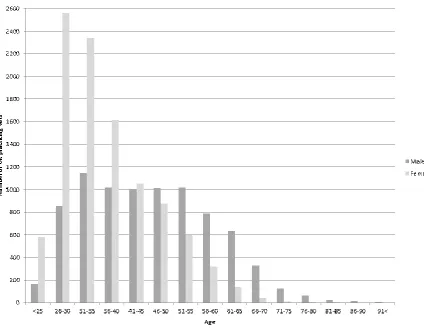
Veterinary medicine is an increasingly female-dominated profession. Although the current workforce is gender-balanced overall, it is highly skewed towards older male vets and younger female entrants (Figure 1) (Royal College of Veterinary Surgeons 2014).
Statistics show that male school-leavers are not less successful in gaining places; they are simply not applying for veterinary degrees (Universities and Colleges Admissions Service 2014). The recent VetFutures report specifically identified the gender imbalance as “raising questions about
attractiveness of veterinary medicine as a career choice for men” (Royal College of Veterinary
Surgeons/British Veterinary Association 2015). This study therefore looked at why, given the similarities in entry requirements and training structure, male school-leavers do not consider it as a career option equivalent to medicine or dentistry.
Various studies have looked at gender in the context of higher education decision-making, with broadly similar results. Briggs (2006) and Gross (2011) found that boys prioritised academic reputation, quality of staff, employment prospects and social life; whereas girls preferred courses with work placements and relied more on their own perceptions of the institution and course based on campus visits. Galotti (1995) also reported gender differences; boys being more analytical and girls relying more on intuition and “feel”.
2 METHODS
Email contact was made with the Head of Sixth Form/Post-16 (or equivalent) at all secondary schools in one English county, to anonymously survey any school-leaver applicants for medicine, dentistry or veterinary degrees in the 2014 application round. A weblink was provided to the survey. For each degree, respondents were asked whether they had applied, considered, or not considered that subject, and to explain their choice. Free-text responses were analysed thematically; seeking similarities or differences between male and female applicants.
Ethical approval of the project was granted by the Faculty of Social Sciences Research Ethics Advisory Group for Human Participants, University of Kent.
RESULTS
Thirty completed responses were received (11 male, 19 female). In explaining their choice of profession, Males and females differed in their thoughts about future career plans and the nature of the day-to-day work; whereas the themes of childhood ambition and family influence were identified by both. Quotes are identified by M (male) or F (female); and course applied for: Med (human medicine), Den (dentistry) or Vet (veterinary medicine).
Male and female applicants equally cited a long-held ambition as a reason for their choice, and emphasised the vocational aspect of the course: “I’ve always had a strong desire to study medicine - I
wanted a vocation, not just a degree” [M Med]. Males stated exactly where they envisioned their
career going: “I plan to work as an associate dentist for 3-5 years to gain experience, then specialise in
orthodontics and open my own practice” [M Den]. Female applicants were less certain about their
3
myself working on a farm in Cornwall” [F Vet], whereas males focused on the concrete aspects of the
work.
Both groups cited family influences: “I have several family members who are dentists… I know that if
I qualify as a dentist, I will have their support” [M Den]. The other common inspiration was past
experience of a profession, either in their personal lives: “[My] Grandfather took ill with cancer… why
should I not help to bring about new treatments?” [M Med]; or gained during work experience: “I felt
very encouraged by someone I met on work experience… at the end of the week he encouraged me to
apply” [F Vet].
Male applicants mostly cited the nature of the work itself as a reason not to choose a particular degree: “I need to be on the go and dentists are sitting down all day… not enough pressure comes with
the job” [M Med]. Several female applicants rejected medicine due to concerns about their own ability
to cope with specific aspects of the work: “I don’t like the idea of being in a job where people are
dying” [F Vet]; “The reality is that you spend far too much time worried sick that you’ve made a serious
mistake” [F Den]; a factor which appealed to several male applicants: “I relish the mental and
emotional challenges that this course will give me” [M Med].
In general, female applicants found it harder to articulate what exactly about a particular course or career put them off: “Hard to explain, human medicine didn’t interest me at all” [F Vet]; compared to males, who cited very specific reasons for their choice: “It allows for continuous professional
development. I was attracted to the prospect of opening and running my own practices as I have a
keen business side” [M Den].
4
Galotti’s (1995) study of higher education decision-making found that girls care more about people and surroundings, and boys more about future success; and this can be identified in the responses received. The defined structure for career progression in both medicine and dentistry provides a clear post-qualification route for graduates which is missing from the veterinary profession, meaning that, on the evidence of medical and dental applicants, male applicants would be less able to identify a potential career path in veterinary medicine.
The trend is still developing in favour of more women entering, forming a self-reinforcing cycle of female role models; and concern has been expressed about the profession needing to better represent the community it serves. Aligning career development in a similar way to the medical model would provide a clear structure for newly-qualified vets and therefore enable male applicants to better envisage their future prospects. This is obviously only one factor, and warrants further investigation.
Limitations to this study include its small scale, geographic (and therefore demographic) constraint, and restriction to solely school-leaver applicants. A larger-scale study is now desirable to gather enough data for meaningful statistical analysis, deepen the qualitative data gathered with more in-depth interviews or focus groups, and broaden the demographic to include graduate entry and overseas applicants; and to explore what the implications might be for the future of the profession.
REFERENCES
Briggs S (2006). An exploratory study of the factors influencing undergraduate student choice: the case of higher education in Scotland. Studies in Higher Education, 31:705-722.
Galotti K (1995). A longitudinal study of real-life decision making: choosing a college. Applied Cognitive
5
Gross D, Schäfer G (2011). Feminisation in German dentistry. Career paths and opportunities - a gender comparison. Women's Studies International Forum, 34:130-139.
Hodgetts K (2008). Underperformance or 'getting it right'? Construction of gender and achievement in the Australian inquiry into boys' education. British Journal of the Sociology of Education, 29:465-477.
Institute for Employment Studies (2013). Graduate jobs survey summary. Online at www.rcvs.org.uk/document-library/ies-graduate-jobs-survey-summary. Accessed May 2015.
Lincoln A (2010). The shifting supply of men and women to occupations: feminisation in veterinary education. Social Forces, 88:1969-1998.
Mastekaasa A, Smeby J-C (2008). Educational choice and persistence in male- and female-dominated fields. Higher Education, 55:189-202.
Polavieja J (2012). Socially embedded investments: explaining gender differences in job-specific skills.
American Journal of Sociology, 118:592-634.
Royal College of Veterinary Surgeons (2014). RCVS Facts 2014: The Annual Report of the Royal College of Veterinary Surgeons. Online at www.rcvs.org.uk. Accessed December 2015.
Royal College of Veterinary Surgeons/British Veterinary Association (2015). Taking charge of our future: A vision for the veterinary profession for 2030 (“VetFutures Report”). Online at http://vetfutures.org.uk/resource/vet-futures-report/. Accessed April 2016.