Urinary Tract Infection in Patients with Multiple Sclerosis: an overview.
Washigton Luiz Gomes de Medeiros Junior1, Caio Cesar Demore1, Larissa Peres Mazaro1, Matheus Fellipe Nascimento de Souza1, Laura Fiuza Parolin2, Luiz Henrique Melo3, Claudio Rogerio Werka Junior4, Marcus Vinicius Magno Gonçalves5.
1. Medical student - Department of Medicine, University of the Region of Joinville (UNIVILLE), Brazil
2. Medical Doctor and Professor of Neurology, University of the Region of Joinville (UNIVILLE), Brazil.
3. Medical Doctor and Professor of Infectiology, University of the Region of Joinville (UNIVILLE), Brazil.
4. Nephrologist in a private service - Clinic of Nephrology of Joinville, Brazil.
5. Medical Doctor, PhD and Professor of Neurology, University of the Region of Joinville (UNIVILLE), Brazil.
Corresponding author Marcus Vinicius Magno Gonçalves
Department of Medicine, University of the Region of Joinville (UNIVILLE)
Address: Paulo Malschitzki Street, 10 - CEP 89201-972, Joinville, SC, Brazil.
Email: [email protected]
Phone number: +55 47 99974-9668
Study funding
No targeted funding reported.
Disclosure
The authors report no disclosures. All authors and contributors agree to the conditions outlined in the Authorship and Contributorship section of the Information for Authors. The authors have read the Journal's position on issues involved in ethical publication. There was no sponsorship for the scientific article and there was no conflict of interest with all the authors.
Abstract
Introduction: Multiple sclerosis (MS) is a demyelinating, chronic, inflammatory and autoimmune disease of the central nervous system (CNS) with axonal degeneration, presenting a progressive and variable course. MS patients usually have complications, such as bladder dysfunction, presence of urinary symptoms and Urinary Tract infection (UTI), which is one of the three most common non-neurological complications in MS patients.
Objective: Analyze the most diverse aspects of UTI in MS patients, focusing on risk factors, prevalence, hospitalization and mortality rates of UTIs in this group.
Methods: A non-systematic review of articles published on PubMed in the last 10 years with the search terms "Urinary Tract Infection" AND "Multiple Sclerosis".
Discussion: MS patients have a high UTI prevalence, mainly due to the occurrence of urinary disorders in these patients. The most common symptoms of UTI in MS patients are urinary urgency, polyuria, nocturia, urinary retention, and incontinence. Escherichia coli, Pseudomonas aeruginosa, and Klebsiella pneumoniae were the most found organisms and treatment is based on antibiotic therapy. Moreover, UTIs can precipitate outbreaks, worsen the disease, causing more damage and a severe neurological condition deterioration. Therefore, UTIs in this group are associated with a high hospitalizations rate and a high mortality rate. Conclusion: UTI represents a great risk and concern in MS patients. The high prevalence, hospitalization rate and mortality rate of UTI in MS is worrying, such as the cause-consequence relationship between UTIs and the use of corticosteroids in outbreaks. Therefore, it is important to be aware of a UTI in this group to make early diagnoses, adequate management, and new infections prevention. Thus, further studies are needed to thoroughly analyze each nuance of this important comorbidity for MS patients.
Abbreviations aOR– Adjusted Odds Ratio
CI - Confidence Interval
CISC - Clean Intermittent Self-Catheterization
CNS – Central Nervous System
EDSS - Expanded Disability Status Scale
ICD – International Classification of Diseases
MS – Multiple Sclerosis
TLR2 - Toll-like receptors type 2
Manuscript Introduction
Multiple sclerosis (MS) is a demyelinating, chronic, inflammatory and autoimmune disease of the central nervous system (CNS) with axonal degeneration, presenting a progressive and variable course. It affects 1 person per 1,000 in the United States. MS is the most prevalent neurological disease in people between 20 and 45 years old (Nikseresht et al., 2016), being 3 times more prevalent in women than in men (Costello et al., 2017). It often presents complications resulting from partial remission after an outbreak, with one of the possible complications being bladder dysfunction, affecting 50-80% of patients (Gallien et al., 2014), and in 70% of these patients, the urinary symptoms will progress according to the functional and neurological deterioration (DeLong et al., 2011). The most common symptoms are: urinary urgency, polyuria, nocturia, urinary retention and incontinence (Kantor et al., 2015; Tudor et al., 2016), and the presence of Urinary Tract Infections (UTI) in MS patients is closely related to the difficulty of these patients in having their bladder empty (Holland et al., 2012; Holland et al., 2016; Sand et al., 2013). However, according to Kapica-Topczewska and colleagues, of 815 MS patients of northeastern Poland, 39% had urinary incontinence (an important risk factor for UTI development) and 3.5% had UTI (Kapica-Topczewska et al., 2020).
Due to the high incidence of urodynamic changes (Salinas-Casado et al., 2019), MS patients are predisposed to urinary tract colonization and, consequently, urinary tract infection (Rakusa et al., 2012). Advanced age, previous use of antibiotics, presence of urinary catheter, the severity of MS, urinary pressure and high bladder pressure are risk factors for the development of the UTI (Balsara et al., 2013; Jahromi et al., 2014; Salinas-Casado et al., 2019). In addition, urinary problems previously installed in MS patients make it difficult to diagnose UTI in these patients, which can cause misdiagnosis (Nikseresht et al., 2016). Thus, we discuss here the various characteristics of this type of infection in the MS population, from its intrinsic relationship with outbreaks, hospitalizations and deaths to the broader parameters such as diagnosis, management and treatment.
Discussion
The relationship between UTI and MS outbreaks
al., 2012). Furthermore, UTI is a contraindication to the use of corticosteroids, as it makes the patient unable to perform a satisfactory immune response (Jahromi et al., 2014). If a patient has an underlying UTI or bacteriuria, steroid use may expose the infection and make it difficult to handle once the treatment commences (Mahadeva et al., 2014). A case report written by Tutuncu and colleagues demonstrates the relationship between UTI and the outbreaks exacerbation in MS, in which a patient developed acute diplopia and dysarthria with a new gadolinium-enhancing lesion after a UTI. After UTI treatment he recovered completely within 2 weeks (Tutuncu et al., 2011).
UTIs, hospitalization rate and death rate in MS population
In this context, urinary infections cause 30 to 50% of hospitalizations, being one of the 3 most frequent non-neurological causes (Marrie et al., 2014; Manack et al., 2011). An important large-scale study conducted by Manack and colleagues looked at patients with neurogenic bladder with spinal cord injury and MS from 2002 to 2007. The study revealed that 21% required UTI hospitalization in that period and 31% of patients were diagnosed with UTI within one year after diagnosis (Manack et al., 2011). Moreover, there is a possible relationship between a high score on the Expanded Disability Status Scale (EDSS) and the duration of the disease, which influences the increase in the likelihood of infections (Jick et al., 2015; Phé et al., 2016). Also, according to current evidence, urinary tract infections are a predictive factor of death for these patients, which can double the risk of death (Jick et al., 2015; Salinas-Casado et al., 2019).
An important retrospective study conducted by Harding et al. analyzed the MS death causes in British Columbia - Canada, between 1986 and 2013. For this, they analyzed death certificates that contained MS as a cause according to the International Classification of Diseases (ICD) and analyzed the second ICD contained in the certificate to identify which disease most contributes to death in patients with MS. UTI was the main cause, contributing to 8% of MS deaths while contributing to only 2% of general population deaths. The adjusted Odds Ratio (aOR) was 10.2 with a 95% confidence interval (CI), 8.7-12.0. Also, a gender difference for the death causes of UTI was found (men: aOR, 14.9 [95% CI, 11.5–19.3]; and women: aOR, 8.00 [95% CI, 6.53–9.81]). The other most relevant causes were respiratory infection (aOR 3.03 [95% CI, 2.73–3.36]), aspiration pneumonia (aOR, 7.15 [95% CI, 6.23– 8.22]), sepsis (aOR, 1.34 [95% CI, 1.15 –1.56]), and skin disease (aOR, 5.06 [95% CI, 3.96–
6.46]) (Harding et al., 2020).
Diagnosis of UTI in the MS population
neurological status deterioration, reduced appetite or lethargy, leakage between Clean intermittent Self-catheterization (CISC), catheter blockage or the report of a cloudy urine with increased odor (Massa et al., 2009; Phé et al., 2016). Fitzgerald and colleagues reinforce that the foul-smelling urine as a potential independent predictor of probably/possible UTI in MS patients with a suspected relapse, such as female gender, previous history of UTI and patients with walking impairment (Fitzgerald et al., 2019).
As recommended by international guidelines, the gold standard for the UTI diagnosis is urine culture (EAU guidelines, 2020). However, MS patients may have a more pressing need for rapid diagnosis and prompt UTI treatment. This approach does not conform to the delay found with urine culture and sensitivity results. For this population, the urine dipstick is a great diagnosis test (considering its speed in the result and cost-effectiveness), followed by treatment based on the dipstick results (Fowler et al; 2009; Rakusa et al., 2012). The presence of nitrites and leukocyte esterase in urine dipstick tests, associated with a high negative predictive value, also contribute to the UTI diagnosis (Deville et al., 2004). Taking that into account, a prospective study developed by researchers in the United Kingdom analyzed 299 MS patients in acute relapse. Patients underwent urine dipstick and were treated for UTI if 2 or more of: nitrites, leukocyte esterase and cloudy urine were positive. The algorithm showed a specificity of 94%, a predictive negative value of 91% and an accuracy of 87%. Although the sensitivity is 24%, the algorithm has improved accuracy and safety for conduct with antibiotic therapy in MS patients (O'Herlihy et al., 2019).
Most prevalent microorganisms in MS population UTIs
Some studies have analyzed which microorganisms are more prevalent in UTIs. In MS population specifically, the findings were that Escherichia coli, Streptococcus beta-hemolytic B, Klebsiella pneumoniae, Proteus mirabilis, and Staphylococcus coagulase-negative were the bacteria responsible for the UTIs of the patients under analysis (Rakusa et al., 2012). Clark and Welk, in turn, in a retrospective study of 146 people who had a neurogenic bladder, compared the result of subsequent urine cultures from patients who had at least 2 positive urine cultures in 2 years. The most found organisms were Escherichia coli, Pseudomonas aeruginosa and Klebsiella pneumoniae (Clark and Welk, 2018). Other studies found, also in patients with neurogenic bladder, that Escherichia coli is the most common isolated pathogen (50%), followed by Pseudomonas aeruginosa (15%), Acinetobacter (15%), Enterococcus faecalis (6%) and multi organisms infections (Shigemura et al., 2015; Jahromi et al., 2014).
Other findings
of the disease in patients with MS. Therefore, 35 patients with MS and 25 healthy controls were evaluated by collecting serum and urine samples. The results showed that patients with relapsing-remitting MS have high levels of soluble TLR2 (a biomarker of recent infection) and C-Reactive Protein in the serum compared to the control group, both in relapse and remission periods. In patients' urine, TLR2 stimulant activity has been shown to be greater in MS patients than in healthy patients. As soluble TLR2 is released from excessive TLR2 stimulation, the authors looked for potential stimulants and found data which suggested that bacteria responsible for UTIs were potent TLR2 stimulators (Gram-negative: Escherichia coli, Klebsiella pneumoniae, Pseudomonas aeruginosa and Proteus vulgaris; Gram-positive: Enterococcus faecalis and Streptococcus pyogenes), relating recent UTIs to exacerbations of the disease. (Hossain et al., 2018).
Management of UTI in the MS population
The management of MS patients without symptoms of bacteriuria is important, since 24% to 90% of these patients have UTI, depending on the voiding frequency. This is due to a possible bladder sphincter dyssynergia (Rouzaud et al., 2017). Moreover, the pharmacological treatment of asymptomatic bacteriuria has no evidence of clinical efficacy, therefore it is not recommended, except in cases of recurrent acute urinary tract infections or cases of need for immunosuppression (Jahromi et al., 2014).
The treatment of symptomatic UTI should be done through antibiotic therapy, preferably broad-spectrum antibiotic, depending on microbial susceptibility local patterns and can be adjusted to lower spectrum antibiotic therapy with the urine culture result (EAU guidelines, 2020), including in symptomatic patients with neurogenic bladder (Jahromi et al., 2014). When UTI is suspected in patients with relapse of MS, corticosteroid therapy should not be discontinued. However, if the patient presents with urinalysis changes, antibiotic therapy is recommended. Furthermore, it is essential to conduct clinical follow-up of MS patients who have recurrent UTI, since frequent infections can amplify the lower urinary tract symptoms, such as greater urgency and urinary frequency, besides to predisposing a higher risk of complications in the upper urinary tract (Phé et al., 2016).
Prophylaxis of UTI in the MS population
further studies are needed to establish efficacy (Phé et al., 2017). Moreover, the apathogenic Escherichia coli bacterium inoculation seems to induce a better UTI prognosis, however further studies are needed to prove its efficacy for UTI prophylaxis in patients with MS (Jahromi et al., 2014). Other UTI prophylaxis therapies and management in MS patients have been studied, such as bladder irrigation and Methenamine Hippurate, but without efficacy evidence (Jahromi et al., 2014). Compared to placebo, the use of cranberry extract twice a day for UTI prophylaxis in MS patients was also not efficient (Gallien et al., 2014).
Conclusion
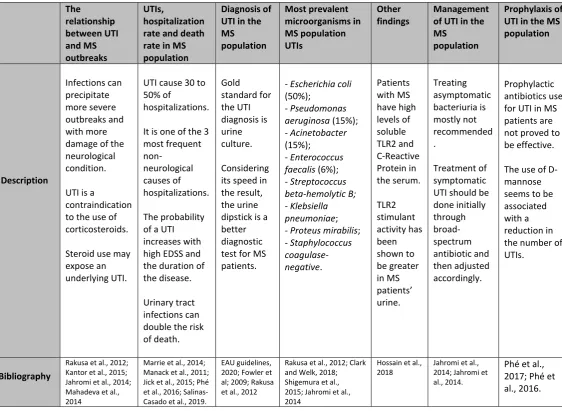
In this review we analyzed the most diverse characteristics of UTIs in patients with MS and the most important features were summarized in table 1. Therefore, MS patients have a high UTI prevalence, mainly due to the occurrence of urinary disorders in these patients. In addition, UTIs in this group are associated with a high hospitalizations rate and a high mortality rate, besides the ability to precipitate outbreaks, aggravating the disease and causing further damage and a serious neurological condition deterioration. The cause-consequence relationship between UTIs and the use of corticosteroids in MS outbreaks is also worrying, due to the immune suppression generated in this process. Several articles demonstrate the UTI relevance in MS patients. Thus, further studies are needed to thoroughly analyze each nuance of this important comorbidity for MS patients.
Table 1: The table summarizes the most important features of Urinary Tract Infection in Multiple Sclerosis patients.
The relationship between UTI and MS outbreaks UTIs, hospitalization rate and death rate in MS population
Diagnosis of UTI in the MS population Most prevalent microorganisms in MS population UTIs Other findings Management of UTI in the MS
population
Prophylaxis of UTI in the MS population Description Infections can precipitate more severe outbreaks and with more damage of the neurological condition.
UTI is a
contraindication to the use of corticosteroids.
Steroid use may expose an underlying UTI.
UTI cause 30 to 50% of
hospitalizations.
It is one of the 3 most frequent non-neurological causes of hospitalizations. The probability of a UTI increases with high EDSS and the duration of the disease.
Urinary tract infections can double the risk of death. Gold standard for the UTI diagnosis is urine culture. Considering its speed in the result, the urine dipstick is a better diagnostic test for MS patients.
- Escherichia coli (50%);
- Pseudomonas aeruginosa (15%); - Acinetobacter (15%);
- Enterococcus faecalis (6%); - Streptococcus beta-hemolyticB; - Klebsiella pneumoniae; - Proteus mirabilis; - Staphylococcus coagulase-negative. Patients with MS have high levels of soluble TLR2 and C-Reactive Protein in the serum. TLR2 stimulant activity has been shown to be greater in MS patients’ urine. Treating asymptomatic bacteriuria is mostly not recommended . Treatment of symptomatic UTI should be done initially through broad-spectrum antibiotic and then adjusted accordingly. Prophylactic antibiotics use for UTI in MS patients are not proved to be effective.
The use of D-mannose seems to be associated with a reduction in the number of UTIs.
Bibliography
Rakusa et al., 2012; Kantor et al., 2015; Jahromi et al., 2014; Mahadeva et al., 2014
Marrie et al., 2014; Manack et al., 2011; Jick et al., 2015; Phé et al., 2016; Salinas-Casado et al., 2019.
EAU guidelines, 2020; Fowler et al; 2009; Rakusa et al., 2012
Rakusa et al., 2012; Clark and Welk, 2018; Shigemura et al., 2015; Jahromi et al., 2014
Hossain et al., 2018
Jahromi et al., 2014; Jahromi et al., 2014.
Appendix 1: Authors
NAME: LOCATION: CONTRIBUTION: CONTACT AT:
Washigton Luiz Gomes de Medeiros Junior
Universidade da Região de Joinville (UNIVILLE), Brazil
Planned and
organized the study. Analyzed the data and contributed to the writing of the content.
Caio Cesar Demore
Universidade da Região de Joinville (UNIVILLE), Brazil
Assisted in research, acquisition, and interpretation of data for the composition of the study. Contributed to writing the content.
Larissa Peres Mazaro
Universidade da Região de Joinville (UNIVILLE), Brazil
Assisted in research, acquisition, and interpretation of data for the composition of the study. Contributed to writing the content.
[email protected] Matheus Fellipe Nascimento de Souza Universidade da Região de Joinville (UNIVILLE), Brazil
Assisted in research, acquisition, and interpretation of data for the composition of the study. Contributed to writing the content.
Laura Fiuza Parolin
Universidade da Região de Joinville (UNIVILLE), Brazil
Organized the study and revised the manuscript. [email protected] Luiz Henrique Melo Universidade da Região de Joinville (UNIVILLE), Brazil
Organized the study and revised the manuscript. [email protected] Claudio Rogerio Werka Junior Clinic of Nephrology of Joinville, Brazil
Organized the study and revised the manuscript. [email protected] Marcus Vinicius Magno Gonçalves Universidade da Região de Joinville (UNIVILLE), Brazil
Organized the study and revised the manuscript.
References
Balsara ZR et al. Enhanced susceptibility to urinary tract infection in the spinal cord-injured host with neurogenic bladder. Infect Immun. 2013;81(8):3018–26. An important article that
begins to identify some immunologic differences amongst the SCI population that may contribute to increased UTIs.
Costello J. Preserving the independence of people living with multiple sclerosis towards the end of life 2017.
Cruz F, Herschorn S, Aliotta P, Brin M, Thompson C, Lam W, et al. Efficacy and safety of onabotulinumtoxinA in patients with urinary incontinence due to neurogenic detrusor overactivity: A randomized, double-blind, placebo-controlled trial. Eur Urol. 2011;60(4):742–
50.
Delong J, Tighiouart H, Stoffel J. Urinary Diversion / Reconstruction for Cases of Catheter Intolerant Secondary Progressive Multiple Sclerosis With Refractory Urinary Symptoms. J Urol 2011;185:2201–6. doi:10.1016/j.juro.2011.02.002.
Devillé WL, Yzermans JC, van Duijn NP, et al. The urine dipstick test useful to rule out infections. A meta-analysis of the accuracy. BMC Urol. 2004;4:4.
EAU Guidelines. Edn. presented at the European Association of Urology Annual Congress Amsterdam the Netherlands 2020. ISBN 978-94-92671-07-3.
Fitzgerald KC, Cassard LA, Fox SR, Probasco JC, Cassard SD, Mowry EM. The prevalence and utility of screening for urinary tract infection at the time of presumed multiple sclerosis relapse. Mult Scler Relat Disord 2019;35:61–6. doi:10.1016/j.msard.2019.06.038.
Fowler CJ, Panicker JN, Drake M, et al. A UK consensus on the management of the bladder in multiple sclerosis. J Neurol Neurosurg Psychiatry. 2009;80:470–477.
Gallien P, Amarenco G, Benoit N, Bonniaud V, Donzé C, Kerdraon J, et al. Cranberry versus placebo in the prevention of urinary infections in multiple sclerosis: a multicenter, randomized, 2014. doi:10.1177/1352458513517592.
Harding K, Zhu F, Alotaibi M, Duggan T, Tremlett H. Multiple cause of death analysis in multiple sclerosis. Neurology Journal. 2020. doi:10.1212/WNL.0000000000008907.
Holland NJ, Reitman NC. Bladder Dysfunction in Multiple Sclerosis. Prof Resour Cent Natl Mult Scler Soc. 2012 Oct 15;1–7.
Hossain J, Morandi E, Tanasescu R, Frakich N, Caldano M, Onion D, Faraj TA, Gran B. The Soluble Form of Toll-Like Receptor 2 Is Elevated in Serum of Multiple Sclerosis Patients: A Novel Potential Disease Biomarker. Frontiers in immunology 2018;9. doi:10.3389/fimmu.2018.00457.
Jahromi MS, Mure A, Gomez CS. UTIs in Patients with Neurogenic Bladder 2014. doi:10.1007/s11934-014-0433-2.
Jick SS, Li L, Falcone GJ, et al. Epidemiology of multiple sclerosis: Results from a large observational study in the UK. J Neurol 2015; 262(9): 2033–2041.
Kantor D, Chancellor MB, Snell CW, Henney HR, Rabinowicz AL. Assessment of confirmed urinary tract infection in patients treated with dalfampridine for multiple sclerosis. Postgrad Med. 2015;127(2):218–22.
Maghzi AH, Minagar A. Urinary tract infection in multiple sclerosis: a practical algorithm for a common problem. Eur J Neurol. 2013;20(3):408–9.
Mahadeva A, Tanasescu R, Gran B. Urinary tract infections in multiple sclerosis:
under-diagnosed and under-treated? A clinical audit at a large University Hospital. Am J Clin Exp
Immunol. 2014;3(1):57–67.
Manack A, Motslo SP, Haag-Molkenteller C, Dmochowski RR, Goehring EL Jr, Nguyen-Khoa BA, Jones JK. Epidemiology and healthcare utilization of neurogenic bladder patients in a US claims database. Neurourol Urodyn. 2011;30(3):395–401.
Marrie RA, Elliott L, Marriott J, et al. Dramatically changing rates and reasons for hospitalization in multiple sclerosis. Neurology. 2014;83:929–937.
Massa LM, Hoffman JM and Cardenas DD. Validity, accuracy, and predictive value of urinary tract infection signs and symptoms in individuals with spinal cord injury on intermittent catheterization. J Spinal Cord Med 2009; 32(5): 568–573.
Nikseresht A, Salehi H, Foroughi AA, Nazeri M. Association Between Urinary Symptoms and Urinary Tract Infection in Patients With Multiple Sclerosis. Glob J Health Sci. 2015;8(4):120–
6.
O’Herlihy F, John NA, Li V, Porter B, Lyons L, Rakusa M, et al. Screening for urinary tract
colonization prior to corticosteroid administration in acute multiple sclerosis relapses: Validation of an updated algorithm. J Neurol Sci. 2019;407(September):1–5.
Phé V, Pakzad M, Haslam C, Gonzales G, Curtis C, Porter B, et al. Open-label feasibility study evaluating D-mannose combined with home-based monitoring of suspected urinary tract infections in patients with multiple sclerosis. Neurourol Urodyn. 2017;36(7):1770–5.
Rakusa M et al. Testing for urinary tract colonization before high-dose corticosteroid treatment in acute multiple sclerosis relapses: prospective algorithm validation. Eur J Neurol. 2012;20(3):448–52.
Rouzaud C, Hautecoeur P, Donze C, Heinzlef O, Dinh A, Creange A, et al. Treating asymptomatic bacteriuria before immunosuppressive therapy during multiple sclerosis: Should we do it? Mult Scler Relat Disord. 2017;18(May):161–3.
Salinas-Casado J, Virseda-Chamorro M, Méndez-Rubio S, López-Pérez E, Esteban-Fuertes M et al. Clinical and urodynamic risk factors of recurrent urinary tract infections in patients with multiple sclerosis. Arch Esp Urol 2019 Dec;72(10):1010-1017.
Sand PK, Sand RI. The diagnosis and management of lower urinary tract symptoms in multiple sclerosis patients. Disease-a-Month [Internet]. 2013;59(7):261–8. Available from: http://dx.doi.org/10.1016/j.disamonth.2013.03.013
Shigemura K, Takase R, Osawa K, et al. Emergence and prevention measures for multidrug resistant Pseudomonas aeruginosa in catheter-associated urinary tract infection in spinal cord injury patients. Spinal Cord 2015; 53(1): 70–74.
Tudor K, Sakakibara R and Panicker J. Neurogenic lower urinary tract dysfunction: Evaluation and management. J Neurol 2016; 263: 2555–2564.