Type of the Paper (Review)
Optimization of magnetic properties of magnetic
microwires by Post-processing.
Valentina Zhukova1,2, Paula Corte-Leon1,2, Lorena González-Legarreta1,3, Ahmed Talaat1,4, Juan Maria Blanco2, Mihail Ipatov1, Jesus Olivera5,6 and Arcady Zhukov1,2,7*,
Keywords
1 Dept. Mater. Phys., Faculty of Chemistry, University of Basque Country, UPV/EHU, 20018 San Sebastian,
Spain; [email protected] (P.C.-L.); [email protected] (V.Z.); [email protected] (M.I.)
2 Department Applied Physics I, EIG, University of Basque Country, UPV/EHU, 20018, San Sebastian, Spain;
[email protected] (J.M.B.)
3 Dept. QUIPRE, Inorganic Chemistry-University of Cantabria, Nanomedice-IDIVAL, Avda. de Los Castros
46, 39005 Santander, Spain, [email protected] (L.G.L)
4 Department of Mechanical Engineering & Materials Science, Swanson School of Engineering, University of
Pittsburgh, Pittsburgh, PA, 15261, USA, [email protected] (A.T.)
5 Pontificia Universidad Católica Madre y Maestra, Santo Domingo, P.O. Box 2748, Dominican Republic;
[email protected] (J.O.)
6 Laboratorio de la Dirección General de Aduanas, Santo Domingo, Dominican Republic,
[email protected] (J.O.)
7 IKERBASQUE, Basque Foundation for Science, 48011 Bilbao, Spain; [email protected] (A.Z.) * Correspondence [email protected]; Tel.: +34-943-01-8611 (A.Z.)
Abstract: The influence of post-processing conditions on the magnetic properties of amorphous and nanocrystalline microwires have been thoroughly analyzed, paying attention on the influence of magnetoelastic, induced and magnetocrystalline anisotropies on the hysteresis loops of Fe-, Ni- and Co-rich microwires. We showed that magnetic properties of glass-coated microwires can be tuned by the selection of appropriate chemical composition and geometry in as-prepared state or further considerably modified by appropriate post-processing, which consists of either annealing or glass-coated removal. Furthermore, stress-annealing or Joule heating can further effectively modify the magnetic properties of amorphous magnetic microwires owing to induced magnetic anisotropy. Devitrification of microwires can be useful for either magnetic softening or magnetic hardening of the microwires. Depending on the chemical composition of the metallic nucleus and on structural features (grain size, precipitating phases) nanocrystalline microwires can exhibit either soft magnetic properties or semi-hard magnetic properties. We demonstrated that the microwires with coercivities from 1 A/m to 40 kA/m can be prepared.
Keywords: Magnetic microwires; post-processing; hysteresis loops; magnetic anisotropy;
1. Introduction
Development of magnetic sensors is essentially influenced by the technological progress in the field of magnetic materials [1-3]. Indeed, the features of magnetic sensors are determined by selection of appropriate magnetic material. A significant portion of magnetic sensors use soft magnetic materials [3].
One of the most promising families of soft magnetic materials with a number of advantages, such as excellent magnetic softness, fast and inexpensive manufacturing process, dimensionality suitable for various sensor applications, and good mechanical properties, is a family of amorphous and nanocrystalline materials obtained using rapid quenching from the melt [4-6].
Such advanced functional magnetic properties have been reported in amorphous materials with either planar (ribbons) or cylindrical (wires) geometry [4-6]. However, each family of amorphous materials presents specific features making them suitable for rather different applications. Thus, planar (ribbon-shaped) materials with low magnetic losses and high saturation magnetization values are good for applications in transformers [4]. On the other hand, amorphous wires can present quite peculiar magnetic properties, such as spontaneous magnetic bistability associated with single and large Barkhausen jump [7-9] or giant magnetoimpedance, GMI, effect [10-13]. Although it is worth mentioning that in fact, large Barkhausen and GMI effect can be observed either in crystalline wires [14,15] as well as in properly heat treated amorphous ribbons [16,17]. However, high GMI effect and extremely fast single domain wall, DW, propagation can be realized in amorphous magnetic wires in a most simple way (i.e., even without additional post-processing) [18-20].
These features can be attributed to the fact that the cylindrical geometry together with the internal stresses distribution typical for the rapid quenching from the melt provide the unique features, like core-shell domain structure presenting either high circumferential magnetic permeability (in negative magnetostrictive Co-rich compositions) or existence of axially magnetized single inner domain responsible for observation of the single and large Barkhausen jump and related single DW propagation [19,20]. The cylindrical geometry in fact is suitable for realization of the aforementioned unique magnetic properties not only in magnetic wires prepared involving rapid melt quenching, but even in conventional magnetic wires [14,15] and even in nanowires prepared using i.e., electrodeposition [21,22].
It is worth mentioning that recent progress in rapidly quenched technology allows considerable dimensionality reduction of rapidly quenched materials [20,23,24]. Therefore, features reported in rapidly quenched amorphous materials can be useful for nanotechnology.
As mentioned above, most of the studies are related (although not limited) to either GMI effect or single DW dynamics. As regarding the GMI effect, the main interest is related to extremely high impedance sensitivity to an external magnetic field (up to 10 %/A/m) observed in properly prepared and processed magnetic microwires [10-13,18,25,26]. Such features of the GMI effect observed in amorphous wires allowed the development of the GMI technology suitable for numerous applications, such as magnetic compass and acceleration sensors integrated in complementary metal-oxide-semiconductor (CMOS) circuits [27,28], reduced-sized magnetometer suitable for magnetic field mapping [29,30], detection of a biomagnetic field with the pico-Tesla sensitivity [31], magnetoelastic and temperature sensors [32,33].
A variety of technological applications require miniaturization combined with excellent corrosion and mechanical properties and biocompatibility of the magnetic elements [2-4, 12-14]. This combination of physical properties and reduced dimensions can be achieved in glass-coated microwires: among the rapid melt quenching methods, the so-called Taylor-Ulitovsky method allows preparation of the thinnest amorphous wires covered by flexible and insulating glass [34-37]. It is worth mentioning that the method itself is known since the 60-s [34] and the preparation of magnetic amorphous microwires has been reported since the 70-s [18,35,36]. The preparation method consists in the fabrication of glass-coated microwires with metallic nucleus, diameters
typically from submicrometric up to 40 μm, by simultaneous rapid melt quenching of metallic alloy
covered by insulating glass coating [36]. This method is suitable for fabrication of magnetic microwires with either amorphous or nano-micro crystalline structure [18,23-25,33,36-38].
A variety of magnetic properties interesting for various technological applications, such as high GMI effect (up to 650% GMI ratio) [18,25,26], extremely fast single domain wall (DW) propagation (with DW velocity up to 3 km/s) [19,23,24,38], considerable magnetoresistance [36,39] and magnetocaloric [36,40] effects or even semi-hard magnetic properties [36,41] have been reported for glass-coated microwires.
Thus, if the quenching rate achieved during the quenching process from the melt is not high enough, metastable crystalline microwires with crystalline structure of metallic alloy nucleus can be prepared [36,40,41]. However, even magnetic properties of amorphous microwires are affected by the fabrication conditions (like quenching rate or glass-coating thickness) and chemical composition of the metallic alloy [18,43,44]. This compositional dependence is related to the magnetoelastic anisotropy affected by the magnetostriction coefficient as well as by the internal stresses values [18,43-47]. However, appropriate post- processing is the other factor allowing either fine tuning or even drastic modification of magnetic properties [43,44,48].
In this review, we have analyzed the influence of various factors on the magnetic properties of glass-coated microwires and provide the guideline for selection of appropriate post-processing for optimization of properties of magnetic microwires.
2. Experimental Methods and Materials
We prepared and analyzed amorphous glass-coated microwires based on Fe-, Co- and Ni- alloys with minor metalloid additions (Si, B, C) necessary for preparation of amorphous alloys [6-8, 12, 36]. Employed Taylor-Ulitovsky technique is earlier described elsewhere [36].
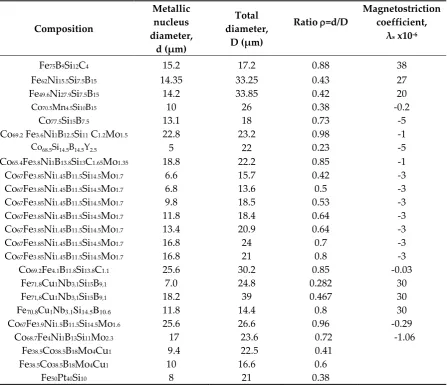
Table 1. Compositions and geometry of studied glass-coated microwires.
Composition
Metallic nucleus diameter,
d (μm)
Total diameter,
D (μm)
Ratio =d/D
Magnetostriction coefficient,
λs x10-6
Fe75B9Si12C4 15.2 17.2 0.88 38
Fe62Ni15.5Si7.5B15 14.35 33.25 0.43 27
Fe49.6Ni27.9Si7.5B15 14.2 33.85 0.42 20
Co70.5Mn4.5Si10B15 10 26 0.38 -0.2
Co77.5Si15B7.5 13.1 18 0.73 -5
Co69.2 Fe3.6Ni1B12.5Si11 C1.2Mo1.5 22.8 23.2 0.98 -1
Co68.5Si14.5B14.5Y2.5 5 22 0.23 -5
Co65.4Fe3.8Ni1B13.8Si13C1.65Mo1.35 18.8 22.2 0.85 -1
Co67Fe3.85Ni1.45B11.5Si14.5Mo1.7 6.6 15.7 0.42 -3
Co67Fe3.85Ni1.45B11.5Si14.5Mo1.7 6.8 13.6 0.5 -3
Co67Fe3.85Ni1.45B11.5Si14.5Mo1.7 9.8 18.5 0.53 -3
Co67Fe3.85Ni1.45B11.5Si14.5Mo1.7 11.8 18.4 0.64 -3
Co67Fe3.85Ni1.45B11.5Si14.5Mo1.7 13.4 20.9 0.64 -3
Co67Fe3.85Ni1.45B11.5Si14.5Mo1.7 16.8 24 0.7 -3
Co67Fe3.85Ni1.45B11.5Si14.5Mo1.7 16.8 21 0.8 -3
Co69.2Fe4.1B11.8Si13.8C1.1 25.6 30.2 0.85 -0.03
Fe71,8Cu1Nb3,1Si15B9,1 7.0 24.8 0.282 30
Fe71,8Cu1Nb3,1Si15B9,1 18.2 39 0.467 30
Fe70.8Cu1Nb3.1Si14.5B10.6 11.8 14.4 0.8 30
Co67Fe3.9Ni1.5B11.5Si14.5Mo1.6 25.6 26.6 0.96 -0.29
Co68.7Fe4Ni1B13Si11Mo2.3 17 23.6 0.72 -1.06
Fe38.5Co38.5B18Mo4Cu1 9.4 22.5 0.41
Fe38.5Co38.5B18Mo4Cu1 10 16.6 0.6
Fe50Pt40Si10 8 21 0.38
microwires present a broad halo typical for completely amorphous materials. The DSC studies were performed using a 204 F1 Netzsch calorimeter.
The microwires were annealed at a temperature, Tann, in the range from 200 oC to 400 oC in a
conventional furnace in order to avoid the crystallization typically reported for Tann≥ 490 oC [49]. The
advantage of amorphous microwires is their superior mechanical properties typically reported for amorphous materials [50,51]. Typically, we fixed annealing time, tann, of 60 min as commonly used for
heat treatment of amorphous and nanocrystalline materials [48,49].
In the case of stress-annealing, the tensile stress was applied during the annealing, as well as during the sample cooling in the furnace. The stress value in the metallic nucleus, σm, was evaluated
considering different Young's modulus of metal, E2, and glass, E1, as following [43,48,52]:
𝜎𝑚= 𝐾∙𝑃
𝐾∙𝑆𝑚+𝑆𝑔𝑙 (1)
where K=E2/E1, P is the applied mechanical load and Sm, and Sgl are the cross sections of the metallic
nucleus and the glass coating, respectively.
Hysteresis loops have been recorded using the fluxmetric method adapted for studies of magnetic microwires [49]. Hysteresis loops can be represented as the normalized magnetization, M/Mo, versus the applied magnetic field, H, where Mo is the magnetic moment of the sample at the
maximum magnetic field amplitude, Ho[49,53].
The magnetostriction coefficient, λs, of the studied microwire, was evaluated by the SAMR
method recently adapted for microwire [54,55]. In this method λs -values are determined in the
microwire saturated by an axial magnetic field, H. Simultaneously, low AC transverse field, Hc,
generated by an AC electric current flowing along the microwire allows a reversible magnetization rotation. More detailed SAMR method description and of the set-up adapted for evaluation of magnetostriction coefficient in microwires are provided elsewhere [54,55].
The glass coating was removed from the microwires by chemical etching using diluted (10%) hydrofluoric (HF) acid.
3. Results and Discussion
Below we have summarized the highlight findings already published and also the obtained recently experimental results on tailoring of magnetic properties of glass-coated microwires, paying attention on amorphous and crystalline microwires.
3.1. Effect of magnetoelastic anisotropy on magnetic properties of amorphous glass-coated microwires
Magnetic properties of amorphous microwires are affected by the value and sign of the magnetostriction coefficient since the magnetoelastic interactions are the main source of the magnetic anisotropy of amorphous materials. The easiest way to tune the magnetostriction constant
λsin amorphous alloys is the modification of its chemical composition [54-57].
Indeed, Fe-rich compositions possess positive λs–values, typically λs~(20-40)x∙10-6, while for
the Co-rich alloys the magnetostriction is negative ranging as λs~-(5-3)x10-6 [56,57]. Accordingly, the
magnetostriction can take vanishing values in Co-Fe or Co-Mn amorphous alloys on Co-rich side [54-58]. Alternatively, the decrease in λsis observed in Fe-Ni alloys with increasing Ni content.
However, Ni doping correlates to the simultaneous decreasing of the saturation magnetization. Thus, zero λs at high Ni-content corresponds to paramagnetic ordering at room temperature [57].
The influence of the λs values and sign on hysteresis loops of amorphous microwires is shown
in Figure 1.
As can be appreciated from Figure 1, the character of hysteresis loops for amorphous microwires with positive and negative λs–values is rather different: amorphous microwires with
positive λs–values present rectangular hysteresis loops, while hysteresis loops of microwires with
Such difference in hysteresis loops character is commonly attributed to different magnetic anisotropy of microwires with positive and negative λs–values: the rectangular hysteresis loop of
microwires with positive λs–values was interpreted in terms of axial magnetic anisotropy [42]. Such
axial magnetic anisotropy is intrinsically related to a peculiar domain structure consisting of inner axially magnetized single domain responsible for observation of the single and large Barkhausen jump and outer domain shell with radial magnetization orientation [9,59,60]. The remagnetization of such microwires is running by the depinning of the reversed domains inside the inner single domain and the consequent domain wall propagation [9,52,59-61]. Perfectly, rectangular shape of the hysteresis loop is related to an extremely high velocity of such domain wall propagation.
On the other hand, the origin of quasi-linear hysteresis loops (see Figures 1b,c) is related to the quasi-reversible magnetization rotation from the circumferential to the axial upon application of an axial magnetic field [60].
As regarding the aforementioned magnetoelastic anisotropy, Kme, another relevant parameter is
the internal stresses value, σi. Indeed, Kme is given by [23,38,62-64]:
Kme 3/2λsσi (2)
where total stresses, σ= σi+σapp, σapp - applied stresses.
There are several factors responsible for the internal stresses value and distribution: i) the difference in the thermal expansion coefficients of metallic alloy nucleus solidifying simultaneously with the glass coating surrounding it; ii) the quenching stresses itself related to the rapid solidification of the metallic alloy nucleus from the surface inside the wire axis; and iii) the drawing stresses [43-46,62-64].
Most theoretical evaluations of the internal stresses value and distribution show that the largest internal stresses are associated with the difference in the thermal expansion coefficients of the metallic alloy and the glass coating [62-64]. The quenching stresses are roughly an order of magnitude lower [42,43].
There are only several attempts of evaluation of internal stresses associated to the continuous mechanical drawing [63,64]. The value of such stresses has been estimated from the results on remanent magnetization measurements in glass-coated microwires with partially removed (by chemical etching) glass-coating under applied tensile stresses [63,64]. The value of this stress component depends on the microwire geometry and was estimated to be about 250-600 MPa, i.e., again about an order of magnitude below the internal stresses related to the difference in the thermal expansion coefficients of metallic alloy and the glass coating [63,64]. Furthermore, they further enhance the axial internal stresses arising from the difference in the thermal expansion coefficients of the metallic alloy and the glass coating.
Provided description allows to predict that the internal stresses value inside the metallic nucleus can be tuned by the -ratio between the metallic nucleus diameter, d, and the total microwire diameter,
-400 -200 0 200 400
-1 0 1
-400 -200 0 200 400
-1 0 1
-1000 -500 0 500 1000
-1 0 1
s=-5 x10 -6
s=-1 x10 -7
(a)
s=40 x10 -6
M
/M
0(b)
H(A/m)
(c)
Figure 1. Hysteresis loops of magnetic microwires Fe75B9Si12C4 with positive (a)
Co67.1Fe3.8Ni1.4Si14.5B11.5Mo1.7 with vanishing (b) and Co77.5Si15B7.5 with negative (c) λs values.
D (=d/D) [42,43,62-64]. In fact, this prediction is confirmed experimentally by correlation of magnetic properties, such as coercivity, Hc, or magnetic anisotropy field, Hk, in magnetic microwires
of various chemical compositions and -ratio [38,42,43,62-64]. Below we provide several experimental evidences of such correlations.
The influence of controllable glass-coating removal by etching in 10% HF on hysteresis loops of Co70.5Mn4.5Si10B15microwire is shown in Figure 2. Gradual transformation of hysteresis loops from
linear to almost perfectly rectangular must be attributed to relaxation of the internal stresses related to the presence of glass-coating. This evolution of hysteresis loops can be understood considering the low negative λs–values and the axial character of internal stresses in most part of the metallic
nucleus [65]. Evident difference in hysteresis loops of as-prepared Co70.5Mn4.5Si10B15microwires and
microwires of the same composition with partially removed glass-coating experimentally confirms the aforementioned theoretical results on character of internal stresses. Low negative magnetostriction coefficient and preferentially axial character of internal stresses explain linear almost non-hysteretic character of hysteresis loops of as-prepared Co70.5Mn4.5Si10B15microwires.
The influence of chemical etching on the hysteresis loops of Co68.5Si14.5B14.5Y2.5microwire with
higher negative λs–values is even more remarkable (see Figure 3): as-prepared Co68.5Si14.5B14.5Y2.5
microwire presents non-hysteretic loops with saturation at magnetic field, H, above 6 kA/m (see Figure 3a). However, upon chemical etching gradual transformation of hysteresis loops from linear to rectangular is observed (see Figures 3b,c). As previously reported [66], after etching in 10% HF for 50 min the glass-coating thickness decreases from 8.5 to 4 μm. Accordingly, the glass-coating thickness can be considered as one of the most relevant parameters that affect the hysteresis loops of glass-coated microwires.
Gradual glass-coating removal by chemical etching must be associated to the gradual relaxation of the internal stresses related to different thermal expansion coefficients of metallic alloy and glass coating.
The commonly accepted model of domain structure of magnetic wires is the core-shell model experimentally proved several times by various methods [60,61,67,68]. In according to this model the domain structure of amorphous magnetic wires can be satisfactory described as consisting of inner axially magnetized core surrounded with the outer shell with transverse magnetization. In the
-600 -300 0 300 600 -1.0
-0.5 0.0 0.5 1.0
-600 -300 0 300 600 -1.0
-0.5 0.0 0.5 1.0
-600 -300 0 300 600 -1.0
-0.5 0.0 0.5 1.0
-600 -300 0 300 600 -1.0
-0.5 0.0 0.5 1.0
(b)
M/M
0
(a)
(c)
(d)
H(A/m)
Figure 2.Hysteresis loops of as-prepared (a) and with chemically etched glass-coating for
5 min (b), 10 min (c) and 50 min (c) Co70.5Mn4.5Si10B15 microwire. (Reproduced with
case of Fe-rich wires the outer shell presents radial magnetization orientation, while in Co-rich microwires bamboo-like domain structure with circular magnetization orientation is reported [60,61,67-70].
The origin for such domain structure is discussed considering the minimization of the energy though the counterbalance of the magnetoelastic energy related to the internal stresses distribution as well as to the exchange energy [69,70].
In the frame of this domain structure model the radius of the inner axially magnetized core, Rc,
can be evaluated from the squareness ratio, Mr/Mo, as:
Rc =R(Mr/Mo)1/2 (3)
where R is the metallic nucleus radius.
From the evolution of the hysteresis loops upon chemical etching provided in Figures 2&3, the increase in the Mr/Mo upon chemical etching
is evidenced. Consequently, we can assume that the radius of inner axially magnetized domain increase upon partial internal stresses relaxation associated to the glass removal. This assumption is evidenced from Figure 4 where evolution of Rc/R on time of chemical
etching, t, for Co70.5Mn4.5Si10B15 and Co68.5Si14.5B14.5Y2.5microwires is shown. As can be observed, for the microwire with lower λs
–value the increase in Rc/R with t is faster.
In order to prove the axial character of the
internal stresses related to glass-coating (i.e., to the difference in thermal expansion
coefficients of glass and metallic alloy) we evaluated the influence of applied tensile stresses, σ, on the hysteresis loops of Co-rich
(Fe3.8Co65.4Ni1B13.8Si13Mo1.35C1.65) microwires with linear hysteresis loop.
As shown in Figure 5a, when tensile stress, σapp, is applied, magnetic anisotropy field, Hk,
increases. At the same time, the hysteresis loops character (linear hysteresis loop with low coercivity) of the studiedmicrowire remains almost the same.
Hk(σapp) dependence evaluated from Figure 5a shows a good linear tendency (Figure 5b). Such linear Hk(σapp) dependence has been explained considering the relationship between the magnetoelastic
anisotropy, Kme,and σapp given by eq. (2)[71]. Consequently, relation between the magnetostriction
coefficient and magnetic anisotropy field, Hk, is given by [71]:
s= μoMs(Hk/3σ) (4)
-4000 0 4000
-1 0 1
-800 -400 0 400 800
-1 0 1
-800 -400 0 400 800
-1 0 1
(a)
M/M
0
(b)
H(A/m)
(c)
Figure 3. Hysteresis loops of as- prepared (a), and
subjected to chemical etching for 35 min (b) and 50
min (c) Co68.5Si14.5B14.5Y2.5 microwires. Adapted
from [66].
0 20 40
0.0 0.3 0.6 0.9
R c
/R
t(min) s=-0.2 x10⁻⁶
s=-5x 10⁻⁶
Figure 4. Rc/R (t) dependencies for Co70.5Mn4.5Si10B15
and Co68.5Si14.5B14.5Y2.5 microwires. The lines are just
where μoMs is the saturation magnetization.
The magnetostriction coefficient is affected by
the stresses, σ, as described elsewhere [71,72]:
s=s - Bσ (5)
where s is the magnetostriction coefficient under
stress, s,0 is the zero-stress magnetostriction
constant and B is a positive coefficient of order 10−10
MPa and − stresses. Therefore, a decrease in s
reported for Co-rich microwires (s <0) upon applied
stresses [54,55] can be associated with the development of circumferential magnetic anisotropy
in the outer shell [71]. Consequently, experimentally observed linear Hk(σapp) dependence can be explained
considering eqs. (2,4, 5).
The influence of chemical etching on the hysteresis loops and on Hk observed in Figures 2, 3 is
exactly the opposite to the effect of tensile stresses. Therefore, the theoretically predicted character of internal stresses with a dominant axial tensile character and its dependence on the -ratio look reasonable. Accordingly, it is expected that the internal stresses value can be tuned by the glass-coating thickness through the −ratio.
The correlation of the −ratio and the hysteresis loops of Co-rich microwires with a vanishing magnetostriction coefficient is reported elsewhere [12,73-75]. For the case of Co67Fe3.85Ni1.45B11.5Si14.5Mo1.7 microwires with vanishing magnetostriction coefficient (see Figure 6)
linear almost non-hysteretic loops with extremely low coercivities (up to 4 A/m) are observed. If we plot Hk obtained from the hysteresis loops of Co67Fe3.85Ni1.45B11.5Si14.5Mo1.7 microwires with various d
and D-values versus the −ratio, we can find out that there is a correlation between these parameters. Magnetic anisotropy field, Hk, increases with decreasing the −ratio (Figure 6b).
As mentioned above, glass-coated microwires with positive λs –value generally present
perfectly rectangular hysteresis loops related to spontaneous magnetic bistability. Typical hysteresis loop of microwires with positive λs–value is shown in Figure 1a. Fast magnetization switching and
related single DW propagation reported in magnetic micro- and nano-wires are proposed for various technical applications, like magnetic sensors, electronic surveillance, magnetic memories and logics [7,75-77]. Thus, the method for magnetic codification using magnetic tags [75] is based on sharp voltage signals induced by fast magnetization switching of magnetically bistable microwires. In this application, each tag contains several microwires with well-defined coercivities, each of them characterized by a rectangular hysteresis loop. Once the magnetic tag submitted to the AC magnetic field, each particular microwire is remagnetized at different magnetic field giving rise to an electrical signal on a detecting system. Variety of coercivities allows to extend the number of combinations for magnetic codification. Therefore, tunability of coercivities, Hc, of magnetically bistabile microwires
is essentially relevant for this application and has been extensively studied [46,78-80]. -1000 -500 0 500 1000 -1,0
-0,5 0,0 0,5 1,0
265.5 MPa 295 Mpa 354 MPa 413 Mpa 472 MPa
M/M
0
H (A/m) 0 MPa 59 MPa 147.5 MPa
206.5 MPa
app
(a)
0 200 400
0 500 1000 1500
Hk
(A/m)
app(MPa)
Co-rich (b)
Figure 5. Effect of applied stress on
hysteresis loops (a) and Hk(σapp) (b) for as-prepared Fe3.8Co65.4Ni1B13.8Si13Mo1.35C1.65
microwires. (Reproduced with permission
from [71] Fig2, Fig.3a Copyright © 2019
Elsevier B.V).
As
expected,
as-prepared
Fe
3.8Co
65.4Ni
1B
13.8Si
13Mo
1.35C
1.65microwire
present
linear
almost
non-hysteretic loop (see Fig2)
. This
–non-hysteretic loop maintains it
linear shape upon applied tensile
stress, however considerably
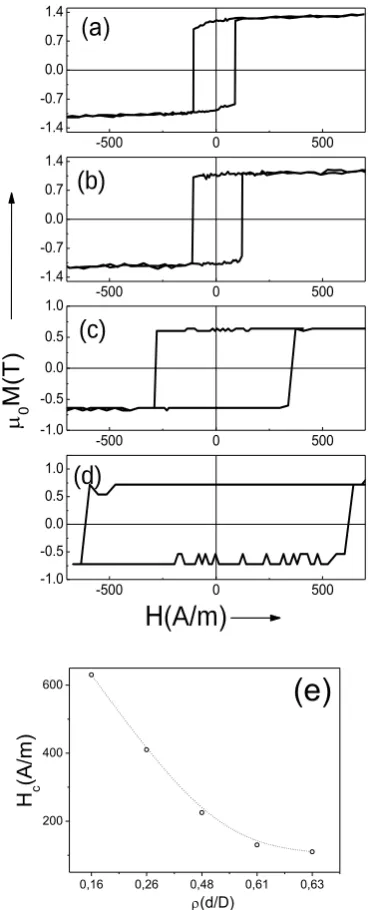
HkAs can be appreciated from Figure 7, even for the same microwire composition, Hc can be changed by almost an order of
magnitude (from 85 to 630 A/m) by adjusting the -ratio. Similarly to the case of Co-rich microwires, Hc-valuesobtained
for microwires with different D and d –
values can be represented by Hc(ρ)
dependence (i.e. Hc –values for different D and d
-values can be represented by Hc(ρ) dependence,
(see Figure 7e).
Considering aforementioned results, one can expect that stresses relaxation by heat treatment can efficiently affect the magnetic properties of microwires.
One of the examples of annealing influence on hysteresis loops of Fe-rich microwires is shown in Figure 8.
For the Fe75B9Si12C4 microwires, annealing does not affect the hysteresis loop character. However, a slight Hc decrease is observed (see Figure 8b).
More complex behavior has been reported for Fe-Ni based microwires with positive magnetostriction and hence presenting spontaneous magnetic bistability [81,82].
As-prepared Fe62Ni15.5Si7.5B15 microwires present
rectangular hysteresis loops (see Figure 9a) as
expected for microwires with positive λs –values
-500 0 500
-1.4 -0.7 0.0 0.7 1.4
-500 0 500
-1.0 -0.5 0.0 0.5
1.0 -500 0 500
-1.4 -0.7 0.0 0.7 1.4
-500 0 500
-1.0 -0.5 0.0 0.5 1.0
(a)
0M
(T
)
(c)
(b)
(d)
H(A/m)
0,16 0,26 0,48 0,61 0,63
200 400 600 H c (A/m ) (d/D)
(e)
Figure 7. Hysteresis loops of Fe70B15Si10C5
amorphous microwires with different metallic
nucleus diameter d and total diameters D: with =
0.63; d=15 m (а);= 0,48; d= 10,8 m (b);
=0,26; d= 6 m (c); =0,16; d= 3 m (d) and Hc(ρ)
dependence of the same microwires. Adapted
from [78].
-400 -200 0 200 400
-1.0 -0.5 0.0 0.5 1.0
d=6.6m; =0.42 d=6.8m; =0.5 d=9.8m; =0.53
M,
(
T)
H, (A/m)
d=11.8m; =0.64 d=13.4m; =0.8 d=16.8m; =0.7 d=16.8m; =0.64
(a)
0.4 0.5 0.6 0.7 0.8
100 200 300 400 500 Hk (A/m)
(b)
Figure 6. Hysteresis loops of Co67.1Fe3.8Ni1.4 Si14.5
B11.5Mo1.7 microwires with different geometry (a) and
Hk(ρ) dependence for the same microwires.
(
Reproduced with permission from [12] Fig7(about 27 x10-6).
After annealing, an increase in coercivity, Hc, is
generally observed (see Figure 9 b-g and Figure 10). The hysteresis loop character remains unchanged: all hysteresis loops present rectangular shape.
Although generally higher Hc -values are observed in
annealed samples, Hc(tann) dependence is not monotonic:
for tann, =128 min some Hc decrease is observed (see Figure
10).
Similarly, the second Fe-Ni based
(Fe49.6Ni27.9Si7.5B15) microwire presents
rectangular hysteresis loops in as-prepared state and
after annealing (see Figure 11). Lower Hc –values
observed in as-prepared Fe49.6Ni27.9Si7.5B15 microwire can
be related to lower λs –values of Fe49.6Ni27.9Si7.5B15
microwires (λs ≈20 x10-6) [54,55]. However, Hc(tann)
dependence is different from that showed by Fe62Ni15.5Si7.5B15 microwire: upon annealing (at the same
0 100 200
100 150 200 250
Hc
(A/m)
tann(min)
Figure 10.Hc(tann) dependence evaluated in
Fe62Ni15.5Si7.5B15 microwires.
(
Reproducedwith permission from [81] Fig 2d Copyright
© 2020 AIP Publishing LLC, Open Access)
-100 0 100
-1 0 1
-100 0 100
-1 0 1
-100 0 100
-1 0 1
(a)
M/M
o
(b)
H(A/m)
(c)
0 50 100 150
75 80 85 90
Hc
(A/m)
tann(min)
(d)
Figure 8. Hysteresis loops of as-
prepared (a), and annealed at Tann=
400 oC for 3 min (b) and 180 min (c)
Fe75B9Si12C4 microwires and
dependence of coercivity on
annealing time (d).
-200
0
200
-10 1
-200
0
200
-1
0
1
-200
0
200
-1
0
1
-200
0
200
-1
0
1
-200
0
200
-1
0
1
-200
0
200
-1
0
1
-200
0
200
-1
0
1
(a)
(b)
(c)
M
/M
0
(d)
(f)
(e)
H(A/m)
(g)
Figure 9. Hysteresis loops of as-prepared (a) and
annealed at Tann=410 0C for 4 min (b), 16 min (c) 32 min
(d), 64 min (e), 128 min (f) and 256 min (g)
conditions, i.e., Tannand tann) first a slight decrease in Hc followed by Hc rising is observed (see Figure
11e).
Considering that the annealing is the common route for the internal stresses relaxation, observed annealing effect on Hc in Fe-Ni microwires looks unexpected. For explanation of rather
different effect of annealing on
coercivity of Fe and Fe-Ni based microwires different factors such as
beginning of crystallization process or domain wall stabilization due to
directional ordering of atomic pairs are considered [81-84]. From our
previous studies we must disregard the crystallization process, since
Fe-Ni based microwires annealed at the same Tann for 8 hours still present
amorphous structure [85].Therefore,
observed Hc(tann) dependencies must
be attributed to the changes in local
atomic environment within the amorphous structure related to
annealing. Thus, local nano-sized precipitations have been observed in annealed Fe-Ni based microwires by
the atom probe tomography [85]. Furthermore, atom pair
ordering and hence DW stabilization is reported for Fe-Ni and Fe-Co
amorphous alloys [81-84,86,87]. Such DW stabilization is
considered as the main origin of the Hc rising upon annealing observed in
amorphous materials containing two or more ferromagnetic elements
[88,89]. Such magnetic hardening is usually reported for annealing temperature below Curie
temperature, Tc. This mechanism can explain the difference in annealing influence on coercivity in
Fe- based and Fe-Ni based microwires. In addition, the Curie temperature, Tc, of Fe49.6Ni27.9Si7.5B15
amorphous alloysis about 400 oC, being considerably lower than that for Fe62Ni15.5Si7.5B15 alloy [90].
Accordingly, the DW stabilization for Fe62Ni15.5Si7.5B15 microwire is expected to be more relevant than
that for Fe49.6Ni27.9Si7.5B15 microwire and hence the internal stresses relaxation plays a major role in
the alloy with lower Tc.
Additionally, chemical composition of Fe49.6Ni27.9Si7.5B15 microwire is similar to the Invar-like
composition (Ni/Fe content about 40/60) [82]. The peculiarity of the Invar-like crystalline materials
with Ni/Fe content about 40/60 is that they can present the Invar anomaly, i.e., low thermal
-200
0
200
-1
0
1
-200
0
200
-1
0
1
-200
0
200
-1
0
1
-200
0
200
-1
0
1
0
100
200
0
60
120
180
AC
(a)
(b)
(d)
(c)
M/M
0
H(A/m)
H
c(A/m)
t
ann(min)
(e)
Figure 11. Hysteresis loops of as-prepared (a) and annealed at
Tann=410 oC for tann= 4 min (b) 32 min(c) 128 min (d) and Hc(tann)
dependence (e) for Fe49.6Ni27.9Si7.5B15 microwires. (Reproduced
with permission from [81] Fig 4 Copyright © 2020 AIP
expansion coefficient [91].The Invar anomaly is intrinsically related to the local atomic structure of Fe-Ni alloys. Considering similarity of short range order of amorphous and crystalline materials [92]
one can expect lower internal stresses influence in Fe49.6Ni27.9Si7.5B15 microwire. In spite of observed
magnetic hardening of Fe-Ni based microwires upon annealing, observed experimental dependencies allows to tune the coercivity value by annealing.
Even more remarkable hardening upon conventional annealing has been reported in variety of Co-rich microwires with vanishing λs–values [49,93]. Thus, considerable magnetic hardening and
transformation of linear hysteresis loop with low coercivity (Hc ≈ 4 A/m) into rectangular with Hc ≈ 90
A/m upon annealing without stress is observed in
Fe3.6Co69.2Ni1B12.5Si11Mo1.5C1.2 microwire (see Figure 12).
Gradual squareness ratio, Mr/Mo, rising upon Tann
increasing can be appreciated, although Fe3.6Co69.2Ni1B12.5Si11Mo1.5C1.2 microwires annealed at
different Tann present similar coercivity.
Observed behavior of Mr/Mo upon annealing must be
attributed to rising of the inner axially magnetized inner
core diameter. Using relation (3) between the radius of
the inner axially magnetized core, Rc, and Mr/Mo, one
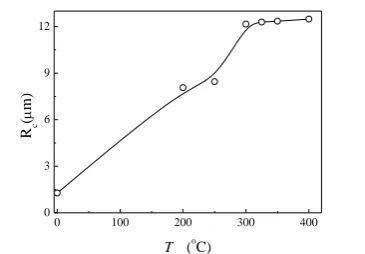
can obtain Rc(Tann) dependence (see Figure 13).
Observed modification of the hysteresis loops shape
and obtained Rc(Tann) dependence are consistent with
the evolution of the hysteresis loop shape upon
glass-coating removal by chemical etching (see Figures 3,4). Accordingly, Rc(Tann) dependence and
observed evolution of the hysteresis loops upon annealing must be related to the relaxation of internal
stresses as discussed elsewhere [74, 93-95]
Such evolution of hysteresis loops upon annealing is confirmed in various Co-based microwires with low and negative λs –values [93-96]. One more example for another Co-rich
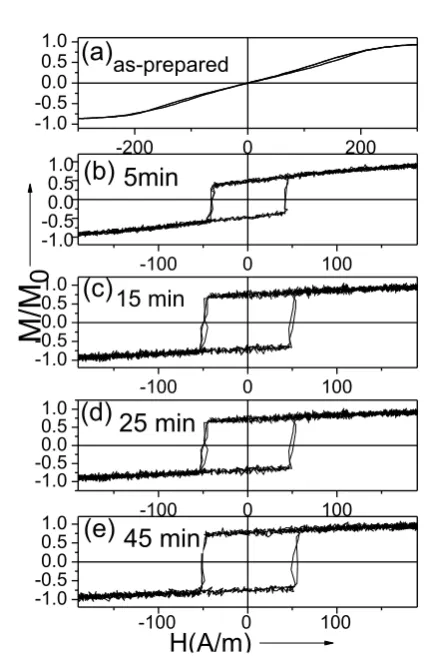
(Co69.2Fe4.1B11.8Si13.8C1.1) microwire with low negative λs–values is shown in Figure 14. In this case the
annealing temperature was fixed (Tann =250 oC) and the hysteresis loops have been recorded at different annealing time, tann. Similarly to the case of Fe3.6Co69.2Ni1B12.5Si11Mo1.5C1.2 microwires, we can
observe a remarkable Hc rising and gradual Mr/Mo, increase with an increase in tann (see Figure 15).
Accordingly, from Rc(tann) evaluated from Mr/Mo we can again observe gradual increase of the inner
axially magnetized domain radius upon annealing.
Consequently, similarly to glass-coating removal, annealing of Co-rich microwires allows to obtain magnetically bistable Co-rich microwires. Such Co-rich microwires with magnetic bistability induced by annealing present fast magnetization switching by propagation of single domain wall,
-600 -300 0 300 600 -1.0
-0.5 0.0 0.5 1.0
Tann=325 oC
Tann= 350 o C Tann=400 oC
M
/M
0
H (A/m)
as-prepared Tann=200
o
C Tann=250ºC
Tann=300ºC
= 0MPa
tann=60 min
Figure 12 Hysteresis loop of the
Fe3.6Co69.2Ni1B12.5Si11Mo1.5C1.2 microwires
annealed without stress at different
temperatures.
(
Reproduced withpermission from [49] Fig3a Copyright ©
2020 Elsevier B.V)
0 100 200 300 400
0 3 6 9 12
Rc
(
m)
T
ann( o
C)
Figure 13. Dependence of radius of inner
axially magnetized core, Rc, on annealing
temperature, Tann, in studied microwire.
similarly to Fe-rich microwires [60]. However, magnetic properties of either annealed or
chemically etched Co-rich microwires are similar
to those of Fe-rich microwires: the coercivity values of either annealed or chemically etched
Co-based microwires are almost an order of magnitude higher than those of as-prepared Co-based microwires.
Therefore, optimization of the magnetic softness of amorphous microwires requires
development of special post-processing. One of the promising routes allowing achievement of better magnetic softness is controllable magnetic anisotropy induction. Below we will present several
examples of thermal treatment allowing magnetic properties optimization of magnetic microwires.
3.2. Effect of induced magnetic anisotropy on hysteretic magnetic properties of amorphous glass-coated microwires
Considering new functional properties provided by insulating and flexible glass-coating, most attention has been paid to tuning of the hysteresis loops of Fe-Co-Ni- based microwires by appropriate annealing. As shown above, conventional annealing provides limited possibilities for tuning the hysteresis loops. Accordingly, several attempts have been performed recently to search more efficient post-processing allowing tuning the magnetic properties [43,52, 97].
0 20 40
0 20 40 60
H c
(A/m)
tann(min)
Tann=250 o
C Tann=300 oC
(a)
0 20 40
3 6 9 12
0 20 40
0.0 0.3 0.6 0.9
Rc
(
m)
tann(min)
Rc
Tann=250oC
(b)
M
r
/M
o
Mr/M0
Figure 15. Dependence of coercivity, Hc, (a) and
reduced remanent magnetization, Mr/MHmax (b) on
annealing time, tann in Co69.2Fe4.1B11.8Si13.8C1.1
microwires. Adapted from [96] Fig. 4 Copyright
© 2014 Springer Nature.
-200 0 200
-1.0 -0.50.0 0.5 1.0
-100 0 100
-1.0 -0.50.0 0.5 1.0
-100 0 100
-1.0 -0.50.0 0.5 1.0
-100 0 100
-1.0 -0.50.0 0.5 1.0
-100 0 100
-1.0 -0.50.0 0.5 1.0
as-prepared
(a)
5min
(b)
H(A/m)
M/M
0
25 min
(d)
45 min
(e)
15 min
(c)
Figure 14. Effect of annealing time on hysteresis loops
of Co69.2Fe4.1B11.8Si13.8C1.1 microwires annealed at Tann
=250 oC. Adapted from [96] Fig. 2 Copyright © 2014
One of the most promising and effective methods for tuning of the magnetic properties of magnetic microwires is stress-annealing. In the case of magnetic microwires with positive magnetostriction coefficient, this post-processing allows remarkable magnetic softness improvement [43,52,86,87,94,95].
From previous knowledge on the origin of induced magnetic anisotropy, it is known that the magnetic anisotropy of amorphous materials can be effectively tailored by either stress or magnetic field annealing [83,84].
Recently, stress-annealing has been successfully employed for tailoring of magnetic properties in glass-coated microwires. Thus, according to several publications on the origin of the induced anisotropy in glass-coated microwires [74,86,87,98] the presence of the glass-coating can be even beneficial for tuning the magnetic anisotropy.
Several examples on the influence of stress-annealing on magnetic properties of glass-coated microwires are provided below.
From Figure 16 we can clearly see that stress-annealing performed at the same conditions (Tann
and tann) allows better magnetic softening and transverse anisotropy induction in Fe-based
(Fe75B9Si12C4) microwire. As reported elsewhere [87,98],
such transverse anisotropy depends on various parameters, like Tann, tann, and stress, σm
,
applied duringthe annealing [87]. Clear example is shown in Figure 17. As can be appreciated from Figure 17, for high enough Tann or σm a remarkable transverse magnetic anisotropy
can be induced.
However, for low enough Tann, tann or σm the hysteresis loops maintain rectangular shape (see
Figure 18a) and can present all the features typical for magnetically bistable microwires, i.e., fast and single domain wall propagation [98]. Lower coercivity is generally observed in stress-annealed Fe-rich microwires (see Figure 18a,b). Consequently, stress annealing allows more effectively tune Hc and Mr/Mo–values (see Figure 18c). However, for sufficiently high Tann, tann or σm the hysteresis
loops of Fe-rich microwires become inclined (similar to that of as-prepared Co-rich microwires) with clear transverse magnetic anisotropy (see Figures 17d, 18b). As recently reported [42,43,86,87], such Fe-rich microwires with stress-induced transverse magnetic anisotropy present better GMI response
-500 0 500
-1.0 -0.5 0.0 0.5 1.0
-500 0 500
-1.0 -0.5 0.0 0.5 1.0
-500 0 500
-1.0 -0.5 0.0 0.5 1.0
-1000 0 1000 -1.0
-0.5 0.0 0.5 1.0
(c)
H(A/m)
M
/M
o
(a) (b)
(d)
Figure 17. Hysteresis loops of as-prepared (a), annealed at 200
oC (b), 250 oC (c) and 300 oC (d) for 1 h and σm ≈900 MPa
Fe75B9Si12C4 microwires. (Reproduced with permission from [87]
Fig 1 Copyright © 2018, Springer Nature, Open Access)
-200 -100 0 100 200
-1.0 -0.5 0.0 0.5 1.0
M/M
0
H (A/m)
As-prepared 45min 60min
(a)
-200 0 200
-1.0 -0.5 0.0 0.5 1.0
M/M
0
H (A/m)
As-prepared 45min 60min
(b)
Figure 16. Hysteresis loops of
as-prepared and annealed at Tann = 325 oC
(a) and as-prepared and stress- annealed
at Tann = 325 oC and σm=190 MPa (b)
Fe75B9Si12C4 microwire. Adapted from
as well as GMI effect and hysteresis loops sensitive to applied stresses [99,100]. Therefore, such microwires can be suitable for development of magnetic sensors based on GMI effect or for magnetoelastic sensors [32,71].
In the case of Co-based microwires higher annealing temperature, time or stresses are required to prevent magnetic hardening associated to relaxation of internal stresses related to glass-coating [42,43, 101]. As can be observed in Figures 19 and 20, for extended range of Tann, tann or σm,
stress-annealed Co-rich microwires present rectangular hysteresis loops. Therefore, stress-annealing
of Co-rich microwires allows to tune their coercivity in quite extended range. Thus, at certain stress-annealing conditions Co68.7Fe4Ni1B13Si11Mo2.3 microwires with rectangular hysteresis loops and
extremely low coercivity of about 1A/m can be obtained (see Figure 21) [102].
For sufficiently high Tann, tann or σm-values linear hysteresis loop of Fe3.6Co69.2Ni1B12.5Si11Mo1.5C1.2
microwires can be recovered (see Figure 19). However, Tann, tann or σm-values at which transverse
-100 0 100
-1,5 -1,0 -0,5 0,0 0,5 1,0 1,5
-100 0 100
-1,5 -1,0 -0,5 0,0 0,5 1,0 1,5
-100 0 100
-1,5 -1,0 -0,5 0,0 0,5 1,0 1,5 M/M 0 as-prepared H(A/m)
tann=1h tann=2h Tann=200
oC
(a)
-600 -300 0 300 600
-1,0 -0,5 0,0 0,5 1,0 M/M 0 H (A/m) as prepared
m=0MPa
m=190MPa
m=380MPa
(b)
0 200 400
20 30 40 50
0 200 400
0,3 0,6 0,9
Hc
(A/m)
m (MPa)
Hc (c) M r /M o
Mr/Mo Tann=300
oC
Figure 18. Hysteresis loops of as-prepared and stress-annealed at Tann=200o C, σ≈900 MPa for different tann(a), effect
of tensile stress applied during the annealing at Tann=300o C on hysteresis loops (b) and Hc and Mr/Mo values (c) of
Fe75B9Si12C4 microwires. Figures 18a is adapted from [87] Fig. 2 (Copyright © 2018, Springer Nature, Open Access)
-500 -250 0 250 500 -1.0 -0.5 0.0 0.5 1.0 M/M 0 H (A/m) as-prepared 0 MPa 118 MPa 354 MPa
Tann= 200
o
C
tann = 60 min
(a)
-400 -200 0 200 400 -1.0 -0.5 0.0 0.5 1.0 M/M o H (A/m) as-prepared 0 MPa 118 MPa 354 MPa T ann= 350 ºC t
ann = 60 min
(b)
-400 -200 0 200 400 -1.0 -0.5 0.0 0.5 1.0 M/M o H (A/m) as-prepared 0 MPa 118 MPa 354 MPa
Tann= 375 ºC
tann = 60 min
(c)
Figure 19. Hysteresis loops of Fe3.6Co69.2Ni1B12.5Si11Mo1.5C1.2 microwires stress-annealed at different conditions.
(
Reproduced with permission from [49] Fig7 Copyright © 2020 Elsevier B.V).-400 -200 0 200 400
-1 0 1
-400 -200 0 200 400
-1 0 1
-400 -200 0 200 400
-1 0 1
(a)
M/M o(b)
H(A/m)(c)
0 200 400
0 40 80 120 Hc (A/m)
m(MPa)
(d)
Figure 20. Hysteresis loops of Fe3.6Co69.2Ni1B12.5Si11Mo1.5C1.2 microwires annealed at Tann=300 oC for tann=1 h
magnetic anisotropy in Co-rich microwires can be induced are considerably higher than those for Fe-rich microwires. One more efficient method for tuning of hysteresis loops of Co-rich microwires, preventing excessive magnetic hardening, is the Joule heating (see Figure 22) [29]. In this case, the current flowing through the microwires produce
heating itself as well as the circumferential magnetic field, Hcirc, (associated to the current I flowing through
the sample) [29,103].
Aforementioned circumferential magnetic field, Hcirc, produced by the current (Oersted field) in the
surface of the metallic nucleus can be evaluated from the formula [29,86]:
H
circ=
I/2πr
(6)where I is the current value, r- radial distance.
Magnetic softening obtained at certain conditions of Joule heating is evidenced by Figure 22 where effect of Joule heating on hysteresis loops of Co67Fe3.9Ni1.5B11.5Si14.5Mo1.6 microwire is shown. In
this case the microwires were heated by a DC current, I, of 30 and 40 mA. These conditions were selected in order to avoid the crystallization and related deterioration of the magnetic properties. In the case of Joule heating the current density is one of the main parameters determining the sample heating [104]. Although the thickness of the glass coating and the metallic nucleus diameter also affect the heat transfer rate [40]. In the given case, the current densities (58.3 and 77.7 A/mm2 for 30
and 40 mA, respectively) are well-below the value that can produce magnetic hardening related to the crystallization [104].
Observed magnetic softening is related to the presence of magnetic field that can considerably affect the magnetic anisotropy of amorphous materials [105]. It was reported that the macroscopic magnetic anisotropy of amorphous materials is originated by a preferred magnetization direction during the annealing and was discussed in terms of either the directional ordering of atomic pairs or compositional and topological short-range ordering [83-85,93-95,105].
3.3. Tuning of hysteretic magnetic properties in crystalline and devitrified glass-coated microwires
-100 -50 0 50 100
-1,0 -0,5 0,0 0,5 1,0
M/M
o
H (A/m)
As-prepared 5min 40mA 5min 30mA
(a)
-100 -50 0 50 100
-1,0 -0,5 0,0 0,5 1,0
M/M
o
H (A/m)
As-prepared 3min 30mA
(b)
Figure 22. Hysteresis loops of as-prepared
and current annealed at 30 mA and 40 mA for 5 min (a), 3 min and 30 mA (b) Co67Fe3.9Ni1.5B11.5Si14.5Mo1.6 amorphous glass-coated microwire. (Reproduced with permission from [26] Fig4 Copyright © 2019 Elsevier B.V)
-400 -200 0 200 400
-1 0 1
-20 -10 0 10 20
-1 0 1
-20 -10 0 10 20
-1 0 1
A
(a)
M/M
0
(b)
H(A/m)
(c)
Figure 21. Hysteresis loops of
as-prepared (a), annealed at Tann=350o C
(b) and stress annealed at Tann=350o C
and σm=250 MPa (c)
Co68.7Fe4Ni1B13Si11Mo2.3 microwires.
The devitrification of amorphous nucleus reached by post annealing process is another useful tool allowing considerable modification of the magnetic properties and even magnetic softening in some Fe-rich microwires [48].
In the case of FeSiBNbCu (so-called Finemet) alloys low magnetostriction values and better magnetic softness can be achieved by the devitrification of amorphous precursor [57]. Magnetic softening of Finemet alloys is commonly attributed to vanishing magnetocrystalline anisotropy, as well as to nearly-zero magnetostriction value of the material obtained by nanocrystallization of their amorphous precursors, and consisting of nano-sized grains, with average size about 10 nm, embedded in an amorphous matrix [57].
As discussed elsewhere, after nanocrystallization the average magnetostriction constant takes nearly - zero values [57,106], thanks to the control of the crystalline volume fraction: the existence of two phases (amorphous and crystalline) provides a good balance of a negative magnetostriction of
α-Fe-Si nanocrystallites of about (𝜆𝑠𝐹𝑒𝑆𝑖≈ -6 x 10⁻⁶) [48] and a positive one for the amorphous matrix
of about (𝜆𝑠𝑎𝑚≈ 20 x 10-6) [48] resulting finally in vanishing net magnetostriction values [105]:
𝜆𝑠 𝑒𝑓𝑓
≈ 𝑉𝑐𝑟 𝜆𝐹𝑒𝑆𝑖𝑠 + (1 − 𝑉𝑐𝑟) 𝜆𝑠𝑎𝑚 (7)
being λseffthe saturation magnetostriction coefficient, and Vcr denotes the crystalline volume fraction.
This nanocrystallization of FeSiBNbCu alloys is usually observed after annealing in the range of 500-600oC for 1 hour (i.e., at temperatures between the first and second crystallization stages). One of
the examples of the evolution of the hysteresis loops of Finemet-type microwires upon nanocrystallization is shown in Figure 23. As can
observed from Figure 23, in the case of the
Fe70.8Cu1Nb3.1Si14.5B10.6 microwire, annealing at Tann
up to 550 oC allows considerable decrease of
coercivity. For these annealing conditions the character of hysteresis loops does not change: all the hysteresis loops present rectangular shape. In some cases rectangular hysteresis loops are reported not only upon devitrification of Finemet-type, but even after second crystallization process when values up to 2400 A/m are observed [107]. One of the examples is shown in Figure 24a, where hysteresis loop of Fe71,8Cu1Nb3,1Si15B9,1
microwire (=0.282) annealed at Tann =700 oC is
shown
.
However, Fe71,8Cu1Nb3,1Si15B9,1 microwire(=0.467) present rather different step-wise hysteresis loops (see Figure 24b) that can be attributed to partially crystalline (bi-phase) structure. Such partially crystalline magnetic microwires, with step-wise hysteresis loops related to magnetic interaction between crystals or mixed amorphous-crystalline structure, can be interesting for applications in electronic surveillance systems [108].
The microwires obtained by devitrification exhibit higher saturation magnetization and at certain annealing conditions can present better magnetic softness and GMI response than as-prepared Fe-rich microwires and therefore they are useful for GMI sensors and metacomposites applications [47].
-100 -50 0 50 100
-1 0 1 -1 0 1 -1 0 1
H (A/m)
M/
M
o
As-prepared
Hc = 44.5 A/m
(a)
Hc = 15.9 A/m
Hc = 34.9 A/m Hc = 32.5 A/m
1
0
4000C
-1
5000C
5500C
0 100 200 300 400 500 600
0 20 40 60 4000 8000 12000 16000
H
c
(A
/m)
Tann ( 0 C) = 0.6 = 0.7 = 0.8
(b)
Figure 23 Hysteresis loops of as-prepared and
annealed Fe70.8Cu1Nb3.1Si14.5B10.6 microwire samples at
Tann between 400°C-600°C (a); coercive field
dependence on Tann of Fe70.8Cu1Nb3.1Si14.5B10.6 for
different ρ-ratios (b). (Reproduced with permission
In fact, microwires with nanocrystalline structure can be obtained even directly in as-prepared state without annealing [109, 110]. The advantage of such microwires is that they can present better mechanical properties [109,110].
It is worth mentioning, that the use of specially designed compositions allows further increase of saturation magnetization, μoMs, [111] and also obtain
extremely magnetically soft nanocrystalline materials. In the case of microwires, the use of a similar chemical composition allows preparation of nanocrystalline microwires with improved DW mobility without any post processing [109]. The partially crystalline (Fe0.7Co0.3)83.7Si4B8P3.6Cu0.7 microwire presents elevated
values of Hc (about 480 A/m) and rather high
saturation magnetization of about 1.6 T (see Figure 25).
Such elevated Hc -values are quite similar to that exhibited by other partially nanocrystalline
microwires, i.e., Hitperm-like Fe38.5Co38.5B18Mo4Cu1 microwires with similar average grain size (about
38 nm and 23-33 nm for (Fe0.7Co0.3)83.7Si4B8P3.6Cu0.7 and Hitperm-like microwires, respectively) [110].
Accordingly, even partially
crystalline or
nanocrystalline microwires can present perfectly rectangular hysteresis
loops. For
(Fe0.7Co0.3)83.7Si4B8P3.6Cu0.7
microwire elevated μoMs
-values allowed to obtain extremely fast domain wall velocity even in as-prepared state [110].
Aforementioned Hitperm-like
Fe38.5Co38.5B18Mo4Cu1
microwires are the other example of nanocrystalline microwires with perfectly rectangular hysteresis loops (see Figure 26) and hence fast magnetization switching by single domain wall propagation [110]. Higher Hc -values of
Fe38.5Co38.5B18Mo4Cu1 and (Fe0.7Co0.3)83.7Si4B8P3.6Cu0.7 microwires have been attributed to elevated
magnetostriction coefficient of these microwires as-compared to Finemet-type microwires.
On the other hand, magnetically hard and semi-hard wires are potentially quite interesting for various applications related to the design of smart markers for the electronic article surveillance, motors, compass needles and tachometers, magnetic microelectromechanical systems (magnetic MEMS), dentistry and for magnetic tips for magnetic force microscopy [112,113].
Recently a few successful attempts to achieve hard magnetic properties in microwires have been reported. Among others, various approaches are being developed to enhance hard magnetic
behavior by employing novel alloys, i.e., Fe-Pt based alloys [114] or Heusler-type (Ni-Mn-Ga) alloys [115].
-8000 -4000 0 4000 8000
-1 0 1
-8000 -4000 0 4000 8000
-1 0 1
=0,282
(a)
M/M
0
H(A/m)
=0,467
(b)
Figure 24. Hysteresis loops of Fe71,8Cu1Nb3,1Si15B9,1
microwires with =0,282 (a) and =0,467 (b) annealed at 700oC. Adapted from ref. [107].
-10000 -5000 0 5000 10000
-1.5
-1.0
-0.5
0.0
0.5
1.0
1.5
-1000 -500 0 500 1000
-1.5 -1.0 -0.5 0.0 0.5 1.0 1.5
(Fe0,7Co0,3)83,7Si4B8P3,6Cu0,7 microwire
Fe83,7Si4B8P3,6Cu0,7 microwire
0
M
s(T)
H(A/m) (Fe0,7Co0,3)83,7Si4B8P3,6Cu0,7 microwire Fe83,7Si4B8P3,6Cu0,7 microwire
0M
s(T)
H(A/m)
Figure 25. Hysteresis loops of studied (Fe0.7Co0.3)83.7Si4B8P3.6Cu0.7 and
Magnetic hardening in Fe50Pt40Si10 microwires
has been observed after annealing upon the
formation of L10-type superstructure after crystallization of as-prepared amorphous precursor (see Figure 27). In this case after
devitrification of amorphous Fe50Pt40Si10 microwire
Hc≈40 kA/m is observed.
Magnetic hardening is also reported in Co-rich microwires annealed by Joule heating
[116].
Consequently, magnetic properties of
crystalline microwires depend on the chemical composition of the metallic nucleus and on
structural features (grain size, precipitating phases)
of either as-prepared or annealed microwire: crystalline microwire can exhibit either soft magnetic properties or semi-hard magnetic properties.
4. Conclusions
We showed that the magnetic properties of glass-coated microwires prepared by the Taylor-Ulitovsky method can be tuned in as-prepared state or further modified by appropriate post-processing.
Magnetic properties of amorphous magnetic microwires can be tuned either in as-prepared state or by controlling the magnetoelastic anisotropy through the magnetostriction coefficient value and by the internal stresses values related to the fabrication conditions and geometry of microwires. Furthermore, appropriate post-processing (including either conventional heat treatment, heat treatment in the presence of applied stress or magnetic field or glass-coating removal) allows further tuning of magnetic properties of magnetic microwires.
We showed that the microwires with coercivities from 1 A/m to 40 kA/m can be prepared. Depending on the chemical composition of metallic nucleus as well as structural features (grain size, precipitating phases) prepared microwire can exhibit soft magnetic properties or semi-hard magnetic properties.
-1000 -500 0 500 1000
-1.0 -0.5 0.0 0.5 1.0
-1000 -500 0 500 1000
-1.0 -0.5 0.0 0.5 1.0
M/M
o
H (A/m)
(a)
(b)
Figure 26. Hysteresis loops of as-prepared
Fe38.5Co38.5B18Mo4Cu1 microwires: sample 1 with = 0.41 (a) and sample 2 with = 0.6 (b) measured at f=50 Hz
.
(Reproduced with permission from [109] Fig1 Copyright © 2016 Elsevier B.V)-100 0 100
-1.0 -0.5 0.0 0.5 1.0
M/
M 5K
H(kA/m)
5K 75K 150K 300k
(a)
-100 0 100
-1.0 -0.5 0.0 0.5 1.0
M/M
5K
H(kA/m)
T=5K 50K 200K 300K 350K
(b)
Figure 27. Hysteresis loops of as-prepared (a) and annealed at 500 oC for 1 h (b) Fe50Pt40Si10 microwires measured at different
Author Contributions: Conceptualization, A.Z. and V.Z.; methodology, M.I., J.M.B. and V.Z.; validation, A.Z; formal analysis, A.Z.; investigation, A.Z., A.T., P.C.L, J.O., L.G.L. and V.Z.; resources, A.Z.; data curation, V.Z., P.C.L., J.M.B., M.I., L.G.L. and A.T.; writing—original draft preparation, A.Z.; writing—review and editing, A.Z., P.C.L., J.M.B., L.G.L. and A.T.; supervision, A.Z.; funding acquisition, A.Z. and V.Z. All authors have read and agreed to the published version of the manuscript.
Funding: This research was funded by Spanish MCIU under PGC2018-099530-B-C31 (MCIU/AEI/FEDER, UE), by the Government of the Basque Country under PIBA 2018-44 and Elkartek (CEMAP and AVANSITE) projects and by the University of Basque Country under the scheme of “Ayuda a Grupos Consolidados” (Ref.:
GIU18/192).
Acknowledgments: Authors give thanks for technical and human support to SGIker of UPV/EHU (Medidas Magnéticas Gipuzcoa) and European funding (ERDF and ESF).
Conflicts of Interest: The authors declare no conflict of interest.
References
1. Lenz, J.; Edelstein, S. Magnetic sensors and their applications. IEEE Sens. J. 2006, 6, 631–649, doi:10.1109/JSEN.2006.874493.
2. Díaz-Michelena, M. Small Magnetic Sensors for Space Applications. Sensors 2009, 9, 2271–2288, doi:10.3390/s90402271.
3. Ripka, P.; Vértesy, G. Sensors based on soft magnetic materials Panel discussion. J. Magn. Magn. Mater.
2000, 215–216, 795–799, doi:10.1016/S0304-8853(00)00291-2.
4. Fiorillo, F.; Bertotti, G.; Appino, C.; Pasquale, M. Soft Magnetic Materials. In Wiley Encyclopedia of Electrical and Electronics Engineering; John Wiley & Sons, Inc, 2016; pp. 1–42 ISBN 978-0-471-34608-1.
5. Jiles, D.C. Recent advances and future directions in magnetic materials. Acta Mater.2003, 51, 5907–5939, doi:10.1016/j.actamat.2003.08.011.
6. High Performance Soft Magnetic Materials; Zhukov, A., Ed.; Springer Series in Materials Science; Springer International Publishing, 2017; p. 216 ISBN 978-3-319-49705-1.
7. Mohri, K.; Humphrey, F.B.; Kawashima, K.; Kimura, K.; Mizutani, M. Large Barkhausen and Matteucci
effects in FeCoSiB, FeCrSiB, and FeNiSiB amorphous wires. IEEE Trans. Magn. 1990, 26, 1789–1791, doi:10.1109/20.104526.
8. Ogasawara, I.; Ueno, S. Preparation and properties of amorphous wires. IEEE Trans. Magn. 1995, 31, 1219–1223, doi:10.1109/20.364811.
9. Vazquez, M.; Chen, D.-X. The magnetization reversal process in amorphous wires. IEEE Trans. Magn.1995,
31, 1229–1238, doi:10.1109/20.364813.
10. Panina, L.V.; Mohri, K. Magneto‐impedance effect in amorphous wires. Appl. Phys. Lett. 1994, 65, 1189–1191, doi:10.1063/1.112104.
11. Beach, R.S.; Berkowitz, A.E. Giant magnetic field dependent impedance of amorphous FeCoSiB wire. Appl. Phys. Lett.1994, 64, 3652–3654, doi:10.1063/1.111170.
12. Zhukov, A.; Ipatov, M.; Zhukova, V. Chapter 2 - Advances in Giant Magnetoimpedance of Materials. In
Handbook of Magnetic Materials; Buschow, K.H.J., Ed.; Elsevier, 2015; Vol. 24, pp. 139–236.
13. Knobel, M.; Vázquez, M.; Kraus, L. Giant Magnetoimpedance. In Handbook of Magnetic Materials; Handbook of Magnetic Materials; Elsevier, 2003; Vol. 15, pp. 497–563.
15. Sixtus, K.J.; Tonks, L. Propagation of Large Barkhausen Discontinuities. II. Phys. Rev.1932, 42, 419–435, doi:10.1103/PhysRev.42.419.
16. Zhukov, A.P. The remagnetization process of bistable amorphous alloys. Mater. Des.1993, 14, 299–306, doi:10.1016/0261-3069(93)90130-N.
17. Phan, M.-H.; Peng, H.-X.; Yu, S.-C.; Vázquez, M. Optimized giant magnetoimpedance effect in amorphous
and nanocrystalline materials. J. Appl. Phys.2006, 99, 08C505, doi:10.1063/1.2162089.
18. Zhukov, A.; Zhukova, V.; Blanco, J.M.; Gonzalez, J. Recent research on magnetic properties of glass-coated
microwires. J. Magn. Magn. Mater.2005, 294, 182–192, doi:10.1016/j.jmmm.2005.03.033.
19. Varga, R.; Richter, K.; Zhukov, A.; Larin, V. Domain Wall Propagation in Thin Magnetic Wires. IEEE Trans. Magn.2008, 44, 3925–3930, doi:10.1109/TMAG.2008.2001997.
20. Corodeanu, S.; Chiriac, H.; Ó vári, T.-A. Accurate measurement of domain wall velocity in amorphous
microwires, submicron wires, and nanowires. Rev. Sci. Instrum.2011, 82, 094701, doi:10.1063/1.3635223. 21. Biziere, N.; Gatel, C.; Lassalle-Balier, R.; Clochard, M.C.; Wegrowe, J.E.; Snoeck, E. Imaging the Fine
Structure of a Magnetic Domain Wall in a Ni Nanocylinder. Nano Lett. 2013, 13, 2053–2057, doi:10.1021/nl400317j.
22. Da Col, S.; Jamet, S.; Staňo, M.; Trapp, B.; Le Denmat, S.; Cagnon, L.; Toussaint, J.C.; Fruchart, O.
Nucleation, imaging, and motion of magnetic domain walls in cylindrical nanowires. Appl. Phys. Lett.2016,
109, 062406, doi:10.1063/1.4961058.
23. Blanco, J.M.; Zhukova, V.; Ipatov, M.; Zhukov, A. Magnetic Properties and Domain Wall Propagation in
Micrometric Amorphous Microwires. Sens. Lett.2013, 11, 187-190(4), doi:info:doi/10.1166/sl.2013.2782. 24. Ó vári, T.-A.; Corodeanu, S.; Chiriac, H. Domain wall velocity in submicron amorphous wires. J. Appl. Phys.
2011, 109, 07D502, doi:10.1063/1.3536797.
25. Pirota, K.R.; Kraus, L.; Chiriac, H.; Knobel, M. Magnetic properties and giant magnetoimpedance in a
CoFeSiB glass-covered microwire. J. Magn. Magn. Mater. 2000, 221, L243–L247,
doi:10.1016/S0304-8853(00)00554-0.
26. Corte-León, P.; Zhukova, V.; Ipatov, M.; Blanco, J.M.; Gonzalez, J.; Zhukov, A. Engineering of magnetic
properties of Co-rich microwires by joule heating. <

![Figure 2.permission from [65], Fig.5. Copyright © 2000 Elsevier)Hysteresis loops of as-prepared (a) and with chemically etched glass-coating for 5 min (b), 10 min (c) and 50 min (c) Co 70.5Mn4.5Si10B15 microwire](https://thumb-us.123doks.com/thumbv2/123dok_us/1046969.1604942/6.595.104.465.313.539/figure-permission-copyright-elsevier-hysteresis-prepared-chemically-microwire.webp)