1
Decomposition and Intersection of Two Fuzzy Numbers for the Fuzzy
Preference Relations
Hui-Chin Tang
Department of Industrial Engineering and Management, National Kaohsiung University
of Applied Sciences, Kaohsiung 80778, Taiwan, R.O.C.
Abstract
In fuzzy decision problems, the ordering of fuzzy numbers is the basic problem.
Among which, the fuzzy preference relation is the reasonable one to represent
preference relation by a fuzzy membership function. This paper studies the Nakamura’s
and Kołodziejczyk’s preference relations. Eight cases of representing different level of
overlapping between two triangular fuzzy numbers are considered. We analyze the
ranking behaviors of all possible combinations of decomposition and intersection of two
fuzzy numbers for the Nakamura’s and Kołodziejczyk’s preference relations of these
test cases. The results indicate that the decomposition and intersection can affect the
fuzzy preference relations, thereby the final total order relation of fuzzy numbers.
1. Introduction
For solving decision making problems in a fuzzy environment, the overall utilities
of a set of alternatives are represented by the fuzzy sets or fuzzy numbers. A
fundamental problem of a decision making procedure involves ranking a set of fuzzy
sets or fuzzy numbers. Ranking functions, reference sets and preference relations are
three categories to rank a set of fuzzy numbers. For a detailed discussion, we refer the
reader to surveys by Chen and Hwang [1] and Wang and Kerre [2, 3]. For ranking a set
of fuzzy numbers, this paper concentrates on the fuzzy preference relations which are
able to represent preference relations in linguistic or fuzzy terms and to make pairwise
comparison. To propose the fuzzy preference relation, Nakamura[4] employed a fuzzy
minimum operation followed by the Hamming distance. Kołodziejczyk [5] considered
the common part of two membership functions and used the fuzzy maximum and
Hamming distance. Yuan [6] compared the fuzzy subtraction of two fuzzy numbers
with real number zero and indicated that the desirable properties of a fuzzy ranking
method are the fuzzy preference presentation, rationality of fuzzy ordering,
distinguishability and robustness. Li [7] included the influence of levels of possibility of
dominance. Lee [8] presented a counterexample of Li’s method [7] and proposed an
on deviation degree. Zhang et al. [11] presented a fuzzy probabilistic preference relation.
Zhu et al. [12] proposed the hesitant fuzzy preference relations. Wang [13] adopted the
relative preference degrees of the fuzzy numbers over average. Liu et al. [14] modified
the Farhadinia’s hesitant fuzzy set lexicographical ordering method [15] and was more
reasonable in more general cases. This paper evaluates and compares two fundamental
fuzzy preference relations, one is proposed by Nakamura [4], and the other is by
Kołodziejczyk [5]. The intersection of two membership functions and the
decomposition of two fuzzy numbers are two differences between these two
preference relations. Since the desirable criteria cannot easily be represented in
mathematical forms, their performance measures are often tested by using test
examples and judged intuitively. To this end, we consider eight complex cases of
representing different level of overlapping between two fuzzy numbers. For the
Nakamura’s and Kołodziejczyk’s fuzzy preference relations, this paper analyzes and
compares the ordering behaviors of the decomposition and intersection tested on a
group of selected examples.
The organization of this paper is as follows. Section 2 briefly reviews the fuzzy
sets and fuzzy preference relations and presents the eight test cases. Section 3 analyzes
the behaviors of Kołodziejczyk’s fuzzy preference relation. Section 5 analyzes the
effect of the decomposition and intersection on the fuzzy preference relations. Finally,
we end with some concluding remarks.
2.Fuzzy Sets and Test Problems
We firstly review the basic notations of fuzzy sets and fuzzy preference relations.
Consider a fuzzy set A defined on a universal set of real numbers ℜ by the
membership function (x), where A(x):ℜ→[0,1].
Definition 1. Let A be a fuzzy set. The support of A is the crisp set
} 0 ) ( { ∈ℜ >
= x A x
SA . A is called normal when supx∈SA A(x)=1. An α −cut of A is a
crisp set Aα ={x∈ℜA(x)≥α}. A is convex if, and only if, each of its α-cut is a
convex set.
Definition 2. A normal and convex fuzzy set whose membership function is piecewise
continuous is called a fuzzy number.
Definition 3. A triangular fuzzy number A, denoted A=(a,b,c), is a fuzzy number
with membership function given by
≤ ≤ ≤ ≤ = −− − − otherwise 0 if if )
( b x c
b x a
x
A cc bx
where −∞ < a ≤ b≤ c <∞ . The set of all triangular fuzzy numbers on ℜ is denoted by
) ( TFℜ .
Definition 4. For a fuzzy number A, the upper boundary set ̅ of A and the lower
boundary set of A are respectively defined as
( ) = sup ( )
and
( ) = sup ( ).
Definition 5. The Hamming distance between two fuzzy numbers A and B is defined by
d( , ) = | ( ) − ( )|
= ( ) ( ) ( ) − ( ) + ( ) ( ) ( ) − ( ) .
Definition 6. Let A and B be two fuzzy numbers. Let × be an operation on ℜ, such as
+, ─, *, ÷…. By extension principle, the extended operation ⊗ on fuzzy numbers can
be defined by
)} ( ), ( min{ sup ) ( : , y B x A z y x z y x B A × = ⊗ = μ .
Definition 7. A fuzzy preference relation R is a fuzzy binary relation with membership
function R(A,B) indicating the degree of preference of fuzzy number A over fuzzy
number B.
B.
2. R is transitive if, and only if, R(A,B)≥0.5 and R(B,C)≥0.5 implies
5 . 0 ) , (A C ≥
R for all fuzzy numbers A, B and C.
3. R is a fuzzy total ordering if, and only if, R is both reciprocal and transitive.
For simplicity, we denote R'(A,B) for the degree of preference of fuzzy number
B over fuzzy number A.
The evaluation criteria of comparing two fuzzy numbers cannot easily be
represented in mathematical forms, it is often tested on a group of selected examples.
The membership functions of two fuzzy numbers can be overlapping/nonovelapping,
convex/nonconvex, and normal/nonnormal. All the approaches proposed in the literature
seem to suffer from some questionable examples, especial for the portion of overlapping
between two membership functions.
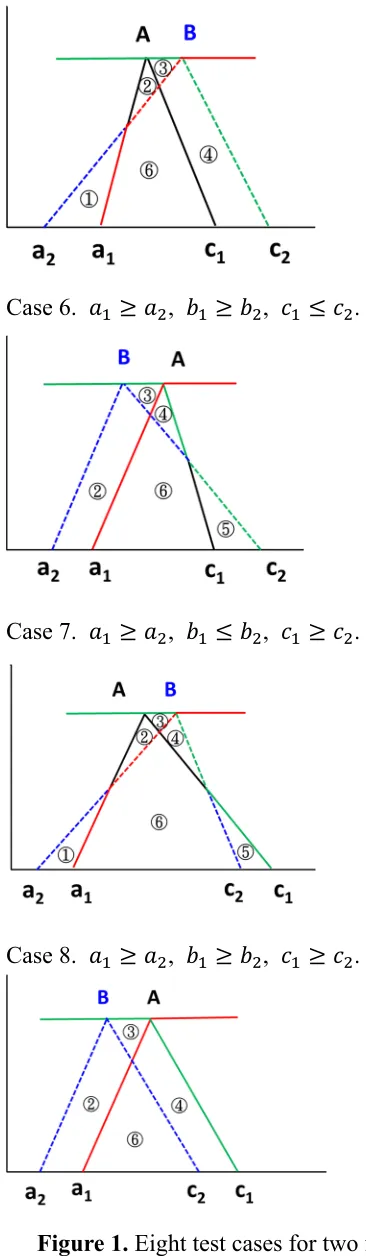
Let ( , , ) and ( , , ) be two triangular fuzzy numbers. Figure 1
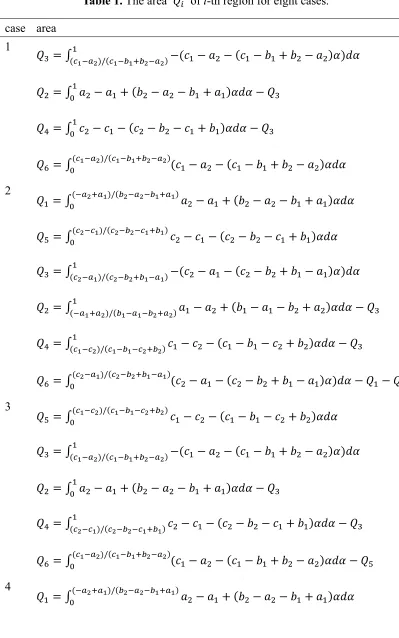
displays eight test cases of representing different level of overlapping between A and B
and Table 1 shows the area of i-th region in each case. More precisely, the eight test
cases are
Case 1. ≤ , ≤ , ≤ .
Case 3. ≤ , ≤ , ≥ .
Case 4. ≤ , ≥ , ≥ .
Case 5. ≥ , ≤ , ≤ .
Case 6. ≥ , ≥ , ≤ .
Case 7. ≥ , ≤ , ≥ .
Case 8. ≥ , ≥ , ≥ .
(Insert Figure 1 about here.)
(Insert Table 1 about here.)
3. Nakamura’s Fuzzy Preference Relation
Using fuzzy minimum, fuzzy maximum and Hamming distance, Nakamura’s fuzzy
preference relation is defined as follows.
Definition 8. For two fuzzy numbers A and B, Nakamura defines ( , ) and
′( , ) as fuzzy preference relations by the following membership functions
( , ) = ( , , ) + ( , , )
, + ,
and
′( , ) = ( ∩ , 0) + (A, ( , B))
( , 0) + ( , 0)
respectively. Yuan [6] showed that N( , ) is reciprocal, transitive and not robust.
, , = , ,
, , = ( , , )
, , + , , = ,
, , + , , = ,
2 (A ∩ B, 0) + A, ( , B) + B, ( , B) = ( , 0) + ( , 0).
It follows that
( , ) + ( , ) = 1
′( , ) + ′( , ) = 1.
For two triangular fuzzy numbers ( , , ) and ( , , ), then
= [ , ] = [ + ( − ) , − ( − ) ]
= [ , ] = [ + ( − ) , − ( − ) ]
so
( , ) = , ,, ,, ,
= .
Define
= − = ( ) − + ( − − + )
= − = ( ) − + ( − − + )
= − = ( ) − − ( − − + ) ,
then
( , ) = .
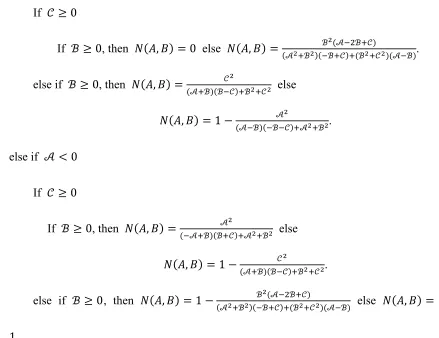
Let = − , ℬ = − and = − . The steps of implementing the
Nakamura’s fuzzy preference relation ( , ) are as follows.
Algorithm 1.
If ≥ 0
If ≥ 0
If ℬ ≥ 0, then ( , ) = 0 else ( , ) =( ℬ )( ℬℬ ( ) (ℬℬ ) )( ℬ).
else if ℬ ≥ 0, then ( , ) =( ℬ)(ℬ ) ℬ else
( , ) = 1 −( ℬ)( ℬ ) ℬ .
else if < 0
If ≥ 0
If ℬ ≥ 0, then ( , ) =( ℬ)(ℬ ) ℬ else
( , ) = 1 −( ℬ)(ℬ ) ℬ .
else if ℬ ≥ 0, then ( , ) = 1 −( ℬ )( ℬℬ ( ) (ℬℬ ) )( ℬ) else ( , ) =
1.
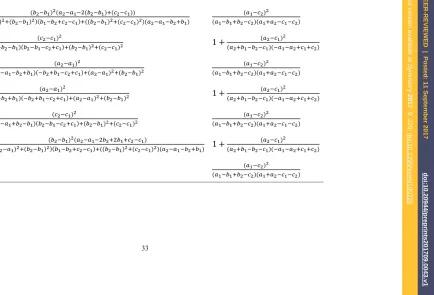
Table 2 shows the values of ( , ) and ′( , ) for each test case. The first
( , ) + ( , ) = 1
( , ) + ( , ) = 1
( , ) + ( , ) = 1
( , ) + ( , ) = 1.
Comparing the values of ( , ) with ′( , ) of each case, we have that 1 −
( , ) ≥ ( , ) and 1 − ( , ) ≤ ( , ). If + 2 + ≥ − 2 −
, we obtain that 1 − ( , ) ≤ ( , ) , 1 − ( , ) ≥ ( , ) , 1 −
( , ) ≤ ( , ), 1 − ( , ) ≥ ( , ), 1 − ( , ) ≤ ( , ) and 1 −
( , ) ≥ ( , ).
(Insert Table 2 about here.)
4. Kołodziejczyk’s Fuzzy Preference Relation
By considering the common part of two membership functions, Kołodziejczyk’s
method [5] is based on fuzzy maximum and Hamming distance to propose the following
fuzzy preference relation.
Definition 9. For two fuzzy numbers A and B, Kołodziejczyk defines 1′( , ) and
2′( , ) as fuzzy preference relations by the following membership functions
1′( , ) = , , + , , + ( ∩ , 0)
2′( , ) = , max , + , max ,
, + ,
respectively. 1′( , ) is reciprocal, transitive and robust [3, 5]. Since
2′( , ) = 1 − ( , )
the results of 2′( , ) can be obtained from those of ( , ).
For two triangular fuzzy numbers ( , , ) and ( , , ), then
= [ , ] = [ + ( − ) , − ( − ) ]
= [ , ] = [ + ( − ) , − ( − ) ].
Define
= , , = −
= −
, = +
= , , = −
= −
, = +
= ( ∩ , 0) = − − − − −
Then
1′( , ) =
2′( , ) = .
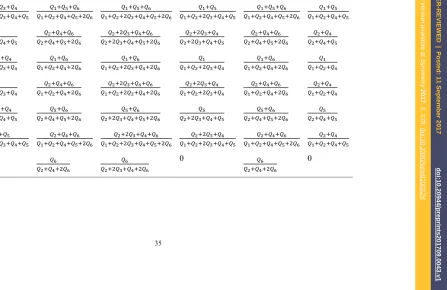
In Table 3, we display the values of 1′( , ) and 2′( , ) for each test case. An
examination of the table reveals that
1 ( , ) = 1 ( , ) = 1 ( , ) = 1 ( , ) = 1 −
( )
( )( ) ( )
1 ( , ) = 1 ( , ) = 1 ( , ) = 1 ( , ) =
( )
( ) ( )( ) ( ) .
If = , we have
1 ( , ) = 1 − −
( − + − )=
−
( − + − )
1 ( , ) = −
( − + − )
so
1 ( , ) = 1 ( , )
1 ( , ) + 1 ( , ) =( ( ) ).
It follows that
1 ( , ) + 1 ( , ) = 0 for = and = .
1 ( , ) + 1 ( , ) = 1 for = and − = − .
5. Comparative Studies
If the fuzzy number A is less than the fuzzy number B, then the Hamming distance
between A and ( , ) is large. Two representations are adopted. One is
d( , ( , )) . The other is , , + , , which
decompose A into and . To analysis the effect of decomposition, we consider the
following preference relations without decomposition
1′( , ) = ( , max( , )) + ( ∩ , 0) ( , 0) + ( , 0)
and
2′( , ) = ( , max( , )) ( , )
which are the counterparts of the Kołodziejczyk’s preference relations 1′( , ) and
2′( , ). Therefore the preference relations 1′( , ) and 2′( , ) consider the
decomposition of fuzzy numbers, while 1′( , ) and 2′( , ) do not. The
preference relations 1′( , ) and 1′( , ) consider the intersection of two
membership functions, while 2′( , ) and 2′( , ) do not. For completeness,
Table 4 displays the values of ( , ), ′( , ), 1′( , ), 2′( , ), 1′( , )
and 2′( , ) of each test case in terms of the values of . The 1′( , ) considers
the decomposition and interection of two fuzzy numbers, while 2′( , ) do not. From
1′( , ) → 2′( , ) → 2′( , )
and
1′( , ) → 1′( , ) → 2′( , ).
The first feature of Table 4 is that the differences between 1′( , ) and 1′( , )
and between 2′( , ) and 2′( , ) are . More precisely, the numerator and
denominator of both 1′( , ) and 2′( , ) include 2 for cases 1, 3, 5 and 7,
the denominator of both 1′( , ) and 2′( , ) include 2 for cases 2, 4, 6 and
8. Therefore, 2 represents the effect of the decomposition of fuzzy numbers. The
differences between 1′( , ) and 2′( , ) and between 1′( , ) and 2′( , )
are . More precisely, the numerator and denominator of both 1′( , ) and
1′( , ) include and 2 , respectively. Therefore, represents the effect of
the intersection of membership fuctions. After some computations, the characteristics of
1′( , ), 2′( , ), 1′( , ) and 2′( , ) are described as follows.
Theorem 1. Let 2′( , ) = .
(1)If ≤ , β ≤ 2 + or ≥ , β + 2 ≤ , then 1′( , ) ≤ 2′( , ).
If ≤ , β ≥ 2 + or ≥ , β + 2 ≥ , then 1′( , ) ≥
2′( , ).
If ≥ , then 2′( , ) ≤ 2′( , ).
(3)If α ≥ β, then 1′( , ) ≤ 2′( , ).
If α ≤ β, then 1′( , ) ≥ 2′( , ).
(4)If ≤ , then 1′( , ) ≥ 1′( , ).
If ≥ , then 1′( , ) ≤ 1′( , ).
(5)If ≤ , β(2 + ) ≤ or ≥ , β ≤ ( + 2 ), then
1′( , ) ≤ 2′( , ).
If ≤ , β(2 + ) ≥ or ≥ , β ≥ ( + 2 ), then
1′( , ) ≥ 2′( , ).
For each test case of two triangular fuzzy numbers ( , , ) and ( , , ),
we analyze the behaviors of 1′( , ), 2′( , ), 1′( , ) and 2′( , ) by
applying Theorem 1 as follows. For ≤ , we have
1′( , ) ≤ 1′( , ) ≤ 2′( , ) = 2′( , ) = 1
for case 1. For cases 3, 5 and 7, we have
(1)if + 2 + ≥ + 2 + , then 1′( , ) ≤ 2′( , )
if + 2 + ≤ + 2 + , then 1′( , ) ≥ 2′( , )
(2) 2′( , ) ≥ 2′( , ).
(3)From α − β = ( )( ( ) () )( ), it follows that
if + + ≥ + + , then 1′( , ) ≤ 2′( , ).
if + + ≤ + + , then 1′( , ) ≥ 2′( , ).
(4) 1′( , ) ≥ 1′( , ).
(5)If + 2 + ≥ + 2 + , then 1′( , ) ≥ 2′( , ).
If + 2 + ≤ + 2 + , then 1′( , ) ≤ 2′( , ).
Therefore, for the cases 3, 5 and 7, if + 2 + ≤ + 2 + , then
1′( , ) ≥ 2′( , ) ≥ 2′( , )
and
1′( , ) ≥ 1′( , ) ≥ 2′( , ).
For ≥ , we have
2′( , ) = 2′( , ) = 0 ≤ 1′( , ) ≤ 1′( , )
for case 8. For cases 2, 4 and 6, we have
(1)if + 2 + ≥ + 2 + , then 1′( , ) ≤ 2′( , )
if + 2 + ≤ + 2 + , then 1′( , ) ≥ 2′( , ),
(2) 2′( , ) ≤ 2′( , ).
(3)From α − β = (− + − 2 + 2 − + + ( ) ) , it follows that
if + 2 + ≥ + 2 + , then 1′( , ) ≤ 2′( , )
if + 2 + ≤ + 2 + , then 1′( , ) ≥ 2′( , ).
(4) 1′( , ) ≤ 1′( , ).
(5)If + 2 + ≥ + 2 + , then 1′( , ) ≤ 2′( , ).
If + 2 + ≤ + 2 + , then 1′( , ) ≥ 2′( , ).
Therefore, for the cases 2, 4 and 6, if + 2 + ≥ + 2 + , then
1′( , ) ≤ 2′( , ) ≤ 2′( , )
and
1′( , ) ≤ 1′( , ) ≤ 2′( , ).
For the two triangular fuzzy numbers ( , , ) and ( , , ), the second
comparative study is the five case studies shown in Figure 2 to compare the fuzzy
preference relations 1′( , ), 2′( , ), 1′( , ) and 2′( , ).
(Insert Figure 2 about here.)
Case (a) ( , , ) and ( , , ) with ≥ .
1′( , ) =( + ) + ( + ) + 0
( + ) + ( + ) + 0= 1
2 ( , ) =( + ) + ( + )
( + ) + ( + ) = 1
1′( , ) =0 + (( + )
+ ) = 1
2′( , ) =(( ))= 1.
For this simple case, all the preference relations give the same degree of preference of B
over A.
Case (b) ( − , , + ) and ( − , , + ).
We have
1′( , ) = + 0 +
+ + 2 = 1/2
2 ( , ) = + 0
+ = 1/2
1′( , ) =( ) = 1/2.
2′( , ) =
+ = 1/2
From the viewpoint of probability, fuzzy numbers A and B have the same mean, but
fuzzy number B with smaller standard deviation. The results indicate that the
differences of the decomposition and intersection of A and B cannot affect the degree of
preference of B over A.
Case (c) ( , + , + 2 ) and ( + α, + + α + β, + α + 2 + 2β).
For this case, the fuzzy number B is right shift of the fuzzy number A. Therefore, B
1′( , ) =(( ) () ( )) = ( ( ) ) > 1/2
2 ( , ) = (( ) () ( ))= 1
1′( , ) =( () ( ) )= 1 −(( ))
2′( , ) = = 1.
All the methods prefer B, but 1′( , ) is indecisive. More precisely,
If 2 + < , then 1′( , ) < 1/2, so >
If 2 + = , then 1′( , ) = 1/2, so =
If 2 + > , then 1′( , ) > 1/2, so < .
Hence, a conflicting ranking order of 1′( , ) exists in this case.
Case (d) ( , , + ) and ( , + , + ) with ≥ .
This case is more complex for the partial overlap of A and B. The membership
function of B has the right peak, B expands to the left of A for the left membership
function, and A expands to the right of B for the right membership function. We have
1′( , ) =( ( ) () ( ) ) = 0.5 + ( )
2 ( , ) =( ( ) () ( ) )= ( )
1′( , ) =( () ( ) )= ( )( )
2′( , ) = = ( ) .
If −2 + + 2 < 0, then 1′( , ) < 1/2 and 2 ( , ) < 1/2, so > .
If −2 + + 2 = 0, then 1′( , ) = 1/2 and 2 ( , ) = 1/2, so = .
If −2 + + 2 > 0, then 1′( , ) > 1/2 and 2 ( , ) > 1/2, so < .
If < (1 + √2)( − ), then 1′( , ) < 1/2 and 2′( , ) < 1/2, so > .
If = (1 + √2)( − ), then 1′( , ) = 1/2 and 2′( , ) = 1/2, so = .
If > (1 + √2)( − ), then 1′( , ) > 1/2 and 2′( , ) > 1/2, so < .
Three special subcases are considered as follows.
(1)Subcase (d1) If = (1 + √2)( − ), then ( , , 2 + √2 − (1 + √2) ) and
( , 1 + √2 − √2 , (1 + √2) − √2 ) , therefore 1′( , ) = 2′( , ) =
0.5, so = . However, 1′( , ) = √ , 2 ( , ) = 2/3 and < .
(2)Subcase (d2) If = 2( − ), then ( , , 3 − 2 ) and ( , 2 − , 2 − ),
therefore 1′( , ) = 7/16, 2′( , ) = 1/3, so > . However, 1′( , ) =
2 ( , ) = 0.5 and = .
(3)Subcase (d3) If (0.3,0.3,0.9) and (0.1,0.7, 0.7), then 1′( , ) = 0.5556,
2 ( , ) = 0.6667, 1′( , ) = 0.5556, 2′( , ) = 0.6667, so < .
Therefore, if < 2( − ), then 1′( , ) < 1/2, 2 ( , ) < 1/2, 1′( , ) <
2 ( , ) > 1/2, 1′( , ) > 1/2 and 2′( , ) > 1/2, so < .
Case (e) ( + , b, 1 − + ) and ( , 0.5, 1 − ).
For this case, the fuzzy number B is symmetric with respect to = 0.5. The fuzzy
number A is parallel translation of the fuzzy number B except its peak. We have the
following results.
(1) 1′( , ) =( ( ) () ( ) ) = . If
(1-2a-2b)(3+2a-2b-4c)< 0, then 1 ( , ) < 1/2, so > . For simplicity, the
other two conditions are omitted.
(2) 2 ( , ) =( ( ) () ( ) )= ( ( ) ) . If 2 + 2 − 1 > 0 , then
2 ( , ) < 1/2, so > .
(3) 1′( , ) =( () ( ) ) = 2(1-b-c)(1-2c
)-2(1+2a-2b)(3+2a-2b-4c)(1-2c) and 2′( , ) =
= ( () ( ) () )( ) . If > −0.5 + +
(1 − 2 )(3 − 4 − 2 ), then 1′( , ) < 1/2 and 2′( , ) < 1/2, so >
.
Four special cases are considered as follows.
(1) Subcase (e1) If = −0.5 + + (1 − 2 )(3 − 4 − 2 ), then 1′( , ) =
2′( , ) = 0.5, so = . However, 1′( , ) > 0.5, 2 ( , ) > 0.5 and
(2) Subcase (e2) If 2 + 2 − 1 = 0, then 1′( , ) = 0.5 − ( ( )() )< 0.5,
2′( , ) =( ( ) )< 0.5, so > . However, 1′( , ) = 2 ( , ) = 0.5
and = .
(3)Subcase (e3) If A(0.3,0.4,0.9) and B(0.2,0.5, 0.8), then 1′( , ) = 0.4896,
2 ( , ) = 0.4286, 1′( , ) = 0.4896, 2′( , ) = 0.4286, so > .
(4)Subcase (e4) If ≥ 0.5, then (1-2a-2b)(3+2a-2b-4c)< 0, 2 + 2 − 1 > 0 and
> −0.5 + + (1 − 2 )(3 − 4 − 2 ), so 1 ( , ) < 1/2, 2 ( , ) <
1/2, 1′( , ) < 1/2 and 2′( , ) < 1/2, hence > .
6. Conclusion
This paper analyzes and compares two types of Nakamura’s fuzzy preference
relations ( ( , ) and ′( , )), two types of Kołodziejczyk’s fuzzy preference
relations ( 1′( , ) and 2′( , )) and the counterparts of the Kołodziejczyk’s
fuzzy preference relations ( 1′( , ) and 2′( , )) on a group of selected eight cases
with different level of overlapping between two triangular fuzzy numbers ( , , )
and ( , , ). For ( , ) and ′( , ), ( , ) + ( , ) = 1, =
1,2,3,4. If + 2 + ≥ − 2 − , we have that 1 − ( , ) ≥ ( , ) for
= 4,6,8. Furthermore, 1 ( , ) + 1 ( , ) = 0 for = and = and
1 ( , ) + 1 ( , ) = 1 for = and − = − . For test case 1,
1′( , ) ≤ 1′( , ) ≤ 2′( , ) = 2′( , ) = 1. For the test cases 3, 5 and 7, if
+ 2 + ≤ + 2 + , then 1′( , ) ≥ 2′( , ) ≥ 2′( , ) and
1′( , ) ≥ 1′( , ) ≥ 2′( , ). For test case 8, we have 2′( , ) = 2′( , ) =
0 ≤ 1′( , ) ≤ 1′( , ). For test cases 2, 4 and 6, if + 2 + ≥ + 2 +
, then 1′( , ) ≤ 2′( , ) ≤ 2′( , ) and 1′( , ) ≤ 1′( , ) ≤ 2′( , ).
References
1. Chen, S.J.; Hwang, C.L., Fuzzy Multiple Attribute Decision Making, Springer,
Berlin, 1992.
2. Wang, X.; Kerre, E.E. Reasonable properties for the ordering of fuzzy quantities
(I). Fuzzy Sets Syst.2001, 118, 375-385.
3. Wang, X.; Kerre, E.E. Reasonable properties for the ordering of fuzzy quantities
(II). Fuzzy Sets Syst.2001, 118, 387-405.
4. Nakamura, K. Preference relations on a set of fuzzy utilities as a basis for decision
making. Fuzzy Sets Syst.1986, 20, 147-162.
5 Kolodziejczyk W. Orlovsky's concept of decision-making with fuzzy preference
relation- further results. Fuzzy Sets Syst.1990, 19, 197-212.
6. Yuan, Y. Criteria for evaluating fuzzy ranking methods. Fuzzy Sets Syst. 1991, 44,
139-157.
7. Li, R.J. Fuzzy method in group decision making. Comput. Math. Appl. 1999, 38,
91–101.
8. Lee, H.S. On fuzzy preference relation in group decision making. Int. J. Comput.
Math. 2005, 82, 133–140.
9. Asady, B. The revised method of ranking LR fuzzy number based on deviation
degree. Expert Syst. Appl. 2010, 37, 5056–5060.
10. Wang, Z.X.; Liu, Y.J.; Fan, Z.P.; Feng, B. Ranking LR fuzzy number based on
deviation degree. Inf. Sci. 2009, 179, 2070–2077.
11. Zhang, F.; Ignatius, J.; Lim, C.P.; Zhao, Y. A new method for ranking fuzzy
numbers and its application to group decision making. Appl. Math. Model. 2014,
38, 1563–1582.
12. Zhu, B.; Xu, Z.; Xu, J. Deriving a ranking from hesitant fuzzy preference relations
under group decision making. IEEE Tran. Cyber. 2014, 44, 1328-1337.
13. Wang, Y.J. Ranking triangle and trapezoidal fuzzy numbers based on the relative
14. Liu X.; Wang Z.; Zhang S. A modification on the hesitant fuzzy set
lexicographical ranking method. Symmetry 2016, 8, doi:10.3390/sym8120153.
15. Farhadinia, B. Hesitant fuzzy set lexicographical ordering and its application to
Case 1. ≤ , ≤ , ≤ .
Case 2. ≤ , ≥ , ≤ .
Case 3. ≤ , ≤ , ≥ .
Case 4. ≤ , ≥ , ≥ .
Case 6. ≥ , ≥ , ≤ .
Case 7. ≥ , ≤ , ≥ .
Case 8. ≥ , ≥ , ≥ .
Case (a) ( , , ) and ( , , ) with ≥
Case (b) ( − , , + ) and ( − , , + ).
Case (c) ( , + , + 2 ) and ( + α, + + α + β, + α + 2 + 2β).
Case (e) ( + , b, 1 − + ) and ( , 0.5, 1 − ).
Table 1. The area of i-th region for eight cases.
case area 1
= ( )/( )−( − − ( − + − ) )
= − + ( − − + ) −
= − − ( − − + ) −
= ( )/( )( − − ( − + − )
2
= ( )/( ) − + ( − − + )
= ( )/( ) − − ( − − + )
= ( )/( )−( − − ( − + − ) )
= ( )/( ) − + ( − − + ) −
= ( )/( ) − − ( − − + ) −
= ( )/( )( − − ( − + − ) ) − −
3
= ( )/( ) − − ( − − + )
= ( )/( )−( − − ( − + − ) )
= − + ( − − + ) −
= ( )/( ) − − ( − − + ) −
= ( )/( )( − − ( − + − ) −
4
= ( )/( )−( − − ( − + − ) )
= ( )/( ) − + ( − − + ) −
= − − ( − − + ) −
= ( )/( )( − − ( − + − ) ) −
5
= ( )/( ) − + ( − − + )
= ( )/( )−( − − ( − + − ) )
= ( )/( ) − + ( − − + ) −
= − − ( − − + ) −
= ( )/( )( − − ( − + − ) −
6
= ( )/( ) − − ( − − + )
= ( )/( )−( − − ( − + − ) )
= − + ( − − + ) −
= ( )/( ) − − ( − − + ) −
= ( )/( )( − − ( − + − ) ) −
7
= ( )/( ) − + ( − − + )
= ( )/( ) − − ( − − + )
= ( )/( )−( − − ( − + − ) )
= ( )/( ) − − ( − − + ) −
= ( )/( )( − − ( − + − ) − −
8
= ( )/( )−( − − ( − + − ) )
= − + ( − − + ) −
= − − ( − − + ) −
Table 2. ( , ) and ′( , ) for eight cases.
case ( , ) ′( , )
1 0
1 +( ( )( ) )
2 ( ) ( ( ) ( ))
(( ) ( ) )( ) (( ) ( ) )( )
( )
( )( )
3 ( )
( )( ) ( ) ( ) 1 +
( )
( )( )
4
1 −( )( ( ) ) ( ) ( ) ( ( )( ) )
5 ( )
( )( ) ( ) ( ) 1 +
( )
( )( )
6
1 −( )( ( ) ) ( ) ( ) ( ( )( ) )
7
1 −(( ) ( ) )(( ) ( ) (( ) ( ) ) )( ) 1 +( ( )( ) )
8 1 ( )
( )( )
doi:10.20944/preprints201709.0043.v1
Peer-reviewed version available at
Table 3. 1′( , ) and 2′( , ) for eight cases.
case 1′( , ) 2′( , )
1
1 −( )(( ) ) ( ) 1
2 ( )
( ) ( )( ) ( ) 1 −
( ) ( ( ) ( ))
(( ) ( ) )( ) (( ) ( ) )( )
3
1 −( )(( ) ) ( ) 1 −( )( ( ) ) ( ) ( )
4 ( )
( ) ( )( ) ( )
( )
( )( ) ( ) ( )
5
1 −( )(( ) ) ( ) 1 −( )( ( ) ) ( ) ( )
6 ( )
( ) ( )( ) ( )
( )
( )( ) ( ) ( )
7
1 −( )(( ) ) ( ) (( ) ( ) )(( ) ( ) (( ) ( ) ) )( )
8 ( )
( ) ( )( ) ( )
0
doi:10.20944/preprints201709.0043.v1
Peer-reviewed version available at
Table 4. ( , ), ′( , ), 1′( , ), 2′( , ), 1′( , ) and 2′( , ) for eight cases.
case ( , ) ′( , ) 1′( , ) 2′( , ) 1′( , ) 2′( , )
1 0
1 1
2
3
4
5
6
7
8 1
0 0
doi:10.20944/preprints201709.0043.v1
Peer-reviewed version available at
Symmetry
2017
,
9
, 228;