R E S E A R C H
Open Access
Concept networks of students’
knowledge of relationships between physics
concepts: finding key concepts and their
epistemic support
Ismo T. Koponen
*and Maija Nousiainen
*Correspondence: [email protected] Department of Physics, University of Helsinki, Gustaf Hallstromin katu 2, P.O. Box 64, FI-00014 Helsinki, Finland
Abstract
Concept maps, which are network-like visualisations of the inter-linkages between concepts, are used in teaching and learning as representations of students’ understanding of conceptual knowledge and its relational structure. In science education, research on the uses of concept maps has focused much attention on finding methods to identify key concepts that are of the most importance either in supporting or being supported by other concepts in the network. Here we propose a method based on network analysis to examine students’ representations of the relational structure of physics concepts in the form of concept maps. We suggest how the key concepts and their epistemic support can be identified through focusing on the pathways along which the information is passed from one node to another. Towards this end, concept maps are analysed as directed and weighted networks, where nodes are concepts and links represent different types of connections between concepts, and where each link is assumed to provide epistemic support to the node it is connected to. The notion of key concept can then be operationalised through the directed flow of information from one node to another in terms of communicability between the nodes, separately for out-going and in-coming weighted links. Here we analyse a collated concept network based on a sample of 12 original concept maps constructed by university students. We show that communicability is a simple and reliable way to identify the key concepts and examine their epistemic justification within the collated network. The communicabilities of the key nodes in the collated network are compared with communicabilities averaged over the set of 12 individual concept maps. The comparison shows the collated network contains an extensive set of key concepts with good epistemic support. Every individual networks contain a sub-set of these key concepts but with a limited overlap of the sub-sets with other individual networks. The epistemically well substantiated knowledge is thus sparsely distributed over the 12 individual networks.
Keywords: Concept maps, Learning science, Directed networks, Communicability
Introduction
Learning scientific knowledge requires learning its key concepts and their lexicon: how these concepts are related, how they can be used with other concepts and how they are connected as part of a system of other concepts. Scientific knowledge thus forms a sys-tem of networked concepts, where interconnections between the concepts also have an essential role in establishing their meaning (Rescher1979; Kuhn2000; Hoyningen-Huene
2013). An obvious approach to analysing scientific knowledge is to focus on terms that stand for the concepts, and on how relationships between the terms emerge on differ-ent contexts. These relationships form a networked lexicon of terms and names, where the connections between them derive from contextualised instances of how the terms are used and how situations are named (Kuhn2000). In what follows, we refer to such lexical networks of knowledge simply as concept networks.
The assumption that concept’s meaning is related to the lexical system of terms is sup-ported by recent advances in understanding how the meaning of ordinary concepts builds up through interlinked connections (Stella et al.2017; Vitevich and Castro2015). Inter-estingly, according to these studies difficulties and deficiencies in learning the meaning of words are directly reflected in the relational structure of the lexical networks, espe-cially in the local and global connectivity of words in the network. The results of these studies show the importance of the relational connections between words in learning their meaning and how certain key words play a special role in learning the lexicons (Stella et al.2017; Vitevich and Castro2015).
The structure of the knowledge system affects how concepts are introduced in teaching scientific knowledge and how they are acquired in formal teaching and learning. In learn-ing and teachlearn-ing, too, conceptual knowledge is often approached from the viewpoint of semantic networks, because all retrieval and inference is based on traversing such net-works (Chi and Ohlsson2005). From the viewpoint of semantic networks, the concepts (or terms corresponding to them) that tend to form clusters of close connections are of particular interest because concepts within clusters share more similarities than concepts between clusters (Chi and Ohlsson2005). In the case of lexicons of ordinary words and terms, such closeness of concepts has been successfully operationalised and measured by the closeness centrality, which is found to be indicative of key concepts (Stella et al.2017; Vitevich and Castro2015). This, however, may not be the case in regard to abstract, rela-tional concepts, where long contiguous (i.e. uninterrupted directed) paths relate concepts in different clusters to each other, and when experts’ knowledge focuses on these contiguous, complex paths instead of simpler locally cohesive connections (Lachner and Nückles2015). As well, studies on how students represent their understanding of the relatedness of physics concepts suggest that the most important concepts are the ones connected to other concepts through many contiguous paths (Koponen and Nousiainen2013; 2018; Nousiainen2013; Nousiainen and Koponen2017). Such concepts arethe key conceptsin the students’ conceptual network and finding them in reliable way is an important and yet unresolved problem in research that attempts to understand how scientific knowledge is learned.
knowledge, which is explicated knowledge, written down or expressed in symbolical form, e.g. as formulas (Chi and Ohlsson 2005). In this form, concept maps reflect students’ conceptual understanding and are thus also used as tools of assessment and evaluation in learning (Ruiz-Primo and Shavelson1996; Nicoll et al.2001; Liu2004). Consequently, many quantitative and qualitative techniques for the analysis of concept maps have been proposed and tested.
The quantitative methods of concept map analysis are often based on counting the hierarchical levels and the number of cross-links within a given hierarchical level. Quanti-tative analysis thus focuses on how concepts are interconnected within the semantic fields provided by the local connections (Ruiz-Primo and Shavelson1996; Nicoll et al.2001; Liu
2004; McClure et al.1999; vanZele et al.2004), but it fails to pay proper attention to the global structure and connectedness of concept maps. The qualitative methods of concept map evaluation attempt to correct and improve this deficiency of quantitative methods by paying attention to the global, overall visual appearance of concept maps (Kinchin et al.2000,2005; Liu2004; Safayeni et al.2005; Derbentseva et al.2007). Such qualitative methods for analysing concept maps have revealed that visually discernible complexity in the form of spoke-, tree- or web-like features provides valuable information about the quality of knowledge represented in the concept maps (Kinchin et al.2000,2005). How-ever, the validity and reliability of the qualitative methods are difficult to assess, because the criteria of being “complex” or “web-like” is based on visual inspection only. One should also be cautious in accepting the claim that the overall look of concept maps, i.e. likeness to spokes, trees or webs, has any true bearing on how individual conceptual ele-ments are supported within the structure. The problems with qualitative analysis are thus the reverse of the ones with quantitative analysis: while the quantitative approach fails to capture the global structure, the qualitative approach fails to discern the effect of the structure on individual nodes.
Recent studies on students’ knowledge of physics concepts, investigated by using con-cept maps, networks and related techniques, have revealed that students’ declarative knowledge is structured on a global scale, and is web-like (Koponen and Nousiainen2013,
2014; Nousiainen 2013) but not hierarchically organised in so simple ways as often assumed (Ruiz-Primo and Shavelson1996; Nicoll et al.2001; McClure et al.1999; vanZele et al. 2004). The web-like concept networks drawn by students are tightly connected locally, having highly clustering cliques but at the same time being globally well connected through long paths that connect several concepts. The property of clustering, however, is not indicative of the key concepts but instead appears to be related to how students use auxiliary concepts. The key concepts, on the other hand, are characterised by long and contiguous paths to many other concepts in the network; the key concepts communicate with many other concepts in the network (Koponen and Nousiainen2013,2014,2018; Nousiainen2013, Nousiainen and Koponen2017).
are globally important in the concept networks. In addition to global connectivity, we are also interested in how the given concept is connected through directed contiguous connections to other concepts in the network. Such contiguous directed connections are associated with the flow of information from one node to another, which is needed to substantiate the meaning of the concept with the network. Furthermore, the connections are weighted, where weights are associated with the epistemic strength of the information flow. These properties of interest are conveniently operationalised in terms of communi-cability (Estrada and Hatano2008; Estrada et al.2012; Estrada2012; Benzi and Klymko
2013). Communicability allows us to study the in-coming and out-going weighted paths of the node separately, and how they contribute to the epistemic substantiation of the given node (concept) itself or provide substantiation to other nodes.
We examine 12 different concept maps constructed by individual students, where they represent their views of the relationships between concepts in electricity and mag-netism. First, we discuss how these maps are constructed by students. Based on the 12 individual we construct a collated concept network where all acceptable elements (121 altogether) and the best substantiated connections (787 altogether) found in the 12 original maps are aggregated. The collated network thus contains the best avail-able knowledge within the group of 12 students. Here, the target of analysis is this collated network. Second, we focus on the global roles of the nodes in the collated network and introduce a method based on communicability of nodes to find the key concepts that are structurally the most important. The content is discussed to the extent to determine if such concepts are also relevant from the point of view of con-tent. Further details of the content and content analysis have been presented elsewhere (Koponen and Nousiainen 2013; Nousiainen 2013; Nousiainen and Koponen 2017). Here, we extend our previous study (Koponen and Nousiainen2018) and provide more details of the analysis method and also explore to what extent the local connectivity of nodes determines the communicability. This is done by using an appropriate null-model, where in- and out degrees and epistemic weight distribution are preserved but links are shuffled. Third, we now compare the collated network to individual maps constructed by the students. The comparison is based on the similarity of the key concept sets and how the sets are shared. This comparison shows how much of the knowledge harboured within the group of 12 students is actually shared. The comparison provides information about how much the unshared knowledge provides the potential to improve the learning if it could be made available to group members.
Methods
The empirical sample studied here consists of 12 concept maps constructed by university students, where the students present their understanding and views of how physics con-cepts, in electricity and magnetism, are related. The sample of 12 concept maps contains
ensemble of 12 networks, each of which is a substructure of the collated network, is analysed similarly and the communicabilities of all their nodes averaged over the set of 12 networks is compared with the communicabilities of nodes in the collated network.
Empirical sample: Concept maps
The empirical sample was produced during a course of seven weeks’ duration that focused on questions concerning the conceptual structure of electricity, magnetism and elec-tromagnetism, in level of first year studies in physics. During the teaching sequence, the students first produced an initial concept network, and later, after instruction and group discussions, a final version of the network. Here, only the final versions are con-sidered because the final stage of the students’ understanding of the relational structure of concepts is of interest. In constructing the concept maps, students were asked to con-centrate on their discussions and reflections on the central concepts, laws, models and experiments they thought important in forming a well-organised and coherent picture of the topic. The construction of the concept maps was based on special kinds of concept nodes representing conceptual knowledge. The concept nodes in these networks repre-sent: quantities, laws, models or experiments. Students were asked to pay attention on these types of knowledge and if appropriate, mention the type in the written report. Of these concept nodes, laws are either experimental laws or law-like predictions in spe-cific situations (derived from a theory), or general laws (e.g. conservation laws) (Koponen and Nousiainen2013; Nousiainen2013). Students were free to introduce any concepts or conceptual elements they found necessary and were able to substantiate. However, a preliminary list of about 40 concepts was provided as a prompting, but students were asked to expand it and discard any item in the list they found not useful. The links in the network are different procedural relations between nodes (concepts), such as the fol-lowing: the quantity can be changed, measured or kept constant (in experiments), or that its value is predicted or used as a parameter (e.g. models). The experiments that are central in the construction of the concept networks discussed here are the tradi-tional teaching laboratory experiments, which are quantitative, and where a concept is operationalised, that is, made measurable through pre-existing concepts. The models involved in the construction of the concept networks are traditional textbook models used to introduce new concepts and laws. In constructing the maps, students had to give in a written report epistemic justification for the relationships between concepts, laws, models and experiments they represented in their concept maps. The concept networks and written reports thus contain only such concepts and relational connections that the students could substantiate (or justify) when they integrated new concepts as part of the networks.
Fig. 1An example of an individual concept map. A concept map constructed by one student, shown (redrawn for clarity) to illustrate the overall appearance of the maps. The content of the links is not essential here
Method of qualitative epistemic analysis
The analysis of the concept network is based on the qualitative method first to analyse the epistemic quality of the content, and on the subsequent quantitative method to anal-yse how that knowledge is used in the network at a global scale and how it is passed from one node to another. Qualitative analysis is used in assessing the degree of epis-temic justification for the knowledge expressed in each single node contained in the maps and written reports. The qualitative analysis, based on discerning different epistemic levels, is explained in detail elsewhere (Nousiainen2013), and only a short summary is given here. Quantitative analysis operationalises the epistemic support of each node as it receives support or is supporting other nodes in the network. In that the communicability (Estrada and Hatano2008; Estrada et al.2012; Estrada2012) of the nodes is central as a measure of information flow. Consequently, the communicability of nodes is used to
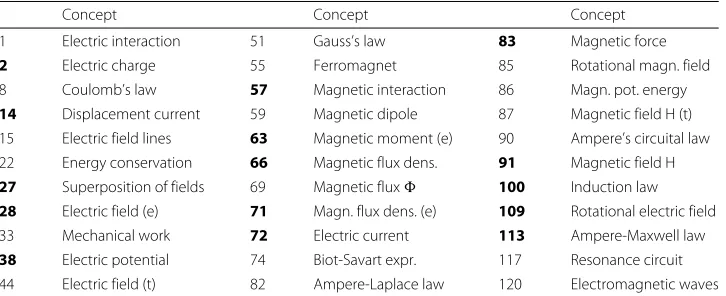
Table 1 Key concepts appearing in students’ concept maps
Concept Concept Concept
1 Electric interaction 51 Gauss’s law 83 Magnetic force
2 Electric charge 55 Ferromagnet 85 Rotational magn. field 8 Coulomb’s law 57 Magnetic interaction 86 Magn. pot. energy
14 Displacement current 59 Magnetic dipole 87 Magnetic field H (t) 15 Electric field lines 63 Magnetic moment (e) 90 Ampere’s circuital law 22 Energy conservation 66 Magnetic flux dens. 91 Magnetic field H
27 Superposition of fields 69 Magnetic flux 100 Induction law
28 Electric field (e) 71 Magn. flux dens. (e) 109 Rotational electric field 33 Mechanical work 72 Electric current 113 Ampere-Maxwell law
38 Electric potential 74 Biot-Savart expr. 117 Resonance circuit 44 Electric field (t) 82 Ampere-Laplace law 120 Electromagnetic waves
identify the key concepts and to find out how they are affected by the epistemic support deriving from their connection to other nodes.
The epistemic criteria of the validity of knowledge is related to the substantiation (or justification) of knowledge. Proper substantiation of knowledge can be associated with a contiguous chain of arguments which are rational and supported by evidence (Rescher
1979; Hoyningen-Huene2013). The evaluation of the epistemic quality of such argumen-tation is based here on an epistemic taxonomy consisting of four levels (Nousiainen2013): 1) Ontology, which uses ontologically correct entities and terms referring to them; 2) Factual statements such as laws, principles and relations, which are correct and have no inherent contradictions; 3) Methodological strategies, which contain possible and correct procedures of setting up experiments and developing models; 4) Justification of knowl-edge claims, which is systematic, coherent and logically sound. These four epistemic criteria are tiered. Each knowledge element (node) is scored so that the scoringSfrom 1 to 4 gives the highest tier on which the epistemic norms are fulfilled. On this basis, each node is assigned an epistemic strengths = S/SmaxwithSmax = 4 and wheres ∈[ 0, 1]. Epistemically strong nodes have strengths 0.75 < s < 1, while weak nodes have values 0.0<s<0.25. The links are simply taken as they are drawn, and their content is ignored here. This is due to the fact that the linking words are not as informative as the node content.
Method of quantitative structural analysis
Following the interpretative analysis of the knowledge content, the strengthssof nodes contain the relevant information of the quality of the content of every single node. Only this information is used here to identify the key concepts. In what follows, the strength of nodeiis denoted bysi, whileaijis the link from nodeito nodejhaving a value 1 if the link exists and a value 0 if not. The set of valuesaijprovides the NxN adjacency matrixaof the network. Because we are interested in how the information is passed from one node to another, we transform the directed node-weighted network to a directed link-weighted network. The weightswijof the directed links in the new weighted network are defined as (Koponen and Nousiainen2018)
wij=βsβi aij/wmax (1)
wherewmax=Max
βsβi
is the maximal weight. All weights are thus normalised and
wij∈[ 0, 1]. This definition of weights is motivated by the notion that the directed linkswij pass supporting information from nodeito nodejin proportion to the epistemic strength of the node it originates from. The factorβallows enhanced weighting of strong links so that forβ 1 only strong links withwij≈1 survive while forβ1 all links are weighted equally. The weighted network is now described through the weighted adjacency matrix
Wwith elements [W]ij=wijand allows us to perform the analysis as a weighted, directed network (Koponen and Nousiainen2018). The collated network, which is in focus here, consists of the best substantiated connections with the highest values onwijas resulting from the connections in 12 individual networks. The collated network contains thus 121 nodes and 787 directed, weighted links.
flow of information through all contiguous paths. An obvious candidate of all centrality measures, then, is the communicability (Estrada and Hatano2008; Estrada et al.2012; Estrada2012). As its name suggests, the communicability is closely connected to the idea of communicating between the connected nodes. As such, it is in many ways similar to Katz -centrality (Estrada2012; da Costa et al.2007). Although the analysis and its results would be very similar using Katz -centrality, here we prefer the communicability because of its convenient mathematical properties and easy interpretation (Estrada et al.2012; Estrada2012; Benzi and Klymko2013).
When the networks are described using the weighted adjacency matrixW, it becomes possible to operationalise the notion of key nodes in passing the epistemic support from one node to another in terms of the communicability, which pays attention to the walks between nodes. The communicability between nodes is based on counting a weighted sum
Gpqof walks between nodespandq, where the weight is given by an inverse of a factorial of the length of the walk (Estrada and Hatano2008; Estrada et al.2012; Estrada2012)
Gpq=1+
W1pq
1! +
W2pq
2! +
W3pq
3! +...=
eW
pq (2)
The communicabilities of a nodevrelated to out-going (OUT) and in-coming links (IN) are then defined as the total out-communicability and in-communicability, respectively, as
GOUT(v)=
p=v
Gvp, GIN(v)=
p=v
Gpv (3)
The in- and out- communicabilities are simple and robust measures closely related to the passing of information from node to node in the network. The parameterβ allows us to explore the effect of epistemic weighting on the communicabilities of the nodes and thus to assess the degree of epistemic substantiation of the knowledge in the concept networks. By increasingβ, the epistemically strongest links are retained while those with low strength are effectively removed from the networks. At the other limit, whereβ 1 all links receive an equal weight. Because we are studying only the relative importance of concepts, and because link weights remain normalised to the maximum value 1, limit β 1 corresponds to a situation where all links are completely justified, i.e., maximal epistemic justification. For comparison we also calculate the in- and out-strengthsDIN
andDOUTof nodes, respectively, defined as (Estrada2012; da Costa et al.2007)
DOUT(v)=
p=v
wvp, DIN(v)=
p=v
wpv (4)
The in- and out strengths coincides with in- and out degrees of node whenβ1.
Null-model and statistical significance
with original collated networks. All rewirings are performed with IGraph software (Csardi and Nepusz2006). For the ensemble of rewired networks, we calculate average values Oand standard deviationsσO of variablesO ∈ {DIN,DOUT,GIN,GOUT}. The
statisti-cal significance of the valuesOis then assessed by calculating the so-called Z-scores (i.e. standardised value) of variableOdefined as (Estrada2012; Kolaczyk2009)
Z= O− O σO
(5)
whereOis the observable value in the empirical sample. The reliability and statistical sig-nificance requires that absolute values|Z|of Z-scores are high enough, usually the value |Z| =2 taken as a limiting case. Assuming that the variables are normally distributed, Z-scores|Z| =2 and|Z| =3.0 correspondp-values 0.02 and 0.001, respectively. Here, we have chosen to use|Z| = 2 as a cut-off for statistically significant deviations deserving special attention.
Similarity
The similarity comparisons of networks requires that the type of similarity in question is defined. Here we are not interested in local structural similarity, because local struc-ture itself is not enough in deciding which concepts are the key concepts. Instead, the similarity comparisons must focus on the communicability of nodes in the network. The similarity we are interested in here is such that networks, where the same nodes have high communicabilities, are taken as similar: the more they share the same high communicability nodes, the more similar they are in all relevant aspects, irrespective of how the low values of communicabilities are distributed within the remaining nodes. When link weights are normalised, the “high” value of the communicability is taken to be those ones which exceed the limiting value 0.50. In a collated network consisting of 121 nodes, roughly 30% of the nodes have a communicability higher than 0.50 and 15% higher than 0.70. However, a direct comparison based on distributions of communicabil-ity values and standard similarcommunicabil-ity measures which pay attention to the whole distribution e.g. by using Kullback-Leibler divergence (Kolaczyk 2009) is not an option, because nodes with low values of communicability are not of interest and not relevant to the similarity.
The comparison of the similarity of two networks g and g’ is based on comparing the differences of the communicabilities of the shared set of high communicabilities. First, we selectMnodes which are common to both networks and selectm< Mhighest ranking nodes. Second, we calculate for each nodev∈ {m}the difference between communica-bilitiesG(v)andG(v)corresponding to a node either in g or g’, respectively. Because in the similarity comparison, the in- and out-communicabilities are treated similarly, IN and OUT indices are dropped in what follows. Third, we define the relative dissimilarity of communicability as a ratior = |G(v)−G(v)|/(G(v)+G(v)). The relative dissimilarity 0< r< 1 takes into account that the effect of the difference depends on the value ofG; for low communicability nodes smaller changes are relevant to deciding the dissimilarity than for nodes that have higher values of communicabilities. The total similaritySg,g of the networks g and g’ is then defined as
Sg,g =1− 1
m
v∈m
|G(v)−G(v)|
In practice, the exact value ofSg,g depends on the number mof the highest ranking nodes and the numberMof nodes which are common, out of whichmnodes is picked. However, in range 10<M<30 the results are rather stable, and we use the value that is the average of the 30% values around the most probable one whenMvaries from 10 to 30 and 5<m<0.9M. This selection ofmcorresponds roughly to relative values of commu-nicability and strengths in range from 0.5 to 0.8, depending on epistemic weight. Of the different possible ways to define the similarity, this method proved to be the most stable and robust. The possible values ofSg,g are from 0 to 1 and can be roughly interpreted as the relative similarity of networks g and g’.
Results
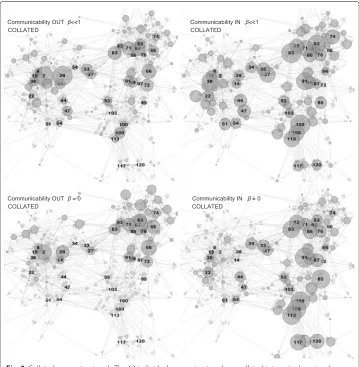
The collated concept network consisting of 12 individual concept maps is shown in Fig.2, where node sizes are scaled according to values of the out- and in-communicabilities
GOUT(v) andGIN(v). Results are shown for weak epistemic weighting (β 1) and for epistemic substantiation corresponding to the original concept maps (β = 0). The key nodes are numbered as explained in Table1. Other symbols and abbreviations used throughout the text are provided in Table 2. For weak weighting, all links are equally weighted and the resulting out- and in-communicabilities correspond to the situation where all links would be maximally weighted. As Fig.2shows, the collated network is modular and consists of three modules. This modularity, however, emerges from the task structure. Students discussed separately the tasks of electrostatics, magnetostatics and electromagnetism.
Communicabilities
Figure2 shows that the out-and in-communicabilitiesGOUT(v) andGIN(v) of a given node v are for many nodes essentially different. The nodes which have high out-communicability are those which feed information to other nodes and thus are (source) nodes that support the substantiation of other nodes. The nodes which have high in-communicability are ones where the information fed by other nodes ends; these are the strongly supported and substantiated (target) nodes. Nodes in these source and tar-get groups are central to the network, and are thus the nodes associated with the key concepts. When epistemic weighting of the network is changed by changing weight parameterβas given by Eq.2, the in- and out communicabilities are for some nodes sub-stantially changed. Varying the weighting allows us to study the epistemic strength of the substantiation of conceptual knowledge as the collated concept network represents it.
Fig. 2Collated concept network. The 12 individual concept networks as collated into a single network. Nodes are shown in proportion to their out- and in-communicability. In the upper row node weighting is β=10−2and in the lower rowβ=0. Note that only the part of the most importance is shown and marginal parts with auxiliary nodes are cut-off on borders
modules of electro- and magnetostatics are needed to support the knowledge in the first electromagnetism module.
The collated network with weightingβ =0 (lower panel of Fig.2) shows the case where the weighting corresponds the best substantiated nodes as collated from the original 12 concept maps. In comparison to caseβ = 10−2, a slightly lesser fraction of nodes have now a high in- and out-communicability. The network is now also clearly divided into modules of source and target nodes. Many of the high out-communicability source-nodes
Table 2Summary of symbols and abbreviations used in text and figures
Symbol/Abbreviation Symbol/Abbreviation
W Weighted adjacency matrix DIN Strength, in-coming links
wij Elementijof matrixW DOUT Strength, out-going links
aij Elementijof unweighted adjacency matrix GIN Communicability, in-coming links
β Epistemic weight parameter GOUT Communicability, out-going links
Sg,g Similarity of networksgandg COLL Collated network
are now found in the module mediating (magnetostatics ) between the other modules of source nodes (electrostatics and electromagnetism). In one of the source modules (elec-trostatics) only a few concepts now have the role of key concept, while in the target module the role of certain concepts as the key concepts is enhanced. In the mediating module, the changes of nodes in their roles of key concept are not very substantial and many key concepts retain their roles. The most prominent target-node module is obvi-ously the electromagnetic module, because concepts in it need to be supported both electrostatics and magnetostatics concepts. The in- and out communicability quantifies thus quite naturally the information flows from source to target nodes.
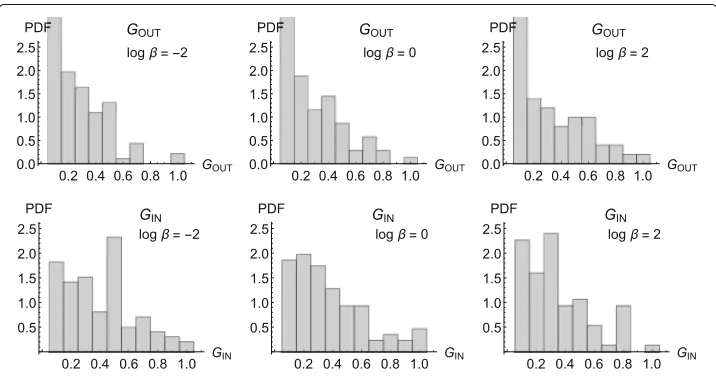
The key concepts are supposedly those ones which receive high enough communicabil-ities. The histogram in Fig.3shows the distribution of communicability of nodes when epistemic weighting is varied. The histograms show that nodes with “high” values of com-municability can be taken those ones with in- and out-communicabilities exceeding the value of 0.5. These nodes are rare, and many of them have anomalously low Z-scores. For epistemic weight logβ = 2 communicability of nodes 28, 38, 74, 100 109 and 113 have Z-scores in range−2.5< Z < −3.5, while for logβ = 0 only nodes 28, 38, 74 and 109 have equally low Z-scores. Only nodes 57, 85 and 117 have statistically significant positive Z-scores, having 2.5<Z<3.5. For no epistemic weighting with logβ= −2 all key con-cepts have Z-scores|Z|<2. These results indicate that while many of the key nodes have communicability as expected on basis of null-model, yet several of them have a commu-nicability not determined by local connectivity alone. Particularly clear this is for strong epistemic weighting. The conclusion that high-communicability nodes are special set of nodes is supported by examining the correlations between in- and out strengthsDINand
DOUT and corresponding in- and out-communicabilitiesGIN andGOUT of the nodes.
The ranking based Spearmanρand Kendallτ non-parametric correlations (Corder and Foreman2014) are summarised in Table3. The correlations show that forβ 1 com-municabilities of interest are determined by the strength of node (i.e. degree of node), but for increased demand for epistemic weighting the correlations become weaker. The
Fig. 3Histograms of distributions of in- and out- communicability. The histograms of values ofGINandGOUT
deterioration of correlation shows that the communicability provides essential new infor-mation of long contiguous paths and how epistemic weighting affect them. Roughly, the message of Z-scores and correlations is that for students, it is very demanding to maintain the contiguous, logically ordered chain of connections from source nodes to target nodes, and that these chains are very often disrupted by failed or poorly established epistemic substantiation of the connections. This feature comes visible only through examination of communicabilities and is not available by focusing on local connectivity e.g. in form of node strengths.
The key concepts
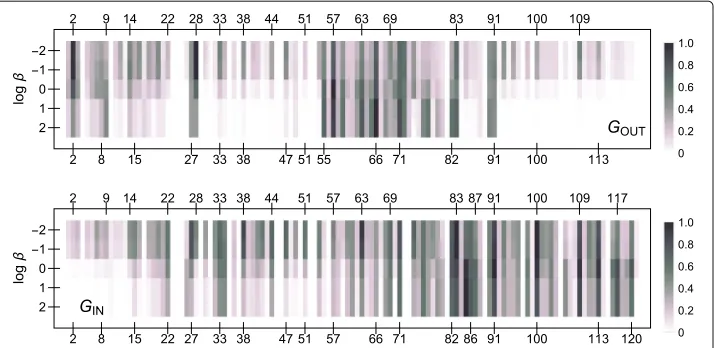
The key concepts and how they change when epistemic weighting is increased are shown in Fig.4as a fingerprint -map (Koponen and Nousiainen2014). The map shows the key concepts of high in- or out-communicability as black stripes, and the lesser the communi-cability is the lighter is the colour of the stripe. The fingerprints reveal that there are about 23 key concepts of which, with increasing epistemic weighting, the number of strongly substantiated nodes (concepts) diminish and only about 15 remain epistemically strongly substantiated. The 23 nodes and the 15 most strongly substantiated (in boldface) are: 2, 14, 28, 27, 33 and 38 (for electrostatics, names of the concepts as in Table1);55,57,59,
63,66,71, 74,82,83,85and86(for magnetostatics); and 90,91,100,109,113,117and 120 (for electromagnetism). All these nodes represent concepts which are also central for the content, abstract and thus widely applicable across different contexts. Importantly, many of these concepts are general field concept of electricity and magnetism. Therefore, they are also key concepts in regard to the content.
The set of strongly substantiated nodes forβ1 represents that part of knowledge for which the student group is able to provide a proper epistemic justification. As is seen by comparing the results in Fig.4for weak (β1) and strong epistemic (β1) weighting, the key concept in the strongly weighted group is a sub-set of key concepts corresponding to the maximally substantiated (β1) network. It is this more limited set of key concepts that students can bring to their discussions and use in a justified manner when construct-ing arguments and makconstruct-ing knowledge claims; these key nodes thus provide important information concerning what one can expect about the quality of knowledge within the student group and how it appears in discussions and argumentation within the group.
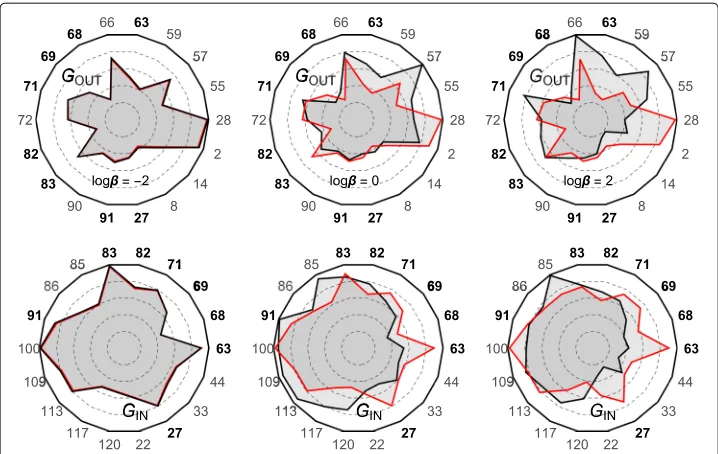
The set of key concepts and the changes in it with increasing epistemic weighting can conveniently be displayed using radar maps (or spider-web maps), where each concept is given as a corner in a polygon and the distance from the centre of the polygon is propor-tional to the value of the communicability. Such radar maps for source (OUT) and target (IN) key concepts are shown in Fig.5for 18 key concepts that appear in cases of
low-Table 3Correlation coefficients[X,Y] between variablesX,Y∈ {DIN,DOUT,GIN,GOUT}
[DIN,DOUT] [GIN,GOUT] [DIN,GIN] [DOUT,GOUT]
logβ -2\0 \2 -2\0 \2 -2\0 \2 -2 \0 \2
ρ 0.66\0.66\0.59 0.64\0.31\0.29 1.00\0.89\0.84 0.99\0.86\0.82 τ 0.51\0.50\0.44 0.48\0.20\0.18 0.95\0.73\0.68 0.95 \0.71\0.66
Fig. 4Fingerprint maps of the key concepts in the collated concept network. The key concepts having a high communicability are shown as black stripes. The weighting of links withβ=10pchanges fromp= −2 top=2 as shown on the scale on the right. The communicability through out-going links (OUT) is shown in the upper panel and through in-coming links (IN) in the lower panel. Numbering of nodes is given in upper-and lower sides of the stripes. The colour-legend for relative strengths of communicability is provided on the right. Note how differently weighted networks have different sets of key nodes. The key nodes surviving after the strong epistemic weighting region are the most strongly supported/supporting ones
and high epistemic weighting. For comparison, the radar map shows also the in- and out-strengths of the nodes. The radar maps in the left panel show the key concepts forβ1, in which case all the links are equally weighted and the relative strengths of the commu-nicabilities have the same values as would be obtained in a fully substantiated network where all links would receive weights 1.
When the epistemic weighting is increased, the radar maps reveal how certain concepts gradually lose their role as key concepts and only a smaller sub-set of key concepts sur-vives whenβ1. The in-and out strengths, however, remain largely unaffected, because they depend only on epistemic weights on nearest neighbour links. Moreover, as shown by results in Table3only for logβ = −2 the communicability and strength of node are strongly correlated. This difference in values of communicability and strength show that epistemic weighting of long contiguous paths depend sensitively on quality of epistemic substantiation and thus it provides more information of the epistemic substantiation than strength of node. The column at the right in Fig.5shows the key concepts forβ = 102,
which is already a limiting case and further increase inβhas no effect on the relative val-ues of the communicabilities, and thus on the set of key concepts. The set of key concepts is remarkably robust, which indicates that many links contained in the collated network are sufficiently well substantiated to make the set resilient under the increased demand for epistemic substantiation.
Auxiliary concepts
Fig. 5Radar maps of the key concepts in the collated network. The radar map representation of the 18 most important key concepts in the collated concept network. In the left column, the communicability (black polygon) is compared with the strength of nodes (red polygon) for the weightingβ=10−2. In the middle, the communicability (black) and the strenght (red) are compered forβ=100, and on the right forβ=102. The out- and in-communicabilities are shown in the upper and lower rows, respectively
high-clustering nodes have Z-scores 2.5 < Z < 4.5. The average value of local cluster-ing of collated network nodes is 0.13. None of these concepts or conceptual elements appear among nodes listed in Table 1 and none of them is indispensable for the content in general. The top conceptual elements with high local clustering coefficient are spe-cific and context related model based derivations of certain laws, models, experiments or statement-type definitions. For example, some of the top-ranking nodes are: 121. Model exemplifying RCL-circuit and 107. Definition of mutual inductance. For collated and indi-vidual networks the 15 highest ranking concepts according to their clustering coefficient contain 12 which are derivations, models, model based definitions or experiments. More-over, these items and ways they are reported in students’ reports closely match textbook presentations.
Similarity comparisons
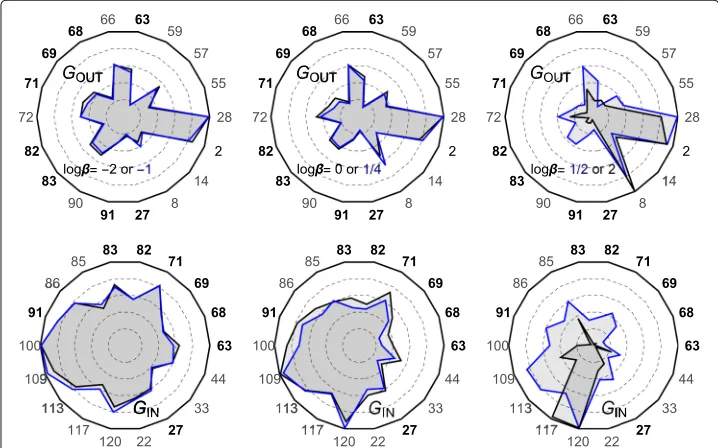
the collated network. In Fig.6are shown the communicabilities averaged over 12 individ-ual networks for the key concepts shown in Fig.5. The changes in the set of key concepts with increased epistemic weighting reveal substantial changes in the communicabilities, and forβ 1 only a few of the key concepts remain. Interestingly, in the set of source nodes, nodes 2 (electric charge) and 28 (empirically operationalised electric field) are dominant. In the set of target nodes, nodes 109, 117 and 120, related to magnetoelec-tric induction (the inverse of electromagnetic induction) are dominant. The unexpected dominance of certain key concepts in case of strong epistemic weighting is in contrast to the collated network, which turned out to be rather robust with the increased demand for epistemic substantiation. This indicates that a good and robust substantiation of the collated network actually originates only from one or two of the individual networks. Although many of the individual networks contain very few well-substantiated nodes, every network contains some which are not found in any other network. The collated network collects all these rare cases and the outcome is a well-substantiated and robust concept network, which is also highly satisfactory from the viewpoint of targeted content knowledge.
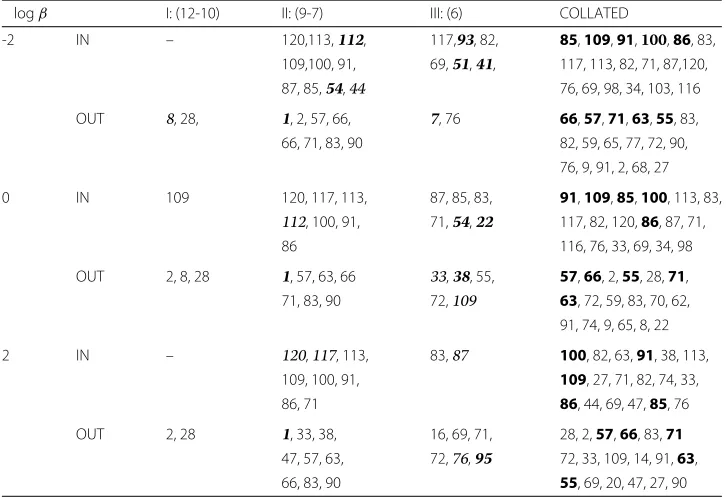
A more detailed breakdown of the key concepts in individual networks as compared to the collated network is provided in Table4, where the key concepts in individual net-works are divided into three categories: I, II and III. Category I contains the concepts that appear in at least 10 networks, category II concepts appearing in at least 7 but at most 9, and III concepts that appear in exactly 6 networks only. The column COLLATED shows concepts in the collated network in order of their ranking based on the communicabil-ity. The key concepts in category I in Table4show that the concepts which appear in 11
Table 4Key concepts as they appear in the collated and 12 individual concept networks logβ I: (12-10) II: (9-7) III: (6) COLLATED
-2 IN – 120,113,112, 117,93, 82, 85,109,91,100,86, 83, 109,100, 91, 69,51,41, 117, 113, 82, 71, 87,120, 87, 85,54,44 76, 69, 98, 34, 103, 116
OUT 8, 28, 1, 2, 57, 66, 7, 76 66,57,71,63,55, 83, 66, 71, 83, 90 82, 59, 65, 77, 72, 90,
76, 9, 91, 2, 68, 27
0 IN 109 120, 117, 113, 87, 85, 83, 91,109,85,100, 113, 83,
112, 100, 91, 71,54,22 117, 82, 120,86, 87, 71,
86 116, 76, 33, 69, 34, 98
OUT 2, 8, 28 1, 57, 63, 66 33,38, 55, 57,66, 2,55, 28,71,
71, 83, 90 72,109 63, 72, 59, 83, 70, 62, 91, 74, 9, 65, 8, 22
2 IN – 120,117, 113, 83,87 100, 82, 63,91, 38, 113, 109, 100, 91, 109, 27, 71, 82, 74, 33, 86, 71 86, 44, 69, 47,85, 76
OUT 2, 28 1, 33, 38, 16, 69, 71, 28, 2,57,66, 83,71
47, 57, 63, 72,76,95 72, 33, 109, 14, 91,63, 66, 83, 90 55, 69, 20, 47, 27, 90
The columns from I to III show 18 key concepts selected from the 25 highest ranking concepts common to all 12 networks. Column I shows the concepts that appear in at least 10 networks; in II the concepts that appear in at least 7 but at the most 9 networks, and in III the concepts that appear in exactly 6 networks only. The column COLLATED shows concepts in the collated network in order of their ranking based on the communicability. The results in I-III and COLLATED are given for epistemic weights Logβ= −2, 0 and 2, and for in-coming (IN) and out-going (OUT) links. In the COLLATED, the five highest ranking concepts for Logβ= −2 are shown in boldface. In Columns I-III the concepts not contained in the key concepts in COLLATED for the epistemic weightβare given in slanted font. If the concept is not among any of the 18 key concepts for collated, it is in slanted boldface
The results in Table4show that the differences between individual student-made con-cept maps are substantial, as well as the difference between any individual student map and the collated network. Here, the similarity of interest derives from the similarity of the set of key concepts and how their communicability values are distributed. A suitable sim-ilarity measure which fulfils these requirements is the simsim-ilarity defined in Eq.6. Roughly, such similarity can be interpreted as a relative, total communicability similarity between the compared networks. The similarity functionSis shown in Fig.7. The similarity of the epistemically weighted collated network to the unweighted collated (COLL) network cor-respondingβ1 is shown by the uppermost curves for out-going (OUT) links at the left and for in-coming links (IN) at the right. The results show that when setting the highest demand on the epistemic weighting (β 1), the similarity is reduced to 50% and to 60% for source and target concepts, respectively. The situation is more severe for the individ-ual concept maps, whose similarity to the similarly weighted collated network are shown as gray dots. These similarities are forβ1 in the best cases 50% but in the worst cases only 30%, and are reduced to very low values less than 20% forβ 1. For a comparison, the similarity of averaged (AVER) values of the communicabilities to values obtained for the collated network, corresponding to equalβ, are shown, as well as the fitting function to the average over the individual network similarities. These results confirm the con-clusion drawn on the basis of the radar maps in Figs.5and6and the results shown in Table4; the individual concept maps contain only sparsely the relevant conceptual knowl-edge, but when they do this, it is often well substantiated. By collecting all separate well substantiated-elements, a highly satisfactory collated network results.
Discussion and conclusions
We have focused on finding the key concepts in how university students conceive the rela-tional conceptual structure of electricity and magnetism. The study sample was a set of 12 concept maps and accompanying study reports made by students during a seven-week course. The 12 individual networks were agglomerated into a single collated network, which could be taken to represent the totality of concepts and their relationships which arose in the discussions and which were focused on exercises during the course. Here,
we showed that the communicability of nodes in the collated network had good resolv-ing power in revealresolv-ing how different nodes (concepts) in the collated network channelled information to provide epistemic substantiation of other nodes in the network, and how the other nodes were substantiated by that information. The nodes that had a key role in transmitting or receiving the information were those with a high communicability through either the out-going or in-coming links, respectively. These nodes were the key concepts in the network.
The analysis method based on finding the key concepts on the basis of the ranking of nodes according to their communicability provided insight on the quality of the epis-temic substantiation of the knowledge as it was represented in the concept network. The method introduced here for global analysis augments the traditional methods of concept network and concept map analysis, which focus on the local properties through count-ing links (Ruiz-Primo and Shavelson1996; Nicoll et al.2001; McClure et al.1999) or on visual appearances of the patterns found in the concept maps (Kinchin et al.2000,2005). The method based on communicability operationalises the desired property of the con-ceptual contiguity of the concept network and the information flow from node to node in the network. It also provides a way to study the effect of the epistemic weighting on the emergence of the key concepts.
The results of the analysis for the collated network were compared to the results obtained by averaging the communicabilities of the nodes over all 12 individual networks. The comparison indicated that the individual networks were rather limited sub-sets of the collated network, with many of the concepts poorly substantiated. However, every sin-gle network contained some essential key concepts which the students had managed to substantiate well. Most often these concepts were found to be associated with magneto-statics. It appears that students relied on magnetostatics as mediating module of concepts which link electrostatics concepts to electrodynamics, while less information is chan-neled directly from electrostatics to electrodynamics. This feature may be partly related to the structure of the task, but may also emerge partly from the recency of the learned magnetostatics in comparison to electrostatics. Magnetostatics having a special role is similarly seen in a different kind of analysis, suggesting that concepts of magnetism have for students an important role in organising their knowledge of electricity and magnetism around that mediating role (Koponen and Nousiainen2013).
In several recent studies it has been claimed that experts’ knowledge builds around interrelated set of concepts connected by their relational structure (Goldwater and Schalk
clustering coefficients. These concepts and conceptual elements are specific derived mod-els or specific examples, or auxiliary concepts connected with them. They are not key concepts but auxiliary and strongly context specific concepts and conceptual elements and have a role in supporting or augmenting the theoretical skeletal structure formed by the abstract theoretical concepts with high global connectivity.
Interestingly, by collecting all the best substantiated nodes and connections contained in the 12 individual concepts maps into a collated network, a highly satisfactory con-cept network emerges with a rich collection of key concon-cepts and with a strong epistemic substantiation. However, individual networks have quite a lot variability in number of nodes, links and in selection of nodes. This is in agreement with findings that also indi-vidual semantic networks have large variability and aggregated network based on them may be very different from individual networks (Morais et al.2013). On the other hand, the results suggests that in the group of 12 students, a substantial amount of relevant and well-substantiated knowledge was harboured, but with each individual student pos-sessing only a fraction of the knowledge potentially available at the group level. If this unshared knowledge within the group could be somehow better shared, it would provide great potential for successful peer-to-peer learning.
In summary, we have shown how students’ knowledge of the relational knowledge of scientific concepts can be analysed and approached by utilising the appropriate network methods. We believe that the results presented here could not be obtained by any of the traditional methods for analysing concept maps. Moreover, the present method reduces the interpretative component of the analysis to a minimum (only the recognition and eval-uation of epistemic levels is needed), overcomes the limits of local analysis, and replaces the awkward visual inspection of global analysis methods with quantitative operational-isations of the global features of interest for examining students’ declarative knowledge and the quality of its substantiation.
Acknowledgements
The Academy of Finland and the Department of Physics, University of Helsinki, Finland, are acknowledged for making this research possible.
Funding
This research received funding from the Academy of Finland through Grant 311449.
Availability of data and materials
Data is available on request from the corresponding author.
Author’s contributions
ITK has been the lead author of the manuscript, largely conceptualised the problem, and designed and implemented the quantitative network analysis. MN has made key contributions in conceptualising the problem, in collecting the data and designing the empirical research setup, and in conducting the qualitative analysis. Both authors read and approved the final manuscript.
Competing interests
The authors declare that they have no competing interests.
Publisher’s Note
Springer Nature remains neutral with regard to jurisdictional claims in published maps and institutional affiliations.
Received: 12 February 2018 Accepted: 13 June 2018
References
Benzi M, Klymko C (2013) Total communicability as centrality measure. J Complex Netw 1:124-149 Börner K (2015) Atlas of knowledge: Anyone can map. MIT Press, Cambridge
Börner K, Scharnhorst A (2009) Visual conceptualizations and models of science. J Informetr 3:161-172
Chi MTH, Ohlsson S (2005) Complex Declarative Learning. In: Holyoak KJ, Morrison RG (eds). Cambridge Handbook of Thinking and Reasoning. Cambridge University Press, New York. pp 371-400
Corder GW, Foreman DI (2014) Nonparametric Statistics: A Step-by-Step Approach. Wiley, New York
Csardi G, Nepusz T (2006) The Igraph software package for complex network research. Inter J Complex Syst 1695 da Costa LF, Rodrigues FA, Travieso G, Villas Boas PR (2007) Characterization of complex networks: A survey of
measurements. Adv Phys 56:167–242
Derbentseva N, Safayeni F, Canas A (2007) Concept Maps: Experiments on Dynamic Thinking. J Res Sci Teach 44:448–465 Estrada E (2012) The structure of complex networks. Oxford University Press, Oxford
Estrada E, Hatano N (2008) Communicability in complex networks. Phys Rev E 77:036111
Estrada E, Hatano N, Benzi M (2012) The physics of communicability in complex networks. Phys Rep 514:89-119 Goldwater MB, Schalk L (2016) Relational Categories as a Bridge Between Cognitive and Educational Research. Psychol
Bull 142:729–757
Hoyningen-Huene P (2013) Systematicity: The Nature of Science. Oxford University Press, Oxford
Ingec S (2009) Analysing concept maps as an assessment tool in teaching physics and comparison with the achievement tests. Int J Sci Educ 31:1897–1915
Kemp C, Tenenbaum JB (2008) The Discovery of Structural Form. PNAS 105:10687–10692
Kinchin I, De-Leij F, Hay D (2005) The Evolution of a Collaborative Concept Mapping Activity for Undergraduate Microbiology Students. J Furth and High Educ 29:1–14
Kinchin I, Hay D, Adams A (2000) How a qualitative approach to concept map analysis can be used to aid learning by illustrating patterns of conceptual development. Educ Res 42:43-57
Kolaczyk ED (2009) Statistical Analysis of Network Data. Springer, New York
Koponen IT, Nousiainen M (2013) Pre-service physics teachers’ understanding of the relational structure of physics concepts: Organising subject contents for purposes of teaching. Int J Sci Math Educ 11:325–357
Koponen IT, Nousiainen M (2014) Concept networks in learning: Finding key concepts in learners’ representations of the interlinked structure of scientific knowledge. J Complex Netw 2:187–202
Koponen IT, Nousiainen M (2018) Concept Networks in Learning and the Epistemic Support of their Key Concepts. In: Cherifi CB, Cherifi H, Karsai M, Musolesi M (eds). Complex Networks & Their Applications VI: Proceedings of Complex Networks 2017. Springer International Publishing AG, Cham. pp 759–769
Kuhn TS (2000) The Road Since Structure. University of Chicago Press, Chicago
Lachner A, Nückles M (2015) Bothered by abstractness or engaged by cohesion? Experts’ explanations enhance novices’ deep-learning. J Exp Psychol Appl 21:101–115
Liu X (2004) Using Concept Mapping for Assessing and Promoting Relational Conceptual Change in Science. Sci Educ 88:373–396
McClure JR, Sonak B, Suen HK (1999) Concept map assessment of classroom learning: Reliability, validity, and logistical practicality. J Res Sci Teach 36:475–492
Morais AS, Olsson H, Schooler LJ (2013) Mapping the Structure of Semantic memory. Cog Sci 37:125–145
Nesbit JC, Adesope OO (2006) Learning with concept and knowledge maps: A meta-analysis. Rev Educ Res 76:413–448 Nicoll G, Francisco J, Nakhleh M (2001) A three-tier system for assessing concept map links: A methodological study. Int J
Sci Educ 23:863–875
Nousiainen M (2013) Coherence of pre-service physics teachers’ views of the relatedness of physics concepts. Sci Educ 22:505–525
Nousiainen M, Koponen IT (2017) Pre-service physics teachers’ content knowledge of electric and magnetic field concepts: Conceptual facets and their balance. Eur J Sci Math Educ 5:74–90
Rescher N (1979) Cognitive Systematization: A Systems-Theoretic Approach to a Coherentist Theory of Knowledge. Rowman & Littlefield, New Jersey
Ruiz-Primo MA, Shavelson R (1996) Problems and issues in the use of concept maps in science assessment. J Res Sci Teach 33:569–600
Safayeni F, Derbentseva N, Cañas A (2005) A Theoretical Note on Concepts and the Need for Cyclic Concept Maps. J Res Sci Teach 42:741–766
Shi F, Foster JG, Evans JA (2015) Weaving the fabric of science: Dynamic network models of science’s unfolding structure. Soc Networks 43:73–85
Stella M, Beckage NM, Brede M (2017) Multiplex lexical networks reveal patterns in early word acquisition in children. Sci Rep 7:46730
vanZele E, Lenaerts L, Wieme W (2004) Improving the Usefulness of Concept Maps as a Research Tool for Science Education. Int J Sci Educ 26:1043–1064
![Table 3 Correlation coefficients �[ X, Y] between variables X, Y ∈ {DIN, DOUT, GIN, GOUT}](https://thumb-us.123doks.com/thumbv2/123dok_us/828896.1580429/13.595.116.480.658.716/table-correlation-coefficients-variables-din-dout-gin-gout.webp)