R E S E A R C H
Open Access
Software mediators as first-class entities
of systems-of-systems software architectures
Lina Garcés
1,2*, Flavio Oquendo
2and Elisa Yumi Nakagawa
1Abstract
Context: In contrast to traditional software systems that are mostly created from scratch, current software systems are engineered as a junction of systems already in operation. Examples can be found in domains, such as smart cities, crisis and emergency, IoT, big data, industry 4.0, and connected health systems. Most of them can be considered systems-of-systems (SoS), since they refer to alliances of operational and managerial independent software-intensive systems, which are sometimes distributed over different environments. Therefore, SoS software architectures must be dynamic, evolve over time, and support the execution of emergent behaviors to accomplish SoS missions. They must be also designed to enable the connection of heterogeneous systems, making possible their interoperation,
communication, coordination, cooperation, and collaboration, most of the times, in a seamless way. Similar challenges have been addressed by using software mediators as architectural entities. However, the application of mediators in SoS has not been properly explored.
Goal: This article introducesMediArch, a layered architecture that considers mediators as first-class software entities
to be used in the construction of SoS architectures. Our objective is to present evidence about howMediArch’s can
support the construction of SoS architectures.
Methods: The following four steps were conducted to defineMediArch: (1) identification of mediation requirements to allow SoS properties; (2) establishment and categorization of twelve types of mediators, for enabling capabilities of communication and control of constituent systems interactions and conversion of heterogeneous messages
exchanged through a mediation infrastructure; (3) specification of duties, behaviors, assumptions, and guarantees of mediators; and (4) organization ofMediArchin three layers, namely, the constituents & consumer systems layer; the communication, conversion, & coordination layer; and the control layer. This architecture was used as the backbone for the software architectures of two SoS in different domains, namely, flood monitoring system-of-systems (FMSoS),
and health-care supportive home system-of-systems (HSH-SoS), for providing evidence on howMediArchsupports
the architecting process of SoS.
Results: MediArch(1) supports the integration of independent constituent systems, (2) provides strategies to manage emergent behaviors, (3) defines different schemes of control authorities, (4) offers elements to support SoS evolution, and (5) promotes the resilience and adaptability of SoS architectures.
Conclusions: AlthoughMediArchcontributes to the establishment of SoS architectures, some challenges related to performance, resource consumption, security, safety, and non-disruptive reconfigurations must still be overcome.
Keywords: Software architecture, Systems-of-systems, Mediator, Connector, Crisis and emergency systems, Health-care supportive home systems
*Correspondence:[email protected]
1Department of Computer Systems, University of São Paulo, Av. Trabalhador São-carlense, 400 - Centro, 13566-590 São Carlos, Brazil
2IRISA - University of Southern Brittany, Rue Yves Mainguy, 56000 Vannes, France
Introduction
Software systems have grown in complexity and size and, therefore, require paradigms for their engineer-ing, specifically for their architecting. Modern systems are conceived to execute composed functionalities that depend on interactions among heterogeneous and dis-tributed software-intensive systems. The construction of these systems must contemplate a diversity of stakehold-ers and multidisciplinary practitionstakehold-ers and must consider the establishment of requirements and behaviors at early stages of their development, as well as during operation. In this context, a type of complex, software-intensive, and large systems has emerged and has been known as systems-of-systems (SoS).
SoS are comprised of other software systems (some-times in operation) that are heterogeneous, distributed, and managerially and operationally independent of the SoS control. Behaviors of SoS emerge from the interac-tion among constituent systems; therefore, SoS missions cannot be achieved by any constituent alone, but through their cooperation [46, 52]. In short, missions are sys-tems’ activities to pursue stakeholders’ goals [7]. In this perspective, software architectures of SoS are considered dynamic, since alliances of constituent systems are modi-fied, sometimes seamlessly at runtime, depending on the SoS missions, constituent availability, and environmental settings [46,52]. This scenario raises important challenges for the design of SoS architectures.
Software architects must deal with interoperability issues that arise during the dynamic exchange of data among constituent systems. This is mostly due to differ-ences in protocols, data formats, workflows, and interfaces, which are usually neither well defined, nor documented. Interoperability problems have been presented in many types of software systems over the years and are still an open issue. For SoS, interoperability is a critical require-ment, since it directly impacts on their capabilities of evolution, dynamicity, and mission achievement.
The software engineering community has conceived the mediator concept as a solution to deal with the integra-tion of heterogeneous and distributed data sources [70]. In a general way, mediators have been used as software entities responsible for achieving interoperability among diverse and disperse software components through the translation of exchanged data and coordination of sys-tems’ interactions [72,73]. In the SoS context, mediators have been proposed as architectural elements that con-nect constituent systems to enable their communication, coordination, cooperation, and collaboration [54].
Important advances in software connectors, medi-ators, emergent middleware, software platforms, and frameworks have been made to overcome interoper-ability problems in complex and large-scale systems [3, 8, 25, 36, 40, 42–44, 47, 62, 63]. However, existing
approaches do not consider strategies to enable all inter-operability levels, i.e., technical, semantic, syntactic, and organizational, neither other important issues of SoS architectures [32], such as dynamic integration of con-stituent systems, incorporation of new SoS missions or requirements, prediction of emergent behaviors, decision making, and resilience.
This article presents MediArch, a three-layered archi-tecture that establishes mediators as first-class software entities to construct SoS. Mediators are located at the two higher layers and aim to offer capabilities of communi-cation, conversion, coordination, and control. MediArch
was used as a backbone for the design of two SoS, namely, FMSoS (Flood Monitoring SoS) and HSH-SoS (Health-care Supportive Home SoS). Both SoS gave us evidence to conclude thatMediArchadvances the state-of-the-art on SoS architecting, since it (1) allows the integration of independent constituent systems, (2) provides strate-gies to control emergent behaviors, (3) defines stratestrate-gies of control authorities, (4) gives structures for SoS evolu-tion, and (5) promotes resilience and adaptability of SoS architectures.
The remainder of this article is structured as follows. The “Background” section presents the theoretical back-ground used in this work. The “Materials and methods” section details the methods used to establish and assess
MediArch. The “Software mediators for SoS” section describesMediArch and specifies all software mediators that compose this layered architecture. The “Evaluation of MediArch” section reports results obtained during
MediArchassessment. The “Discussion” section discusses the results of constructing FMSoS and HSHSoS based on MediArch. In the same section, related works (the “Related work” section), contributions of MediArch (the “MediArch contributions” section), limitations of our work (the “Limitations and directions for future studies” section), and threats to validity (the “Threats to validity” section) are described. Finally, conclusions and future work are listed in the “Conclusions and future works” section.
Background
This section presents the theoretical foundation contain-ing the main topics embraced in this work, namely, SoS and software mediators.
Systems-of-systems
the Apollo 12 system is [7] “to perform inspection, survey, and sampling in lunar mare area.”
A system can be considered an SoS if it presents the following characteristics [46,52]:
• Operational independence. Constituent systems are independent and able to operate even when the SoS is disassembled; hence, constituents must be low coupled without harnessing operations of their peers; • Managerial independence. Constituent systems are
governed by their own rules, rather than by external ones when they participate in an SoS. This
characteristic raises challenges for the creation of SoS, due to uncertainties on constituents operations reliability, which can negatively or positively impact SoS behaviors and the achievement of their missions. • Distribution. Constituent systems are dispersed;
therefore, a type of mediator is required to allow the communication of their operations results with other constituents and, depending on the type of SoS, with the central authority. Mediators must enable communication, coordination, and (if required) translation of messages to support inter-operations between constituents and the SoS.
• Evolutionary development. SoS can be under constant changes due to modifications in missions, e.g., market tendencies can change business strategies, which results in changes of missions, and inclusion of new constituents or removal of those that are not longer required.
• Emergent behavior. An SoS behavior emerges as a result of the synergistic collaboration of its
constituent systems. An emergent behavior addresses a global mission, rather than individual missions accomplished by the constituent systems separately. Depending on the complexity to characterize, measure, and predict emergent behaviors, an SoS can be modeled as deterministic or stochastic systems [48].
Depending on the independence level of constituents, an SoS can be classified as follows [15,38]: (1)directed, if constituent systems are controlled by a central authority to satisfy the SoS missions; (2) acknowledged, if con-stituent systems maintain independent management and missions, but collaborate with the SoS to achieve its mis-sions; (3)collaborative, when constituent systems are not forced to follow a central management, but voluntarily collaborate to achieve the SoS missions; and (iv)virtual, if the SoS has neither a central authority, nor clear missions, its constituent systems are unaware of their participation in the SoS; therefore, its behaviors are highly emergent.
SoS characteristics and types impose the follow-ing properties to their architectures [31, 32, 52]: (a)
continuous integration of constituent systems and capa-bilities, as required by the SoS to achieve its missions; (b) definition of design decisions to assure predicted emer-gent behaviors [48]; (c) establishment of decision-making authorities that control SoS operations and govern (if pos-sible) alliances of constituent systems; (d) strategies for SoS evolution, such as new missions, requirements, and other significant changes appear; and (e) resilience and adaptability of SoS operations for ensuring desired quality levels and avoiding unexpected emergent behaviors.
Characteristics of distribution and operational and managerial independence of constituent systems hamper the construction of SoS, mainly due to interoperabil-ity barriers. In SoS, interoperabilinteroperabil-ity can be defined as the ability of constituent systems alliances to exchange specified state and data and interact following a com-manding authority or predefined agreements [49]. The following four levels of interoperability have been consid-ered in distributed software systems, and also are required in SoS:
- Technical interoperability, related to establish links and transmit data among constituent systems. It is domain-independent and does not know about the meaning of data exchanged [9]. Therefore, technical interoperability only guarantees the correct
transmission of bits, but it does not communicate anything about the meaning of these bits and what they represent [41]. It is often focused on
communication protocols and infrastructure necessary for the protocols to operate.
- Syntactic interoperability, related to the syntax that defines rules on the type of data exchanged,
structures, and organization. It provides data formats, well-defined syntax, and encoding (e.g., message content structure, size of headers, size of the message body, and fields contained into a message) [41]. - Semantic interoperability, related to semantics that
defines the exact meaning of the data exchanged (e.g., clear definitions of domain terminology or
vocabulary). Data are conceived, in the semantic layer, as information to be shared, processed, and well-understood (with no ambiguity) by systems. Semantic interoperability is specific to domain and context and requires the use of unambiguous codes and identifiers [9].
(as part of their own workflows), and such commitments are specified in contracts.
Software mediator
Issues on interoperability among software entities (e.g., components, systems, services), such as exchanged data and behavioral heterogeneity, have been overcome through intermediary software entities called mediators [36]. Mediators perform the necessary translations of the data exchanged and appropriately coordinate interactions among software entities [71]. Similarly to connectors in software architectures, mediators can be seen as first-class software entities, that specify their internal behaviors, protocols, duties, commitments, and roles, making pos-sible the definition of mediators patterns to be reused by software architects in different software projects [23,62].
Because of their benefits, mediators have been stud-ied in other types of complex systems, for instance, in services-based systems on distributed environments. Sev-eral types of mediators (some of them considered as pat-terns) [8,36,43,62,63] to improve interoperation among heterogeneous components and services.
In an SoS perspective, mediators are considered archi-tectural elements that connect constituent systems to allow their communication, coordination, cooperation, and collaboration [54]. SoS mediators must be defined in an abstract way and instantiated at run-time, for enabling SoS emergent behaviors and missions accomplishment [55]. In contrast to software connectors, which act as com-munication channels to transfer data or control among constituents, mediators have communication, coordina-tion, and conversion roles [55] and facilitate SoS control over dependent entities. Moreover, since they can be cre-ated or destroyed by the SoS at run-time, they must be under SoS management.
Figure1shows a representation of an SoS mediator used in this work. In its simple form, a mediator is configured to receive input data (through its fromExinterface) and send output data (through itstoEyinterface).
A mediator has a gatethat provides an interface (i.e., interaction points) among systems (either SoS, or their constituents) and their local environment. Each gate spec-ifies duties (or obligations) to be fulfilled by the entity connected with the gate. A gate is governed by a proto-colthat defines a set of rules to guide interactions among
Fig. 1General representation of a mediator. Source [23]
the interconnected entities through the gate. The gate also defines someassumptionsandguaranteeson behav-iors, properties, and environment of the entity connected through the mediator’s gate. Therefore, the interested entity must provide a respective gate thatcommitsto offer duties specified in the mediator’s gate towards a successful interaction. Most of the times,commitmentsor contracts are dynamically created at run-time to achieve assump-tionsandguaranteesspecified in the gates of the mediator and the other software entity (e.g., constituent system or another mediator) interested in being connected. More details about mediators’ internal composition and formal specification can be found in [54].
Materials and methods
This section presents the methods used for the construc-tion and assessment of MediArch, a mediators-oriented architecture for SoS.
Identification of mediation requirements in SoS
As an initial step, the literature on SoS fundamentals [46,52] was read and SoS properties proposed in [32] were studied. Important requirements of quality attributes for each SoS property were defined to understand architec-tural challenges that mediators must address. The map-ping between properties (P) [32] and quality attributes requirements of SoS [59] are detailed in the first two columns of Table1.
Additionally, we studied architectural strategies to address both SoS’ quality attributes requirements and properties. We searched for architectural patterns and styles used for constructing SoS architectures. For this, the search string (“architectural pattern?” OR “architec-tural style?”) AND (“System-of-Systems” OR “Systems-of-Systems” OR “System of Systems”) was executed in data libraries Scopus and Google Scholar. Such libraries were selected since they index research published in other important computer science academic libraries, such as ACM, SpringerLink, and IEEEXplorer. The search was limited to Title-Abstract-Keywords. Studies [5, 12, 13, 31, 32, 39, 50, 53, 57, 58, 69] were returned, and, to the best of our knowledge, they are the only studies on architectural patterns and styles for SoS architectures. We also looked for architectural patterns and styles for self-organizing systems, since they share characteristics of dynamism and emergent behaviors with SoS [16,53,56]. Architectural patterns and styles related to quality attributes and properties of SoS are shown in the third column of Table1.
Furthermore, research on software connectors [3, 25,
Table 1Relationship among properties (P), quality attributes, architectural patterns and styles, and mediation categories in SoS
SoS properties Quality attributes Architectural patterns/styles Mediator categories
P1—continuous accommodation or integration of constituent systems.
Cooperation, integration, interoperability (i.e., technical, semantic, and syntactic), portability, and flexibility of constituents, and low-coupling between constituents and the SoS
Centralized architecture, publish-subscribe, contract monitoring, ESB, trickle-up, pace layering, MAPE-K, share data, broker, and observer-controller
Communication and conversion
P2—assurance of emergent behaviors
Coordination of constituents’ capabilities, organizational interoperability, and situation-aware
Centralized architecture, SOA, supply chain, reconfiguration control architecture, contract monitor, trickle-up, evolution styles, reflection, MAPE-K, observer-controller, and master-slave
Coordination, conversion, and control
P3—necessity of a decision-making or control authority
Centralized, decentralized, or full-decentralized control, and accountability of decisions
Centralized architecture, SOA,
publish-subscribe, pipe-filter, supply chain, reconfiguration control architecture, infrastructure grid, trickle-up, MAPE-K, shared-data, observer-controller, and master-slave
Control
P4—evolutionary development.
Maintainability, modifiability, separation of concerns, adaptability, portability, low-coupling, flexibility, scalability, integration, and interoperability
SOA, publish-subscribe, supply chain, infrastructure grid, ESB, pace layering, evolution styles, reflection, and MAPE-K
Coordination, conversion, control
P5—resilience or adaptability of SoS architecture (e.g., dynamic reconfigurations)
Adaptability, fault-tolerance, self-organization, robustness, dynamic configurations, availability, and security
SOA, publish-subscribe, blackboard, pipe-filter, supply chain, reconfiguration control architecture, ESB, pace layering, evolution styles, reflection, and MAPE-K
Coordination and control
understanding, we abstracted mediation capabilities pre-sented in architectural patterns and styles used in SoS architectures.
Categorization of mediators
Similar mediation capabilities (identified in architectural patterns and styles) were grouped to define types of mediation. Three categories of mediators, namely, com-munication & coordination, conversion, and control, were defined as important for SoS architectures. The last col-umn of Table1 shows them and their relationship with SoS properties, quality attributes, and architectural pat-terns/styles.
Specification of mediators
The description of each mediator was based on spec-ifications proposed in SosADL, an ADL (Architectural Description Language) defined to systematically represent software architectures of SoS [55]. SosADL proposes the following structure for the specification of mediators [55]:
• Duties, which are obligations to be fulfilled by mediator’s gates when the mediator is connected to a constituent system through an interface
• Behaviors, which are capabilities offered by the mediator to satisfy duties specified in the interface • Assumptions, which are conjectures about the
interface offered by the mediator for the desired behavior
• Guarantees, which are assertions about the results of the mediator’s behavior to satisfy the duties specified in the interface.
Definition ofMediArch
Since SoS architectures must be conceived to address a continuous integration of constituent systems, dynamic reconfigurations, evolution, scalability, and resilience, mediators must be organized towards satisfying such requirements. Therefore, they must be structured in a way they can be created, composed, removed, modified, and reconfigured at without affecting SoS behaviors or constituent systems operations.
Evaluation ofMediArch
To obtain evidence of the applicability of MediArch, the mediators contained in this architecture were used as first-class software entities for the construction of the software architecture of two SoS, namely, FMSoS (Flood Monitoring SoS) and HSH-SoS (Healthcare Supportive Home SoS). The FMSoS is an SoS whose main mis-sions are the continuous monitoring of rivers in a city and emergency situations detection (e.g., floods). The HSH-SoS’ mission is to assist patients diagnosed with chronic diseases (e.g., diabetes mellitus) in the manage-ment of their conditions during their daily life activities. Both SoS have been a focus of research of our group over the past years, and their mediators-based archi-tectures are detailed in the “Evaluation of MediArch” section.
The creation of FMSoS and HSH-SoS architectures fol-lowed the guidelines for architecting software systems in [29], using MediArch as backbone. The mediators-oriented architectures of FMSoS and HSH-SoS were assessed regarding their feasibility to allow SoS properties and their related quality attributes described in the two first columns of Table1. For this, the following research questions were investigated:
RQ1 - How do SoS architectures based on MediArch enable continuous accommodation or integration of constituent systems?
RQ2 - How do SoS architectures based on MediArch
assure emergent behaviors?
RQ3 - How can different strategies of control authori-ties be established in SoS architectures based on
MediArch?
RQ4 - How can SoS architectures based on MediArch
evolve?
RQ5 - How do SoS architectures based on MediArch
address resilience or adaptability?
Software mediators for SoS
Figure2a illustratesMediArch, a three-layered architecture that provides a general structure to design SoS architec-tures for SoS considering mediators as first-class soft-ware entities. Mediators in MediArch were categorized into three types, namely, communication, conversion, and control. Altogether, they support different capabil-ities required during SoS operations, such as informa-tion exchange, request and reply messages transmission, coordination of capabilities, conversion of messages, and reconfigurations, among others. Mediators allow inter-actions between the following software entities: (a) stituent and constituent, (b) SoS and constituent, (c) con-stituent and SoS, (d) consumers and SoS, (e) SoS and consumers, and (f ) mediators and mediators. For the sake of clarity and simplicity, constituent systems, consumer systems, and mediators are referred to as software entities, i.e.,E, that can be mediated.
MediArchwas defined following thepace layering pat-tern [57] and is composed of a hierarchy of mediators that establishes dependencies among all type of software entities found in SoS, as illustrated in Fig. 2. Therefore, mediators in upper layers depend on data coming from entities in lower layers. Mediators in thecontrol layeruse data provided by mediators in thecommunication, conver-sion, & coordination layerto define the current status of the SoS and establish, for instance, emergency and recon-figuration plans. Similarly, this middle layer depends on
data supplied by the constituent and consumer systems layers to compose new information that will allow the execution of emergent behaviors and, thus, to enable the accomplishment of SoS missions. Moreover, the media-tors’ hierarchy inMediArchallows SoS managers to spec-ify reconfigurations commands at different levels. In this context, mediators in upper layers can define, propose, and send emergency and reconfigurations plans. Those plans detail which types of modifications or actions (pre-ventive or corrective actions) to be executed by entities in lower layers.
Elements inMediArchare described in the remainder of this section.
Constituents and consumers layers
The lowest layer ofMediArchis composed of constituents and consumers systems. Constituents are important sys-tems for SoS operations. Consumers are syssys-tems that interact with the SoS, utilizing results of SoS operations, which are the result of interactions among constituents and SoS controller.
As shown at the right side of Fig. 2, although both types of systems (i.e., consumer and constituent systems) are in the same level, they do not communicate directly while participating of the SoS. This is mainly because the information required by consumers can only be pro-duced during interactions between constituent systems and through the transformations and communication of exchanged data by SoS mediators. Such systems are out of the SoS control, operationally and managerially indepen-dent, and distributed through the environment. Moreover, their interfaces, transferred data, data formats, and tech-nologies are heterogeneous.
Communication, conversion, & coordination layer
This layer is the intermediate layer between constituent and consumer systems, and also mediators in the control layer. Mediators, in this layer, are concerned with inter-operability, communication, and coordination issues. All systems participating in the SoS (i.e., consumers and con-stituents) only can request and exchange interoperable information through mediators in this layer. Mediators for communication and conversion purposes are explained as follows. For each mediator, it is offered its general descrip-tion, duties, behaviors, assumptions, and guarantees, as proposed in [54], and detailed in “Software mediator” section.
Communication & coordination mediators
Mediators for communication allow (synchronous or asynchronous) transmission of data, messages, events, or operation results among entitiesEi, e.g., constituent
sys-tems, consumers syssys-tems, and software mediators, and coordination of interactions among SoS entities. Four mediators for communication & coordination purposes, namely, pipe, collaborator, distributor, and router are defined in this intermediary layer, as showed in Fig.3a–d. They were abstracted from architectural patterns/styles pipe-filter, publish-subscribe, observer-controller, and pace layering, which are some approaches used for com-munication & coordination purposes in SoS [32,39,57], as shown in Table1.
Pipe (P) Communicates datad from E1 to E2. It is an
unidirectional transfer, as shown in Fig. 3 a. Pipes can be used when an SoS just receives output messages from constituent systems, but no request can be sent to their
(a)
(b)
(c)
(d)
constituents. Pipes can also be used in some virtual SoS, in which no central control exists to request data from constituent systems, which are not aware of their partici-pation in the SoS.
Collaborator (C) Used to request/supply services/data between entities, E1 and E2, as illustrated in Fig. 3b.
Collaborators can be used in SoS with certain control level over their constituent systems, e.g., in directed or acknowledged SoS.
Distributor (D) Useful in distributed systems to com-municate datad to several receptors (i.e., broadcasting). Distributors can be used when an SoS must communicate reconfiguration requests or for coordination purposes among multiple entities. Distributor is depicted in Fig.3c.
Router (R) Coordinates data flow when multiple entities are transmitting and receiving data in an SoS. As pre-sented in Fig. 3d, R receives data d1,d2,d3, ...,dn from
multiple entities (E1,E2,E3, ...,En) (differently from a
dis-tributor, which has an unique input interface), and coordi-nately, sends datadxto interested entities registered in an entityList.
Conversion mediators
This type of mediators is concerned with interoperabil-ity among constituent and consumer systems, and secu-rity issues when data is transmitted. Four mediators, namely, filter, wrapper, adapter, and data fusion, showed in Fig.4a–d, were defined to support interoperable and secure communications and collaborations among enti-ties, through operations on exchanged data or proto-cols. These mediators were abstracted from architectural styles/patterns trickle-up, SOA, shared-data, and broker, which have been applied for conversion purposes in SoS [32,37,57,58].
Filter (F) Selects and removes parts of input data D
simplifying its structure. Filters can select relevant infor-mation from outputs of constituent systems that contain more information than that required for SoS operations. Filters can be used to decrypt messages for security pur-poses, obtain data related with specific message headings for syntactic interoperability intentions, or to eliminate noise in data provided by constituent systems before their
(a)
(b)
(c)
(d)
use in SoS operations. This mediator is presented in Fig.4a.
Wrapper (W) Enables technical and syntactic interop-erability among constituent systems, consumer systems, and mediators that use different communication or trans-port protocols, or distinct data formats. Moreover, it adds encryption data or authentication information for secu-rity purposes. This mediator can add extra informationw
to data exchangeddto constructD, following a wrapping rulewr. Wrapper is depicted in Fig.4b.
Adapter (AT) Known asTranslator, it supports semantic interoperability of exchanged datadi among constituent
systems, consumer systems, and mediators. This type of interoperability is done through the translation or map-ping between different data formats Datatype. More-over, adapters can be used to match interaction protocols among constituent systems. Figure4c shows this media-tor.
Data fusion (DF) Sometimes referred to as Aggregator, it collects and merges individual datad1,d2,dn from
dif-ferent entities E1,E2,En and creates a single aggregated
outputDfor further transmission, following a predefined aggregation ruleagr.Dcontains (parts of )d1,d2,dnand,
if needed, some additional informationwfor SoS control purposes. Aggregated data is important to SoS to under-stand about its current status and decide future behaviors or reconfigurations in its structure. Data fusion mediator is presented in Fig.4d.
Control layer
The upper layer of MediArch is focused on control issues, ensuring the identification and execution of emer-gent behaviors, dynamicity of the SoS, and missions accomplishment.
Mediators in this layer only have direct interaction with mediators located in the communication and con-version layer. Hence, a direct connection between control mediators and constituent or consumer systems is not possible.
Mediators in the control layer are concerned with behavioral and control issues of SoS software architec-tures. Four mediators, namely, monitor, analyzer, plan-ner, and executer, were defined to deal with architectural reconfigurations for the execution of emergent behav-iors, availability of constituent systems capabilities, or changes in SoS missions or its environment. Media-tors for control purposes are presented in Fig. 5a–d. These mediators were abstracted from architectural styles/patterns Observer, Publish-subscribe, reflection, MAPE-K, SOA, centralized architecture, reconfigura-tion control architecture, contract monitor, pace lay-ering, and evolution styles, which have been utilized in SoS for control, emergent behaviors identification, evolutionary development, and dynamic reconfiguration purposes [12, 13, 32, 50, 57, 58, 69], as described in Table1.
Monitor (M) Collects1 information d
i from groups
of SoS entities Ej registered in an entityList and
provides their status s1,s2, ...,sj (e.g., constituents
behavior under execution, current environment sta-tus, constituent availability). Entities status sj is
aggregated to estimate entities situations eSituation
during SoS operations. Figure 5a depicts the monitor mediator.
Analyzer (A) Establishes the situation of an SoS, SoSi-tuation, based on historical knowledge on SoS (which is presented as model SoSModel) and its entities’ cur-rent situation, eSituation. Examples of SoS situations are current emergent behavior under execution, SoS mission addressed, or if the SoS is presenting prob-lems in its operation. This mediator is presented in Fig.5b.
(a)
(b)
(d)
(c)
Fig. 5Control mediators. Adapted from [23].aMonitor.bAnalyzer.cPlanner.dExecuter
Planner (PD) Also known as Decider, it selects a bet-ter configuration plan, confPlan, to be executed by an SoS (or by parts of it). Configuration plans can change an SoS architecture (e.g., adding or removing mediators, connecting or disconnecting constituents) and its behav-iors, or request new functionalities to constituent systems. For this, the planner must request reconfiguration poli-cies and to decide which configuration plan,confPlan, is the most adequate for the current SoS situation, SoSitu-ation, and based on SoS historical behaviors,SoSHystory. The selected plan is communicated for further execution by responsible parts. Figure5c illustrates this mediator.
Executer (Ex) Occasionally referred to as Actuator, it realizes the reconfiguration plan, confPlan, provided by
planners, and distributes reconfiguration requests, recon-fRequest, to specific SoS entities (i.e., entities under con-trol of the SoS) registered in aentityList. The executer is showed in Fig.5d.
Evaluation ofMediArch
To assess the applicability of MediArch , presented in the “Software mediators for SoS” section, the software architectures of two SoS, FMSoS and HSH-SoS, were structured considering mediators as first-class entities and are presented in the “Examples of SoS architectures application based onMediArch” section. The “Results of
MediArch assessment” section provides answers to the five research questions introduced in the “Materials and methods” section.
Examples of SoS architectures application based on
MediArch
stage of synthesis, software architectures of both SoS were built following the structure proposed in Medi-Arch, depicted in Fig.2. In the remainder of this section, both architectures for FMSoS and HSH-SoS are presented in the “Flood monitoring systems-of-systems—FMSoS” and “Healthcare supportive home systems-of-systems —HSH-SoS” sections, respectively.
Flood monitoring systems-of-systems—FMSoS
FMSoS monitors river levels in a given region and uses the information provided by heterogeneous and indepen-dent water level sensors (or motes) distributed on the banks of the river [14]. Besides these sensors, other types of systems participate of the FMSoS, such as, pollution level sensors, crowd-sourcing systems, telecommunica-tion gateways, unmanned aerial vehicles (UAVs), vehicular ad hoc networks (VANETs), meteorological centers, fire and rescue services, hospital centers, police departments, short message service centers, and social networks, as described in [26,54].
In a general way, the FMSoS missions are detection of floods, prediction of evacuation situations, alert to respec-tive authorities, and minimization of impacts caused by floods [27].
Two versions of architectures for FMSoS were pre-liminarily defined and assessed in [26, 27]. This section presents a new version of the FMSoS architecture based on mediators. Figure6a shows the layered view of FMSoS software architecture, as an instanceMediArch.
• Constituent and consumer systems layer. In this version of FMSoS, constituent systems are sensorsSj
and GatewaysGi. This layer also contains consumer
systems, namely, sensor observation, web map, and emergency services. FMSoS does not control any systems in this layer, since their operation and management are independent of this SoS. Constituent systems are distributed through the river. Interfaces, transferred data, data formats, and technologies of consumer systems are heterogeneous, since they were developed following neither
predefined communication protocols, nor semantic standards. Therefore, constituent systems do not address technical and semantic interoperability. As shown in Fig.6a, constituent and consumer systems do not establish direct communication; therefore , they only can interact through mediation layers of communication, conversion & coordination, and control layers.
• Communication, conversion, & coordination layer. Based on mediators proposed in the “Software mediators for SoS” section and on non-functional requirements of FMSoS presented in [26,27], the following mediators were selected to grant communication, conversion, and coordination capacities: Collaborators (C), Distributer (D), Routers (R), and Adapters (AT). These mediators create the composed mediators C-AT and R-AT. C-AT is a mediator that aggregates the capabilities of mediators Collaborator (C) and Adapter (AT). In the FMSoS, mediator C-AT was allocated for each constituent system to communicate, in a bidirectional way, constituent systems data (e.g., river levels, river temperature, water velocity) with other mediators and systems and, at the same time, allows semantic interoperability among connected entities. R-AT was
(a)
(b)
defined as a mediator that contains capabilities of routing (R) and adaptation (AT), and it is used to deliver data to consumer systems in a comprehensible way. In FMSoS, mediator R-AT communicates flood alerts, river situations, or SoS situations to sensor observation, web map, and emergency services. This communication is interoperable, since this mediator transforms heterogeneous data in standardized data formats and communication protocols, enhancing data comprehension by all consumer systems. • Control layer. This layer is mainly formed by
instances of mediators Monitor (M), Analyzer (A), Planner (PD), and Executor (Ex). Monitor collects data from sensors and gateways and establishes the current river and constituents status (e.g., river levels by region, river velocity, or contamination index). Such a status is directly communicated to the Analyzer that identifies possible situations of the FMSoS or its constituents (e.g., the incidence of floods in a region, unavailability of constituents or mediators, or normal operation). To predict FMSoS situations, the Analyzer uses a probabilistic situation model (SoSModel ) stored in a repository. The Analyzer communicates the FMSoS situation to the Planner that establishes a reconfiguration plan for the SoS. These plans can define commands for
deleting/instantiating new mediators, restarting of constituents, communicating emergency situations to different systems, or increasing sensing rates of whole sensors to improve river situation reliability.
Reconfiguration plans are sent to the Executor that identifies software entities involved in a
reconfiguration, organizes activities as workflows commands to be executed by each entity, and sends those commands to be delivered by the Distributor. Hence, the composed mediator D-Ex guarantees the correct distribution of reconfiguration commands in the FMSoS. Finally, mediators in the control layer do not interact directly with constituents and with consumer systems, therefore, requests are made by mediators in the middle layer.
Healthcare supportive home systems-of-systems—HSH-SoS
HSH-SoS has been designed to overcome the increasing demand for tele-homecare due to the growth of dis-eases and disabilities and avoid long-term hospitalization [20,22]. HSH-SoS involves a variety of technologies and provides an autonomous life in residences to patients suf-fering from chronic diseases (e.g., diabetes, hypertension, Alzheimer’s, Parkinson’s), handicapped individuals, and dependent elderly people [19].
HSH systems are collaborative SoS, as each constituent system maintains its operational and managerial indepen-dence; however, constituents collaborate with the HSH
system to achieve and evolve global missions. Exam-ples of constituent systems are smart homes, domotic systems, electronic health records (EHR) systems, moni-toring systems, smart devices, and rehabilitation systems [20]. In these SoS, collaborations among constituent sys-tems grant responses to alarm situations and trigger pre-ventive actions based on perceived trends and behavioral patterns. Such systems are based on intelligent situa-tion analysis, help in the assessment of patient health conditions, and assist on fitted interventions. Moreover, HSH-SoS can consider local interventions (e.g., resorting to robotics, opening/closing doors or windows, emer-gency callings, activity monitoring, oxygen provision), tele-presence (in connection with carers, family, or com-munity), or interventions provided by active supporting teams from the care network [21].
Figure 7 depicts the architecture of HSH-SoS, whose construction followedMediArch. The HSH-SoS has a mis-sion to support patients diagnosed with diabetes mellitus during the self-management of their diseases at home. Requirements of this SoS can be consulted in [67], and a preliminary version of its software architecture is detailed in [24]. In a general way, the HSH-SoS architecture is specified as follows.
• Constituents and consumers systems layer. The bottom layer contains the following three types of services:
– Services provided by constituent systems that are of interest of HSH systems to achieve their missions, but that are managerially and operationally independent of this SoS, e.g., services furnished by domotic system, sleep monitor, heart monitor, weight assessment system, body measurement system, blood pressure monitor, insulin, and blood glucose monitor. These systems are presented at the bottom-left of Fig.7.
– Services offered by constituent systems that are under the SoS control and depend on the information provided by external systems. These constituents, shown at the bottom-right of Fig.7, are dietetic assistant systems, diabetes monitor, emergency manager, AoDL (activities of daily life) monitor, patient’s physical signs and symptoms monitor, pharmacological treatment manager, disease intervention manager, and physical exercise monitor. – Consumer services that interact with the SoS,
Fig. 7Layered view of HSH-SoS
health records, report services, exercise plan manager, HSH SoS manager, health-care team managers, and medication managers,
presented at the top of Fig.7.
• Communication, conversion, & coordination layer. The middle layer is composed of mediators of type Pipe (P), Collaborator (C), and Router (R) for communication and coordination purposes, and Filter (F), Adapter (AT), and Wrapper (W) for conversion. Based on these mediators, two composed mediators were used in the HSH-SoS: The
P-F-AT-W, which transfers data, unidirectionally, from constituent systems that are totally independent of the SoS to elements in upper layers. Constituent systems connected to the SoS through composed mediatorsP-F-AT-W are located at bottom-left in Fig.7. Moreover,P-F-AT-W selects only important information for SoS operations from data obtained from constituents, as well as the translation and modification of such data to be communicated in an interoperable way to other entities participating in the SoS. In this SoS, a mediatorP-F-AT-W was
allocated for each constituent system. The another composed mediator isC-F-AT-W, which differs from theP-F-AT-W only in the sense that allows
bidirectional communications among constituent and consumer systems and the SoS control. Then, C-F-AT-W also facilitates multiple transformations of data among constituents, consumers, and the SoS, whileRouters (R) were used to communicate all transformed and standardized data to elements in the three layers, namely, constituent systems, consumers systems, and mediators.
• Control layer. The higher layer is responsible for coordinating HSH-SoS operations and executing their missions. This layer is composed of mediators of typeMonitor (M), Analyzer (A), Planner (P), and Executer (Ex). As showed in Fig.7, only mediators Monitor and Executer have bidirectional
communication withRouter (from the
(e.g., systems faults, patient emergency situation) and communicates them to thePlanner, that establishes different plans of action for avoiding or recovering from the predicted situations. Plans are sent to the Executer that defines the entities (i.e., mediators, constituent systems, consumer systems) involved in the execution of these plans.Executer communicates actions to be fulfilled by entities through theRouter.
Results ofMediArchassessment
Based on the experience of using software mediators defined inMediArchto construct FMSoS and HSH-SoS, we present a descriptive analysis about how MediArch
can contribute to address important properties of SoS architectures, namely, integration of constituent systems, emergent behavior assurance, decision-making or control strategies, evolutionary development, and adaptability or resilience [32]. In the remainder of this section, we answer the five research questions (RQs) proposed for our study, which were introduced in the “Evaluation ofMediArch” section.
RQ1—How do SoS architectures based on MediArch allow continuous accommodation or integration of constituent systems?
To permit continuous integration of constituent systems, a SoS architecture must offer entities to ensure inter-operability at technical, semantic, and syntactic levels. Only when interoperability is granted,cooperationamong constituents and among other SoS entities is possible. Moreover, the fact that constituents participate in an SoS must not affect their operational and managerial inde-pendence. Therefore, SoS architectures must allow porta-bilityandflexibilitywhen constituents are plugged to or unplugged from the SoS without affecting their internal structure and configuration.
SoS architectures based onMediArchcan address inter-operabilityamong constituent systems through the com-position of communication, conversion, & coordination mediators. For instance, in FMSoS (see Fig.6b) for each constituent system (e.g., sensors Sj and gateways Gi), a composed mediator C-AT (including capabilities of col-laborator and adapter mediators) was allocated with the aim of modifying data formats, vocabularies, and pro-tocols used by each system into a common standard. Similarly, a composed mediator R-AT (containing capa-bilities of router and adapter mediators) was allocated to establish communication and information adaptations to consumer systems, such as sensor observer, emer-gency, and web map services, among others. For the same purpose, in HSH-SoS (see Fig. 7) two composed medi-ators, namely P-F-AT-W and C-F-AT-W were defined. The former aggregates capabilities from pipes (P), to obtain data from constituents; filters (F), to select only
relevant data for SoS operations; adapter (AT), to trans-late concepts contained in constituents data to an uni-fied vocabulary managed by the SoS; and wrapper (W), to transform constituents data formats into standard-ized data format to be managed in the SoS. The medi-ator C-F-AT-W also promotes data filtering, concepts translation, and data format transformation; however, it permits bidirectional data exchange among SoS enti-ties, differently from P-F-AT-W, whose interactions are unidirectional.
Mediators in the communication, conversion, & coor-dination layer allow interoperability and coorcoor-dination of data exchanged among SoS entities. Specifically, medi-ators Collaborator (C), Distributer (D), and Router (R) are responsible for delivering data, messages, events from constituent systems, consumer systems, and medi-ators to the SoS controllers, and vice-versa, pro-moting cooperation of constituents with other SoS entities.
In FMSoS and HSH-SoS architectures, constituent sys-tems were not directly connected to SoS controllers, but through mediators from the communication, conversion, & coordination layer, that were allocated to each con-stituent system. InMediArch, these mediators allowlow coupling among constituent systems, consumer systems, and SoS controllers, since they can cooperate making use of mediation capabilities, and avoid adaptations of their interfaces for communication purposes. Moreover,
MediArch promotes separation-of-concerns, since each type of mediator has unique responsibilities that can be reused at connecting constituent or consumer systems, saving these systems to include mediation capabilities in their operations. Moreover, once constituent or con-sumer systems are removed from the SoS, they can be fully operational and used in other contexts. In this sce-nario,MediArchenablesportabilityandflexibilityof con-stituent and consumer systems to be used by the same SoS in different scenarios, or by purposes outside of SoS scope.
RQ2—How do SoS architectures based on MediArch assure emergent behaviors?
SoS must predict or evaluate possible emergent behav-iors and estimate their impact over operations and mis-sions achievement [32, 48, 52]. Therefore, SoS archi-tectures must be constructed to facilitate the reasoning about emergent behaviors [32]. For this, SoS architectures must alloworganizational interoperabilityallowing coor-dinated interactions among participants, andawareness of SoS situationsto perceive possible unexpected behaviors.
InMediArch, mediators of type Collaborator (C), Dis-tributor (D), and Router (R) are responsible to coordinate interactions among entities participating in a SoS. Hence, these mediators can be specialized for executing work-flows required during SoS operations. These workwork-flows are a combination of capabilities (functionalities, opera-tions, processes) offered by constituent systems that are arranged in a systematic way to allow the execution of SoS missions, achievingorganizational interoperability. It is only through the coordination of constituents capabil-ities that new SoS behaviors emerge [46,48, 52]. In the FMSoS, the communication, conversion, & coordination layer contains all mediators needed to allow the coopera-tion of systems in a crisis situacoopera-tion. For instance, consumer systems (web map service, sensor observation service, and emergency service) can exchange information (in an interoperable way) making use of the mediator R-AT to coordinate efforts to assist people during a disaster. More-over, consumer systems can obtain updated information from constituent systems to support their decisions.
Through mediators located in the control layer of Medi-Arch, it is possible to obtain a partial situation of each participant in a SoS. These situations are useful to estab-lish possible behaviors and their effects on SoS operations. This is allowed thanks to the interaction between media-tors of type Monitor (M) and Analyzer (A). For instance, in the HSH-SoS, the Monitor, through the Router (R), can obtain different information from constituent sys-tems (e.g., domotic system, sleep monitor, heart monitor, insulin monitor); define the status of each system (active, inactive), patient parameters (quality of sleep, heartbeats, blood sugar levels), house condition (empty, occupied); and communicate such information to the Analyzer (A). The Analyzer then defines possible situations for both patient’s health and the SoS. In this context, the monitor-analyzer duo offerssituation-awarecapabilities required to measure risks in SoS operations or patient’s health status.
Trade-offs Having continuous monitoring and analysis of constituent systems and SoS operations to establish situations and predict emergent behaviors might nega-tively impact time and resource consumption [32]. Models of possible SoS situations are required, demanding high
efforts in SoS architectural analysis stage. Mostly, these models are modified at runtime, requiring the adoption of challenging strategies, as [email protected] [1].
RQ3—How can different strategies of control authorities be established in SoS architectures based on MediArch?
Depending of the SoS type, namely, directed, acknowl-edge, or collaborative, control authority varies, e.g., a directed SoS can require a centralized control, differ-ently from acknowledge or collaborative SoS whose con-trol authorities can bedecentralizedorfully-decentralized
[32,46,52,57]. Therefore, SoS architectures must be flex-ible regarding the composition of entitiesaccountable for decision-making.
In MediArch, mediators in the control layer, namely, Monitor (M), Analyzer (A), Planner (PD), and Executer (Ex), are low-coupled making it possible to create dif-ferent configurations of composed mediators. Hence, for directed SoS, the composed controller mediator M-A-PD-EX can be arranged to control all operations, configura-tions, and qualities in acentralizedway. In this scenario, the mediator M-A-PD-Ex can be set up following the pattern MAPE-K, also known as autonomic manager [61]. Moreover, different control activities (e.g., monitor-ing operations, analyzmonitor-ing systems situation, plannmonitor-ing of reconfigurations, or executing of control commands) can be performed individually by specialized mediators fol-lowing workflows configured to pursuit SoS missions. In FMSoS and HSH-SoS, decisions were made by control mediators arranged ina decentralizedway. For instance, in FMSoS (see Fig. 6b), control mediators were config-ured to enable (1) bidirectional interactions between the monitor and the analyzer, (2) unidirectional communi-cation from the analyzer to the planner, and (3) unidi-rectional communication between the planner and the executer. Whereas, in the HSH-SoS (see Fig. 7), control mediators were set up to have bidirectional communi-cation between monitor-analyzer, analyzer-planner, and planner-executer.
Additionally, control mediators can be organized in a fully-decentralized configuration enabling concurrent analysis of different situations. For instance, a composed control mediator M-A-PD-Ex can be created to manage each desired quality in an SoS, e.g., performance, reliabil-ity, and safety. Each composed mediator can identify the SoS level-of-agreement regarding each quality property and define different reconfiguration strategies to ensure or recover an expected quality level.
The assurance of an accountable decision-making
Trade-offs The definition of reconfiguration policies is a time-demanding task, since a deep analysis and for-mal representation of architectural trade-offs related to reconfigurations are required. Moreover, over reconfigu-rations of the SoS, participant systems, and mediators can appear, as more composed controllers are defined. This can be mitigated by the reflection strategy [12], in which a higher layer (out of the SoS control) monitors the SoS as a whole, prioritizing types of reconfigurations and quality properties.
RQ4—How can SoS architectures based on MediArch evolve?
New missions, requirements, and policies can be required in an operating SoS. This can imply adding or removing constituent systems, requiring new capabilities from par-ticipants, or creating, removing, or modifying mediators configurations. Therefore, entities in SoS architectures must beadaptable,scalable, andmodifiablefor consider-ing unforeseen changes without affectconsider-ing the SoS quality.
The strategy adopted inMediArchfor addressing adapt-ability andmodifiabilityand facilitatingmaintainability
of SoS architectures and its mediators were proposed con-sidering separation-of-concerns and low-coupling, avoid-ing possible interdependencies among constituent sys-tems, consumer syssys-tems, and SoS controllers. In this scenario, SoS entities can be added/removed and SoS operations can change, as required by the controller, with-out affecting participant systems configurations. These characteristics are required to allow SoS evolution and
scalability. For instance, in the FMSoS, new constituent systems (e.g., sensors or gateways) can be located in a dif-ferent region of a river to increase the area monitored by this SoS. For this, mediators C-AT can be created as new constituents are included in the SoS. Information from new constituents is aggregated to offer updated informa-tion to consumer systems, e.g., web map service or sensor observation service.
Trade-offs Reconfigurations of an SoS require to pre-serve the current execution state (e.g., data values, active operations, interdependencies) of all entities (e.g., con-sumers, constituents, mediators, controllers) involved in the reconfiguration plan. Strategies that ensure safety and non-disruptive reconfiguration approaches [66] must be defined and considered inMediArch.
RQ5—How do SoS architectures based on MediArch address resilience or adaptability?
Most operational and managerial independence and dis-tribution of constituent systems imply inaccessibility of constituents capabilities (due to network problems or unavailability of systems) required in SoS operations. Therefore, SoS architectures must beresilientto support SoS operations in challenging environments. Resilience
can be considered in software architectures for enabling the self-organization of their structures and dynamic reconfigurationof their operations. Resilience is an impor-tant requirement for SoS and assure reliableandrobust
operations [52,64].
In MediArch, self-organization and dynamic configu-ration can be achieved by two strategies. The first one is to organize MediArch mediators following the pace layering pattern [57], also known as layers of changes. The second strategy was to allow the composition of mediators located in the control layer. These media-tors can be aggregated to realize the autonomic man-ager pattern (or MAPE-K) [61], which is a strategy in self-adaptive systems to achieve architecture reconfigu-rations in run-time [2, 69]. Moreover, control media-tors can identify faults in constituent systems and SoS operations and, through a predefined set of policies, propose changes in structure and setting of the SoS to prevent or recover from faults. This scenario brings a strategy to achieve reliability and robustness in SoS architectures [32,52,64].
Trade-offs SoS resilience and adaptability at runtime depend on the quality of reconfiguration policies specifi-cations. As inMediArch, the policies logics is independent of SoS controllers capabilities, accessing and processing such policies could raise bottlenecks during reconfigu-rations execution, thus affecting the overall SoS perfor-mance.
Discussion
Related work
Different strategies have been proposed to support inte-gration, interoperability, coordination, and collaboration of distributed software systems [10]. These solutions vary from specific architectural structures such as connectors and mediators, to more complete architectural solutions, e.g., middlewares, frameworks, and platforms.
Mehta et al. [47] proposed, by the early 2000s, the first initiative to consolidate a taxonomy of software connec-tors for component-based systems. This taxonomy com-prises four categories of connectors, i.e., communication, coordination, conversion, and facilitation. Since then, connectors started to be considered as first-software enti-ties for component-based architectures, separating com-munication logic (provided by connectors behaviors) from business logic (implemented in components). However, connectors are limited when dynamic alliances between heterogeneous components (developed in different pro-gramming languages or running in different platforms) are required. Despite connectors which enhance reuse in component-based systems, they are in some ways high-coupled since they are set up to components they con-nect, limiting their use in more dynamic settings, such as in SoS. This is evidenced in two works [17, 51] who focused in directed SoS in the military domain. Combs and Vaggle [51], describe a directed service-oriented SoS, that dynamically creates connectors to integrate services in the architecture. These connectors are only focused on communication protocol conversions. Similarly, Ehrman-ntraut [17] proposes to use software connectors for inte-grating constituent systems. For each system, a connector is set up for allowing the transformation of communi-cation protocols. In both works, the connector logic of communication and conversion is implemented in a high-coupled way.
The increasing need for creating dynamic alliances of distributed and heterogeneous systems lead the creation of software mediators, initially referred to as mediation connectors. Mediators were initially defined in [70,73] as an intermediate layer to promote communication, simpli-fication, abstraction, reduction, merging, communication, and intelligence during interaction among highly dis-tributed systems and heterogeneous data representation. Different types of mediators have been proposed in com-plex systems during the last fifteen years [8,18,36,43,62]. Ege et al. [18] define a three-layered framework composed of three types of mediators (i.e., presence, integration, and homogenization) for information systems. This frame-work is oriented to collect data from different databases and integrate such data to be presented in an aggregated way to final users. However, this framework does not con-sider interactions, collaboration, or coordination among data providers which is a common characteristic in SoS. Li et al. [43] define a mediator to allow cooperation among
different web services, focusing on the conversion of indi-vidual services work-flows to collaborate in the execution of composed business processes. Spalazzese et al. [62] is one of the first works proposing the dynamic synthe-sis of mediators in networked systems. The creation of mediators at runtime is made by a central controller and supports interoperability at technical and organizational levels since communication and operational protocols of distributed systems are homogenized. Despite works of Li et al. [43] and Spalazzese et al. [62] enhancing organiza-tional interoperability in service-oriented, networked, and component-based systems, solutions for important issues, such as technical, semantic, syntactic interoperability, and control of distributed, heterogeneous, and independent systems (as those found in SoS) are not described.
strategies to support important properties of SoS archi-tectures, such as dynamism, evolution, and organizational interoperability.
Finally, the emergent middleware, proposed by Issarny and Bennaceur [36] and Bennaceur and Issarny [8], is the most related work found in the literature. This middleware enables the on-the-fly creation, remotion of mediators allowing adaptability and dynamic con-figuration of SoS architectures. This middleware has learning enablers to continuously determine components behaviors, it achieves semantic interoperability through ontologies, and it was conceived to support alliances of components in directed, acknowledge, and collaborative SoS.
MediArchcontributions
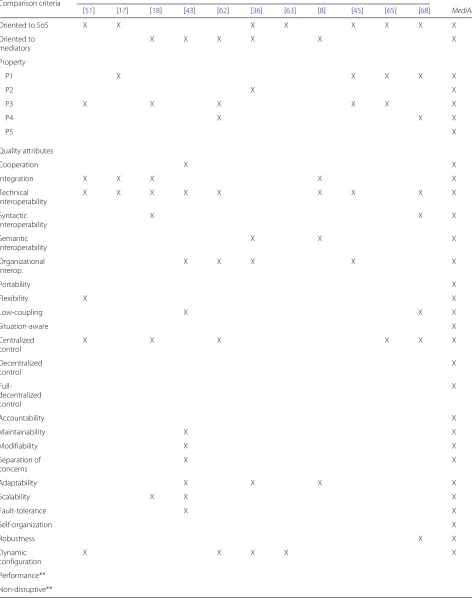
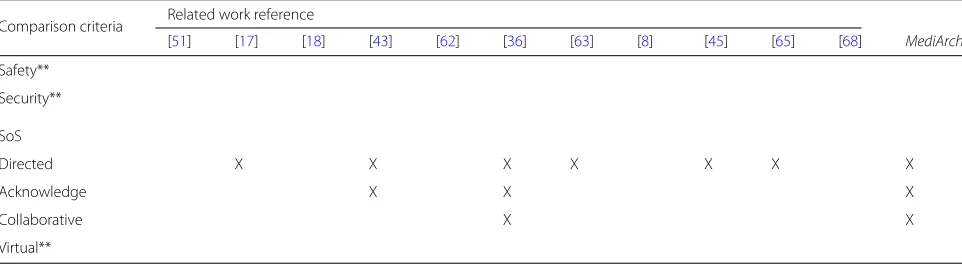
Last column of Table 2, summarizes MediArch contri-butions to support architectural properties (P), quality attributes, and SoS types. Properties and qualities of SoS architectures were introduced in the “Identification of mediation requirements in SoS” section and types of SoS were defined in the “Systems-of-systems” section. Table2
compares contributions made in MediArch and related works.
MediArchadvances the state-of-the art, since from our knowledge, is the second approach proposed to overcome problems in SoS architectures that considers mediators as first-class entities. The first work in this line is reported in [36].MediArchalso proposes mediators organizations that can be configured to support (at least partially) all SoS properties. Therefore, SoS architectures based on Medi-Arch could be able to dynamically integrate constituent systems, identify possible emergent behaviors, set up dif-ferent strategies for control and decision-making (i.e., centralized, decentralized, full-decentralized), evolve over time including or modifying new requirements, policies, or constituents, and decide and execute reconfigurations at runtime. This is possible, due to mediators were pro-posed inMediArch to address important qualities, such as interoperability (in all its levels), low-coupling, sepa-ration of concerns, scalability, and maintainability. More-over, based on experiences at architecting FMSoS and HSH-SoS, we are confident that MediArch can be used as backbone to create software architectures for directed, acknowledge, and collaborative SoS.
Limitations and directions for future studies
The SoS construction requires investments of time, eco-nomical resources, human resources, and the establish-ment of partnerships and collaborations among own-ers and managown-ers of the SoS and its constituent sys-tems. Hence, architectures of both FMSoS and HSH-SoS were conceptually validated in this work. Medi-Archwas assessed regarding organizations of SoS entities
(constituent systems, consumer systems, and mediators) for achieving requirements of interoperability, integration, modifiability, low-coupling, and flexibility. Low-coupling capabilities brought by mediators allow us to visualize how SoS architectures could support dynamic reconfig-urations; however, more investigations about mediators synthesis at runtime must be conducted to verify this hypothesis. Moreover, additional studies about how Medi-Arch could overcome issues related to performance, non-disruptive configurations, safety, and security must be done. These issues were identified as trade-offs during
MediArchassessment.
Complementary decisions to define internal structures and behaviors of each mediator must be made. For instance, for communication mediators,Collaborator (C)
can implement theRPC2pattern,Router (R)can be struc-tured followingpublish-subscribe, andDistributor (D)can be assembled as a service bus. For control mediators,
Monitor (M) can be instantiated either as an Observer
when no clear contract exists between SoS and moni-tored constituent systems, or as part of apublish-subscribe
strategy when Monitor (M)subscribes to messages sent by constituent systems. ForAnalyzer (A), additional deci-sions are related to approaches for predicting situations (or emergent behaviors) based on historic SoS status. Situations can be predicted using machine learning algo-rithms, such as those proposed in [30], namely, dimen-sion reduction, clustering, classification, or regresdimen-sion. For
Planner (P)a standardized template to represent reconfig-uration plans must be established, since reconfigreconfig-uration strategies could be modified at runtime by the SoS man-ager. Both reconfiguration plans (used byPlanner (P)) as situations records (used by Analyzer (A)) can be mod-eled through ontologies, XML schemes, graphs, entity-relationship, key-value, or NoSQL schemes, and stored in dedicated repositories. Decisions to implement medi-ators will depend on (1) the nature of each SoS, i.e., directed, acknowledged, collaborative, and virtual [46,52]; (2) categories of emergent behaviors that the SoS could present, i.e., simple, weak, strong, or spooky [48]; and (3) SoS requirements related to quality attributes, e.g., performance, reliability, or security.
Besides using MediArch, SoS architects will need to define strategies for mediators synthesis at runtime, to achieve requirements of reliability, dynamic evolution, and adaptivity. Automatic synthesis is required, as medi-ators must be created or removed during SoS operations. Some interesting approaches architects could follow are presented in [27,33–35].
Initial research on requirements of quality attributes and architectural styles/patterns for SoS and self-adaptive, self-management, self-organizing (self-*) systems served
Table 2Comparison betweenMediArchand related work
Comparison criteria Related work reference
[51] [17] [18] [43] [62] [36] [63] [8] [45] [65] [68] MediArch
Oriented to SoS X X X X X X X X
Oriented to mediators
X X X X X X
Property
P1 X X X X X
P2 X X
P3 X X X X X X
P4 X X X
P5 X
Quality attributes
Cooperation X X
Integration X X X X X
Technical interoperability
X X X X X X X X X
Syntactic interoperability
X X X
Semantic interoperability
X X X
Organizational interop.
X X X X X
Portability X
Flexibility X X
Low-coupling X X X
Situation-aware X
Centralized control
X X X X X X
Decentralized control
X
Full-decentralized control
X
Accountability X
Maintainability X X
Modifiability X X
Separation of concerns
X X
Adaptability X X X X
Scalability X X X
Fault-tolerance X X
Self-organization X
Robustness X X
Dynamic configuration
X X X X X
Performance**
![Fig. 1 General representation of a mediator. Source [23]](https://thumb-us.123doks.com/thumbv2/123dok_us/854969.1583132/4.595.58.291.651.715/fig-general-representation-mediator-source.webp)

![Fig. 2 MediArch, a layered architecture for SoS based on mediators. Adapted from [23]](https://thumb-us.123doks.com/thumbv2/123dok_us/854969.1583132/6.595.58.540.503.715/fig-mediarch-layered-architecture-sos-based-mediators-adapted.webp)
![Fig. 3 Communication mediators. Adapted from [23]. a Pipe. b Collaborator. c Distributor](https://thumb-us.123doks.com/thumbv2/123dok_us/854969.1583132/7.595.59.541.503.713/fig-communication-mediators-adapted-pipe-b-collaborator-distributor.webp)
![Fig. 4 Conversion mediators. Adapted from [23]. a Filter. b Wrapper. c Adapter. d Data fusion](https://thumb-us.123doks.com/thumbv2/123dok_us/854969.1583132/8.595.57.542.442.718/conversion-mediators-adapted-filter-wrapper-adapter-data-fusion.webp)
![Fig. 5 Control mediators. Adapted from [23]. a Monitor. b Analyzer. c Planner. d Executer](https://thumb-us.123doks.com/thumbv2/123dok_us/854969.1583132/10.595.56.539.86.329/fig-control-mediators-adapted-monitor-analyzer-planner-executer.webp)
![Fig. 6 FMSoS architecture. Adapted from [23]. a Layered view. b Mediator view](https://thumb-us.123doks.com/thumbv2/123dok_us/854969.1583132/11.595.60.542.501.722/fig-fmsos-architecture-adapted-layered-view-mediator-view.webp)