R E S E A R C H
Open Access
Topological study of the convergence in
the voter model
Inés Caridi
1*, Sergio Manterola
2, Viktoriya Semeshenko
3,4and Pablo Balenzuela
2,5*Correspondence:[email protected] 1Calculus Institute, University of Buenos Aires and CONICET, Buenos Aires, Argentina
Full list of author information is available at the end of the article
Abstract
The voter model has been widely studied due to its simple formulation and attainable theoretical treatment. The study of the “active links”, edges that connect nodes in different states, has been a key element in the analysis of the convergence of the model. Typically, the density of active links,ρ, is used to characterize the system when approaching to absorbing state. However, more information can be extracted from how the active links are distributed across the underlying network.
In this paper we study the dynamics of active links in the voter model, from a perspective of complex networks. This approach allows us to understand how the dynamics of the model is mapped in topological features of a dynamical network of active links. We found that certain topological properties of the Active Link Network show salient features related to the dynamics of the model. The Active Link Network goes from a state similar to the underlying random network in the initial state to extremely disassortative graph when the dynamics approaches to absorbing state. In this state, the active link network is dominated by “star-like” motifs, where different opinions take different topological roles on the network. Thus, the Active Link Network shows some properties which are distant from the hypothesis made by the current theoretical models, which assume there are no correlations among active links.
Introduction
The voter model is one of the most well-known models with non-equilibrium dynamics. It has been studied extensively as a paradigmatic opinion dynamics model in the framework
of probability theory (Clifford and Sudbury1973; Liggett1999) and statistical physics, and
is one of the few non-equilibrium stochastic processes that can be solved exactly (Redner
2001). The model consists ofNagents placed in the nodes of an interacting network. Each
agent is characterized by a single variableswhich can take values+1 or−1. The standard
rules of the model establish that at each time stept, a random individual is selected (agent
i) and a random neighbour is selected among his nearest neighbours (agentj). If the states
of agents are different, agentiimitates the state of agentj, otherwise the states remain
unchanged. This imitation dynamics has been proposed as a social influence mechanism
in contexts of great uncertainty (Bikhchandani et al.1992).
Starting from random initial conditions, these simple rules tend to increase the order of the system. For instance, in finite systems, this dynamics gives place to the emergence of the consensus of one of the two states. The time to reach consensus depends on the
sizeNand dimensiondof the system (Cox1989). An interesting question that appears is
whether full consensus is reached in a system of infinite size.
The voter model has been solved exactly for hypercubic lattices of arbitrary dimensions using different approaches. Early studies performed by probabilists (Clifford and
Sud-bury1973; Holley and Liggett1975; Liggett1985; Cox and Griffeath1986) used the fact
that the model can be exactly mapped on a model of random walkers that coalesce upon encounter. Another approach based on master equations in order to derive the general
solution on lattices was followed in (Krapivsky1992; Frachebourg and Krapivsky1996).
The authors used the master equation for the probability distribution function for the
stateSof the system to derive the asymptotic behavior of the density of active links (or
interface), and concluded that the voter model reaches consensus for dimensionsd≤2.
Ford > 2, instead, it exhibits asymptotically a finite density of links which means that
no consensus is reached. The density of active links is a useful measure to describe the dynamics of the system towards its asymptotic state and it is a good quantity to use as an order parameter, given that it is nonzero while the system is not in one of the absorbing states and zero otherwise.
The original voter model does not include the possibility of spontaneous changes
in the variables given that the state of a node only changes through interaction with
nearest neighbors. However, the noisy voter model (Scheucher and Spohn1988;
Gra-novsky and Madras1995; de Oliveira et al.1993) incorporates this option producing the
disappearance of long range order (de Oliveira et al.1993).
Given its simplicity, the voter model has been studied under several modifications. For
instance, (Mobilia2003; Mobilia et al.2005; Mobilia et al.2007) incorporate the
pres-ence of “zealots”, i.e., individuals that does not change the opinions during dynamics. On
the other hand, in (Vázquez et al.2003; Vázquez and Redner2004) the constrained voter
model is analyzed. In this work, agents can be in three states (leftists, rightists, or cen-trists) but interactions involve only centrists. When the change of the state of the agent requires the agree of several of his neighbors, it is called the q-voter model and has been
analyzed in Timpanaro and Galam (2014); Javarone and Squartini (2015). Several other
modifications can be found in 67 (Castallano et al.2009).
The collective dynamics can be modified if the underlying topology is not regular
and is represented by complex networks (Castellano et al.2003; Sood and Redner2005;
Suchecki et al.2005a; Castellano2005; Sood et al.2008). In these cases, different ways
of defining the voter dynamics, which are perfectly equivalent on regular lattices, give rise to nonequivalent generalizations of the voter model. The most natural
generaliza-tion is called thedirect voter modeland consists in picking up a node and making it equal
to one of its neighbors. With this rule the global magnetization is not longer conserved
(Castallano et al.2009; Suchecki et al.2005b). The magnetization is conserved if a link
updating rule is implemented (Suchecki et al.2005b). If a selected node copies its state to
a randomly selected neighbor it is calledreverse voter model.
The voter model has been studied on different complex networks (Castellano et al.
2003; Sood and Redner2005; Suchecki et al.2005a; Castellano2005; Sood et al.2008),
where various variables have been analyzed: mean consensus time in finite networks, the influence or degree of randomness, among others. The co-evolving voter model, in which nodes follow rules of the voter model and reorganization of the links takes place through
rewiring dynamics, has been analyzed in (Holme and Newman2006; Vazquez et al.2008;
Kimura and Hayakawa2008; Durrett and et al.2012; Böhme and Gross2011; Demirel
single connected network to a network with two components (Holme and Newman2006;
Vazquez et al.2008).
From previous works we have seen that for an ensemble of finite complex networks,
the density of active links (ρ) follows an exponential decay fromρ 0.5 for a random
initial state to zero as the dynamics converges to absorbing state (Suchecki et al.2005a).
However, the study of the active links in terms of networks has not been done yet.
The master equation forρ(t)was also used to analyze the dynamics towards absorbing
state in complex uncorrelated networks where it was derived using the homogeneous
pair approximation (Vazquez and Eguiluz2008). An improvement to this analysis could
be found in (Pugliese and Castellano2009) where a heterogeneous pair approximation is
developed allowing a dependence of the density of active links with the node degree,ρ(k),
generalizing the previous studies.
The above mentioned works provide the solutions in the thermodynamic limit, and assume that active links are uncorrelated. However, as it was suggested in (Böhme and
Gross2011), this assumption is not correct. The authors studied the fragmentation
tran-sition (FT) in an adaptive voter model. In this work, the voter model dynamics is analyzed
in the vicinity of the fragmentation zone, where the density of active links (ρ) is low, and
noticed that active links can not be treated as independent because “they all become inert at once if the focal node reverts to its original opinion” (active links form star-like motifs in this regime). This correlation underlies the observed inaccuracy in mean field approxi-mations which are overcame by the authors using a motif-like dynamics of multiple active links.
These ideas have been further explored in (Demirel et al.2014), where the authors
high-lighted the importance of the heterogeneity of active links given by star-like motifs, and developed a theoretical description of fragmentation dynamics in the neighborhood of the transition.
Given that the distribution and dynamics of active links are crucial in order to understand the evolution of the model and related topics, we analyze numerically the sub-graph of the underlying network formed by the active links. In particular, we study the convergence process of the voter model in some complex networks by analyzing the evolution and topological properties of the Active Links Network. We observe that the system evolves from an Active Link Network similar to the
underlying graphs (when ρ 0.5) to a graph dominated by star-like motifs, when
ρ is close to zero. This little structures are highly dissasortative, and there exist
a strong correlation between the topological role of nodes and the value of their opinions.
The model
We consider the evolution of a direct voter model ofNagents immersed in a contact
net-work,G. Here,Gis an Erdos-Renyi (ER) random network with mean degree<k >=12
although results for ER with mean degree<k>=6 and a Barabasi-Albert type are shown
in AppendixA. Let us callsithe opinion state ofi-agent, which can take two possible
val-ues: 1 and−1. Initially, the states of agents are set up randomly with the same probability
for each one.
of links ofG. The Active Links Network, calledGALis defined as the induced sub-graph
ofGfrom the set of active links. Hence,GALis included inG.
Here is important to make clear the difference between the underlying (contact) net-work, which remains static during the implemented voter model dynamics, and the Active Links Network, which is a dynamical structure reflecting the dynamical state of the whole system.
In what follows, we analyze the topological properties of the Active Links Network
GAL, resulting from a voter model dynamics, in order to extract the information of the convergence process encoded in this topology.
As we mentioned in the Introduction, given the exponentially monotonic decaying
rela-tionship between the average ensemble of density of active linksρ(t)in complex networks
(Suchecki et al.2005a), we describe the convergence process in terms ofρ, which makes
it easier to calculate and compare the results with related problems (Böhme and Gross
2011; Demirel et al.2014).
Results
In order to proceed with the analysis, we select two particular instants of the dynamics
which correspond to different values of the parameterρ: early times corresponding to
large values ofρ(0.5) and times close to convergence which correspond to small values
ofρ(0.0).
In order to describe the Active Links Network,GAL, we begin with the analysis of the
connectivity properties of the network, and the comparison between the connectivity
properties of nodes in both networks (the contact one andGAL): the degreekof an agent
on the contact network, the mean degree<kk>of his neighbors on the contact network,
the degree of an agent onGAL, kAL, and the mean degree of his neighbors onGAL, <
kk>AL.
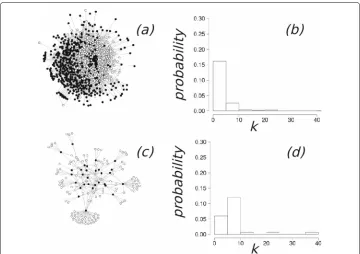
In order to visualize the main differences in the GAL at the different stages of the
dynamics, we plot snapshots ofGALas shown in Fig.1a, c.
In right panels of Fig.1b, d we plot the degree distribution of the corresponding graph
GAL. We can observe that for large values ofρ, the result looks similar to the underlying
static ER network. It is the expected result given that the dynamics does not alter the
collective state of the system. Empty points correspond to states−1, and filled points to
states 1.
However, if we look at theGALclose to the converged state, we can appreciate that the
degree distribution is completely different from the previous one, and it is dominated by a high number of nodes with degree one and two. We can also observe a small peak of nodes with higher degree. This is consistent with the star-like motifs observed in the snapshots. We can see from the quasi converged snapshot, that the nodes in the dominant state are all with degree one (standing for the role of leaves of the stars), or degree two (connecting two stars), and eventually, degree three (connecting three stars).
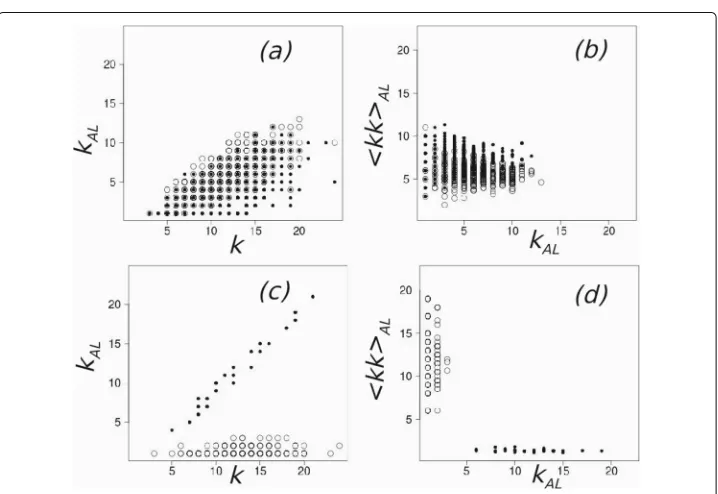
In order to understand how collective properties of the model are mapped into theGAL,
we plot the degree of nodes inGAL(kAL) versus the degree of nodes in the underlying
static network (k) in left panels of Fig.2a, c, for the same two values ofρ.
In top panel, we observe that nodes in the active link network take values under the
diagonal for large values ofρ. This comes from the definition ofGAL and there is no
Fig. 1Realization of a system withN=1000 agents, and Erdos-Renyi contact network of<k>=12. Figures correspond to two values of the parameterρ. Up: early timesρ=0.47; Down: times close to convergenceρ=0.026. Left panela,c: snapshots ofGAL. Right panelb,d: degree distribution of the
corresponding graphGAL
Fig. 2Snapshots and degree distribution ofGALfor Erdos-Renyi contact network of<k>=12 with N=1000 agents. Upper panelsaandbcorrespond toρ=0.47. Down panelscanddcorrespond to
ρ=0.026. Left panelsa,c: degree of the nodes inGAL(kAL) versus the degree of the nodes in the underlying
When we look at the collective state at small values ofρwe can observe that the dynamic leads the system to a state close to consensus and it is reflected in the connectivity prop-erties of the nodes, consistently with the star-like motifs observed in the previous figure:
few nodes with the approximately the same degree in theGALandG(kkAL), and most
of the nodes withkAL=1 orkAL=2, no matter their degrees in the ER static network.
In right panels of Fig.2b, d we plot the degree correlation ofGAL, i.e., the mean degree
of the neighbors of the nodes ofGAL(< kk>AL) vs the degree of the same nodes in the
Active Link Network (kAL). We observe a clear degree correlation among nodes of the
GALcorresponding to the star-like motifs: neighbours of nodes with high degree have low
mean degree and vice-versa. This is consistent with the large peak observed at lowkAL
and the small peak at intermediate values ofkALin the degree distribution of Fig.1d.
From both figures we would like to point out that when the system is close to the
absorb-ing state (values ofρclose to zero), nodes are separated in accordance with their opinion
state. In the present example, white circles correspond to small degree values while the mean degree of their neighbors is high. The opposite occurs for black circles. The
snap-shot of the correspondingGAL Fig.1c reveals that white nodes are playing the role of
leavesof stars, and black nodes the role ofcentres.
The main result can be summed up as follows: when the system converges, the topo-logical role of the nodes splits according to their state in the network. The nodes that correspond to the dominant opinion display low degree in the Active Link Network and are connected to the nodes expressing the opposite opinion which have high degrees in star type motifs.
Given the different topological roles of both populations in the networkGAL, we found
that it could be more informative to analyze its topological properties according to their
dynamical states, i.e., separating populations by their opinions (1 or−1).
Once we understand that it is informative to observe the properties of the network
GALfor both populations in a separate way, we try to capture to what extent these two
populations could be separate or not from the topological point of view of the network.
The results of Fig.2correspond to a single realization of the system, for two different
values of the parameterρthat display the dynamics at different stages of the evolution.
We can extrapolate these results to the case of several realizations of the system and, at
the same time, for different values ofρ, thus trying to characterize the transition from
large values ofρto small values.
In Fig.3a, we plot the mean degree of theGAL(<k>AL) as a function ofρfor each one
of the populations for 100 realizations of the system. For each time every 20 time steps,
we averaged the values of degree for all agents in states=1, and the same for agents in
states = −1. In this way, we obtain two values for each selected step. We can observe
that, when the system evolves decreasingρ, two branches separate from each other. The
superior branch corresponds to the population which is playing the role of centres of starts, while the inferior branch is associated with the population that is playing the role of
leaves of the stars. This separation is clear for low values ofρ. In order to clarify different
stages of the evolution, we define colors for given ranges ofρ. In case we consider the two
populations as a whole, both branches disappear and the mean degree ofGALdecays fromk/2
whenρ0.5 to a value near 2 whileρapproaches to zero, as we can observe in Fig.3b.
In order to understand the effects of the dynamics, we compare the Active Link Network
Fig. 3Degree and degree correlations between the Erdos-Renyi contact network of<k>=12 and theGAL
forN=1000 agents and 100 realizations of the dynamics. Panela: mean degree of theGALfrom each state’s
population vsρ. Each step of realization contributes with two points to the plot: one for the mean degree of the population of agents in state 1 and one for agents in state−1. Different colors are used to identify different ranges of values ofρ. Red points correspond to the case in which the states of the agents are assigned at random and theGr
ALis determined from this random assignation. Panelb:mean degree of the GALvsρwithout separating populations
points in Fig.3a) consists in selecting the same number of agents with states= +1 and
s = −1 for a given time in the evolution and assigning them randomly to nodes. When
comparingGAL withGrAL, the main difference is observed in the upper branch of the
curve in Fig.3a which is the minority of both populations. On the other hand, the bottom
branch overlaps withGrAL, showing almost the same behavior whenρdecreases. This if
what we expect if a node of the majority population is placed at random in the underlying network: the chances to be alike as in the real Active Link Network are high.
Figure4shows the evolution of assortativity of theGAL(<kk>ALvskAL) for an
ensem-ble of 100 realizations and the whole range of values ofρ, but separating nodes according
to its opinion state as in Fig.3. Once again, the case of low values ofρ(<0.1) reflects a
completely separated behavior of the populations (black points), while for large values of
ρ(violet points, corresponding toρ >0.4), nodes with different opinions do not
differ-entiate themselves. As in Fig.3, red points correspond to random assignments of opinion
state to nodes, without following the voter dynamics.
Once again we can observe that separating the populations of nodes by their dynam-ical state allows us to appreciate how different topologdynam-ical properties clearly emerge. In order to quantify the relation between the state of the nodes and their topological roles
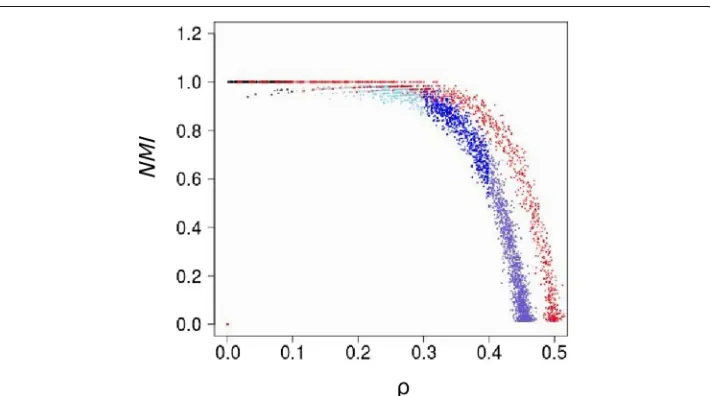
in theGAL, we calculate their Normalized Mutual Information (NMI) according to the
definition sketched in AppendixB.
Figure5showsNMIas a function ofρ. We observe that, for high values ofρ, data about
the statesof the agents in theGALdoes not bring information about their topological role
thusNMIis close to zero. On the other hand, whenρdecreases, the fact of knowing one
of the variables brings information about the other makesNMIincreases its value. The
extreme scenario is reached when the Normalized Mutual Information has the maximum
value 1: the knowledge of the state of nodes inGALdetermines unequivocally their
topo-logical roles and vice-versa. These result are consistent with the observed in Figs.1c, d
and2c, d.
As in Figs.3and4, red points of Fig.5correspond to random assignment of opinion
Fig. 4Degree correlations ofGALfor each agent ofGALseparating nodes according to its opinion state for
different values ofρ. 100 realizations ofN=1000 agents with an underlying network of contacts of Erdos-Renyi of<k>=12. Each step of each realization contributes with two points to the plot: one for
<kk>ALof the population of agents in state 1 and one for agents in state−1. Different colors are used to
identify different ranges of values ofρ. Red points correspond to the case in which the states of the agents are assigned at random and theGALis determined from this random assignation
Conclusions
The voter model is a non-equilibrium dynamical model which has been widely studied from different points of view and with multiple variations. One of the most successful approaches used to describe the macroscopic dynamical evolution of the voter model is by
describing the time evolution of the density of active linksρ, which goes fromρ0.5 for
a random initial condition toρ=0 for the system near the absorbing state. This average
magnitude has been used to compare analytical formulation of the model with numerical
calculations, as in (Vazquez and Eguiluz2008), (Pugliese and Castellano2009). However, the distribution of the active links over the contact network among nodes in different states serves as a map of the dynamical state of the system with much more information
than simply its average valueρ.
In this paper we explore numerically the dynamics of active links in the voter model from a perspective of complex networks. This approach allows to comprehend how the dynamics of the model is mapped inside the topological features of a network of active links and how their dynamical evolution brings a more detailed understanding of the voter model.
At early times in the dynamics, the Active Links Network is similar to the underlying contact network, but when the system evolves towards the absorbing state, the graph of active links becomes highly dissasortative and a degree distribution dominates by a high
peak at low degree values. When we look at the snapshots of Fig.1, we can appreciate that
it is dominated by star-like motifs and is completely different from the contact networks. These star-like structures are the signature that the voter model is closer to the consensus state.
The results displayed for the contact Erdos-Renyi network with mean degree<k >=
12 are similar to those observed for the same kind of underlying network with different
mean degree (ER with< k >= 6), or for Barabasi-Albert scale free distribution, as is
shown in the AppendixA.
An interesting result is that the description of Active Link Network is even more
infor-mative from topological point of view if nodes with states= +1 ands= −1 are plotted
separately. When the system is close to the consensus state, nodes from the majority
pop-ulation are theleavesof the star-like structures and therefore, they have degrees one or
two in the active link network. If we plot the mean degree in theGALor the mean degree
of the nearest neighbors, we can observe how populations separate in different states
when the systems evolves toward consensus (asρdecreases). Finally, Fig.5show that for
ρ≤0.3 the state of the nodes determines their topological role in structures of the active
link network, as indicated by the normalized mutual information.
This analytical framework could be used to analyze models with a more complex
dynamics, like for instance the q-voter model (Timpanaro and Galam 2014; Javarone
and Squartini2015), the multistate voter model (Böhme and Gross2012) or the Axelrod
model (Axelrod1997) where each node can see different number of networks and can be
in different states respectively. In these cases, we do not expect that active link networks evolves towards star-like motifs of two states, because these structures are produced with two-states nodes only, like the classical voter model. However, these and other models deserve a careful further analysis.
Finally, we would like to point out that the use of complex networks for mapping the dynamical state of a complex system has been used in other fields to represent collective states when the underlying topology was unknown, as for instance in large scale brain
experiments as in (Eguíluz et al.2005), (Tsonis and Roebber2004), but not as a tool to
describe the evolution of a system towards asymptotic state, as was shown in this work.
Appendix A
In this Appendix we present the results when the voter model runs over different underlying
Fig. A.1 Realization of a system withN=1000 agents, and Barabasi-Albert contact network of mean degree
<k>=12. Figures correspond to two values of the parameterρ. Up: early timesρ=0.49; Down: times close to convergenceρ=0.07. Left panela,c: snapshots ofGAL. Right panelb,d: degree distribution of the
corresponding graphGAL
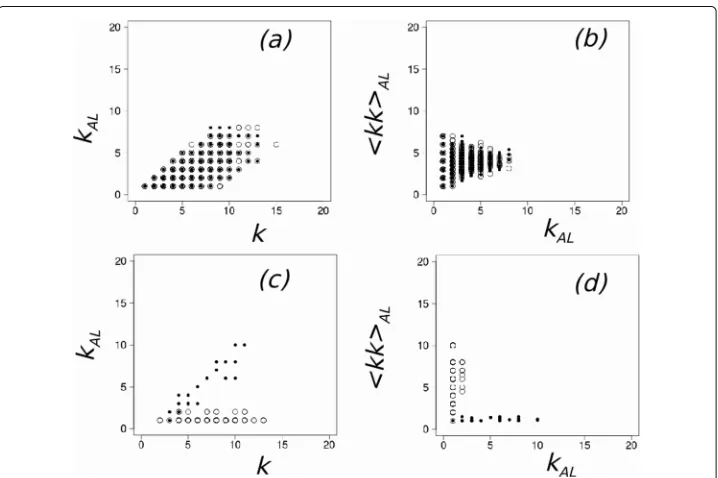
Fig. A.2 Realization of a system withN=1000 agents, and Barabasi-Albert contact network of<k>=12. Left panelsa,c: Degree of the nodes inGAL(kAL) versus the degree of the nodes in the underlying static
network (k). Right panelsb,d: degree correlation ofGALfor each agent ofGAL. Upper panelsaandb
Fig. A.3 Realization of a system withN=1000 agents and Erdos-Renyi contact network of mean degree
<k>=6. Figures correspond to two values of the parameterρ. Up: early timesρ=0.49; Down: times close to convergenceρ=0.04. Left panela,c: snapshots ofGAL. Right panelb,d: degree distribution of the
corresponding graphGAL
Barabasi-Albert (<k>=12) contact networks. Upper panels correspond to initial stage
of the evolution (ρ = 0.49), while bottom panels correspond to the almost converged
system (ρ = 0.07). On the other hand, Figures A.3 and A.4 show the same result for
Erdos-Renyi<k>=6 contact network. Upper panels correspond toρ=0.49 value and
bottom panels toρ=0.04 value.
Fig. A.4 Realization of a system withN=1000 agents, and Erdos-Renyi contact network of mean degree
<k>=6. Left panelsa,c: degree of the nodes inGAL(kAL) versus the degree of the nodes in the underlying
static network (k). Right panelsb,d: degree correlation ofGALfor each agent ofGAL. Upper panelsaandb
We can appreciate that the main conclusions about the behavior of the Active Link
Networks for the Erdos-Renyi< k >= 12 remain qualitatively the same for these two
different contact networks: the system evolves towardsGALdominated by star-like motifs
where nodes in different states play different topological roles. In the case of Erdos-Renyi,
the differences betweenGALand the contact networks are more evident than in the case
of Barabasi-Albert. These differences are better appreciated when the mean degree of the network is increased. For the Barabasi-Albert case, although it is clear for the snapshot of the network (Figure A.2(c)) that one of the populations is playing the role of leaves and the
other one the centres of stars, the difference between both networks (GALand the contact
networks) is appreciated better in the relation between degrees than in the assortativity ofGAL.
Appendix B
In this appendix we provide the definition of Mutual Information used in Fig. 5. The
mutual information of two variablesxandyis defined as (Cover and Thomas2006):
MI(x,y)=H(x)−H(x|y)
whereH(x|y)is the conditional entropy of variablexgiven thatyis a known variable and
H(x)is the entropy of variablex. The entropy of a given variablexis defined as the average
of the Shannon Information contained in the possible outcomes of the variables, such as:
H(x)=P(x=1)h(x=1)+P(x=0)h(x=0)
beingP(x = 1)the probability of variablextaking value 1 andh(x = 1)the Shannon
Information contained in the outcome value 1 of variablex, which is defined as h(x =
1)= −log2P(x=1).
With the purpose of studying the relation between the state of the nodes and their
topo-logical roles, we define two categorical variables: theactivityof an agentai, which takes
the value 1 when belongs to theGAL, and 0 otherwise, and theroleof an agenti,ri, which
takes three possible values:ri =1 ifkkAL > kAL(iagent is considered a leaf ),ri =0 if
kkAL < kAL(iagent is a centre of a star), andri=2 ifkkAL = kAL(otherwise).
The Normalized Mutual Information (NMI) is defined byMI(r,s|a= 1)/H(r|a= 1),
beingH(r|a=1)the Entropy ofr, given that the nodes belong to theGAL, and thus, the
maximum value thatMI(r,s|a=1)can take.
Therefore, if the opinion states of the nodes determine unambiguously their topological
roles in theGAL, the Mutual InformationNMIshould be maximum. In the opposite case,
when states of the nodes do not carry any information about the topological role, it should be zero.
Acknowledgements
We wold thank Lic. Ariel Salgado for enrichment discussions about the work.
Authors’ contributions
CI and BP designed the work; CI and MS implemented the simulations; CI prepared the figures; CI, SV and BP discussed the results and wrote the manuscript. All authors read and approved the final manuscript.
Funding
Conicet funding PIP 11220130100484CO01.
Availability of data and materials
Competing interests
The authors declare that they have no competing interests.
Author details
1Calculus Institute, University of Buenos Aires and CONICET, Buenos Aires, Argentina.2Departamento de Física, Facultad
de Ciencias Exactas y Naturales, Universidad de Buenos Aires, Buenos Aires, Argentina.3Universidad de Buenos Aires.
Facultad de Ciencias Económicas, Buenos Aires, Argentina.4CONICET-Universidad de Buenos Aires. Instituto
Interdisciplinario de Economía Política de Buenos Aires, Buenos Aires, Argentina.5Instituto de Física de Buenos Aires
(IFIBA), CONICET, Buenos Aires, Argentina.
Received: 9 July 2019 Accepted: 13 November 2019
References
Axelrod R (1997) The dissemination of culture a model with local convergence and global polarization. J Confl Resol 41(2):203–226
Bikhchandani S, Hirshleifer D, Welch I (1992) A Theory of Fads, Fashion, Custom, and Cultural-Change as Informational Cascades. J Pol Econ 100:992–1026
Böhme GE, Gross T (2011) Analytical calculation of fragmentation transitions in adaptive networks. Phys Rev E 83:035101 Böhme GA, Gross T (2012) Fragmentation transitions in multistate voter models. Phys Rev E 85:066117.https://doi.org/10.
1103/PhysRevE.85.066117
Castallano C, Fortunato S, Loreto V (2009) Statistical Physics of Social Dynamics. Rev Mod Phys 81:591
Castellano C (2005) Effect of network topology on the ordering dynamics of voter models. AIP Conf Proc 779:114 Castellano C, Vilone D, Vespignani A (2003) Incomplete ordering of the voter model on small-world networks. Europhys
Lett 63:153–158
Clifford P, Sudbury A (1973) A model for spatial conflict. Biometrika 60:581–588
Cover TM, Thomas JA (2006) Elements of Information Theory. Wiley Series in Telecommunications and Signal Processing, United States of America
Cox J (1989) Coalescing Random Walks and Voter Model Consensus Times on the Torus in Zd.Ann. Probab 17:1333 Cox J, Griffeath D (1986) Diffusive Clustering in the Two Dimensional Voter Model. Ann Probab 14:347
Demirel G, Vazquez F, Böhme GE, Gross T (2014) Moment closure approximation for discrete adaptive networks. Phys D 67(267):68–80
de Oliveira, M, Mendes J, Santos M (1993) Nonequilibrium spin models with Ising universal behaviour. J Phys A 26:2317 Durrett R, et al. (2012) Graph fission in an evolving voter model. Proc Natl Acad Sci USA 109:3682
Eguíluz VM, Chialvo DR, Cecchi GA, Baliki M, Apkarian AV (2005) Scale-Free Brain Functional Networks. Phys Rev Lett 94:018102
Frachebourg L, Krapivsky PL (1996) Exact results for kinetics of catalytic reactions. Phys Rev E 53:R3009 Granovsky B, Madras N (1995) The noisy voter model. Stoch Proc Appl 55:23
Holley R, Liggett T (1975) Ergodic Theorems for Weakly Interacting Infinite Systems and the Voter Model. Ann Probab 3:643 Holme P, Newman MEJ (2006) Nonequilibrium phase transition in the coevolution of networks and opinions. Phys Rev E
74:056108
Javarone M, Squartini T (2015) Conformism-driven phases of opinion formation on heterogeneous networks: The q-voter model case. J Stat Mech Theory Exp:P10002.https://doi.org/10.1088/1742-5468/2015/10/P10002
Krapivsky PL (1992) Kinetics of a monomer-monomer model of heterogeneous catalysis. Phys Rev A 45:1067 Kimura D, Hayakawa Y (2008) Coevolutionary networks with homophily and heterophily. Phys Rev E 78:016103 Liggett TM (1999) Stochastic Interacting Systems: Contact, Voter and Exclusion Processes. Springer, New York Liggett TM (1985) Interacting Particle Systems. Springer-Verlag, New York
Mobilia M (2003) Does a single zealot affect an infinite group of voters? Phys Rev Lett 91:028701 Mobilia M, Georgiev, IT (2005) Voting and catalytic processes with inhomogeneities. Phys Rev E 71:046102
Mobilia M, Petersen A, Redner S (2007) On the role of zealotry in the voter model. J Stat Mech: Theory Exp:P08029.https:// doi.org/10.1088/1742-5468/2007/08/p08029
Pugliese E, Castellano C (2009) Heterogeneous pair approximation for voter models on networks. EPL 88:58004 Redner S (2001) A Guide to First-passage Processes. Cambridge University Press, Cambridge
Scheucher M, Spohn H (1988) A soluble kinetic model for spinodal decomposition. J Stat Phys 53:279 Sood V, Antal T, Redner S (2008) Voter models on heterogeneous networks. Phys Rev E 77:041121 Sood V, Redner S (2005) Voter Model on Heterogeneous Graphs. Phys Rev Lett 94:178701
Suchecki K, Eguiluz V, San Miguel M (2005) Voter model dynamics in complex networks: Role of dimensionality, disorder, and degree distribution. Phys Rev E 72:036132
Suchecki K, Eguíluz VM, San Miguel M (2005) Conservation laws for the voter model in complex networks. Europhys Lett 69:228
Timpanaro AM, Galam S (2014) An analytical expres- sion for the exit probability of the q-voter model in one dimension. arxiv:1408.2734
Tsonis AA, Roebber PJ (2004) The architecture of the climate network. Phys A Stat Mech Appl 333:497–504 Vazquez F, Eguiluz VM (2008) Analytical solution of the voter model on uncorrelated networks. New J Phys 10:063011 Vazquez F, Eguíluz VM, San Miguel M (2008) Generic absorbing transition in coevolution dynamics. Phys Rev Lett
100:108702
Vázquez F, Krapivsky PL, Redner S (2003) Constrained opinion dynamics: freezing and slow evolution. J Phys A 36:L61 Vázquez F, Redner S (2004) Ultimate fate of constrained voters. J Phys A 37:8479
Publisher’s Note