An IND‑CCA2 secure post‑quantum
encryption scheme and a secure cloud storage
use case
Peng Zeng
1, Siyuan Chen
2*and Kim‑Kwang Raymond Choo
3Introduction
With rapid advances in Internet and information and communication technologies (ICT; e.g., computation devices, speed of communication and device processors), our society is becoming increasingly reliant on technologies. This is particularly true for technologi-cally advanced countries. This has also given rise to a significant increase in the amount of data generated, and needed to be processed and stored (e.g., using distributed stor-age servers such as cloud server). Cloud storstor-age service providers such as Amazon’s S3 offer users public cloud storage services, where users can backup, access and/or process their data anywhere from some computing devices (e.g., Android and iOS devices) con-nected to the Internet. Popularity of such services is also driven by financial costs, as it may be cheaper to pay for what you use than building, maintaining and securing one’s local storage services. One downside, however, is the potential data privacy and integrity risks since data is now outsourced to some public cloud service providers that may be
Abstract
Code‑based public key encryption (PKE) is a popular choice to achieve post‑quantum security, partly due to its capability to achieve fast encryption/decryption. However, code‑based PKE has larger ciphertext and public key sizes in comparison to conven‑ tional PKE schemes (e.g., those based on RSA). In 2018, Lau and Tan proposed a new rank metric code‑based PKE scheme, which has smaller public key and ciphertext sizes compared to other code‑based PKE schemes. They also proved that their scheme achieves IND‑CPA security, assuming the intractability of the decisional rank syndrome decoding problem. It is known that IND‑CCA2 security is the strongest and most popular security assurance for PKE schemes. Therefore, in this paper, we obtain a new code‑based PKE scheme from Lau and Tan’s scheme, in order to inherit the underlying small public key and ciphertext sizes. However, our new scheme is shown to achieve IND‑CCA2 security, instead of the weaker IND‑CPA security. Specifically, the respective public key size and ciphertext size in our new scheme are 15.06 KB and 1.37 KB under 141‑bit security level, and 16.76 KB and 1.76 KB under 154‑bit security level. We then present a use case for the proposed scheme, that is for secure cloud storage. Keywords: Post‑quantum cryptography, Public key encryption, Rank metric codes, IND‑CCA2 security, Cloud storage
Open Access
© The Author(s) 2019. This article is distributed under the terms of the Creative Commons Attribution 4.0 International License (http://creat iveco mmons .org/licen ses/by/4.0/), which permits unrestricted use, distribution, and reproduction in any medium, provided you give appropriate credit to the original author(s) and the source, provide a link to the Creative Commons license, and indicate if changes were made.
RESEARCH
*Correspondence: siyuanchen1900@outlook. com
2 College of Computer Science and Technology, Shanghai University of Electric Power, Shanghai, China
semi-trusted. Thus, massive techniques are proposed for ensuring the data security and decreasing the useless data such as semi-supervised learning, spammer detection frame-work and cryptographic protocol [1–4].
Generally, a cloud storage system should ensure availability (e.g., for any legiti-mate customer, (s)he can reach his/her uploaded data from some Internet-connected devices), reliability (of user data outsourced to the cloud), efficient retrieval (of user data outsourced to the cloud), data sharing (between authorized users), security (i.e., both confidentiality and integrity [5]), and other features required/stated in the service level agreements (SLAs). Cryptographic schemes, such as proxy re-encryption, attribute-based encryption, searchable encryption [6–9], have been designed to achieve several of these features.
Nowadays, most existing cryptographic schemes are number-theoretic-based [10–12], which are not resilient against Shor’s quantum attack algorithm [13, 14] using quantum computers. Code-based public key encryption (PKE) proposed by McEliece [15] in 1978 is widely considered to be post-quantum secure [16]. There are two key advantages in McEliece-like code-based PKE schemes, namely: encryption/decryption speed is very fast, and its security relies on hard problems in coding theory which is believed to resist quantum computing attacks. However, such schemes are not widely used in practice, partly due to large public key size (in comparison to classic number-theoretic-based schemes). Hence, how to design a code-based PKE scheme with small public key size is an area of active research. In 2017, for example, Loidreau proposed a code-based PKE scheme from rank metric [17], which can significantly reduce the size of public keys compared to Hamming metric encryption schemes. More recently in 2018, Lau and Tan introduced a public key generation approach and a new rank metric code-based PKE scheme (hereafter refer to LT scheme) to further reduce the public key size [18]. The LT scheme was also shown to be indistinguishability against chosen plaintext attacks (IND-CPA) secure, based on the decisional rank syndrome decoding (DRSD) assumption.
Our contribution
For a PKE scheme, however, the strongest and the most popular security notion is indis-tinguishability against adaptive chosen ciphertext attacks (IND-CCA2). This is the gap we seek to address in this paper. Our contribution in this paper include three aspects. Firstly, we propose a new IND-CCA2 secure PKE scheme based on the LT scheme. While the semantic security in our PKE scheme has been improved to be IND-CCA2 secure, the public key and ciphertext sizes remains small. Secondly, we give the formal proof of our PKE scheme under the DRSD assumption. Thirdly, we present a use case of our PKE scheme in secure cloud storage.
Paper organization
under 141-bit security level which is acceptable in many today’s applications. We use cloud storage as a use case and explain its potential utility in "A secure cloud storage use case" section. Finally, we conclude this paper in "Conclusion" section.
Preliminaries
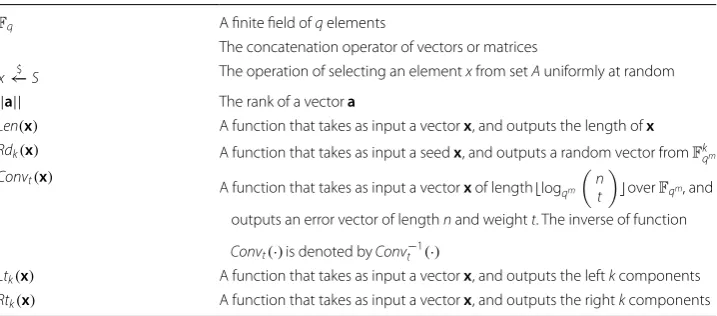
In this section, we revisit the definitions, notations and materials relevant to rank metric codes, which is required in the understanding of our proposed scheme. In the rest of this paper, we will use the notations and the functions as we defined in Table 1.
Definition 1 (Linear code and its generator matrix) An [n,k]q linear code C is a linear
subspace of Fnq with dimension k, and a matrix G∈Fkq×n is called a generator matrix of C
if its row vectors form a basic of C.
Definition 2 (Rank metric) Let Fqm be an extension field of Fq for some posi-tive integer m, and β =(β0,β1,. . .,βm−1) a basis of Fqm over Fq. For each vector a=(a0,a1,. . .,an−1)∈Fnqm, we associate it with an m×n matrix
M(a)=(aij)0≤i≤m−1,0≤j≤n−1∈Fmq×n s.t. aj=m−i=01mijβi , j=0, 1,. . .,n−1 . The rank of a , denoted by a , is defined as the rank of the matrix M(a) , and the rank distance between any two vectors x and y in Fnqm is defined by �x−y�.
Definition 3 (Circulant matrix) Given a vector c=(c0,c1,. . .,cn−1)∈Fnqm , we associate it with an n×n circulant matrix Rot(c)=(cij)0≤i,j≤n−1∈Fnq×mn satisfying
cij=c(i−j) modn for 0≤i≤n−1 , 0≤j≤n−1 . That is, we have
Rot(c)=
c0 cn−1 · · · c2 c1
c1 c0 cn−1 c3 c2 ..
. c1 c0 . .. ...
cn−2 ... . .. ... cn−1
cn−1 cn−2 · · · c1 c0
.
Table 1 Some notations in this paper
Fq A finite field of q elements
| The concatenation operator of vectors or matrices
x←−$ S The operation of selecting an element x from set A uniformly at random ||a|| The rank of a vector a
Len(x) A function that takes as input a vector x , and outputs the length of x
Rdk(x) A function that takes as input a seed x , and outputs a random vector from Fk qm
Convt(x)
A function that takes as input a vector x of length ⌊logqm
n t
⌋ over Fqm , and
outputs an error vector of length n and weight t. The inverse of function
Convt(·) is denoted by Convt−1(·)
Further, we use the notation Rotk(c) to denote a k×n matrix consisting of the first k
rows of Rot(c).
Definition 4 (Decisional rank syndrome decoding (DRSD) problem) For a given full rank matrix A∈Fkq×mn and an integer t, we define SA,t,0= {(A, y)|y←−$ Fnqm} and SA,t,1= {(A, xA+e)|x∈Fkqm, e∈Fnqm and �e� =t}.
Input: a full rank matrix A∈Fkq×mn , an integer t, and a vector s∈Fnqm.
Output: a bit b∈ {0, 1} s.t. (A, s)∈SA,t,b.
Let A be a probabilistic polynomial time (PPT) algorithm for the DRSD problem. With respect to a security parameter , we define the advantage of A as
In [19], the DRSD problem is proven to be NP hard in the worst case; thus, it is reason-able to assume that AdvDRSDA () is negligible with regard to .
Definition 5 (IND-CPA attack) To describe the IND-CPA attack we first introduce the power of the adversary, denoted by A , in the attack.
Chosen Plaintext Adversary: A can choose the plaintext adaptively and he can get the corresponding ciphertext of the chosen plaintext through the encryption mechanism.
We define an IND-CPA attack as an experiment. The experiment runs the key genera-tion algorithm and gets a public-private key pair (pk, sk). An IND-CPA adversary uses pk to get several message-ciphertext pairs and stores them in a table. A distinguisher D gets pk and the message-ciphertext table. D randomly chooses two messages m0 and m1 (not in the message-ciphertext table) and sends them to the encryption mechanism. The encryption mechanism randomly chooses a message mb , b∈ {0, 1} , and sends the corre-sponding ciphertext cb to D . D takes as input (pk,m0,m1,cb) and outputs a guess b′ of b. If b′=b , the experiment successes. Otherwise, the experiment failures. The probability that D succeeds in the IND-CPA experiment is denoted by PrCPA.
A PKE scheme is called IND-CPA secure if |PrCPA−12| is negligible.
Revisiting the LT scheme [18]
The LT scheme [18] consists of four PPT algorithms, namely: Setup, KGen, Enc, and Dec which are described as follows.
• Setup(1 ): Given a security parameter , the algorithm chooses a prime power q, a group of integers (n,m,k,k0,k1,t) s.t. n>k, k0= ⌊k2⌋, k1=k−k0,t≤ ⌊n−k2 ⌋ according to . The algorithm then outputs the public parameter
params=(q,n,m,k,k0,k1,t).
• KGen(params): Give the public parameter params, the algorithm AdvDRSDA ()=
– Chooses a generator matrix G∈Fkq×mn of a [n,k]qm linear code C with error cor-recting ability t and an efficient decoding algorithm DE C(·);
– Chooses a vector x←−$ Fnqm s.t. �x� =n;
– Chooses two invertible matrices Q∈Fkq×mk and P ∈Fn×nq uniformly at random;
– Computes Gˆ =QG+Rot
k(x)P.
The public/private key pair is ( pk=(Gˆ, x),sk=(Q,G,P,DE C(·))).
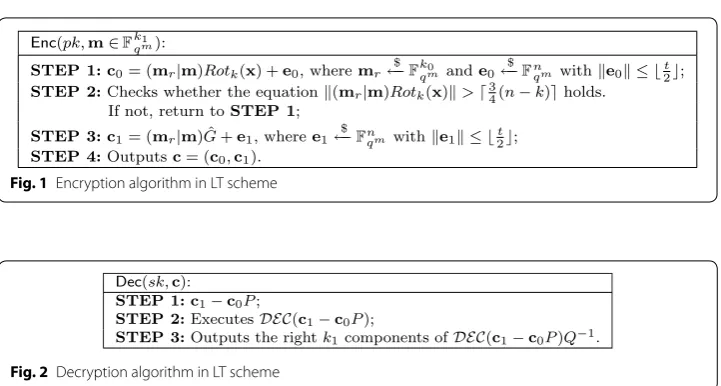
The algorithms Enc and Dec are listed in Figs. 1 and 2, respectively.
As mentioned previously, the LT scheme was proven to be IND-CPA secure under the DRSD assumption in [18].
Our IND‑CCA2 secure PKE scheme
In this section, we convert the LT scheme into an IND-CCA2 secure PKE scheme in which two error vectors come from a random value. This allows the new scheme to avoid the expansion of ciphertext.
Our new IND-CCA2 secure PKE scheme consists of the following four algorithms:
• Setup(1 ): Given a security parameter , the algorithm
• Chooses a prime number power q, a group of integers (n,m,k,k0,k1,t,t0,t1) s.t.
n>k, k0= ⌊k2⌋, k1=k−k0, t≤ ⌊n−2k⌋ , t0= ⌊2t⌋, t1=t−t0;
• Chooses a random vector con over Fqm with Len(con)≤ 1
2ℓ , where
ℓ0= ⌊logqm
n t0
⌋ , ℓ1= ⌊logqm
n t1
⌋ , and ℓ=ℓ0+ℓ1;
• Outputs the public parameter params=(q,n,m,k,k0,k1,t,t0,t1, con).
• KGen(params): Give the public parameter params=(q,n,m,k,k0,k1,t,t0,t1, con) , the algorithm
Enc(pk,m∈ k1qm):
STEP 1: c0= (mr|m)Rotk(x) +e0, wheremr←−$ qk0m ande0←$− qnm withe0 ≤ t2;
STEP 2:Checks whether the equation(mr|m)Rotk(x)>34(n−k)holds. If not, return toSTEP 1;
STEP 3: c1= (mr|m) ˆG+e1, wheree1←−$ n
qm withe1 ≤ 2t;
STEP 4:Outputsc= (c0,c1).
Fig. 1 Encryption algorithm in LT scheme
Dec(sk,c):
STEP 1: c1−c0P;
STEP 2:ExecutesDEC(c1−c0P);
STEP 3:Outputs the rightk1components ofDEC(c1−c0P)Q−1.
• Chooses a generator matrix G∈Fkq×mn of an [n,k]qm linear code C with error correct-ing ability t and an efficient decodcorrect-ing algorithm DE C(·);
• Chooses a vector x←−$ Fnqm s.t. �x� =n;
• Chooses two invertible matrices Q∈Fk×kqm and P∈Fnq×n uniformly at random;
• computes Gˆ =QG+Rot k(x)P.
The public key is pk=(G, x)ˆ and the private key is sk =(Q,G,P,DE C(·)).
Similar to in "Revisiting the LT scheme" section, we list the algorithms Enc and Dec of our proposed PKE scheme in Figs. 3 and 4, respectively.
Security proof
In this section, we prove the correctness and IND-CCA2 security of our code-based PKE scheme presented in the preceding section.
Enc(pk,m∈ k1 qm):
STEP 1:Generates a vectorv←$− q−mLen(con);
STEP 2: u1=Rdk1+Len(con)(v) + (m|con);
STEP 3: u2=v+H(u1), whereH:{0,1}∗→ −Len(con)
qm is a secure hash function;
STEP 4: u3|u4=u1|u2, whereLen(u3) =,Len(u4) =k1;
STEP 5: e0=Convt0(Lt0(u3)),
e1=Convt1(Rt1(u3));
STEP 6: c0= (mr|u4)Rotk(x) +e0, wheremr←−$ k0qm;
STEP 7:Checks whether the equation(mr|u4)Rotk(x)>34(n−k)holds. If not, returns toSTEP 6.
STEP 8: c1= (mr|u4) ˆG+e1; STEP 9:Outputsc= (c0,c1).
Fig. 3 Encryption algorithm in our scheme
Dec(sk,c):
STEP 1: c1−c0P;
STEP 2:DEC(c1−c0P);
STEP 3: u
4=Rtk1(DEC(c1−c0P)Q−1); STEP 4: e0=c0−(DEC(c1−c0P)Q−1)Rot
k(x),
e1=c1−(DEC(c1−c0P)Q−1) ˆG;
STEP 5:Conv−1t0 (e0),Conv−1t1 (e1) to getu3 =Conv−1t0 (e0)|Conv−1t1 (e1);
STEP 6: u1|u2=u3|u4s.t.Len(u1) =k1+Len(con) andLen(u2) =−Len(con); STEP 7:Outputsmifcon=conand⊥otherwise.
Correctness
According to the Enc and Dec algorithms of our scheme, we can easily get:
Then, we can compute the error vectors e0 and e1 correctly with the vector u4 and get
u′
3=Conv−1t0 (e0)|Conv−1t1 (e1)=u3 . From u3 and u4 , we can recover u1 and u2 correctly and obtain the message m by computing
This concludes the correctness proof of our scheme.
IND‑CCA2 security
The IND-CCA2 security for any PKE scheme can be defined as follows.
Definition 6 (IND-CCA2 security) For any two-stage (find stage and guess stage) adversary A=(A1,A2) against a PKE scheme E=(Setup,KGen,Enc,Dec) , the IND-CCA2 security is modeled as an experiment ExpIND-CCA2A,PKE () with respect to a security
parameter .
ExpIND-CCA2A,PKE (): params←Setup()
(pk,sk)←KGen(params)
(m0, m1, state)←A1Dec(sk,·)(pk) , where m0 and m1 have the same length
b←− {0, 1}$
c′←Enc(pk, mb)
b′←A2Dec(sk,·)(c′, state) . Note that A2 is not allowed to make decryption query on c′.
Outputs 1 if b′=b , otherwise outputs 0.
The advantage, AdvIND-CCA2A,PKE () , of A in ExpIND-CCA2A,PKE () can be defined by
A PKE scheme E=(Setup,KGen,Enc,Dec) is IND-CCA2 secure if for any PPT A , AdvIND-CCA2A,PKE () is negligible with respect to . In addition, the above experiment can become an IND-CPA experiment if A is not allowed to make decryption query. We denote by ExpIND-CPAA,PKE () the IND-CPA experiment and the advantage of A is defined by
u′4=Rtk1(DE C(c1−c0P)Q
−1)
=Rtk1(DE C((mr|u4)Gˆ +e1−(mr|u4)Rotk(x)P−e0P)Q
−1)
=Rtk1(DE C((mr|u4)QG+e1−e0P)Q−1)
=Rtk1((mr|u4)QQ−1)
=u4.
v=u2−H(u1) and m|con=u1−Rdk1+Len(con)(v).
(1) AdvIND-CCA2A,PKE ()=
2 Pr[Exp
IND-CCA2
A,PKE ()=1] −1 .
(2) AdvIND-CPAA,PKE ()=
2 Pr[Exp IND-CPA
We divide the security proof of our scheme into two phases following the approach in [20]. First, we give the IND-CPA security proof based on the IND-CPA security of the LT scheme. Then, we prove the IND-CCA2 security of our scheme in the random oracle model.
Theorem 1 Assume thatAis an attacker in the experimentExpIND-CPAA,PKE ()with
advan-tageǫagainst the LT scheme. Then, we have
whereqRdis the query times to oracleRdandris the length of the output vectors of the
functionRd.
Proof We assume that C is a challenger, who is responsible for the generation of the
public parameters params and a public-private key pair (pk, sk) by running the algo-rithms Setup and KGen , respectively. It is obvious that A should have the advantage
AdvIND-CPAA,PKE () against our scheme if C simulates two oracles H and Rd correctly. After receiving m0 and m1 from A , C randomly chooses a vector v , a bit b and computes H and
Rd as
If A makes a query to Rd on a vector v′ , C first checks whether v′=v . If yes, C out-puts Rd(v)=u1−(mb|con) . Otherwise, C outputs a random vector. If A makes queries to H on a vector u′
1 , C first checks whether u1′ =u1 . If yes, C outputs H(u1)=u2−v. Otherwise, C outputs a random vector. It is obvious that C can not simulate the Rd
cor-rectly if C doesn’t know u1 . Hence, C could simulate Rd and H correctly if and only if A made queries to H on u1 first and then to Rd on v . We define two events Evt1 and Evt2 as follows:
• Evt1 : the event that v is queried to Rd in qRd queries before u1 is queried to H.
• Evt2 : the event that u1 is queried to H in qH times before v is queried to Rd.
It is obvious that the probability Pr[Evt1∧Evt2] =0 from the definition of Evt1 and Evt2 and we have
While the event ¬Evt1∧ ¬Evt2 happens, A can not get any information about the con-nection between mb|con and u1|u2 . Hence, the advantage of A is negligible in this case. For another case that Evt1∨Evt2 happens, A can guess b correctly. Then we have the inequation 2 Pr[ExpIND-CPAA,PKE ()=1] ≤2 Pr[Evt1∨Evt2] +1−Pr[Evt1∨Evt2] . That is, we have
AdvIND-CPAA,PKE ()≤ε+ qRd qmr,
Rd(v)=u1−(mb|con) and H(u1)=u2−v.
(3) Pr[Evt1∨Evt2] =Pr[Evt1] +Pr[Evt2].
(4)
Pr[ExpIND-CPAA,PKE ()=1] ≤
1+Pr[Evt1∨Evt2]
According to Eq. (2), we have
and
i.e.,
As we know, b and v are generated randomly by C , so A could not obtain any informa-tion about them if the event Evt1∨Evt2 did not happen. For instead, C can recover u4 from c if the event Evt2 happens. In the other words, while event Evt2∧ ¬Evt1 happens, C could use A to break the LT scheme. Thus, we have
On the other hand, the probability that v is exactly queried to Rd is q1mr . Hence, the prob-ability that Evt1 happens during the qRd queries on Rd is
According to Eqs. (3), (5), (6), (7) we can get:
That is, we have
Theorem 2 Assume thatAis an attacker in the experimentExpIND-CCA2A,PKE ()who has
the advantageǫagainst the LT scheme. Then, we have
whereqRdandqDare the query times to the oraclesRdandD , respectively, andris the
length of the output vectors of the functionRd. Pr[ExpIND-CPAA,PKE ()=1] =
AdvIND-CPAA,PKE ()+1
2
AdvIND-CPAA,PKE ()+1
2 ≤
1+Pr[Evt1∨Evt2]
2 ,
(5) AdvIND-CPAA,PKE ()≤Pr[Evt1∨Evt2].
(6) Pr[Evt2∧ ¬Evt1] =ε.
(7)
Pr[Evt1] ≤1−
1− 1
qmr
qRd
≤ qRd qmr.
ε=Pr[Evt2∧ ¬Evt1] =Pr[Evt2]
=Pr[Evt2∨Evt1] −Pr[Evt1]
≥AdvIND-CPAA,PKE ()−
qRd
qmr.
AdvIND-CPAA,PKE ()≤ε+
qRd
qmr.
AdvIND-CCA2A,PKE ()≤ε+ qRd
qmr +
Proof We assume that C is a challenger, who is responsible for the generation of the public
parameters params and a public-private key pair (pk, sk) by running the algorithms Setup and KGen , respectively. It is clear that A should have the advantage AdvIND-CCA2A,PKE () against our scheme if C simulates oracles H , Rd and the decryption oracle D correctly. C
simulates H and Rd in the same way of the proof of Theorem 1. Then, C uses the
plaintext-extractor described in [21] to construct the decryption oracle via the following steps.
• The plaintext-extractor takes as input a ciphertext c.
• For qRd times queries to Rd, the input and the output pairs of Rd are denoted by (vi,Vi) , 1≤i≤qRd . Similarly, the input and the output pairs of H are denoted by (u1j,U1j) ,
1≤j≤qH.
• The plaintext-extractor finds the pair (vi,Vi)=(u2−U1j, u1j−(m|con)) s.t.
are two error vectors of c and Rtk(u1j|u2) is the plaintext of c in the LT scheme. • If the plaintext-extractor cannot find the pair (vi,Vi) or (u1j,U1j) , it rejects the
cipher-text c.
Based on the above construction, we know that the plaintext-extractor cannot simulate D unless A made queries u1j to H and vi to Rd before the ciphertext c is queried to D . It should be noted that in this case we have Eqs. (8) and (9). For further analysis, we define a new event, denoted by Evt3 , as
• Evt3 : the event that A queries the appropriate ciphertext c to D before A queries u1j to
H and vi to Rd.
It is obvious that the probability that the appropriate ciphertext c is queried to D is 1
q2mn . Hence, we get the probability that the event Evt3 occurs in at most qD queries satisfies
As in the proof of Theorem 1, C could simulate these oracles correctly while the event Evt2 (equivalent to event Evt2∧ ¬Evt3∧ ¬Evt1 ) happened. Then, we have
(8) e0=Convt0(Ltℓ0(Ltℓ0+ℓ1(u1j|u2))),
(9) e1=Convt1(Rtℓ1(Ltℓ0+ℓ1(u1j|u2))
(10) Pr[Evt3] ≤1−
1− 1
q2mn
qD ≤ qD
q2mn.
ε=Pr[Evt2∧ ¬Evt3∧ ¬Evt1]
=Pr[Evt2∧ ¬Evt1] −Pr[¬Evt2∧Evt3∧Evt1]
≥Pr[Evt2∧ ¬Evt1] −Pr[Evt3]
≥Pr[Evt2] −Pr[Evt3]
≥Pr[Evt2∨Evt1] −Pr[Evt1] −Pr[Evt3]
≥AdvIND-CCA2A,PKE ()−
qRd qmr −
qD
That is, we have AdvIND-CCA2A,PKE ()≤ε+qqRdmr + qq2mnD .
Efficiency
In this section, we analyze the efficiency of our proposed PKE scheme by compar-ing with two recently proposed schemes (i.e., Wang’s scheme [22] and Loidreau’s scheme [17]), in terms of public key and ciphertext sizes. It should be noted that both Loidreau’s scheme and our proposed scheme are based on rank metric codes, while Wang’s scheme is based on Hamming metric codes. For a better understanding of our strengths, we introduce a family of the most representative rank metric codes called Gabidulin codes first.
Definition 7 (Gabidulin codes) For an element a∈Fqm and an integer i∈Z ,
we denote a[i]=aqi
. Further for a vector a=(a0,a1,. . .,an−1)∈Fnqm , we denote a[i]=(a[0i],a[1i],. . .,an[i−]1). Then, an [n,k]Fqm Gabidulin code C(a) for a vector
a=(a0,a1,. . .,an−1)∈Fnqm is defined with the following k by n generator matrix:
According to the analysis in [18, 23–25], a secure code-based PKE scheme should be able to resist several structural attacks, such as key recovery attack, reduction attack and moore decomposition attack [23]. In particular, we can obtain the lower bound of the computation costs that an adversary needs to break a PKE scheme based on Gabidulin codes. The lower bound, known as the PQ-security level [17, 26], can be computed by the following formula:
where t is the correction ability of the underlying Gabidulin codes.
As the same in the LT scheme [18], we choose two sets of parameters
params1=(q=2,m=75,n=73,k=21,t0=t1=13) and params2=(q=2,m=85,
n=83,k=18,t0=t1=16), which can achieve the security levels
2141≈753·2·(13−1)⌊21·min{75,73}146 ⌋ and 2154≈853·2·(16−1)⌊18·min166{85,83}⌋ , respectively, accord-ing to Eq. (11). Recall that the ciphertext in our scheme is of the form c=(c0, c1) , where
c0 and c1 are two vectors of the same length n over Fqm . For the first parameter set params1 , we have the ciphertext size of 2·73·75 bits =10950 bits ≈1.37 KB .
Simi-larly, we can get the ciphertext size of 2·83·85 bits =14110 bits ≈1.76 KB for the second parameter set params2.
As to the public key, it has the form of pk=(G, xˆ ) in our scheme,
where Gˆ is a k×n matrix over Fqm and x is a vector of the length n over Fqm. For the first parameter set params1, we have the public key size of 75·(21+1)·73 bits =120450 bits ≈15.06 KB . Similarly, we can get the public key
a0[0] a1[0] · · · a[n−0]1 a[01] a1[1] · · · a[n1−]1
..
. ... . .. ... a0[k−1] a1[k−1] · · · a[n−k−11]
.
(11)
size of 85·(18+1)·83 bits =134045 bits ≈16.76 KB for the second parameter set
param2.
We note that the ciphertext and public key sizes of our IND-CCA2 secure scheme are exactly the same to the ones of the IND-CPA secure LT scheme. Compared to Loidreau’s scheme [17], which is a recently proposed PKE scheme based on rank metric codes, our PKE scheme has a significant advantage in terms of public key size and ciphertext size (see Table 2).
For a fair comparison between our rank metric codes-based PKE scheme and Wang’s scheme from Hamming metric codes [22], we choose two new sets of parameters params3=(q=2,m=71,n=69,k=19,t0=t1=13) and
params4=(q=2,m=101,n=99,k=22,t0=t1=17), which can achieve the security levels 713·2·(13−1)⌊19·min138{71,69}⌋≈2133 and
1013·2·(17−1)⌊22·min198{101,99}⌋≈2196 ,
respectively, according to Eq. (11). For the parameter set params3 , we have the ciphertext size of 2·69·71 bits =9798 bits ≈1.22 KB and public key size of
71·(19+1)·69 bits =97890 bits ≈12.25 KB . Similarly, we can get the cipher-text size of 2·99·101 bits =19998 bits ≈2.50 KB and public key size of
101·(22+1)·99 bits =229977 bits ≈28.75 KB for the parameter set params4 .
From Table 2, we observe that our code-based PKE scheme also has a significant advan-tage to Wang’s scheme in terms of public key size.
A secure cloud storage use case
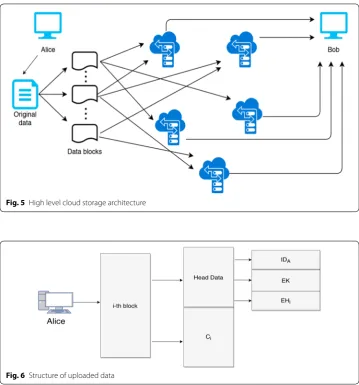
In this section, we explain how our proposed code-based PKE scheme can be deployed in a cloud storage system. We use the notations CBEnc(·)/CBDec(·) and SEnc(·)/SDec(·) to denote the encryption/decryption algorithms in our proposed code-based PKE scheme and a secure symmetric encryption scheme, respectively. In our cloud storage system, we assume that there are two users (Alice and Bob) and multiple storage servers. Alice splits her data into some data blocks and sends each block to storage servers (one data block can be sent to several storage severs). Bob can get the data blocks from the cloud and recover them into the original data (see Fig. 5).
If Alice wants to store data M in the cloud and shares it with Bob, she can select a random session key K for the symmetric encryption algorithm and encrypts it under Bob’s public key pkB to get a ciphertext EK =CBEnc(pkB,K) . Then, Alice can split
Table 2 Performance evaluation of our scheme, Loidreau’s scheme [17] and Wang’s scheme [22]: a comparative summary
qm n k t Ciphertext
size (KB) Public key size (KB) Security level Semantic security
Loidreau’s scheme 2128 90 24 11 1.44 21.50 140 IND‑CCA2
2128 120 80 4 1.92 51.00 141
Wang’s scheme 29 1020 660 180 1.15 980 128 Not Given 210 1560 954 203 1.95 2460 192
Our PKE scheme 275 73 21 13 1.37 15.06 141 IND‑CCA2
285 83 18 16 1.76 16.76 154
271 69 19 13 1.22 12.25 133
the data M into m blocks M=M1�M2� · · · �Mm and uses K to encrypt them to get
Ci=SEnc(K,Mi) , 1≤i≤m . Next, Alice computes the hash values hi=Hash(Ci) ,
1≤i≤m , and saves them in her local storage, where Hash(·) is a secure collision-resist-ant hash function. Then, Alice sets the information IDA , EK, and EHi=SEnc(K,hi) to each ciphertext block Ci , 1≤i≤m , as the header data (see Fig. 6). Finally, she sends the header data and ciphertext Ci , 1≤i≤m , to m storage servers. If Alice wants to check the data integrity of some ciphertext block Ci , she can ask the corresponding storage server to compute Hash(Ci) and send it back to her. If the received Hash(Ci) matches her local hash value for Ci , she is assured that the data are intact and have not modified by the cloud storage server.
On the other hand, if Bob wants to get the data M from Alice via the cloud stor-age system, he can find the corresponding m ciphertext data blocks Ci , 1≤i≤m , and their header data (IDA,EK,EHi) by searching for IDA in the cloud. Then, Bob can download them and runs CBDec(skB,EK) to recover the symmetric key K with his private key skB . Next, for each 1≤i≤m , Bob uses the obtained symmetric key K to decrypt EHi and Ci to get Hash(Ci) and Mi , respectively. To verify the data integrity of
Fig. 5 High level cloud storage architecture
Ci
EK
EHi Head Data
IDA
Alice
i-th block
Mi , Bob computes Hash(Ci) and checks whether it is equal to hi obtained from EHi . If yes, it means that Ci has not been modified by the storage server and the correspond-ing Mi is the original data from Alice. Otherwise, Bob asks the corresponding SSi of the non-matching Ci to send the data again.
From the above description, we find that the security of the proposed cloud storage system relies mainly on the security of our code-based PKE scheme and the symmet-ric encryption scheme. As mentioned in "Introduction" section, our scheme is able to resist quantum computer-facilitated attacks and achieves IND-CCA2 security as demonstrated in "Security proof" section. Clearly, Alice can access her data stored in the cloud using any devices by searching for the data with her ID. Moreover, both Alice and Bob can check the integrity of the downloaded data from the cloud. In the event that the data were modified by the cloud storage server or during the commu-nication, Bob can detect this and then proceed to download the corresponding blocks again. Thus, the proposed cloud storage system provides availability, reliability, effi-cient retrieval and data sharing, even in the post-quantum era.
Conclusion
Code-based public key cryptography (PKC) can potentially be deployed in real-world applications to ensure quantum computing attack resilience. Existing code-based PKC schemes are broadly categorized into those based on Hamming metric codes and those based on rank metric codes, and it is believed that the latter generally has smaller public key and ciphertext sizes than the former under the same security level.
In this paper, we presented a new rank metric codes-based public key encryption scheme from Lau and Tan’s scheme [18], and hence inherits the latter’s small public key and ciphertext size properties. However, our new scheme achieves IND-CCA2 secure (the highest security assurance possible), as shown in this paper. We also ana-lyzed its efficiency in term of the public key size and the ciphertext size. Finally, we presented a use case to demonstrate its utility in practice.
Future work includes constructing more rank metric codes-based cryptographic primitives, such as proxy re-encryption and attribute-based encryption, to achieve other desirable properties in practical applications. We also intend to implement and evaluate a prototype of the proposed/extended scheme in collaboration with a (small) cloud storage service provider.
Acknowledgements
We would like to thank the reviewers for their valuable comments. Authors’ contributions
The authors have contributed significantly to the research work presented of this manuscript. All authors read and approved the final manuscript.
Funding
The work is supported in part by the National Key R&D Program of China under Grant No. 2017YFB0802300, the NSFC‑Zhejiang Joint Fund for the Integration of Industrialization and Informatization under Grant No. U1509219, the Shanghai Natural Science Foundation under Grant No. 17ZR1408400, the National Natural Science Foundation of China under Grant Nos. 61601129, 11701179, the Shanghai Science and Technology Commission Program under Grant No. 18511105700, and the Shanghai Sailing Program under Grant No. 17YF1404300.
Availability of data and materials
The datasets used and analysed in this study are available from the corresponding author on reasonable request. Competing interests
Author details
1 Shanghai Key Laboratory of Trustworthy Computing, East China Normal University, Shanghai, China. 2 College of Com‑ puter Science and Technology, Shanghai University of Electric Power, Shanghai, China. 3 Department of Information Systems and Cyber Security, The University of Texas at San Antonio, San Antonio, TX 78249, USA.
Received: 31 December 2018 Accepted: 16 August 2019
References
1. Rathore S, Sharma PK, Park JH (2017) XSSClassifier: an efficient XSS attack detection approach based on machine learning classifier on SNSs. J Inf Process Syst 13(4):1014–1028
2. Rathore S, Park JH (2018) Semi‑supervised learning based distributed attack detection framework for IoT. Appl Soft Comput 72:79–89
3. Rathore S, Loia V, Park JH (2018) SpamSpotter: an efficient spammer detection framework based on intelligent deci‑ sion support system on Facebook. Appl Soft Comput 67:920–932
4. Rathore S, Sangaiah AK, Park JH (2018) A novel framework for internet of knowledge protection in social networking services. J Comput Sci 26:55–65
5. Kamara S, Lauter K (2010) Cryptographic cloud storage. In International conference on financial cryptography and data security. Springer, Berlin, pp 136–149
6. Liu Q, Wang G, Wu J (2014) Time‑based proxy re‑encryption scheme for secure data sharing in a cloud environment. Inf Sci 258:355–370
7. Mishra B, Jena D (2018) CCA secure proxy re‑encryption scheme for secure sharing of files through cloud storage. In 2018 fifth international conference on emerging applications of information technology (EAIT). IEEE, Piscataway, pp 1–6
8. Li J, Zhang Y, Chen X, Xiang Y (2018) Secure attribute‑based data sharing for resource‑limited users in cloud com‑ puting. Comput & Secur 72:1–12
9. Liu Z, Li T, Li P, Jia C, Li J (2018) Verifiable searchable encryption with aggregate keys for data sharing system. Future Gener Comput Syst 78:778–788
10. Chu CK, Chow SSM, Tzeng WG, Zhou J, Deng RH (2014) Key‑aggregate cryptosystem for scalable data sharing in cloud storage. IEEE Trans Parallel Distrib Syst 25(2):468–477
11. Haeger ES, Schurig K, Cenname M, et al. (2015) Crypto proxy for cloud storage services: U.S. Patent 9,137,222[P]. 2015‑9‑15
12. Xu L, Wu X, Zhang X (2012) CL‑PRE: a certificateless proxy re‑encryption scheme for secure data sharing with public cloud. In: Proceedings of the 7th ACM symposium on information, computer and communications security. ACM, New York, pp 87–88
13. Shor PW (1994) Algorithms for quantum computation: Discrete logarithms and factoring. Proceeding of FOCS 1994, Santa Fe, New Mexico, November 20–22, 1994, pp 124‑134
14. Shor PW (1999) Polynomial‑time algorithms for prime factorization and discrete logarithms on a quantum com‑ puter. SIAM Rev 41(2):303–332
15. Mceliece RJ (1978) A public‑key cryptosystem based on algebraic coding theory. Deep Space Netw Prog Rep 42–44(1978):114–116
16. Bernstein DJ (2009) Introduction to post‑quantum cryptography. In: Post‑quantum cryptography, Springer, Berlin. pp 1–14
17. Loidreau P (2017) A new rank metric codes based encryption scheme. In: Lange T, Takagi T (eds.) PQCrypto 2017. LNCS, 10346, pp 3–17
18. Lau TSC, Tan CH (2018) A new encryption scheme based on rank metric codes. In: Australasian conference on infor‑ mation security and privacy. pp 750–758
19. Gaborit P, Hauteville A, Phan DH, Tillich J‑P (2017) Identity‑based encryption from codes with rank metric. In: Katz J, Shacham H (eds.) CRYPTO 2017. LNCS, 10403, pp 194–224
20. Kobara K, Imai H (2001) Semantically secure McEliece public‑key cryptosystems‑conversions for McEliece PKC. Int Workshop Pract Theory Public Key Cryptogr Public Key Cryptogr 1992:19–35
21. Bellare M, Rogaway P (1994) Optimal asymmetric encryption. Eurocrypto 950(6):92–111
22. Wang Y (2016) Quantum resistant random linear code based public key encryption scheme RLCE. IEEE Int Symp Inf Theory (ISIT) 2016:2519–2523
23. Horlemann‑Trautmann AL, Marshall K, Rosenthal J (2015) Extension of overbeck’s attack for gabidulin based crypto‑ systems. Des Codes Cryptogr 86(2):1–22
24. Otmani A, Kalachi HT, Ndjeya S (2018) Improved cryptanalysis of rank metric schemes based on Gabidulin codes. Des Codes Cryptogr 86(9):1983–1996
25. Gaborit P, Zémor G (2016) On the hardness of the decoding and the minimum distance problems for rank codes. IEEE Trans Inf Theory 62(12):7245–7252
26. Bernstein DJ (2010) Grover vs. mceliece. Post‑Quantum Cryptography 2010. Lecture Notes Comput Sci 6061:73–80 Publisher’s Note

![Table 2 Performance evaluation of our scheme, Loidreau’s scheme [17scheme [] and Wang’s 22]: a comparative summary](https://thumb-us.123doks.com/thumbv2/123dok_us/840458.1581760/12.595.118.479.589.725/table-performance-evaluation-scheme-loidreau-scheme-comparative-summary.webp)