R E S E A R C H
Open Access
Randomized controlled trial of oatmeal
consumption versus noodle consumption on
blood lipids of urban Chinese adults with
hypercholesterolemia
Jian Zhang
1*, Lixiang Li
1, Pengkun Song
1, Chunrong Wang
1, Qingqing Man
1, Liping Meng
1, Jenny Cai
2and Anne Kurilich
3Abstract
Background:Cardiovascular disease (CVD) is the leading cause of death in China and worldwide. Whole grain oats can reduce risk of CVD by reducing total and LDL-cholesterol, major risk factors for CVD. While this association has been established in many populations, data from Asian populations is limited. Thus, this study investigated the impact of oat consumption on cholesterol levels in Chinese adults. Male and female data from this work were previously published separately in mandarin in two Chinese journals. The combined male and female data were reanalyzed and are presented here.
Methods:A randomized, controlled, parallel-arm study was conducted at Beijing Hospital, Beijing china. Subjects were adults (men and women) with mild to moderate hypercholesterolemia. The oat group (n=85) consumed 100grams of instant oat cereal versus the control group (n=81) who consumed 100grams of wheat flour-based noodles daily for 6weeks. Laboratory and anthropometric measurements were conducted at baseline and at the end of the 6-week intervention.
Results:Dietary fiber intake increased significantly in the oat group compared to the control group at the end of the 6-week intervention. Total-, LDL-cholesterol and waist circumference decreased significantly in the oat group compared to the control. HDL-cholesterol decreased significantly in the control group versus the oat group. There were no significant changes in blood pressure, other anthropometric or laboratory measures between the two groups at the end of the intervention.
Conclusions:Instant oatmeal consumed daily for 6 weeks significantly increased fiber intake and decreased major risk factors for CVD in Chinese adults with hypercholesterolemia. Increased consumption of whole grains, including oats, should continue to be encouraged.
Keywords:Oats, Oatmeal, Cholesterol, Chinese adults
Background
Cardiovascular disease (CVD) is the leading cause of death in China [1] as well as worldwide [2]. Established risk factors for CVD include elevated total cholesterol (TC), elevated low density lipoprotein cholesterol (LDL-C), low high density lipoprotein cholesterol (HDL-C)
and hypertension. These risk factors are modifiable by lifestyle factors including diet and exercise [3].
Epidemiological studies suggest that diets high in whole grains are associated with a reduced risk of CVD and mortality [4-7]. In China, recent changes to the traditional diet, including significant reductions in wholegrain intake (104g/day in 1982 to 24g/day in 2002) may be contributing to the increased CVD mortality [8].
Wholegrain oats can significantly lower serum TC and LDL-C and reduce risk for CVD [9]. Authoritative regu-latory bodies in several countries, including the United * Correspondence:[email protected]
1Chinese Center for Disease Control and Prevention, Beijing 100050, China
Full list of author information is available at the end of the article
States, Canada, Europe and Malaysia, have reviewed the available evidence and allow a health claim on food labels regarding the relationship between oat consump-tion and a reducconsump-tion in blood cholesterol concentraconsump-tion and reduced risk of CVD [10-13].
Data regarding impact of oat consumption on CVD risk factors in Asian populations, including the Chinese population, is limited. Therefore, the present study investigated the relationship between instant oatmeal in-take and CVD risk factors in a sample of urban Chinese adults with mild to moderate hypercholesterolemia.
Methods
Study design
This was a randomized, controlled, parallel-arm study conducted at Beijing Hospital, Beijing China. Screening of potential study subjects was held in August and September 2008. The six week intervention was con-ducted from October 2008 through December 2008 dur-ing which the subjects visited the research site once per week. The study protocol was approved by the ethics committee of the Institute of Nutrition and Food Safety, Chinese center for Disease control and Prevention. Par-ticipants provided written informed consent before any study procedures were performed. Due to the nature of the food products serving as control (wheat noodles) and test (oatmeal) product, it was not possible to blind the subjects or the researchers, however, the statistician analyzing the data was blinded to the treatment groups.
Study participants
Based on the diagnostic standards in theChinese Guide-lines on Prevention and Treatment of Dyslipidemia in Adults[14] the selection criteria were as follows: (1)males and females 35 to 70 years of age; (2) serum total choles-terol ≥5.18mM, low density lipoprotein cholesterol
≥3.37mM; (3) no serious liver, kidney, digestive tract dis-ease, diabetes or other metabolic diseases; (4) no use of cholesterol lowering medication or foods that have been approved by the China State Food and Drug Administra-tion as funcAdministra-tional foods with blood lipid lowering prop-erties in the last 6 months; and (5) did not habitually consume oat products. Screening of study participants was done in August and September 2008. Based on data obtained from a basic health questionnaire, food fre-quency questionnaire and results of a fasting blood lipid test, 182 subjects (109 females, 73 males) were selected to participate and randomized to either the oat group or the control group. Participants were instructed to con-sume their normal diet during the study period. Partici-pants who smoked could not have plans to change smoking habits during the treatment period.
Diet and study product
A 3-day 24-hour dietary recall was conducted at the start and end of the study to determine food and nutri-ent intake. The 24 hour dietary recall questionnaire was validated in the 2002 Chinese Nutrition and Health Sur-vey project. SAS 8.2 software was used to calculate nu-trient intake based on Chinese Food composition Table.
Prior to beginning the intervention, all participants were provided with basic nutrition counseling following the Chinese Food Pagoda guidelines which consisted of advice to consume a variety of foods including cereals, fruits, vegetables, dairy and lean meats and to reduce so-dium and limit alcohol intake. Participants were instructed not to change their exercise habits and to maintain their normal dietary habits with the exception of replacing a portion of a staple food product (rice, steamed bread, noo-dles, etc.) with the intervention product (oats or wheat noodles). Oatmeal (Quaker Instant Oatmeal produced by PepsiCo Foods (China) co., Ltd.) was packaged in 200g (dry wt) packages and 4 packages were provided to partici-pants one week followed by 3 packages the next week. Participants receiving the oatmeal were instructed to pre-pare ½ a package (~100g dry wt, providing approximately 3.6g soluble fiber) each day according to the on-pack preparation instructions (with hot water or milk). Con-sumption of the prepared amount could be split across two or three meals each day for the six week intervention period. Wheat noodles (“Shengchu” brand processed wheat flour based noodles) were purchased in 450g packages at the local grocery store and distributed to par-ticipants on a weekly basis. Parpar-ticipants were instructed to prepare and consume 100g (dry wt) each day. All subjects in the control group were shown a 100g portion of dry noodles that had been weighed on a scale to help them visualize the amount that they should prepare and con-sume each day. Wheat based noodles are a standard staple in the diets of this population and this amount can easily be consumed in one meal. Each participant was asked to record the quantity of the test food they consumed each day. The oat and noodle packs were dis-tributed once each week to facilitate weekly communi-cation with the participants and discuss intake of food and any relevant concerns or issues linked with the daily oat or noodle consumption.
Anthropometric and laboratory measurements
Anthropometric measurements were conducted at base-line and at the end of the six week intervention period. Standing height was measured. Participant weight was measured while wearing light weight clothing and with-out shoes. Waist circumference was measured on a horizontal plane at the level of the iliac crest using a
non-stretch anthropometric tape. Two consecutive
methods described in the 2010 Chinese Guidelines for the management of hypertension [15] with the subject in a seated position after 5 minutes of rest. The mean of the two measurements was used for statistical ana-lysis. Fasting blood samples were collected at baseline and at the end of the intervention period. Blood biochem-ical parameters were measured using a Shimazu 7600 fully automatic biochemical analyzer and included serum total cholesterol (TC), serum triglycerides (TG), high density lipoprotein cholesterol (HDL-C), low density lipoprotein cholesterol (LDL-C), apolipoprotein A1 (ApoA1), apolipo-protein B (ApoB) and plasma glucose.
Statistical methods
The statistician was blinded to the treatment groups. All statistical summaries and analyses were performed using SAS V 8.2 for windows (SAS Institute, cary, NC). Cat-egorical data were summarized as frequencies and pro-portions within each group. When analyzing for group differences among the categories, a 2-sided Fisher’s exact test was used. Effect of intervention on dietary compos-ition was analyzed as change from baseline to minimize the bias of any baseline differences. Baseline data and changes from baseline were analyzed using f-test from analysis of covariance (ANCOVA) where the group ef-fect was fixed and the covariates were age, sex, smoking status, alcohol consumption, educational status, and medication use. The effects of intervention on anthropo-metrics, blood pressure, lipids and glucose were also analyzed for baseline group differences and as change from baseline after six weeks. Summaries of these out-comes were presented as least squares means (LSM) and standard errors (SE) obtained from the ANCOVA model to account for any baseline unbalance in the groups and the effects of the covariates. Statistical significance was set at P<0.05.
Results
Study compliance
During the study period there were 9 subjects from the control group and 7 subjects from the oat group that dropped out or were eliminated due to non-compliance with the study protocol. Two subjects from each group were eliminated due to incorrect recording of food amounts as determined by unreasonably low calculated daily calorie intake values (< 500 kcal / day),while 2 sub-jects from the control group and 1 subject from the oat group were eliminated due to use of products that may reduce serum cholesterol. In addition, 5 subjects from control group and 4 subjects from the oat group dropped out due to personal reasons such as losing interest in the study or travel requirements. A total of 85 subjects in the oat group and 81 subjects in the control group were included in the final data analysis. There
were no adverse events reported during the intervention period except for some complaints about the taste of the oat product.
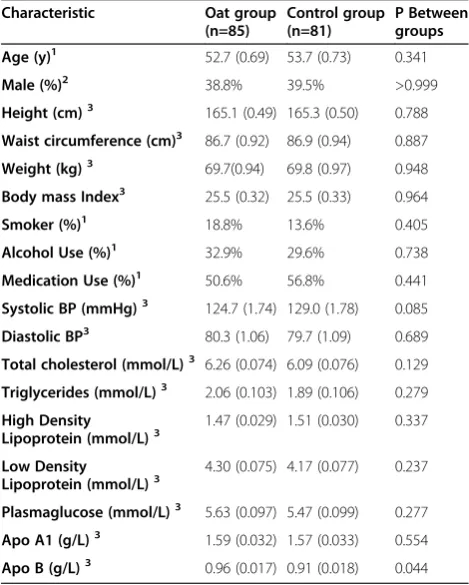
Baseline characteristics of the two test groups are pro-vided in Table 1. There were no statistically significant differences between groups for any of the demographic characteristics or any of the anthropometric measures. There was a statistical difference between groups in ApoB levels at baseline with the oat group having slightly higher levels than the control group (p=0.044). However, both groups were within the normal reference range of 0.60-1.94g/L.
Covariates were evaluated in the analysis of baseline characteristics to determine their effect on each measure prior to intervention. Age was a significant covariate in systolic blood pressure and blood glucose. Sex was a sig-nificant covariate in height, waist circumference, weight, systolic blood pressure, diastolic blood pressure, total cholesterol, triglycerides, HDL-C and ApoA1 levels. Smoking status was a significant covariate in total chol-esterol, LDL-C and ApoB levels. Alcohol consumption was a significant covariate in height and diastolic blood pressure. Education status was a significant covariate in waist circumference, BMI and systolic blood pressure.
Table 1 Baseline characteristics of subjects
Characteristic Oat group (n=85)
Control group (n=81)
P Between groups
Age (y)1 52.7 (0.69) 53.7 (0.73) 0.341
Male (%)2 38.8% 39.5% >0.999
Height (cm)3 165.1 (0.49) 165.3 (0.50) 0.788
Waist circumference (cm)3 86.7 (0.92) 86.9 (0.94) 0.887
Weight (kg)3 69.7(0.94) 69.8 (0.97) 0.948
Body mass Index3 25.5 (0.32) 25.5 (0.33) 0.964
Smoker (%)1 18.8% 13.6% 0.405
Alcohol Use (%)1 32.9% 29.6% 0.738
Medication Use (%)1 50.6% 56.8% 0.441
Systolic BP (mmHg)3 124.7 (1.74) 129.0 (1.78) 0.085
Diastolic BP3 80.3 (1.06) 79.7 (1.09) 0.689
Total cholesterol (mmol/L)3 6.26 (0.074) 6.09 (0.076) 0.129
Triglycerides (mmol/L)3 2.06 (0.103) 1.89 (0.106) 0.279
High Density
Lipoprotein (mmol/L)3 1.47 (0.029) 1.51 (0.030) 0.337
Low Density
Lipoprotein (mmol/L)3
4.30 (0.075) 4.17 (0.077) 0.237
Plasmaglucose (mmol/L)3 5.63 (0.097) 5.47 (0.099) 0.277
Apo A1 (g/L)3 1.59 (0.032) 1.57 (0.033) 0.554
Apo B (g/L)3 0.96 (0.017) 0.91 (0.018) 0.044 1
LSM (SE) and p-value obtained from ANOVA.
2
Proportion and p-value obtained from 2-sided Fisher’s Exact test.
3
Medication use was not a significant covariate for any characteristics. Due to the mixed and overlapping influ-ences of these covariates, all covariates were kept in the subsequent analyses of dietary compositions and changes in anthropometric and lipid measures after 6 weeks of intervention.
Dietary intake
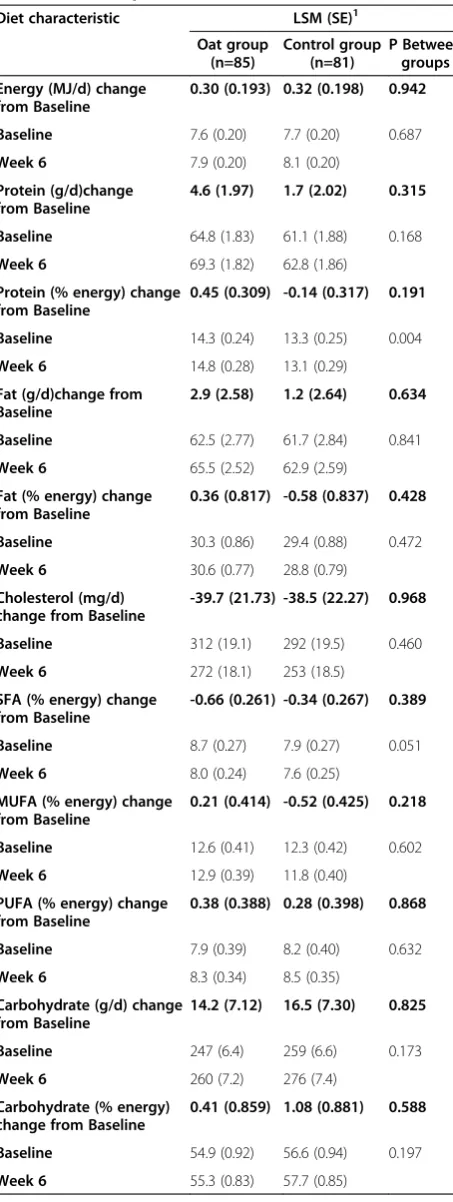
Dietary compositions at baseline and after 6 weeks of intervention are presented in Table 2. Baseline dietary composition was consistent between the groups for all components except percent of energy from dietary pro-tein which was significantly higher among the oat group than the control group (p=0.004). After 6 weeks of intervention, dietary fiber significantly increased among the oat group compared to the control group (p<0.001). No other changes in composition were notable between the groups.
Anthropometric measures and blood pressure
Anthropometric measures and blood pressure after 6 weeks and as change from baseline are presented in Table 3. Waist circumference significantly decreased after 6weeks in the oat group compared to the control group (p=0.002). No other measures changed significantly.
Serum lipids and plasma glucose
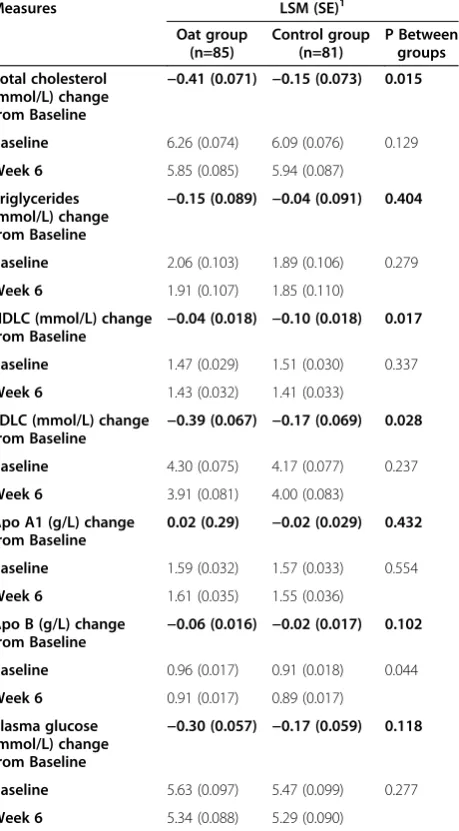
Serum lipids and plasma glucose after 6weeks and as change from baseline are presented in Table 4. The oat group showed significant decreases in total cholesterol (p=0.015) and LDL-C (p=0.028) compared to the control group. In addition, HDL-C decreased significantly in the control group compared to the oat group (p=0.017). Effects of intervention were observed for these same lipids when summarized as a percentage change from baseline (Figure 1). There were no significant differences in plasma glucose levels between the two groups.
Discussion
The results of this study show that when instant oats are consumed daily in place of another staple food (rice, steamed bread, noodles, etc.) compared to wheat noo-dles as replacement for another staple food, there is a significant increase in dietary fiber intake and significant decreases in waist circumference, TC and LDL-C in
Table 2 Diet compositions
Diet characteristic LSM (SE)1
Oat group (n=85)
Control group (n=81)
P Between groups
Energy (MJ/d) change from Baseline
0.30 (0.193) 0.32 (0.198) 0.942
Baseline 7.6 (0.20) 7.7 (0.20) 0.687
Week 6 7.9 (0.20) 8.1 (0.20)
Protein (g/d)change from Baseline
4.6 (1.97) 1.7 (2.02) 0.315
Baseline 64.8 (1.83) 61.1 (1.88) 0.168
Week 6 69.3 (1.82) 62.8 (1.86)
Protein (% energy) change from Baseline
0.45 (0.309) -0.14 (0.317) 0.191
Baseline 14.3 (0.24) 13.3 (0.25) 0.004
Week 6 14.8 (0.28) 13.1 (0.29)
Fat (g/d)change from Baseline
2.9 (2.58) 1.2 (2.64) 0.634
Baseline 62.5 (2.77) 61.7 (2.84) 0.841
Week 6 65.5 (2.52) 62.9 (2.59)
Fat (% energy) change from Baseline
0.36 (0.817) -0.58 (0.837) 0.428
Baseline 30.3 (0.86) 29.4 (0.88) 0.472
Week 6 30.6 (0.77) 28.8 (0.79)
Cholesterol (mg/d) change from Baseline
-39.7 (21.73) -38.5 (22.27) 0.968
Baseline 312 (19.1) 292 (19.5) 0.460
Week 6 272 (18.1) 253 (18.5)
SFA (% energy) change from Baseline
-0.66 (0.261) -0.34 (0.267) 0.389
Baseline 8.7 (0.27) 7.9 (0.27) 0.051
Week 6 8.0 (0.24) 7.6 (0.25)
MUFA (% energy) change from Baseline
0.21 (0.414) -0.52 (0.425) 0.218
Baseline 12.6 (0.41) 12.3 (0.42) 0.602
Week 6 12.9 (0.39) 11.8 (0.40)
PUFA (% energy) change from Baseline
0.38 (0.388) 0.28 (0.398) 0.868
Baseline 7.9 (0.39) 8.2 (0.40) 0.632
Week 6 8.3 (0.34) 8.5 (0.35)
Carbohydrate (g/d) change from Baseline
14.2 (7.12) 16.5 (7.30) 0.825
Baseline 247 (6.4) 259 (6.6) 0.173
Week 6 260 (7.2) 276 (7.4)
Carbohydrate (% energy) change from Baseline
0.41 (0.859) 1.08 (0.881) 0.588
Baseline 54.9 (0.92) 56.6 (0.94) 0.197
Week 6 55.3 (0.83) 57.7 (0.85)
Table 2 Diet compositions(Continued)
Dietary fiber (g/d) change from Baseline
7.1 (0.60) 1.4 (0.62) <0.001
Baseline 12.2 (0.52) 11.4 (0.53) 0.296
Week 6 19.3 (0.55) 12.9 (0.56)
1
Chinese adults with moderate hypercholesterolemia. During the intervention period there was a 6.2% crease in TC for the oat group compared to a 2.3% de-crease in the control group. There was also an 8.4% decrease in LDL-C for the oat group compared to a 3.5% decrease in the control group.
The oat group consumed 100 grams of instant oats per day which provided ~3.6 grams of soluble fiber. Oat products containing β-glucan soluble fiber decrease TC and LDL-C by altering bile acid metabolism and increas-ing bile acid excretion [16,17]. The reductions in TC and LDL-C observed in this study are similar to previous reports in free living individuals. Van Horn et al. [18] reported a 5.2% reduction in TC in healthy adults con-suming 60g/day of either oat bran or oatmeal for 6weeks as part of a low fat diet. Karmally and colleagues [19] provided 3g/day ofβ-glucan from ready-to-eat (RTE) oat cereal for 6weeks to adults with mild to moderate hyper-cholesterolemia and observed reductions of 4.5% in TC and 5.3% in LDL-C. In a recent trial a 5.4% reduction in TC along with an 8.7% decrease in LDL-C was reported following consumption of 3g/day of β-glucan from ready-to-eat (RTE) oat cereal for 12 weeks in overweight or obese adults [20]. A 2007 cochrane review reported
results of a meta-analysis based on 8 randomized clinical trials that used oats as a wholegrain intervention. A sig-nificant effect of oat consumption to lower both TC (P=.0005) and LDL-C concentrations (P=.0008) was observed. The mean percentage reduction in LDL-C from baseline (95% confidence interval) was 4.9% (7.6% to 2.4%) [9].
The prevalence of dyslipidemia in Chinese adults has been reported to be 2.9% for hypercholesterolemia (serum TC≥5.18 mmol/L) and 11.9% for hypertriglyceri-demia (serum TG ≥1.70 mmol/L) based on a nationally representative sample of subjects [21]. However, certain subgroups of the population have a higher reported prevalence of hypercholesterolemia. The prevalence is
Table 4 Changes in lipids and glucose during study period
Measures LSM (SE)1
Oat group (n=85)
Control group (n=81)
P Between groups
Total cholesterol (mmol/L) change from Baseline
−0.41 (0.071) −0.15 (0.073) 0.015
Baseline 6.26 (0.074) 6.09 (0.076) 0.129
Week 6 5.85 (0.085) 5.94 (0.087)
Triglycerides (mmol/L) change from Baseline
−0.15 (0.089) −0.04 (0.091) 0.404
Baseline 2.06 (0.103) 1.89 (0.106) 0.279
Week 6 1.91 (0.107) 1.85 (0.110)
HDLC (mmol/L) change from Baseline
−0.04 (0.018) −0.10 (0.018) 0.017
Baseline 1.47 (0.029) 1.51 (0.030) 0.337
Week 6 1.43 (0.032) 1.41 (0.033)
LDLC (mmol/L) change
from Baseline −
0.39 (0.067) −0.17 (0.069) 0.028
Baseline 4.30 (0.075) 4.17 (0.077) 0.237
Week 6 3.91 (0.081) 4.00 (0.083)
Apo A1 (g/L) change from Baseline
0.02 (0.29) −0.02 (0.029) 0.432
Baseline 1.59 (0.032) 1.57 (0.033) 0.554
Week 6 1.61 (0.035) 1.55 (0.036)
Apo B (g/L) change
from Baseline −
0.06 (0.016) −0.02 (0.017) 0.102
Baseline 0.96 (0.017) 0.91 (0.018) 0.044
Week 6 0.91 (0.017) 0.89 (0.017)
Plasma glucose (mmol/L) change from Baseline
−0.30 (0.057) −0.17 (0.059) 0.118
Baseline 5.63 (0.097) 5.47 (0.099) 0.277
Week 6 5.34 (0.088) 5.29 (0.090)
1
LSM (SE) and p-value obtained from ANCOVA, where covariates were age, sex, smoking status, alcohol consumption, education status, medication use. Table 3 Changes in anthropometric measures and blood
pressure during study period
Measures LSM (SE)1
Oat group (n=85)
Control group (n=81)
P Between groups
Waist circumference (cm) change from Baseline
−1.27 (0.473) 0.85 (0.485) 0.002
Baseline 86.7 (0.92) 86.9 (0.94) 0.887
Week 6 85.4 (0.82) 87.7 (0.84)
Weight (kg) change from Baseline
0.46 (0.306) 0.67 (0.313) 0.621
Baseline 69.7(0.94) 69.8 (0.97) .0948
Week 6 69.8 (0.93) 70.4 (0.96)
Body mass Index change from Baseline
0.04 (0.092) 0.25 (0.094) 0.108
Baseline 25.5 (0.32) 25.5 (0.33) 0.964
Week 6 25.6 (0.32) 25.7 (0.32)
Systolic Blood Pressure change from Baseline
1.01 (1.120) 0.85 (1.477) 0.919
Baseline 124.7 (1.74) 129.0 (1.78) 0.085
Week 6 125.7 (1.65) 129.9 (1.69)
Diastolic Blood Pressure change from Baseline −
0.13 (0.916) 0.76 (0.938) 0.500
Baseline 80.3 (1.06) 79.7 (1.09) 0.689
Week 6 80.1 (0.97) 80.4 (1.00)
1
higher in adults over 60 years of age and has been reported to be 20.2% in males and 38.7% in females in this age group [22]. The prevalence of dyslipidemia has also been reported to be higher for urban (21%) com-pared to rural (17.7%) Chinese adults [21].The reduction in LDL-C observed in this study is of the magnitude to reduce risk of CHD since every 1% reduction in LDL-C is associated with a decreased risk for CHD of 1% to 3% [23,24].
A dietary pattern characterized by a high intake of vegetables, fruit and soy is one protective lifestyle factor associated with a marked decreased risk of coronary heart disease, cerebrovascular disease, and overall CVD mortality in Chinese men and women [25].The trad-itional Chinese diet included a high intake of vegetables and coarse grains, which are the main sources of total and insoluble dietary fiber in the Chinese population [8,26]. However significant dietary changes have oc-curred in recent years which may be contributing to the prevalence of hypercholesterolemia within the popula-tion. The national average daily intake of cereals decreased from 510g/day in 1982 to 402g/day in 2002. The amount of coarse grains decreased from 104g/day to 24g/day in the same time period [8]. Average intake of total dietary fiber decreased from 22.6g/day in 1989 to 18.1g/day in 2006 and insoluble dietary fiber intake decreased from 15.1g/day in 1989 to 11.9g/day in 2006 [26]. The 2007 Chinese food based dietary guidelines (FBDGs) issued by the Chinese Nutrition Society include a recommendation to include an appropriate amount of coarse grains. The proposed guidelines recommend a coarse grain intake, including whole grains, of no less than 50 grams per day for adults [8]. In this study the oat group had a significant increase in dietary fiber in-take (7.1 grams/day) compared to the control group
(1.4grams/day, p<0.001) during the treatment period. Intake of course grains was not calculated in this study.
The control group had a significant decrease in HDL-C concentration compared to the oat group during the intervention period (p=0.017). Dietary factors that im-pact HDL-C concentration include total fat andtransfat intakes along with the ratio of dietary saturated to un-saturated fat. The decrease in HDL-C in this study is puzzling since there were no significant changes in en-ergy or total, saturated, mono- or poly-unsaturated fat intakes during the intervention period. There also was no significant change in ApoA-1 observed during the treatment period in this study. ApoA-1 concentration is also influenced by the ratio of polyunsaturated to satu-rated fat [27].
Waist circumference decreased 1.27 cm in the oat group compared to a 0.85 cm increase in the control group (p=0.002). Abdominal obesity is strongly associated with metabolic disturbances such as hypertriglyceridemia and insulin resistance [28]. Consumption of whole grains has been associated with smaller waist circumference in popu-lation studies [29,30]. Maki et al [20] reported a ~1.5cm reduction in waist circumference in overweight adults consuming 3g/day ofβ-glucan for 12weeks from RTE oat cereal. The clinical implications of a reduction in waist cir-cumference without simultaneous changes in BMI or weight should be investigated.
There was no significant effect of oat consumption on blood pressure at the end of the 6 week treatment period in this study. Previous studies have reported mixed results of the effect of oats,β-glucan or whole grains on blood pressure. Keenan et al [31] reported reduced sys-tolic and diassys-tolic blood pressure in a pilot trial with oats. Whole-grain diets reduced blood pressure in mildly hypercholelsterolemic men and women [32]. Other -6.2
-2.3
-3.1 5.2
-2.5
-6.5
-8.4 -3.5
2.1
0.3
-5.1 -0.9
-12.0 -10.0 -8.0 -6.0 -4.0 -2.0 0.0 2.0 4.0 6.0 8.0 10.0 12.0
Percent Change from Baseline (%)
Oat Control
TC p=0.018
TG p=0.193
HDLC p=0.027
LDLC p=0.028
ApoA1 p=0.525
ApoB p=0.101
investigators reported no effect on blood pressure after consumption of foods containing oatβ-glucan [33], oats [34] and RTE oat cereal [20]. One confounding factor in this study is that slightly more than 50% of the total sub-jects were using medications including antihypertensive medication during the intervention.
One limitation of this study is exercise/activity levels were not reported however the subjects were instructed not to make any changes to their habitual diet or other lifestyle factors during the intervention. Another limita-tion is that antihypertensive medicalimita-tions were allowed during the trial and therefore the impact of the oat inter-vention on blood pressure was confounded. As the soluble fiber content of the diet before and after intervention could not be calculated, it is not possible to determine if there were changes to soluble dietary fiber intake over the course of the study.
Conclusions
Consumption of 100 grams of instant oatmeal per day significantly reduced TC, LDL-C and waist circumfer-ence in moderately hypercholesterolemic Chinese men and women. Replacement of a staple food with oatmeal significantly increased dietary fiber intake. Recent Chinese dietary guidelines include a recommendation to consume an appropriate amount of coarse grains including whole grains. The results of this study demonstrate that con-sumption of a wholegrain oat cereal has beneficial effects on risk factors for CVD.
Abbreviations
CVD: Cardiovascular Disease; TC: Total cholesterol; LDL-C: Low Density Lipoprotein cholesterol; HDL-C: High Density Lipoprotein cholesterol; TG: Triglycerides; ApoA1: Apolipoprotein A1; ApoB: Apolipoprotein B; ANCOVA: Analysis of covariance; LSM: Least Square mean; SE: Standard Error; RTE: Ready To Eat; FBDGs: Food Based Dietary Guidelines.
Competing interests
Authors AK and JC are employees of PepsiCo, Inc. and Pepsi Co china Foods, respectively.
Authors JZ, LL, PS, QM, LM and CW are employees of Institute of Nutrition and Food Safety, Chinese center for Disease control and Prevention, and declare no conflicts of interests.
Authors’contributions
The study was designed by JZ. LL, QM and CW carried out the study and collected the data (under the supervision of JZ). PS was responsible for the dietary survey and nutrient calculations. LM and AK were responsible for data analyses. JZ and AK were responsible for interpretation of results and manuscript writing. JC, AK and JZ reviewed manuscript drafts and the final manuscript. All authors read and approved the final manuscript.
Acknowledgements
The authors thank gang Hu and Jie Wei from Beijing Hospital for their assistance with subject recruitment and biochemical measurements, and Susan Spruill from Applied Statistics and consulting for biostatistics consultation. Funding for this project was provided by Xin Tan Health Research Development center (project no. 20080101).Pepsi Co china Foods provided the Quaker Instant Oatmeal.
Author details 1
Chinese Center for Disease Control and Prevention, Beijing 100050, China.
2PepsiCo China Foods, 168 Xizhangmiddle Road, Shanghai 200001, China. 3
Long Term Research, PepsiCo Inc, 617w.main St, Barrington, IL 60010, USA.
Received: 1 March 2012 Accepted: 28 June 2012 Published: 6 August 2012
References
1. National center for Health Statistics and the American Heart Association:
Facts about cardiovascular disease [abstract].Circulation1992,85:A103. 2. World Health Organization:1990 World Health Statistics Annual. Geneva:
World Health Organization; 1991. ISBN 10:92404678905.
3. Krauss RM, Eckel RH, Howard B, Appel LJ, Daniels SR, Deckelbaum RJ, Erdman JW Jr, Kris-Etherton P, Goldberg IJ, Kotchen TA, Lichtenstein AH, Mitchw E, Mullis R, Robinson K, Wylie-Rosett J, St Jeor S, Suttie J, Tribble DL, Bazzarre TL:AHA Dietary guidelines: revision 2000: A statement for healthcare professionals from the Nutrition committee of the American Heart Association.Circulation2000,102:2284–99.
4. He J, Klag MJ, Whelton PK, Mo JP, Chen JY, Qian MC, Mo PS, He GQ:Oats and buckwheat intakes and cardiovascular disease risk factors in an ethnic minority of china.Am J Clin Nutr1995,61:366–372.
5. Liu S, Stampfer MJ, Hu FB, Giovannucci E, Rimm E, Manson JE, Hennekens CH, Willett WC:Whole-grain consumption and risk of coronary heart disease: results from the Nurses' Health Study.Am J Clin Nutr1999,70:412–419. 6. Mellen PB, Walsh TF, Herrington DM:Whole grain intake and
cardiovascular disease: a meta-analysis.Nutr Metab Cardiovasc Dis2008,
18:283–290.
7. Jacobs DR, Pereira MA, Meyer KA, Kushi LH:Fiber from whole grains, but not refined grains, is inversely associated with all-cause mortality in older women: the Iowa women's health study.J Am Coll Nutr2000,
19:326S–330S.
8. Ge K:The transition of Chinese dietary guidelines and food guide pagoda.Asia Pac J Clin Nutr2011,20:439–446.
9. Kelly SAM, Summerbellc D, Brynes A, Whittaker V, Frost G:Whole grain cereals for coronary heart disease.Cochrane Database of Systematic Reviews2007,(2). doi:Art. No.:cD005051. DOI: 10.1002/14651858.CD005051. pub2.
10. Andon MB, Anderson JW:State of the art reviews: the oatmeal-cholesterol connection: 10 years later.Am J Lifestyle Med2008,2:51–57. 11. Bureau of Nutritional Sciences, Food Directorate, Health Products and Food
Branch, Health Canada:Oat Products and cholesterol Lowering. Summary of Assessment of a Health claim About Oat Products and Blood cholesterol Lowering. 2010. http://hc-sc.gc.ca/fn-an/label-etiquent/claims-reclam/assess-evalu/oat-avoine-eng.php.
12. Scientific opinion on the substantiation of a health claim related to oat beta-glucan and lowering blood cholesterol and reduced risk of (coronary) heart disease pursuant to Article 14 of Regulation (EC) No 1924/2006.EFSA Journal2010,8:1885–1900.
13. Technical working group on Nutrition guidelines:National coordinating committee on Health and Nutrition. Ministry of Health Malaysia: Malaysian Dietary Guidelines. Malaysia; 2010.
14. Joint committee for compiling Chinese guidelines on Prevention and Treatment of Dyslipidemia in Adults:Chinese guidelines on Prevention and Treatment of Dyslipidemia in Adults.Chinese Journal of cardiology 2007,35(5):390–409.
15. Liu LS:The 2010 Chinese Guidelines for the management of hypertension.Chinese Journal of Hypertension2011,19(8):701–743. 16. Marlett JA, Hosig KB, Vollendorf NW, Shinnick FL, Haack VS, Story JA:
Mechanism of serum cholesterol reduction by oat bran.Hepatology1994,
20:1450–1457.
17. Lia A, Hallmans G, Sandberg AS, Sundberg B, Aman P, Andersson H:Oat beta-glucan increases bile acid excretion and a fiber-rich barley fraction increases cholesterol excretion in ileostomy subjects.Am J Clin Nutr1995,
62:1245–1251.
18. Van Horn LV, Liu K, Parker D, Emidy L, Liao YL, Pan WH, Giumetti D, Hewitt J, Stamler J:Serum lipid response to oat product intake with a
fat-modified diet.J Am Diet Assoc.1986,86:759–764.
20. Maki KC, Beiseigel JM, Jonnalagadda SS, Gugger CK, Reeves MS, Farmer MV, Kaden VN, Rains TM:Whole-grain ready-to-eat oat cereal, as part of a dietary program for weight loss, reduces low-density lipoprotein cholesterol in adults with overweight and obesity more than a dietary program including low-fiber control foods.J Am Diet Assoc2010,
110:205–214.
21. Zhao WH, Zhang J, Zhai Y, You Y, Man QQ, Wang CR, Li H, Li Y, Yang XG:
Blood lipid profile and prevalence of dyslipidemia in Chinese adults.
Biomed Environ Sci2007,20:329–335.
22. Li Z, Yang R, Xu G, Xia T:Serum lipid concentrations and prevalence of dyslipidemia in a large professional population in Beijing.Clin Chem 2005,51:144–150.
23. The Lipids Research clinics coronary Primary Prevention Trial result. I:
Reduction in incidence of coronary heart disease.JAMA1984,
251:351–364.
24. Grundy SM, Cleeman JI, Merzc N, Brewer HB Jr, Clark LT, Hunninghake DB, Pasternak RC, Smith SC Jr, Stone NJ:National Heart, Lung, and Blood Institute; American college of cardiology Foundation; American Heart Association: Implications of recent clinical trials for the National cholesterol Education Program Adult Treatment Panel III guidelines.
Circulation2004,110:227–239.
25. Odegaard AO, Kohw P, Grossm D, Yuan JM, Pereiram A:Combined lifestyle factors and cardiovascular disease mortality in Chinese men and women: the Singapore Chinese health study.Circulation2011,
124:2847–2854.
26. Wang HJ, Zhang B, DUw W, Liu AD, Zhang JG, Wang ZH, Su C, Ma YX, Zhai FY:
Trends of the dietary fiber intake among Chinese aged 18–45 in nine provinces (antonomous region) from 1989 to 2006.Zhonghua Yu Fang Yi Xue Za Zhi2011,45:318–322.
27. Krauss RM, Eckel RH, Howard B, Appel LJ, Daniels SR, Deckelbaum RJ, Erdman JW Jr, Kris-Etherton P, Goldberg IJ, Kotchen TA, Lichtenstein AH, Mitchw E, Mullis R, Robinson K, Wylie-Rosett J, St Jeor S, Suttie J, Tribble DL, Bazzarre TL:AHA Dietary guidelines: revision 2000: A statement for healthcare professionals from the Nutrition committee of the American Heart Association.Circulation2000,102:2284–2299.
28. Després JP:Intra-abdominal obesity: an untreated risk factor for Type 2 diabetes and cardiovascular disease.J Endocrinol Invest2006, 29(3 Suppl):77–82.
29. Good CK, Holschuh N, Albertson AM, Eldridge AL:Wholegrain consumption and body mass index in adult women: an analysis of NHANES 1999–2000 and the USDA pyramid servings database.J Amcoll Nutr2008,27:80–87.
30. Newby PK, Maras J, Bakun P, Muller D, Ferrucci L, Tucker KL:Intake of wholegrains, refined grains, and cereal fiber measured with 7-d diet records and associations with risk factors for chronic disease.Am J Clin Nutr2007,86:1745–1753.
31. Keenan JM, Pins JJ, Frazel C, Moran A, Turnquist L:Oat ingestion reduces systolic and diastolic blood pressure in patients with mild or borderline hypertension: a pilot trial.J Fam Pract2002,51:369.
32. Behall KM, Scholfield DJ, Hallfrisch J:Whole-grain diets reduce blood pressure in mildly hyper cholesterolemic men and women.J Am Diet Assoc2006,106:1445–1449.
33. Maki KC, Galant R, Samuel P, Tesser J, Witchger MS, Ribaya-Mercado JD, Blumberg JB, Geohas J:Effects of consuming foods containing oat beta-glucan on blood pressure, carbohydrate metabolism and biomarkers of oxidative stress in men and women with elevated blood pressure.Eur J Clin Nutr2007,61:786–795.
34. Davy BM, Melby CL, Beske SD, Ho RC, Davrath LR, Davy KP:Oat
consumption does not affect resting casual and ambulatory 24-h arterial blood pressure in men with high-normal blood pressure to stage I hypertension.J Nutr2002,132:394–398.
doi:10.1186/1475-2891-11-54
Cite this article as:Zhanget al.:Randomized controlled trial of oatmeal consumption versus noodle consumption on blood lipids of urban Chinese adults with hypercholesterolemia.Nutrition Journal201211:54.
Submit your next manuscript to BioMed Central and take full advantage of:
• Convenient online submission
• Thorough peer review
• No space constraints or color figure charges
• Immediate publication on acceptance
• Inclusion in PubMed, CAS, Scopus and Google Scholar
• Research which is freely available for redistribution