www.pharmascholars.com
44
Original Article
CODEN: IJPNL6
INTERACTIVE EDUCATIONAL MODULE: AN INTERVENTION AMONG NURSES
ON
KNOWLEDGE,
ATTITUDE
AND
PRACTICE
TOWARDS
PHARMACOVIGILANCE AND ADR REPORTING AT A TERTIARY CARE
HOSPITAL
Sunita Kumari
1, Senthilkumar Palaniappan
2*, Poonam Rishishwar
31
Sri Venkateshwara University – Pharmacy Stream, NH-24, Venkateshwara Nagar, Rajabpur,
Gajraula, Amroha, (U.P.) – 244 236, India
2
KMCH College of Pharmacy, Kovai Estate, Kalapatti Road, Coimbatore – 641 048, India
3School of Pharmaceutical Sciences, Sri Venkateshwara University – Pharmacy Stream, NH-24,
Venkateshwara Nagar, Rajabpur, Gajraula, Amroha, (U.P.) – 244 236, India
*Corresponding author e-mail: [email protected]
Received on: 10-05-2016; Revised on: 05-06-2016; Accepted on: 24-06-2016
ABSTRACT
Nurse’s knowledge and expertise is important to the application of drug safety profile. Nurses are more likely to report & detect adverse drug reactions than other healthcare professionals as they are the first point of contact to patients and doctors. The main objective of the study is to find out the effect of educational intervention among the nurses towards the knowledge, attitude & participation in reporting adverse drug reactions at tertiary care hospital in New Delhi. This study was conducted using validated Knowledge Attitude Practice (KAP) questionnaire. A total of 230 nurses responded, from the hospital. In Pre-KAP survey it was observed that hospital nurses lacked awareness about pharmacovigilance and needs to update their knowledge and practice. After intervention, a significant improvement in the knowledge, attitude and practice towards pharmacovigilance was observed among hospital nurses.
Keywords: Pharmacovigilance, Adverse Drug Reaction, Educational intervention, Hospital Nurses, KAP.
INTRODUCTION
The awareness about the adverse drug reactions
(ADRs) in emergence of the practice of
pharmacovigilance can be defined as the science of detection, assessment, understanding, and prevention of adverse effects or any other possible drug-related problems[1,2]. It is widely accepted that a drug has to go through phases of clinical trial to establish its safety and efficacy before it is marketed. However, clinical trial offers various limitations, as it excludes some population groups such as children, pregnant women, and old age population during the trials. Moreover some other factors causing adverse drug reactions such as genetic factors, environmental
factors, and drug-drug interactions may not have been studied during the clinical trials[3].
Medicines have changed the life by controlling and managing the diseases. Besides their tremendous benefits, ample evidence continue to mount regarding adverse drug reaction such as they may cause illness, disability and even death, when taken for illness. ADRs rank top 10 leading causes of mortality[4,5]. Aside from the intrinsic dangers associated with the products themselves, individual patients may exhibit particular and unpredictable sensitivities to certain medicines. The selection and use of the best and safest medicines for a given individual out of many choices available, thus requires considerable skill on behalf of the prescribing practitioner[6].
www.pharmascholars.com
45
World Health Organization (WHO) defines
Pharmacovigilance “as the science and activities relating to the detection, assessment, understanding and prevention of adverse effects or any other drug related problems”[7]. ADRs accounts for 0.2 to 24 %
of hospital admissions, 3.7 % of patients have fatal
ADRs[8]. ADR leads to number of medical and
economic consequences like prolong hospital stay, increase the cost of treatment and risk of death. Hence, early detection and prevention of ADR is necessary. The global interest in the monitoring of drug safety showed a remarkable increase in the last four decades especially after the thalidomide disaster in pregnant women in the sixties[9]. In India, National Pharmacovigilance Program of India (PvPI) is responsible for conducting activities related to ADR monitoring. Spontaneous reporting of ADRs by health professionals is the corner stone of pharmacovigilance. The health professionals have major contribution in signal detection of unsuspected and unusual ADRs previously undetected during the initial evaluation of a drug[10]. The major limitation associated with spontaneous ADR reporting system is underreporting[11]. It is estimated that only 6–10% of all ADRs are reported[12]. India rates below 1% in terms of ADR reporting[13]. This clearly emphasizes that the current status of pharmacovigilance in India is far from satisfactory. Assessment of awareness of
Pharmacovigilance among the healthcare
professionals is very important due to under reporting of adverse drug reactions. Although previous studies indicated that Nurses are pivotal players in ADR monitoring and reporting, most nurses are unaware or not knowledgeable about the guidelines used by their
respective countries, drug regulatory bodies
responsible for assessing ADRs[14,15]. As drug experts, Nurses should be equipped with the skills to prevent, identify, and resolve drug related problems and counsel patients on drug therapy[16]. The involvement of Nurses in pharmacovigilance programs is considered to be vital. Modern nurses consider Pharmaceutical care as their prime focus and play an important role in patient care. Ensuring the safe use of drugs is a combined responsibility of the healthcare team that includes doctors, nurses, and other supporting staffs[17]. As future nursing staffs need to be well trained on how to recognize, prevent and report ADRs.
OBJECTIVE
The aim and objective of this study is to evaluate and compare the knowledge, attitude and practice about Pharmacovigilance and ADR reporting among nurses at various hospitals by an interactive educational module as an intervention.
MATERIALS AND METHODS
This study was conduct by using validated KAP questionnaire after getting approval from Institutional Ethics Committee of Apollo Hospitals, New Delhi, India. The survey was carried from 3rd April 2014 to 3rd June 2014 where we personally approached nurses of T-care hospitals in Delhi with the validated KAP questionnaire.
Based on our previous studies on the nurses towards the pharmacovigilance[18], briefly, the reliability of validated KAP questionnaires was analyzed by conducting pilot study on 50 Nurses and calculating Cronbach Alfa value (0.823), in order to identify the
Knowledge attitude practice of Nurses in
Pharmacovigilance. The sample size (230) was calculated using Statistical Package for Social Science (SPSS) version 21.0 with the significant level P <0.001. The standard deviation (SD) between pre and post KAP score is 24 and the mean per cent difference is 4. The survey questionnaire was administered to 230 staff nurses, and belonged to different specialties practicing across the tertiary healthcare hospital in New Delhi. The final KAP
questionnaire (Appendix I) consisted of 22
questionnaire out of which question number 1 to 13 were knowledge based, question number 14 to 19 were attitude based and question number 20 to 22 were practice based questions, designed specifically to answer the awareness about Pharmacovigilance. In order to preclude any potential bias the disclosure of name of the responder was made optional. All participants were also provided with sufficient time to fill the KAP questionnaire. KAP questionnaire was administered at the beginning of the study, in order to
identify the knowledge attitude practice of
Pharmacovigilance. The KAP survey questionnaire was analyzed, question wise and their percentage value was calculated.
The nurses were taught with the importance of pharmacovigilance and reporting of ADRs. The nurses were also trained on ADR handling, types of report includes serious, non-serious and various regulations pertaining to ICH guidelines and Good vigilance practices. Overview of Uppsala monitoring centre was also given. After one month of educational intervention for same set of nurses who
filled Pre-KAP Questionnaire[18], Post-KAP
Questionnaire were given and the data was compared.
RESULT AND DISCUSSION
www.pharmascholars.com
46
comparing the pre-KAP[18] study with the post KAPresponse, the following observations were seen. The study was performed on 230 nurses from tertiary care hospitals and Pre- and Post-KAP questionnaire were distributed after intervention in Delhi to evaluate the knowledge, attitude and practice of Pharmacovigilance and the results are tabulated in
table 1 and 2.
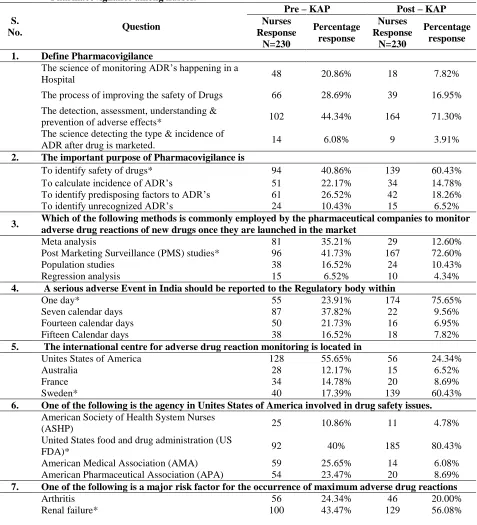
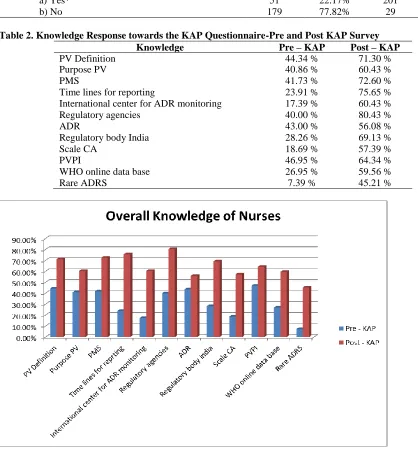
Question 1 sought information about definition of Pharmacovigilance. A Pre-KAP response rate for Question 1 for nurses were 44.34 % whereas for Post-KAP found to be 71.30 %.
Question 2 dealt with the important purpose of Pharmacovigilance. A Pre-KAP response rate for was 40.86 % whereas for Post-KAP found to be 60.43 %. Question 3 sought information about methods commonly employed by the pharmaceutical company for monitoring ADRs of new drugs once they are launched in the market. Pre-KAP response rates nurses were 41.73 % while it was 72.60 % response for Post-KAP.
Question 4 investigated health care professional’s awareness of reporting serious adverse events with regulatory body in India. Approximately 23.91 % of nurses gave correct Pre-KAP response whereas it was 75.65 % for Post-KAP.
Question 5 sought information about international center for ADRs monitoring and the Pre-KAP response rate for nurses were 17.39 % and it was found to be 60.43 % for Post-KAP.
Question 6 sought information about agency in United States of America involved in drug safety issues. Pre-KAP response rate from hospital nurses found to be 40 % whereas for Post-KAP it was 80.43 %.
Question 7 sought information about major risk factors for the occurrence of maximum adverse drug reactions. Pre-KAP response rate was 43.47 % and it was found to be 56.08 % for Post-KAP.
Question 8 investigated about the regulatory body responsible for monitoring ADRs in India. Pre KAP response rate was found to be 28.26 % whereas for Post KAP it was 69.13 %.
Question 9 sought information about most commonly used causality assessment of ADRs. According to the Pre-KAP data, 18.69 % of nurses gave correct response. 57.39 % nurses after Post-KAP survey gave correct response.
Question 10 investigated the ADR reporting system of the respective countries by means of match the following. In case of Pre-KAP nurses response for yellow card – United Kingdom 48.69 %, green card – Scotland 36.52 %, ADR reporting form – India 67.82 %, blue card – Australia 43.04 %. For Post-KAP nurses response for yellow card – United Kingdom 64.78%, green card – Scotland 60.00 %, ADR
reporting form – India 79.56 %, blue card – Australia 11.30 %.
Question 11 sought information about knowledge of National Pharmacovigilance centre in India. Nurses responded as 46.95 % in Pre-KAP. Whereas it was 64.34 % for Post-KAP.
Question 12 investigated about WHO online data base for reporting ADRs. The percentages of correct response in Pre-KAP was found to be 26.95 % and for Post-KAP it was 59.56 %.
Question 13 sought information about rare ADRs that can be identified during which phase of a clinical trial. The percentages of correct response in Pre-KAP nurses was 7.39 %. And it was 45.21 % for post-KAP response.
Question 14 sought information about professional responsibility for reporting ADRs. The percentages of correct Pre-KAP response was 52.60 % and Post-KAP response was 93.47 %.
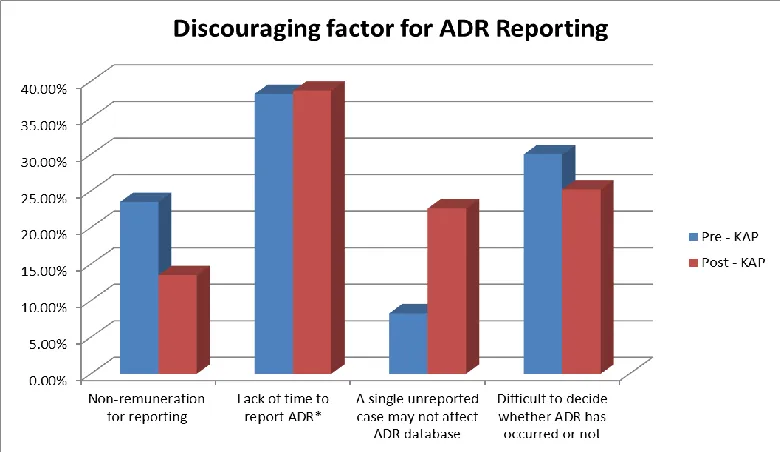
Question 15 investigated about factors discouraging them for reporting ADRs. In Pre-KAP survey 38.26 % of nurses from hospital found lack of time to report ADRs where as in Post-KAP survey it was 22.17 %.
Question 16 dealt about attitude of reporting ADRs. The percentage of correct response of Pre-KAP hospital nurses was 52.60 % and 72.72 % for the Post-KAP.
Question 17 investigated opinion about establishing ADR monitoring centre in every hospital. The percentage of correct response in Pre-KAP and Post-KAP questionnaire were found to be 70.86 % and 83.91 % respectively.
Question 18 sought information about attitude of nurses towards pharmacovigilance by means of ‘yes’ or ‘no’ questionnaires. The percentage of correct response for Pre-KAP Questionnaire was 90 % whereas it was 100 % in Post-KAP.
Question 19 also sought information about attitude of nurses towards pharmacovigilance by means of ‘yes’ or ‘no’ questionnaires. The percentage of correct response for Pre-KAP Questionnaire was 87.82 % whereas it was 99.1 % in Post-KAP.
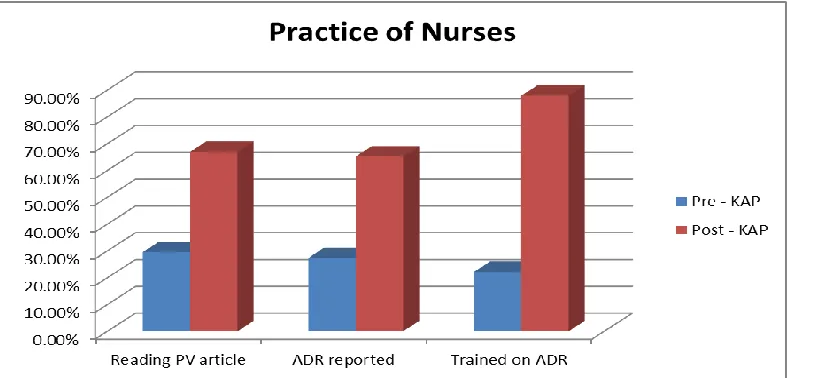
The aim of the Question 20 was to assess health care professionals’ perception and practice of reading articles on prevention of adverse drug reaction. It was found in Pre-KAP survey that only 29.56 % of nurses were in habit of doing this whereas after intervention 66.95 % nurses attitude was changed.
www.pharmascholars.com
47
A significant improvement in the knowledge, practiceand attitude of hospital nurses towards reporting of ADRs was observed after educational intervention. (Figure 1 to 5)
CONCLUSION
In conclusion, there was a need for an educational intervention to increase the knowledge, awareness
and to change the attitude towards
pharmacovigilance. The nurses were educated with the importance and procedures for ADRs reporting. After intervention, by using post KAP analysis it was noticed that there was significant increase in term of
knowledge, attitude and practices towards
pharmacovigilance among the nurses. .
Table 1. Pre and Post KAP analysis to evaluate the knowledge, attitude and practice towards Pharmacovigilance among nurses.
S.
No. Question
Pre – KAP Post – KAP Nurses
Response N=230
Percentage response
Nurses Response
N=230
Percentage response 1. Define Pharmacovigilance
The science of monitoring ADR’s happening in a
Hospital 48 20.86% 18 7.82%
The process of improving the safety of Drugs 66 28.69% 39 16.95%
The detection, assessment, understanding &
prevention of adverse effects* 102 44.34% 164 71.30%
The science detecting the type & incidence of
ADR after drug is marketed. 14 6.08% 9 3.91%
2. The important purpose of Pharmacovigilance is
To identify safety of drugs* 94 40.86% 139 60.43%
To calculate incidence of ADR’s 51 22.17% 34 14.78%
To identify predisposing factors to ADR’s 61 26.52% 42 18.26%
To identify unrecognized ADR’s 24 10.43% 15 6.52%
3. Which of the following methods is commonly employed by the pharmaceutical companies to monitor adverse drug reactions of new drugs once they are launched in the market
Meta analysis 81 35.21% 29 12.60%
Post Marketing Surveillance (PMS) studies* 96 41.73% 167 72.60%
Population studies 38 16.52% 24 10.43%
Regression analysis 15 6.52% 10 4.34%
4. A serious adverse Event in India should be reported to the Regulatory body within
One day* 55 23.91% 174 75.65%
Seven calendar days 87 37.82% 22 9.56%
Fourteen calendar days 50 21.73% 16 6.95%
Fifteen Calendar days 38 16.52% 18 7.82%
5. The international centre for adverse drug reaction monitoring is located in
Unites States of America 128 55.65% 56 24.34%
Australia 28 12.17% 15 6.52%
France 34 14.78% 20 8.69%
Sweden* 40 17.39% 139 60.43%
6. One of the following is the agency in Unites States of America involved in drug safety issues.
American Society of Health System Nurses
(ASHP) 25 10.86% 11 4.78%
United States food and drug administration (US
FDA)* 92 40% 185 80.43%
American Medical Association (AMA) 59 25.65% 14 6.08%
American Pharmaceutical Association (APA) 54 23.47% 20 8.69%
7. One of the following is a major risk factor for the occurrence of maximum adverse drug reactions
Arthritis 56 24.34% 46 20.00%
www.pharmascholars.com
48
Visual impairment 53 23.04% 35 15.21%
Vasculitis 21 9.13% 20 8.69%
8. In India which Regulatory body is responsible for monitoring of ADR’s
Central Drugs Standard Control Organization* 65 28.26% 159 69.13%
Indian Institute of sciences 42 18.26% 21 9.13%
Pharmacy Council of India 108 46.95% 41 17.82%
Medical Council of India 15 6.52% 9 3.91%
9. Which of the following scales is most commonly used to establish the causality of an ADR
Hartwig scale 78 33.91% 40 17.39%
Naranjo algorithm * 43 18.69% 132 57.39%
Schumock and Thornton scale 85 36.95% 46 20.00%
Karch & Lasagna scale 24 10.43% 12 5.21%
10. Match the ADR reporting systems to the respective countries.
1) Yellow card - United Kingdom 112 48.69% 149 64.78%
2) Green card – Scotland 84 36.52% 138 60.00%
3) ADR reporting Form - India 156 67.82% 183 79.56%
4) Blue card – Australia 99 43.04% 141 61.30%
11. One among these is a national Pharmacovigilance centre
Kasturba Hospital, Manipal 46 20% 26 11.30%
AIIMS Delhi* 108 46.95% 148 64.34%
JSS Medical College & Hospital, Mysore 51 22.17% 35 15.21%
CMC, Vellore 25 10.86% 21 9.13%
12. Which one of the following is the ‘WHO online database’ for reporting ADRs
ADR advisory committee 111 48.26% 58 25.21%
Medsafe 39 16.95% 25 10.86%
Vigibase* 62 26.95% 137 59.56%
Med watch 18 7.82% 10 4.34%
13. Rare ADRs can be identified in the following phase of a clinical trial
During phase-1 clinical trials 77 33.47% 28 12.17%
During phase-2 clinical trials 76 33.04% 55 23.91%
During phase-3 clinical trials 60 26.08% 43 18.69%
During phase-4 clinical trials* 17 7.39% 104 45.21%
14. The healthcare professionals responsible for reporting ADR in a hospital is/are
Doctor 8 3.47% 15 6.52%
Pharmacist 54 23.47% 00 00%
Nurses 47 20.43% 00 00%
All of the above* 121 52.60% 215 93.47%
15. Which among the following factors discourage you from reporting Adverse Drug Reactions
Non-remuneration for reporting 54 23.47% 14 6.08%
Lack of time to report ADR* 88 38.26% 51 22.17%
A single unreported case may not affect ADR
database 19 8.26% 53 23.04%
Difficult to decide whether ADR has occurred or
not 69 30% 112 48.68%
16. Do you think reporting is a professional obligation for you
Yes* 121 52.60% 221 96.08%
No 59 25.65% 00 00%
Don’t know 24 10.43% 00 00%
Perhaps 26 11.30% 9 3.91%
17. What is your opinion about establishing ADR monitoring centre in every hospital
Should be in every hospital* 163 70.86% 193 83.91%
Not necessary in every hospital 12 5.21% 12 5.21%
One in a city is sufficient 29 12.60% 19 8.26%
Depends on number of bed size in the hospitals. 26 11.30% 6 2.60%
www.pharmascholars.com
49
a) Yes* 207 90% 230 100%
b) No 23 10% 00 00%
19. Do you think Pharmacovigilance should be taught in detail to healthcare professionals
a) Yes* 202 87.82% 228 99.13%
b) No 28 12.17% 2 0.86%
20. Have you anytime read any article on prevention of adverse drug reactions
a) Yes* 68 29.56% 154 66.95%
b) No 162 70.43% 76 34.08%
21. Have you ever come across with an ADR
a) Yes* 63 27.39% 150 65.21%
b) No 167 72.60% 80 34.78%
22. Have you ever been trained on how to report Adverse Drug Reaction (ADR)
a) Yes* 51 22.17% 201 87.93%
b) No 179 77.82% 29 12.60%
Table 2. Knowledge Response towards the KAP Questionnaire-Pre and Post KAP Survey Knowledge Pre – KAP Post – KAP
PV Definition 44.34 % 71.30 %
Purpose PV 40.86 % 60.43 %
PMS 41.73 % 72.60 %
Time lines for reporting 23.91 % 75.65 %
International center for ADR monitoring 17.39 % 60.43 %
Regulatory agencies 40.00 % 80.43 %
ADR 43.00 % 56.08 %
Regulatory body India 28.26 % 69.13 %
Scale CA 18.69 % 57.39 %
PVPI 46.95 % 64.34 %
WHO online data base 26.95 % 59.56 %
Rare ADRS 7.39 % 45.21 %
www.pharmascholars.com
50
Figure 2. Knowledge of nurses towards International organization for ADR reporting system (Pre- and Post- KAP)
Figure 3. Change in attitude of nurses towards Pharmacovigilance after educational intervention
www.pharmascholars.com
51
Figure 5. Pre- and Post- KAP analysis after educational intervention towards practice among the nurses. REFERENCES
1. Klepper MJ. Drug Saf, 2004; 27: 569-78.
2. Livio F, Renard D, Buclin T. Rev Med Suisse, 2012; 8(324): 116-19.
3. Mann RD, Andrews EB. Introduction. in Pharmacovigilance (eds R. D. Mann and E. B. Andrews). John Wiley & Sons, Ltd, Chichester, UK: 2002.
4. Davies EC, Green CF, Taylor S, Williamson PR, Mottram DR, Pirmohamed M. PLoS One, 2009; 4(2): 443-9.
5. Davies EC, Green CF, Mottram DR, Pirmohamed M. Curr Drug Saf,. 2007; 2(1): 79–87.
6. World Health Organization, Safety monitoring of medicinal drugs: Guidelines for setting up and running up
of pharmacovigilance centre, the Uppsala Monitoring Centre, Sweden. 2000. http://apps.who.int/medicinedocs/en/d/Jh2934e/
7. World Health Organization, Switzerland: 2012.
http://www.who.int/medicines/areas/quality_safety/safety_efficacy/pharmvigi/
8. Rehan HS, Vasudev K, Tripathi CD. Natl Med J India, 2002; 15 (1): 24-6.
9. Meyboom RH, Egberts AC, Gribnau FW, Hekster YA. Drug Saf, 1999; 21(6): 429-47.
10. Wysowski DK, Swartz L. Arch Intern Med, 2005; 165(12): 1363-9
11. Lopez-Gonzalez E, Herdeiro MT, Figueiras A. Drug Saf, 2009; 32(1): 19-31.
12. Smith CC, Bennett PM, Pearce HM, Harrison PI, Reynolds DJ, Aronson JK, Grahame-Smith DG. Br J Clin
Pharmacol, 1996; 42(4): 423-9.
13. Prakash S. Indian J Pharmacol, 2007; 39(3): 123.
14. Vallano A, Cereza G, Pedròs C, Agustí A, Danés I, Aguilera C, Arnau JM. Br J Clin Pharmacol, 2005; 60(6): 653-8.
15. Bäckström M, Mjörndal T, Dahlqvist R. Pharmacoepidemiol Drug Saf, 2004; 13(7): 483-7.
16. Hassali M, Kong D, Stewart K. Pharm Educ, 2007; 7(1): 89.
17. Hepler CD. Pharmacotherapy, 2004; 24(11): 1491-8.