www.pharmascholars.com
168
Original Article
CODEN: IJPNL6
UPLC METHOD DEVELOPMENT AND VALIDATION FOR THE DETERMINATION
OF CEFPIROME SULPHATE IN PHARMACEUTICAL DOSAGE FORM
Satish Pavuluri, Sridhar Siddiraju
1
Department of pharmacy, Shri Jagdish Prasad Jhabarmal Tibrewala University, Rajasthan, India
2
Department of Pharmaceutical Chemistry, Malla Reddy College of Pharmacy, Osmania
University, Secunderabad, India
*Corresponding author e-mail:
[email protected]
Received on: 10-04-2016; Revised on: 06-06-2016; Accepted on: 29-06-2016
ABSTRACT
A simple, rapid, and precise UPLC method is developed for the quantitative determination of Cefpirome sulphate in pharmaceutical dosage form. The chromatographic separation of Cefpirome sulphate was achieved with an phenomnex c18 (2.5 X 100 mm, 3.0 µm) analytical column using 0.01M phosphate buffer and acetonitrile taken in 50:50%v/v and the response was detected at 265 nm by using PDA detector. The retention time was found to be 0.652 min. The described method shows excellent linearity over a range of 7.5-75 μg/mL. The correlation coefficient for Cefpirome sulphate was found to be 0.999. The relative standard deviation for six measurements in two sets of Cefpirome sulphate in injection is always less than 2%. The proposed method was found to be suitable and accurate for quantitative determination of Cefpirome sulphate in pharmaceutical preparations.
Key words:UPLC, Cefpirome sulphate, Assay, Validation parameters.
INTRODUCTION
Cephalosporins are bactericidal antibiotics that inhibit cell wall synthesis of bacteria. These antibiotics are derived from cephalosporin C which was for the first time isolated from the cultures of Cephalosporium acremonium in 1948 by an Italian scientist, Giuseppe Brotzu. The first agent was
cephalothin, discovered in 1964. Now new
generation cephalosporins are available along with four generations of cephalosporins in pharmaceutical dosage forms.
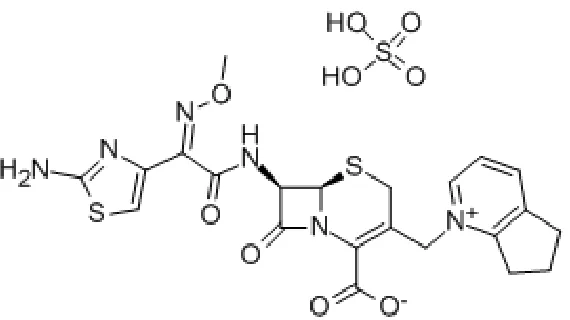
Cefpirome sulphate is belongs to fourth generation cephalosporin drug and its molecular formula is C22H24N6O9S3. Route of administration for cefpirome sulphate is orally. And it is having anti microbial and anti bacterial characters.
The literature survey reveals that there is no UPLC analytical method available for estimation of
Cefpirome sulphate in pharmaceutical dosage form. The reported methods available for the estimation of
Cefpirome sulphate individually are spectro
photometric method and HPLC methods. Since the
lack of official high performance liquid
chromatographic methods for the simultaneous estimation of Cefpirome sulphate, we have planned to develop a simple, precise, economic and accurate Stability indicating UPLC method development and validation for the estimation of Cefpirome sulphate in pharmaceutical dosage form.
MATERIAL AND METHODS Instrumentation:
Waters-Acquity UPLC system equipped with auto sampler, and DAD Detector was used for the separation. An analytical column; Phenomnex C 18 (2.5 x 100mm, 3.0m) was used in the analysis with
International Journal of Pharmacy
www.pharmascholars.com
169
the flow rate is 0.3 ml per minute and wave length is265 nm and injection volume is 2 l and column oven temperature is 400C with the run time of 3 minutes. For data collection and processing, Chromatographic software Empower -2 was used.
Reagents and chemicals:
The standard cefpirome sulphate drug was provided as gift samples from Spectrum pharma research solutions, Hyderabad. HPLC grade Acetonitrile and ammonium acetate and all other chemicals were purchased from Merck chemical division, Mumbai. HPLC grade water was used throughout the study. Formulation was purchased from the pharmacy.
Preparation of Phosphate buffer:
To prepare Phosphate buffer solution, By adding 6.8gms of potassium di hydrogen ortho phosphate in a 1000ml water. Adjust this solution to pH 3.5
Preparation of mobile phase:
Mix a mixture of above buffer 500 mL (50%) and
500 ml Acetonitrile HPLC (50%) and degas in
ultrasonic water bath for 5 minutes. Filter through 4.5 µ filter under vacuum filtration.
Diluents Preparation:
Water : Acetonitrile(50:50) ratio
Standard Stock Solution Preparation:
Accurately weigh and transfer 10 mg of Cefpirome sulphate working standard into a 10ml clean dry volumetric flask add Diluents and sonicate to dissolve it completely and make volume up to the mark with the same solvent. (Stock solution)
Sample Solution Preparation:
Accurately weigh and transfer equivalent to 10 mg of Cefpirome sulphate sample into a 10ml clean dry volumetric flask add about 7mL of Diluents and sonicate to dissolve it completely and make volume up to the mark with the same solvent. (Stock solution).
Further pipette 1.5 ml of Cefpirome sulphate of the above stock solution into a 10ml volumetric flask and dilute up to the mark with Diluents. Further pipette 3.0 ml of Cefpirome sulphate of the above stock solution into a 10ml volumetric flask and dilute up to the mark with Diluents.
METHOD VALIDATION: System suitability:
System suitability parameters are determined in the different view of parameters like area, tailing factor and theoretical plates.
Precision: Repeatability:
Pipette out 1.5 ml of Cefpirome sulphate of the above stock solution into a 10ml volumetric flask and dilute up to the mark with Diluents. Further pipette 3.0 ml of Cefpirome sulphate of the above stock solution into a 10ml volumetric flask and dilute up to the mark with Diluents.This standard solution was injected for six times and measured the area for all six injections in HPLC. The %RSD for the area of six replicate injections was found to be within the specified limits.
Intermediate Precision:
To evaluate the intermediate precision of the method, Precision was performed on different day by using different make column of same dimensions. Pipette out 1.5 ml of Cefpirome sulphate of the above stock solution into a 10ml volumetric flask and dilute up to the mark with Diluents.
Further pipette 3.0 ml of Cefpirome sulphate of the above stock solution into a 10ml volumetric flask and dilute up to the mark with Diluents. The standard solution was injected for six times and measured the area for all six injections in UPLC. The %RSD for the area of five replicate injections was found to be within the specified limits.
Accuracy:
The recovery experiments were performed at three levels, in which sample stock solutions were spiked with standard drug solution containing 50, 100 and 150% of labeled amount of the Cefpirome sulphate. Three replicate samples of each concentration level were prepared and the %recovery at each level (n = 3), and mean% recovery (n=9) were determined.
Linearity:
From the stock solution pipette out 0.5, 1, 2, 3.0, 4 & 5 ml was taken into the clean and dry 10 ml volumetric flask and make up the solution with diluents to prepare the concentration of 7.5-75ppm of
Cefpirome. Inject each level into the
chromatographic system three times and measure the peak area. Plot a graph of peak area versus concentration (on X-axis concentration and on Y-axis Peak area) and calculate the correlation coefficient.
LOD and LOQ:
The limit of detection (LOD) and limit of quantitation (LOQ) for DCZ was determined by using calibration curve method.
Solution stability:
www.pharmascholars.com
170
standard solution.Robustness:
As part of the Robustness, deliberate change in the Flow rate, Mobile Phase composition, Temperature Variation was made to evaluate the impact on the method. The flow rate was varied at 0.27 ml/min to 0.33ml/min, mobile phase is varied ±5% and the temperature is varied from 35 to 45 degrees Celsius.
Assay:
The Content of Cefpirome sulphate in the pharmaceutical dosage form was found by using the developed method. The percentage purity of Cefpirome sulphate was found to be 99.68%, and %RSD values for Cefpirome sulphate was within limit of ≤2.
RESULTS & DISCUSSION
The chromatographic method was optimized by using different stationary phases like C18, C8, CN and different mobile phases containing buffers like phosphate, ammonium acetate, and triethylamine with different pH (2–5), and organic modifier (acetonitrile) were used. Finally, the chromatographic separation was achieved using Phenomnex C 18 (2.5 x 100mm, 3.0m) column. Changing the composition of mobile phase optimized the chromatographic method. To develop a stability-indicating method
assessing the effect of change of proportion, the pH of mobile phase was maintained at 3.5 and the drug was well-resolved at mobile phase composition of buffer–acetonitrile (50:50, v/v) and the flow rate of mobile phase 0.3mL/min, and column temperature 40°C was optimal. The analyte had adequate retention, peak shape, less tailing and the chromatographic analysis time was less than 3 min.
The developed method was validated for system suitability, Linearity, accuracy, precision, LOD, LOQ and robustness. All the results were found to be within the limits and were summarized in the table 1.
CONCLUSION
A new, simple, rapid and precise ultra performance liquid chromatographic method was developed for
the estimation of Cefpirome sulphate in
pharmaceutical dosage form. Hence this method can be applied for the estimation of Cefpirome sulphate in drug testing laboratories and pharmaceutical industries.
ACKNOWLEDGEMENT
The authors would like to thanks to the principle,
Kottam pharmacy college, yerravally (post),
Mahaboob Nagar District., Telangan state, India, for providing the necessity facilities.
www.pharmascholars.com
171
Fig. 2. Standard chromatogram of cefpirome sulphate
Fig. 3. Assay chromatogram of cefpirome sulphate
Table 1: Results of validation parameters
S.
No.
Validation Parameter
Result
ICH guidelines
1
System suitability:
No of theoretical Plates
Tailing factor
2842
1.52
>2000
˂2
2
Specificity
No other peaks at drug
peak
No interference of excipients
www.pharmascholars.com
172
3
Linearity
R
2= 0.9995
R
2= 0.999
4
Intermediate Precision
Repeatability
%RSD = 1.37
%RSD = 0.81
%RSD = ˂2
%RSD = ˂2
5
Accuracy
%RSD = 1.67
%RSD = ˂2
6
Lod and Loq
0.35 & 1.08µg/ml
Sensitive
7
Solution Stability
SD= 0.11
SD˂2
8
Robustness
%RSD˂2
%RSD = ˂2
REFERENCES
1. Young VR, Ajami AM. Glutamines-review: J Nutr 2001; 131(9 Suppl): 2449S–2459S.
2. Fürst P, Stehle P: Glutamine and glutaminecontaining dipeptides. In: Metabolic and Therapeutic Aspects of Amino Acids in Clinical Nutrition. Cynober L (Ed). Boca Raton, FL, CRC Press; 2004, p 613–632.
3. Tseng SH, Yang YH, Chen YR, Chen SH. Determination of cefepime in plasma and cerebrospinal fl uid by
micellar electrokinetic chromatography with direct sample injection. Electrophoresis 2004;25:1641-7. 4. Palacios FJ, Mochón MC, Sánchez JC, Carranza JH. Adsorptive stripping voltammetric determination of
cefepime at the mercury electrode in human urine and cerebrospinal fl uid, and differential pulse polarographic determination in serum. J Pharm Sci 2003;92:1854-9.
5. Valassis IN, Parissi-Poulou M, Macheras P. Quantitative determination of cefepime in plasma and vitreous
fluid by high-performance liquid chromatography. J Chromatogr B Biomed Sci Appl 1999;721:249-55.
6. Devang. N. Wadia and hemant. T. Desai studied Ultra performance liquid chromatography (uplc) method
development and validation for the estimation of lalanyl-l-glutamine in pharmaceutical dosage form (infusions). International Journal of life science and Pharma research, Vol 2/Issue 1/Jan-Mar 2012, 179-184.
7. Aleem Ahamed, Krishnamurthy, Bhojya Naik H. & Ramesha, Development and validation of stability indicating ultra performance liquid chromatographic method for etravirine, International Journal of Pharmacy and Pharmaceutical Sciences, Vol 4, Issue 1, 2012, 255-261.
8. Brinda1, V. Krishna Reddy, E.Sasikiran Goud, Development and validation of ultra performance liquid chromatographic method for assay of omeprazole blend, IJPBS,Volume 4, Issue 1, JAN-MAR 2014, 38-44.
9. Bhupendra Shrestha, Nihar Ranjan Bhuyan1, Barij Nayan Sinha, Simultaneous Determination of Cefepime
and Tazobactam in Injectables by Ultra-High Performance Liquid Chromatography Method, Pharmaceutical Methods, Vol 5, Issue 1, Jan-Jun 2014, 20-26.
10. Chang YL, Chou MH, Lin MF, Chen CF, Tsai TH. Determination and pharmacokinetic study of unbound
cefepime in rat bile by liquid chromatography with on-line microdialysis. J Chromatogr A 2001;914:77-82.
11. Palacios FJ, Callejón M, Sánchez JC, López MA, Pérez AG. Validationvof an HPLC method for
determination of cefepime (a fourth generation cephalosporin). Determination in human serum, cerebrospinal fl uid and urine. Pharmacokinetic profi les. Chromatographia 2005; 62: 355-61.
12. Beale, John M. In: Wilsons and Gisvold’s Textbook of Organic Medicinal and Pharmaceutical chemistry,
Editors John H block and John M Beale Jr., chapter- 10, 11th edition, Lippincott Williams & Wilkins: pp- 318-326.
13. Garrigues TM, Martin U, Paries-Ribera JE, Prescott LF. Dose-dependent absorption and elimination of cefadroxil in man. Eur J Clin Pharmacol. 1991; 41: 179-183.
14. United States Pharmacopeia 31. Roukville: The United States Pharmacopoeia Convention, 2008; Vol 2, pp
1163-1165.
15. Brisson AM, Fourtillan JB. Pharmacokinetic study of cefadroxil following single and repeated doses. J Antimicrob Chemother. 1982; 10(B): 11-15.
16. McAteer JA, Hlltke MF, SiIber BM, Faulkner RD. Liquidchromatographic Determination of Five Orally
www.pharmascholars.com
173
17. F.J. Jimenez palacios, M.Calle jonmocnon, MAbellolopez, Validation of an HPLC Method for
Determination of Cefepime (a Fourth-Generation Cephalosporin). Determination in Human Serum, Cerebrospinal Fluid, and Urine. Pharmacokinetic Profiles., chromatographia, volume No: 62, P.No. 355-361.
18. Shaikh K.A., Devkhile.A.B., method developement and validation for third generation cephalosporins by UV-Visible spectrophotometer., IRJP, 2(1), P.No. 222-229.
19. S.J. Ingale, chandramohan sahu, R.T.Paliwal, A.K.Singhai, Advance approches for the impurity profiling of pharmaceutical drugs; A Review; IJPLS, vol.2, issue-7-suppl; 2011, P.No. 955-962