Extraction of colorant from leaves of Terminalia catappa using Non conventional technique Shweta Umale and P.A Mahanwar *
Department of Polymer and Surface Engineering, Institute of Chemical Technology, Matunga,
Mumbai – 400019 (India) Email: [email protected]
Abstract
Recently, dyes derived from natural sources for various applications have emerged as an important alternative to potentially harmful synthetic dyes and pose need for suitable effective extraction methodologies. In present work Microwave assisted extraction (MAE) technique was developed for fast extraction of colorant from Terminalia catappa leaves. The influence of process parameters on the extraction efficiency such as output power, time, effect of solvent system and amount of material has been studied. The method has been compared with conventional extraction methods such as Heat reflux method (HRE) and Soxhlet extraction (SOX). The influence of extraction parameters on the extraction yield of flavonoids has been evaluated. All of the extracts were tested for their radical scavenging and antioxidant activities by measuring their capacity to scavenge the
2,2-diphenyl-1-picrylhydrazyl (DPPH) radical. To our knowledge no MAE application, for the extraction of colorant from Terminalia catappa have found in bibliography The use of microwave is found to have significant improvement in the extraction efficiency of colorant.
Keywords –Extraction, Microwave,
Antioxidant, Flavonoids, Terminalia catappa,
conventional methods.
I. Introduction
colon carcinogens, which is a possible hazard to humans when chronically exposed [2]. During textile/leather processing, inefficiencies in dyeing result in a large amount of dyestuff being directly lost in the waste water, which ultimately finds way into the environment. It is estimated that 10–35% of the dye is lost in the effluent during the dyeing process, while in the case of reactive dyes, as much as 50% of the initial dye load is present in the dye bath effluent [3]. EU decision on the restriction of azo based dyes with potential breakdown into certain toxic amines (22 in numbers) as well as recent regulation for chemicals i.e. REACHES. These factors tend to restrict the use of synthetic dyes due to routine monitoring of this industrial effluent. The enhancement of product recovery by microwave is generally attributed to its heating effect, which occurs due to the dipole rotation of the solvent in the microwave field. This causes the solvent temperature to rise, which then increases the solubility of the compound of interest. Specifically, solvent heating by microwave occurs when molecules of the polar solvent could not align themselves quickly enough to the high frequency electric field (typically 2450 MHz) of microwave. This discrepancy causes the solvent molecules to dissipate the absorbed energy in the
form of heat. Although many reports have been published on application of microwave heating for extraction of organic compounds from environmental matrices [4,5], microwave has only recently been applied to extraction of plant materials [6-9]. Some examples of these are extractions of glycyrrhizic from the licorice root, ginsenoside from ginseng root, artemisinin from Artemisia annua L. [10-12]. Recently, Dabiri et al. [13] reported their investigation on optimization of MAE of alizarin and purpurin from the roots of madder plants, a similar plant to M. citrifolia belonging to the Rubiaceae species. In their work, the emphasis was placed on extraction of pigment compounds from the plant roots. In the present study, MAE of M.citrifolia roots was carried out, in which the biological activity of the extract as well as the amount of anthraquinones in the extract was concerned.
II. Material and methods
from Sigma Chemicals (Mumbai, India). Other chemicals were purchased from S D Fine chemical.
III. EXPERIMENTAL
The process of MAE was performed in a Microwave synthesis system (Mass-II) a frequency of 2450 MHz With output power 1000 watt.
A. THE EXTRACTION PROCEDURE B. SOXHLET EXTRACTION
A sample powder 2.5 g was accurately weighted and put into150mL Soxhlet thimble. The apparatus was fitted with 500mLround bottom flask containing 200mLof extraction solvent. The extraction temperature was controlled at 80 ◦C with a regulator .The flask was heated for certain time and the solvent was refluxed. After extraction, the extract was filtrated and transferred into a volumetric flask. The solvent was used to rinse the distilling flask and the sediment three times. The rinsed solvent was also added into the flask and then the solvent was added to the mark.
C. HEAT REFLUX EXTRACTION
A sample powder 0.5 g was accurately weighted and then put in the distilling flask, fitted with a water cooling condenser, in which 50mL of extraction solvent added into it. After being heated at 80 ◦C for a given time, the extract was filtrated and transferred into a volumetric
flask. The solvent was used to rinse the distilling flask and the sediment three times. The rinsed solvent was also added into the flask and then the solvent was added to the mark.
D. TOTAL FLAVONOID CONTENT DETERMINATION
The total flavonoid content was determined using the Dowd method [16]. 5 mL of 2 % aluminium trichloride (AlCl
3) in methanol was mixed with the same volume of the extract solution (0.4 mg/mL). Absorption readings at 415 nm using PerkinElmer UV-VIS lambda 25 spectrophotometer were taken after 10 minutes against a blank sample consisting of a 5 mL extract solution with 5 mL methanol without AlCl
3. The total flavonoid content was determined using a standard curve with catechin (0 - 100 mg/L) as the standard. Total flavonoid content is expressed as mg of catechin equivalent.
D. DPPH FREE RADICLE SCAVENGING ACTIVITY
added and the mixture was shaken vigorously. The mixture was left to stand for 5 min and the absorbance was measured using a spectrophotometer at 517 nm. Ethanol was used to zero the spectrophotometer. A blank sample containing the same amount of ethanol and DPPH was also prepared. All determinations were performed in triplicate. The radical scavenging activities of the tested samples, expressed as percentage of inhibition were calculated according to the following equation (20):
Percent of DPPH inhibition= [(AB-AA)/AB]× 100
Where AA and AB are the absorbance values of the test and of the blank sample, respectively. A percent inhibition versus concentration curve was plotted and the concentration of sample required for 50% inhibition was determined and expressed as IC50 //value.
IV. Result and discussion
A. EFFECT OF MICROWAVE POWER
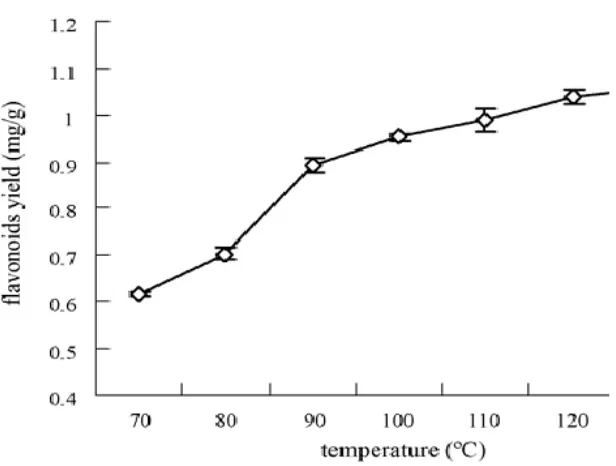
An amount of 5.0 g was extracted with 50 ml 90% aqueous ethanol at 90 ◦C for two cycles under different microwave powers (200, 400, 600, 800, and 1000W) (see Fig. 2). In general, the extraction efficiency was improved by raising microwave power from200 to 1000W. During short
irradiation time (5 and 10 min) yield of flavonoids were enhanced with microwave power increasing. When the extraction solutions were heated long enough (15min),the yields under different powers were similar. The difference of the flavonoids yield among 200 to 1000Wappears more significant with short irradiation times compared to long irradiation times. A similar result was also reported previously in MAE of notoginseng saponins from cultured cells of Panax notoginseng [14] and MAE of flavonoids from Saussurea medusa maxim cultured cells [15].The accelerated extraction of flavonoids by increasing microwave power is related to the direct effects of microwave energy on biomolecules by ionic conduction and dipole rotation which result in power dissipated inside the solvent and plant material and then generate molecular movement and heating [16].More electromagnetic energy was transferred to the extraction system quickly and improved the extraction efficiency when the microwave power increased from 200 to 1000W.
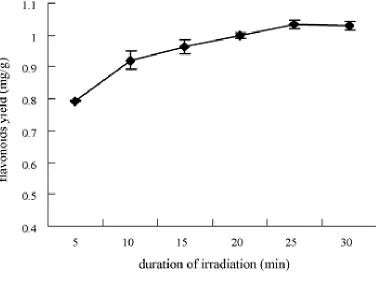
were studied. It is seen in Fig. 6 that the yield of flavonoids at the beginning increased with the increase of duration of microwave radiation and reaches its maximum1.033mg/g at 25 min, then fell down slightly. Therefore, the best microwave radiation time is 25min. Overexposure in the microwave may cause the loss of flavonoids. This was also observed in the extraction of aromatic amines from leather, where the recovery of some amines decreased with irradiation time increasing [17]and similar results was obtained in the extraction of tri Terpenoids saponins from Ganoderma atrum [18]. Therefore, 25 min was chosen as the optimal time for MAE.
C. EFFECT OF MATERIAL TO SOLVENT RATIO
Generally in conventional extraction techniques a higher volume of solvent will increase the recovery, but in MAE a higher solvent volume may give lower recoveries [17, 18]. To investigate the influence of solvent to material ratio on yield of flavonoids, several grams were extracted for 10min with 50 ml of solvent at different ratios of solvent to material (10, 15, 20, 25, 30, 35, 40 ml/g, respectively). It is seen in Fig. 3 that the yield of flavonoids increased with the increase of solvent to material ratio and reached its maximum1.019mg/g at 30 ml/g. It
decreased as the ratio was above30 ml/g. This was probably due to the larger volume of 90% ethanol causing excessive swelling of the material by water and absorbing the effective constituent [19]. As there was no significant difference between the yield at 25 and that at 30 ml/g, the value of 25 was considered as the optimal ratio of solvent to material
MAE can save a lot of time as compared to Soxhlet and heat reflux method and bring higher yield of flavonoids than HRE and ultrasound-assisted extraction. It is worth noting that MAE is a good alternative to ultrasound-assisted extraction and HRE in the practical production of Radix flavonoids. Table .1.
E. ANTIOXIDANT ACTIVITY OF
EXTRACT OF T.CATAPPA
LEAVES ACCORDING TO DPPH METHOD
Scavenging effects of methanolic extract on DPPH radicals was excellent at concentrations as low as 0.1 mg/ml . At 0.1 mg /ml, the scavenging effect of the methanolic extract was 92.5–95.7% and comparable to those of vitamins C and E and BHA (95.2–96.7%). Ko (1998) found that at 5 mg/ml, water extracts from green, yellow fallen and red fallen leaves of T. catappa scavenged DPPH radicals by 52.1, 41.4and 41.1%, respectively. However, at 50 mg /ml, the scavenging effects of water extracts from green, yellow fallen and red
V. Conclusion
In this study suitable methodology for the fast extraction of colorant from the leaves of Terminalia catappa was developed. MAE method has several advantages over conventional method .The consumption of energy, solvent and time for the extraction was much reduced. Method can be
employed on industrial scale. This study gives a strong impact for expanding the investigations of antioxidants compounds extracted with microwave-assisted method from T. Catappa.
References
1. Osman O.Y., Sharaf I.A., Osman H.M., Ahemad E.I., (2004) J. Biomed. Sci.61 128-132
2. Sivakumar V., Rao P.G., (2003) Ultrason. Sonchem.10 85-94
3. Sivakumar V., Rao P.G., (2004) Environ. Sci. Technol. 38, 1616-1621 4. Sivkumar V. Swaminathan G., Rao P.G., (2005) J. Microsc. (Oxf) 22031-35
5. K. McLaren, The Colour Science of Dyes and Pigments, Bristol, Adam Hilger Ltd, 1983.
6. M.Y. Osman, I.A. Sharaf, H.M. Osman, Z.A. El-Khouly, E.I. Ahmed, Br. (2004) J. Biomed. Sci. 61 (3) 128–132.
7. H. Rai, M.S. Battacharyya, J. Singh, T.K. Bansal, P. Vats, U.C. Banerjee, (2005) Crit. Rev.Env. Sci. Technol. 35, 219–238.
8. M. Al-Harahsheh, S.W. Kingman, (2004) Microwave-assisted leaching—a review, Hydrometallurgy 73, 189–203.
9. R. Liu, J.L. Zhou, A. Wilding, (2004) J. Chromatogr. A 1038, 219–226. 10. X. Pan, G. Niu, H. Liu, (2003) Chem. Eng. Proc. 42, 129–133.
11. H. Li, C. Bo, Z. Zhang, S. (2004) Talanta 63, 659–665.
12. X. Pan, H. Liu, G. Jia, Y.Y., (2000) Biochem. Eng. J. 5, 173–177. 13. Y.Y. Shu, M.Y. Ko, Y.S. Chang,(2003) Microchem. J. 74 ,131–139.
14. J. Hao, W. Han, S.D. Huang, B.Y. Xue, X. Deng, (2002) Sep. Purif. Technol.28 191– 196.
16. W. Vongsangnak, J. Gua, S. Chauvatcharin, J. Zhong(2004)., Biochem.Eng. J. 18 115–120.
17. M. GAO, B.Z. Song, C.Z. Liu, (2006) Biochem. Eng. J. 32 79–83. 18. M. Gfrerer, E. Lankmayr, (2005), Anal. Chim. Acta 533,203–211. 19. C.S. Eskilsson, E. Bj ¨ orklundw(2000), J. Chromatogr. A 902 ,227–250. 20. Y. Chen, M.Y. Xie, X.F. Gong, (2007) J. Food Eng. 81 ,162–170.
21. The State Pharmacopoeia Commission of PR China, Pharmacopoeia of the People’s 22. Republic of China, Chemical Industry Press; Beijing, 2005, China, vol. 1, pp. 212–
213.
23. S.G. Ji, X. Li, Z.Y. Lou, G.B.Wan., Y.F. Chai, (2005) J. Sec. Mil. Med. Univ. 26 ,1168–1170.
Table 1. Comparison of extraction methodologies
Number Extraction method
Extraction time
Solvent Solvent consumption (ml/g)
Yield of flavonoid
1 Soxhlet 4h Methanol 20 1.291±0.033
2 HRE 2 h ×2 90 % Ethanol 25 0.736±0.038
Fig . 1. Schematic diagram of microwave equipment
Fig. 2. Effect of extraction temperature on flavonoids yield. Extraction conditions: 1000W, 90%
Fig. 3. Effect of duration of irradiation on flavonoids yield. Extraction conditions: 1000W,
90% ethanol, solvent ratio 10 ml/g, 90 ◦C, two cycles.
Fig. 4. Effect of solvent ratio on flavonoids yield. Extraction conditions: 1000W, 90%ethanol, 90 ◦C,