Process Planning Knowledge Discovery Based on
CAPP Database for Mechanical Manufacturing
Enterprise
[10 font size blank 1] [10 font size blank 2]
Jia Xiaoliang
School of Mechatronic, Northwestern Polytechnical University, Xi’an, China Email: [email protected]
[10 font size blank 1] Zhang Zhenming and Tian Xitian
Institute of CAPP & Manufacturing Engineering Software, Northwestern Polytechnical University, Xi’an, China Email: {zhangzm, tianxt}@nwpu.edu.cn
[10 font size blank 1] [10 font size blank 2] [10 font size blank 3] Abstract—Knowledge discovery in database have been
attracting a significant amount of research, industry attention in recent years. Process planning knowledge (PPK) is one of the most important knowledge in mechanical manufacturing enterprise. The traditional method of turning data into knowledge relies on manual analysis and interpretation. This paper analyzes the source and composing of process planning knowledge and state of arts on process planning discovery in mechanical manufacturing enterprise. On the basis of the widely application of computer aided process planning (CAPP) system in mechanical manufacturing enterprise, the concept of process planning knowledge discovery (PPKD) is proposed based on process planning databases. This paper provides an overview CAPP database of the field, clarifying how PPKD in CAPP database are related both to each other and to related fields, the technology architecture of process planning knowledge discovery is founded based on object-oriented model-driven technology, and the process planning knowledge discovery script is designed. Elementary application research in typical process knowledge discovery is described in detail. The technology of PPKD in this paper has been tested in an aeronautical manufacturing enterprise to support the automatically knowledge acquisition in CAPP system. Good application effect has been revealed.
[9 font size blank 1]
Index Terms—knowledge discovery, process planning knowledge discovery, CAPP database, mechanical manufacturing
[9 font size blank 1]
I. INTRODUCTION
With the development of knowledge economic, knowledge resource becomes the most important resource in mechanical manufacturing enterprise. The competition superiority of enterprises comes from the effectively development and management on knowledge resource. Ref. [1] Nowadays, with the rapid application of enterprise information softwares, the location of
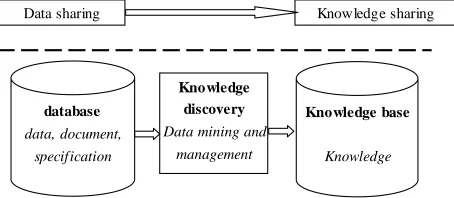
knowledge resource is changing from employee’s brain and papery document to digital databases in mechanical manufacturing enterprise. These databases are the foundation and sources of knowledge management. How to change these data into knowledge is the work of knowledge discovery. Knowledge management in mechanical manufacturing enterprise can be divided into three parts; they are creating knowledge, finding knowledge and spreading knowledge. Figure1 shows the aim of knowledge management.
database
data, document,
specification
Knowledge discovery
Data mining and management
Knowledge base
Knowledge
Data sharing Knowledge sharing
Figure 1. From data management to knowledge management
Ref. [2] Data mining is a recent popular theme in reflecting the effort of knowledge discovery from data. It provides the techniques that allow managers to obtain managerial information from their legacy systems. Data mining is made possible by the very presence of the large databases. While knowledge discovery often refers to the process of discovering useful knowledge from data, data mining focuses on the application of algorithms for extracting patterns from data. Knowledge discovery seeks to find patterns in data and to infer rules that common queries do not reached effectively.
(CAPP) system, digital process planning data is accumulated rapidly in databases. How to accomplish knowledge discovery of technique, experience, data, principle, and specification in industry practice has been the key problem in mechanical manufacturing enterprise. How to discover new knowledge and enrich process planning knowledge base (PPKB) based on the accumulated product process planning database (PPDB) is concerned by engineers significantly. It is a new technology as we called process planning knowledge discovery (PPKD). Nowadays, knowledge discovery technology has been widely used in finance industry, communication industry, retail industry etc., but for mechanical manufacturing industry, especially on process planning knowledge discovery in CAPP application system, it has less report and research.
In fact, process planning discovery technology covers the theoretical issues related to data mining, learning-by-examples, knowledge acquisition, knowledge discovery, database, and information mapping. Ref. [3] We believe that PPKD is certainly not for humans entirely; actually, most analysis work needs to be automated. A goal for PPKD is to build a foundation for the application of knowledge discovery based on CAPP database from an interdisciplinary perspective including artificial intelligence, database, software technology, statistics, and management. Recent research achievement in expert system (ES), artificial intelligence (AI), knowledge management (KM), data mining (DM), database (DB) etc. have established abundant foundation for PPKD.
II.PROCESS PLANNING KNOWLEDGE MANAGEMENT IN MECHANICAL MANUFACTURING ENTERPRISE
A. Analysis of process planning knowledge in mechanical manufacturing enterprise
Process planning knowledge in mechanical manufacturing enterprise includes foundation data, process planning specification, and experience of expert etc. for process planning. All types of PPK are synthetically used generally, for example, selecting manufacturing method, designing fixture, arranging route etc. In commonly, PPK can be divided into four types.
(1) Handbook knowledge: It includes data and knowledge in handbook and engineering standard for process planning, for example, tolerance, material, cutting feed and process planning specification etc.
(2) Manufacturing resource knowledge: It implies data and knowledge that has close relation with manufacturing environment, such as machine, cutter, fixture and process planning database etc.
(3) Decision-making knowledge: It is compose of experiential rule, procedure algorithm and control knowledge for process planning that commonly exists in engineering expert’s brain.
(4) Model knowledge: It includes process planning data model and process planning knowledge model, for instance, product, part, process planning, operation, step, fixture, machine etc.
The traditional method of turning data into knowledge relies on manual analysis and interpretation. PPKD is the process of mining and formalization domain process planning knowledge in manufacturing enterprise. Nowadays, the main method of PPKD is done by human knowledge engineers assisted by domain expert from literature, document, handbook, process planning file etc. in papery information source. For example, in mechanical manufacturing enterprise, it is common for experts to periodically analyze current trends and documents in enterprise, and on a quarterly or yearly basis. Ref. [4] The experts can provide an outline document of the analysis to the engineering department; the effect of this document for decision-making and planning on new product is rather limited. In addition, this form of manual probing of information set is slow, expensive, and highly subjective, and depends on domain experts greatly. In fact, as information volumes grow dramatically, this type of manual information analysis is becoming completely impractical in engineering work, and these problems result in the poor implementation of PPKD.
In fact, with the application of CAPP system in manufacturing enterprises, process planning knowledge is implicated in digital process planning databases. It becomes a main PPK source in manufacturing enterprise. Based on representation of process planning knowledge model, technology and method, discovering knowledge from digital process planning databases can be an effective method to solve the bottleneck in PPKD.
In our view, PPKD refers to the overall process of discovering useful process planning knowledge from CAPP database, and process planning data mining is a particular step in this process. It is the application of specific algorithms for extracting patterns from database. Ref. [5] The whole steps in the PPKD include, such as data preparation, data selection, data cleaning, incorporation of appropriate prior knowledge, and proper interpretation of the results of mining, are essential to ensure that useful knowledge is derived from the CAPP database.
B. Mechanical manufacturing enterprise process planning Information model
TABLE I. DESCRIPTION OF PPIM
Name Description ProdM Product model, it includes product no, product name,
version and assembly relation etc.
PartM Part model. it includes part name, part no, version, fixture, cutting elements etc.
PPM Process planning model, it describes the relation of process, operation, step, product, part, manufacturing resource etc.
MRM Manufacturing resource model, it includes machine, fixture, cutter and measure etc.
MOM Manufacturing object model, it includes manufacturing object such as material, blank etc. PPDM Process planning decision model, it describes
methods and rules based on object class.
PCM Process card model that is used to define process card based on process planning data model.
PFM Process file model that is used to define the relation of process planning files.
WFM Work flow model, it includes approval workflow model, process planning assignment model, process planning change model etc.
OM Organization model, department and organization in manufacturing enterprise associated with CAPP are defined in OM.
UM User model, user, role and right in manufacturing enterprise associated with CAPP are defined in UM. FCM Function configuration model, system configuration,
function choice etc. are defined in FCM.
Application model base
ProdM,PartM,PPM,MRM, MOM,PPDM,PCM,PFM, WFM,OM,UM,FCM Process planning
knowledge base (PPKB)
Product process planning database
(PPDB)
object-oriented model driven mapping
PPK
(1) PPIM (2) Process planning
decision knowledge (3) Process planning
knowledge and resource (4) procedure model (5) Specification
(1) Process file (2) Process data (3) Statistic data (4) Task data (5) BOM data
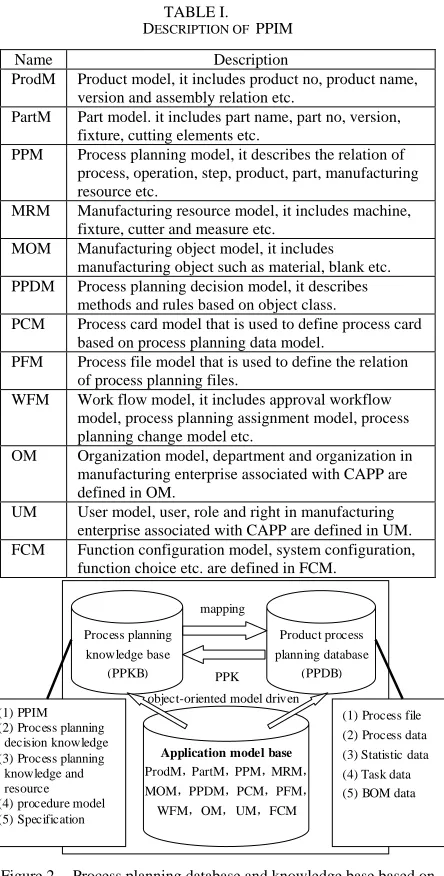
Figure 2. Process planning database and knowledge base based on PPIM
III. PROCESS PLANNING INFORMATION MODEL-DRIVEN ARCHITECTURE IN CAPP DATABASE
The realization of CAPP development platform design on object-oriented information model-driven is the guarantee to the universal, maintenance, expansion of CAPP system, CAPP system can running in uniform information model, it can realize the dynamic change of system data structure, data flow by the change of information model for adapting to the change in manufacturing enterprise. The information model of CAPP development platform uses object-oriented technology as modeling method. Object-oriented method is a way that uses object, class, instance, etc. concepts to describe software system, it’s a fundamental method to understand research domain in natural way, the definition and identification of information model entities are in human’s impersonality thinking way. Object-oriented method is intuitionistic, natural and easy understanding
modeling method. Figure3 shows the process planning information model-driven architecture in CAPP database.
ProdM,PartM,PPM,MRM,
MOM,PPDM,PCM,PFM,
WFM,OM,UM,FCM Analys is of
enterprise CAPP application
Application requirement Application model development
Analys is design test submission maintenance
CAPP application system running mechanism based on information model driven
Analys is of CAPP domain
and model
Domain
requirement Domain basic model
Enterprise CAPP application system
ProdM,PartM,PPM,MRM,
MOM,PPDM,PCM,PFM,
WFM,OM,UM,FCM Enterprise application model
Figure 3. Process planning information model-driven architecture in CAPP database
A. Process Planning Knowledge Base Model in CAPP Database
Process planning and process management involves large numbers of information and knowledge. In traditional CAPP systems, the process planning knowledge base (PPKB) mainly stores decision-making knowledge for process planning decision-making. In the information model-driven CAPP system, the knowledge base includes not only process planning knowledge and decision-making knowledge, but also the CAPP application system information model. It is used in process planning procedure, the development, application, and maintenance of CAPP system. The knowledge base in CAPP development platform can be divided into two levels.
1) Special information model for a manufacturing enterprise: It includes product information model, part information model, process planning information model, manufacturing resource information model, manufacturing information model, process planning decision information model, process card information model, process file information model, work flow information model, organization information model, user information model, and function configuration information model.
2) Based on the information model-driven mechanism in CAPP development platform, the object instance and method is used in process planning knowledge base to describe process knowledge, such as typical process, typical operation etc. The knowledge in process planning knowledge base can substitute handbook and can retrieve process instance to improve the design efficiency.
process planning knowledge base model is the basis and central for PPKD. In addition, with the improving on process planning level and the change on manufacturing environment, the process planning knowledge base model need to be changed constantly.
B. The Object-oriented Information Model Description in PPKB
Using the object-oriented modeling tool, the process planning knowledge base model is founded in the development of CAPP development platform. It is the basis on the realization of information model-driven mechanism in CAPP system. The CAPP application information model can be denoted on different views based on PPKB model, such as organization view, personnel view, workflow view, document view and data view. In CAPP system, the PPKB model is analyzed and optimized by different views to realize system development.
Ref. [6] In CAPP development platform based on information model-driven, object-oriented method is adopted to describe the relation and manipulation of entities structure and object in CAPP system. Object class is the basis on describing process information and knowledge. Object instance represents the actual data. Object method and rule describes process planning decision-making knowledge and system configuration. Table II shows the object-oriented information model representation.
TABLE II.
THE OBJECT-ORIENTED INFORMATION MODEL DESCRIPTION IN PPKB
Object class ::= <[object class name], [object class attribute],
[object class method], [object class instance]> object class name ::= string
object class attribute ::= <[NO], [attribute name], [attribute type], [attribute restriction], [calculate formula], [get mode], [relevancy]>
NO ::= int
attribute name ::= string
attribute type ::= < ‘int’ | ‘float’ | [‘string’,[length]] | ‘text’ | [‘object’, [reference object class name]] | [‘object list’, [reference object class name]] | ‘logic’>
length ::= int
reference object class name ::= <[object class name]>
attribute restriction ::= <[] | [attribute value list]> attribute value list ::= <[ attribute value],[ attribute value]……]>
calculate formula ::= <[] | [arithmetic expression]> get mode ::= <‘free get’ | ‘restriction get’ | ‘reference get’>
reference ::= <‘no reference’ | [‘single reference’, [reference object class name]] | [‘multi reference’, [reference object attribute name list]]>
reference object attribute name list ::= <[ reference object attribute name], [[reference object attribute name]...]>
reference object attribute name ::= <[attribute name]>
object class method ::= <[method name ], [reasoning mode]>
object class instance ::= <[instance name], [attribute value list]>
instance name ::= string
attribute value list ::= <[ attribute value], [[attribute value]...]>
IV. PROCESS PLANNING KNOWLEDGE DISCOVERY BASED ON PPKB AND PPDB IN CAPP DATABASE
A. Process Planning Knowledge Management in CAPP Database
In recent years, on the basis of model-driven mechanism for CAPP development platform, we have developed a CAPP development platform-CAPPFramework that supported by 863/CIMS in China. CAPPFramework takes object-oriented information model-driven mechanism in software development and system application. The kernel system software data model is designed based on object-oriented information model-driven mechanism. The basic model in CAPPFramework is designed for processing domain’s key words and system commands. The application model in CAPPFramework is designed for processing user-defined information model in a practical manufacturing environment. The basic model and the application model have the same data model and processing pattern in CAPPFramework, it can realize convenient system development and maintenance. In the research work of PPKD, we take CAPPFramework as a fundamental research platform and industry practice example.
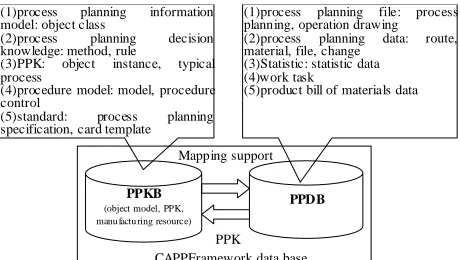
In the implement and development of CAPP system based on CAPPFramework, PPK related with CAPP system is analyzed and defined by the actual environment of enterprise and is stored in process planning data base (PPDB), process planning knowledge base (PPKB) in the form of object classes, object instances based on the object-oriented model-driven mechanism of CAPPFramework. Process planning knowledge base manages object classes; object class instances, object class methods, object class rules. PPDB manages process planning data which exists in the form of object instances based on the object model defined in PPKB. The mapping relation of PPKB and PPDB is showed in figure 4.
PPKB
(object model, PPK, manu factu ring resource)
PPDB
(1)process planning information model: object class
(2)process planning decision knowledge: method, rule
(3)PPK: object instance, typical process
(4)procedure model: model, procedure control
(5)standard: process planning specification, card template
(1)process planning file: process planning, operation drawing
(2)process planning data: route, material, file, change
(3)Statistic: statistic data (4)work task
(5)product bill of materials data
CAPPFramework data base Mapping support
PPK
Figure 4. PPDB based on object-oriented information model of PPKB
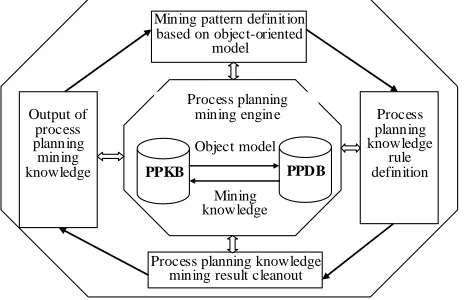
B. Stages of Process Planning Knowledge Discovery The application process of CAPP system can be divided into three stages, they are foundation implementation, accumulation of process planning data, process planning knowledge discovery. PPKD can be implemented in the third stage. Based on the PPIM, PPKD combines software technique and PPDB based on PPKB to realize the computer aided knowledge analysis and acquisition, it provides support to the standardization and specification for PPK. The application foundation of PPKD based on PPIM is the foundation, application, maintenance of PPKB. PPKD based on PPKB and PPDB in CAPPFramework is showed in figure 5.
Process planning mining engine
PPKB
Mining pattern definition based on object-oriented
model
Process planning knowledge
rule definition
Process planning knowledge mining result cleanout Output of
process planning
mining knowledge
Object model
Mining knowledge
PPDB
Figure 5. Process planning knowledge discovery based on CAPP database
C. Process of Process Planning Knowledge Discovery in CAPP Database
Process planning database and process planning knowledge model database are the basis of PPKD. In PPKD, the pattern of PPIM, task of PPKD needs to be defined and to make the knowledge discovery on the interest of users. Ref. [7] The application tools of process planning knowledge discovery provide knowledge discovery rules and algorithm. It can be used to interact with user. The procedure of PPKD is described as follows. (1) Relative process planning data definition in PPKD. In this phase, the problem of what is the relative process planning data in PPKD is solved. Database tables and attributes in PPKD are defined. Relative Object class, attribute and conditional are associated based on PPKM.
(2) What type of knowledge to be discovery: In this phase, the problem of what type of knowledge in PPKD is solved. Such as concept, item, typical operation, process planning.
(3) Background knowledge: It is a high level domain knowledge that can be used in PPKD. It is very useful for instructing and evaluating of PPKD. Background knowledge is provided by system user, domain expert and knowledge engineer.
(4) Measurement of interest degree: In this phase, the problem of what is the interest of PPKD is solved. Uninterested pattern can be separated in the procedure of PPKD. Application tool is provided for user to change the dataset, threshold value etc.
(5) Knowledge representation and view: Users can select the display pattern of PPKD, for example, rule, table, graph, tree etc.
D. Process Planning Knowledge Discovery Language— PPKDL
The current generation of rational database systems is designed mainly to support business applications. Ref. [8] The success of Structured Query Language (SQL) has capitalized on a small number of primitives sufficient to support a vast majority of such applications. Unfortunately, these primitives are not sufficient to capture the emerging family of new applications dealing with knowledge discovery. Database mining should learn from the general experience of DBMS field and follow one of the key DBMS paradigms. However, PPKD have to be much more specific than SQL; similarly, the queried objects have to be far more complex than records in relational database. Ref. [9] To achieve this, we define process planning knowledge discovery language —
PPKDL. PPKDL can define PPKD objects, PPKD queries, and bring back the concept of closure of a query language as a basic design paradigm. By PPKDL, the pattern of PPKD can be defined and make the data mining on the interest of users. Based on the object-oriented model-driven mechanism, the PPKDL is designed to define data mining pattern, communication of PPDB and PPKB, support the procedure of process planning knowledge discovery. The realization of PPKDL helps the application standardization of PPKD.
Based on the PPDB and PPKB, PPKDL can realize many PPK in rational database. The syntax of PPKDL has an analogy to SQL; it adopts BNF definition and can be easily mapped to SQL. PPKDL is showed in table III. Table IV explains some reserved words in PPKDL. In principle, a PPKDL query can be nested within a regular relational query.
RULE 1: The object class in PPKDL is mapped into a
corresponding database table in PPIM. PPKDL transforms it into SQL statement and is mapped into the operation of database table.
RULE 2: Generic attributes of object class in PPKDL
is mapped into database section, the section type is defined by PPIM in PPKB.
RULE 3: Complex attributes (such as object and
object list) of object class in PPKDL is mapped into several corresponding database tables in PPIM. PPKDL can be accomplished by the joint operation from main table to secondary tables.
RULE 4: Sorting, grouping, including operation in
PPKDL is mapped into order by, group by, having operation in SQL statement.
RULE 5: Fuzzy matching rule in PPKDL is mapped
into such SQL statement as like_, like% etc.
TABLE III.
BNF DEFINITION OF PPKDL
PPKDL::= <[ PPKDL _Statement],[[PPKDL _Statement]……]>
Data_Mining_Statement ::= <use PPDB [process_database_name],
use PPKB [knowledge_database_name] , use hierarchy [hierarchy_name] for [attribute],[Mine_Knowledge_Specification],
in relevance to [class_attribute_list],from [[class(s)],[where [condition>],order by [order_list],group by [grouping_list],having [condition]] , with [interest_measure_name] threshold [[threshold_value],for [attribute(s)]]>
Mine_Knowledge_Specification ::= <[Mine_Char] | [Mine_Discr] | [Mine_Class]>
Mine_Char ::= <mine characteristics [as [pattern_name],
analyze [measure(s)]>
Mine_Disc ::= <mine comparison [as [pattern_name],for [[target_class],where [target_condition],versus [[contrast_class_i],
where [contrast_condition_i],analyze [measure(s)]>
Mine_Class ::= <mine classification [as [pattern_name],
matching [measure(s)]]>
Concept_Hierarchy_Definition_Statement> ::= <define hierarchy [[hierarchy_name] , for [attribute]],on [class],as [[hierarchy_description],where [condition]]>
Visualization_and_Presentation ::= <display as [result_form]>
TABLE IV.
RESERVED WORDS DESCRITION IN PPKDL
No Name Explanation
1 Part Part set in PPDB 2 Plan Process set in PPDB 3 Operation Operation set in PPDB 4 Step Step set in PPDB
5 M_E Machining element set in PPDB 6 Feature Feature set in PPDB
7 Use CAPP database source 8 Table Display result as table form
In PPKDL, the pattern of PPKDL needs to be defined and make the knowledge discovery on the interest of users. Based on the PPIM, the PPKDL is designed to define knowledge discovery pattern, communication of PPDB and PPKB, support the procedure of PPKD. The realization of PPKDL helps the application standardization of PPKD. PPKDL can be used by user for defining interest dataset, data mining task, process planning type, mining procedure, evaluating and display mining result etc. PPKDL can realize the communication of PPKD engine with other software system to support the data and procedure integration. The main application process of PPKDL includes the relative data of task, knowledge type for mining, background knowledge, evaluation of interest threshold value, representation and visualization of mining knowledge.
V. TYPICAL PROCESS KNOWLEDGE DISCOVERY BASED ON PPKDL IN CAPP DATABASE
Based on PPIM, in the development of CAPPFramework, a PPKD application tools are researched that takes PPDB as the core. Ref. [10] The PPKD application tool uses PPIM to realize knowledge model of CAPP system, and PPKD is optimized in CAPP application procedure to support the stepwise implementation and development of CAPP system.
In the application of PPKD based on PPIM, PPKD technology was used to solve process planning standardization and specification by the analysis of PPDB, concept, item, typical operation, typical step, typical process and optimization of process planning can be achieved.
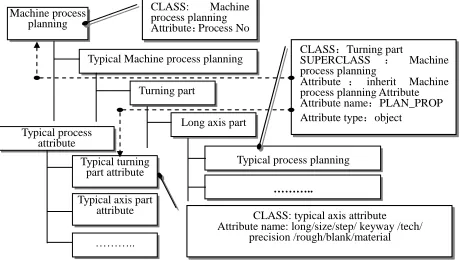
Typical process discovery takes the group coding (GC) and process flow analysis (PFA) as technique foundation. On the basis of operation code (OPC) matrix based on PPIM and analysis of typical operation, typical step, and similarity model of process planning knowledge is defined. Ref. [11, 12, 13, 14] PPKD in CAPPFramework is a clustering procedure, the knowledge discovery procedure and method is the same in different classes. In this section we use a machining process model as an example to explain the typical machining process knowledge discovery procedure. A machining process planning knowledge model is shown as an example in figure 6. The machining process class model is showed as table V. Machining typical process knowledge discovery process is described based on these models.
Machine process planning
Typical Machine process planning
Turning part
Long axis part
Typical process planning
………..
CLASS:Turning part SUPERCLASS : Machine process planning
Attribute:inherit Machine process planning Attribute Attribute name:PLAN_PROP Attribute type:object Typical process
attribute
Typical turning part attribute
………..
CLASS: typical axis attribute Attribute name: long/size/step/ keyway /tech/
precision /rough/blank/material CLASS: Machine
process planning Attribute:Process No
Typical axis part attribute
Figure 6. Process planning knowledge model of machining process
TABLE V.
MACHING PROCESS INFORMATION MODEL
NO Attribute name Attribute alias name Value type 1 PPLAN_NO Process NO string(64) 2 USE_SHOP Using workshop string(64) 3 PLAN_ID Process identifier string(64) 4 PART_TYPE Part type string(64) 5 PART_TYPE_ID Part type coding string(64)
(1) Knowledge discovery class definition: It is to define the knowledge discovery class that defined in PPKB. The object class of typical machining process knowledge discovery is machining process class. The PPKD engine in CAPPFramework can automatic find relative database tables in PPDB based on knowledge discovery class definition.
(2) Key attributes definition: Typical process knowledge discovery class definition is a clustering procedure, it needs to analysis the class attributes, define the clustering rules of machining process in PPDB, and confirm the analysis of typical machining process on specified part type.
(3) Associated support classes definition: Typical process knowledge discovery procedure needs to build OPC matrix based on part process, it needs the support of machining operation and OPC. So machining operation class and other relative classes must be defined in PPIM. By doing this, the operations in part process can be mapped into typical operation.
example of table V, key attributes can be defined as shop, workshop section, operation name. Only the three attributes value is all the same, we think this matching is success.
(5) Knowledge discovery rule: Process comparability rule need to be defined on a specified part type,. Three rules are founded in PPKD of CAPPFramework. It includes MaxOPNum rule, MaxPlanNum rule and SysSynth rule.
y MaxOPNum rule: All{OPC} is the set of all
operations coding of all part process on a specified part type. By the analysis of a part process with All{OPC}, we think the most maximum part process is the typical process of this part type. It shows as formula 1.
(1)
y MaxPlanNum rule: Parts are divided by the rate of
part process and All{OPC} based on MaxOPNum rule. So set of {Type 1,Type 2,……,Type N} can be acquired. We select the set of Type X{Part 1{OPC},Part 2{OPC},……,Part N{OPC}}, it has the most part process. In this set, we use MaxOPNum rule to select the typical machining process.
y SysSynth rule: We take the set All{OPC}as typical
process and according the position, frequency of every OPC in part process. By the statistic and sorting, the operation set and sequence of typical machining process can be reached.
(6) Cleanout of discovery result: For the complexity of process planning knowledge, the knowledge discovery result probably includes invalid or repetitive knowledge, cleanout of these result is essential. It includes two patterns.
y Contrast with PPKB: It is to contrast the result set
with PPKB, if repeated instance was founded, the instance is deleted in result set. Interaction is allowed between system and user.
y Handiwork cleanout: The result set is displayed in
tree form or list form, process planning management personnel can checkup and dispose freely.
(6) Output of result set: When the result set is cleaned, it can be added to PPKB in computer memory or output as external file (XML, txt format) for more checkup and export.
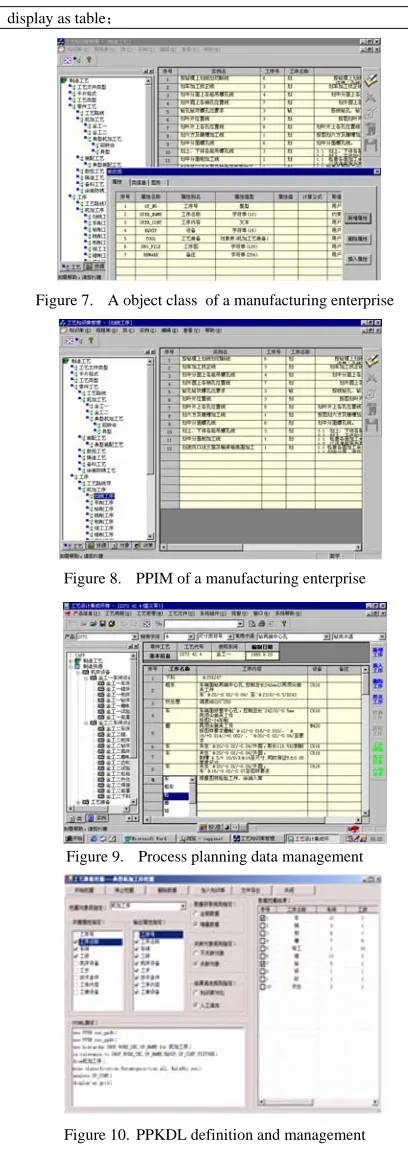
For machining process class in table V, the PPKD script is showed in table VI. The script can be stored in PPKB for repeated use later. Figure 7-10 are some typical application interface of PPKD in CAPPFramework.
TABLE VI.
PPKML SCRIPT FOR TYPICAL MACHINING PROCESS
use PPDB xac_ppdb;
use PPKB xac_ppkb;
use hierarchy PART_TYPE_ID for machining process;
in relevance to machining process.all, machining operation.all
;
from machining process,machining operation;
mine characteristics MaxPlanNum;
display as table;
Figure 7. A object class of a manufacturing enterprise
Figure 8. PPIM of a manufacturing enterprise
Figure 9. Process planning data management
Figure 10. PPKDL definition and management
VI. CONCLUSION
discovery and management can not be success implementation by the supporting of software system. By the industry practice of using PPKD technology in CAPP system developed based on CAPPFramework platform, PPKD can be executed automatically in PPDB and PPKB. It can solve the standardization of process planning knowledge to a certain extent and helps the standardization and specification of process planning data effectively. In an aeronautical manufacturing enterprise, we have use PPKD technology in CAPPFramework to support the automatically knowledge acquisition in CAPP system, and good application effect has been revealed.
ACKNOWLEDGMENT
This work was supported in part by a grant from National High Technology Project Foundation (2007AA040503) in China and Northwestern Polytecnical University cultivation project of outstanding ability teacher (05XE0127).
REFERENCES
[1] A. Paul Rodgers, H.M. Nicholas Caldwel, and P. John Clarkson, “Managing knowledge in dispersed design companies——Facilitating context-driven design support through multiple perspectives,” J.S.Gero(ed.), Artificial Intelligence in Design. 2000, pp. 147-167.
[2] J. Ciurana, M.L.G. Romeu, and R. Castro, “Optimizing process planning using groups of precedence between operations based on machined volumes,” Engineering Computations (Swansea, Wales). 20(2), 2003, pp. 67-81. [3] M. Shakeri, “Implementation of an automated operation
planning and optimum operation sequencing and tool selection algorithms,” Computers in Industry. 54(3), 2004, pp. 223-236.
[4] H. Stephan, F. Karl, “Knowing plant—Decision supporting and planning for engineering design”, Intelligent Systems in Design and Manufacturing III. Proceedings of SPIE, 2000, pp. 376-384.
[5] P. Johannesson, “A Method for Transforming Relational Schemas into Conceptual Schemas,” In 10th International Conference on Data Engineering, Ed. M. Rusinkiewicz. 1994, pp. 115 - 122, Houston,IEEE Press.
[6] T. Halpin, “Information Modeling and Relational Databases: from conceptual analysis to logical design,” Morgan-Kaufmann, San Francisco, 2001.
[7] R. Agrawal, K. Shim, “Developing tightly-coupled data mining applications on a relational database system,” In Proceedings of the 2nd International Conference on Knowledge Discovery in Databases and Data Mining (Montreal, Canada., Aug. 1996, pp. 287–290.
[8] T. Imielinski, H. Hirsh, “Query-based approach to database mining,” Technical report, Rutgers University, Dec. 1993. [9] T. Imielinski, A. Virmani, A. Abdulghani, “Disovery board
application programming interface and query language for database mining,” In Proceedings of KDD96 (Portland, Ore.), Aug, 1996, pp. 20–26.
[10] W.M Shen, K. Ong, B. Mitbander, C. Zaniolo, “Metaqueries for Data Mining,” In Advances in Knowledge Discovery and Data Mining, U. M. Fayyad, G. Piatetsky-Shapiro,” P. Smyth, and R. Uthurusamy, Eds., AAAI, 1996, pp. 375–398.
[11] Z.H Wang, X. Shao, G.J Zhang, “Process planning discovery based on extended rough sets,” Chinese Journal of Mechanical Engineering. 2005,41(7), pp. 84~89 [12] A. Gunasekaran, “Next generation computer-integrated
manufacturing strategies and techniques,” International Journal of Computer Integrated Manufacturing. 14(2), 2001, pp. 137-139.
[13] M. Farid, V. Sunil, “Intelligent systems in manufacturing:current developments and future prospects,” Integrated Manufacturing Systems. 11(4), 2000, pp. 218-238.
[14] “Industrial Automation System and Integration─Product Data Representation and Exchange, Part 28: Implementation methods: XML representations of EXPRESS schemas and data,” ISO/TS 10303-28, IS., Switzerland, 2002.
[9 font fize blank 1] [9 font fize blank 2] [9 font fize blank 3] [9 font fize blank 4] [9 font fize blank 5]
Jia Xiaoliang was born in Jilin province of China in 1975. He obtained his Ph.D. and M.S. degrees in Mechanical Engineering and Manufacturing Engineering from Northwestern Polytechnical University in 2004 and 1999, Xi’an China.
He is presently an Associate Professor at School of Mechatronic , Northwestern Polytechnical University in China. His current research interests include computer aided process planning, computer aided manufacturing, manufacturing process management for discrete mechanical manufacturing industry. In these areas, he has published in refereed journals and proceedings of international conferences, contributed to books, and participated in several local funded projects.
[9 font fize blank 1] [9 font fize blank 2] [9 font fize blank 3]
Zhang Zhenming was born in Henan province of China in 1967. He obtained his Ph.D. degree in Mechanical Engineering from Northwestern Polytechnical University in 1999, Xi’an China.
He is presently a Professor of Northwestern Polytechnical University in China. His current research interests include computer aided process planning, computer aided manufacturing, and product lifecycle management for manufacturing industry.
[9 font fize blank 1] [9 font fize blank 2] [9 font fize blank 3]
Tian Xitian was born in Henan province of China in 1965. He obtained his Ph.D. degree in Mechanical Engineering from Northwestern Polytechnical University in 2003, Xi’an China.