ISSN (e): 2250-3021, ISSN (p): 2278-8719
Vol. 09, Issue 5 (May. 2019), ||S (I) || PP 12-18
Foreground Segmentation and Change Detection Using Singular
Value Decomposition
Priyanshi Sachan, Pooja Khanna
(CSE, Amity University Lucknow,, India) Corresponding Author:Priyanshi Sachan
Abstract:
Separating background from a video image is an important step for change detection. Most of the change detection methods depend on intensity and texture variations. These algorithms may not give very satisfactory results because of the illumination variation and presence of noise. In this paper we have attempted to segregate moving foreground from video data set and change detection in time series datasets using singular value decomposition (SVD) which is a generalization of the Eigen decomposition which can be used to analyze rectangular matrices. „CDnet 2012‟, an open source dataset is used as input image dataset. We have taken SVD for all input images and singular values of all these images were used for detecting any change present in images. A comparison was made for obtained results with the results of „CDnet 2012‟. It is found that the obtained results are very effective and clearly segregate foreground.Key points:
Background Subtraction, Singular Value Decomposition, Eigen Values, CDnet 2012.--- --- Date of Submission: 23-04-2019 Date of acceptance: 06-05-2019
---
---I.
INTRODUCTION
Segmentation of foreground object is a big problem in computer vision tasks such as image processing, medical image analysis and traffic data surveillance etc. A large number of algorithms and techniques to achieve this task have been already developed. In this paper we have presented a method to segment foreground non-static object from non-static background in a time series data set. We have used Singular value decomposition (SVD) technique for our work. We have also used SVD for change detection. SVD is basically a factorization of amatrix and is a widely used algorithm in image processing and signal processing for different applications such as dimensionality reduction and image compression.The main aim of our work is to find out the static background of image. Once we know the background then the non-static objects can be easily segregated by simply subtracting the background from image. SVD provides the singular values for our dataset. Graphical analysis of these singular values will help in setting a threshold for background and foreground. This is explained in methodology part in detail.
This paper is organized as follows. In section 2 we present the SVD algorithm and its application for our work. In section 3 we have presented our methodology and approach. Section 4 presents the results and section 5 is the conclusion of this paper.
II.
SINGULAR VALUE DECOMPOSITION
Singular value decomposition is a method of decomposing a matrix into three other matrices:
Where:
A is an m × n matri
III. METHODOLOGY
We have taken „CDnet 2012‟ open source data as our input images. This data set contains a lot of images of different categories. For our experiment we have chosen „shadow‟ and „baseline‟ datasets. The input data set is selected in such a way that few images will have no moving or changing objects and few image frames will have non-static objects.
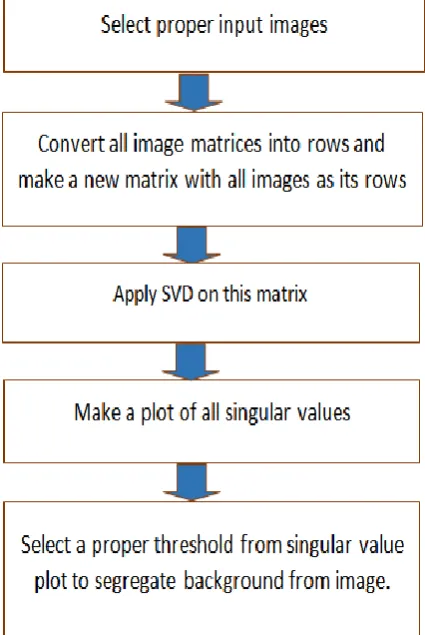
As explained in previous section, SVD factorizes a matrix and provides its singular values. The input image matrices are converted into an array and all of these arrays are arranged in a matrix in such a way that all image vectors will be in row. Now singular value decomposition algorithm is applied on this matrix of images and all singular values are arranged in decreasing order. A plot has been made for these singular values and based on the plot we will decide the threshold for segregating foreground from image. These steps are explained in below flow diagram.
Figure 1. This flow diagram explains the process of background segregation using SVD.
IV. RESULTS
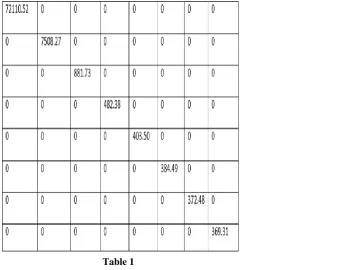
Figure 1 In this figure first 7 frames are having static background but in last frame there is a car.
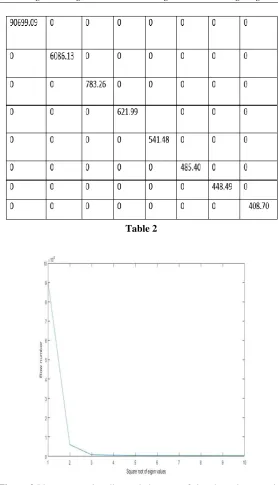
Figure2: Plot representing diagonal elements of singular values matrix.
From above plot we can select first singular value as our background and remaining singular values as our foreground. The processors is explained below-
If A is our input matrix then
As explained earlier also U is an m × n orthogonal matrix which is made from Eigen vectors of AAT, S is an n × n diagonal matrix with Eigen values of AATas diagonal elements in decreasing order and V is an n × n orthogonal matrix which is made from Eigen vectors of ATA. Now, from the above plot, for selecting background, we have taken only first singular value. The following equation is used in MATLAB code-
A back = U : ,1: 1 ∗ S 1,1 ∗ V(1: 1, : )′
Similarly for foreground we have chosen remaining singular values,
A fore = U : ,2: 8 ∗ S 2: 8,2: 8 ∗ V(2: 8, : )′
The image on the left (a) is the original image and the center image (b) is the background image and image on the right (c) is foreground image.
Similar experiments was done for different data sets-
Table 2
Figure 2 Plot representing diagonal elements of singular values matrix.
V.
CONCLUSION AND FUTURE SCOPE
Many techniques for background segregation and change detection from images are already established. We have attempted to exploit the utility of singular value decomposition to detect the change in any time series image. In our experiment we have implemented SVD using MATLAB software. It can be seen that the results obtained are very good and can be compared with any established change detection and background segregation algorithm. Our technique worked well with almost all the datasets we have chosen. It generates singular vectors for equivalent to number of input images. It has been observed from the plots of singular vectors that only first singular value provides the background information in all cases.
This technique is very fast when compared to other established techniques for background segregation from time series data sets.
BIBLIOGRAPHY-
[1]. Singular Value Decomposition (SVD) Tutorial. BE.400 / 7.548
http://web.mit.edu/be.400/www/SVD/Singular_Value_Decomposition.html
[2]. C. Hsu and C. Chen, SVD-Based Projection for Face recognition http://ieeexplore.ieee.org/xpl/articleDetails.jsp?arnumber=4374514
[3]. Singular Value decomposition, Wolfram
MathWorldhttp://mathworld.wolfram.com/SingularValueDecomposition.html [4]. Singular Value Decomposition (SVD) – Chapter 4
https://www.cs.cmu.edu/~venkatg/teaching/CStheory-infoage/book-chapter-4.pdf
[5]. Banerjee, Sudipto; Roy, Anindya (2014), Linear Algebra and Matrix Analysis for Statistics, Texts in Statistical Science (1st ed.)
[6]. Lili Guo1, Dan Xu, ZhenpingQiang, School of Information and Engineering, Yunnan University. Background Subtraction using Local SVD Binary Pattern.
[7]. O. Barnich and M. Van Droogenbroeck. ViBe: A universal background subtraction algorithm for video sequences. IEEE Transactions on Image Processing, 20(6):1709 – 1724, 2011.
[8]. G. A. Bilodeau, J.-P. Jodoin, and N. Saunier. Change detection in feature space using local binary similarity patterns. In Proceedings - 2013 International Conference on Computer and Robot Vision, CRV 2013, pages 106–112, 2013.
[9]. M.MoussaJlassi, A. Douik, H. Messaoud. Objects Detection by Singular Value Decomposition Technique in Hybrid Color Space: Application to Football Images. Int. J. of Computers, Communications & Control, ISSN 1841-9836, E-ISSN 1841-9844 Vol. V (2010), No. 2, pp. 193-204
[10]. A. Elgammal, R. Duraiswami, D. Harwood, and L. S. Davis, Background and Foreground Modeling Using Nonparametric Kernel Density Estimation for Visual Surveillance, Proc. IEEE 90(7), pp. 1151-1163, 2002.
[11]. Y. Ming, J. Jiang, J. Ming, Background Modeling and Subtraction Using a Local-Linear-Dependence-Based Cauchy Statistical Model, Proc. VIIth Digital Image Computing: Techniques and Applications, pp. 469-478, 2003.
[12]. SaleheErfanianEbadi, Student Member, IEEE, Valia Guerra Ones, and EbroulIzquierdo, Senior Member, IEEE. Approximated Robust Principal Component Analysis for Improved General Scene Background Subtraction.
[13]. X. Ding, L. He, and L. Carin, “Bayesian robust principal component analysis.” IEEE Transactions on Image Processing, vol. 20, no. 12, pp. 3419–3430, 2011.
[14]. X. Zhou, C. Yang, and W. Yu, “DECOLOR: Moving object detection by detecting contiguous outliers in the low-rank representation.” IEEE Transactions on Pattern Analysis and Machine Intelligence, vol. 35, no. 3, pp. 597–610, 2013.