ISSN (e): 2250-3021, ISSN (p): 2278-8719
Vol. 09, Issue 6 (June. 2019), ||S (I) || PP 53-58
Performance Analysis of Dynamic Compressive Wide-Band
Spectrum Sensing in Cognitive Radio for Internet of Things
Application
Aparna Singh Kushwah,
Ayushi Rai
Assistant Professor Department of Electronics and Communication Engineering UIT-RGPV, Bhopal ScholarDDI-PG Department of Electronics and Communication Engineering UIT-RGPV, Bhopal
Corresponding Author:Aparna Singh Kushwah
Abstract:
With the rising of new paradigms in wireless communications such as Internet of things (IoT), current static frequency allocation policy faces a primary challenge of spectrum scarcity, and thus encourages the IoT devices to have cognitive capabilities to access the underutilized spectrum in the temporal and spatial dimensions. Wideband spectrum sensing is one of the key functions to enable dynamic spectrum access. Wide-band spectrum sensing plays an important role in building such CR networks of IoT. In this paper, we propose a dynamic compressive wide-band spectrum sensing method based on channel energy reconstruction. After a bank of wide-band random filters is employed to measure the channel energy, rather than to recover all the channel energy in the whole spectrum, only the channel energy with a changing occupancy status in consecutive time slots is recovered.Keywords:
Cognitive Radio, Spectrum Sensing, Internet of Thing, Wide-band Spectrum--- --- Date of Submission: 27-05-2019 Date of acceptance: 13-06-2019 --- ---
I.
INTRODUCTION
The recent development of Internet of things (IoT) has drawn world-wide attention of both academia and industry with the vision of extending Internet connectivity to a vast number of “things” in our physical world [1]. With turning IoT paradigm into a reality, the amount of IoT devices is expected to grow in large numbers, which leads to difficulty in allocating sufficient spectrum resource to these devices. Therefore, it is the vision that smart IoT devices should have cognitive capabilities to enable spectrum sharing over wideband spectrum [2]. With cognitive capabilities, interference among the IoT devices can be alleviated by seeking for vacant channels through dynamic spectrum access. Spectrum sensing, as one of the vital important technologies in cognitive radio (CR), was proposed to efficiently explore the underutilized spectrum [3]. However, it is unrealistic to directly acquire the wideband signals by conventional Nyquist sampling scheme, especially in the energy-constrained IoT devices, since that requires high sampling rates (double or more than the bandwidth of the signal in frequency domain), resulting in high power consumption in the analog-to-digital converter (ADC) or low sampling rates in sequential manner but introducing large sensing latency.
Therefore, compressive sensing (CS) was applied to to realize wideband spectrum sensing without the high-rate signal sampling and processing. It enables fast and accurate spectrum detection with sub-Nyquist sampling by exploiting the sparse nature of underutilized wideband spectrum in practice [4]. This thesis will present several algorithms that implement wideband spectrum sensing with CS, aiming to invoking the efficient usage of the underutilized spectrum in cognitive IoT scenarios.
Opportunistically use the spectrum not used by the primary users. Spectrum sensing is a key enabler for dynamic spectrum access in cognitive radios. It is the task of obtaining awareness regarding the radio spectrum as well as identifying idle spectrum. It enables the SUs to explore and exploit the unused PU spectrum. In addition it is crucial for managing the level of interference caused to the PUs of the spectrum. Spectrum sensing can be done by an individual SU and is called as single-user sensing or local detection. Single-user sensing becomes difficult in challenging propagation environments like multipath fading, Doppler spread, and shadowing. In such a scenario a SU has to distinguish between a white space, where there is no primary signal, and a deep fade, where it is hard to detect the primary signal. Cooperative sensing (CS), where different SUs collaborate to detect the presence of a PU, provides diversity gains to tackle the fading and shadowing effects. CS also helps to increase the SNR gain and network coverage.
II.
COGNITIVE
RADIO
IN
IOT
IoT is extending internet connectivity in physical world. IoT will enable real-world objects to exchange their information, interact with people and co-create knowledge. Effective deployment of IoT systems will lead to significant cost savings, new revenues, and employee productivity enhancements. With turning IoT paradigm into a reality, the amount of IoT devices is expected to grow in large numbers. It is projected that there will be approximately 11.6 billion mobile devices and connections by 2020, among which 7.4% are low-power devices [5], which leads to difficulty in allocating sufficient spectrum bands to these devices. Additionally, transmission performance degeneration will be caused due to the overcrowding in the unlicensed industrial, scientific and medical (ISM) bands. CR has been considered as one of the promising solutions to tackle the spectrum scarcity in future wireless networks, i.e., 5G and beyond. CR can sense the surrounding spectrum environment and accordingly adapt radio parameters such as the centre frequency, bandwidth, transmit power, and waveform to utilize spectrum bands currently not used by primary users. These tasks can be implemented by cognitive cycle:spectrum analysis, modelling and learning, spectrum sensing, and spectrum management [6].
In the spectrum analysis, modelling and learning step, the secondary user (SU) analyses the spectrum, estimates the PU’s transmission parameters, and models the PU’s transmission structure through observations over a long time period. This information can then be used to formulate the threshold, noise statistics, etc. in the spectrum sensing step. Finally, in the spectrum management step, SU adapts itself to transmit in the open bands, potentially changing its carrier frequency, transmit power, modulation type, and packet length. Therefore, it is the vision that smart IoT devices should have cognitive capabilities to enable spectrum sharing over wideband spectrum. With cognitive capabilities, interference among the IoT devices can be alleviated by seeking for the vacant channels through dynamic spectrum sharing.
III.
DYNAMIC
SPECTRUM
SHARING
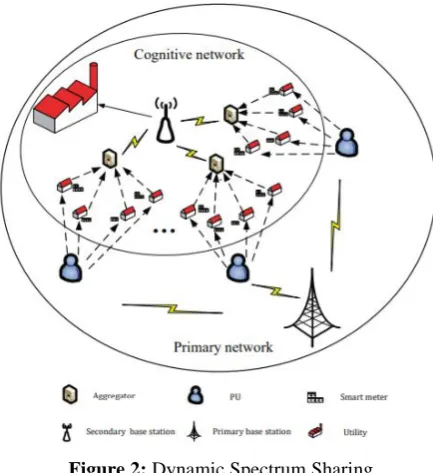
Figure 2: Dynamic Spectrum Sharing
Static spectrum access is the main policy for the current wireless communication technologies, where fixed channels are assigned to licensed users for exclusive use while unlicensed users are prohibited from accessing even when the channels are unoccupied. Nowadays, regulatory bodies worldwide are facing that the rapid growth of wireless communication industry is overwhelming current static spectrum supply, and thus encourages an urgent need for improved spectrum assignment strategy to mitigate the gap between the available spectrum and the demand [7].
IV.
PROPOSED METHODOLOGY
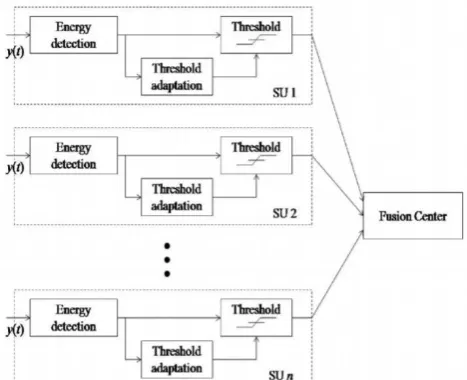
We consider a cognitive network with K number of CR’s. One primary user and one fusion center (i.e., common receiver).The spectrum sensing is done by each CR independently. The decision taken by CR is sent to the fusion center and the fusion center will decide whether the primary user is present or not. To determine this we are considering two hypotheses: The received signal will be
)
(
)
(
)
(
)
(
)
(
t
w
t
s
t
h
t
w
t
x
i i ii (1)
When the signal is received at the ith CR in timeslot t, s(t) is the PU signal. hi(t)is the complex channel
gain of the sensing channel between the PU andith CR.wi(t) is the Additive White Gaussian Noise (AWGN).We
assume that the sensing time is lesser than the coherence time of the channel. The coherence time is the time duration over which the channel impulse response remains constant. So hi(t) will be time invariant (hi(t) = hi) i.
e., time independent. Also we assume that during sensing time, PU does not change its state. We use energy detection technique as PU signal is unknown. For each ith CR by energy detection we found average probability of detection, false alarm, missed detection over AWGN channel with following equations:
)
(
)
2
,
(
,u
u
P
i f
(2)
)
,
2
(
,i u i i
d
Q
P
(3)i d i
m
P
Figure 3: Block Diagram for Dynamic Compressive Wide-band Spectrum Sensing
))
(
)
(
ˆ
(
))
(
)
(
(
)
(
)
1
(
11 2 2t
x
t
y
r
c
t
x
t
y
r
c
t
V
t
V
ij j
ij ij
ij ij
(6)
)
1
(
)
(
)
1
(
t
x
t
V
t
x
ij ij ij(7)
Where vij(t) denotes the velocity of ith particle in jth dimension at t-th iteration, c1 and c2 are referred as
acceleration constants, r1 and r2 are uniformly distributed random values ranging in [0, 1]. yij(t) is referred as
pbest, which is the best position found by the ith particle in jth dimension so far by the tth iteration whereas yˆ j(t) is referred as gbest, which is the best position found by the entire swarm in j-th dimension so far at the tth iteration. xij(t) denotes the position of ith particle in jth dimensionat tth iteration. Another parameter,
so-calledmaximum velocity, Vmax is imposed to limit thevelocity of each particle to ensure exploration withinthe
search space. A pseudocode of PSO is shownin Figure 3 for a given minimization problem.
V.
SIMULATION
RESULTS
This section describes the MATLAB-based simulations that provide interactive access to check the performance and comparative analysis for energy detection method theoretically as well as practically by varying various parameters.
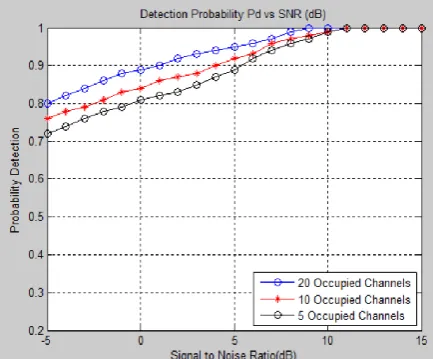
Figure 4: Probability of Detection Pd vs. SNR (dB) with p = 20 under occupied channels.
Figure5 shows the graphical illustration of the performance of cooperative spectrum sensing in AWGN channel discussed in this research work in terms of total error rate. From the above graphical representation it can be inferred that the cooperative spectrum sensing in AWGN channel for n=10 is the minimum error rate probability.
Figure 5: Total error rate of cooperative spectrum sensing in AWGN channel
Probability of detection with different occupied channels is shown in figure 6. It is clearly shows the graph to increase the occupied channel than probability of detection almost 1 with respect to signal to noise ratio.
10.1109/COMST.2015.2452414.
[3]. Q. Wu, G. Ding, Y. Xu, S. Feng, Z. Du, J. Wang, and K. Long, “ Cognitive internet of things: a new paradigm beyond connection.” IEEE Internet of Things Journal, vol. 1, no. 2, April 2014, pp. 129–143.
[4]. M. Shbat, F. C. Ordaz-Salazar, J. S. González-Salas, “Smart Antennas and Beam-formation,” Chapter 1 in Antenna Arrays and Beam-formation, InTech, Rijeka, Croatia, 2017.
[5]. S. K. Goudos, P. I. Dallas, S. Chatziefthymiou, and S. Kyriazakos, “A survey of IoT key enabling and future technologies: 5G, mobile IoT, sematic web and applications,” Wireless Pers. Commun., vol. 97, July 2017, pp. 1645–1675.
[6]. S. Sharma, T. Bogale, S. Chatzinotas, B. Ottersten, L. Le, and X. Wang, ”Cognitive radio techniques under practical imperfections: a survey,” IEEE Commun. Surveys and Tutorials, vol. PP, Issue. 99, July 2015, doi: 10.1109/COMST.2015.2452414.
[7]. Q. Wu, G. Ding, Y. Xu, S. Feng, Z. Du, J. Wang, and K. Long, “ Cognitive internet of things: a new paradigm beyond connection.” IEEE Internet of Things Journal, vol. 1, no. 2, April 2014, pp. 129–143.
[8]. M. Shbat, F. C. Ordaz-Salazar, J. S. González-Salas, “Smart Antennas and Beam-formation,” Chapter 1 in Antenna Arrays and Beam-formation, InTech, Rijeka, Croatia, 2017.
[9]. M. Dabbagh, and A. Rayes, Interner of things security and privacy, Chapter 8 in Internet of Things- from Hype to Reality. Springer International Publishing , 2017, pp. 195–223.
[10]. M. Lopez-Benitez, and F. Casadevall, “Signal uncertainty in spectrum sensing for cognitive radio,” IEEE Trans. Commun. vol. 61, no. 4, April 2013, pp. 1231–1241.
[11]. Z. Tian and G. B. Giannakis, “A wavelet approach to wideband spectrum sensing for cognitive radios,” in Proc. IEEE Int. conf. on Cognitive radio oriented wireless networks and communications (CROWNCOM), Mykonos Island, Jun. 2006, pp. 1–5.
[12]. Z. Quan, S. Cui, A. H. Sayed, and H. V. Poor, “Optimal multiband joint detection for spectrum sensing in cognitive radio networks,” IEEE Trans. Signal Process., vol. 57, no. 3, pp. 1128–1140, Mar. 2009.
[13]. T. Yucek and H. Arslan, “A survey of spectrum sensing algorithms for cognitive radio applications,” IEEE Commun. Surveys Tutorials, vol. 11, no. 1, pp. 116–130, Jan. 2009.
[14]. Aparna Singh Kushwah, Monika Jain, “Performance Enhancement of MIMO-OFDM System based on Spectrum Sensing Cognitive Radio Networks using Matched Filter Detection”, International Journal of Innovative Research in Computer and Communication Engineering, Vol. 6, Issue 6, June 2018.
[15]. Aparna Singh Kushwah, Alok Kumar Shukla, “BER Reduction of Distributed Spatial Modulation in Cognitive Relay Network based MIMO-OFDM System”, International Journal of Innovative Research in Computer and Communication Engineering, Vol. 6, Issue 6, June 2018.
[16]. J. S. González-Salas, M. Shbat, and F. C. Ordaz-Salazar, “Analyzing chaos systems and fine Spectrum sensing using detrendend fluctuation analysis (DFA) algorithm,” Mathematical Problems in Engineering, vol. 2016, Article ID 2865195, 18 pages, 2016. doi:10.1155/2016/2865195.
[17]. C. Bouras, V. Kokkinos, K. Kontodimas, and A. Papazois, “A simulation framework for LTE-A systems with femtocell overlays,” 7th ACM Workshop on Performance Monitoring and Measurement of Heterogeneous Wireless and Wired Networks (PM2HW2N’12), October 2012, Paphos, Cyprus, pp. 85-90.
[18]. S. F. Dehkordy, K. N. Plataniotis, and S. Pasupathy, ”Two-stage spectrum detection in cognitive radio networks,” IEEE International Conference on Acoustics, Speech, and Signal Processing, March 2010, Dallas, Texas, USA, pp. 3119-3121.