Exploring Ontology-driven Modeling Approach
for Multi-agent Cooperation in Emergency
Logistics
Li Zhang
Department of Logistical Information, Logistical Engineering University, Chongqing, China Email: [email protected]
Dali Jiang1, Youjun Zeng2, Yahui Ning1 and Qianzhu Wang3 1
Department of Logistical Information, Logistical Engineering University, Chongqing, China 2
Department of Foreign Training, Logistical Engineering University, Chongqing, China 3
3G Academy, Chongqing University of Posts and Telecommunications, Chongqing, China Email: [email protected], [email protected], [email protected], [email protected]
Abstract—Current emergency logistics strongly features geographical scatter, collaborative work and time priority. Although some models have been designed for application in emergency logistics, the knowledge heterogeneity in that field is still a major obstacle to intelligent cooperation. This study aims at applying ontology-based modeling approach to clearly represent the emergency logistics knowledge for decision optimization and multi-agent cooperation. An emergency logistics ontology representation model and ontology repository with Web Ontology Language (OWL) is developed through a five-layer modeling approach. This model allows multiple agents to share a clear and common understanding about the definition of emergency logistics problem and the semantics of exchanged emergency logistics knowledge. An extended ontology model with OWL format is designed in an illustrative example to represent a distribution routing problem in the relief work of 2008 Wenchuan Earthquake in China, and a rule-based intelligent reasoning application is implemented with the Jena ontology API supporting to validate the effectiveness of the proposed approach.
Index Terms—collaborative work, emergency logistics, ontology, reasoning, Multi-agent System (MAS)
I. INTRODUCTION
Current emergency logistics processes have suggested a growing trend towards being more knowledge-intensive, distributed and collaborative. Large amounts of heterogeneous data and poor knowledge have become the main obstacles to logistics collaborative work. Although many emergency logistics modeling frameworks have been designed for standalone logistics business
applications and proven effective in those fields, the heterogeneity of emergency logistics knowledge representation is still a problem for incorporating emergency logistics modeling methodology into the multi-agent cooperation environment.
Emergency logistics process differs markedly from that of business logistics system, featuring uncertainty, multi-principal participation and time maximization. It may not be addressed as easily as by traditional business modeling approach. It has raised a continuous challenge to develop the suitable computing model for emergency logistics field. One of the most well-known model focusing on emergency logistics planning is developed by Özdamar [1], in which vehicles were treated as commodities to assist with decomposing the comprehensive emergency logistics distribution problem into two multi-commodity network sub-problems, and then the problems were solved with Lagrangean relaxation. Sheu [2] described a three-layer emergency logistics co-distribution framework to resolve emergency logistics distribution problem, and suggested a hybrid fuzzy clustering-optimization approach to the operation of emergency logistics distribution responding to the urgent relief demands in the crucial rescue period. As for path selection, Yuan and Wang [3] presented a two-stage modeling approach to resolving this problem. The first stage is a single-objective model with a modified Dijkstra algorithm to minimize total travel time, and the second is a multi-objective path selection model to minimize the path complexity. Similar researches include Tovia’s emergency logistics response system [4], Li and Tang’s artificial emergency-logistics-planning system [5], Chang, Tseng and Chen’s decision-making tool for flood emergency logistics [6], Liu, Ren and Peng’s emergency order allocation model [7], Liao’s knowledge element-based emergency management method [8], Zhang’s emergency decision support platform [9], etc.
This work was supported by the National Science Foundation of China (Grant# 71101152)、Natural Science Foundation Project of CQ CSTC (Grant# 2011jjA00008, 2011BB0045, 2010BB9200) .
These models and tools, however, are applicable to stand-alone computer system and cannot be accessed
easily by the emergency logistics response personnel and decision makers. Their basic architecture is insufficient to provide a dynamic, seamless and scalable framework for effectively implementing emergency logistics collaborative work on a large scale. Multi-agent system (MAS) have been advocated as the natural solution for distributed process simulation and problem solving, and have been applied to such fields as emergency response and logistics process simulation. A number of emergency response systems and logistics systems have been developed based on MAS approach such as DrillSim [10], DEFACTO [11], MASFIT [12], Cougaar [13] and FireGrid [14], etc.
In contrast, the complexity in emergency logistics increases greatly in a distributed, collaborative environment where knowledge exchanges among multiple agents are common. Most existing emergency logistics models or approaches, paying attention to special problem solving, fail to capture the semantics of exchanged emergency logistics knowledge rigorously and unambiguously and as a result, prevent the automated reasoning in the multi-agent environment. The ontology technique possesses a huge potential to overcome this knowledge representational difficulties, albeit in a different domain. It enables intelligent agents to access and process the distributed, heterogeneous data resources efficiently. Some ontology-based modeling approaches have been used in logistics transportation and emergency management, and the corresponding ontology repositories have shown their advantages gradually. Bloodsworth and Greenwood [15] discussed how multi-agent systems could be employed to help address the planning for large-scale disasters, and described an ontology-centric multi-agent system for hospitals in response to a large-scale disaster by producing a web-based emergency plan. Preist [16] presented a demonstrator system which applies semantic web services technology to business-to-business integration, focusing specifically on a logistics supply chain. Ha, et al. [17] suggested a bi-dimensional knowledge representation architecture based on ontology technique, and developed a prototype component as a communication bridge between logistics decision system and ERP applications.
From the above-mentioned literature review, it shows that multi-agent technique is suitable for distributed problem solving, and that ontology-driven approach can integrate heterogeneous data with a common semantic agreement. The ontology-based modeling approach is a relatively new technology in the logistics field, especially in emergency logistics domain. The literature on this approach is scarce. Feng et al [18] proposed the emergency plan ontology for representing emergency logistics plan, from which a proper executable plan can be retrieved through the concept relevance computing. Liu et al [19] used domain ontology to represent the emergency logistics knowledge, and built the emergency logistics ontology file with OWL format. These two papers explored the use of ontology technique in emergency logistics, showing only the incomplete features of ontology modeling. They were neither a
referenced modeling framework nor an intelligent reasoning application which validated the effectiveness the modeling process. Both researches lack an effective approach and application of modeling emergency logistics knowledge with ontology. It is a novel strategy to develop the ontology-driven multi-agent system for emergency logistics decision. An ontology-based emergency logistics modeling is highlighted in this research.
The rest of this paper is organized as follows. Section II introduces the five-layer ontology modeling approach and the ontology-based emergency logistics knowledge representation model. Section III proposes an ontology-based MAS architecture for collaborative work of emergency logistics entities. In Section IV, the proposed model is used to present an example of emergency logistics ontology repository of 2008 Wenchuan Earthquake, and it also defines the inference rules to support the semantic retrieval and intelligent reasoning. Finally, Section V concludes and provides future research directions.
II. ONTOLOGY BASED MODELING FOR EMERGENCY LOGISTICS KNOWLEDGE
Multi-agent collaborative work for emergency logistics is a very complex process that involves extensive emergency logistics knowledge at different decision phases, including the concepts such as material, equipment, facilities, time, place, organization, resource, environment, event, etc. Additionally, related data are often distributed geographically and represented in heterogeneous form, making it critical to effectively capture, retrieve, reuse, share and exchange knowledge in a distributed emergency logistics decision environment. This is the main reason to create an ontology model for emergency logistics.
A. The Five-layer Ontology Modeling Approach
The bottom layer of Fig. 1 is the knowledge elicitation layer, which covers the interactions with various knowledge sources such as emergency logistics databases, emergency logistics legacy systems, emergency logistics computing models and related documents through emergency logistics knowledge acquiring service, and it includes a set of generic knowledge elicitation activities such as data mining, data conversion and information extraction, in order to elicit domain knowledge and produce a federated description, i.e., entity relation, work process, business rule and function achievement.
The layer above the bottom is the ontology modeling layer, which serves as the basis of the whole approach. According to the definition of ontology concept and the object-oriented method, a process schema is suggested to formalize the emergency logistics ontology. The process schema consists of four elements of class definition, property definition, individual definition, and rule
definition. First step, entity relation and function achievement will be developed into entity classes and business classes respectively, and the class hierarchical relationship of emergency logistics goes through the class definition process. Property is the detailed description of a class; furthermore, it also expresses the relationship among multiple classes. The subsequent step is to create properties for classes by the property definition process. The third step is individual definition, which means creating emergency logistics instances of the classes and properties according to the requirements of domain cases. Rule definition is also an important step in this layer. Inference rules can be decomposed into two parts. One is semantic rules with description logic, and the other is business rules. Using this process schema, an ontology-based emergency logistics knowledge representation model and an emergency logistics ontology repository can be developed, which facilitate automatic reasoning in the multi-agent environment.
Figure1. Ontology-based modeling approach for emergency logistics Ontology registration service
Ontology indexing service Ontology
transformation service Ontology querying
service
Ontology reasoning service
SPARQL query engine Description logic and rule-based reasoner Emergency logistics
collaborative work
Emergency logistics knowledge retrieval
SPARQL expression
Inference expression OWL
fragments
OWL language
Query request
Inference request Call
inference
Ontology executing layer Ontology visiting layer
Knowledge application layer
Ontology modeling layer
Visiting request Ontology knowledge
Class definition Property definition Individual definition Rule definition
Semantic rules Business rules Emergency logistics ontology repository
Emergency logistics knowledge acquiring service
Legacy systems
Documents Databases
Knowledge elicitation layer
Emergency logistics decision making
Ontology visiting agent Various functional
agents
The middle layer is ontology executing layer. The emergency logistics ontology is built with the formal representation language OWL, which is the most expressive semantic markup language to date on the Semantic Web. An ontology registration service is used to register the ontology to an aggregate directory and to notify the visiting agent of the availability of the required ontology. An ontology indexing service provides a kind of data structure and retrieving algorithm to accelerate retrieval efficiency. An ontology transformation service is used to enable the system infrastructure to translate or map the information from one ontology to another, and to negotiate meanings or otherwise to resolve differences among ontologies. The detailed design of these services can refer to the mothed suggested in literature [21].
The fourth layer is the ontology visiting layer. The purpose of semantic descriptions for emergency logistics knowledge is to facilitate knowledge discovery, sharing, and reuse, which is achieved by utilizing ontology query service and ontology reasoning service in this layer. The ontology query service provides query to the emergency logistics concepts, including classes, properties and relationships in the underlying ontology repository, e.g. returning the properties and relationships of a concept using SPARQL [22]. The ontology reasoning service
employs Description Logic (DL) reasoner such as Racer [23] to provide semantic reasoning capabilities over various knowledge entities in the ontology repository. At the same time, a rule-based reasoner such as Jena’s Generic Rule Reasoner [24] is also adopted to facilitate business knowledge reasoning. Through querying and reasoning services, ontology visiting agent can acquire the emergency logistics knowledge effectively, and it forms the basis of the collaborative work among multiple agents.
The top layer is the knowledge application layer. Multiple functional agents submit their visiting request to ontology visiting agent with FIPA message, and the latter will transform the ontology query request and the inference query into a matching format before execution. The retrieved emergency logistics knowledge with OWL format will be wrapped into the agent message by ontology visiting agents and provided for the functional agents. This application mechanism facilitates the emergency logistics knowledge exchange in multi-agent environment, and enables the use of semantic level in different application direction such as emergency logistics knowledge retrieval, emergency logistics collaborative work, and emergency logistics decision making.
Figure 2. Emergency logistics ontology representation model Organization
Place Material
Equipment Facilities Resource Environment Task
Scheme
Demand Event
Time Emergency event
Emergency material demand
Emergency logistics task
Latest start time Latest finish time Emergency material
Inventory location Delivery location Emergency logistics
command department
Receiving unit Emergency logistics
equipment Emergency logistics
execution entity
Emergency logistics resource Emergency logistics
facilities
Emergency logistics environment Emergency logistics
execution scheme
B. Emergency Logistics Ontology Representation Model
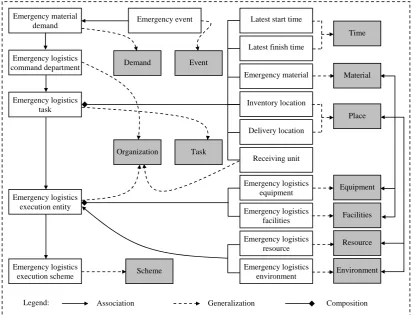
In order to describe the emergency logistics knowledge formally and explicitly, an emergency logistics ontology representation model is developed by applying the suggested ontology-based modeling approach, especially the process schema of ontology modeling layer. The proposed ontology model includes Meta ontologies and top ontologies of emergency logistics, and emergency logistics decision-making workflow serves as the skeleton to provide the connection of different ontologies. The definition of Meta ontologies classes and the organization of emergency logistics workflow provide higher semantic capacity to describe the knowledge of the emergency logistics domain.
We have defined the Meta ontologies set of emergency logistic in Fig. 2 by analyzing the emergency logistics decision process and related concepts in knowledge elicitation layer. This set comprises not only such general physical classes as Material, Place, Organization, Equipment, Facilities, Resource, Environment and Time, but also other general procedural classes such as Event, Demand, Task, and Scheme.
The other part is the top ontologies, which are inherited from the Meta ontologies and organized according to the emergency logistics decision workflow. The top layer classes in the top ontologies set include emergency logistics task, emergency logistics equipment, emergency logistics resource, emergency material, etc. They are the foundations of sub-concepts extending and function achievement; for instance, emergency logistics equipment can be specialized as transportation equipment and vehicle is a kind of transportation equipment.
In the upper ontology sub-model, the most important factors are three kinds of relationships: association, composition and generalization. Association links the emergency event, material demand, logistics command department, logistics task, logistics entity and logistics execution scheme, which forms the basic skeleton of the emergency logistics decision-making process. Composition shows the relationship between the parts and the whole; for instance, the relation between emergency tasks and the latest starting time, emergency material and delivery location is described as composition. Generalization shows the inheritance between classes. With the above mentioned relationship, a class network comes into being, which is the basis of constructing the domain ontology.
III.CONCEPT ARCHITECTURE OF ONTOLOGY-BASED MULTI-AGENT COOPERATION
Multi-agent technology, as one of the most promising technologies for complex process simulation and distributed problem solving, is feasible to address the emergency logistics decision problems. Based on the ontology-driven modeling approach, we seek to propose an ontology-based multi-agent architecture for emergency logistics collaborative work. Referring to Fig. 3, the suggested multi-agent system is a distributed architecture, which includes the centric MAS with decision making in the top level, and a series of MAS with collaborative work in the local level. Furthermore, JADE [25] serves as the design and execution platform in the MAS, and emergency logistics knowledge ontology serves as the content language inside the agent messages to support the ontology-based communication and collaboration between multiple agents.
Figure 3 Basic skeleton of ontology-based multi-agent cooperation for emergency logistics
Emergency logistics top workflow
FIPA Emergency material
requirements
Emergency logistics ontology repository
Multi-agent system with top level decision making
Emergency logistics tasks distribution scheme
Jade platform with Java
Emergency logistics task
Multi-agent system with local emergency logistics entity
Emergency logistics executable plan
……
OWL
Emergency logistics task
Multi-agent system with local emergency logistics entity
The top level introduces a centralized decision making sub-system with multiple agents. The basic input is the emergency material demand. Emergency logistics ontology repository functions as the semantic basis of top decision making, and is utilized by such top-level decision processes as task generation, task decomposition, negotiation control, workflow generation, and task distribution with related agents. Its products are emergency logistics top workflow and emergency logistics task distribution scheme. The former describes the main processes of emergency logistics with milestones under the global perspective, and the latter provides the mapping between tasks and emergency logistics execution entities.
The local level depicts the decision process of logistics entity agent for its own emergency logistics executable plan generation. After receiving special emergency logistic tasks from the distribution scheme in the top level, the logistics entity agent starts to prepare his emergency logistics support plan. According to the input emergency logistics task, emergency logistics entity agent properly evaluates its capability with the ontology repository. If it is capable of fulfilling the task requirements, the agent will generate its executable plan accordingly; otherwise, a request will be submitted to the top level for teamwork. Through the agent negotiation at top level, a joint executable plan of emergency logistics comes into being.
The basis of the proposed architecture is the ontology communication in multi-agent environments. JADE provides an agent middleware service to support the agent representation, agent management and agent communication. FIPA-ACL enables agents to collaborate with each other by setting out the encoding, semantics and pragmatics of the communicating messages. The request for emergency logistics ontology can be transformed from FIPA-ACL messages into OWL format, while that ontology with OWL format can be encapsulated into FIPA-ACL messages to facilitate communication and sharing among multiple agents.
IV. AN ILLUSTRATIVE EXAMPLE
This section, taking the distribution routing of emergency logistics in China's Wenchuan Earthquake as an example, illustrates the actual application of emergency logistics ontology model to validate its effectiveness.
The application scenario: In the later period of Wenchuan earthquake disaster relief, the materials required for delivery from Dujianyan to Shuimo town,
Wenchuan County. What is the optimal distribution routing? Known conditions are as follows: Xuanshan Road, the only county road to Shuimo town was still under rush repair due to serious damage in earthquake and thus was inaccessible. The national road G317, the provincial road S106 and the county road Qingchengshan road in that region, however, were reopened.
A.Implementation Emergency Logistics Ontology Repository with Protégé
Based on the administrative map and the traffic situation map of Wenchuan, the emergency logistics ontology model is extended to establish the relevant properties and individuals, which is realized by Protégé to form the emergency logistics ontology repository in OWL format.
Fig. 4 indicates the set of object properties defined by the Protégé’s PROPERTY EDITOR. For instance, The property Accessible is an object property, whose domain and range are the class Place, expressing the accessibility between two places; the property is_part_of is also the object property of the class Place, expressing the relationship between the part and the whole, for instance, Lijiaping is a part of Dujianyan, and Dujiangyan is a part of Chengdu; the object property Nearby exhibits the relationship between two neighboring places at the same level, for instance, Dujiangyan is close to Wenchuan; the domain of the object property Pass-through is the class of Road, and its range is the class Place displaying the relationship between the road and along-the-way place; the object property Connect_to expresses the connection of different roads, and so on. In addition to object property, the data type properties of relevant class are defined in the PROPERTY EDITOR. For instance, the data type properties of Place_no, Place_name and Place_type are defined to describe the general qualities of the class of Place.
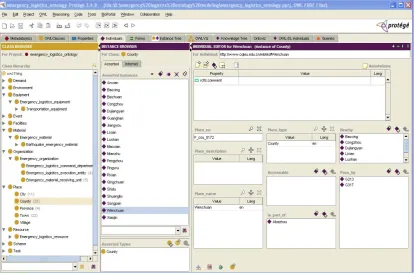
Fig. 5 reveals the relationship between the individuals and the class defined by the Protégé’s individuals tab as well as the description of individuals. As an example, in the subclass County of the class Place, 20 individuals in the class of County including Anxian, Beichuan, Chongzhou, Dujiangyan and Wenchuan are defined. In the property value of the individual Wenchuan, the property is_part_of indicates Wenchuan's relationship with Abazhou, the property Passby expresses the road G213 and the road G317 pass by Wenchuan, the property
Nearby reveals Wenchuan is close to Baoxing,
Figure 4. Properties definition of emergency logistics ontology Model
B.Definition of Reasoning Rules
The reasoning rules of the emergency logistics ontology repository comprises two parts, semantic reasoning rules and business reasoning rules, which respectively adopt the description logic reasoner and the
rule-based reasoner for reasoning. The semantic reasoning rules are defined according to the grammar standard of OWL-DL, defining the relation and binding among classes and properties. In this example, the sub-class restriction, inverse relationship, symmetric relationship and transitive relationship are included. For
instance, the property Accessible is defined to feature being Symmetric and Transitive, so if P1 Accessible P2 =>P2 Accessible P1, P1 Accessible P2 and P2 Accessible P3 => P1 Accessible P3; the properties Pass_through and Pass-by feature being Inverse, so if R1 Pass_through P1 => P1 Pass_by R1. Due to space limit, similar semantic reasoning rules cannot be listed one by one here.
Semantic-level inference can be made through semantic reasoning rules, but they failed to support some business-related inference. For example, they cannot address this simple business inference: if a Road passes by two Places, P1 and P2, then P1 and P2 are accessible to each other. So such business inference can be addressed by adopting the Jena tools, the rule definition mechanism and the Generic Rule Reasoner. Establishing the business reasoning rules of class Place and class Road
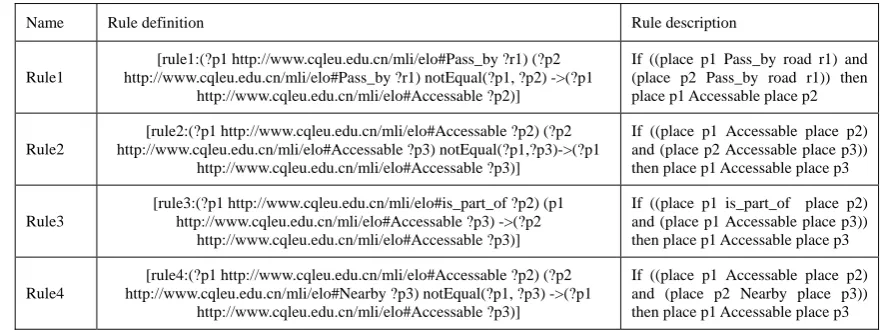
by adopting the Jena's rule definition syntax is shown in Table I. Where Rule1 defines the basic implication of the property Accessible, namely a Road passes by two Places P1 and P2, and then P1 and P2 are accessible to each other; Rule2 defines the transference of the property Accessible, and this rule can be replaced by the Transitive of the property Accessible; Rule3 defines the extended implication of the property Accessible, namely if Place P2 contains Place P1, and P1 can visit P3, then P2 can visit P3 too; Rule4 defines another extended implication of the property Accessible, namely if Place P1 can visit Place P2, and Place P2 is next to Place P3, then P1 can visit P3. It is obvious that applying Rule4 can address the distribution routing selection when there is no accessible road to the target Place.
Table I. Rules Definition between Class Road and Class Place in Emergency Logistics Ontology Model Name Rule definition Rule description Rule1
[rule1:(?p1 http://www.cqleu.edu.cn/mli/elo#Pass_by ?r1) (?p2 http://www.cqleu.edu.cn/mli/elo#Pass_by ?r1) notEqual(?p1, ?p2) ->(?p1
http://www.cqleu.edu.cn/mli/elo#Accessable ?p2)]
If ((place p1 Pass_by road r1) and (place p2 Pass_by road r1)) then place p1 Accessable place p2 Rule2
[rule2:(?p1 http://www.cqleu.edu.cn/mli/elo#Accessable ?p2) (?p2 http://www.cqleu.edu.cn/mli/elo#Accessable ?p3) notEqual(?p1,?p3)->(?p1
http://www.cqleu.edu.cn/mli/elo#Accessable ?p3)]
If ((place p1 Accessable place p2) and (place p2 Accessable place p3)) then place p1 Accessable place p3 Rule3
[rule3:(?p1 http://www.cqleu.edu.cn/mli/elo#is_part_of ?p2) (p1 http://www.cqleu.edu.cn/mli/elo#Accessable ?p3) ->(?p2
http://www.cqleu.edu.cn/mli/elo#Accessable ?p3)]
If ((place p1 is_part_of place p2) and (place p1 Accessable place p3)) then place p1 Accessable place p3 Rule4
[rule4:(?p1 http://www.cqleu.edu.cn/mli/elo#Accessable ?p2) (?p2 http://www.cqleu.edu.cn/mli/elo#Nearby ?p3) notEqual(?p1, ?p3) ->(?p1
http://www.cqleu.edu.cn/mli/elo#Accessable ?p3)]
If ((place p1 Accessable place p2) and (place p2 Nearby place p3)) then place p1 Accessable place p3
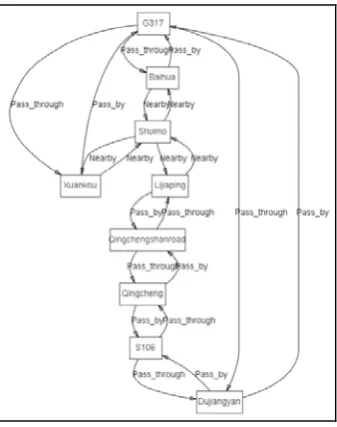
C.Reasoning and Retriving the Replaced Target Node According to the above-mentioned material delivery requirements, materials need to be transported from Dujiangyan to Shuimo town, Wenchuan County. Since the only road to the terminal Shuimo town was damaged, there would be no distribution routing based on traditional key word query. According to the emergency business rules of nearby distribution, however, a few nearby places to the target node can become the substitution node. The relationship between relevant Place Individuals and Road Individuals displayed by the Protégé plug-in Ontoviz is shown as Fig. 6. The query sentence introducing emergency logistics ontology repository and inference rules through Jena and defining the substitution nodes from Dujiangyan to Shuimo through SPARAL query language is shown as Fig. 7. The Where clause of query sentence defines two binding triples. The first binding indicates that the query result should be Places accessible from Dujiangyan. The second binding reveals that the query result should be Places next to Shuimo. The query result by running code in Eclipse environment is shown as Fig. 8. Lijiaping, Baihua and Xuankou have become the distribution substitution nodes of Shuimo.
D.Distribution Path Generation Strategy
Take the Place individual Dujiangyan as the starting point of the route and the new substitution node as the finish line. Add the on-the-way nodes to form a new route network. According to the estimation of the peer-to-peer transportation cost, one can assign the weight value to each arc of the network accordingly and find out the path cost from the starting to different substitution nodes by use of the known shortest path algorithm. After taking the hand haulage cost into account, the optimal distribution routing is obtained. This paper will discuss this no further since executing this strategy is not the focus of this case.
V.CONCLUSIONS
Due to current trend in emergency logistics field towards distributed problem solving, the introduction of multi-agent technology to simulate emergency logistics collaborative process becomes a novel and effective research perspective. To provide the common semantic agreement among multi-agent environment, ontology-based emergency logistics knowledge modeling acts as the basis in the multi-agent system, which facilitates the share, exchange and reuse of emergency logistics knowledge in a standard measurement. This paper describes an investigation into using ontology-based modeling approach to represent emergency logistics knowledge during the collaborative decision process in
multi-agent system. Through applying the suggested five-layer modeling approach, especially the process schema of ontology modeling layer, an emergency logistics ontology representation model is developed for multiple agents to share a clear and common understanding as to the definition of emergency logistics problem and the semantics of exchanged emergency logistics knowledge. As our example has shown, a road-to-place problem in Wenchuan earthquake disaster relief is represented through extending the suggested ontology model with OWL format, and a rule-based intelligent reasoning application is implemented with jena to validate the effectiveness of the suggested approach and model.
Although the authors’ work falls in the emergency logistics domain of specific application, this approach can be extended for more general emergency logistics decision applications among multi-agent environment. In the last part of this paper, concept architecture of multi-agent decision system for emergency logistics is proposed as a reference model for further research. The future work is to develop more meaningful and intelligent applications based on ontology representation model in order to capture an extensive set of annotations of general emergency logistics knowledge with a communitywide agreement. As a result, more and more stand-alone, one-off, locally stored emergency logistics applications can be federated, integrated and consumed in the emergency logistics multi-agent system.
Figure 6. Part of individuals and relationships diagram of case description "PREFIX
emergency_logistics_ontology:<http://www.cqleu.edu.cn/mli/elo# > ""+
"SELECT ?Optional_place " + "WHERE {?Optional_place
emergency_logistics_ontology:Accessable
emergency_logistics_ontology:Dujiangyan . ?Optional_place emergency_logistics_ontology:Nearby
emergency_logistics_ontology:Shuimo}
ACKNOWLEDGMENT
This work was supported by the National Science Foundation of China (Grant# 71101152), and the Natural Science Foundation Project of CQ CSTC (Grant# cstc2011jjA00008). This wok was also supported in part by the Natural Science Foundation Project of CQ CSTC (Grant# 2011BB0045, 2011BB0045, 2010BB9200).
Figure 7. SPARQL fragment for replaced nodes retrieving
REFERENCES
[1] L. Özdamar, E. Ekinci and B. Küçükyazici, “Emergency logistics planning in natural disasters”, Annals of Operations Research, vol. 129, issue 1-4, pp. 217-245, July 2004.
[2] J. Sheu, “An emergency logistics distribution approach for quick response to urgent relief demand in disasters”, Transportation Research Part E: Logistics and Transportation Review, vol. 43, issue 6, pp. 687–709, November 2007.
Figure 8. The results of replaced target nodes retrieving
[3] Y. Yuan and D. Wang, “Path selection model and algorithm for emergency logistics management”, Computers and Industrial Engineering, vol. 56, issue 3, pp. 1081–1094, April 2009.
[4] F. Tovia, “An emergency logistics response system for natural disasters”, International Journal of Logistics: Research & Applications, vol. 10, issue 3,pp.173-186, 2007.
[5] L. Li and S. Tang, “An artificial emergency-logistics-planning system for severe disasters”, IEEE Intelligent Systems, vol.23 , issue 4, pp.86 – 88, 2008.
pp. 737–754, November 2007.
[7] W.H. Liu, Z.X. Ren and Y. Peng, “An emergency order allocation model based on multi-provider in two-echelon logistics service supply chain”, Supply Chain Management: An International Journal, vol. 16, issue 6, pp. 391–400, 2011.
[8] K.J. Liao, H.H. Xiong, D.H. Ye and C.Y. Zhang, “A method of emergency management based on knowledge element theory”, Journal of Software, vol. 7, issue 1, pp. 41–48, 2012.
[9] M. Zhang, F.Z. Wang, P. Li and Y.J. Wang, “Supervision and operation decision support platform for urban rail transit”, Journal of Software, vol. 8, issue 4, pp. 878–884, 2013.
[10] V. Balasubramanian, D. Massaguer, S. Mehrotra, and N. Venkatasubramanian, “DrillSim: a simulation framework for emergency response drills”, in: Intelligence and Security Informatics, (San Diego, CA, USA), 2006, pp. 237-248.
[11] M. Hall, “Defacto: a design environment for adaptive computing technology”, in: Proceedings of the 6th Reconfigurable Architectures Workshop(RAW’99) , 1999, pp. 570-578.
[12] M. Cuni, P. Esteva, E. Puertas, F. Sierra and T. Solchaga, “MASFIT: multi-agent system for fishtrading”, in: Proceedings of the 16th Eureopean Conference on Articial Intelligence , 2004, pp. 710-714.
[13] A. Helsinger, M. Thome and T. Wright, “Cougaar: a scalable, distributed multi-agent architecture”, in: Proceedings of the IEEE Systems, Man and Cybernetics Conference, (The Netherlands), 2004, pp. 1910-1917. [14] L. Han, S. Potter, G. Beckett, G. Pringle, S. Welch, S.
Koo, G. Wickler, A. Usmani, J.L. Torero, and A. Tate, “FireGrid: an e-infrastructure for next-generation emergency response support”, Journal of Parallel and Distributed Computing, vol. 70, issue 11, pp. 1128–1141, 2010.
[15] P. Bloodsworth and S. Greenwood, “COSMOA: an ontology-centric multi-agent system for coordinating medical responses to large-scale disasters”, AI Communications, vol. 18, pp.229-240,2005.
[16] C. Preist, “A conceptual architecture for semantic web services”, in: Proceedings of the International Semantic Web Conference (ISWC 2004), (Hiroshima,Japan), 2004, pp. 395-409.
[17] J.B. Ha, Y.N. Wei and Y. Jin, “Logistics decision-making support system based on ontology”, International Symposium on Computational Intelligence and Design, vol.1, pp.309-312,2008.
[18] Z.Y. Feng, Q. Qian, G.Z. Rao, C. Zhang and G.P. Li, “Knowledge representation in the field of natural disaster emergency logistics based on ontology”, International Journal of Advancements in Computing Technology, vol.4, issue 13.15, pp.131-137, 2012.
[19] C.N. Niu, S. Deng, X.H. Yang and Y.Y. Huang, “Representation and application of ontology based emergency plan for logistics”, Application Research of Computers, vol.28, issue 11, pp.4209-4212, 4227, 2011. [20] L. Zhang, G. Chen, Y.Z. Wang and J.X. Dong,
“Ontology-based function modeling framework and collaborative function design environment”, Computer Integrated Manufacturing Systems, vol.13, issue 3, pp.456-464, 2007.
[21] Y. Zhang, X.M. Liu, Z.X. Wang and L. Chen, “A service-oriented method for system-of-systems requirements analysis and architecture design”, Journal of Software, vol. 7, issue 2, pp. 358–365, 2012.
[22] E. Prud'hommeaux and A.Seaborne, “SPARQL Query Language for RDF”, W3C Recommendation 15 January 2008, [EB/OL] http://www.w3.org/TR/2008/REC-rdf-sparql-query-20080115/.
[23] V. Haarslev and R. Moller, “RACER system description”, in: Proc. of the Int. Joint Conf. on Automated Reasoning (IJCAR 2001) , 2001, pp. 701-705.
[24] J. Carroll, I. Dickinson, C. Dollin, D. Reynolds, A. Seaborne and K. Wilkinson, “Jena: implementing the semantic web recommendations”, in: Proceedings of the 13th international World Wide Web conference on Alternate track papers & posters. ACM, 2004, pp. 74-83. [25] F. Bellifemine, G. Rimassa and A. Poggi, “JADE - a
FIPA-compliant agent framework”, in: Proceedings of the 4th International Conference and Exhibition on The Practical Application of Intelligent Agents and Multi-Agents, (London), 1999 , pp. 97-108.
Li Zhang was born in Chongqing, China, on January 4th 1976. He received a Bachelor’s degree of engineering in computer science from Southwest Normal University in 1998, and a Master’s degree of engineering in the field of computer application in Artificial Intelligence Institute, Zhejiang University in 2006, and currently he is a Ph.D. Candidate in Modern Logistics Institute, Logistical Engineering University. His research interest includes knowledge engineering, emergency logistics, virtual logistics, etc.
He is an associate professor in the Department of Logistic Information Engineering, Logistical Engineering University. In the past three years, he has participated in five research projects, including a project of Natural Science Foundation of China, a project of Natural Science Foundation Project of Chongqing and a project of China Society of Logistics (CSL), and has published over 20 academic papers. He is also a member and a special researcher of CSL.
Dali Jiang was born in Beijing, China, on January 26th 1967. He received a Bachelor’s degree of engineering in the field of automation from the College of Automation, National University of Defense Technology in 1988, a Master’s degree of engineering in the field of logistics engineering from the Institute of Modern Logistic, Logistical Engineering University in 1995, and a Doctor’s degree of management in the field of transportation and logistics management from the College of Communication and Transportation, Southwest Jiaotong University in 1998. During the period of March 2009 to March 2010 he did research work as a visiting scholar in University of Missouri-St. Louis. His research interests focus on the field of logistics management.