nowadays there has been an evolution on bootstrapping security for wireless sensor networks purely based on physical layer characteristics. The main focus has been on two Basic security issues - device authentication and secret key extraction. To accomplish gadget confirmation and master key extraction at the same time without the assistance of cutting edge equipment and out-of-band channels an open issue. In this project, we propose an answer for this issue in the setting of wireless Body Area Networks (BANs). We propose a lightweight quick validated mystery key era plan for Intra-WBAN correspondence. This scheme neither introduces any advanced hardware nor relies on out-of-band channels. To perform device authentication and fast secret key extraction at the same time, we exploit the heterogeneous channel characteristics among the collection of on-body channels during body motion. Mainly with simple body movements, channel variations between line-of-sight on-body devices are relatively stable while those for non-line-of-sight devices are unstable. ASK-BAN utilizes the relatively static channels for device authentication and the dynamic ones for secret key generation. On one hand, ASK-BAN achieves authentication through multi-hop stable channels, which greatly reduces the false positive rate as compared to existing work. On the other hand, based on dynamic channels, the key extraction process between two on-body devices with multihop relay nodes is modeled as a max- ow problem, and a novel collaborative secret key generation algorithm is introduced to maximize the key generation rate.
Keywords: Wireless body area network, sensor, Authentication, physical layer
________________________________________________________________________________________________________
I. INTRODUCTION
Secure The field of computer science is constantly evolving to process larger data sets and maintain higher levels of connectivity. At same time, advances in miniaturization allow for increased mobility and accessibility. Body Area Networks represent the natural union between connectivity and miniaturization. A Body Area Network (BAN) is defined formally as a system of devices in close proximity to a persons body that cooperate for the benefit of the user. The BBC's Jo Twist gave a more informal definition of Body Area Networks in her article title When technology gets personal.
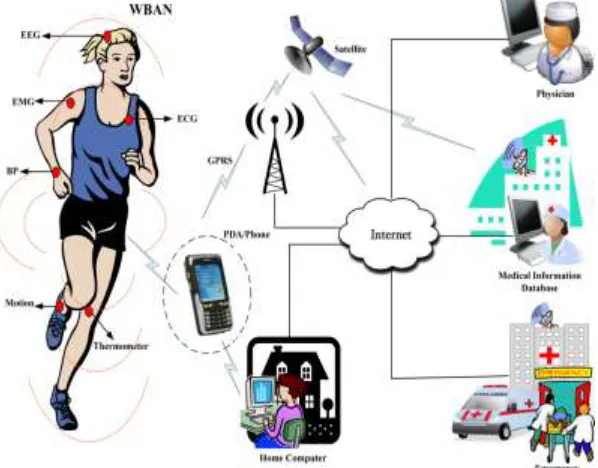
Fig. 1: WBAN
A Novel Collaborative Secret Key Generation
and Device Authentication Scheme for Securing
Intra Wireless Body Area Network
Shashikant B Patil Ms. Sanchari Saha
M. Tech Student Assistant Professor
MVJ College of Engineering Bangalore, India MVJ College of Engineering Bangalore, India
Continuous technological advances in integrated circuits, wireless communication, and sensors enable development of miniature, non-invasive physiological sensors that communicate wirelessly with a personal server and subsequently through the Internet with a remote emergency, weather forecast or medical database server; using baseline (medical database), sensor (WBAN) and environmental (emergency or weather forecast) information, algorithms may result in patient-specific recommendations. The personal server, running on a PDA or a 3 G cell phone, provides the human-computer interface and communicates with the remote server(s). Figure 1 shows a generalized overview of a multi-tier system architecture; the lowest level encompasses a set of intelligent physiological sensors; the second level is the personal server (Internet enabled PDA, cell-phone, or home computer); and the third level encompasses a network of remote health care servers and related services (Caregiver, Physician, Clinic, Emergency, Weather). Each level represents a fairly complex subsystem with a local hierarchy employed to ensure efficiency, portability, security, and reduced cost.
Secret Key Generation Algorithm:
It’s a process of generating keys in cryptography. A key is used to encrypt and decrypt whatever data is being encrypted/decrypted. Wireless body area network (WBAN) is one type of wireless networks that utilized for communication among sensor nodes. It operates on, in or around the human body to monitor some crucial parameters and body movements. The WBAN technology has been developed in 1995 by viewing wireless personal area network (WPAN) technologies for communications on, near and around the human body. Afterward in 2001, the name of WPAN has been changed to body area network (BAN) to signify the communications on, in and near the body only. In November 2007, IEEE 802.15 Task Group 6 (BAN) has been launched by IEEE to build up a communication standard optimization for low power devices that operating on, in or around the human body in order to provide a wider range of applications such as personal healthcare, consumer electronics and so forth.
Nowadays, WBAN technology has been paid a lot of attentions among medical professions and health care practitioners including engineers in information and communication technology field. This technology is a key element that can contribute to the future e-health initiative to make major improvements in patient care and health screening. For example, by looking on the service delivery point of views, this WBAN technology could make some of the specialist treatments more accessible and efficient as well as cost-effective.
As these wireless networks are implanted or body worn, they require specific studies and investigations under stringent constraints include minimum radiated power, low power consumption, flexibility, small device size and low weight. Conflict between requirements of BANs like security, efficiency and safety are also the challenges that need to be addressed and monitored. All of these issues are particular true at the antenna design level and its propagation.
An antenna is any structure that acts as a transducer that converts electromagnetic waves to electrical energy or vice versa. It is significantly impacts on the system link performance between transmitting and receiving mode. The design of an antenna in wireless communication either for transmitting or receiving mode can be in many different shapes and types which are based on their applications. In this project, microstrip antenna has been chosen due to some advantageous features like low profile, lightweight, ease of fabrication, inexpensive, conformability, and not difficult to integrate with feeding lines and active devices. This microstrip antenna is developed in circular polarization (CP) with single feed scheme.
The increasing use of wireless networks and the constant miniaturization of electrical devices has empowered the development of wireless body area networks (WBANs). –In these networks various sensors are attached on clothing or on the body or even implanted under the skin. These devices provide continuous health monitoring and real-time feedback to the user or medical personnel. The wire-less nature of the network and the wide variety of sensors offer numerous new, practical and innovative applications to improve healthcare and the quality of life. The sensor measures certain parameters of human body, either externally or internally. Examples include measuring the heartbeat, body temperature or recording a prolonged electrocardiogram (ECG). Several sensors are placed in clothes, directly on the body or under the skin of a person and measure the temperature, blood pressure, heart rate, ECG, EEG, respiration rate, SpO2 levels etc. An example of a medical WBAN used for patient monitoring.
II. RELATED WORK
ASK-BAN: Authenticated Secret Key Extraction Utilizing Channel Characteristics for Body Area Networks
Recently there has been an increasing interest on bootstrapping security for wireless networks merely using physical layer characteristics. In particular, the focus has been on two fundamental security issues - device authentication and secret key extraction. While most works emphasize on tackling the two issues separately. In this paper, for the _rst time, we answer this open problem in the setting of Wireless Body Area Networks (BANs).
Disadvantages Of ASK-BAN:
It can handle with only simple body movements. In this paper the line-of-sight on-body devices are stable.
Ask-ban utilizes static channels for authenticating devices & key extraction.
Bana: Body Area Network Authentication Exploiting Channel Characteristics:
In wireless body area network (BAN), node authentication is essential for trustworthy and reliable gathering of patient’s critical health information. Traditional authentication solutions depend on prior trust among nodes whose establishment would require either key pre-distribution or non-intuitive participation by inexperienced users.
Most non-cryptographic authentication schemes require advanced hardware or significant modifications to the system software, which are impractical for BANs. In this paper, for the first time, proposed a lightweight body area network authentication scheme BANA. And does not depend on prior-trust among nodes and can be efficiently realized on commercial off-the-shelf low-end sensors.
They achieved this by exploiting a unique physical layer characteristic naturally arising from the multi-path environment surrounding a BAN, i.e., the distinct received signal strength (RSS) variation behaviours among on-body channels and between on-body and off-body communication channels. Based on distinct RSS variations, BANA adopts clustering analysis to differentiate the signals from an attacker and a legitimate node. We also make use of multi-hop on-body channel characteristics to enhance the robustness of our authentication mechanism.
Fig. 2: Illustration of wireless channels from the OBS and the attacker, respectively, to the control unit.
Biometric-based Two-level Secure Access Control for Implantable Medical Devices amid Crises
Implantable Medical Devices (IMDs) are widely used to treat chronic diseases. Nowadays, many IMDs can wirelessly communicate with an outside programmer/reader. However, the wireless access also introduces security concerns. An attacker may get an IMD reader and gain access to a patient’s IMD. IMD security is an important issue since attacks on IMDs may directly harm the patient. A number of research groups have studied IMD security issues when the patient is in nonemergency situations. However, these security schemes usually require the patient’s participation, and they may not work during emergencies for various reasons. In this paper, we propose a light-weight secure access control scheme for IMDs during emergencies. This scheme utilizes patient’s biometric information to prevent unauthorized access to IMDs. The scheme consists of two levels: level 1 employs some basic biometric information of the patient and it is lightweight; level 2 utilizes patients’ iris data for authentication and it is very effective. In this research, we also make contributions in human iris verification: we discover that it is possible to perform iris verification by comparing partial iris data rather than the entire iris data. This significantly reduces the overhead of iris verification, which is critical for resource-limited IMDs.
Ensemble: Cooperative Proximity-Based Authentication:
trusted devices cannot properly distinguish proximity in all cases, a collection of trusted devices can do so reliably. Our Ensemble prototype extends Diffie-Hellman key exchange with proximity-based authentication.
Fig. 3: example of a pairing scenario, where a user is authenticating with a vending machine.
III. EXISTING SYSTEM
Our scheme neither introduces advanced hardware nor relies on out-of-band channels. To perform device authentication and fast secret key extraction at the same time, we exploit the heterogeneous channel characteristics among the collection of on-body channels during body motion. On one hand, MASK-BAN achieves authentication through multihop stable channels, which greatly reduces the false positive rate as compared to existing work. On the other hand, based on dynamic channels, key extraction between two on-body devices with multihop relay nodes is modeled as a max-flow problem, and a novel collaborative secret key generation algorithm is introduced to maximize the key generation rate
Disadvantages Of Existing System:
To achieve device authentication and secret key extraction simultaneously which increases the hardware integrity.
Increased complexity in authentication of secret key extraction process which leads in increase in delay and also decreases overall network performance.
Existing system exploits the selection of unstable channel failure which leads to data loss / packet loss.
IV. PROPOSED SYSTEM
We propose a lightweight quick validated mystery key era plan for Intra-WBAN correspondence. This plan neither presents propelled equipment nor depends on out-of-band channels. To perform gadget validation and mystery key extraction in the meantime, heterogeneous channel attributes among gathering of on-body channels while body is on move is presented. On one hand, this plan will accomplish verification through multi-bounce stable channels which incredibly diminishes the false positive rate. Then again, in view of element channels key era between two on-body gadgets with multi-jump transfer hubs is modelled as max-stream problem. A novel collective mystery key era calculation will be acquainted with boost the key era rate. Broad reproduction based investigations will accept this current plan's awesome confirmation ability and high-secret key era rate.
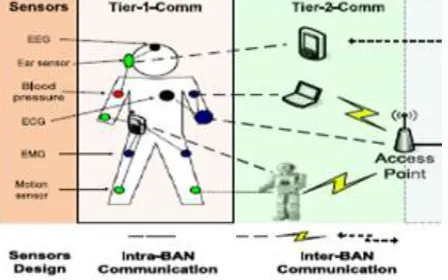
The system architecture of wireless body area network generally consists of two tiers to communicate with the outside network through which the data or the information collected from the sensor nodes can be transferred. The tire 1 consists of sensors deployed in the human body which collects the human health information’s like body temperature, blood pressure, body movement, etc., where all the sensors are connected to a central unit which can mobile device or any portable device, this portable device comes under the tier 2. The tier 1 contains collecting the health related information of the deployed human body and the tier 2 contains the transferring the collected information by the sensors to the small portable devices securely, this information can be passed to the outside network by passing the sensor collected information through the access points over the network.
System Architecture:
Fig. 5: System architecture
The above figure shows the system architecture of the WBAN, where it consists of the sensor nodes deployed in or on the human body. WBAN is nothing but the human body deployed with the sensor nodes which will be connected to a personal device like mobile phones, tablets, laptops, etc. Each sensor node deployed must be registered or authenticated with the central control unit (CCU), these sensors will collect the human health status like blood pressure, body temperature, motion, glucose, etc. and send those data to the central controlling unit or the personal devices. These devices will be having the internet through which these devices can be connected to the WWAN network where the base station will be present. The personal devices will act as an intermediate between the WBAN and the WWAN networks.
The whole project is divided into 5 modules Sensor node deployment
DSS authentication Dynamic key extraction Key aggregation broadcast Back end server & internet
Sensor Node Deployment:
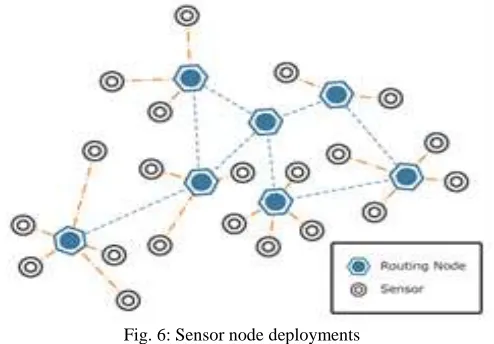
Here Sensor nodes can be initialized with some number of nodes say(N =20), along with the area of 100*100, node can be characterized using xloc and yloc with initial node properties, here initial energy of the node is 100j, and also nodes can be identified using Unique identity number.
Fig. 6: Sensor node deployments
The above figure shows the sensor nodes and routing nodes. Routing nodes which take part in routing the information.
DSS Authentication:
to a corresponding public key. Each signatory has their own paired public (assumed to be known to the general public) and private (known only to the user) keys. Because a signature can only be generated by an authorized person using their private key, the corresponding public key can be used by anyone to verify the signature.
Dynamic Key Extraction:
After pairwise key extraction, dynamic key is extracted as fallows;
Authenticated Secret Capacity Broadcast:
Secret capacity denotes the number of bits with each pairwise secret key generated in previous step. Each sensor nodes broadcasts a capacity message containing ID of the endpoints of the channel with each of its neighbors, trust relationship learned from previous steps, and channel secret capacity. Sensors that receive capacity messages store the messages in the buffer temporarily. At the end of this phase, each node has the knowledge of all the channel capacity information as well as the set of trusted neighbors. An undirected weighted graph of capacity topology can be derived based on the capacity messages, with the weight of each edge representing the capacity on the channel.
Maximum Entropy:
Each sensor runs the maximum flow algorithm on the capacity topology to seek the path through which the entropy of the key information transmitted from itself to CU can be maximized.
Key Aggregation Broadcast:
After finding the max-flow path in between, the sensor node securely exchanges its secret key obtained along the path to construct the final shared secret key of maximum size between itself and CU. For that each intermediate sensor on the path broadcasts the XORed value of the keys shared with its previous hop and next-hop sensors in turn. The broadcast message is accepted if and only if its sender is in the trust table.
Security Analysis:
After key broadcasting for all the sensor nodes, security for the extracted key is analyzed by using Man-in-the-Middle (MITM) Attacks and Beam-Forming Attacks.
Back end Server and Internet:
After cluster formation key extraction mechanism can be done from Back end server to all Body are nodes using above techniques, with reduces energy consumption, here communication can be done via internet from Backend server to Master server
Master Server: Finally, complete patient information is received via internet in Master server then distributing to respected destination that is it may be Medical Server/ Family / Doctor.
V. RESULTS
Scenario 1:
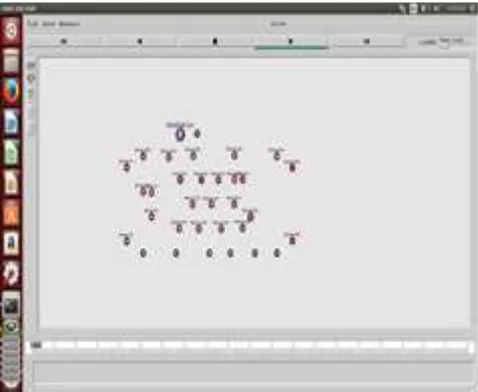
Creation of nodes and base station displaying the number of sensor nodes and options displaying source nodes, relay nodes and base station, options in the tab and speed up and down the execution, also allows to perform zooming operations
Scenario 2:
Fig. 8: Authentication of base station.
Scenario 3:
Fig. 9: Data transmission
Scenario 4:
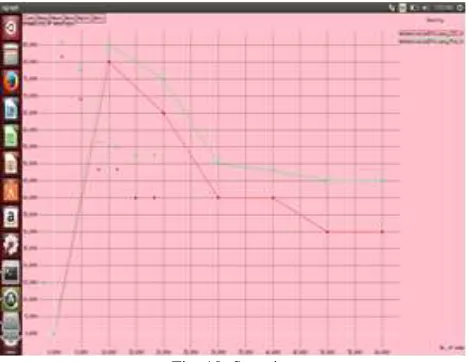
Graph show proposed system is more secure than the older one.
VI. CONCLUSION AND FUTURE WORK
In this paper, we have proposed a lightweight authenticated secret key extraction scheme for Body Area Network based on wireless channel. We observe that the miscellaneous channel qualities among the collection of on-body channels between on-body devices are relatively stable and dynamic. Using this channel property, we give the solution for achieving effective node authentication and fast secret key extraction simultaneously. To maximize the secret key generation rate, a novel collaborative secret key extraction solution is given based on the max-flow algorithm. Our multihop authentication method greatly reduces the false positive rate compared to previous work. Experimental and simulation results show both authentication effectiveness and secret key extraction efficiency.
ACKNOWLEDGMENT
Shashikant thanks to Ms. Sanchari Saha, who is always encouraging and motivating me to do research activities. I am also very thankful my families and friends.
REFERENCES
[1] L. Shi, J. Yuan, S. Yu, and M. Li, “Ask-ban: Authenticated secret key extraction utilizing channel characteristics for body area networks,” in Proc. 6th ACM Conf. Security Privacy Wireless Mobile Netw. (WiSec’13), 2013, pp. 155–166.
[2] L. Shi,M. Li, S. Yu, and J. Yuan, “BANA: Body area network authentication exploiting channel characteristics,” in Proc. 5th ACM Conf. Security Privacy Wireless Mobile Netw. (WISEC’12), 2012, pp. 27–38.
[3] X. Hei and X. Du, “Biometric-based two-level secure access control for implantable medical devices during emergencies,” in Proc. IEEE INFOCOM, Apr. 2011, pp. 346–350.
[4] A. Kalamandeen, A. Scannell, E. de Lara, A. Sheth, and A. LaMarca, “Ensemble: Cooperative proximity-based authentication,” in Proc. 8th Int. Conf. Mobile Syst. Appl. Serv. (MobiSys’10), 2010, pp. 331–344.
[5] L. Cai, K. Zeng, H. Chen, and P. Mohapatra, “Good neighbor: Ad hoc pairing of nearby wireless devices by multiple antennas,” in Proc. Netw. Distrib. Syst. Security Symp. (NDSS’11), Feb. 6–9, 2011.
[6] C. Cornelius and D. Kotz, “Recognizing whether sensors are on the same body,” in Proc. 9th Int. Conf. Pervasive Comput. (Pervasive’11), 2011, pp. 332– 349.
[7] L. Lai, Y. Liang, and W. Du, “Phy-based cooperative key generation in wireless networks,” in Proc. 49th Annu. Allerton Conf. Commun. Control Comput. (Allerton’11), Sep. 2011, pp. 662–669.
[8] K. K. Venkatasubramanian and S. K. S. Gupta, “Physiological valuebased efficient usable security solutions for body sensor networks,” ACM Trans. Sens. Netw., vol. 6, no. 4, pp. 1–36, Jul. 2010.