IJSTE - International Journal of Science Technology & Engineering | Volume 2 | Issue 11 | May 2016 ISSN (online): 2349-784X
Provision of Suitable Traffic Control Measure
for Complex Intersection
Abhijeet Sanjay Khone Dr. B. V. Khode
M. Tech Scholar Professor
Department of Civil Engineering Department of Civil Engineering G. H. Raisoni College of Engg, Nagpur G. H. Raisoni College of Engg, Nagpur
Abstract
This paper is purely based on the selection of the traffic control measure for the complex intersection where the traffic fluency is not achieved. The same thing is done with the intersection situated in Nagpur which has seven legs who contributes there traffic volume to the intersection. Currently the intersection is operated on the principle of roundabout which causes major traffic congestion at the time of morning and evening peak hours. An attempt is done to give the best possible solution for this traffic intersection by analyzing the three models for different traffic conditions with the real time data. The concept of metering signals and the roundabout along with the all leg signaled is mentioned in this work. Finally by comparing the results of three different models for different traffic parameters the best possible traffic control measure is suggested.
Keywords: Roundabout; Metering signals; VISSIM; Signalized Roundabout; Travel Delay; Stop Delay
________________________________________________________________________________________________________
I. INTRODUCTION
Day by day Nagpur is growing rapidly as it is at the point of greatest development. Multi model international cargo hub and airport is the one of the largest projects in Nagpur. Many of the businessmen, industrialists, workers, employees have migrated to Nagpur, So that the human density in Nagpur has been increased with a greater percentage. The human population is directly proportional to the population of vehicles in the respective city. In these days people became more luxury and privacy conscious which reflects in their choice of vehicle. People prefer spacious and luxuries vehicles for their daily purposes. Many of the traffic parameters got disturbed due to this unexpected growth in traffic. Many of the locations in Nagpur experiencing the ample of problems related to the traffic. The failure of the traffic forecast and the improper management of the traffic are the two main causes of these problems. In addition to this the amount of heterogeneity of traffic and the human mentality of the road users in country also contributes in the failure of several traffic parameters.
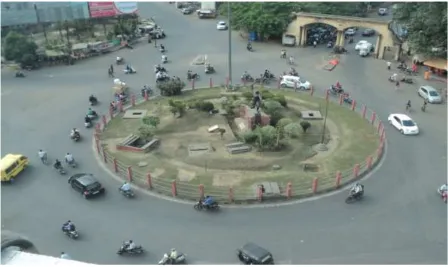
In real time condition the same situational parameters are faced by the Ram Nagar (Bajiprabhu Deshpande) intersection in Nagpur. The intersection is basically operated on the principle of the roundabout. It has seven major legs and one minor leg which is also merged in the one of the major legs 15 meters short to the approach width of the leg. Five of the legs are two-way single lane whereas remaining two are two way two lane. A tremendous amount of traffic is contributed from these legs in peak hours. The basic working quality of the intersection depends on its traffic control measure. As the traffic at the aforesaid intersection is controlled by roundabout then its initial qualitative analysis can be done by checking its degree of saturation.
All rights reserved by www.ijste.org 337 Fig. 1: Top view of the Ram nagar intersection
In peak hours as the current traffic control measure is failing to regulate the traffic fluently, the models of two different kinds were created with the different traffic controlling measures and situations. These controlling measures were designed according to the real time situations faced by the intersection. The results of all three models were compared and the most feasible solution for the real time situation is suggested.
II. LITERATURE SURVEY
The modeling of the traffic flow for Indian conditions in case of the parameters considered is widely expressed by the Manraj Singh Bains and Shriniwas S Arkatkar (2012).
The PCU value gets affected as the V/C parameter increased which is independent of the class of vehicle. Edwin L Chong (2007) has suggested the procedure to design the intersection with signals and roundabout. The parameters to be considered while designing and implementing were broadly discussed.
Emmanuel Natalizio (2005) presented the concept of the metering signals along with the roundabout and gave the efficient results comparing with the different traffic controle measures.
Edwin L Chong (2005) studied the both capacity and performance analysis of the metering signals and given the best probable situation to use the metering signals for all legs and for limited ones.
Michael Trueblood and P.E. PTOE (2003) developed a model of roundabout in VISSIM and showed the simplicity and flexibility of the software.
Joe G. Bared and Praveen K. Edara (2005) modeled a roundabout and analyzed it for the critical traffic conditions. The paper ended with the conclusion that the below capacity level the roundabout is enough to operate the traffic smoothly whereas when it crosses the capacity level the signalized roundabout is the better alternative.
Abhishai Polus and Ardeshir Faghri conducted the study of the intersections ruled by all way stop signal control and suggested the possibilities to convert them into signalized or unsignalised roundabout.
Glenn Geers (2009) presented the project in New South Wales where the metering signal is provided for the specific legs and given the reason for the same thing.
Akmal Abdelfatah and Anil Minhans (2014) analysed the intersection for different congestion amount and for different percentage of vehicle distribution. There observation states that the roundabouts are small traffic volume oriented whereas the traffic signals are appropriate for large volumes.
Marian Tracza and Janusz Chodur (2012) assessed the performance and traffic safety for the signalized roundabout. The drawbacks of the system along with the remedial measures are also mentioned. They have also focused the physical parameters of the roundabout and its standards according to the volume per hour.
Provision of Suitable Traffic Control Measure for Complex Intersection (IJSTE/ Volume 2 / Issue 11 / 061)
III. METHODOLOGY
The work is divided into two major parts according to the progress of work. The intersection is one of the greatest intersect ions in the Nagpur as it has 7 legs. The data required for the project is to be collected. The coll ected data is the required to simulate in software, So that the methodology is bifurcated into the following two parts.
Data Collection
1) The data required for this work is of two types. 2) Physical Parameters of the intersection 3) Traffic data for weekends and for week days
The physical parameters of the roundabout such as the road width of each leg, approach width, width of the waving section, diameter of the roundabout.
The data required is the traffic data. For this purpose the videography method is used. Traffic data for each leg is recorded for both weekends and week days for 3 hours in morning and evening. Then the segregation of data is done according to the requirement of the software. The recorded traffic data is then analyzed and calculated the class and amount of vehicles travelling from different legs. The peak hour traffic data is then studied so as to get the hour assessing the maximum traffic volume, a nd the same traffic volume data is taken as a input data for the simulation model.
Simulation Model Development
The data required for the simulation is to be put in the software for the proper scaled design. The satellite image of the intersection is to be imported in the software and the scale factor is then fixed. Then by using the satellite image the road networks are laid on the pictorial view by giving the virtual dimensions. Then the traffic behavior of the different vehicles is assign by routing them. Likewise the all procedure is to be done as per the user guide given by the PTV VISSIM .
The model which is to be developed is of three types. 1) Real time situation model
2) Roundabout with metering signals 3) Signalized roundabout (All legs)
The real time situation model is done with the help of the data collected from the intersection. The intersection is operated on the principle of the roundabout and the traffic parameters are analyzed. The traffic parameters are to be analyzed with he lp of creating the model providing the metering signal. The metering is provided for the legs having fatal traffic volume as compared to other legs. The signal cycle is designed according to the IRC 93 -1985. The last model is designed by Appling the signals to the all legs along with the roundabout. It is not possible to provide the signals without providing the roundabout as the conflict points at the intersection becomes more. The same traffic parameters are to be opted as similar for the previous two models.
IV. RESULT
After the simulation of the data for three different models the unbelievable results were obtained.
All rights reserved by www.ijste.org 339 Fig. 2: Comparison of three models for Queue length
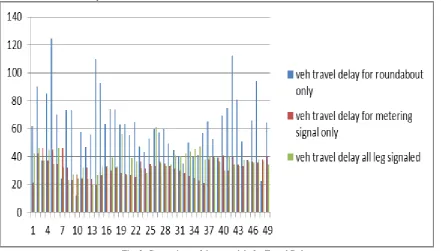
The travel delay of the intersection shows the variability with respect to the change in traffic control measure. The travel delay is very enourmus in case of first model whereas it is 53.45% of the first case in second model. While compairing with third model, it shows the 60% of the travel delay that of first case.
Fig. 3: Comparison of three models for Travel Delay
Provision of Suitable Traffic Control Measure for Complex Intersection (IJSTE/ Volume 2 / Issue 11 / 061)
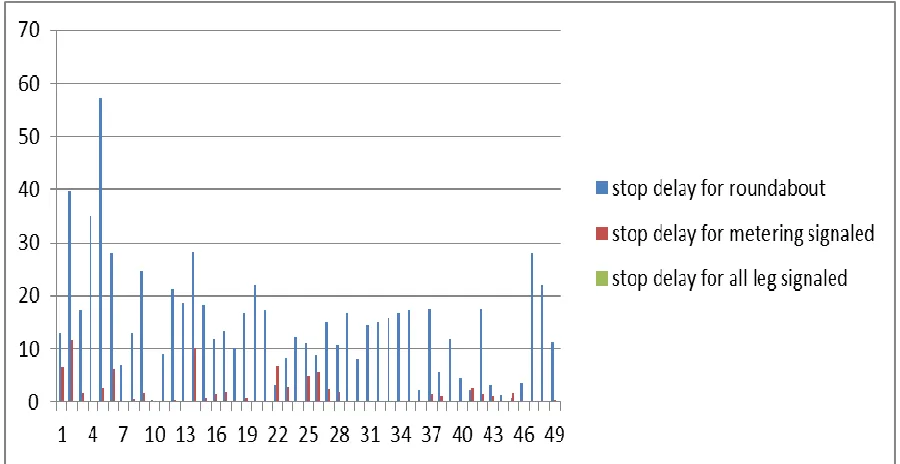
Fig. 4: Comparison of three models for Stop Delay
V. CONCLUSION
The aforesaid results which are provided by the three different models for three different traffic control measures provided the best possible solution that the case in which the intersection is provided with metering signals for the massive traffic volume contributory legs along with the roundabout can be adopted for the real time situation. It shows the present performance in case of queue length, travel delay and stop delay than other models. In peak hours this provision is very much feasible and also provides the more safety to the intersection.
REFERENCES
[1] Emmanuel Natalizio, “Institute of transportation engineers 2005 Annual meeting”, Melbourn, Austrelia, August
[2] Daniel R Dryland and edwin l chong, “design and implementation of A signalised roundabout: Sh20 hillsborough ring road”, IPENZ Transportation Group Conference, Tauranga 10-10-2007
[3] Joe G. Bared and Praveen K. Edara, “Simulated Capacity of Roundabouts and Impact of Roundabout within a Progressed Signalized Road”, National Roundabout Conference – 2005 Draft
[4] Jian-an Tan, “Comparison of capacity between roundabout design and signalised junction design”, 1st Swiss Transport Research Conference Monte Verità / Ascona, March 1.-3. 2001
[5] Michael Trueblood, P.E., PTOE and Jim Dale, P.E, “Simulating Roundabouts With VISSIM”, 2nd Urban Street Symposium (Anaheim, California) — July 28-30, 2003
[6] Rahmi Akcelik, “Capacity and performance analysis of roundabout metering signals” TRB National Roundabout Conference, Vail, Colorado, USA, 22-25 May.
[7] Glenn Geers and Bernhard Hengst, “Enhanced Roundabout Metering”, Conference Paper · January 2009