Design And Simulation of Binary Tree
Comparators using Constant Delay Logic in
180nm Technology
Amy Mariam George Jyothish Chandran G
PG Student Assistant Professor
Department of Electronics & Communication Engineering Department of Electronics & Communication Engineering Saintgits College of Engineering Saintgits College of Engineering
Abstract
A binary tree based 8 bit comparator with constant delay (CD) logic is presented in this paper. The constant delay logic used in the comparator design predischarges the output to logic 0 and makes a transition to logic 1 through a critical path clocked PMOS transistor for an NMOS transistor network. This logic is twice faster than a dynamic logic gate during its D to Q operation mode for a complex logic like a two bit binary comparator. The proposed comparator architecture has two stages, where the first stage utilizes a tree structure designed using a static logic to achieve low power consumption while the second stage utilizes a high performance CD logic without sacrificing the overall energy efficiency. Design and analysis of the Comparators has been carried out in Mentor Graphics ELDO Simulator using 180nm technology.
Keywords: Binary Tree Comparator, Constant Delay Logic, Clock Gating, Dynamic Comparator, PG Logic
________________________________________________________________________________________________________
I.
I
NTRODUCTIONBinary comparator is one of the most basic components in digital systems with wide range of applications. Dynamic Logic was used widely in most of the comparator works for achieving high performance operations. Despite the dynamic logics superior performance in terms of delay, it is not suitable for low power operations because of its high data activity factor. Static Logic on the other hand has low activity factor making it energy efficient than dynamic logic for low power operations. Recently, tree based comparators were proposed which makes use of a tree structure, similar to the carry merge tree of a parallel prefix adder. A comparator based on the tree structure is one of the fastest schemes since the delay for comparing two N bit numbers depends on the logarithm of N. This binary tree comparator maintains low power dissipation by implementing with a pass transistor or a static logic and also achieves high performance operations through tree based architecture. In this paper a new and improved comparator realized using constant delay logic is presented. The constant delay logic is used for timing critical stages in order to reduce the overall delay without sacrificing the energy consumption. CD logic shows speed improvement over the dynamic domino logic and moreover the delay is not affected by the logic expression.
An energy efficiency and delay analysis of the parallel prefix comparators with and without clock gating has been presented in this thesis. Also, by adding a clock gating circuitry, the overall energy consumption can be reduced without compromising the performance. By reducing the voltage swing of the dynamic comparator used in the parallel prefix comparator, the power dissipation can also be reduced to a certain extent thereby showing better energy efficiency.
The paper is organized into 6 sections. Section 2 covers the characteristics of the existing logic families. Section 3 describes the binary tree comparators and their design. Section 4 gives the simulation results and their comparison. Section 5 concludes the paper.
II.
L
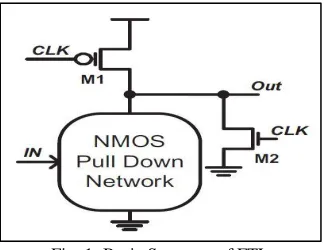
OGIC FAMILIESFig. 1: Basic Structure of FTL
In order to mitigate the limitation of Feedthrough Logic, a high performance Constant Delay Logic has been proposed. This logic provides a local window technique as well as a self reset circuit which enables robust operation with minimized power consumption. It is also capable of maintaining Feedthrough logics speed advantage. The CD logic consists of a Timing Block and a Logic Block. The Timing Block (TB) creates an regulating window period which helps to reduce the static power dissipation by adjusting the contention period. The Logic Block (LB) helps in reducing unwanted glitches and also makes cascading of different logics practical.
Fig. 2: Constant Delay Logic
The operation of the Constant Delay Logic is such that during the rest phase, the CLK will be high, CD logic predischarges both the X and Y nodes to GND. When CLK is low, CD logic enters the evaluation phase and any of the three modes of operation can take place namely, the contention, C to Q delay, or D to Q delay mode. The contention mode happens when the input is at logic one when the clock is low. C to Q delay mode happens when input makes a switch from high to low before the clock falls low. D to Q delay mode employs the pre evaluation characteristics of the CD logic for ensuring high performance operations. In FTL, the contention lasts for the entire evaluation period but the Timing Block of the CD logic reduces the po wer consumption during the contention mode. The local window technique allows customizing the window width for different logic expressions to achieve minimum power dissipation.
III.
B
INARY TREE COMPARATORSThe binary tree based comparator is inspired by the fact that G (generate) and P (propagate) signals can be defined for binary comparisons, similar to the Generate and Propagate signals used for binary additions. Hence, a binary comparator can be considered as a subset of the carry merge tree in a parallel prefix adder, where only the final carry out signal is necessary in interpreting the result.
A two 2-bit binary number (A1A0 and B1B0) comparison can be realized with
̅̅̅̅
̅̅̅̅̅̅̅̅̅̅̅̅
̅̅̅
(3.1) (3.2) Considering the following carry generation:
(3.3)
Comparing (3.1) and (3.3), we can define that ̅̅̅̅ , and ̅̅̅̅ for . The encoding equation is given as
Fig. 3: 8 bit Tree Diagram of a Binary Comparator
Fig. 3.1 shows an 8 bit diagram of the binary tree comparator. The pre-encoding circuitry is optimized for energy efficiency and is designed to minimize the number of transistors. So a pass transistor logic style is employed which reduces the number of transistors required from 16 to 9. The comparison generation circuitry (depicted as black circles in Fig. 3.1) is optimized for power delay product and hence, static logic is employed to facilitate low power high performance operations.
Binary Tree Constant Delay Logic Comparator with Clock Gating: A.
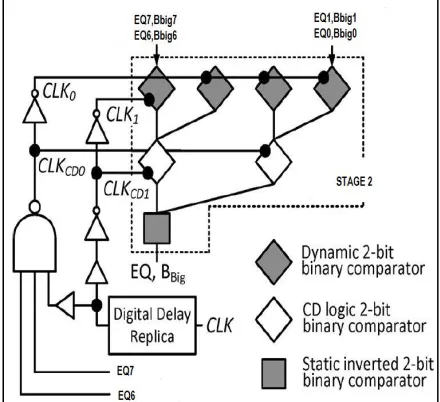
The binary tree based comparator structure can be divided into two stages, where the first stage includes eight 2 bit comparators in parallel along with encoding circuitries. The second stage consists of a single 8 bit comparator. The second stage implements a radix 2 reconciling with the footed dynamic logic comparator. Constant Delay logic is utilized in the second stage due to its domino compatibility and it acts as a high performance logic boundary between the dynamic comparator and the static logic comparator. The clock tree is arranged such that the CD logic always operates in the high performance D to Q mode. The static inverted comparison circuit acts as a Logic Block for the constant delay comparator which reduces the unwanted glitch that is seen at the output while computing the final stage comparison. Inversion Property is employed in each of the stages in order to avoid unnecessary inverters.
Fig. 4: Stage 1 of 8 Bit CD Logic Comparator with Clock Gating
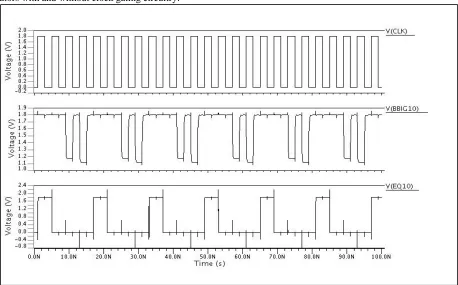
The clock generation circuitry consists of a digital tunable delay replica and a clock gating circuitry controlled by two EQ signals. The digital delay replica makes sure that the input signals to the dynamic comparator will always arrive earlier than CLK0 and CLK1. In the 8bit comparator, one dynamic and one CD logic comparator will be triggered in every clock cycle by CLK1 and CLKCD1 respectively. Alternatively, the rest of three dynamic and the other CD logic comparator enters the evaluation period if both the EQ7 and EQ6 signals are at logic 1.The probability that CLK0 goes to high and CLKCD0 goes to low that is the 3 dynamic comparators and one CD logic comparator enters the evaluation period is only 0.4%. Clock gating effectively reduces the energy consumption without compromising the performance.
Proposed Small Swing Dynamic Comparator: 1)
The output swing range of the proposed dynamic comparator circuit can be modulated by adjusting the size of the twist connected transistors and also the load capacitance. Thus the proposed twisted transistor small swing Dynamic Comparator is effective in saving power consumption my making use of the small swing technique though the logic gates occupy a slightly larger area. The Nodes OUT and X are charged to VDD during the pre charge mode when the input is 0. The substrate bias of So the voltage at node OUT remains lower than VDD.. The circuit operates with the same mechanism in the evaluation mode also.
Fig. 6: Proposed Small Swing Dynamic Comparator (Left) and Small Swing Circuit (Right)
IV.
S
IMULATION AND RESULTSTo compare the performance of the binary tree comparators with previous works, each circuit was simulated in Mentor Graphics ELDO SPICE. All circuits have been simulated using 0.18 µm CMOS technology with VDD = 1.8 V. A clock signal of 20ns width and 40ns period has been taken. The comparators were optimized and the transistor dimensions were scaled.
8 Bit Static Binary Tree Comparator: A.
Simulation is done for inputs A=B, A>B and A<B. The output for A>B ie A=11111111 and B= 01111111 is shown in Fig. 4.1. This circuit has a delay D to Q of 2.22ns when the inputs are A=01111111 and B=11111111. The power dissipated by this circuit is comparatively low when compared to the CD logic comparators with and without clock gating circuitries.
8 Bit Binary Tree CD Logic Comparator with Clock Gating: B.
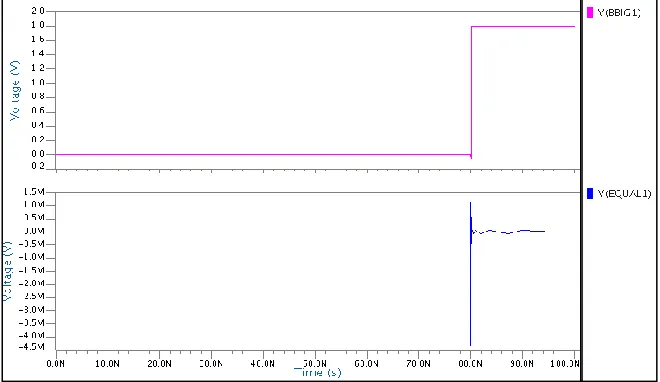
The output for A>B ie A=11111111 and B= 01111111 is shown in Figure 12. This circuit has a CLK to Q delay of 1.017ns when the inputs are A=01111111 and B=11111111. This circuit dissipates more power when compared to that of Static Binary Tree Comparator. Since both EQ7 and EQ6 are not 1 in this case, the 3 dynamic Comparators triggered by CLK0 and CD comparator triggered by CLKCD0 will not enter the evaluation period and results in lower power dissipation when compared to the one without clock gating.
Fig. 8: Waveform for A>B
8 Bit Binary Tree CD Logic Comparator without Clock Gating: C.
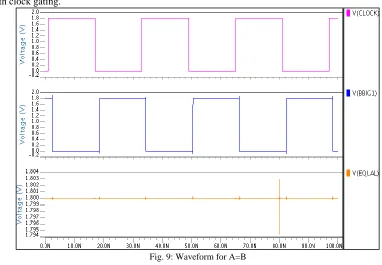
The output for A=B ie A=11111111 and B= 11111111 is shown in Fig. 4.3. This circuit has a CLK to Q delay of 1.3409ns when the inputs are A=01111111 and B=11111111. This circuit dissipates more power when compared to that of Binary Tree CD logic Comparator with clock gating.
Fig. 9: Waveform for A=B
Proposed 8 Bit CD Logic Comparator with Clock Gating: D.
overall energy efficiency of the proposed comparator circuit is much better than that of the Static Comparator and CD comparators with and without clock gating circuitry.
Fig. 10: Output Waveform for Small Swing Dynamic Comparator
The comparison table has been presented to compare the results of the binary comparators. Table - 1
Performance Comparison
Power(nW) Delay(nS) PDP(aJ) EDP(aJ*nS) 8 bit Static Binary TreeComparator
91.05nW 2.222nS 202.313 449.539
8 bit binary tree CD Comparator without clock gating
190.845nW 1.3409nS 255.904 343.14 8 bit binary tree CD Comparator with clock gating
118.135nW 1.017nS 120.14 122.18
Proposed 8 bit binary tree CD Comparator with clock gating 102.15nW 1.0325nS 105.469 108.896
V.
C
ONCLUSION8 bit binary tree comparator with Constant Delay (CD) logic has been designed and simulated. The comparators with and without clock gating has been compared and it is concluded that the binary comparator with clock gating circuitry has got better delay performance. The proposed small swing comparator architecture has shown better PDP and EDP compared to all the other designs. The clock gated CD logic binary tree comparator implemented exclusively in the timing critical path achieves additional speed advantage with comparable energy consumption over the same design with static logic only.
R
EFERENCES[1] C.-H. Huang and J.-S. Wang, ―High-performance and power-efficient CMOS comparators,‖ IEEE J. Solid-State Circuits, vol. 38, no. 2, pp. 254–262, Feb.
2003.
[2] F. Frustaci, S. Perri,M. Lanuzza, and P. Corsonello, ―A new low-power high-speed single-clock-cycle binary comparator,‖ in Proc. IEEE Int. Symp.
Circuits Syst..
[4] P. Chuang, D. Li, and M. Sachdev, ―Design of a 64-bit low-energy high performance adder using dynamic feedthrough logic,‖ in Proc. IEEE Int. Circuits Syst. Symp., May 2009, pp. 3038–3041.
[5] P. Chuang, D. Li, and M. Sachdev, ―A low-power high-performance single-cycle tree-based 64-bit binary comparator,‖ IEEE Trans. Circuits Syst. II, Exp.
Briefs, vol. 59, no. 2, pp. 108–112, Feb. 2012.
[6] P. Chuang,D. Li, andM. Sachdev, ―A constant delay logic style,‖ IEEE Trans. Very Large Scale Integr. Syst., vol. 21, no. 3, pp. 554–565, Mar. 2013.
[7] P.-J. Chuang, D. Li, M. Sachdev, and V. Gaudet, ―A 148 ps 135 mW 64-bit adder with constant-delay logic in 65 nm CMOS,‖ in Proc. IEEE Custom Integr. Circuits Conf. (CICC), Sep. 2012, pp. 1–4.
[8] P.-J. Chuang, D. Li, M. Sachdev, and V. Gaudet,‖ A 167-ps 2.34-mW Single-Cycle 64-Bit Binary Tree Comparator With Constant-Delay Logic in 65-nm
CMOS‖, IEEE Transactions On Circuits And Systems—I : Regular Papers, Vol. 61, No. 1, January 2014
[9] S. Kiaei, S.H. Chee, and D. Allstot, ―CMOS source-coupled logic for mixed-mode VLSI,‖ Proc. Of IEEE Int. Circuits Syst. Symp., New Orleans, LA, May
1990, pp. 1608–1611.
[10] S. Perri and P. Corsonello, ―Fast low-cost implementation of singleclock- cycle binary comparator,‖ IEEE Trans. Circuits Syst. II, Exp. Briefs, vol. 55, no.
12, pp. 1239–1243, 2008.
[11] S. Y. Ahn and K. Cho, ― Small Swing Domino Logic Based on Twist Connected Transistors‖, Electronics Letters, 17th July 2014 Vol. 50 No. 15 pp.
1054–1056
[12] V. Navarro-Botello, J. A. Montiel-Nelson, and S. Nooshabadi, ―Low power arithmetic circuit in feedthrough dyanmic CMOS logic,‖ in Proc. IEEE Int. 49th Midw. Symp. Circuits Syst., Aug. 2006, pp. 709–712.
[13] V. Navarro-Botello, J. A. Montiel-Nelson, and S. Nooshabadi, ―Analysis of high-performance fast feedthrough logic families in CMOS,‖ IEEE Trans. Circuits Syst. II, Exp. Briefs, vol. 54, no. 6, pp. 489–493, Jun, 2007.
[14] Weste and Harris, ―CMOS VLSI Design: A Circuits and System Perspective‖, 4/e, 2011, Addison – Wesley
[15] R. Zimmermann and W. Fichtner, ―Low-power logic styles: CMOS versus pass-transistor logic,‖ IEEE J. Solid-State Circuits‖, vol. 32, no. 7, pp. 1079–