Abstract
India liberalised its foreign direct investment (FDI) policy for multi-brand retail to attract international retailers with an intention to bring more investment in to the country and also to encourage the Indian retailers to create competitive advantage by leveraging the resources and capabilities of their supply chain partners. But the Government's decision to allow 51 per cent foreign direct investment (FDI) in multi-brand retail has been a subject ofdebate for quite some time now as different stakeholders have different opinions based on their perception of the likely impact of the policy. The present study is a small attempt in this direction which aims to analyse the norms of the policy and it implications. This paper also examines the views and perceptions of the consumers with regard to FDI in Multi Brand Retailing Trade in India. From the findings of the study, it is evident that majority of the educated respondents are in favour of FDI in Multibrand retailing and the education level of the consumers has an influence on their perceptions.
Keywords: FDI, Multi Brand Retailing, FDI Norms, Consumers, Perceptions.
1. Introduction
Foreign Direct Investment plays an important role in the development process of a country's economy. India has been able to attract significant amount of Foreign Direct Investment, especially after the liberalization and is still continuing to explore opportunities in FDI inflows. This hasgradually led to the advent of FDI in the retail sector in India which has positively impacted the retail and ancillary industries such as supply chain, manufacturing and agriculture. The recent liberalization of the FDI retail policy has come as a major boon to foreign retailers for those who are looking to set up or expand operations in the country.India further decided to relax sourcing and
* Professor & Head, Department of Commerce, S.N.D.T. Women's University, New Marine Lines, Mumbai - 400 020. (India), E-mail :[email protected]
** Assistant Professor, Thakur Institute of Management Studies and Research, Kandivali (East). Mumbai-400001, E-mail :[email protected]
Consumers’ Perception on FDI in Multi-Brand
Retailing in India - A Study
investment rules for the retail sector in a renewed attempt to attract foreign supermarket chains such as Wal-Mart Stores and Tesco. Amidst lot of political controversies, the government decided to permit 51 percent FDI in multi-brand retail trade and raised foreign direct investment (FDI) in single-brand to 100 per cent in September 2012 subject to approvals by the states. Opening up of FDI in multibrand is expected to bring benefits like employment opportunities, organized retail stores, availability of quality products at a better price etc.
There are various viewpoints regarding the impacts it will have on the retail sector in specific and the Indian economy in general, but the decision is a big step in the direction of strengthening organized retail in the country. This policy can take India's consumerism to a new growth trajectory as it is likely to result in increase in investments and growth in Indian retail sector, which is ranked amongst the top retail destinations in the world. It is also expected that FDI in multibrand retail will address the concerns of the foreign investors who have till date tried to understand the nuances of the FDI policy related to multi brand retail.
The industry chamber ASSOCHAM and private sector lender Yes Bank has come up with a joint report in conjunction with the widening of foreign direct investment (FDI) up to 51 percent, in multi-brand retail segment. This published report foresees about Rs 40,000 crore investment in multi-brand segment of India and expects an organized market growth to Rs 480,000 crore by 2016-17, as compared to 2011-12's Rs 160,000 crore growth.
Different stakeholders have different opinions based on their perception of the likely impact of FDI in MBRT in India on their interests. Though foreign players are already operating in the Indian market as cash and carry and single brand retail formats, present controversy centers on repercussions of FDI in multi-brand retailing. Against this background, it becomes imperative to examine the highly debated decision that has allowed foreign capital in multi-brand retailing and its likely impact on the sensitive issues that might have an implication on the different stakeholders of the society.
As it has been widely acknowledged by many parties that consumers will be benefited by price reduction and pampered with wide choice of products under one roof which in turn can lead to greater output and domestic consumption, the study aims to examine the perception of consumers with regard to FDI in Multi Brand Retailing in India as they are the ones who will be affected or benefited by this decision.
2.
Review of Literature
Joshi Deepak (2012)carried out an exploratory research to find out the perception of the unorganized retailers in business capital of Uttarkhand with respect to FDI in MBRT and has found out that correlation of the various responses led to a conclusion that the source of information was also a factor of voicing against the FDI and the influence of Education level was quite evident.
Baskaran Kamala Devi (2012 ) in her study "FDI in India's Multi Brand Retail -Boon or Bane" explores the myths and realities of the global giants' entry to India and studies the status of organised food retailing in India with SWOT Analysis and highlights on farmer's issues towards FDI in multi brand retailing.
Khan A.Q. and Siddiqui Ahmad Taufeeque (2011) studied the impact of FDI on Indian economy and a comparison with China & USA. The paper has set strategies to deal with the issues & problems in attracting FDI for promotion & growth of international trade. The double log model has been used to find elasticity between different factors in this paper. They also highlight the impact of FDI on employment.
Chris Devonshire-Ellis and Ankit Shrivastava (2012) are of the view that FDI in MBRT will benefit the unorganized and local players in long run and opine that the advantages outweigh the disadvantages as successful experiments in countries like Thailand and China demonstrate. They also list benefits of allowing FDI like they will cut waste, big players will build backend infrastructure, price stability and job creation. Jain M. and Suklecha M.L., (2012) in their paper emphasise on the need to invite FDI in multi brand retailing by analyzing the positive and negative impacts of the reforms. Bisaria G., (2012) examined the responses of consumers on the government policy on multibrand retailing and found majority of people supporting the policy.
As a common consensus cannot be reached from the above review of past studies, it becomes vital to study this topic andthis study aims to bring more lightto the topic under investigation.
3.
Objectives of the Study
1. To examine the policy that opened up Foreign Direct Investment (FDI) in Multi-Brand Retail Trade (MBRT) in India.
2. To analyse the likely implications and consequences that are feared to emerge with the introduction of FDI in Multi-Brand Retailing in India and to investigate the same.
4.
Hypotheses of the Study
Ho- The Null Hypothesis assumes that there is no significant relationship between Education Levels and the Consumers' perceived value towards FDI in Multi-Brand Retailing in India.
Ha- The Alternative Hypothesis accepts that there is significant relationship between Education Levels and the Consumers' perceived value towards FDI in Multi-Brand Retailing in India.
5.
Research Design and Methodology
This study aims to examine the current FDI policy with regard to Foreign Direct Investment (FDI) in Multi-Brand Retailing in India and also to analyse the perceived value of consumers with respect to various factors. The methodology of the study is discussed below:
a. Research Design
In order to examine the perceptions of the consumers, this study has used a single cross- sectional descriptive research design. The association between the dependent and independent variable has been inferred using the causal-comparitive design. b. Sampling Design
Convenient sampling method was adopted for administering the questionnaires to measure the perceptions of 100 consumers among the age groups (20-30, 30-40 and 30-40&above) was collected from Western Suburbs of Mumbai region. However, the data was gathered only from consumers who had awareness about the concept FDI in Multibrand retailing in India as the aim of the study was not to explore the awareness of FDI but to measure the perception of the consumers with regard to the same.
c. Method of Data Collection
d. Statistical Tools Used to Test the Hypothesis
A chi-square analysis has been used to analyze the data collected and to determine the extent of relationship among the variables. Then the Cramer's V has been computed to find out the strength of association among the levels of the row and column variables.
e. Limitations of the Study
The research undertaken has some limitations that need to be addressed; firstly the samplingframe that was used was small (n= 100), therefore due to the small sample size, it is difficult to fully understand the consumer perceptions towards FDI in Multibrand Retailing in India. Secondly, questionnaire respondents were selected through the use of a convenience sampling method; therefore the results cannot be generalized.
6.
Review of India's FDI norms in Multi Brand Retail Trade (MBRT)
FDI in Multi Brand retail implies that a retail store with a foreign investment can sell multiple brands under one roof. When the government decided to allow 51 per cent FDI in multi-brand retailing and 100 per centFDI in single-brand retailing , though subject to certain conditions, this was considered as a long-awaited boon to large international retailers who had been eagerly waiting to tap into the estimated US$ 750 Indian retail market. Almost nine months later, no global retailer has moved so far to file applications with the Foreign Investment Promotion Board (FIPB). No foreign investment has taken place in the sector so far. This attitude of the foreign retailers is also largely the result of earlier policy confusions and global retailers like Walmart, Tesco and Carrefour demanded further clarifications in the policy. So the government clarified the policy and took safer measures by allowing FDI in multi-brand retail only in those Indian cities with a population of one million or more as per the 2011 census, covering an area of 10 kms around the limits of that city. This automatically restricts the number of cities to 53 where it can be implemented. Only 10 states and UTs have so far conveyed to the Centre their agreement to open FDI in the multi-brand retail. The retail trading in any form by means of e-commerce has been made non-permissible for companies with FDI in multi-brand retailing.
must also domestically outsource 30 per cent of the finished products sold in the market. This procurement clause ensures that domestic industry is not adversely impacted by the FDI inflows but stand to benefit from sales. If we look at the domestic front with regard to the above policy framework, lot of debate has been going on. According to the majority of the opponents; some of the likely impacts of the policy are as follows: 1. The policy will affect the small retailers (Kirana shops).
2. Millions of jobs will be lost.
3.
Entities like Walmart, with deep pockets, will take over large segments
of the retail sector.
In our investigation about the likely impact, we have come to the conclusion that the issues that are feared to emerge with the introduction of FDI in MBRT is only a misconception. The policy is only an enabling policy and it is up to the State Governments to take their own decisions with regard to implementation of the policy. Retail is a booming sector and as indicated in the policy, it can be seen that FDI in multi-brand retail can only be set up in only in those Indian cities that has a population of one million or more as per the 2011 census, covering an area of 10 kms around the limits of that city. Again, if we take the example of Mumbai, there is no possibility of big foreign entity being set up in Cuffe Parade or Juhu as the prices of urban land are far too high and hence it would become an uneconomical venture. There is also no empirical data to suggest that small retail stores would vanish. The second proposition which claims millions will be out of a job, is equally baseless. Infact, more jobs will be created as it is mandatory in the FDI policy 2013, that 50 per cent of any investment over a $100 million would be in the backend infrastructure. So investments will be made at the back-end of retail and more supply chains will be established. This will also eliminate agents who survive merely on trading and pave way for more jobs. Lastly, the argument that it would destroy the retail sector as it will take over our retail is not accepted because it is Indian retail which is going to tie up with FDI in multi-brand retail. The local retailers who already are aware of the nuances of our market conditions will have enough domestic demand to cater to consumers` needs. From the above discussion, it is evident that the consequences that are feared to emerge are only a myth.
7.
Perception of Consumers with regard to FDI in Multi Brand Retailing
in India
out what Indian consumers think about FDI in multibrand retailing. This study has also attempted to establish the perceptions of the consumers for which a survey was carried out in the Western Suburbs of Mumbai region with the help of a formalized and concealed questionnaire. The questionnaire that was administered on the respondents had a set of formal questions about age, education and a five-point Likert scale which is a psychometric response scale primarily used in questionnaires to obtain participant's preferences of degree of agreement or disagreement with a set of favourable and unfavourable statements. The likert scale was constructed with a set of 7 statements based on exploratory research using a focus group. The following section shall now present and discuss the results that were obtained through the distribution of the questionnaires to the respondents (n= 100). Annexure 1 shows the cumulative percentages of the responses on a five point likert scale for the seven statements that were administered on the respondents. As the aim of the study is also to test the association between education and perceptions of the respondents, it becomes imperative to find out the education levels of the respondents.The detailed descriptive figures of table 1 which breaks down the figures in to our two participant categories based on education level (Below graduation and Graduation and above) along with the cumulative percentages of the respective statement's level of agreement, disagreement and neither agreement nor disagreement respondents felt towards each statement that was posed is shown in Annexure 2.
8.
Analysis and Interpretation of Survey Results
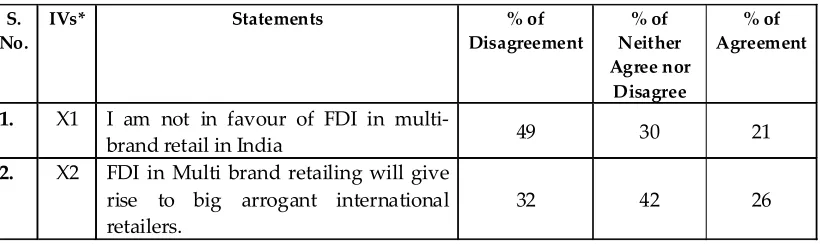
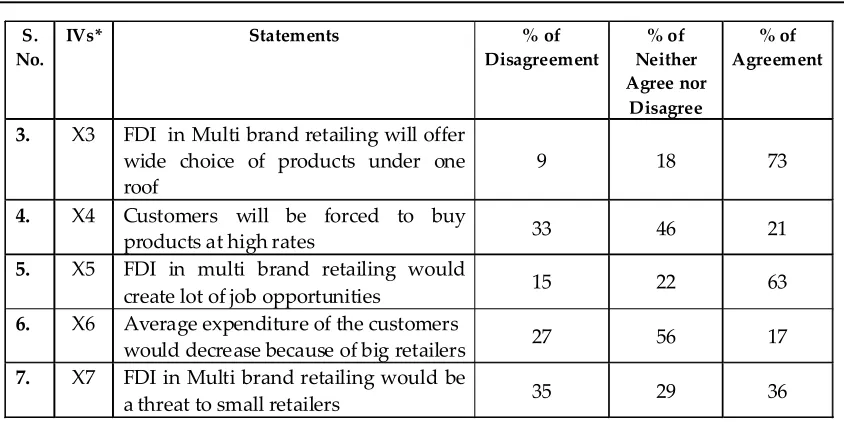
The study was carried out on a sample of 100 respondents out of which 59 were male respondents and 41 were female respondents. Next for analysis purpose, the cumulative percentages of the responses as shown in annexure 2, the degree of agreement and disagreement were collapsed by combining the upper and lower categories into a 3 level "Agree/Neither/Disagree" breakdown. The collapsed cumulative percentages are presented below.
Table 1 : Cumulative percentages of Consumers' Perceptions
S. No.
IVs* Statements % of
Disagreement
% of Neither Agree nor
Disagree
% of Agreement
1. X1 I am not in favour of FDI in
multi-brand retail in India 49 30 21
2. X2 FDI in Multi brand retailing will give rise to big arrogant international retailers.
S. No.
IVs* Statements % of
Disagreement
% of Neither Agree nor
Disagree
% of Agreement
3. X3 FDI in Multi brand retailing will offer wide choice of products under one roof
9 18 73
4. X4 Customers will be forced to buy
products at high rates 33 46 21
5. X5 FDI in multi brand retailing would
create lot of job opportunities 15 22 63
6. X6 Average expenditure of the customers
would decrease because of big retailers 27 56 17
7. X7 FDI in Multi brand retailing would be
a threat to small retailers 35 29 36
Source: Compiled from Primary Data
*IVs-Independent Variable Factors
consequences of this policy and the primary data result proves that the consumers feel that it will only create more job opportunities. When an attempt was made to find out whether average expenditure of the customers would decrease because of big retailers, majority of the respondents (56 per cent) remained neutral. This reflects clearly that they were actually not sure about this or may be not willing to comment about the said statement. The fear that the emergence of multibrand retailing will be a threat to small retailers isnot fully founded in our survey. There is no empirical evidence to prove that the entry of big multinational retailers would affect the small retailers as 29 per cent of the respondents chose to be neutral in this regard. This also indicates the respondents are still not clear about FDI in MBR's impact on small retailers and they are divided in their opinions.
Table 2 : Consumers' Perceived Effects of Education level against FDI in Multibrand Retailing
I.Vs*. Statements % of
Disagreeme nt
% of Neither Agree nor Disagree
% of Agreement
BG G&A BG G&A BG G&A
X1 I am not in favour of FDI in
multi-brand retail in India 11 38 8 22 13 8
X2
FDI in Multi brand retailing will give rise to big arrogant international retailers.
3 29 8 34 21 5
X3 FDI in Multi brand retailing will offer
wide choice of products under one roof 7 2 5 13 20 53
X4 Customers will be forced to buy
products at high rates 7 26 9 37 16 5
X5
FDI in multi brand retailing would
create lot of job opportunities 14 1 13 9 5 58
X6 Average expenditure of the customers would decrease because of big retailers 14 13 13 43 5 12
X7 FDI in Multi brand retailing would be a
threat to small retailers 1 34 3 26 28 8
Source: Compiled from Primary Data
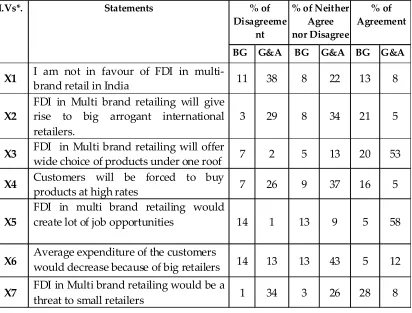
As discussed earlier, since the aim of the study is to test the association between education and perceptions of the respondents, only two education levels were included in the questionnaire and the degree of agreement and disagreement were collapsed by combining the upper and lower categories into a 3 level "Agree/Neither/Disagree" breakdown. The results shows that 32 per cent of the respondents were below the graduation level and 68 per cent were above the graduation level. Further, the observations that were made clearly shows that majority of the respondents whose educational level is below graduation have inclined negatively towards opening up of FDI in Multibrand retailing in India. A majority of 14 respondents out of the total 32 respondents are of the opinion that FDI in multi brand retailing would not create lot of job opportunities. This could be due to fear of loss of jobs. They also felt that the average expenditure of the customers would not decrease because of big retailers. A majority of the respondents who have not graduated have expressed similar view points for statements 2, 3 & 4. They have also expressed their fear by strongly agreeing (28 out of 32) that FDI in Multi brand retailing would be a threat to small retailers. In contrast, the educated category has positively inclined towards FDI (53 out of 68) due to availability of wide variety of products under one roof. The reasons could be convenience, time factor and quality products. This group is also of the opinion (58 out of 62) that there is a possibility of lot of job opportunity. Thus the results indicate clearly that the educated respondents have inclined positively and the respondents below graduation level have inclined negatively towards FDI in multibrand retailing in India.
9.1 Statistical Results of Perceived effects of Education level against favouring
of FDI in Multibrand Retailing
Table 3 : Computation of Chi Square
S.No. Education Level Below
Graduation
Graduation and Above
1. % of Disagreement 11 38
2. % of Neither Agree nor Disagree 8 22
3. % of Disagreement 13 8
Chi-Square Df P
11.08 2 5.991
Cramer’s Value = 0.3329
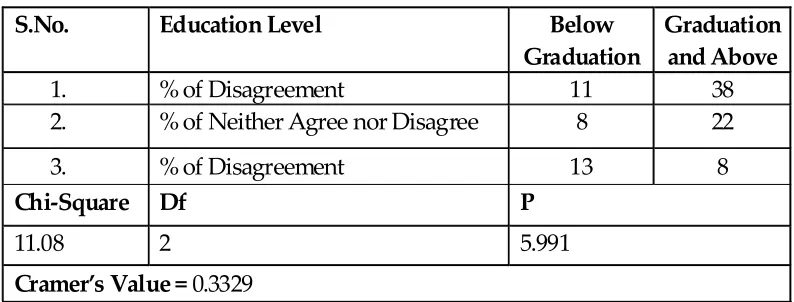
In order to statistically test the hypothesis and to find out the relationship between education levels and perceptions of consumers with reference to the statement, 'I am not in favour of FDI in multi-brand retail in India', agree, strongly agree and disagree, strongly disagree were collapsed as agree and disagree as discussed earlier. Next, 3x5 cross tabulations were computed between educational level variable and the perceived value of the factor under consideration. Then a Chi-square statistics was used to analyze the data collected and to determine the extent of relationship among the variables. The computed value of Chi-square statistics is 11.08.Since the computed value of 11.08 is greater than the critical value of 5.991, the statistical decision is to accept the alternate hypothesis. In other words, there is significant relationship between Education Levels and the Consumers' perceived value towards FDI in Multi-Brand Retailing in India. The computed value of Cramer's V, which is 0.3329,also indicates a strong association among the levels of the row and column variables. This further proves the relationship between the dependent and the independent variables.
9.
Conclusions
The decision to liberalise FDI norms in multibrand retailing comes in the backdrop of the country's economic growth. The intentions look commendable but its impacts are widely debatable. Arguments like extinction of kirana stores, loss of employment to millions of people etc. have been cited as the negative impact of FDI in Multibrand Retail. So, this study made an attempt to examine the policy related to FDI in Multibrand Retailing in India and also to investigate the issues that are feared to emerge with the policy. After very carefully examining the policies and the likely impacts of the policy, this study concludes the following:
1. The government has introduced the policy only as an enabling policy and sufficient safe measures for each clause has been adopted.
2. There is also no empirical evidence to prove that the small retailers will be affected or millions would be out of job. So all the propositions placed by the critics against the policy is only a misconception.
3. The study which also attempted to find out the perception of consumers with regard to the policy has found out the there is significant relationship between Education Levels and the Consumers' perceived value towards FDI in Multi-Brand Retailing in India.
5. These research findings have important implications for the policy makers and the government needs to focus more on, educating small and unorganized retailers for future course of action to excel in their business and to create awareness about the benefits of the policy in the minds of the uneducated consumers.
6. Finally, the study concludes that with the opening up of FDI in multibrand retail, the sector is expected to bring in adequate infrastructure creation, better quality product offerings to the consumers and create numerous job opportunities directly as well as indirectly but the apprehensions of the different stake holders need to be resolved immediately to generate wider acceptance of this policy.
10. Findings of the Study
1. From the survey, it has been found that 53 per cent of respondents feel that FDI in Multi brand retailing will offer wide choice of products under one roof.
2. Out of the total respondents, 42 per cent of the respondents have neither agreed nor disagreed when asked FDI in Multi brand retailing will give rise to big arrogant international retailers.
3. The respondents who are of the opinion that FDI in multi brand retailing would create lot of job opportunities has been found out to be 63 per cent
4. Out of the total respondents surveyed, 32 per cent of the respondents were below the graduation level and they have inclined negatively towards opening up of FDI in Multibrand retailing in India.
5. Out of the total respondents surveyed, 68 per cent of the respondents were above the graduation level and they have inclined positively towards opening up of FDI in Multibrand retailing in India.
11. Recommendations
1. The Government should play a vital role to increase the level of awareness of FDI in Multibrand retailing trade in India and its implications in the minds of the stake holders so as to build a positive environment.
2. Government should guard against the risk of foreign retailers becoming monopolistic and charging high prices by allowing them in restrictive manner. 3. It is also important for Indian policymakers to learn lessons from FDI in multibrand
experiences of other countries like China and adopt a cautious approach.
5. In order to increase the credit facilities to Indian farmers, monetary transactions should be done through Indian Banks only.
6. First priority should be given to the Indian goods and products produced by Indian incorporate for consumption purpose.
Thus it can be seen that FDI in Multibrand retailing can play a significant role for economic growth and development through its strengthening of domestic capital, productivity and employment creation by integrating its economy with that of the global economy.
References
1. Bahree, M. "India unlocks door for global retailers", Wall Street Journal, Nov 24, 2011. 2. Baskaran Kamala Devi, "FDI in India's Multi Brand Retail - Boon or Bane", Universal Journal
of Management and Social Sciences, Vol. 2, No.1; January 2012.
3. Basu, R., Sengupta, K., & Guin, K. K., "Format perception of Indian apparel shoppers: Case of single and multi-brand stores. IUP Journal of Marketing Management" 2012, 11(3), 25-37. 4. Bisaria G., "Foreign Direct Investment in Retail in India", 2(1), 31-36.
5. Cabinet eases sourcing norms for multi-brand retailers. (2013, Aug 02). Accord Fintech. Retrieved from http://search.proquest.com
6. Choudhury, S., & MAMGAIN, P.,"Government may allow 100% FDI in single-brand retail retailing", The Economic Times, 2012. Retrieved from http://search.proquest.com
7. Chris Devonshire-Ellis and Ankit Shrivastava, " Foreign Direct Investment in India's Single and Multi-Brand Retail", viewed on http://www.india-briefing.com/news/foreign-direct-investment-indias-single-multibrand-retail-5232.html/
8. FDI in retail and aviation sectors set to become a reality now policy]. (2012, Sep 22). The Economic Times (Online). Retrieved from http://search.proquest.com
9. FDI in retail: It's time for states to ensure FDI in multi-brand retail policy]. (2011, Nov 26). The Economic Times (Online). Retrieved from http://search.proquest.com
10. FDI in retail: Won't step back on retail FDI, says PM Manmohan Singh, The Economic Times, Nov 2011. Retrieved from http://search.proquest.com
11. Government in no mood of rollback; notifies FDI in retail. (2012, Sep 21). Accord Fintech. Retrieved from http://search.proquest.com
12. Government panel decides not to make any suggestion for FDI in multi Multi-brand FDI to hit kirana shops: Metro cash & carry retailing, The Economic Times, July 2013. Retrieved from http://search.proquest.com
13. Jain M. and Sukhlecha M. L., "FDI in Multibrand retail: Is it the need of the hour?", Zenith International Journal of Multidisciplinary Research, 2(6), 108 -131.
14. Khan.A.Q&Siddiqui Ahmad, Taufeeque, 'Impact of FDI on Indian Economy: A Comparison with China & USA', International Journal of Business & Information technology, vol-1 no 1: 2011. 15. Sen., A., "States opposing FDI in multi-brand retail have constitutional right to do so", The
Annexure 1
Consumers' Perception towards FDI in MBRT (Cumulative Responses in %)
I.Vs Statements Strongly Disagree
(%)
Disagree
(%)
Neither Agree nor
Disagree (%)
Agree
(%)
Strongly Agree
(%)
Total
X1 I am not in favour of FDI in multi-brand retail in India
35 14 30 14 7 100
X2 FDI in Multi brand retailing will give rise to big arrogant
international retailers.
15 17 42 15 11 100
X3 FDI in Multi brand retailing will offer wide choice of products under one roof
4 5 18 45 28 100
X4 Customers will be forced to buy products at high rates
7 26 46 10 11 100
X5 FDI in multi brand retailing would create lot of job opportunities
7 8 22 31 32 100
X6 Average expenditure of the customers would decrease because of big retailers
11 16 56 9 8 100
X7 FDI in Multi brand retailing would be a threat to small retailers
13 22 29 21 15 100
Annexure 2
Consumers’ Perception towards FDI in MBRT against Education Level
(Cumulative Responses in %)
I.Vs Strongly Disagree Disagree Neither Agree nor
Disagree
Agree Strongly Agree
Below Grad
Graduation and above
Below Grad
Graduation and above
Below Grad
Graduation and above
Below Grad
Graduation and above
Below Grad
Graduation and above
X1 6 29 5 9 8 22 8 6 5 2
X2 2 13 1 16 8 34 11 4 10 1
X3 3 1 4 1 5 13 13 32 7 21
X4 3 4 4 22 9 37 8 2 8 3
X5 7 0 7 1 13 9 3 28 2 30
X6 6 5 8 8 13 43 3 6 2 6
X7 0 13 1 21 3 26 15 6 13 2