An Efficient Method for 2D to 3D Conversion
using Grouping of Image
Shyna Nazar Viji T
M. Tech Student Assistant Professor
Marian Engineering College Marian Engineering College
Abstract
In recent years 3D display has become a trend in visual processing field.3D display provide better visual quality than conventional 2D displays. The three-dimensional (3D) displays requires the depth information which is unavailable in the conventional 2D content. This work presents an algorithm that automatically converts 2D images into 3D ones. The proposed method first divides the image into object groups by choosing an effective grouping method. Based on a hypothesized depth gradient model the depth map is assigned. Next, the depth map is assigned by cooperating with a cross bilateral filter to diminish the blocky artifacts. A Multiview image can be readily generated by processing the filtered image using a depth image based rendering method. Keywords: Bilateral Filtering, Depth Map Generation, Edge Information, K-Means Clustering, Region Growing
________________________________________________________________________________________________________
I. INTRODUCTION
In 3D display technology, humans can experience more realistic and unique 3Deffects.In addition to generating realistic visual experience than conventional 2D displays, emerging 3D displays have many applications, including broadcasting, movies, gaming, photography, camcorders, medical imaging and education. With the advances in 3D applications, the conversion of existing 2D images to 3D images becomes an important component for 3D content production. The conversion process of existing 2D images to 3D is commercially viable and is fulfilling the growth of high quality stereoscopic images. The most important technique for such content conversion is to develop a depth map for each frame of 2D material.
When observing the world, the human brain usually combines the heuristic depth cues for the generation of the depth perception. The binocular depth cues from two eyes and monocular depth cues from a single eye [6]. are the major depth perceptions to be noted. The disparity of binocular visual system helps human eyes to converge and also to accommodate the object at the right distance. Focus/defocus, motion parallax, relative height/size, and texture gradient are the monocular.depth cues provide various depth perceptions based on human experience. Therefore, humans are able to recognize depth from the single-view image/video
.
The key step in 2D to 3D conversion process is the production of a dense depth map. Most depth extrication algorithms make use of a certain depth cue but a few of them combines two or more depth cues to obtain depth map. 2D-to-3D depth generation algorithms generally face two problems. One of them is the depth uniformity inside the same object. A better grouping of pixels results in a better result for the depth uniformity inside the object. The other challenge involves retrieving an appropriate depth relationship among all objects[3][4].In order to overcome these two challenges, this work presents an algorithm that uses simple depth hypothesis to assign the depth of each group instead of extract the depth value straight from the depth cue. At first, the proposed algorithm chooses an effective grouping method. Then based on a hypothesized depth gradient the depth values are assigned . Cross bilateral filter is then used to enhance the visual comfort.
II. RELATED WORKS
In recent years, according to the principle of human visual system a number of depth generation algorithms are proposed. Every algorithm has its own pros and con. A novel depth map generation method - the short-term motion assisted color segmentation, which merges the pictorial, monocular and binocular depth cues of human vision. This method avoids the motion jitter error in common motion segmentation by using motion/edge registration technique. And the motion/image segment adaptation algorithm matches the connected components with the motion segments. Even for static scene, the connected component algorithm is still working for the generation of depth map. [3]
Stereoscopic video generation methods can generate stereoscopic content from conventional video filmed with monoscopic cameras. A stereoscopic video generation method using motion analysis which transforms motion into disparity values and takes into account multi-user conditions and the characteristics of the display device. The field of vision and the maximum and minimum disparity values were determined in the stereoscopic display characterization stage and were then put on to various types of 3D displays values were determined in the stereoscopic display characterization stage and were then put on to various types of 3D displays. After motion estimation, three cues were used to decide the scale factor of motion-to-disparity conversion. These cues were the magnitude of motion, camera movements and scene complexity.[4]
In these 2 methods However, these methods use motion parallax as the primary depth cue. When the object with different self-motion vectors these methods obtain false depth information. The pixels belong to the same object that may be assigned with different depth values.
The 2D-to-3D conversion combines two major depth generation modules, the depth from motion and depth from geometrical perspective. A block-based algorithm is applied and co-operates with the bilateral filter to avoid block effect and obtain a comfortable depth map. After generating the depth map, the multi-view video is rendered to 3D display[2]
Depth-image-based rendering (DIBR) is the process of synthesizing “virtual” views of a scene from still or moving images and associated per-pixel depth information. This method can solve the hole-filling problem in DIBR system efficiently with high quality[8]
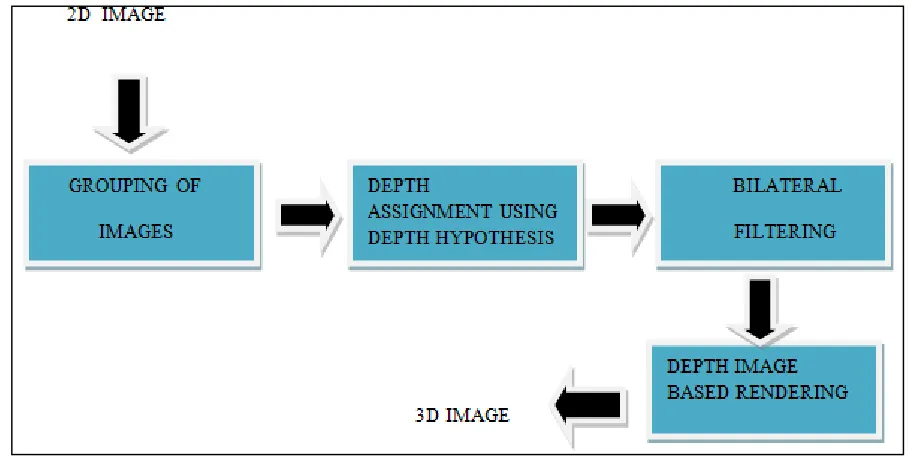
Fig. 1: Proposed Conversion System
III. PROPOSED CONVERSION SYSTEM
The work here describes efficient 2D-to-3D conversion method based on the grouping the image. Grouping is done by two methods, using edge information and by using k-means clustering, Initially, the image is considered to segment it into multiple groups. Then with the help of an initial depth hypothesis, the depth of each segment is assigned. Next, by using cross bilateral filtering the blocky artifacts have to be removed. Finally, multi-view images are obtained by DIBR technique. As a result, the input 2D image is converted into visually comfortable 3D image without the presence of artifacts which enhances the quality of the image in the display. The proposed conversion system is shown in fig 1.
Grouping of Images
Block Based Region Grouping
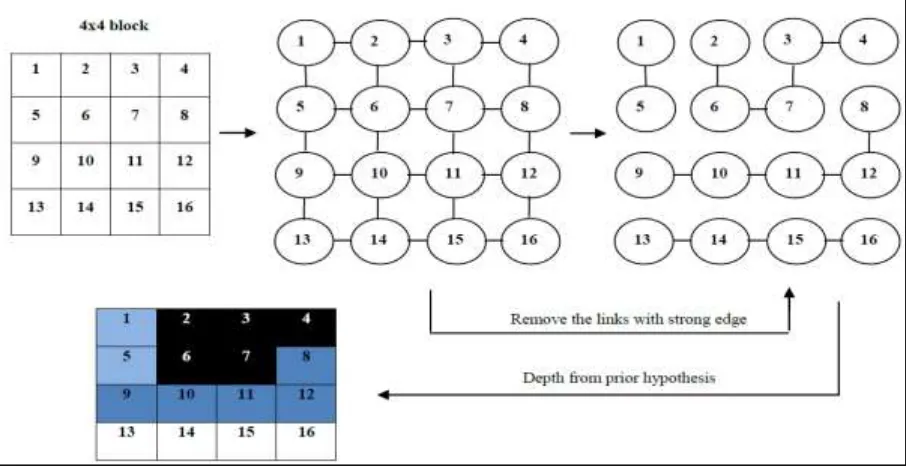
Block based region grouping is done with the help of the edge information. The grouping is based on the pixels having similar colors and spatial locality.. A 4-by-4 block is used as an example. Each node is a 4-by-4-pixel block, and is four-connected. The value of each link is obtained by calculating the absolute difference of the mean of neighboring blocks.
Diff(a,b)= | mean(a) - mean(b) | (1)
Fig. 2: Flow of block-based region grouping
The pseudo code for MST algorithm is shown in Table 1. When a series of regions, which differ slightly from each other, bridge a large gap in the feature space is a situation where MST algorithm fails. As the edge weights are small, the graph will not be cut and so very different objects in terms of feature space characteristics will be combined.
Table - 1
Pseudo Code of Segmentation using Minimum Spanning Tree
Region growing based on block based k- means clustering
Image segmentation refers to the decomposition of a scene into different components. This can be done by region growing incorporated with k means clustering. Clustering is also termed as grouping. In this process the image is divided into clusters and the further process is done in these clusters. K-means is the one of the simplest unsupervised learning technique that solve the well-known clustering problem[10].The procedure follows a simple and easy way to classify a given data set through a certain number of clusters (assume k clusters) fixed apriori. The main idea is to define k centers, one for each cluster. These centers should be placed in a cunning way because of different locations causes different result. So, the better choice is to place them as much as possible far away from each other.
The next step is to take each point belonging to a given data set and associate it to the nearest center. When no point is pending, the first step is completed and an early group age is done. At this point we need to re-calculate k new centroids as bary center of the clusters resulting from the previous step. After we have these k new centroids, a new binding has to be done between the same data set points and the nearest new center. A loop has been generated. As a result of this loop we may notice that the k centers change their location step by step until no more changes are done or in other words centers do not move any more. Finally, this algorithm aims at minimizing an objective function know as squared error function given by.
(2) ‘||xi - vj||’ is the Euclidean distance between xi and vj.
‘c’ is the number of cluster centers xi and vj are neighbouring clusters Advantages
1)Fast, robust and easier to understand.
2)Gives best result when data set are distinct or well separated from each other.
a) Region Growing:
Region Growing is an approach to image segmentation in which neighboring pixels are examined and added to a region class if no edges are detected. This process is iterated for each boundary pixel in the region. If adjacent regions are found, a region-merging algorithm is used in which weak edges are dissolved and strong edges are left in tact.
Region Growing offers several advantages over conventional segmentation techniques. Unlike gradient and Laplacian methods, the borders of regions found by region growing are perfectly thin (since we only add pixels to the exterior of our region) and connected. The algorithm is also very stable with respect to noise.
The first step in region growing is to select a set of seed points[9]. Seed point selection is based on some user criterion (for example, pixels in a certain gray-level range, pixels evenly spaced on a grid, etc.). The initial region begins as the exact location of these seeds. The regions are then grown from these seed points to adjacent points depending on a region membership criterion. The criterion could be, for example, pixel intensity, gray level texture, or color.
Since the regions are grown on the basis of the criterion, the image information itself is important. For example, if the criterion were a pixel intensity threshold value, knowledge of the histogram of the image would be of use, as one could use it to determine a suitable threshold value for the region membership criterion.
Advantages:
1) Region growing methods can correctly separate the regions that have the same properties we define.
2) Region growing methods can provide the original images which have clear edges the good segmentation results.
3) The concept is simple. We only need a small numbers of seed point to represent the property we want, then grow the region. 4) We can determine the seed point and the criteria we want to make.
5) We can choose the multiple criteria at the same time. 6) It performs well with respect to noise.
Disadvantages
1) Noise or variation of intensity may result in holes or oversegmentation. 2) This method may not distinguish the shading of the real images
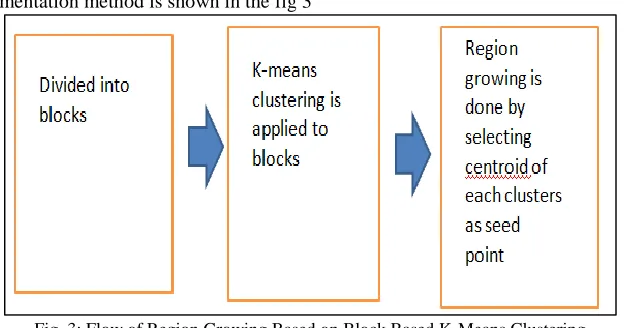
The algorithm for this segmentation method is shown in the fig 3
Fig. 3: Flow of Region Growing Based on Block Based K-Means Clustering
In this segmentation method the image is divided into blocks. Blocks can be of any size 4x4,2x2, etc. After dividing it into blocks the k means clustering algorithm is applied to each of the blocks. The blocks are divided into clusters by using this k means clustering algorithm. then next is the main part of this grouping method. that is region growing which is applied to these clustered blocks. for this first select a seed point in each clusters. the seed point can be the centroid of each clusters. and then region growing is applied. it results in generating regions by growing regions which is similar to the seed points.
Depth from Prior Hypothesis
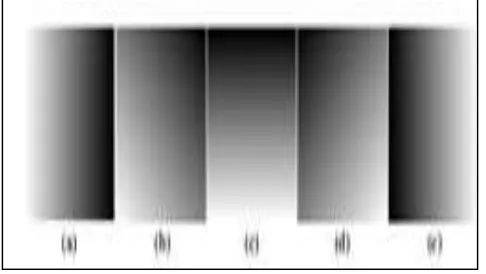
In this conversion process after the generation of the image groups, the corresponding depth for each groups are assigned by using depth gradient hypothesis. This process includes the generation of gradient planes, depth gradient assignment, consistency verification of the detected region, and finally the depth map generation. When each scene change is detected, the linear perspective of the scene can be analyzed with the help of line detection algorithm using Hough transform[2]. Based on the linear perspective information, the hypothesized depth gradient is derived
Fig. 4: Major Depth Gradients
The depth value of a given block group R is assigned by:
Depth(R)=128+255
{∑pixel(x,y)∈RWrl
x−width2 width +Wud
y−height2 height }
pixel _num(R) (3)
where |Wrl| + |Wud| =1.
A larger amount of deep - set means a pixel closer to the user. The above equation suggests certain depth several is the center of gravity of a group, explaining, why where each belonging to the same depth value. The whole value and sign of Wrl and Wud can adjustable weight from left to right and top end to depth gradient. The analysis results that the bottom up method is the important mode in real world. Depth hypothetical slope orientation can be derived from the analysis of a real world. Linear method fails to detect scene mode, the bottom-up method is selected as default.
Bilateral Filtering
The bilateral filter is non-iterative . it can achieve satisfying results with only a single pass. This makes the filters parameters relatively intuitive as their effects are not cumulated over several iterations. Although it is slow, the bilateral filter has proven to be much useful. It is nonlinear and also its evaluation is computationally expensive because the traditional accelerations like performing convolution after an FFT, are not applicable. Nonetheless, solutions have been proposed later in order to speed up the evaluation of the bilateral filter. Unfortunately, these methods seem to exist on approximations that are not grounded on firm theoretical foundations.
This conversion method uses the cross bilateral filtering among the variants of the bilateral filter. In some applications like computational photography, it is often useful to decouple the data to be smoothed to define the edges to be preserved. The chosen cross bilateral filter is a variant of the classical bilateral filter. This filter is used to smoothen the image. Smoothening is done to locate the edges to preserve. The depth map generated contains blocky artifacts. Here, the blocky artifacts are eliminated by using the cross bilateral filter, as expressed in the following equation
Depth(xi)= 1
N(Xi)∑ e
−0.5[|Xj−Xi|
σx2 +
|u(Xj)−u(Xi)|2
σr2 ]depth(Xj)
Xj∈Ω(Xi) (4)
N(Xi)= ∑ e−0.5[σx2|Xj−Xi|+σr2|u(Xj)−u(Xi)|2]
Xj∈Ω(Xi) (5)
here u (xi) denotes the intensity value of the pixel xi, Ω (xi) denotes the neighboring pixels of xi, N (xi) denotes normalization factor of the filter coefficients and Depthf is given by the filtered depth map. The cross bilateral filter here finely smoothens the depth map while preserving the object boundaries . The blocky artifact in the generated depth map is effectively eliminated. while the sharp depth discontinuities along the object boundary are conserved[7]
Depth Image Based Rendering
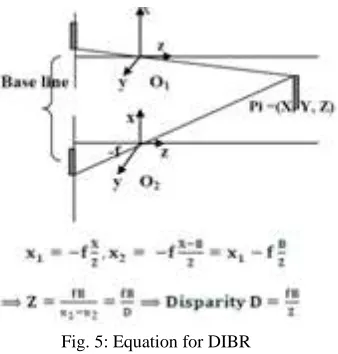
Fig. 5: Equation for DIBR
Advanced 3D TV System using DIBR can be illustrated IN the following block diagram. This DIBR system includes three parts, pre-processing of depth map, 3D image Warping and Hole- Filling.
Fig. 6: Advanced 3D TV system
Smoothing filter is first stage applied to smooth the depth image. Then the 3D image warping generates the left and right view according to the smoothed depth map and also intermediate view. Mapping of intermediate view pixel by pixel to left or right view according to the pixel depth value is done in 3D image warping. In the other words, 3D image warping transforms the location of pixels according to depth value.If there are still holes in the image, hole-filling is then applied to fill color into these holes.
IV. RESULTS
The proposed method which uses edge information for grouping that is block based region grouping generates excellent and comfortable visual quality since it is not restricted in horizontal line tracing. In contrast with the conventional motion-based algorithms [2], [3] and [4] in generating depth from multiple frames, this conversion method uses only a single image with only slight side effects.
The run time for 3d display obtained by using region growing based on block based k-means as the grouping method is nearly 1 seconds but the run time for block based region grouping method is 5 minutes. The graph shows this comparison for two images of size 128x128 and 256x256
Table - 2 Comparison of Runtimes
Image size Runtime using block based region grouping Runtime using region growing based on block based k means clustering
128x128 300 sec 1 sec
256x256 300 sec 1 sec
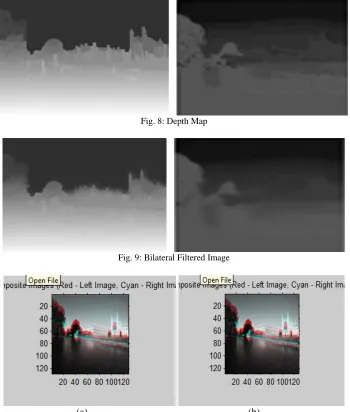
Fig. 8: Depth Map
Fig. 9: Bilateral Filtered Image
(a) (b)
Fig. 8: (a) Outputs obtained using block based region grouping (b) Outputs obtained using region growing based on block based region growing
Figure 8 shows the result obtained. The results show original images, depth maps and red-cyan images. The results obtained by using the two grouping methods. that is by using block based region grouping and region growing based on k- means clustering. The results also indicate that the images violating the initial hypothesis still generate an acceptable quality. Thus the proposed method is assuring of high quality and comfortable visual images giving a 3D display from those data available in the input 2D image.
V. CONCLUSION
This work presents automatic 2D-to-3D conversion algorithm. The conversion algorithm group the image into coherent regions. For grouping two techniques are used and they are compared. A simple depth hypothesis is adopted here to assign the depth for each region and a cross bilateral filter is subsequently applied for removing the blocky artifacts. The algorithm which uses region growing based on k- means clustering reduces the run time, that is computational complexity is reduced. By using both grouping methods comfortable 3d effect can be generated.
REFERENCES
[1] Chao-Chung Cheng, Chung-Te Li and Liang-Gee Chen, “A 2D-To-3D Conversion System Using Edge Information” in Proceedings of IEEE International Conference on Consumer Electronics, 2010
[2] C.-C. Cheng, C.-T.Li, P.-S.Huang, T.-K.Lin, Y.-M. Tsai, and L.-G.Chen, “A block-based 2D-to-3D conversion system with bilateral filter” in Proceedings of IEEE International Conference on Consumer Electronics, 2009
[4] D. Kim, D. Min, and K. Sohn, “A Stereoscopic Video Generation Method Using Stereoscopic Display Characterization and Motion Analysis”, in IEEE Trans. On Broadcasting, Vol. 54, Issue 2, pp. 188-197, 2008
[5] Y. J. Jung, A. Baik, J. Kim, and D. Park, “A novel 2D-to-3D conversiontechnique based on relative height depth cue,” in SPIE ElectronicsImaging, Stereoscopic Displays and Applications XX, 2009.
[6] W. J. Tam, and L. Zhang, “3D-TV content generation: 2D-to-3D conversion,” in Proc. ICME, pp. 1869-1872, 2006
[7] S. Paris and F. Durand, “A fast approximation of the bilateral filter using a signal processing approach”, in MIT Technical Report (MIT-CSAIL-TR-2006-073), 2006
[8] W.-Y. Chen and Y.-L.Chang and S.-F.Lin and L.-F.Ding and L.-G. Chen.”Efficient depth image based rendering with edge dependent depth filter and interpolation,” in Proc. ICME, pp. 1314-1317, 2005
[9] Polak, M, Zhang, H. & PI, M. 2009. An evaluation metric for image segmentation of multiple objects. Image and Vision Computing, 27(8):1223-1227. [10] Rein, A, Hamida, A. B. & Benjelloun, M. 2009. An Optimal Unsupervised Satellite image Segmentation Approach Based on Pearson System and k-Means