(www.dvpublication.com) Volume 4, Issue 1, 2019
IMPROVING THE PERFORMANCE OF CONTENT CENTRIC
NETWORK USING CACHE NODE LOCATION
Dr. R. Vasanthi* & S. Chitra**
* Head of Department, Department of Computer Science and Engineering, Tagore Institute of Engineering and Technology, Attur, Salem, Tamilnadu.
** PG Scholar, Department of Computer Science and Engineering, Tagore Institute of Engineering and Technology, Attur, Salem, Tamilnadu.
Cite This Article: Dr. R. Vasanthi & S. Chitra, “Improving the Performance of Content Centric Network Using Cache Node Location”, International Journal of Advanced Trends in Engineering and Technology, Volume 4, Issue 1, Page Number 1-5, 2019.
Abstract:
Internet users consider content information to be useful, but the current Internet approach treats location information as more important as so ties the former to the latter. A Content-Centric Network (CCN) allows the user to obtain content without regard to its location. CCN caches the contents information at its intermediate nodes. If any cache node is located on the shortest path, the content can be obtained from the nearest cache node; so far fewer hops are needed compared to the network without any cache node. However, this efficiency is not achieved if no cache node is located on the shortest path one proposal sets cache nodes that broadcast their contents to surrounding nodes; the user is able to obtain the content from the cache node, rather than the node that has the original content, if the cache node is closer to the user. Since large ILPs cannot be solved in practical time, we introduce a Betweeness Centrality (BC) approach that determines the location of cache nodes by computing the BC value of each node and ranks the nodes in descending BC order. Simulations show that the BC approach offers drastically reduced computation time, while the average number of hops is just 5.8% higher than that determined with the ILP approach.
Key Words: Centric Network, Computer Networks & Distribution Networks.
1. Introduction:
Nowadays, Internet usage habits have changed. People use social networking services to share their information and activities or to view shared information. The Internet has turned into a huge distributed network with gigantic amounts of contents. Internet users need higher speed transmission, with greater efficiency and security to access the content. They obtain the contents without consideration of the contents’ location. The existing Internet Protocol (IP) network allows content retrieval only by reference to a specific physical location. With this architecture, the traffic flowing through the network is high, since the content is repeatedly uncast from source to each requestor (client hereafter).
A technology that retrieves copies of the content from nodes local to the client, instead of the original content, has been introduced. The Content-Centric Network (CCN) architecture provides one example of how content name can be used to obtain content. CCN uses two packet types: interest packet and data packet. The interest packet is sent to a node having the requested content. The data packet returns the content along the path that the interest packet was routed on. In this way, the content can be obtained without accessing the original content location. A routing scheme developed for the Internet of Things (IoT) emphasizes content detail and is more efficient than the current Internet technology. In CCN, cache nodes store content copies and are distributed throughout the network. This ensures that the content is delivered over the shortest distance, so the delivery time is short. The objective is to minimize the number of hops. Several schemes to search for cached content by using interest packets have been introduced. To reduce the number of hops for a given number of cache nodes, it is essential to optimize the location of the cache nodes. Note that no all nodes in the network are cache nodes. Since ILP problem cannot be solved practical time if the network is large, we apply the betweenness centrality (BC) approach.
In the BC approach, the BC value of each node is computed and used to rank the nodes in descending order. The nodes with high BC value are those that appear most frequently on the shortest paths for all source-destination combinations and are configured as cache nodes. An evaluation shows that the BC approach is much greatly reduces the computation time of while the average number of hops is just 5.8% higher compared to the basic ILP approach. The structure of this paper is organized as follows. Section II describes the fundamentals of CCN including current routing schemes and their problems. Section III describes the ILP and BC approaches. Section IV evaluates performance of both approaches in terms of the number of hops and computation time. Finally, Section V draws our conclusions from the study results
2. Related Work:
A technology that retrieves copies of the content from nodes local to the client, instead of the original content, has been introduced. (V. Jacobson, D. K. Smetters, J. D. Thornton, M. F. Plass, N. H. Briggs, R. L. Braynard, "Networking named content" in Year 2009). A routing scheme developed for the Internet of Things (IoT) emphasizes content detail and is more efficient than the current Internet technology. (E. Baccelli, C. Mehlis, O. Hahm, T. C. Schmidt, M. Wahlisch, "Information centric networking in the IoT: Experiments with
Network 3 is the US IP backbone network Topology (N. Kitsuwan, E. Oki, "Design of IP tunneling for OSPF network to reduce advertising delay", IEICE Commun. Exp., vol. 3, no. 8, pp. 229-234, Aug. 2014). The ILP is solved by the optimization solver CPLEX 12.6.1.0 [17] using an Intel(R) Xeon(R) CPU E5-2609 [email protected] and 64 GB of memory (CPLEX Optimizer, Oct. 2016).
In this section, we calculate the rebroadcast delay and rebroadcast probability of the proposed protocol. We use the upstream coverage ratio of an RREQ packet received from the previous node to calculate the rebroadcast delay, and use the additional coverage ratio of the RREQ packet and the connectivity factor to calculate the rebroadcast probability in our protocol, which requires that each node needs its 1-hop neighborhood information.
3. Content Centric Network:
There are three types of nodes in CCN: client, source, and cache node. The client node requests provision of the con-tent. The source node is the original holder of the requested content. The cache node holds a copy of the content. The client node obtains the requested contents from either a cache node or the source node, depending on the routing scheme, so that the number of hops to deliver the contents to the client is equal or shorter than that from the source.
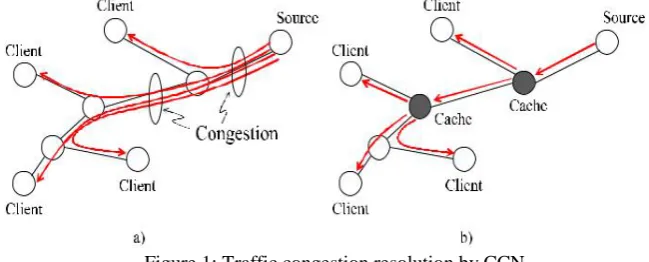
Figure 1: Traffic congestion resolution by CCN
Figure 1 demonstrates the effectiveness of CCN. Several clients are watching live streaming from the same source. Traf c congestion occurs on several links in the network due to duplication of the same content on the same links, as shown in Fig. 1(a). CCN resolves the Traf c congestion by setting the content to cache nodes, as shown in Fig. 1(b). The clients obtain the content from the cache nodes. CCN uses two types of packet: interest packet and data packet. An interest packet carrying the content name is sent by a client to request the content. A data packet, which contains both name and content including a signature by the producer's key, is sent from the cache node to the client using the reverse path taken by the interest packet. The packet forwarding functions of CCN use three data structures: Pending Interest Table (PIT), forwarding information base (FIB), and content store (CS). PIT retains records of unsatisfied interest packets. FIB contains multiple outgoing interfaces for each name pre x, rather than a single interface as in an IP network. CS temporarily stores the content packets to satisfy future requests. A node that has the CS function is called a cache node.
A. Routing Schemes in Content Centric Network: CCN uses hooding to implement content search [11]. Since the information is not registered in FIB, the received interest packet is forwarded to all interfaces and thus spreads through-out the network.
Effectiveness of cache node with / without potential-based routing scheme
(www.dvpublication.com) Volume 4, Issue 1, 2019
Example of hop count similarity when the cache node is located near source
The content is obtained from the nearest node that has the requested content. The client selects only one stream of data packets and drops the rest. As a result, the number of interest and data packets in the net-work becomes impractically large. Several routing schemes to decrease the number of interest packets and the number of hops have been raised for CCN. The open shortest path rst (OSPF) protocol was extended in. A dynamic routing mechanism for failure protection was introduced. In content information is advertised from source nodes. Nodes that receive an advertisement identify the shortest path to the source. Of course, if a cache node lies between the source of the original content and the client, the content can be obtained from the cache node with fewer hops. Therefore, the traffic on the network can be reduced.
B. Problem of Routing Schemes: Once a path between the original source and client is determined, the content is searched for only along the determined path. In fact, the content may be stored near the client, but not on the path. In this case, the client obtains the content from the original source since the location of the cache node is unknown. Cache content updates can be performed by the least recently used (LRU) algorithm. When a content cached in the node is frequently updated and the cache node having the requested content is not on the shortest distance between the source and the client, the cache node that satisfies the requested content must obtain the contents from the source.
C. Minimization Problem of Hop Count for Cache Node Placement: We start by formulating the optimization problem that min-imizes the number of hops in the network as an integer linear programming (ILP) problem to determine the optimum locations of the cache nodes. Then, a heuristic approach using Betweeness centrality is presented.
Integer Linear Programming: An ILP problem is formulated to determine cache node position so as to minimize the number of hops; the number of cache nodes is assumed to be given. We formulate the problem of placing the cache nodes to minimize the number of hops taken to arrive at the node having the original content or the cache node for all contents at each node as the following ILP
Betweenness Centrality: Considering a network with a large number of nodes, ILP may not yield a solution in a practical time. We introduce a heuristic approach that determines the locations of cache nodes by using betweenness centrality (BC). We call this the BC approach. In the BC approach, the betweenness centrality is computed and cache node position is determined in descending order. By computing betweenness centrality, nodes that appear most frequently on the shortest path considering all patterns of source-destination pairs among all nodes on the network are determined. The total number of hops can be reduced by selecting, as cache nodes, the nodes with highest betweenness centrality values pass through the target node to the number of all shortest paths between all pairs of nodes other than the target node. Betweenness centrality, CB(v), of node v 2 V is given by the following equation.
Simulated Network Topologies
Performance Evaluation of Cache Node Placement: The section determines the location of the cache nodes, using the ILP and BC approaches, so as to minimize the number of hops. We rst evaluate the impact of cache node location on the number of hops; the number of cache nodes is set to one. It should be noted that index 0 means that no cache node exists in the network. A shortest path is assumed from each node to the original content node or a cache node, depending on the nearest location. The total number of hops for every case of original content node location is evaluated.
Figure plots the dependency of the number of hops on cache node location for networks 1 to 4. The total number of hops depends on the location of the cache node. It is minimum if the cache node is set at node 2 in network 1, node 7 in network 2, node 9 in network 3, and node 14 in networks 4. We observe that the number of hops is minimum when the cache node is set at the node with the highest node degree. The value of CB (v) for every node is also investigated. Table 2 ranks the nodes in descending order of CB (v). Number of contents and the same number of source nodes. The number of hops is evaluated from the summation of the number of hops for each number of contents and each number of cache nodes. The ILP approach and the BC approach offer the same number of hops in network 1. The BC approach requires more hops than the ILP approach in networks 2-4. The maximum difference in number of hops is 28.5% for two cache nodes in network 2, 40% for +ve cache nodes in network 3, and 28% for give cache nodes in network 4. The BC approach matches the ILP approach when the number of cache nodes is high.
Number of hops when jCj D jSj D 1 / Number of hops when jCj D jSj D 3
Computation Time: The computation times for the ILP and BC approaches are compared using the sample networks in Fig. 5 with jCj D 1, jSj D 1. Table 3 shows the computation time for each num-ber of cache nodes. The BC approach determines CB(v) of all nodes, and the computation time is constant regardless of the number of cache nodes. If we compare the short-est computation time of the ILP approach to those of the BC approach, for networks 1 to 4 the BC approach is 72, 2,019, 31,066, and 45,887 times faster than the ILP approach. Thus shows that the BC approach drastically reduces the computation time compared with the ILP approach with only a slight increase in the number of hops (5.8% average).
(www.dvpublication.com) Volume 4, Issue 1, 2019
4. Conclusion:
This paper introduced a practical approach to determine the location of cache nodes that attempts to reduce the number of hops in CCN while drastically reducing time needed to determine optimum cache node location. We formulated the problem of determining cache node location using the ILP approach. Since ILP problems may excessively long times to solve if the network is large, we introduced the approach of using betweenness centrality. Simulations showed that the proposed BC approach is significantly faster than the ILP approach for real-world size problems with only a slight increase (average of 5.8%) in the number has number of hops.
5. References:
1. V. Jacobson, D. K. Smetters, J. D. Thornton, M. F. Plass, N. H. Briggs, and R. L. Braynard, “Networking named content”, in Proc. ACM 5th Int. Conf. Emerg. Netw. Experim. Technol., Rome, Italy, 2009, pp. 1 12.
2. E. Baccelli, C. Mehlis, O. Hahm, T. C. Schmidt, and M. Wählisch, ``Information centric networking in the IoT: Experiments with NDN in the wild,'' in Proc. 1st ACM Conf. Inf.Centric Netw., Paris, France, 2014, pp. 77 86.
3. (Oct. 2017). Cicn. [Online]. Available: https://wiki.fd.io/view/Cicn
4. L. Wang, A. K. M. M. Hoque, C. Yi, A. Alyyan, and B. Zhang, ``OSPFN: An OSPF based routing protocol for named data networking,'' Univ. Memphis/Univ. Arizona, Tech. Rep. NDN-0003, Jul. 2012.
5. D. Rossi and G. Rossini, ``Caching performance of content centric net-works under multi-path routing (and more),'' Télécom Paris Tech, Paris, France, Tech. Rep. CCN-TR11a, Jul. 2011
6. R. Chiocchetti, D. Rossi, G. Rossini, G. Caro glio, and D. Perino, ``Exploit the known or explore the unknown?: Hamlet-like doubts in ICN,'' in Proc. 2nd Ed. ICN Workshop Inf.-Centric Netw., Helsinki, Finland, 2012
7. (May 2017). Japan Photonic Network Model. [Online]. Available: http://www.ieice.org/cs/pn/jpn/ jpnm.html
8. (Oct. 2016). CPLEX Optimizer. [Online]. Available: http:// www-01.ibm.com/software/commerce/opti mization/cplex-optimizer/