ISSN (Online): 2320-9364, ISSN (Print): 2320-9356
www.ijres.org Volume 6 Issue 9 Ver. I ǁ 2018 ǁ PP. 15-20
Object tracking with similar background
Qian Xiaoxiao
(Shanghai University Of Engineering Science, College of electronic and electrical engineering, China)
ABSTRACT: In view of the boundary effect of the object tracking algorithm based on the correlation filter and the low tracking success rate in complicated cases, aobject tracking algorithm based on similar background and color histogram is proposed. First of all, through the cosine similarity, selecting the background area with high similarity to the object as the negative sample and training the correlation filter template and reduce the boundary effect. At the same time, we employ a color histogram basedBayes classifier to distinguish between the object and the background in complex cases. Finally, weprovide both quantitative and qualitative comparison of our approach with state-of-thearttrackers on the OTB-50 and OTB-100 video sets and the result improvesthat our tracker can effectively improve the accuracy and success rate of tracking, superior state-of-the-art tracking algorithms .
KEYWORDS: correlation filter; background information; Bayes classifier; color histogram;
--- Date of Submission: 18-12-2018 Date of acceptance: 31-12-2018
---
I. INTRODUCTION
In recent years, object tracking has become an attracting area of computer vision. Many excellent object tracking algorithms are proposed, especially some object tracking algorithms based on correlation filters such as KCF[1]、DSST[2]、Staple[3]、SRDCF[4]、C-COT[5]. The excellent tracking results of these correlation filter-based tracking algorithms in OTB-50[6] and OTB-100[7] demonstrate that the correlation filter can improve the performance of object tracking under complex conditions such as illumination changes, fast motion and scale changes. However, there are two problems with most object tracking algorithms based on correlation filters. First, CF trackers are affected by the boundary effect; Secondly, most of them can not effectively use the object's color information to track.
Most existing object tracking algorithms based on correlation filters train the correlation filters based on periodic hypotheses. Taking the initial object as a positive sample, a negative sample generated by the shift operation of the positive sample by a cyclic matrix is used. Finally, the correlation filter template is trained by using positive and negative samples in the frequency domain. This method based on the assumption of extended negative samples to train the correlation filter can effectively train and detect using Fast Fourier Transform (FFT). However, since the negative samples are implicitly generated by the cyclic matrix, the correlation filters will be affected by the boundary effect of the cyclic matrix and the tracking performance of the correlation filter will be worse. In addition, since the negative sample is a false sample constructed by the positive sample, it is not a true negative sample collected from the video, so that the correlation filter can hardly distinguish between background and goal.
In order to solve the boundary effect caused by the circular matrix, Galoogahi proposed the CFLB[8] algorithm, which uses the augmented matrix to construct a relatively negative sample to solve the boundary effect. Although this method can effectively reduce the influence of the boundary effect, the correlation filter tracking effect is still poor when the object and the background are similar because it is still constructed by negative samples. Henriques proposed in the SRDCF[4] algorithm to reduce the effect of boundary effects by reducing the response of non-object areas through spatially regularized response areas. The main disadvantage of this approach is that even in the Fourier domain, the regularized goal requires a large amount of computation. In addition, careful tuning of a set of hyper-parameters in order to form normalized weights can have an impact on tracking performance.
II.
BASED
ON
THE
CORRELATION
FILTER
OBJECT
TRACKING
2.1 Position tracking
The existing object tracking algorithm based on the correlation filter is generally as follows: Firstly, the initial position of the object in the image is obtained, positive and negative samples are obtained by shifting the initial region of the object by the cyclic matrix, and the two-dimensional Gaussian model is constructed by taking the geometric center of the initial region as the peak, and simultaneously extracting the features of the object. Then, Gaussian Newton method is used to calculate the correction filter template based on the two-dimensional Gaussian model and the object features. The correlation filter template to meet an output minimum error function
:
2 2
1 2 1 2
( )
d d
i i i
i i
E H
Y
H
F
H
(1)d m n
F R isobject characteristic, d m n
H R is correlation filter template,
E H
(
)
is the desired output of the goal. Eq. 1 can be identically expressed as a ridge regression objective in the spatial domain:2 2
1 2 1 2
( )
(j)
d d
i i i
j
i i
E H
Y
H F
H
(2)i
F represents the object candidate area. jis cyclic matrix, by i
j
F ,positive and negative samples are obtained. When lower theE H( ), the more accurate the object tracking.
The Gaussian model is established for the positive sample area and the features are selected to train the correlation filters:
1
1 d
i
i t i
d i t i
GF
A
H
B
FF
(3)i t
H is the most suitable correlation filter. When i t
H obtained, in the next frame of picture, the characteristics 1
i t
F
of the candidate sample areas are introduced into the filter i t
H to obtain the response sety (ii0,1 , )n :
1 1 i
i t t
y
F
(
H
F
)
(4) 1F is inverse Fourier transform. Transforming the space domain to the frequency domain improves the speed of computation. The maximum response max(y )i is the new center point of the object movement.
2.2 Scale estimation
According to the size of the previous frame 1
s t
Z , multiplied by the scale series n, to obtain different sizes of the
scale set s t
Z , into the correlation filter H , get the response set y (s i0,1 , )n , select the most suitable scale. The principle of size selection is:
n n
s P s R
(5)The
s
is a scale factor fixed for the initial value, PandR represent the width and height of the previous frame, and then is the scale series range.Optimal scale selection formula:
1 s scale s i t scale i
A
z
y
F
B
(6)2.3 Template update
In the new frame, according to the maximum response pointyi1,ys, the new center location Pi1 and scale Zs+1 are obtained. According to the new central location eq(1), the filter template is updated. The formula is as follows.
1
(1
)
t t t t
A
G F
l A
(7)*
1
(1
)
t t t t
B
F F
l B
(8)is the learning rate, AtandBt are the molecules and denominator of the filter template of the current frame, 1
t
III.
OBJECT
TRACKING
BASED
ON
SIMILAR
BACKGROUND
AND
COLOR
HISTOGRAM
3.1 Similar backgrounds
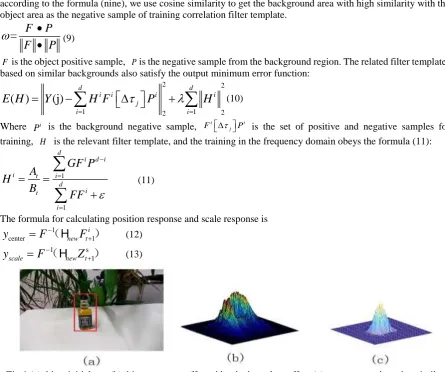
The existing object tracking algorithm based on correlation filter selects the object area as the positive sample, and then obtains the negative samples through the cyclic matrix, and trains the correlation filter template. In order to reduce the influence of the boundary effect caused by the cyclic matrix, we select the object area. Then, according to the formula (nine), we use cosine similarity to get the background area with high similarity with the object area as the negative sample of training correlation filter template.
=
F
P
F
P
(9)F is the object positive sample, Pis the negative sample from the background region. The related filter templates based on similar backgrounds also satisfy the output minimum error function:
2 2
1 2 1 2
( )
(j)
d d
i i i i
j
i i
E H
Y
H F
P
H
(10)Where i
P is the background negative sample, FijPi is the set of positive and negative samples for
training, H is the relevant filter template, and the training in the frequency domain obeys the formula (11):
1
1 d
i d i
i t i d
i t
i
GF P
A
H
B
FF
(11)The formula for calculating position response and scale response is
1
center 1
i new t
y
F
(
H
F
)
(12)1 s
1 scale new t
y
F
(
H
Z
)
(13)Fig 1 (a)object initial area(b)object response affected by the boundary effect (c) our response by using similar background
IV.
EVALUATION
4.1 parameter settings and test video set
The experiment used by the computer CPU i5-6500, 3.2GHZ, GTX1050. The program parameters are set as follows: The candidate box is 2.5 times the initial object size. Learning rate of 0.01. The OTB-50[6]and OTB-100[7]test sets were used for testing, which consisted of complex images such as blurred photography, fast motion, large scale changes, obvious changes of illumination, complex background environment, Challenge conditions. Moreover, OTB-50[6]and OTB-100[7] not only have dozens of short-term object tracking but also long-term object tracking. The Comparison algorithm are DSST, Staple, SRDCF, MDnet[9], C-COT and TCNN[10]. The former tracking algorithms not only runs fast, but also have high tracking accuracy and good robustness for scale changes. In addition, the evaluation index selected in this experiment is overlap and tracking success rate (Success rate).
Table 1 Comparison algorithms
algorithm name source
DSST Cvpr2014
Staple Cvpr2015
SRDCF Cvpr2015
TCNN Cvpr2016
BACF Cvpr2017
4.2Algorithm Comparison and Analysis
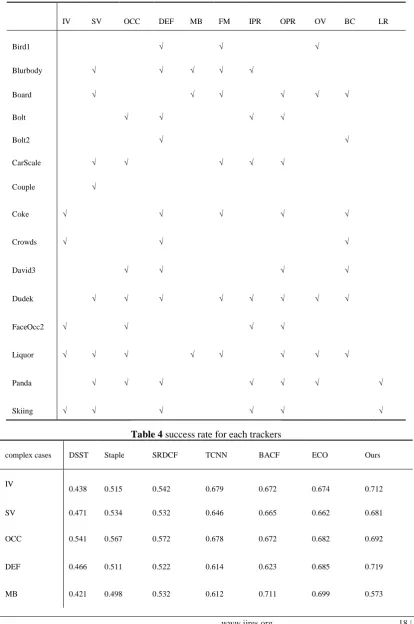
Fifteen representative videos were selected based on OTB-50 and OTB-100 for testing. The 15 videos include eleven complex cases: light change (IV), scale change (SV), occlusion (OCC), DEF Motion Blur, MB, IPR, OPR, OV, BC and LR. The proposed method is compared with the six tracking algorithms DSST, Staple, SRDCF, TCNN, MDnet and C-COT.Algorithm Comparison Test video and test results are as follows:
Table 2 videos from OTB-50 and OTB-100
IV SV OCC DEF MB FM IPR OPR OV BC LR
Bird1 √ √ √
Blurbody √ √ √ √ √
Board √ √ √ √ √ √
Bolt √ √ √ √
Bolt2 √ √
CarScale √ √ √ √ √
Couple √
Coke √ √ √ √ √
Crowds √ √ √
David3 √ √ √ √
Dudek √ √ √ √ √ √ √ √
FaceOcc2 √ √ √ √
Liquor √ √ √ √ √ √ √ √
Panda √ √ √ √ √ √ √
Skiing √ √ √ √ √ √
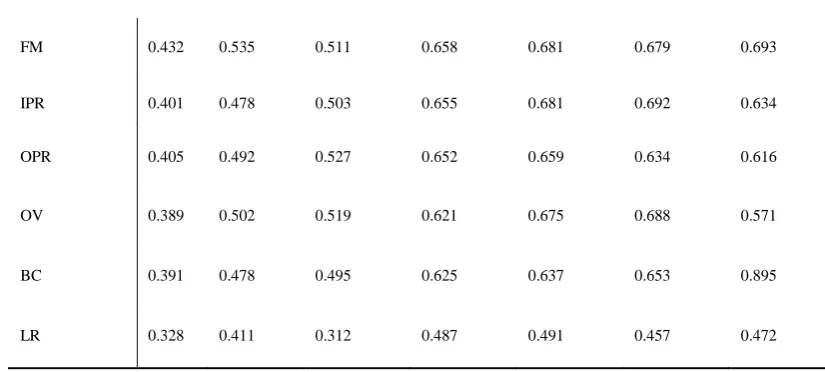
Table 4 success rate for each trackers
complex cases DSST Staple SRDCF TCNN BACF ECO Ours
IV
0.438 0.515 0.542 0.679 0.672 0.674 0.712
SV 0.471 0.534 0.532 0.646 0.665 0.662 0.681
OCC 0.541 0.567 0.572 0.678 0.672 0.682 0.692
DEF 0.466 0.511 0.522 0.614 0.623 0.685 0.719
FM 0.432 0.535 0.511 0.658 0.681 0.679 0.693
IPR 0.401 0.478 0.503 0.655 0.681 0.692 0.634
OPR 0.405 0.492 0.527 0.652 0.659 0.634 0.616
OV 0.389 0.502 0.519 0.621 0.675 0.688 0.571
BC 0.391 0.478 0.495 0.625 0.637 0.653 0.895
LR 0.328 0.411 0.312 0.487 0.491 0.457 0.472
From the table (3), we can see that the success rate of tracking is higher than that of the other six in the four test videos of light change (IV), object deformation (DEF), fast motion (FM) and background complexity (BC) Kind of algorithm And the success rate of the four algorithms is the best one in the aspects of scale transformation (SV), out of plane rotation (OPR), object evanescence (OV) and low resolution object (LR). However, in the three cases of occlusion (OCC), motion blur (MB) and in-plane rotation (IPR), the tracking success rate is low.
Table (5) FPS for each trackers
Staple SRDCF TCNN MDnet C-COT Our
Avg FPS 30.4 31.5 14.5 12.2 10.1 30.3
Table (5) shows the average tracking rate under 15 groups of videos of this algorithm and other algorithms. Since the proposed algorithm only uses HOG features and does not use convolutional neural networks and convolution features with TCNN, MDnet and C-COT, the real-time performance is better than these three algorithms. However, compared with Staple and SRDCF algorithms, this paper improves the correlation filter. Adding background modeling and color histogram-based Bayes classifier increases the computational complexity of tracking and is therefore lower than Staple and SRDCF in real-time.
V.
CONCLUSION
This paper presents aobject tracking algorithm based on background information. The algorithm selects the background similar to the object cosine as the negative sample to train the correlation filter to reduce the boundary effect and improve the performance of the correlation filter. The successful tracking rate of model and color histogram is higher than those of the six algorithms for illumination change, object deformation, fast motion and background complicated object tracking.
REFERENCES
Journal Papers:
[1]. Henriques J F, Rui C, Martins P, et al. High-Speed Tracking with Kernelized Correlation Filters[J]. IEEE Transactions on Pattern Analysis & Machine Intelligence, 2015, 37(3):583-596.
[2]. Danelljan M, Häger G, Khan F S, et al. Accurate Scale Estimation for Robust Visual Tracking[C]// British Machine Vision Conference. 2014:65.1-65.11.
[3]. Bertinetto L, Valmadre J, Golodetz S, et al. Staple: Complementary Learners for Real-Time Tracking[C]// Computer Vision and Pattern Recognition. IEEE, 2016:1401-1409.
[4]. M. Danelljan, G. Hager, F. Shahbaz Khan, and M. Felsberg. Learning spatially regularized correlation filters for visual tracking. In ICCV, pages 4310–4318, 2015.
[5]. Danelljan M, Robinson A, Khan F S, et al. Beyond Correlation Filters: Learning Continuous Convolution Operators for Visual Tracking[C]// European Conference on Computer Vision. Springer, Cham, 2016:472-488.
[6]. Wu Y,Lim J,Yang M H. Online object tracking: a benchmark[C]. IEEE Conference on Computer Vision and Pattern R
ecognition.IEEE Computer Society,2013: 2411-2418.
[7]. Wu Y, Lim J, Yang M H. Object Tracking Benchmark[J]. IEEE Transactions on Pattern Analysis & Machine Intelligence, 2015, 37(9):1834.
www.ijres.org 20 | Page
[9]. Nam Hyeonseob, Han B. Learning Multi-domain Convolutional Neural Networks for Visual Tracking[C]// Computer Vision and Pattern Recognition. IEEE, 2016:4293-4302.
[10]. Nam H, Baek M, Han B. Modeling and Propagating CNNs in a Tree Structure for Visual Tracking[J]. 2016.