117805-0303 IJVIPNS-IJENS © October 2011 IJENS
I J E N S
Multi-Agent System for Negotiation in a
Collaborative Supply Chain Management
Hussein A. Rady
El-Shorouk Academy, Higher Institute for Computer & Information Technology, Egypt. [email protected]
Abstract-- To improve the performance of Supply Chain(SC) decisions, agents technology is slowly becoming the best alternative . In general, most of the components in Supply Chain
Management (SCM) work in isolation and achieving
coordination among SCM partners turns out to be a difficult proposition. But in a multi-agent system (MAS), an agent while making a local optimal decision, it sees how it will effect the other agents and in case required it coordinates with other agents to workout for a new alternative. In SCM, what is required is how to improve the performance. Today SCM needs to work in coordination with various like minded organizations to produce and supply to multiple market. In such circumstance MAS, with beneficial features like autonomous, collaborative, coordinate and intelligence with ability to work in a distributed environment provides a best platform to make SCM performing at its best. Supply Chain Management is a set of synchronized decision & activities, utilized to effectively integrate suppliers, manufacturers, transporters, warehouses, retailers & customers so that the right product or service is distributed at the right quantities, to the proper locations & at the appropriate time, in order to minimize system wide costs while satisfying customer service level requirements. In this paper, a Multi-Agent System to support Supply Chain Management was proposed. The proposed model consists of seven agents that are working together to maintain supplying, manufacturing, inventory and distributing. The main operations of the software agents include: (1) managing all other agents (2)receiving orders (3) check the inventory (4) issue the order of raw materials from suppliers (5) production (6) financing (7) storing the information of stock, components and material. In addition to communication protocols among agents.
Index Term-- Supply Chain Management, Agent Technology, Multi-Agent System, Negotiation, JADE.
I. INTRODUCTION
In today’s competitive business environment industry is recognizing the importance of efficient and effective supply chain management. Supply Chain can be viewed as a network of facilities and distribution options that performs the functions of procurement of materials, transformation of these materials into intermediate and finished products, and the distribution of these finished products to customers. These autonomous or semiautonomous business entities that perform all processes associated with the flow and transformation of goods and services from the raw material stage, through to the end user, as well as the associated information flows, the objective of supply chain management is to produce and distribute merchandise at the right quantities, to the right locations, at the right time, in order to minimize systemwide costs while satisfying service level requirements. To realize the objective, the successful supply chain management
requires effective support of advanced information technology and information system. Many information systems have been developed for the SCM from enterprise resource planning into the newly developed advanced planning and scheduling system and e-commerce solutions. However, the capability of current information systems to support collaborative planning and control in the supply chain systemwide level is limited due to the complexity and dynamics of the supply chain in today’s globalized business environment. Recently, agent-based system technology have been applied as a new paradigm for conceptualizing, designing and implementing the software system, which offers the potential to overcome many limitations of current information systems for the SCM[10].
On the other hand, in order to optimize performance of a supply chain, its functions must operate in a coordinated manner. But the dynamics of the enterprise and the market make this difficult: materials are delayed in shipment, production facilities experience downtime, workers call in sick, customers change orders or cancel, and other issues cause deviations from the plan. In the global marketplace with shortening product life cycles and fast changing trends, the need for real time supply chain coordination is vital. Information technology and information sharing make coordination possible. The major contribution of information technologies such as the Internet is to enable many companies to make contact with customers directly without time zone or distance intervention. Collaborations in supply chains cannot be governed by any single company in a one-directional way, but need to be coordinated by autonomous participation of companies. For these reasons, agent technology is regarded as one of the best candidates for supply chain management[4].
The supply chain is a worldwide network of suppliers, factories, warehouses, distribution centers, and retailers through which raw materials are acquired, transformed, and delivered to customers[7], [13]. The supply chain consists of all the activities associated with the flow and transformation of goods from the raw material stage, through to the end user, as well as the associated information flows[8], [20], [23].
117805-0303 IJVIPNS-IJENS © October 2011 IJENS
I J E N S
scheduling, control, transport, resources, personnel, materials, quality, etc, but also with its partners, suppliers and customers through heterogeneous software and hardware environments. Supply Chain encompasses companies and all those activities needed to design, make, deliver and use a product or service. A supply chain typically extends across the multiple enterprises including suppliers, manufactures, transportation carriers, warehouses, retailers as well as customers and entails sharing forecast, order, inventory, and production information to better coordinate management decisions at multiple points throughout the extended enterprise[1].
The remainder of this paper is organized as follows: Section(II) discusses a Related Work and directions to this paper. Section(III) discusses the Supply Chain Management. Section (IV) introduces the Agent Development Framework. Section (V) presents Multi-Agent Negotiation. In Section (VI), the similarities between MAS and SCM are outlined. In Section (VII), the proposed System are discussed. And finally, Section(VIII) outlines the conclusions.
II. RELATED WORK AND DIRECTIONS
In supply chain management, improving the efficiency of the overall supply chain is of key interest. Because of market globalization and the advancement of e-commerce the importance of supply chain network is increasing. It is very difficult for different companies in supply chains to share information. A supply chain can produce products for multiple markets. Also, an individual company is likely to have only limited visibility of the supply chain structure, which makes it difficult to make future demand estimations, because the pattern of demand propagation through the supply chain depends on the capabilities and strategies of companies along the path from the markets to the company[4].
S. Yung et al. [13] states that research in coordination of supply chains can be categorized into the following four areas: 1. Modeling of Supply Chains – the processes and functionality of supply chains must be organized and coordinated efficiently to achieve better performance. Recently, constraint network model have been studied and applied.
2. Modeling of Information Flows – which provides the communication among facilities within the supply chains, where real-time data are critical in supporting decision making. It enables quick response and accurate data transmission. Electronic data interchange (EDI) is one of the most popular applications. However, EDI is a closed environment for facilities within the supply chain. Internet provides a channel to support communication for both the facilities within and outside the supply chains.
3. Human Computer Interface (HCI) – the amount of information generated from a supply chain is overwhelming. It is important to have a good interface for users to input and retrieve data or information. Recently, many research have focused on software agents to model the behavior of the users and use the captured behavior to support design of better graphical user interface (GUI). 4. Optimization Method – optimization is an important
research area to search for better resources allocation in
supply chain management. Some mathematical models have been applied to increase the performance of supply chains. But such research can be computational intensive if the number of facilities is large.
S. Srinivasan et al. [1] proposed a multi-agent architecture for integrated dynamic scheduling of the steel pipe industry, each agent performs a specific function of the organization and share the information with other agents.
X. Xu and J.Lin [5] proposed an advancing mechanism that integrates High Level Architecture with multi-agent distributed simulation to meet time management in supply chain simulation.
G. Seitz et al. [6] proposed an agent-based architecture for appending sensor data to a digital product memory in a generic way.
V. Misra et al. [8] survey the Supply Chain Management Systems and states that, six characteristics define current supply chain management philosophy: 1) Shared Information, 2) Organizational Relationships, 3) Inventory Management, 4) Total Pipline Coordination, 5) Readiness to adopt Flexibility and 6) Costing Issues. They regarded Agent-Based SCM is the vision and states that: Agents can help transform closed trading partner networks into open markets and extend such applications as production, distribution, and inventory management functions across entire supply chains spanning diverse organizations.
R. Carvalho and L. Custodio [9] proposes a Multi-agent system fo Managing Supply-Chain Problems. They applied their systems on chemistry industry and the Hewlett-Packard. M. Paolucci et al. [12] proposes a multi-agent based system that would enable small and medium-size manufacturing organizations to dynamically achieve cost-effective aggregate sales and operations plans in supply chain contexts.
M. Uppin and S. Hebbal [19] outlines two major outcomes of the literature survey is that information sharing is most important requirement of efficient supply chain and multi agent modeling is most suitable for designing of supply chains.
V. Kumar and S. Srinivasan [20] review SCM system with short explanation and conclusion to this system.
M. Abdoli and B. Al-Salim [21] provide a conceptual framework for implementing a sales agent at Internet-based stores (e-stores).
117805-0303 IJVIPNS-IJENS © October 2011 IJENS
I J E N S
opinion, one of the best designed to address the issues of accessing and sharing information pertinent to a specific application. In this paper, the proposed model consists of sevenagents that are working together to maintain supplying, manufacturing, inventory and distributing the cables which specified in details in the proposed model section.. The main operations of the software agents include: managing all other agents, receiving orders, check the inventory, issue the order of raw materials from suppliers, production, financing, storing the information of stock, components and material. In addition to communication protocols among agents. information sharing among neighboring agents that is very important to the SCM for decision making are verified and when we make negotiation we consider not only price but also review point and delivery time.
The directions for building Supply chain management systems are outlined as follows:
Fuzzy set theory approach helps to convert decision-makers’ experience to meaningful results by applying linguistic values to assess each criterion and alternative suppliers. Fuzzy Principal Component Analysis can be used in “Automation in Construction”.
An agent architecture that combines the use of Component-based Software Engineering and Aspect-Oriented Software Development.
Agent – based modeling and simulation is a new approach to modeling systems comprised of interacting autonomous agents.
Simulation of any number of agents plus heuristics for decision making. Agents can be used with rule-based system. Heuristic search or problem decomposition methods, random search methods, such as genetic algorithms, and negotiation methods may not guarantee global optimality, but their solutions are quiker to get and the differences from the optimal ones may be acceptable. Operations Research techniques and artificial intelligence
techniques are used to modify plans while minimizing impacts on performance.
A case based reasoning system is an excellent option especially in a SCM environment where decisions have to be taken instantaneously.
Mobile – agents can be used to enhance the technology of building SCMs.
III. SUPPLY CHAIN MANAGEMENT
Supply Chain Management is defined as “the integration of key business processes from end user through original suppliers that provide products, services, and information that add value for customer and other stakeholders[8], [14]. It is an important management paradigm to understand and analyze the flow of goods, services and the accompanying values reaching to the consumers followed by the processes of purchasing, production and distribution with combining and connecting the whole system[4],[15]. SCM involves managing the flow of material and information through multiple stages of manufacturing, transportation and distribution with the
objective of maintaining low inventories without compromising customer service level. The effective practice of SCM is critical to participating companies especially in today’s business trend whereby companies are geographically distributed throughout the globe[5].
Supply Chain Management is the most effective approach to optimize working capital levels, streamline accounts receivable processes, and eliminate excess costs linked to payments. Analysts estimate that such efforts can improve working capital levels by 25%. Today, the best companies in a broad range of industries are implementing financial supply chain management solutions to improve business performance and free cash resources for growth and innovation[3].
In addition Supply Chain Management is about managing the physical flow of product and related flows of information from purchasing through production, distribution and Delivery of the finished product to the customer. This requires thinking beyond the established boundaries, strengthening the linkages between the supply chain functions and finding ways to pull them together. The result is an organization that provides a better service at a lower cost. Many managers now realize that actions taken by one members of the chain can influence the profitability of all others in the chain. Two firms are increasingly thinking in terms of competing as part of a supply chain against other supply chains, rather than as a single firm against other individual firms. Also, as firms successfully streamline their own operations, the next opportunity for improvement is through better coordination with their suppliers and customers. The costs of poor coordination can be extremely high. To the best of our knowledge an integrated, agent based methodology analysis and design approach to the supply chain procurement, production and customer order bidding problem has not been addressed in the literature thus far. Thus applying the notion of Multi-Agent Systems is necessary in these fields[2].
IV. AGENT DEVELOPMENT FRAMEWORK
A. Agents
117805-0303 IJVIPNS-IJENS © October 2011 IJENS
I J E N S
reactive means that agents can perceive the environment around itself and are able to respond in a timely fashion to changes in the environment (reactive). In additions, agents do not simply act in response to the environment but are parts of a more complex goal-oriented behavior (proactive). Also, agents can change their behavior based on their previous experience (learning)[10], [22].
On the other hand, an agent is a software entity that has a set of protocols which govern the operations of the manufacturing entity, a knowledge base, an inference mechanism and an explicit model of the problem to solve[12]. Agents communicate and negotiate with the other agents, perform the operations based on the local available information and may pursue their local goals. This definition has both technical and organizational aspects. Technically, agents possess sufficient knowledge and inferential capability to behave in a manner that would be classified as “intelligent” if performed by a person. Organizationally, agents are entrusted with sufficient authority to make commitments for users. This enables them to represent their principals and adhere to the same corporate rules, policies and procedures required to be followed by people in the organization.
The common characteristics possessed by an agent are: Autonomy: The agent is able to do at least part of its functionality independently and follow goals autonomously Intelligence: The agent has some specialized knowledge in one or more application fields.
Interaction: The agent is able to collect information or to react on conditions of its environment.
Reactivity: An agent must be capable of reacting appropriately to inputs from its environment.
Pro-activity/goal-orientation: An agent does not just react to changes to its environment but it takes the initiative.
Learning: An agent has to change its behavior based on its previous experience.
Mobility: Mobility enables an agent to transport itself from one node of a network to another.
Communication/cooperation: An agent can use the communication capability to make contact with its environment[18], [19], [21].
B. Multi-Agent Systems
A multi-agent system is a computer program with problem solvers situated in interactive environments, which are each capable of flexible, autonomous, yet socially organized actions that can be, but need not be, directed towards predetermined objectives or goals. Thus, the four criteria for an intelligent agent system include software problem solvers that are: 1) Situated 2) Autonomous 3)Flexible, and 4) Social [11], [22].
1. The situatedness of an intelligent agent means that the agent receives input from the environment in which it is active and can also effect changes within that environment. Examples of environments for situated agents include the internet, game playing, or a robotics situation.
2. An autonomous system is one that can interact with its environment without the direct intervention of other agents. To do this it must have control over its own actions and internal state. Some autonomous agents can also learn from their experience to improve their performance over time. For example, on the internet, an autonomous agent could do a credit card authentication check independent of other issues in the purchasing transaction.
3. A flexible agent is both intelligently responsive as well as proactive depending on its current situation. A responsive agent receives stimuli from its environment and responds to them in an appropriate and timely fashion. A proactive agent does not simply respond to situations in its environment but is also able to be opportunistic, goal directed, and have appropriate alternatives for various situations. A credit agent, for example, would be able to go back to the user with ambiguous results or find another credit agency if one alternative is not sufficient.
4. Finally, an agent is social that can interact, as appropriate, with other software or human agents.
On the other hand, a multi-agent system is one that consists of a number of agents that take specific roles and interact with one-another to solve problems that are beyond the capabilities or knowledge of any individual agent. These interactions can vary from simple information interchanges, to request for particular actions, and on to cooperation, coordination and negotiation in order to manage interdependent activities. The interaction and coordination are the core process of a multi-agent system. Agent technology and multi-multi-agent system can also be used to develop highly complex systems. “agent-based modeling is most appropriate for domains characterized by a high degree of localization and distribution and dominated by discrete decision”. Supply chain system is a large-scale complex system. Decentralization, collaboration and intelligence are its essential characteristics[10], [25].
Multi-agent system is a fast developing information technology, where a number of intelligent agents, representing the real world parties, co-operate or compete to reach the desired objectives designed by their owners. The increasing interest in MAS is because of its ability to provide robustness and efficiency; to allow inter-operation of existing legacy systems; and to solve problems in which data, expertise, or control is distributed. The general goal of MAS is to create systems that interconnect separately developed agents, thus enabling the ensemble to function beyond the capabilities of any singular agent in the set-up. MASs try to solve the entire problem by collaboration with each other. In this way, MAS can help to solve complex problems and make decisions or support humans to make decisions. Therefore, agents are especially suitable for coordination of supply chains due to the following characteristics[7]:
Data, resources and control over data and resources are inherently distributed.
117805-0303 IJVIPNS-IJENS © October 2011 IJENS
I J E N S
management components owned by a particular supply chain entity.
Studying the work of some authors, allowed the identification and assertion of some advantages and disadvantages of MAS. Among the advantages it is possible to find: 1)efficiency and speed of simulation, due to asynchronous functioning; 2) robustness and liability, if one agent fails other agents can perform the same roles; 3) scalability and flexibility, it is possible to adapt the system according to the problem; 4) more cost effective, because implementation can be more simple than using mathematical methods; 5) reusability of agents, that can be developed by experts and innovation to develop new technological applications; 6) useful, when information is scarce. MAS can also be the most suitable method to distributed problems. These problems are complex and multifaceted (e.g., vehicle production) or only solvable if decomposed, or that means an important cost reduction (e.g., monitoring of a wide geographic area) or lead to more efficacy ( e.g., product delivery). According to this definition, it is hard to identify a problem that is inherently distributed; many problems are solvable in both a distributed or centralized way, the choice depends on specific characteristics. This concept appears as a mean to obtain solutions to different problems or to those that can be solved using fewer resources. Three main disadvantages of MAS can be states, 1) agents with oversized granularity, 2) few interaction possibilities, and 3) insufficient mechanisms to model the organizational structure. Despite these advantages and disadvantages, if there are some modules that are clearly generic that can be reused in other applications, we clearly gain when developing new applications using agent-based technologies. Additionally, there is a problem of complexity and characteristics of the problem to solve. Moreover, MAS can also have an important role when there is no analytical solution or when the problems are mainly distributed, and because of that, MAS are the most natural and understandable solution for users[9].
Multi-agent systems are ideal for representing problems that include many problem-solving methods, multiple viewpoints, and multiple entities. In these domains, multi-agent systems offer the advantages of distributed and concurrent problem solving along with the advantages of sophisticated schemes for interaction. Examples of interactions include cooperation in working towards a common goal, coordination in organizing problem-solving activity so that harmful interactions are avoided and beneficial possibilities exploited, and negotiation of subproblem constrains so that acceptable performance ensues. It is the flexibility of these social interactions that distinguishes multi-agent systems from more traditional software and which provides the power and excitement to the agent paradigm[11].
C. Java Agent Development Framework
Java Agent Development Environment (JADE) is a software framework fully implemented in Java language. It simplifies the implementation of multi-agent systems through a middle-ware that complies with the Foundation for Intelligent
Physical Agents (FIPA) specifications and through a set of graphical tools that supports the debugging and deployment phases. The agent platform can be distributed across machines that not even need to share the same OS and the configuration can be controlled via a remote graphical user interface (GUI). The configuration can be even changed at run-time by moving agents from one machine to another one, as and when required. JADE is relatively suitable for simple agent applications and developers, that require FIPA compliance. JADE’s debugging and monitoring tools, and its support for FIPA ACL message format are a sound foundation for systems interactions that require cross-platform interoperability. JADE can be distributed over several hosts, resulting in a distributed system that seems like a single platform from the outside. White and yellow pages services are available. Additionally, Ontologies are supported and a large number of plug-ins and 3rd party software is available[6].
V. MULTI-AGENT NEGOTIATION
Negotiation is a discussion among conflicting parties with the aim of reaching agreement about a divergence of interests[17].Negotiation is used as a coordination mechanism to find an acceptable agreement between partners or to collectively search for a coordination solution. Negotiation may involve two parties (bilateral negotiation) or more than two parties (multilateral negotiation) and one issue (single-issue negotiation) or many (single-issues (multi-(single-issue negotiation).
Negotiation represents a key form of interaction in agent-mediated electronic markets that transcend the sale of uniform goods. Though negotiation, suppliers and consumers can reach complex agreements in an iterative way, which better match the needs and capabilities of different parties[26]. Negotiation may end with either agreement or no agreement. Failure to agree can occur in two ways: (i) either party decides to opt out unilaterally, or (ii) the two do not agree to any proposal. The resistance points or limits play a key role in reaching agreement when the parties have the ability to unilaterally opt out of the negotiation − they define the worst agreement for a given party which is still better than opting out.
In systems composed of multiple autonomous agents, negotiation is a key form of interaction that enables groups of agents to arrive at a mutual agreement regarding some belief, goal or plan, for example. Particularly because the agents are autonomous and cannot be assumed to be benevolent, agents must influence others to convince them to act in certain ways, and negotiation is thus critical for managing such inter-agent dependencies. Three broad topics for research on negotiation, that serve to organize the issues under consideration. First, negotiation protocols are the set of rules that govern the interaction. Second, negotiation objects are the range of issues over which agreement must be reached. Finally, the agents’ reasoning models provide the decision making apparatus by which participants attempt to achieve their objectives[24].
117805-0303 IJVIPNS-IJENS © October 2011 IJENS
I J E N S
negotiators should attend to before actually starting to negotiate. Effective pre-negotiation requires that negotiators prioritize the issues and define the targets. Priorities are set by ranking-order the issues, i.e., by defining the most important, the second most important, and so on. Additionally, effective pre-negotiation requires that negotiators agree on an appropriate protocol that defines the rules governing the interaction. The negotiation literature describes several protocols that vary significantly depending on the type and amount of information exchanged between agents. Simple protocols allow agents to exchange only proposals, i.e., solutions to the problem they face. Richer protocols allow agents to provide feedback on the proposals they receive. This feedback often takes the form of critiques, i.e., comments on which parts of proposals are acceptable or unacceptable. Sophisticated protocols allow agents to provide arguments to support their negotiation stance[17].
Actual Negotiation. Actual negotiation is the process of moving toward agreement (usually by an iterative exchange of offers and counter-offers). The negotiation protocol defines the states (e.g., accepting a proposal), the valid actions of the agents in particular states (e.g., which messages can be sent by whom, to whom, at what stage), and the events that cause states to change (e.g., proposal accepted). It marks branching points at which agents have to make decisions according to their strategies. Thus, at each step of negotiation, agents often need to follow their strategies to choose among different possible actions to execute.
Negotiation techniques are used to overcome conflicts and coalitions, and to come to an agreement among agents, instead of persuading them to accept a ready solution. In fact, negotiation is the core of many agent interactions because it is often unavoidable between different project participants with their particular tasks and domain knowledge whilst they interact to achieve their individual objective as well as the group goals. The importance of negotiation in MAS is likely to increase due to the growth of fast and inexpensive standardized communication infrastructures, which allow separately, designed agents to interact in an open and real-time environment and carry out transactions safely[7].
VI. SIMILARITIES BETWEEN MAS AND SCM
The greater details of the similarities of the nature of agent-based modeling and supply chain system are shown as follows[10]:
1. Individual agent has incomplete information, knowledge or capabilities to solve the problem and thus has a limited viewpoint. Data, information and knowledge are in distributed agents. In addition, different agents also have the different core functionalities that play the different roles in the multi-agent systems. MAS can solve problems that are beyond the capabilities or knowledge of any individual agent. The supply chain network has the same characteristics. A supply chain consists of multiple autonomous participants that play the specific roles along the supply chain. Each supply chain participant has its
own resource, expertise, capabilities and capacities. It performs certain tasks and roles in making the products that conform to customer requirements. Different supply chain participants have different core competency. An individual supply chain participant cannot solve all the tasks in the supply chain.
2. There is no system global control in a multi-agent system. A multi-agent system consists of different autonomous agents can play different roles and functions in the system. Each agent responds on its own to monitor changing environment, proactive to take self-initiated action, and behave socially to interact and communicate with other agents. In most cases there is no single authority in the supply chain. Usually, the different functions belong to different companies in a supply chain. A single company cannot govern or control the whole supply chain performance. The supply chain participants are autonomous or semi-autonomous. They have the authority to implement different supply chain strategies and take certain action in response to the changing markets.
3. The third similar characteristic is collaboration and coordination. In fact coordination is the core process of the multi-agent system. In a multi-agent system, each agent attempts to maximize its own utility while cooperating with other agents through negation and cooperation to achieve their overall goal. In a supply chain, different supply chain participants may have different and conflicting objectives. To optimize performance and achieve the whole system optimization, the supply chain participants must work in a coordinated and collaborative manner. In the collaborative supply chain, decision-making is through multi-party negotiation and coordination in order to minimize the total cost and maximize the total supply chain profitability while meeting the customers’ needs.
4. The structure of the multi-agent system is reconfigurable. It supports handling of dynamics and is capable of making a quick response to the changing environment. Multi-agent system is flexible. Agents in the multi-agent system can be organized according to different control and connection structure and agents can be created or discarded. In addition agents can delegate its task to other agents and coordinate other agents to form a higher-level system. The supply chain is a dynamic system and the relationship among different participates can evolve over time. The supply chain participants may join or quit the supply chain. Therefore, the structure of the supply chain is flexible and is responsive to the changing environment. The structure of the supply chain can be organized differently when implementing different strategies according to different environment and business goals. Also, tasks in supply chain can be decomposed into subtasks, or multiple tasks can be composed to form a large task.
117805-0303 IJVIPNS-IJENS © October 2011 IJENS
I J E N S
collaboration with other agents to propose optimum solution in a difficult situation in any application, their robustness , scalability and reusability, MAS stands out to be a right choice for SCM. Today’s requirement is to reduce inventory, add more product value, proper use of resources, quick in marketing and customer satisfaction. An integrated SCM based on MAS technology is really a great asset. Such SCM will keep the correct information flowing over the entire supply chain, help supplier selection process easier and a proper distribution system [16].
VII. THE PROPOSED SYSTEM
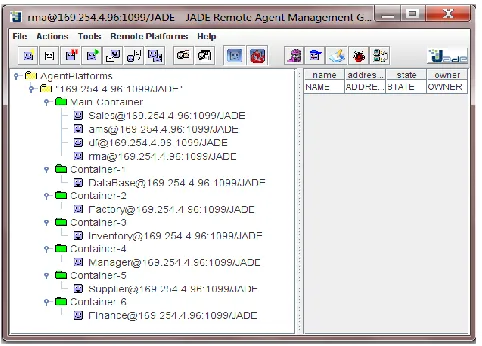
The proposed system is a multi-agent system for supply chain management for manufacturing and selling all certain types of cables and its raw materials constituting these cables. It consists of seven Agents: 1) Sales Agent, 2) Manger Agent, 3) Inventory Agent, 4) Factory Agent, 5) Supplier Agent, 6) Finance Agent, and 7) Data Base Agent. These agents are shown in Figure(1) which represents an interface in Java Agent Development Environment (JADE) Platform, such that the Main-Container holds the Sales Agent and the Container-1 to Container-6 holds the other six Agents.
Fig. The seven Agents appears in the JADE Platform.
Firstly, the modeled system was described The first step in this methodology is the conceptualization phase after which an elicitation task will be carried out to obtain a general description of the problem by following a user-centered approach based on use cases. In this approach, an actor represents a role played by a person, a piece of hardware or another system that interacts with our system. A use case corresponds to a description of the sequence of actions needed to produce an observable result useful for an actor. Table(1) defines the actors and their use cases (activities) modeled in our experiment.
Table I Actors and Use Cases.
Actor Description Use case (Activity)
Sales Agent
A software agent Which receive orders
and deliver products to customers.
receive orders and deliver
products to customers, this agent contacts and interacts with other agents besides the customer’s who want to purchase a certain type of cables.
Manager Agent
A software agent Which manages and
controls all the other
agents.
Coordinates and controls all the other agents. The goal of this agent is Maximizing profit. It requests cable name, quantity from the Inventory Agent, sales Agent responds to that order, request invoice, Get profit from Finance Agent, request cable name, quantity reminder from Factory Agent.
Inventory Agent
A software agent Which controls the
inventory levels.
The Goal of this Agent is Minimizing component holding cost. It manages component, product arrival & consumption,
manage component demand,
controls the inventory levels, which contains the constraints for
monitoring inventory flow,
acquire information from
Manager Agent to calculate the
needed materials based on
historical data for optimal reorder quantities.
Factory Agent
A software agent which controls the manufacturin g processes.
which controls the manufacturing
process, that contains the
constraints for monitoring the operation, production scheduling, and monitoring the quantity of raw materials.
Supplier Agent
A software agent which performs the
function of handling the suppliers and distributors and handling their payment mode also by interacting with Finance
Agent.
The Goal of this Agent is Minimizing component cost. The function of this Agent is handling the suppliers and distributors and handling their payment mode also
by interacting with Finance
Agent. It decide on quantity and future date for supplier, track Supplier prices and Deliveries, Generate supplier Orders, Process Supplier Offers.
Finance Agent
A software agent Which performs the
required financing processes.
Finance Agent performs the required financing processes such as Invoices, Total invoices, total profit, budget. It gets the required information about a given part for processing and computes the bill of material of the part, listing of
assemblies and subassemblies
parts and raw materials needed for a given end product. It Negotiate
about price and quantity,
Negotiate how to transmit
117805-0303 IJVIPNS-IJENS © October 2011 IJENS
I J E N S
Database Agent
A software agent A repository for the needs of all other agents, which includes cases with Factory
Agent, Inventory
Agent, Supplier Agent and
Finance Agent.
This agent is responsible for storing the information regarding
the available
stock/components/material and to give access to the data to other agents through negotiation or by sending standard messages. This
agent also responsible for
updating the data before and after each purchasing activity. The updated information is available as output and accessed by Agents for time phasing, and production scheduling.
Secondly, the role and functionality of each agent are described in short in the following subsections:
A.
Sales Agent (SA)
Fig. 2 Sales Agent.
In addition to receive orders and deliver products to customers, this agent contacts and interacts with other agents besides the customer’s who want to purchase a certain type of cables. The Goals and the activities of this agent is shown in Figure(2). When this agent runs, it displays a GUI requesting the cable Name, Quantity, Customer Name, Customer phone and Customer Address.
The Scenario is as follows:
There are three cases occurred in the system which appears in the functionality of the most agents.
Case(1): when the customer request order from sales department, Sales Agent takes information from the user and sends message to Manager Agent (MA). In this case, if the cable exist, the manager send to sales the message “the cable already exists”. The sales will tell the customer to check the Finance department through the Finance Agent (FA). Case(2&3): when the customer request Order from Sales department, Sales Agent takes information from user and send Message to Manager Agent. In this case, if the cable does not exist, the manager send to sales message with time delaying to tell the customer wait till his order be manufactured and ready, the sales tell the customer to wait if he agree.
B.
Manager Agent (MA)
The agent manages and controls all the other agents. Manager Agent takes the message sent by Sales Agent that contains the customer’s request. The Goals and the activities of this agent is shown in Figure(3). A message sent to the Inventory Agent inquiring about the quantity requested from a certain cable. If the quantity exists, the Manager Agent sends a message to Sales Agent telling him that the order is ready. At the same time, the Manager Agent sends a message to Finance Agent to print the required invoice.
Fig. 3. Manager Agent.
C.
Inventory Agent (VA)
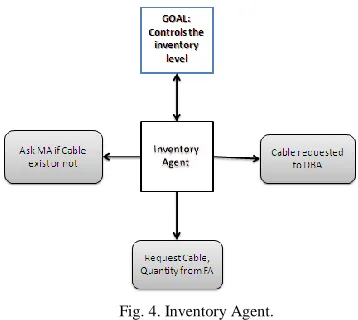
Inventory Agent controls the inventory levels, which contains the constraints for monitoring inventory flow, acquire information from Manager Agent to calculate the needed materials based on historical data for optimal reorder quantities. The Goals and the activities of this agent is shown in Figure(4). When running Inventory Agent, it display the Graphical User Interface (GUI) to add name of cable, quantity, time for manufacturing, price per unit and raw materials constitutes the cable to Database Agent.
Fig. 4. Inventory Agent.
117805-0303 IJVIPNS-IJENS © October 2011 IJENS
I J E N S
and send Message to Manager Agent which takes this message and send to Inventory Agent to check for cable found or not. Inventory Agent will search to Database Agent for this cable. In this case, the Database Agent respond to Inventory Agent that this cable was found. The Inventory Agent will send message to Manager Agent that the quantity requested from the customer is found.
If the cable in not found in the Database, Inventory Agent send message to Manager Agent that the quantity requested from the customer is not found.
D.
Factory Agent (FA)
Factory Agent controls the manufacturing process, which contains the constraints for monitoring the operation,
Fig. 5. Factory Agent.
production scheduling, and monitoring the quantity of raw materials. The Goals and the activities of this agent is shown in Figure(5). When running the Factory Agent, it displays the GUI to add name of Raw Material and Quantity to Database Agent.
E.
Supplier Agent (PA)
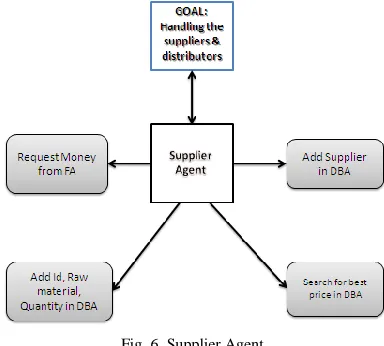
The Supplier Agent performs the function of handling the suppliers and distributors and handling their payment mode also by interacting with Finance Agent. The main objective of the Supplier Agent is getting the raw material that the factory needs. It decide on quantity and future date for supplier, track Supplier prices and Deliveries, Generate supplier Orders, Process Supplier Offers. The Goals and the activities of this agent is shown in Figure(6). When running the Supplier Agent, it display a GUI to add Company information (Company name, phone, address, E-mail, Raw material, price per unit. The Scenario is as follows:
The supplier Agent sends the following messages:
Supplier “id, Raw material” to Database Agent. Supplier “money” to Finance Agent. Supplier “id, raw material, quantity” to Database Agent.
Fig. 6. Supplier Agent.
The Supplier Agent receives the following Messages:
Factory “id, Raw Material1, quantity1, Raw Material” to
Supplier Agent. Database Agent “id, Best price” to Supplier Agent.
After negotiation between the Manager Agent and Inventory Agent and finding that the cable does not exist, the Inventory Agent asks the Factory Agent to manufacture the cable and if there is no raw material, the Factory Agent request the Supplier Agent to prepare it. At this point, the job of the supplier is started:
The Factory Agent requests the raw material by a specific quantity.
Supplier Agent sends to Database Agent to ask about the best supplier (the low price, quantity, …) in the database.
Supplier Agent receive the best price of the raw material from several companies stored in the database.
The Supplier Agent send to the Finance Agent, the price of the raw material.
The Supplier Agent will send finally the raw material with the demanded quantity to the Database.
The Factory Agent sends to Supplier Agent message to purchase raw materials and quantity. The Supplier Agent buy raw material and send it to the Database and the factory started to manufacture the cable. After buying the raw material, the Supplier agent send message to Finance Agent to pay the invoice to the Supplier.
F.
Finance Agent (NA)
Again, when the customer request Order from Sales Department, Sales Agent takes information from user and send Message to Manager Agent which take Message and send it to Inventory Agent to check for Cable if it found or not. Inventory Agent will search to Database Agent for this Cable. The Goals and the activities of this agent is shown in Figure(7).
The Scenario is as follows:
117805-0303 IJVIPNS-IJENS © October 2011 IJENS
I J E N S
Sales Agent telling that this quantity of cables are found, and Manager Agent send message to Finance Agent with message content:
Manager “Id, Cable name, Quantity, Name, Phone, Address”. The finance Agent send message to Database Agent with content:
Finance “Id, Cable name”.
Database Agent reply with this message: Database “price per unit”.
Fig. 7. Finance Agent.
Finance Agent can print an invoice and save it containing the following information:
Date, Order ID, customer Name, Telephone number, Customer Address, Cable Name, Quantity, price per unit, Total price.
Case2: when the cable not found, Inventory Agent send this message to Manager Agent, this will send to Factory Agent that will send message to Database Agent. The Database Agent reply with message contain Raw Material, quantity, requested time for manufacturing raw material. The Factory Agent send message to Manager agent about the status of Manufacturing the raw material. When the Manager Agent tell the Factory Agent execute this message for manufacturing the required quantity of cables. After that the quantity will added in the Database. The Manager Agent send message to the Finance Agent to make an invoice as occurred in case 1.
Case3: this case shows that neither raw material nor cables are found in the inventory and database. The Factory Agent send to Supplier Agent message to purchase raw materials with requested quantity, then Supplier Agent send message to Database Agent to add this quantity which purchased. When Supplier Agent send message to Finance Agent containing: Supplier “Money” to be subtracted from Budget.
After the Factory Agent manufacturing the requested quantity, and sending a message to Manager Agent with the requested cables, the Manager Agent send message to Finance Agent for make an invoice.
Finally, Manager Agent send message request profit from Finance Agent with content:
Manager “Request Profit”.
Finance Agent reply with this message: Finance “Total invoices, Total Profit, Budget”.
G.
Database Agent (DBA)
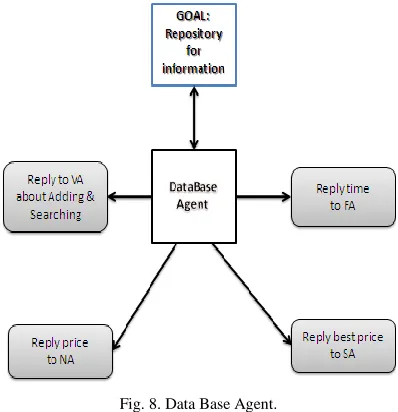
This agent is responsible for storing the information regarding the available stock/components/material and to give access to the data to other agents through negotiation or by sending standard messages. It also responsible for updating the data before and after each purchasing activity. The updated information is available as output and accessed by Agents for time phasing, and production scheduling. The story of
Fig. 8. Data Base Agent.
Database includes cases with “Factory Agent, Inventory Agent, Supplier Agent and Finance Agent”.
Firstly, the Factory Agent, Inventory Agent and Supplier Agent will add to SQL Tables of their data.
Inventory Agent add “Cable-ID, Cable-name, Quantity, time, and price-per-unit” into a table called “Cable”.
Factory Agent add “Raw-material name, Quantity” into a table called “Raw-Material”.
Supplier Agent add “Supplier-name, raw-material, supplier-phone, supplier-address and price-per-unit” in a table called “Supplier”.
117805-0303 IJVIPNS-IJENS © October 2011 IJENS
I J E N S
VIII. CONCLUSION
Multi-agent system is a loosely coupled network of software agents that interact to solve problems that are beyond the individual capacities or knowledge of each problem solver. In general goal of MAS is to create systems that interconnect separately developed agents, thus enabling the ensemble to function beyond the capabilities of any singular agent in the set-up in agent model. Multi-agent systems try to solve the entire problem by collaboration with each other and result in preferable answer for complex problems.
This paper discusses the similarity between supply chain and multi-agent system, and the underlying reasons why agent technology is the appropriate approach for the collaborative supply chain management. With this approach, seven agents with specialized expertise has been designed. Each agent performs a specific function of the organization and share the information with other agents. It is multi-agent technology for decision making and information sharing among neighboring agents that is very important to the SCM. When we make negotiation we consider not only price but also review point and delivery time.
REFERENCES
[1] S. Srinivasan, D. Kumar, and V. Jaglan, “Multi-Agent System Supply Chain Management in Steel Pipe Manufacturing”. IJCSI International Journal of Computer Science Issues, Vol.7, Issue 4, No 4, July 2010. [2] H. Al-zu’bi, “Applying Electronic Supply Chain Management Using
Multi-Agent System: A Managerial Perspective”. International Arab Journal of e-Technology, Vol. 1, No. 3, 2010.
[3] Y. Haghpanah, “A Trust Model for Supply Chain Management”. Proc. Of 10th Int. Conf. on Autonomous Agents and Multiagent Systems (AAMAS 2011) © 2011, International Foundation for Autonomous Agents and Multiagent Systems (www.ifaamas.org).
[4] W. Um, H. Lu, and T. Hall, “A Study of Multi-Agent Based Supply Chain Modeling and Management”. iBusiness, 2, 333-341, 2010. [5] X. Xu, and J. Lin, “A Novel Time Advancing Mechanism for
Agent-Oriented Supply Chain Simulation”. Journal of Computers, Vol. 4, No. 12, December 2009. © Academy Publisher.
[6] C. Seitz , T. Scholler, and J. Neidig, “An Agent-based Sensor Middleware for generating and interpreting Digital Product Memories”. Proc. Of 8th Int. Cof. On Autonomous Agents and Multiagent Systems (AAMAS 2009). © International Foundation for Autonomous Agents and Multiagent Systems (www.ifaamas.org).
[7] S. Saberi, and C. Makatsoris, “Multi Agent System for Negotiation in Supply Chain Management”. The 6th International Conference on Manufacturing Research (ICMR08), Brunel University, UK, 9-11th September 2008.
[8] V. Misra, M. Khan, and U. Singh, “Supply Chain Management Systems: Architecture, Design and Vision”. Journal of Strategic Innovation and Sustainability vol. 6(4) 2010.
[9] R. Carvalho, and L. Custodio, “A Multiagent Systems Approach for Managing Supply-Chain Problems: new tools and results”. Inteligencia Artificial V. 9, No 25, 2005.
[10] X. Li, and K. Lau, “A Multi-Agent Approach Towards Collaborative Supply Chain Management”. Proceedings of the Fifth International Conference on Electronic Business, Hong Kong, December 5-9, 2005, pp. 929-935.
[11] G. LUGER, “Artificial Intelligence, Structures and Strategies for Complex Problem Solving” Fifth edition, pp266-269, 2005.
[12] M. Paolucci, R. Revetria, and F. Tonelli, “An Agent-based System for Sales and Operations planning in Manufacturing Supply Chains”. International Journal of Systems Applications, Engineering & Development, Issue 4, Volume 1, 2007.
[13] S. Yung, C. Yang, A. Lau, and J. Yen. “Applying Multi-Agent Technology to Supply Chain Management”. Journal of Electronic Commerce Research, Vol. 1, No. 4, 2000.
[14] M. Nissen, “Beyond electronic disintermediation through multi-agent Systems”. Logistic Information Management, Volume 14, Number 4, pp 256-275, 2001.
[15] Q. Zhang, “Essentials for Information Coordination in Supply Chain Systems”. Asian Social Science, Vol. 4, No. 10, 2008.
[16] S. Garg, S. Srnivasan, and V. Jaglan, “Multi-agent Collaboration Engine for Supply Chain Management”, International Journal on Computer Science and Engineering, Vol.3, No. 7, 2011.
[17] F. Lopes, and H. Coelho, “Bilateral Negotiation in a Multi-agent Supply Chain System” LNBIP 61, pp. 195-206, 2010. © Springer-verlag Berlin Heidelberg.
[18] N. Julka, R. Srenivasan, and I. Karimi, “Agent-based Supply Chain Management-1: framework”, Computers and Chemical Engineering 26(2002) 1755-1769. ©ELSEVIER.
[19] M. Uppin, and S. Hebbal, “Multi Agent System Model of Supply Chain for Information Sharing”. Contemporary Engineering Sciences, Vol. 3, 2010, No.1, pp 1-16.
[20] V. Kumar, and S. Srinivasan, “A Review of supply Chain Management using Multi-Agent System”. IJCSI International Journal of Computer Science Issues, Vol. 7, Issue 5, September 2010.
[21] M. Abdoli, and B. Al-Salim, “Intelligent Agent-based Approach to Sales Operations at E-stores”. Proceedings of the Eleventh American Conference on Information Systems, Omaha, NE, USA Auguest 11th – 14th 2005.
[22] S. Russell and P. Norvig, “Artificial Intelligence, a Modern Approach”. Second Editions, chapter two: Intelligent Agents, pp32-58 © 2003 Person Education Inc.
[23] A. Goel, S. Gupta, S. Srinivasan, and B. Jha, “Integration of Supply Chain Management Using Multiagent System & Negotiation Model”. International Journal of Computer and Electrical Engineering. Vol. 3, No. 3, 2011.
[24] M. Beer, M d’ Inverno, M. Luck, N. Jennings, C. Preist, and M. Schroeder, “Negotiation in Multi-Agent Systems”. Workshop of the UK Special Interest Group on Multi-Agent Systems, UKMAS’98.
[25] I. Giannoccaro, and P. Pontrandolfo, “How Negotiation Influences the Effective Adoption of the Revenue Sharing Contract: A Multi-Agent Systems Approach”. Supply chain, Theory and Applications, Book editied by: Vedran Kordic, ISBN 978-3-902613-22-6, pp. 558, 2008. Tech Education and Publishing, Vienna, Austria.
[26] S. Putten, V. Robu, H. Poutre, A. Jorritsma, and M. Gal, “Automating Supply Chain Negotiations using Autonomous Agents: a case study in Transportation Logistics”. AAMAS’06, May 8-12, 2006, Hakodate, Hokkaido, Japan. © ACM, 2006.