Increasing The Performance Of Mobile
Smartphones Using Partition And Migration Of
Mobile Applications To Cloud Computing
Hatem M. Abdul Kader, Mohie M. Hadhoud, Salah M El-Sayed, Diaa Salama AbdElminaam
Information Systems Department, Faculty of Computers and Informatics, Menofyia University, Egypt; Information Technology Department, Faculty of Computers and Informatics, Menofyia University, Egypt; Scientific Computing Department, Faculty of Computers and Informatics, Banha University, Egypt; Information Systems Department, Faculty of Computers and Informatics, Banha University, Egypt
Email: [email protected], [email protected], [email protected], [email protected]
ABSTRACT: With the increasing use of smartphones devices, mobile applications with richer functionalities are becoming ubiquitous but mobile devices are limited by their resources for computing and power consumption. Cloud the place for abundant resources. Clouds provide opportunity to do huge computations quickly and accurately so we can use cloud for mobile computations. Mobile Cloud Computing (MCC) which combines mobile computing and cloud computing, has become one of a major discussion thread in the IT world in the recent few years. We developed an architecture that uses cloud to do computations that consume resources badly on mobiles. It aims at finding the right spots in an application automatically where the execution can be partitioned and migrated to the cloud. Thus, an elastic application can augment the capabilities of a mobile device including computation power, storage, and network bandwidth, with the light of dynamic execution configuration according to device‟s status including CPU load, memory, and battery level. We demonstrate results of the proposed application model using data collected from one of our elastic application.
Keywords : Cloud computing, Mobile cloud computing (MCC), GPS, offloading, Partitioning and migration
1
I
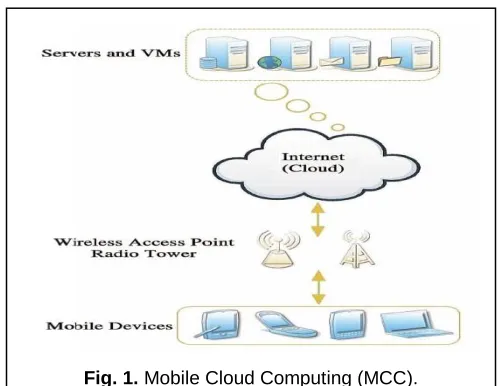
NTRODUCTIONTogether with an explosive growth of the mobile applications and emerging of cloud computing concept, mobile cloud com-puting (MCC) has been introduced to be a potential technolo-gy for mobile services. MCC integrates the cloud computing into the mobile environment and overcomes obstacles related to the performance (e.g., battery life, storage, and bandwidth), environment, and security (e.g. Confidentiality, reliability and privacy) discussed in mobile computing. Mobile devices (e.g., smartphone, tablet pcs, etc) are increasingly have become the primary computing platform for many users [1, 2, 3]. Mobile users accumulate rich experience of various services from mobile applications (e.g., iPhone apps, Google apps, etc), which run on the devices and/or on remote servers via wire-less networks. The rapid progress of mobile computing (MC) becomes a powerful trend in the development of IT technology as well as commerce and industry fields. However, the mobile devices are facing many challenges in their resources (e.g., battery life, storage, and bandwidth) and communications (e.g., mobility and security). The limited resources significantly impede the improvement of service qualities. . Various studies have identified longer battery lifetime as the most desired fea-ture of such systems .Cloud computing (CC) has been widely recognized as the next generation‟s computing infrastructure. CC offers some advantages by allowing users to use infra-structure (e.g., servers, networks, and storages), platforms, and software (e.g., application programs) provided by cloud providers (e.g., Google, Amazon, and Salesforce) at low cost. In addition, CC enables users to elastically utilize resources in an on-demand fashion [4, 5]. As a result, mobile applications can be rapidly provisioned and released with the minimal management efforts or service provider‟s interactions. With the explosion of mobile applications and the support of CC for a variety of services for mobile users, mobile cloud computing (MCC) is introduced as an integration of cloud computing into the mobile environment. Mobile cloud computing (Figure.1) brings new types of services and facilities for mobile users to
take full advantages of cloud computing. This paper introduces the basic terminology of cloud computing and mobile cloud computing, its background, key technology, current research status, and its further research perspectives as well.
The rest of the paper is organized as follows. Section 2 present cloud computing definitions and basic terminology of mobile cloud computing and its architectures Following that, respectively in the next section the discussion of related work of mobile cloud computing. Following that, respectively in the in section 4 present problem definitions and system model, and the description of partition cost module and the evaluation. Finally, the conclusion lies in the last section.
2
O
VERVIEW OFM
OBILEC
LOUDC
OMPUTINGIn order to help us better understanding of Mobile Cloud Com-puting, let‟s start from the two previous techniques: Mobile Computing and Cloud Computing followed by mobile cloud
ISSN 2347-4289
computing.
A. Mobile Computing
B. Cloud Computing
C. Mobile Cloud computing
A. Mobile Computing
Mobile computing exactly is described as a form of human-computer interaction by which a human-computer is expected to be transported during normal usage [6, 7]. Mobile computing is based on a collection of three major concepts: hardware, soft-ware and communication. The concepts of hardsoft-ware can be considered as mobile devices, such as smartphone and lap-top, or their mobile components. Software of mobile computing is the numerous mobile applications in the devices, such as the mobile browser, anti-virus software and games. The com-munication issue includes the infrastructure of mobile net-works, protocols and data delivery in their use.it should have the following feature (mobility, Diversity of network conditions, frequent disconnection and consistency, Dis-symmetrical net-work communication, and Low reliability)
• Current status of mobile applications
Several researchers, [8, 9], have identified the fundamental challenges in mobile computing. Mobile computing environ-ments are characterized by severe resources constraints and frequent changes in operating conditions.
I. Offline Applications: Fat Clients with presentation and business logic processed locally. In offline applica-tions data downloaded from backend. Its advantag-es(Well Integrated, Optimized Performance, Availabili-ty :even without network connectiviAvailabili-ty).its disadvan-tages (No Portability, Complex
II. Online Applications: Online Applications: Only presen-tation layer at the client. All processing done online. Assume constant connectivity with backend. Its ad-vantages: Multiplatform, Direct and Instantaneous Ac-cessibility to better services and its disadvantages: Excessive latency for real time responsiveness, no access to device features, sometimes difficult to main-tain sessions for a long time.
B. Cloud Computing
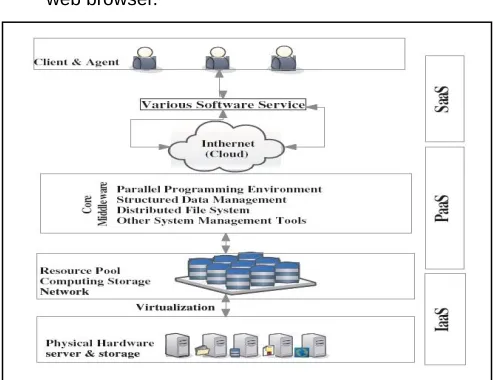
[10, 11, 12] Cloud computing refers to the hardware, systems software, and applications delivered as services over the In-ternet (Fig.2). When a cloud is made available in a pay as you go manner to the general public, we call it a Public Cloud. The term Private Cloud is used when the cloud infrastructure is operated solely for a business or an organization. A composi-tion of the two types (private and public) is called a Hybrid Cloud, where a private cloud is able to maintain high service availability by scaling up their system with externally provi-sioned resources from a public cloud when there are rapid workload fluctuations or hardware failures. In general, cloud providers fall into three categories
• Infrastructure as a Service (IaaS): offering web-based access to storage and computing power. The con-sumer does not need to manage or control the under-lying cloud infrastructure but has control over the op-erating systems, storage, and deployed applications. • Platform as a Service (PaaS): giving developers the
tools to build and host web applications (e.g., APPRIO [13], software as a service provider, is built using the
Force.com [14] platform while the infrastructure is provided by the Amazon Web Service [15]). The users host an environment for their applications. The users control the applications, but do not control the operat-ing system, hardware or network infrastructure, which they are using.
• Software as a Service (SaaS): where the consumer uses an application, but does not control the operat-ing system, hardware or network infrastructure. In this situation, the user steers applications over the net-work. Applications that are accessible from various client devices through a thin client interface such as a web browser.
C. Mobile Cloud computing
There are several definitions of mobile cloud computing [16, 17], and different research refers to different concepts of the „mobile cloud: 2 The term mobile cloud computing means to Mobile Cloud computing a combination of cloud computing, wireless infrastructure, portable devices, and location based services have given rise to it. Mobile cloud computing is a model for transparent elastic augmentation of mobile device‟s capability.The main objective of mobile cloud computing is to provide a convenient and rapid method for users to access and receive data from the cloud, such convenient and rapid method means accessing cloud computing resources effec-tively by using mobile devices.
2
R
ELATEDW
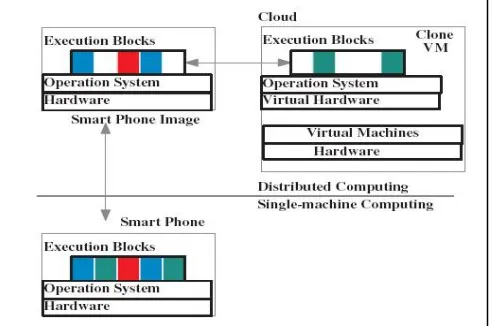
ORKTo give more prospective about the Mobile Cloud Computing, this section discusses the results obtained from other re-sources. It was shown in [18] executes video games in the cloud and delivers video stream to resource-poor clients with-out interrupting the game experience. Many other examples where the cloud can augment mobile devices can be envi-sioned, e.g. virus scan, mobile file system indexing, aug-mented reality applications. In [19] uses VM migration to of-fload part of their application workload to a resourceful server through either 3G or WiFi. CloneCloud(Fig.3) was tested using Android phones with the clones executing on a Dell desktop running Ubuntu. The system is a flexible application partitioned and execution runtime. It enables unmodified mobile applica-tions to offload part of their execution from mobile devices onto device clones operating in a computational cloud.
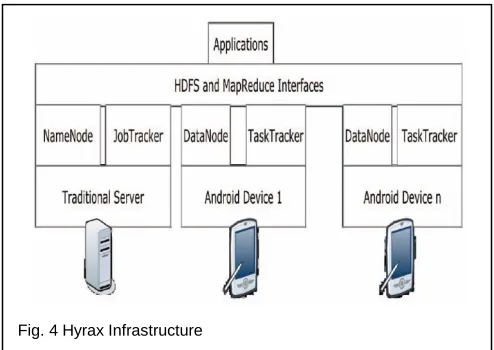
It was presented in [20] „Hyrax‟ for Android smartphone appli-cations which are distributed both in terms of data and compu-tation based on Hadoop ported to the Android platform. Hyrax (Figure.4) explores the possibility of using a cluster of mobile phones as resource providers and shows the feasibility of such a mobile cloud.
As a sample application, they present „HyraxTube‟; which is a simple distributed mobile multimedia search and sharing pro-gram. The objective of HyraxTube is to allow users to search through multimedia files in terms of time, quality, and location. There are several of researches about Mobile Cloud Compu-ting can be found in [21],[ 22], [23],[24],[25],[26]
3
P
ROBLEMD
EFINITION ANDS
YSTEMM
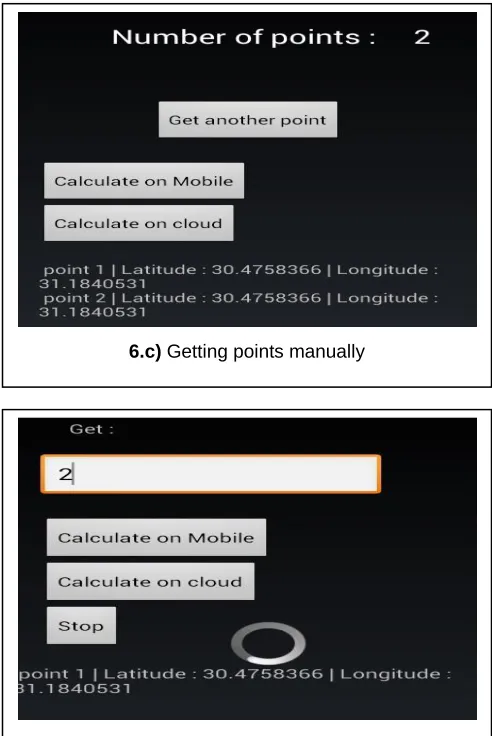
ODELIn this section, we present a model for application execution on the cloud-assisted mobile application platform. Application system architecture as shown in Fig.5 First, we define a mo-bile application profile. Then, we calculate consuming re-sources for application execution, including rere-sources con-sumed for computation on mobile execution and a transmis-sion computation to cloud execution. The following Sequence steps for our framework application as shown in (fig 6) .We use a mobile smartphone SAMSUNG GALAXY GRAND 1.2 GHz Dual Core CPU, and Android 4 Operating Systems in which performance data is collected and tested. In the experi-ments, the GPSTestPerformance application smartphone cal-culate some of GPS calculations such as distance between two points or more till 100 points using different algorithms.
For our experiment, we calculate the effects of Sending com-putation to cloud web service and back with results and study-ing the Offloadstudy-ing computation to save energy on power con-sumption for smartphone mobile in case of running all processes of application on mobile or by partition and offload-ing processes to cloud
In first step: Firstly; Comparison is conducted using two different types of GPS mode (using mobile GPS), and using mobile network .for each type of GPS, we can get latitude and longitude for each point (it can be calculated by mobile GPS satellite or by mobile network)
In second step:After selecting GPS mode of operations, we have to choose between manual or automatic calculation to get latitude or longitude for each point
If automatic calculation is selected, we have to enter number of points and system get points every thirty second
If manual calculation is selected, we have to click to get points
In third step: After selecting method to get points either manually or automatic, we have to choose between calculation way on mobile or by partition and offloading to perform part of calculation on mobile and part on cloud server
a) In case calculation on mobile, calculation is conducted in case of getting points manually or automatic Mobile Ap-plication will take GPS reading and perform calculations over certain period of time
1. GPS reading to determine latitude and longitude for each point either by GPS for mobile (smart phone (satellite) ) or from mobile network
2. Then calculate the distance between two point or more using different algorithms
3. The Application will perform all calculations on smart phone device and calculate the results and the consuming resources such as Memory con-sumed, CPU usage, Time consumed for calcula-tion, battery consumed to perform the processes, time consumed for calculations and for getting points
b) In case of partition and offloading calculation on
cloud and mobile, We implement cloud clone application
that enables the mobile applications developers to take decision of performing all application processes on an an-droid mobile device or to divide the application processes to execute on mobile & cloud
1. GPS reading to determine latitude and longitude for each point either by GPS for mobile (smart phone (satellite) ) or from mobile network (this step execute on mobile device )
2. Then data(longitude and latitude for each point) is transmitted to cloud server to perform calculation on cloud
3. the distance between two point or more using dif-ferent algorithms calculations performed on cloud the distance between two point or more using dif-ferent algorithms
4. The Application will perform distance calculations on cloud server and calculate the results and the
Fig. 3: CloneCloud Migration Overview
ISSN 2347-4289
consuming resources such as Memory consumed for sending and receiving results, Memory con-sumed for distance calculations only, Memory consumed for all process from getting points till receive results, CPU usage, Time consumed for calculation, battery consumed to perform the transmitting data, time consumed for calculations and for getting points
4.1 Mathematical Calculation
4.1.1 Distance using Haversine formula
for our experiment,distance calculations between two point using the „haversine‟ formula to calculate the great-circle dis-tance between two points – that is, the shortest disdis-tance over the earth‟s surface .The formula assumes that the earth is a sphere, (we know that it is "ellipse " shaped) – giving an „as-the-crow-flies‟ distance between the points (ignoring any hills, of course!).
haversine Formula
a = sin²(Δφ/2) + cos(φ1).cos(φ2).sin²(Δλ/2) (1) (1)
c = 2.atan2(√a, √(1−a)) (2) (2)
d = R.c (3) (3)
Δφ is latitude difference (lat2− lat1), Δλ is longitude difference (long2− long1), R is earth‟s radius(mean radius = 6,371km)
4.1.2 Distance using Spherical low of Cosines:
When Sinnott published the haversine formula, computational precision was limited. Nowadays, most modern computers & languages use IEEE 754 64-bit floating-point numbers, which provide 15 significant figures of precision. With this precision, the simple spherical law of cosines formula gives well-conditioned results down to distances as small as around 1 metre
spherical law of cosines formula
d = acos( sin(φ1).sin(φ2) + cos(φ1).cos(φ2).cos(Δλ) ).R (1)
4.1.3 Distance using Equirectangular approximation:
If performance is an issue and accuracy less important, for small distances Pythagoras‟ theorem can be used on anequirectangular projection
Formula
x = Δλ.cos(φ) (1) y = Δφ (2)
d=
R
.
(
x
2
y
2)
(3)4.2 Experiment (Manual Calculations)
4.2.1 Getting Points using GPS satellite
Table 1 shows memory consumed in case of manual calcula-tion in case of getting longitude and latitude for each point manually using GPS satellite for execution application on cloud web services and the for different number of points range from two points till ten points [GPS calculation on mobile smartphone and calculation moved to cloud and return results to mobile
Fig. 5: The Application System Architecture
6.a)Getting points (lat and Long) using network GPS
Fig. 6. Snapshot of elastic GPS application on Samsung Gal-axy Grand
TABLE 1.
RESOURCES CONSUMED FOR EXECUTION APPLICATION ON CLOUD WEB SERVICES(GETTING POINTS USING GPSSATELLITE)
Calculations on Cloud
# of poi nts G P S me mo ry co n-s um ed c onne c-ti on to c loud me m o ry Me mo ry co n-s um ed for c al c u-lati on onl y T otal Me mo ry on M obi le
2 5.050582 1.343775 85.58896 6.394357
3 7.625728 0.7984205 90.784704 8.4241485
4 10.564673 1.27652 102.56821 11.841193
5 13.60835 0.045329 103.8482823 13.653679
6 12.671564 0.431785 106.742794 13.103349
7 20.9655 0.57854 106.8743 21.54404
8 25.56983 0.2678985 101.769765 25.8377285
9 20.87329 0.45698 97.894871 21.33027
10 22.5389 0.53489 108.87314 23.07379
TABLE 2.
RESOURCES CONSUMED IN CASE OF PARTITION AND OFFLOADING TO CLOUD WEB SERVICES (GPSSATELLITE)
Calculations on mobile Smartphone
# of poi
nts G P S Me m o-ry c ons um ed Cal c ul ati on Me mo ry c ons um ed T otal Me m o-ry
2 15.027344 31.971785 46.999129
3 14.988281 12.453125 18.10156225
4 12.3945313 12.3125 15.4726563
5 16.328125 8.484375 18.44921875
6 20.3945313 16.3125 24.4726563
7 22.378906 23.34375 28.2148435
8 29.296875 24.3125 35.375
9 26.800781 28.3125 33.878906
10 23.34375 32.484375 31.46484375
Table 2 shows memory consumed for execution all application on mobile smartphones. The memory unit is bytes.
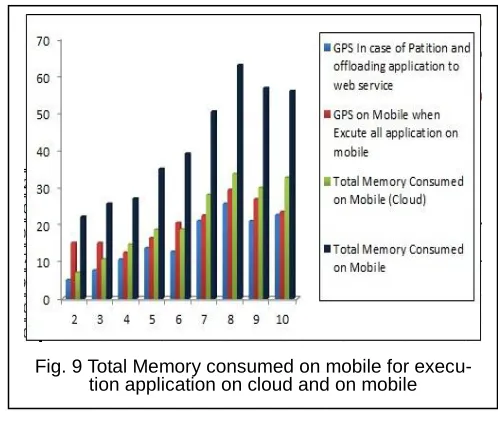
Experimental results are shown in( Fig 7),( Fig 8), and (Fig 9) for different data calculations using manual method for getting longitude and latitude for each point rang from calculating dis-tance between two points till ten points in case of disdis-tance range from approximately 100 meter till 16 kilo meter in case of all calculation done on mobile device or application is parti-tioned and offloading on cloud to perform distance calculation on cloud. (Fig. 7) shows the results of portioned and offloading application and getting latitude and longitude for each point on mobile smart phone and executes distance calculations on cloud. The results include the following matrices
Memory consumed on mobile (bytes) for GPS calcula-tion only (getting longitude and latitude for each point)
Memory consumed on cloud ( bytes) for calculating dis-tances between points on cloud
Memory consumed for send points longitudes and lati-tudes to web services or receive results from web ser-vices to mobile smart phone
Total memory consumed on mobile smartphone for cal-culations
6.c) Getting points manually
ISSN 2347-4289
(Fig. 8) shows the results of execute all application processes on mobile smartphone only. The results include the following matrices
Memory consumed in bytes for GPS calculation only (getting longitude and latitude for each point)
Memory consumed in bytes for calculating distances between points
Total Memory consumed to execute application in Mega Hertz.
From the previous two figures (Fig. 7), and (fig.8), The perfor-mance of execute application on mobile or cloud in terms of memory consumed using different distance and number of points are shown in (Fig 9).the total memory consumed on mobile in the case of cloud or in the case of executed all the application on mobile only
Results analysis
- According to partition algorithm, most of resources consumed on mobile smartphone will decrease approximately to the half as shown in fig 9. In case of partition and offloading application most of resources consumed on cloud and minimize the re-sources consumed in mobile smartphone as shown in (Fig 7), and (Fig.9)
4.2.2 Getting Points using Network GPS
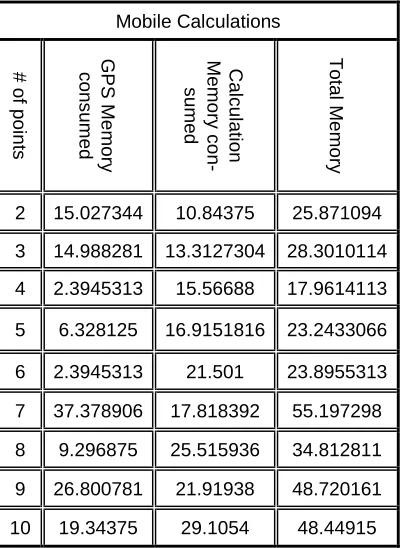
Table 3 shows memory consumed in case of manual calcula-tion in case of getting longitude and latitude for each point manually using Network GPS and Table 4 shows memory consumed for execution all application on mobile smart-phones. The memory unit is bytes.
TABLE 3.
RESOURCES CONSUMED FOR EXECUTION APPLICATION ON CLOUD WEB SERVICES (GETTING POINTS USING NETWORK GPS)
Calculations on Cloud
# of poi
nts
G
P
S
me
mo
ry
c
ons
um
ed
c
onne
c
ti
on to
c
loud
me
mo
ry
Me
mo
ry
c
o
n-s
um
ed fo
r
ca
lc
u
lati
on
onl
y
T
otal
Me
mo
ry
on M
obi
le
2 14.050781 1.109375 89.058594 15.160156
3 10.60156 0.765625 93.7709375 11.367185
4 1.0546875 1.3242188 103.6210937 2.3789063
5 3.609375 0.02734375 103.0632813 3.63671875
6 2.8515625 0.546875 103.4296875 3.3984375
7 25.8125 0.515625 80.5 26.328125
8 15.6645 0.23828125 91.7345 15.90278125
9 20.324219 0.484375 86.8710935 20.808594
10 9.949219 0.51953125 98.64975 10.46875025
Fig. 7 Memory consumed for execution application on cloud(Bytes)
Fig. 8 Memory consumed for execution application on mobile(Bytes)
TABLE 4. RESOURCES CONSUMED IN CASE OF PARTITION AND OF-FLOADING TO CLOUD WEB SERVICES (NETWORK GPS)
Mobile Calculations
# of poi
nts
G
P
S
Me
mo
ry
c
ons
um
ed
Cal
c
ul
ati
on
Me
mo
ry
c
o
n-s
um
ed
T
otal
Me
mo
ry
2 15.027344 10.84375 25.871094
3 14.988281 13.3127304 28.3010114
4 2.3945313 15.56688 17.9614113
5 6.328125 16.9151816 23.2433066
6 2.3945313 21.501 23.8955313
7 37.378906 17.818392 55.197298
8 9.296875 25.515936 34.812811
9 26.800781 21.91938 48.720161
10 19.34375 29.1054 48.44915
Experimental results are shown in( Fig 10),( Fig 11), and (Fig 12) for different data calculations using manual method for getting longitude and latitude for each point rang from calculat-ing distance between two points till ten points in case of dis-tance range from approximately 100 meter till 16 kilo meter in case of all calculation done on mobile device or application is partitioned and offloading on cloud to perform distance calcu-lation on cloud. (Fig. 10) shows the results of portioned and offloading application and getting latitude and longitude for each point on mobile smart phone and executes distance cal-culations on cloud. The results include the following matrices
Memory consumed on mobile (bytes) for GPS calcu-lation only (getting longitude and latitude for each point)
Memory consumed on cloud ( bytes) for calculating distances between points on cloud
Memory consumed for send points longitudes and lati-tudes to web services or receive results from web services to mobile smart phone
Total memory consumed on mobile smartphone for calculations
(Fig. 11) shows the results of execute all application processes on mobile smartphone only. The results include the following matrices
Memory consumed in bytes for GPS calculation only (getting longitude and latitude for each point)
Memory consumed in bytes for calculating distances between points
Total Memory consumed to execute application in Mega Hertz.
From the previous two figures (Fig. 10), and (fig.11), The per-formance of execute application on mobile or cloud in terms of memory consumed using different distance and number of points are shown in (Fig 12).the total memory consumed on mobile in the case of cloud or in the case of executed all the application on mobile only
Fig. 10 Memory consumed for execution application on cloud(Bytes)
ISSN 2347-4289
Results analysis
- According to partition algorithm, most of resources consumed on mobile smartphone will decrease to approximately to half as shown in fig 11. in case of partition and offloading applica-tion most of resources consumed on cloud and minimize the resources consumed in mobile smartphone as shown in (Fig 10),and (Fig.12)
5.
CONCLUSION
AND
FUTURE
WORK
In this paper, we proposed the elastic partition algorithm and partition cost module. Sending computation to another ma-chine is a good idea. Thus, cloud computing can save energy for mobile users through computation offloading. Virtualization, a fundamental feature in cloud computing, lets applications from different customers run on different virtual machines, thereby providing separation and protection. The advantages of Mobile Cloud Computing: Cloud computing can be a prom-ising solution for mobile computing due to many reasons (e.g., mobility, communication, and portability so that cloud can be used to overcome obstacles in mobile computing, thereby pointing out advantages of MCC. Mobile cloud computing can extending battery lifetime (Battery is one of the main concerns for mobile devices). And can reduce power consumption for mobile devices. these solutions require changes in the struc-ture of mobile devices, and mobile application .Computation offloading technique is proposed with the objective to migrate the large computations and complex processing from re-source-limited devices (i.e., mobile devices) to resourceful machines (i.e., servers in clouds). This avoids taking a long application execution time on mobile devices which results in large amount of power consumption. The results demonstrate that the remote application execution can save energy significantly In mobile cloud computing, application offloading is implemented as a software level solution for augmenting computing capabilities of smart mobile devices. In this paper, we present a survey of the energy-efficient technologies in mobile cloud computing, provide the definitions and architec-tural designs of MCC. We summarize related works in energy-efficient wireless transmission. We believe that there are still great opportunities for researchers to make ground-breaking contributions in this field, thus bringing significant impacts to the development in the industry. We hope our work will provide a better understanding of design challenges surrounding
en-ergy-efficient MCC
A
CKNOWLEDGMENTThis study was supported byFaculty of Computers and Infor-matics (Menofyia University, Banha University), Egypt
R
EFERENCES[1] X .Zhang., S. Jeong., A .Kunjithapatham., S .Gibbs. “ To-wards an Elastic Application Model for Augmenting Com-puting Capabilities of Mobile Platforms”. In: The 3rd Inter-national ICST Conference on Mobile Wireless Middleware, Operating Systems, and Applications (MobileWare), vol. 48(4), pp. 161–174 (2010)
[2] X .Fan, J .Cao. “A Survey of Mobile Cloud Computing”. ZTE Commun cations 9(1), 4–8 (2011)
[3] X.Le Guan, K. Meina, and S.Junde, “A Survey of Re-search on Mobile Cloud Computing”, IEEE/ACIS 10th In-ternational Conference on Computer and Information Sci-ence (ICIS), 2010, pp. 387-392.
[4] M .Armbrust, A .Fox, R.Griffith, A.D. Joseph, R.H. Katz, A.Konwinski, G.Lee, D.Patterson, A.Rabkin, I.Stoica, M.Zaharia “ Above the clouds: A berkeley view of cloud computing”. Technical Report UCB/EECS-2009-28, Uni-versity of California, Berkeley (February 2009)
[5] I. Giurgiu, O.Riva, D.Juric, I.Krivulev, G.Alonso . “ Calling the Cloud: Enabling Mobile Phones as Interfaces to Cloud Applications”. In: Bacon, J.M., Cooper, B.F. (eds.) Middle-ware 2009. LNCS, vol. 5896, pp. 83–102. Springer, Hei-delberg (2009)
[6] F.Niroshinie, W.L.Seng, R.Wenny .”Mobile cloud comput-ing: A survey, Future Generation Computer Systems”, Vol-ume 29, Issue 1, January 2013, pp. 84-106.
[7] B.G.Chun, P.Maniatis. “ Augmented smartphone applica-tions through clone cloud execution” .In: USENIX HotOS XII (2009)
[8] D.S.AbdElminaam. H.M. Abdul Kader,M.M..Hadhoud, and S. M El-Sayed. “GPS Test Performance: Elastic Execution Applications between Mobile Device and Cloud to Reduce Power Consumption ". International Journal of Computer Science and Network Security (IJCSNS), VOL.13 No.12, PP. 6-13, December 2013.
[9] M.H.Tang, et.al “A dynamic mechanism for handling mo-bile computing environmental changes,” in InfoScale, no. 7, pp. 1-9, May 2006.
[10]N.R.Vallina, E.J. Crowcroft .” achieving energy savings in mobile OS”, in: Proceedings of the Sixth International Workshop on MobiArch, MobiArch‟11, ACM, New York, NY, USA, 2011, pp. 37–42.
[11]L.Xinhui, L. Ying,L. Tiancheng . “ The method and tool of cost analysis for cloud computing”, in: Proceedings of IEEE International Conference on Cloud Computing, CLOUD‟09, pp. 93–100.
FIG.12TOTALMEMORYCONSUMEDONMOBILEFOR
[12]K. Kumar, Y. Lu . “ Cloud computing for mobile users: can offloading computation save energy? “ Computer 43 (2010) 51–56.
[13]APPRIO Homepage : last accessed 13, October, 2013 http://www.appirio.com/
[14]Force.com Homepage : last accessed 13, October, 2013 http://www.salesforce.com/platform/
[15]Amazon Web Services : last accessed 13, October, 2013 http://aws.amazon.com/
[16]Daniela,E. P., Alina.M. L., “Mobile Cloud Computing”, Book Chapter in “New Trends in Mobile and Web Devel-opment 2012”, Publication series of Lahti University of Applied Sciences, ISBN 978-951-827-141-6, Chapter 10, pp. 287-336, 2012
[17]F. Xiaopeng,C. Jiannong, and M. Haixia, "A Survey of Mo-bile Cloud Computing", ZTE Communications, Special Is-sue on Mobile Cloud Computing and Applications, Vol.9, pp.4-8,No. 1, 2011
[18]OnLive Inc., “OnLIve.” [Online]. Available: http://www.onlive.com
[19]G C .Byung, I.Sunghwan, M.Petros . “ Clonecloud: elastic execution between mobile device and cloud”, in: Proceed-ings of the Sixth Conference on Computer Systems, Eu-roSys‟11, ACM, New York, NY, USA, 2011, pp. 301–314.
[20]E.E .Marinelli, Hyrax. “ cloud computing on mobile devices using MapReduce ”, Masters Thesis, Carnegie Mellon University, 2009.
[21]G.Huerta-Canepa, D. Lee. “A virtual cloud computing pro-vider for mobile devices”. In: Proc. of the 1st ACM Work-shop on Mobile Cloud Computing & Services: Social Net-works and Beyond (2010)
[22]M.Satyanarayanan, P.Bahl, R. Caceres, N. Davies . “ The Case for VM-Based Cloudlets in Mobile Computing”. In: Proc. IEEE Pervasive Computing, vol. 8(4), pp. 14–23 (2009)
[23]D.Kovachev, Y.Tian, R.Klamma. "Adaptive Computation Offloading from Mobile Devices into the Cloud," Parallel and Distributed Processing with Applications (ISPA), 2012 IEEE 10th International Symposium on, vol., no., pp.784-791, 10-13 July 2012.
[24][X.Gu, A.Messer, I. Greenberg, D.Milojicic, K. Nahrstedt. “Adaptive offloading for pervasive computing”. IEEE Per-vasive Computing, 66
[25]D.S.AbdElminaam. H.M. Abdul Kader,M.M..Hadhoud, and S. M El-Sayed. “Developing and Evaluation of New Hybrid Encryption Algorithm". INTERNATIONAL JOURNAL OF COMPUTERS & TECHNOLOGY (IJCT), VOL.13 No.1, PP. 4038-4052, March 2014.
[26]D.S.AbdElminaam. H.M. Abdul Kader,M.M..Hadhoud, and
S. M El-Sayed. “Elastic Framework for Augmenting the Performance of Mobile Applications Using Cloud Comput-ing”, in the proceeding of 9th International Computer En-gineering Conference (ICENCO 2013 ) December 29-30, 2013 Publication Year: 2013, Page(s): 134 - 141
Professor. Hatem. M. Abdul-kader
obtained his BSC. And M.SC. (by re-search) both in Electrical Engineering from the Alexandria University, Faculty of Engineering, Egypt in 1990 and 1995 respectively. He obtained his Ph.D. degree in Electrical Engineering also from Alexandria University, Fac-ulty of Engineering, and Egypt in 2001 specializing in neural networks and applications. He is cur-rently a Lecturer in Information systems department, Faculty of Computers and Information, Menoufya University, Egypt since 2004. He has worked on a number of research topics and consulted for a number of organizations.
Professor Mohiy Mohamed Hadhoud, Former vice president of Menoufia uni-versity for education and student affairs and former dean of Faculty of Com-puters and Information, University, She-bin Elkom, Egypt. Currently, he is the dean of Canadian International College (CIC) in New Cairo. He is a member of National Promotion committee for pro-fessors, he is a member of National Computers and Informat-ics Sector Planning committee, and is the University training supervisor. Prof Hadhoud graduated from the department of Electronics and Computer Science, Southampton University, UK,1987. Since 2001 he worked as a Professor of Multimedia, Signals and image processing and Head of the department of Information Technology (IT), He was a member of the univer-sity council. He is the recipient of the univeruniver-sity supremacy award for the year 2007. He, among others are the recipient of the Most cited paper award form the Digital signal processing journal, Vol.18, No. 4, July 2008, pp 677-678, ELSEVIER Pub-lisher. Prof. Hadhoud has published more than 160 papers in international journals, international conferences, local journals and local conferences. His fields of Interest: Digital Signal Processing, 2-D Adaptive filtering, Digital Image Processing, Digital communications, Multimedia applications, Information security and data hiding.
ISSN 2347-4289
published more than 100 papers in international journals, in-ternational conferences, local journals and local conferences. His fields of Interest: Numerical Analysis, numerical methods of ordinary and partial differential equations, and Information security and data hiding.