ISSN 2347-4289
Analysis And Design Of 220kv Transmission Line
Tower In Different Zones I & V With Different Base
Widths – A Comparative Study
Ch. Sudheer, K. Rajashekar, P. Padmanabha Reddy, Y. Bhargava Gopi Krishna
Assistant Professor, Department of Civil Engineering GVPTC School of engineering, Rushikonda. Assistant Professor, Department of Civil Engineering, Andhra University
Assistant Manager (Design), S.N.Bhobe & Associates Pvt Ltd.
Abstract: -. In this study, an attempt is made that 220kV Transmission line tower is modeled using STADD Pro 2006. The towers are designed in two wind zones I & V with three different base widths 1/4, 1/5 &1/6 of total height of tower. Towers are modeled using parameters such as constant height, bracing system, angle sections and variable parameters of different Base widths and Wind zones. The loads are calculated from IS: 802(1995). After completing the analysis, the comparative study is done with respect to deflections, stresses, axial forces and weight of tower for all 6 different towers.
1.
Introduction:
1.1Transmission line tower:
The advancement in electrical engineering shows need for supporting heavy conductors which led to existence of towers. Towers are tall structures, their height being much more than their lateral dimensions. These are space frames built with steel sections having generally an independent foundation under each leg. The height of tower is fixed by the user and the structural designer has the task of designing the general configuration, member and the joint details (John D Holmes). A high voltage transmission line structure is a complex structure in that its design is characterized by the special requirements to be met from both electrical and structural points of view, the former decides the general shape of the tower in respect of its height and the length of its cross arms that carry electrical conductors(Visweswara Rao, G 1995). Hence it has given rise to the relative tall structures such as towers. The purpose of transmission line towers is to support conductors carrying electrical power and one or two ground wires at suitable distance. In this study, a 220kV Transmission line tower is modeled using STADD Pro 2006. The towers are designed in two wind zones I & V with three different base widths.
1.2 Conductor:
A substance or a material which allows the electric current to pass through its body when it is subjected to a difference of electric potential is known as Conductor. The materials which are used as conductors for over head transmission lines should have the following electrical and physical properties.
It should have a high conductivity
It should have tensile strength.
It should have a high melting point and thermal stability.
It should be flexible to permit us to handle easily and to transport to the site easily.
It should be corrosion resistance.
ACSR Conductors:
Aluminium has an Ultimate Tensile Strength (U.T.S) of 16 – 20 kg / mm2 where as the steel has a U.T.S of about 136 kg / mm2. By a suitable combination of steel and aluminium the tensile strength of the conductor is increased greatly. Thus came into use the Aluminium Conductor Steel Reinforced (ACSR).
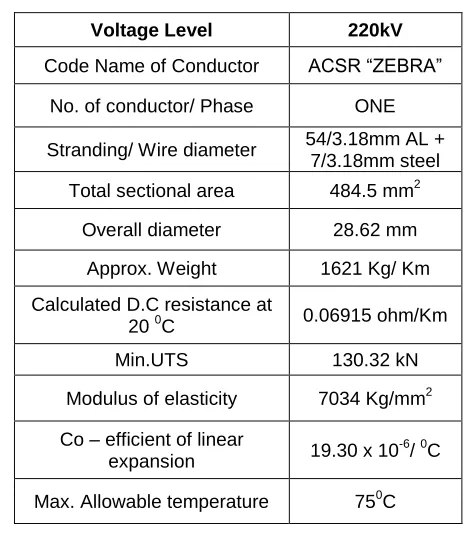
Table 1: Conductor mechanical and electrical properties:
Voltage Level 220kV
Code Name of Conductor ACSR “ZEBRA” No. of conductor/ Phase ONE Stranding/ Wire diameter 54/3.18mm AL +
7/3.18mm steel Total sectional area 484.5 mm2
Overall diameter 28.62 mm Approx. Weight 1621 Kg/ Km Calculated D.C resistance at
20 0C 0.06915 ohm/Km
Min.UTS 130.32 kN
Modulus of elasticity 7034 Kg/mm2 Co – efficient of linear
expansion 19.30 x 10
-6
/ 0C Max. Allowable temperature 750C
1.3 Earthwire:
ISSN 2347-4289
Table 2: Earthwire mechanical and electrical properties
Voltage Level 220kV
Material of Earthwire Galvanized steel
No. of earthwire ONE
Stranding/ Wire diameter 7/3.15mm Total sectional area 54.55 mm2
Overall diameter 9.45 mm
Approx. Weight 428 Kg/ Km
Calculated D.C resistance at
200C 3.375 ohm/Km
Min.UTS 5710 Kg
Modulus of elasticity 19361 Kg/mm2 Co – efficient of linear
expansion 11.50 x 10
-6
/ 0C Max. Allowable Temp. 530C 1.4 Insulator Strings:
Insulators are devices used in the electrical system to support the conductors or to support the conductors carrying at given voltages.
Functions of Insulators: The insulators separate the current carrying conductors of a transmission line from their support structures to prevent the flow of current through the structure to ground and to provide necessary mechanical support to the conductors at a safer height above the ground level. Their main functions may be summarized as follows.
Mechanical: They should be strong to withstand maximum expected loading for different operating conditions such self – weight, wind and ice loads, weight of the conductors and weight of the technicians with tools.
Electrical: They should keep separate the conductors or other current carrying devices with support structures which are at ground potential, under all operating conditions.
2.
Details of tower configuration:
a) Tower type: Suspension and self supporting tower.
b) Bracing system: Pratt system
c) No. of Circuits: Double circuit
d) Wind: As per IS:875 part III, Two wind zones I & V with wind speeds 33 m/s & 50 m/s respectively are taken into consideration.
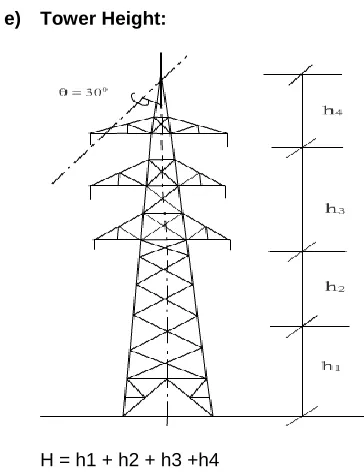
e) Tower Height:
H = h1 + h2 + h3 +h4
Minimum Permissible Ground Clearance (h1): For 220kV - h1 = 7.01m
Maximum Sag (h2): The sag tension calculation for the conductor and earthwire shall be made in accordance with the relevant provisions of IS: 5613 (part – 2 / sec – 1):1985 for the following combinations.
i. 100% design wind pressure after accounting for drag co – efficient and gust response factor at every day temperature, and
ii. 36% design wind pressure after accounting for drag co–efficient and gust response factor at minimum temperature.
For the conductors with higher aluminium content normally used for 220kV lines increased sag of 2 to 4% of the maximum sag value is allowed.
T2 2
[T2 A E
+A α E (t2 – t1) – T1] = A E
From the above equation, we get sag tension of the conductor (T2).
Sag =
The following combinations will be considered: No Wind, t2 = 00 C
ISSN 2347-4289
Sag value for different temperatures and for different wind conditions are calculated and the maximum value of the above combinations + 4% extra will gives the h2 of the conductor.
Spacing of Conductors (h3):
Type of tower
Vertical spacing between conductors
(mm)
Horizontal spacing between conductors(mm) 220kV Double Circuit
(0 - ) 5,200 9,900
Vertical Clearance between Ground Wire and Top Conductor (h4): The same procedure is repeated as done in finding sag of the conductor (h2) but only difference is instead of conductor properties substitute earthwire properties.
H = h1 + h2 + h3 +h4 = 33.52 m.
f) Tower Width: The width of the tower is specified at base, waist and cross – arm / boom level. Base Width: The spacing between the tower footings i.e., base width at concrete level is the distance from the centre of gravity of the corner leg angle to that of the adjacent corner leg angle.
3.
Loadings on Tower:
Loads are calculated as per IS 802:1995 & CBIP manual.
4.
Modelling Approach:
Transmission Line Tower is modeled using STAAD PRO – 06. Tower with different base widths are modeled and loading conditions are considered for two different wind zones I & V. Tower is modeled with 12 panels and is built up with steel angle section, and 3 cross arms with double circuit lines and ground wire at the peak. All the towers are having 12 panels, same angle sections and constant height. The variable parameters are base widths, different wind zones.
5.
Discussions and Results:
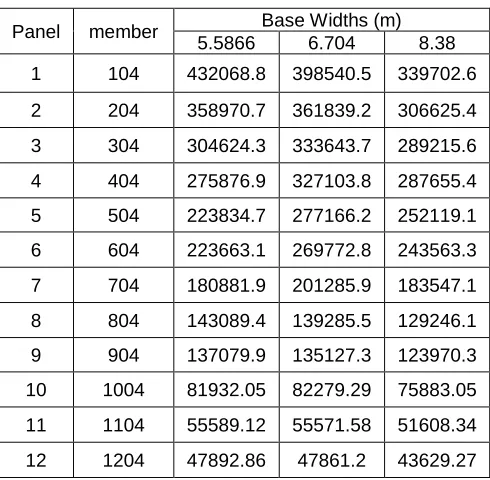
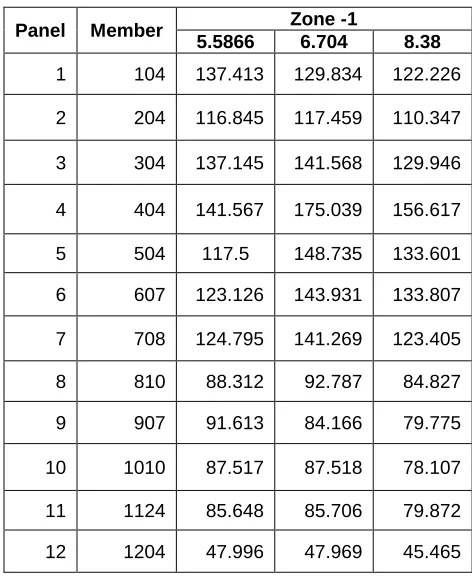
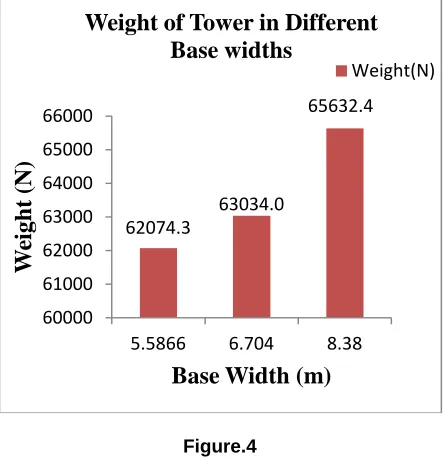
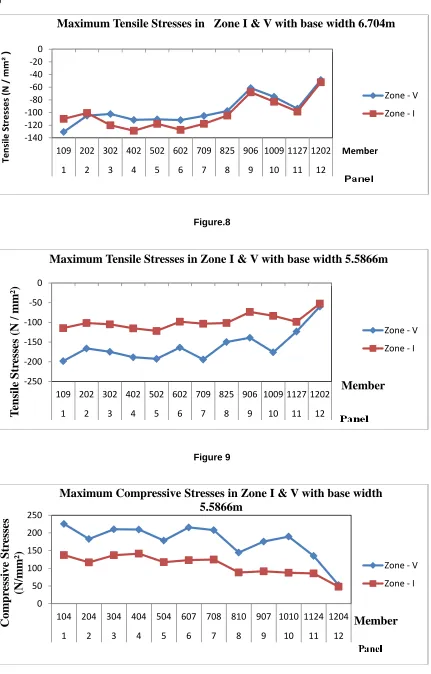
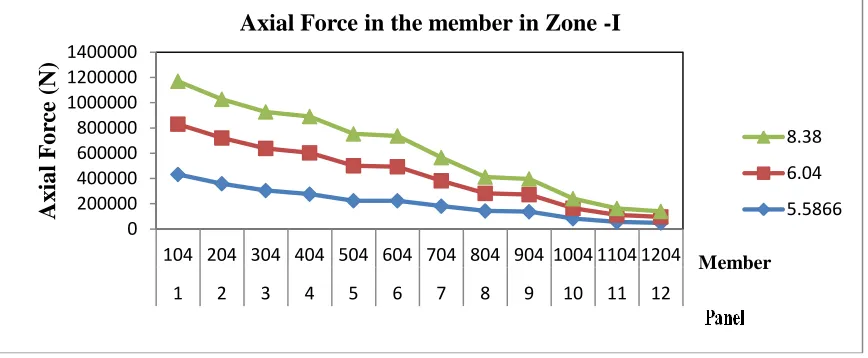
The parameters of this study are maximum compressive and tensile stresses in the tower members, axial forces in the members and maximum deflections of the nodes in x, y & z directions and the above parameters are compared in wind zones I & V with wind speed 33 & 50 m/s respectively. Table 3 represents the maximum axial deflections of nodes in x, y, & z directions in wind zones I & V with the base widths 5.5866 m, 6.704 m & 8.38m. Tables 4 & 5 represent the maximum axial force in tower members in zone I & V with 3 base widths. Table 6, 7, 8 & 9 represents the maximum compressive, tensile stresses in members in wind zones I & V with the base widths 5.5866 m, 6.704 m & 8.38m. The maximum deflections in X, Y & Z direction are presented in figure 1, 2, 3. The tower weight with different base widths is presented in figure 4. The maximum compressive stresses with different base widths are
presented in figure 5,7,10. The maximum tensile stresses with different base widths are presented in figure 6, 8, 9. The maximum axial forces in members are presented in figure 11,12.
Table 3: Maximum Axial Deflections
Base Width (m)
Maximum Axial Deflections (mm) X – direction Y –direction Z - direction
Zone I V I V I V
5.586 -72.4 -72.4 -20.3 -20.3 98.7 216.4 6.704 -83.9 -83.9 -23.5 -23.5 109 239.2 8.38 -60.7 -60.7 -18.7 -18.7 76.7 168.1
Table 4: Maximum Axial Forces in Zone – I
Panel member Base Widths (m) 5.5866 6.704 8.38 1 104 432068.8 398540.5 339702.6 2 204 358970.7 361839.2 306625.4 3 304 304624.3 333643.7 289215.6 4 404 275876.9 327103.8 287655.4 5 504 223834.7 277166.2 252119.1 6 604 223663.1 269772.8 243563.3 7 704 180881.9 201285.9 183547.1 8 804 143089.4 139285.5 129246.1 9 904 137079.9 135127.3 123970.3 10 1004 81932.05 82279.29 75883.05 11 1104 55589.12 55571.58 51608.34 12 1204 47892.86 47861.2 43629.27
Table 5: Maximum Axial Forces in Zone – V
Panel member Base Widths (m) 5.5866 6.704 8.38 1 104 725345.3 663334 559603 2 204 587120.4 591254 495289
3 304 480807 530769 455485
ISSN 2347-4289
Table 6: Maximum Compressive Stresses (N / mm2) in Zone – I with different base widths
Panel Member Zone -1
5.5866 6.704 8.38 1 104 137.413 129.834 122.226 2 204 116.845 117.459 110.347 3 304 137.145 141.568 129.946 4 404 141.567 175.039 156.617 5 504 117.5 148.735 133.601 6 607 123.126 143.931 133.807 7 708 124.795 141.269 123.405
8 810 88.312 92.787 84.827
9 907 91.613 84.166 79.775
10 1010 87.517 87.518 78.107 11 1124 85.648 85.706 79.872 12 1204 47.996 47.969 45.465
Table 7: Maximum Compressive Stresses (N / mm2) in Zone – V with different base widths
Panel Member
Zone -V
5.5866 6.704 8.38 1 104 225.538 122.226 187.747 2 204 182.967 110.347 164.757 3 304 210.269 129.946 196.89 4 404 209.557 156.617 224.752 5 504 178.382 133.601 201.928 6 607 215.604 133.807 229.601 7 708 207.838 123.405 202.085 8 810 144.545 84.827 141.018 9 907 175.613 79.775 140.283 10 1010 189.757 78.107 160.968 11 1124 135.031 79.872 122.219 12 1204 52.686 45.465 49.203
Figure. 1
Figure.2
Figure.3
-72.465
-83.99
-60.731
-100 -80 -60 -40 -20 0
5.5866 6.704 8.38
De
flec
tion(m
m
)
Base width(m)
Deflection in X - direction in
Zone I & V
Deflection
-20.32
-23.557
-18.794 -25
-20 -15 -10 -5 0
5.5866 6.704 8.38
De
flec
tion(m
m
)
Base Width(m)
Deflection in Y - direction in
Zone I & V
Deflection
98.753 109.312
76.736
216.442 239.239
168.156
0 50 100 150 200 250 300
5.5866 6.704 8.38
De
flec
tion(m
m
)
Base Width(m)
Deflection in Z - direction in
Zone I & V
Zone - I
ISSN 2347-4289
Figure.4
Table 8: Maximum Tensile Stresses (N / mm2) in Zone – I with different base widths
Panel Member
Zone -1
5.5866 6.704 8.38 1 109 -114.429 -109.987 -130.641 2 202 -101.513 -100.731 -104.876 3 302 -104.944 -120.074 -102.314 4 402 -115.159 -128.716 -111.643 5 502 -121.768 -117.818 -110.762 6 602 -98.21 -127.299 -111.919
7 709 -103.337 -117.813 -105.262
8 825 -101.485 -104.741 -97.61
9 906 -73.421 -68.02 -61.386
10 1009 -83.377 -82.939 -75.071
11 1127 -98.556 -98.523 -93.846
12 1202 -52.228 -52.159 -48.601
Table 9: Maximum Tensile Stresses (N/mm2) in Zone – V with different base widths
Panel Member
Zone -V
5.5866 6.704 8.38
1 109 -198.393 -130.641
-162.115
2 202 -166.25 -104.876
-146.002
3 302 -174.69 -102.314
-169.024
4 402 -188.607 -111.643
-186.205 5 502 -192.664 -110.762 -174.83
6 602 -163.805 -111.919
-184.652
7 709 -194.269 -105.262
-201.746 8 825 -149.759 -97.61 -141.14
9 906 -138.954 -61.386
-112.305
10 1009 -175.844 -75.071
-151.259
11 1127 -123.258 -93.846
-115.468 12 1202 -59.849 -48.601 -55.112
62074.3
63034.0
65632.4
60000 61000 62000 63000 64000 65000 66000
5.5866 6.704 8.38
W
eigh
t
(N
)
Base Width (m)
Weight of Tower in Different
Base widths
ISSN 2347-4289
Figure.5
Figure.6
Figure.7
0 50 100 150 200 250
104 204 304 404 504 607 708 810 907 1010 1124 1204
1 2 3 4 5 6 7 8 9 10 11 12
Co
m
p
re
ssi
ve
Str
e
sses(N/m
m
²)
Member
Maximum Compressive Stresses in Zone I & V with base width
8.38m
ZONE - V ZONE - I
-250 -200 -150 -100 -50 0
109 202 302 402 502 602 709 825 906 1009 1127 1202
1 2 3 4 5 6 7 8 9 10 11 12
Ten
si
le
Str
e
sses (
N
/m
m
²
)
Member
Maximum Tensile Stresses in Zone I & V with base width 8.38m
ZONE - V
ZONE - I
0 20 40 60 80 100 120 140 160 180 200
104 204 304 404 504 607 708 810 907 1010 1124 1204
1 2 3 4 5 6 7 8 9 10 11 12
Co
m
p
re
ssi
ve
S
tr
e
sses
(
N
/
m
m
²
)
Member
Maximum Compressive Stresses in Zone I & V with base width
6.704m
Zone - V
ISSN 2347-4289
Figure.8
Figure 9
Figure 10
-140 -120 -100 -80 -60 -40 -20 0
109 202 302 402 502 602 709 825 906 1009 1127 1202
1 2 3 4 5 6 7 8 9 10 11 12
Ten
si
le
Str
e
sses (N
/
m
m
²
)
Member
Maximum Tensile Stresses in Zone I & V with base width 6.704m
Zone - V
Zone - I
-250 -200 -150 -100 -50 0
109 202 302 402 502 602 709 825 906 1009 1127 1202
1 2 3 4 5 6 7 8 9 10 11 12
T
en
sil
e
S
tr
esses
(N
/ m
m
²)
Member
Maximum Tensile Stresses in Zone I & V with base width 5.5866m
Zone - V
Zone - I
0 50 100 150 200 250
104 204 304 404 504 607 708 810 907 1010 1124 1204
1 2 3 4 5 6 7 8 9 10 11 12
Com
p
re
ssi
ve
S
tr
esses
(N
/m
m
²)
Member
Maximum Compressive Stresses in Zone I & V with base width
5.5866m
Zone - V
ISSN 2347-4289
Figure 11
Figure 12
Conclusions:
1. At a base width of 6.704m, in all directions, deflections are found to be maximum than other two base widths 5.5866m, 8.380m
2. The maximum axial deflection At a base width of 6.704m is having 15% more than the values at base width of 5.5866m and 35% more than the values at base width of 8.380m in all X, Y & Z directions for both Zone - I & Zone - V.
3. When compared to X and Y directions, deflections in Z-directions shows maximum values in both Zone - I & Zone - V.
4. At base width 6.704 m, the tensile stresses are maximum at member 402 in Zone – I is 128.716 N/mm2 & at member 109 in Zone –V is 130.641 N/mm2.
5. The compressive stresses are maximum at member 404 in Zone – I is 175.039 N/mm2 & in Zone –V is 156.617 N/mm2 at base width 6.704 m.
6. All the deflections are in permissible limits is less than H/100.
7. The maximum axial forces are 398540.5 N in Zone – I and 663334 N in Zone – V at 6.704 m base width.
Reference:
[1]. Mathur G.N and Kuldi Singh, ( 00 ), “Innovative Techniques for Design, Construction, Maintenance and Renovation of ransmission ines”, a er presented at the National Seminar conducted by Central Board of Irrigation and Power.
[2]. IS: 5613 (Part 3/Sec 1): 1989 Code Of Practice For Design, installation And Maintenance For Overhead Power Lines, Part 3 - 400 KV Lines, Section 1 - Design.
[3]. IS: 802 (part 1/sec 1): 1995, Use of structural steel in over head transmission line towers – code of practice (materials, loads and permissible stresses), Sec.1 Materials and Loads.
0 200000 400000 600000 800000 1000000 1200000 1400000
104 204 304 404 504 604 704 804 904 1004 1104 1204
1 2 3 4 5 6 7 8 9 10 11 12
Axial
F
or
ce
(N
)
Member
Axial Force in the member in Zone -I
8.38
6.04
5.5866
0 500000 1000000 1500000 2000000 2500000
104 204 304 404 504 604 704 804 904 1004 1104 1204
1 2 3 4 5 6 7 8 9 10 11 12
Axial
F
or
ce
(N
)
Member
Axial Force in the Member in the Zone - V
8.38
6.704
ISSN 2347-4289
[4]. V. akshmi et al. “Study On Performance Of 220
Kvm/C Ma Tower Due To Wind”, International
Journal of Engineering Science and Technology, ISSN: 0975-5462 Vol. 3 No.3 March 2011 pp 2474 – 2485.
[5]. Visweswara Rao G (1995), “O timum Designs for ransmission ine owers”, Journal of Computers and Structures, Vol. 57, pp 81-92.
[6]. Y. M. Ghugal et al, “Analysis and Design of Three and Four Legged 400KV Steel Transmission Line
Towers: Comparative Study”, International Journal